

How MERN Stack SaaS Speeds Up Development and Revenue?
Explore how MERN stack SaaS accelerates time-to-market, supports scalable SaaS architecture, and powers fast revenue growth for startups.

Mukesh Ram
Introduction
Speed drives early traction and quick revenue. You need a stack that cuts handoffs, shortens cycles, and turns ideas into features on a steady rhythm. A focused MERN stack SaaS lets one team ship end-to-end with MongoDB, Express, React, and Node working in sync.
With SaaS development MERN, you release faster, learn from real users sooner, and iterate without chaos. That momentum fuels a scalable SaaS architecture that grows cleanly and supports cloud-ready SaaS applications across regions.
For founders and product leads, MERN for startups pairs speed with clarity, aligns work with proven SaaS business models, and opens a clear path to revenue. When timelines spike, you can hire MERN stack developers or partner with a trusted MERN stack development company for targeted MERN stack development services that keep delivery on track!
Core Advantages of Using MERN for Startups
Startups win when they launch quickly, adapt fast, and control costs. A MERN stack SaaS supports all three. With one language across MongoDB, Express, React, and Node, teams reduce context switching and move from design to release in less time. That speed helps founders test ideas in the market before competitors react.
Using SaaS development, MERN also creates strong technical alignment. React components keep frontends modular, Node and Express handle APIs with clarity, and MongoDB gives data models room to evolve. This setup builds a scalable SaaS architecture that supports growth without major rewrites.
For founders exploring SaaS business models, the MERN stack makes iteration simpler. You can trial subscription tiers, feature flags, or usage-based pricing while keeping development stable. The stack also fits cloud deployment naturally, which makes building cloud-ready SaaS applications easier from day one!
Cloud-Ready MERN SaaS: Prepare for Growth

Ship with the cloud in mind from day one. Build a MERN stack SaaS that runs clean in containers, scales on demand, and survives region outages. Align your plan with SaaS development MERN routines so every deploy follows the same path from local to production. Target cloud-ready SaaS applications that boot fast, recover quickly, and keep latency low.
Make scaling boring
Containerize React, Node, and supporting jobs with Docker.
Orchestrate services with Kubernetes or ECS. Set autoscaling by CPU, memory, and queue depth to support a scalable SaaS architecture.
Place a CDN in front of static assets. Add an API gateway for rate limits, auth, and routing.
Treat data like a product
Use MongoDB Atlas or an equivalent managed cluster. Enable sharding only when metrics justify it.
Model tenants clearly. Choose database-per-tenant, collection-per-tenant, or row-level tags based on workload.
Add TTL indexes for ephemerals, and compound indexes for hot queries. Run migrations idempotently.
Harden the runtime
Encrypt in transit with TLS. Encrypt at rest with managed keys.
Store secrets in a vault. Rotate tokens and keys on a schedule.
Isolate services with network policies.
Log every sensitive action to support audits.
Design for failure
Keep multi-AZ by default and multi-region for critical paths.
Back up on a cadence and test restores. Practice region failover with runbooks.
Watch golden signals: latency, error rate, saturation, and throughput. Alert on user impact.
Wire revenue to usage
Instrument events for sign-ups, trials, seats, storage, and API calls.
Align pricing with SaaS business models you plan to test: subscription, usage, or hybrid.
Expose real-time usage to customers and to the billing service.
Staff for momentum
When timelines spike, hire MERN stack developers who understand containers, CI/CD, and observability.
If you need a larger lift, partner with a MERN stack development company that delivers end-to-end MERN stack development services.
For early stages, pick MERN for startups talent that ships small, tests well, and tracks outcomes.
Aligning MERN Development with SaaS Business Models
Revenue depends on how well the technology supports your chosen SaaS business models. A MERN stack SaaS setup helps you test, refine, and scale pricing strategies without rebuilding the foundation.
With SaaS development MERN, you can roll out subscription tiers, usage-based billing, or freemium models by wiring logic directly into Node and Express services. MongoDB stores customer plans and usage data flexibly, while React lets you show dynamic dashboards, billing pages, and upgrade prompts. This architecture links revenue features to product features without heavy custom code.
Startups using MERN for startups often find that the stack accelerates experiments. Want to trial premium features? Add a flag in your React components. Need to measure per-seat usage? Track it in MongoDB collections and expose it through secure APIs. This ability to adapt quickly supports both early growth and mature scaling.
Choosing the Right MERN Stack Development Company
A skilled MERN stack development company does more than write code, it helps shape your roadmap, set up a scalable SaaS architecture, and deliver features that match user demand. Startups that pick a strong partner reach the market faster and avoid expensive rework later.
When evaluating options, look for proven experience in building MERN stack SaaS platforms. Ask how they approach SaaS development MERN, from design patterns to CI/CD pipelines. Many also explore MERN for startup packages, which provide lean teams that scale as the product matures.
If deadlines push hard, you can also hire MERN stack developers directly through the same company. This mix of dedicated developers and structured delivery gives you both speed and long-term reliability. A strong partner aligns with your SaaS business models and ensures the product not only launches fast but also grows revenue steadily.
Best Practices That Keep MERN SaaS Fast And Maintainable
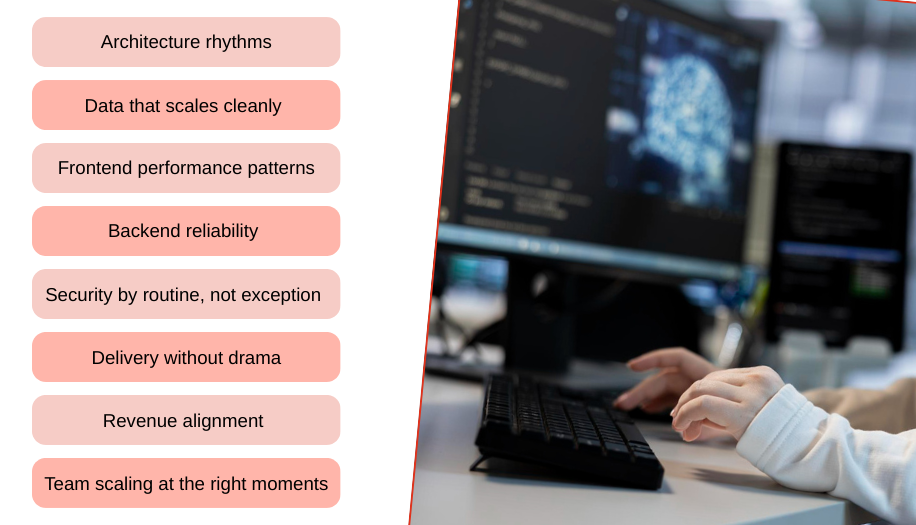
Architecture rhythms
Lock one source of truth for API contracts. Share TypeScript DTOs between React and Node so SaaS development MERN stays aligned.
Keep a release train. Ship small batches on a fixed cadence and roll forward by default.
Use a monorepo with Nx or Turborepo to coordinate React apps, Node services, and shared libs inside your MERN stack SaaS.
Data that scales cleanly
Version documents. Store schemaVersion, write forward-only migrations, and keep rollback scripts ready for incidents.
Add compound indexes for hot queries and TTL indexes for ephemerals. Measure p95 query time before every release to protect a scalable SaaS architecture.
Pick a tenant model early: database-per-tenant for strict isolation or collection-per-tenant for simpler ops.
Frontend performance patterns
Use React Query or equivalent for caching, retries, and background refresh.
Split bundles by route. Serve static assets over a CDN and prefetch critical chunks.
Add lightweight error boundaries that point users to self-serve recovery.
Backend reliability
Guard every endpoint with validation at the edge. Reject unknown fields and enforce rate limits per token and route.
Instrument Node with OpenTelemetry. Track latency, error rate, and saturation; alert on user impact.
Introduce a thin BFF to shield React from churn while you grow service boundaries.
Security by routine, not exception
Rotate JWTs and secrets on a schedule. Enforce RBAC with least-privilege roles.
Scan dependencies in CI and block builds on known CVEs.
Log every sensitive action and wire audit trails to a secure sink. These steps anchor cloud-ready SaaS applications in real control.
Delivery without drama
Containerize everything. Pin base images and sign artifacts.
Use blue-green or canary rollouts with automated health checks.
Keep preview environments per pull request so product and QA can review real changes before merge.
Revenue alignment
Track events for signups, seats, storage, and API calls. Expose usage to billing to support evolving SaaS business models.
A/B test pricing pages and upgrade prompts inside React; ship changes on the same train as features.
Team scaling at the right moments
Bring in specialists when the roadmap spikes. You can hire MERN stack developers for performance, security, or migration sprints.
For end-to-end ownership, partner with a MERN stack development company that delivers structured MERN stack development services while you focus on growth.
Early teams benefit from MERN for startup talent that codes with tests, reads dashboards, and closes loops after release.
Why does this set work?
These habits keep feedback loops short, protect uptime, and control complexity inside a MERN stack SaaS. You sustain velocity across quarters because SaaS development MERN stays predictable, the scalable SaaS architecture stays clean, and your cloud-ready SaaS applications stay ready for traffic.
Bottomline
Startups rise when they reach customers first and improve faster than the rest. A well-planned MERN stack SaaS gives that advantage by keeping one language across the stack, trimming development time, and supporting growth without rewrites.
With SaaS development MERN, teams release quicker, adapt to feedback, and build on a scalable SaaS architecture that handles user growth with ease. Startups that want to grow fast need a tech stack that supports quick launches and reliable scaling.
The MERN stack provides exactly that. By building a MERN stack SaaS, founders can bring products to market sooner, refine them based on real customer feedback, and create a steady path toward revenue.
With SaaS development MERN, every part of the process stays connected, from database to frontend, which reduces complexity and helps teams focus on what matters most: delivering value to users. As the product matures, a scalable SaaS architecture and cloud-ready SaaS applications ensure that growth doesn’t slow progress.
I love to make a difference. Thus, I started Acquaint Softtech with the vision of making developers easily accessible and affordable to all. Me and my beloved team have been fulfilling this vision for over 15 years now and will continue to get even bigger and better.
Table of Contents
Get Started with Acquaint Softtech
- 13+ Years Delivering Software Excellence
- 1300+ Projects Delivered With Precision
- Official Laravel & Laravel News Partner
- Official Statamic Partner