

We've Reviewed 1,300+ Projects: Here's What Separates Great Dev Teams from Expensive Mistakes
After 1,300+ projects, we know exactly what separates a great dev team from an expensive mistake. Here is the data-backed evaluation framework every CTO and Founder needs before signing.

Acquaint Softtech
The Problem Nobody Talks About Until It's Too Late
Most companies do not realise they hired the wrong dev team until three months in. By that point, the sprint has slipped, the codebase is a mess, and the CTO is fielding questions in board meetings that have no good answers.
We have seen this story repeat across more than 1,300 projects spanning a decade. Startups. SaaS scale-ups. Mid-market companies modernising legacy systems. The pattern is remarkably consistent: the warning signs were always there from day one. They just were not visible to someone who did not know what to look for.
This article is the distillation of those patterns. Not theory data. After 1,300+ delivered engagements, 50+ independently verified Clutch reviews, and over 13 years operating as an official Laravel partner, we can tell you with confidence what separates a dev team that delivers from one that quietly drains your budget.

- CTOs and VPs of Engineering evaluating new dev team partners
- Founders who have been burned before and want a framework for evaluation
- COOs who manage vendor relationships and need clear performance benchmarks
- Any decision-maker about to sign a contract with a software development company
The Real Cost of a Bad Dev Team Hire (It Is Never Just the Invoice)
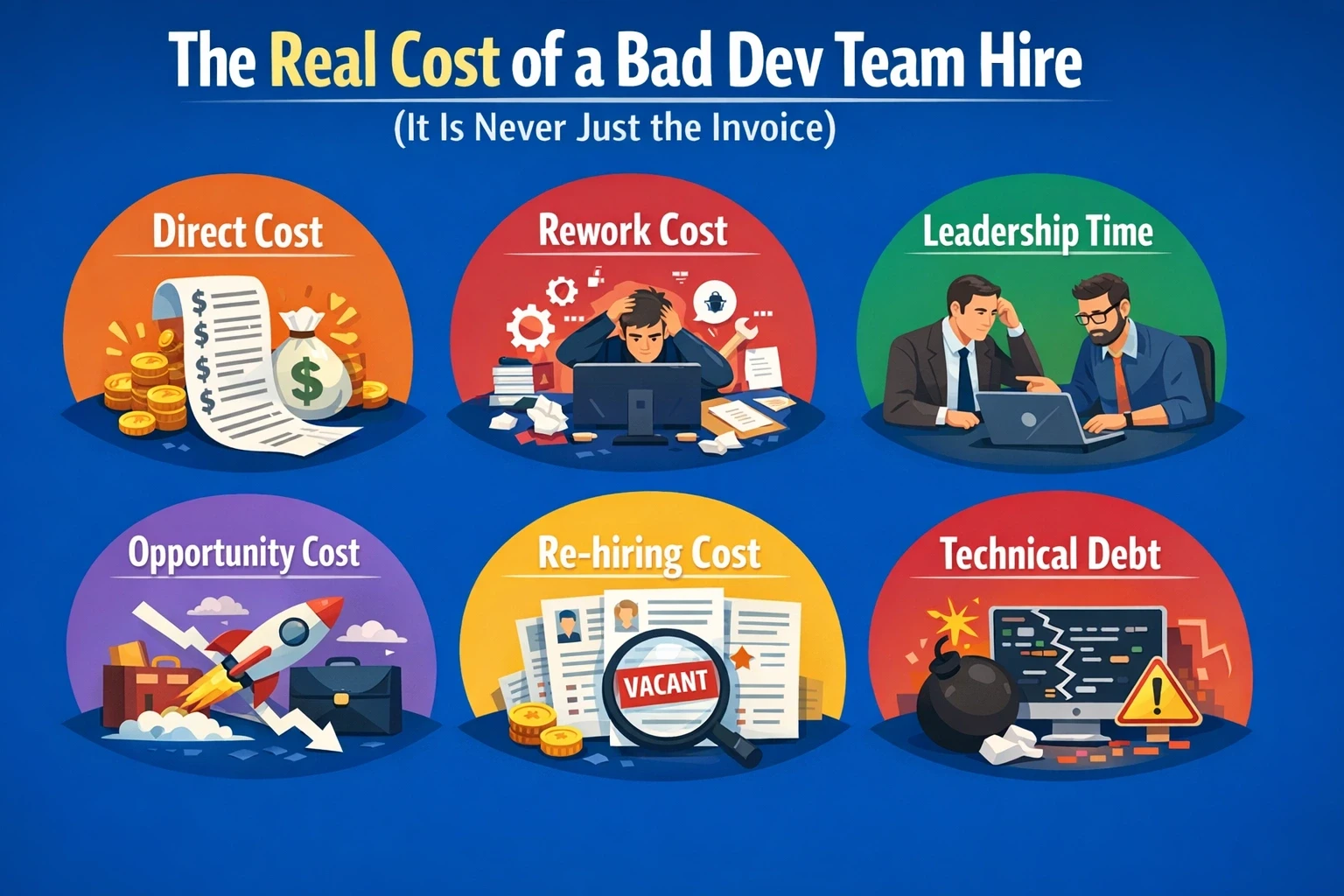
When a dev team underperforms, most companies measure the damage in direct costs, the monthly retainer, the rework hours, the wasted sprint cycles. The real number is always significantly higher.
Here is how the true cost of a bad dev team hire actually breaks down:
Direct Cost | The retainer or hourly fees paid for work that needs to be redone |
Rework Cost | Typically 30–50% of original development cost to fix poor-quality code |
Leadership Time | CTO and PM hours spent managing issues instead of building product, often 8–12 hrs/week |
Opportunity Cost | Features not shipped, competitors gaining ground, customer dissatisfaction |
Re-hiring Cost | New search, onboarding, and knowledge transfer often 2–3 months of lost momentum |
Technical Debt | Architectural shortcuts that accumulate silently and slow every future sprint |
📊 Data Point from Our ProjectsIn engagements where clients came to us after a failed offshore relationship, the average time lost before they made the switch was 4.2 months. The average rework cost was equivalent to 60–70% of the original contract value. That is not a hiring mistake. That is a business setback. - Mukesh Ram. |
The goal of this guide is to help you avoid that situation entirely by giving you the evaluation framework we have built from the other side of 1,300+ engagements.
The 5 Signals of a High-Performing Dev Team
Across every engagement that worked well the ones where clients renewed, referred others, and left five-star Clutch reviews five patterns showed up consistently. These are not soft qualities. Each one is measurable.
Signal 1: They Onboard Fast and Integrate Faster
A strong dev team does not need a month to become productive. At Acquaint Softtech, we deploy pre-vetted developers within 48 hours and expect meaningful contribution within the first sprint. If a team cannot show you a working onboarding framework with clear timelines for environment setup, codebase review, and first PR that is a signal worth noting.
What to ask: "What does your typical developer onboarding look like, and when can we expect the first code commit?"
Signal 2: They Have a Visible QA Culture
Great dev teams do not bolt on QA at the end of a sprint. They build it into every stage. This means mandatory code review, defined test coverage standards, and someone whose job it is to say no to a release when quality is not met. Ask to see their QA process documentation before you sign.
What to ask: "Can you walk me through your code review and QA process on a typical sprint?"
Signal 3: Communication Is Proactive, Not Reactive
In our 50+ Clutch reviews, communication is the quality clients mention more than any other. Not technical skill. Not delivery speed. Communication. The best teams tell you about a problem before it becomes a blocker. They share sprint updates without being chased. They flag risks in planning, not post-delivery.
What to ask: "How do you communicate project risks and delays? Can you show me an example of how you handled a missed milestone?"
Signal 4: They Have Sprint Reliability Data
Any mature dev team should be able to give you a sprint delivery rate. Ours is 95% across all active engagements. If a team cannot tell you what percentage of their sprints are delivered on time, it typically means they have not been tracking it which tells you something important about how they run projects.
What to ask: "What is your sprint delivery rate, and how do you measure and report on it?"
Signal 5: They Take Ownership, Not Just Instructions
The difference between a vendor and a partner is ownership. A vendor does what is specified. A partner pushes back when specifications will create technical debt, flags architectural risks before they become expensive, and thinks about your product roadmap alongside your current sprint. This quality is harder to measure in a proposal look for it in references and case studies.
What to ask: "Can you give me an example where you pushed back on a client's approach and what the outcome was?"
✅ Quick Summary: 5 Signals of a High-Performing Dev Team 1. Fast, structured onboarding with clear timeline to first contribution 2. Built-in QA process, not an afterthought 3. Proactive communication with documented escalation paths 4. Measurable sprint delivery rate (look for 90%+ as a benchmark) 5. Ownership mindset, they think beyond the ticket |
The 5 Red Flags We See in 80% of Troubled Engagements
These patterns appear consistently in projects that stall, go over budget, or fail outright. If you see more than two of these in a proposal or discovery call, treat it as a serious warning sign.
Vague or Generic Proposals: A proposal that does not address your specific tech stack, architecture, or delivery process is a template, not a plan. It signals the team has not invested time understanding your problem.
No Documented QA Process: If quality assurance cannot be described in specific terms, What tools, what standards, who owns sign-off, It does not exist in any structured form.
Freelancer-Heavy Rosters: Teams that rely on a network of subcontractors introduce inconsistency in quality, knowledge continuity gaps, and accountability gaps that compound over time. Ask directly: are all developers full-time employees?
Timezone as an Excuse: Timezone differences are operational, not fundamental. Teams that cite timezone as a reason they cannot commit to regular overlap hours are signalling a structural problem in how they manage client relationships
No References or Verifiable Reviews: Any team worth hiring has a verifiable track record. If they cannot point you to named client reviews on Clutch, G2, or Upwork or provide direct client references treat that absence seriously
The Acquaint Softtech Benchmark. What 'Good' Actually Looks Like
We are not sharing this section to self-promote. We are sharing it because every benchmark needs a reference point. After 13+ years and 1,300+ projects, here is what we have learned about what high performance looks like in practice and the data to back it up.
Developer Onboarding | Pre-vetted developers deployed within 48 hours, contributing in sprint 1 |
Sprint Delivery Rate | 95% of sprints delivered on time across all active engagements |
Team Model | 70+ full-time in-house engineers, zero freelancers or subcontractors |
Quality Validation | Mandatory code review, QA sign-off, and security checks on every sprint |
Client Communication | Direct developer access, daily standups, no account manager layer |
Independent Reviews | 50+ five-star Clutch reviews from named, verifiable clients |
Platform Track Record | |
Official Partnerships | Official Laravel Partner (verified by Taylor Otwell), Statamic Partner, Bagisto Partner, Laravel News Partner |
Global Offices | India, USA, UK, New Zealand, Canada. |
Engagement Flexibility | Part-time, full-time, dedicated team, no long-term lock-in required |
💬 What Clients Say (From Verified Clutch Reviews)
|
The 10-Point Dev Team Evaluation Checklist
Use this checklist on every discovery call with a potential dev partner. A strong team will be able to answer all ten without hesitation. A weak team will hesitate on at least three and usually the same three every time.
The 10-Point Dev Team Evaluation Checklist — acquaintsoft.com | ||
1 | Onboarding Speed | Ask: How long from contract to first code commit? Expect: 48–72 hours for a structured team. |
2 | Team Model | Ask: Are all developers full-time employees? Confirm: No freelancers, no subcontractors. |
3 | Sprint Delivery Rate | Ask: What is your average sprint delivery rate? Expect: 90%+ with documented evidence. |
4 | QA Process | Ask: Walk me through your QA and code review process. Expect: Named tools, defined standards, named owner. |
5 | Communication Protocol | Ask: How do you handle delays and risks? Expect: Proactive escalation process, written protocol. |
6 | Verified References | Ask: Can I speak to two current clients? Expect: Yes, without hesitation. |
7 | Third-Party Reviews | Ask: Where can I read independent client reviews? Expect: Clutch, G2, or Upwork with named, verifiable reviews. |
8 | Official Certifications | Ask: Do you hold any official technology partnerships? Expect: Laravel Partner, Statamic, or similar verified certification. |
9 | Timezone Coverage | Ask: What overlap hours do you guarantee? Expect: Minimum 3–4 hours with your primary timezone. |
10 | Exit Flexibility | Ask: What does your offboarding process look like? Expect: Full IP transfer, documented handover, no lock-in clause. |
Case Study — When a Failed Engagement Led to a 3-Year Partnership
One of our longest-standing clients a SaaS founder building a B2B platform in the US came to us after eight months with a previous offshore vendor. The original team had been technically capable on paper: a portfolio website, some Upwork reviews, reasonable rates.
By month four, sprint delivery had dropped to around 40%. By month six, the client discovered significant architectural decisions had been made without documentation or discussion. By month eight, the CTO they brought in to fix the situation told them the codebase needed a near-complete rebuild.
They found Acquaint Softtech through a Clutch search. Here is how the transition went:
Week 1 | Full codebase audit completed. Documented what was salvageable and what needed rebuilding. Presented to client with honest assessment — no sugar-coating. |
Week 2 | First sprint planned collaboratively. Client had direct access to assigned Laravel developer from day one. Standups started immediately. |
Month 1 | Core architecture refactored. Client reported the first sprint in nine months that was delivered fully on time. |
Month 3 | Platform back on original roadmap. New features shipping weekly. |
Month 12 | Client renewed. Left a five-star Clutch review citing communication and delivery consistency as primary reasons. |
Year 3 | Still an active client. Team has scaled from 2 to 5 developers through our staff augmentation model. |
🔑 Key Lesson The previous team was not incompetent. They were unstructured. No QA process, no sprint tracking, no escalation protocol. The warning signs existed in the proposal they just were not visible to someone who did not have a framework for evaluation. That is what this checklist is for. |
The Difference Is Always Visible Before You Sign
After 1,300+ projects, the conclusion is consistent: great dev teams are identifiable before you commit to them. The signals are measurable, the red flags are repeatable, and the evaluation framework is learnable.
The five signals fast onboarding, built-in QA, proactive communication, measurable sprint reliability, and ownership mindset show up in every high-performing engagement we have been part of. The five red flags show up in every failure.
Use the 10-point checklist in your next vendor call. Ask the specific questions. Pay attention to which ones get hesitation.
Ready to Evaluate Your Current or Prospective Dev Team?
Acquaint Softtech offers a free 20-minute Dev Team Audit Call.
We will review your current engagement or evaluate a shortlisted vendor against the framework in this article.
No pitch. No pressure. Just an honest, experienced perspective.
FAQ's
-
What is the biggest mistake companies make when hiring a dev team?
The most common mistake is evaluating a dev team on price and portfolio alone, without assessing process, communication structure, and sprint reliability. A technically capable team with no QA culture or escalation protocol will consistently underdeliver. Always ask for sprint delivery data and at least two verifiable client references before signing.
-
How do you evaluate the quality of an offshore development team?
Evaluate offshore dev teams on five measurable criteria: onboarding speed (should be under 72 hours), sprint delivery rate (look for 90%+), QA process documentation, verified third-party reviews on platforms like Clutch or Upwork, and direct client references. Avoid teams that cannot provide specific answers to process questions.
-
What is a realistic sprint delivery rate for a professional dev team?
A well-structured development team should maintain a sprint delivery rate of 90% or higher. At Acquaint Softtech, our rate is 95% across all active engagements. Anything below 80% consistently indicates process or communication issues that are unlikely to self-correct without structural changes.
-
How long should it take a new developer to become productive in my team?
With a structured onboarding process, a pre-vetted developer should be contributing meaningfully within the first sprint typically 7–10 days. At Acquaint Softtech, we deploy developers within 48 hours and expect first code contributions within sprint one. Longer ramp-up periods usually indicate gaps in documentation or onboarding processes on either side.
-
Is staff augmentation better than hiring a full dev agency?
Staff augmentation is typically better when you want engineers to integrate directly with your existing team, maintain ownership of your codebase, and scale flexibly without long-term contracts. A full agency model works better for greenfield products where you want end-to-end delivery ownership. The best choice depends on your current team structure, roadmap clarity, and delivery timeline.
-
What makes Acquaint Softtech different from other Laravel development companies?
Acquaint Softtech is one of a small number of Official Laravel Partners globally a certification verified by Laravel creator Taylor Otwell, not self-awarded. Combined with 1,300+ delivered projects, a 95% sprint delivery rate, 34 verified Clutch reviews, and 70+ full-time in-house engineers (no freelancers), the difference is measurable, not claimed.
-
How do I know if my current dev team is underperforming?
Key indicators of dev team underperformance include: sprint delivery rate below 80%, consistent scope creep without client-approved changes, lack of proactive communication about blockers, inability to provide clear technical documentation, and a growing backlog of unresolved bugs. If three or more of these apply, it is worth conducting a structured evaluation.
We’re Acquaint Softtech, your technology growth partner. Whether you're building a SaaS product, modernizing enterprise software, or hiring vetted remote developers, we’re built for flexibility and speed. Our official partnerships with Laravel, Statamic, and Bagisto reflect our commitment to excellence, not limitation. We work across stacks, time zones, and industries to bring your tech vision to life.
Table of Contents
Get Started with Acquaint Softtech
- 13+ Years Delivering Software Excellence
- 1300+ Projects Delivered With Precision
- Official Laravel & Laravel News Partner
- Official Statamic Partner