

MERN real-time app development: Socket.io and MongoDB change streams, zero polling.
MERN's event-loop architecture, Socket.io, and MongoDB change streams make real-time features (live dashboards, chat, collaborative tools, instant notifications) the strongest niche in the stack. Whether you are scoping MERN real time app development, a MERN collaboration app, MERN WebSocket development, MERN Socket.io implementation, real time application MERN patterns, or MERN stack real time architecture that must maintain persistent connections (something Vercel serverless cannot do without external services), Acquaint has shipped this pattern to sub-200ms P95 latency for XOALA Neo Bank and 10,000+ concurrent connections in production. No polling, no page refreshes, no architectural gymnastics.
- Socket.io with Node.js cluster mode for 10,000+ concurrent connections
- MongoDB change streams for database-level real-time event propagation
- Redis pub/sub for horizontal scaling across multiple Node.js instances
- TypeScript types shared between server event emitters and React client handlers
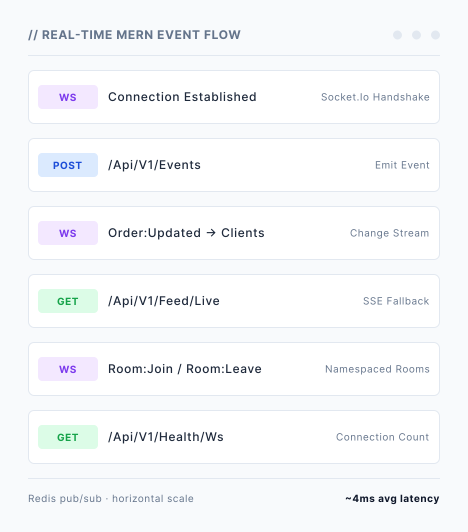








The MERN stack that makes real-time genuinely easy.
MERN real-time app development, in plain terms.
MERN real-time app development is the practice of building web applications on MongoDB, Express.js, React, and Node.js where data updates push from server to client instantly, without the client asking. Socket.io runs on the Node.js server alongside Express, sharing the same process and the same JWT authentication middleware. MongoDB change streams propagate database events, inserts, updates, repletes, to the application layer the moment they happen. React state updates cleanly from WebSocket events via the useSocket pattern.
The practical result: a MERN real-time application built at Acquaint delivers what most teams spend months retrofitting into non-real-time architectures. We design the event architecture in the discovery sprint, which events need persistence, which need broadcasting, which need ordering guarantees, before any code is written. Retrofitting real-time onto a polling architecture after launch is one of the most expensive refactors in web engineering.
Two primary MERN real-time patterns. We pick the right one.
The pattern depends on where the event originates. Application-layer events (user actions, message sends, form submissions) use Socket.io directly. Database-layer events (inventory changes, order status updates, payment events from Stripe webhooks) use MongoDB change streams. Most real-time MERN applications use both.
Application-layer real-time
- Chat and messaging (send message, typing indicators, read receipts)
- Collaborative editing (cursor positions, document edits, presence indicators)
- Live auctions and bidding (bid submitted, countdown updates, winner broadcast)
- Multiplayer games and real-time interactions
Database-layer real-time
- Live inventory (any write to inventory collection pushes to all product pages)
- Order tracking dashboards (order status changes from any source)
- Financial data streams (transaction events from multiple sources)
- Admin dashboards that monitor events across the entire system
Everything a MERN real-time app development project needs.
Not just the WebSocket server. The full engineering stack that takes a MERN real-time application from architecture to a production system handling real concurrent users.
Real-time architecture document
Event catalogue, room and namespace design, persistence strategy, authentication flow for Socket.io connections, and concurrency targets documented before any code is written. Signed off before build starts.
Socket.io server and event handlers
TypeScript-typed Socket.io server on Node.js, namespaced by feature, with room-level access control, JWT authentication on the WebSocket handshake, and rate limiting per socket connection. Event types shared as TypeScript interfaces between server and React client.
MongoDB change streams
Change stream watchers on relevant collections, with resume tokens for reconnection handling, filter pipelines to reduce noise, and event transformation before broadcast. Change stream events mapped to the same TypeScript event types used by Socket.io, so the React client handles both the same way.
React real-time state management
Custom useSocket React hook for clean WebSocket state management. React Query for HTTP data with socket-triggered invalidation so the cache stays fresh without separate polling. Optimistic UI updates where appropriate, with server-side confirmation and rollback on error.
Redis pub/sub for horizontal scaling
Redis pub/sub adapter configured for Socket.io so multiple Node.js instances can broadcast to all connected clients, not just those on their own instance. Redis also used for session storage and rate limiting data shared across Node.js instances. PM2 cluster mode for single-server multi-core scaling.
Load testing at concurrent scale
Artillery or k6 load tests simulating 3x expected peak concurrent socket connections. Tests cover connection establishment time, event latency under load, memory footprint per connection, and reconnection behaviour after server restart. Results reviewed before production launch.
Jest tests on every event handler
Unit tests on every Socket.io event handler, integration tests simulating concurrent connections and room management, and end-to-end tests via Playwright covering real-time user flows. TypeScript strict mode throughout. CI pipeline gates merges on test pass.
Production monitoring for real-time systems
Sentry error tracking on socket event handlers with socket ID and room context on every error. Socket connection count dashboard in the admin. Reconnection rate monitoring (high reconnection rates signal server instability). MongoDB Atlas Performance Advisor on change stream collections. Alerts on connection count drops above threshold.
Named senior engineers on every MERN real-time app project.
Real-time architecture requires pragmatic decisions made early. The event schema, the room structure, the persistence strategy, these are the decisions that are expensive to change after launch.
Manish Patel, CIO
MERN Real-Time Architecture Lead · 12+ years
Six steps from real-time architecture to production MERN app.
Event architecture in week one. TypeScript types shared between server and client from the first sprint. Load tested at concurrent scale before launch. The discipline is what prevents the expensive refactors that come from real-time added as an afterthought.
Discovery and Real-Time Architecture
Map event types, frequency, concurrency targets, and persistence requirements. Choose Socket.io, change streams, Redis pub/sub, or SSE. Output is a written event architecture signed off before code starts.
Event Schema and API Design
Define Socket.io namespaces, room structures, event payload TypeScript interfaces, and HTTP API endpoints. TypeScript types shared between server and React client from the first file. No runtime surprises.
Build with Tests First
Node.js Socket.io server, MongoDB change streams, and React hooks built in two-week sprints with working demos. Jest tests on every event handler. Integration tests simulating concurrent connections from sprint one.
Redis Scaling Layer
Redis pub/sub Socket.io adapter for horizontal scaling, PM2 cluster mode for multi-core utilisation, Redis-based rate limiting per socket, and session sharing across Node.js instances.
Load Testing at Concurrent Scale
Artillery or k6 load tests at 3x expected peak concurrent connections. Event latency benchmarked. Reconnection behaviour tested. Memory footprint per connection profiled. Results reviewed before production launch.
Launch and Monitoring
Production deployment with Sentry on socket event handlers, socket connection count dashboard, reconnection rate monitoring, and MongoDB Atlas Performance Advisor on change stream collections. Monitoring live on day one.
The tools we use for production MERN real-time applications.
Production-tested in real-time systems serving tens of thousands of concurrent connections. Boring and reliable for the parts that need to be boring. Modern for the parts where it matters.
Real-time transport
Database and streams
Node.js backend
React frontend
Testing and load
Hosting and monitoring
A MERN real-time app development project we shipped.
One detailed snapshot from real-time MERN work across our 1,300+ delivered projects. Full case studies sit in our portfolio.
Neo Bank real-time transaction platform: audit-complete event streaming for enterprise financial clients with zero polling.
"They worked as an extension of an internal engineering team as opposed to an external vendor. The ability to provide security and depth of auditing did not impact the speed of the system. Each of our enterprise clients can see exactly what happened to their data, when, and why."
XOALA, a Neo Bank in Sweden, needed enterprise financial clients to see real-time transaction events across their portfolios without a system that sacrificed audit trail completeness for speed. The technical constraint: every transaction event needed to appear on the client dashboard within 200 milliseconds of writing to the database, while every event needed to be written to an immutable audit log before being broadcast. Standard polling could not meet the latency requirement. A naive Socket.io implementation would have missed events during server restarts or reconnections.
MongoDB change streams on the transaction collection, watched by a dedicated Node.js service. Every change stream event was first written to an immutable append-only audit collection (field-level encrypted for sensitive financial fields) before being broadcast via Socket.io to the tenant's authenticated dashboard room. Resume tokens meant the change stream reattached correctly after server restart with zero missed events. Redis pub/sub scaled the broadcast layer across multiple Node.js instances. The React dashboard consumed Socket.io events via a custom useTransactionStream hook with React Query cache invalidation on each event.
Three ways to engage on a MERN real-time app build.
Most clients start with Fixed Price for the real-time feature build, then switch to Dedicated Developer for ongoing performance optimisation and scaling work as the user base grows.
Dedicated Developer
- Full-time, exclusive to your application
- 176 hours per month per engineer
- 5-day developer replacement clause
- Direct Slack and daily standup access
Fixed Price Build
- Architecture, build, load test, and launch
- Working demos every two weeks
- Load testing at 3x peak included
- Full handover with architecture documentation
Time & Material
- Hourly billing, weekly invoices
- Scale engineers up or down on demand
- Full transparency on hours and progress
- Suitable for multi-phase real-time builds
Questions teams ask before starting a MERN real-time app project.
These come from actual pre-sale conversations about our MERN real-time app development services. Cannot find your answer here? Speak directly to a senior engineer.
-
What is MERN real-time app development?
MERN real-time app development is the practice of building web applications on MongoDB, Express.js, React, and Node.js where data updates push from server to client instantly, without polling. Node.js handles concurrent connections efficiently. Socket.io integrates naturally with Express. MongoDB change streams propagate database events in real time. React's state model maps cleanly to live data via the useSocket hook pattern.
-
How does Socket.io work with the MERN stack?
Socket.io runs on the Node.js server alongside the Express.js API, sharing the same process. The same Express JWT middleware authenticates Socket.io connections, so security is consistent. Events emitted on the server broadcast to clients in specific rooms. TypeScript interfaces define event payloads shared between the Node.js emitter and the React handler, so mismatches are caught at compile time, not runtime.
-
What are MongoDB change streams?
MongoDB change streams are a real-time event stream of database operations on a collection or database. When any process writes to a watched collection, the change stream emits an event. Node.js receives it and broadcasts via Socket.io to connected clients. This pattern is used when the event source is the database rather than the application layer, for example inventory changes, financial transactions, or order status updates from multiple sources.
-
How many concurrent connections can a MERN real-time app handle?
A single Node.js Socket.io instance handles 10,000 to 50,000 concurrent connections depending on server resources and event frequency. For larger scale, Redis pub/sub as the Socket.io adapter allows horizontal scaling across multiple Node.js instances. PM2 cluster mode scales across CPU cores on a single server. We load test at 3x expected peak concurrent connections before every production launch.
-
What is the difference between WebSockets and polling?
Polling means the client sends an HTTP request every N seconds asking if anything changed. At 10,000 clients polling every 3 seconds, that is 3,333 requests per second on a quiet server. WebSockets maintain a persistent connection. The server pushes updates only when something changes. Zero requests when nothing changes. For any MERN application with real-time requirements, Socket.io WebSockets is always the correct answer over polling.
-
How do you scale a MERN real-time app?
Redis pub/sub as the Socket.io adapter allows multiple Node.js instances to broadcast to all connected clients. PM2 cluster mode scales across CPU cores on a single server before needing multiple servers. We design the scaling architecture in the discovery session. Most MERN real-time applications handle their first 12 to 18 months of growth on a single scaled Node.js server before needing horizontal scaling.
-
How much does MERN real-time app development cost?
A focused MERN real-time feature added to an existing MERN app costs $8,000 to $20,000. A complete real-time MERN web app built from scratch runs $25,000 to $70,000 depending on complexity, concurrent user targets, and persistence requirements. Our MERN developers start at $22/hr. See our full MERN development cost breakdown.
-
What real-time patterns do you build with MERN?
Five main patterns: live dashboards via MongoDB change streams, chat and messaging via Socket.io rooms, collaborative editing via operational transforms, real-time notifications for specific users, and live inventory via atomic MongoDB writes broadcasting to all open product pages. Most production MERN real-time applications combine two or three of these patterns.
What real-time MERN teams usually pair with this.
Real-time features rarely live alone. Most clients combine real-time work with one or more of these.
MERN vs Next.js for Real-Time
The single most important 2026 comparison for real-time buyers: Vercel serverless cannot maintain persistent WebSocket connections. MERN wins architecturally.
Real-Time MERN + AI Streams
Stream LLM tokens over WebSockets to your React UI. LangChain.js + Node.js is the natural fit; Vercel serverless times out on long agentic loops.
MERN AI Chatbot with Streaming
Real-time streaming React chat UI backed by LangChain.js orchestration and MongoDB memory. From $20K.
Real-Time MERN SaaS
Multi-tenant SaaS with real-time notifications, live dashboards, and tenant-aware Socket.io rooms. Per-tenant scaling built in.
Real-Time MERN for FinTech
Real-time transaction streaming, KYC-ready, PCI-aware MERN for financial products. XOALA sub-200ms P95 case study.
Real-Time Marketplace
Live inventory, active bidding, buyer-seller chat via MongoDB change streams. Kandy 220+ vendor case study.
Hire Real-Time MERN Engineers
Dedicated MERN Socket.io and change stream specialists deployed in 48 hours. From $3,200/month.
Real-Time MERN Cost
Real cost ranges by complexity and concurrent user target. Includes infrastructure cost for 1K, 10K, and 100K concurrent connections.
India (Head Office)
203/204, Shapath-II, Near Silver Leaf Hotel, Opp. Rajpath Club, SG Highway, Ahmedabad-380054, Gujarat
USA
7838 Camino Cielo St, Highland, CA 92346
UK
The Powerhouse, 21 Woodthorpe Road, Ashford, England, TW15 2RP
New Zealand
42 Exler Place, Avondale, Auckland 0600, New Zealand
Canada
141 Skyview Bay NE , Calgary, Alberta, T3N 2K6
Your Project. Our Expertise. Let’s Connect.
Get in touch with our team to discuss your goals and start your journey with vetted developers in 48 hours.