

April Dev Hiring Outlook 2026: Why Q2 Is the Best Time to Add Offshore Developers
Q2 opens in 3 days. CTOs who add offshore dev capacity in April hit full velocity before the Q2 product cycle peaks. Those who wait until June start their Q3 planning with an understaffed team. Here is the full Q2 hiring outlook.

Acquaint Softtech
Q2 Opens in 3 Days. Here Is What That Means for Your Dev Capacity.
Q2 2026 starts April 1. CTOs who start a staff augmentation engagement in the first two weeks of April will have a fully onboarded, sprint-contributing developer by mid-April. That developer reaches full velocity before the Q2 product cycle peaks in May and June.
CTOs who wait until May to make the decision will onboard a developer in late May or early June, just as the Q2 cycle is closing. They start Q3 planning with the same capacity constraint they entered Q2 with.
This article covers the Q2 2026 hiring outlook for offshore developers: why market conditions make Q2 the optimal window, what changes in Q3 and Q4 that makes those quarters more expensive and slower to staff, and the 5-question decision framework for CTOs who want to know whether adding capacity in April is the right call for their specific situation. For the cost comparison with other hiring models, see our staff augmentation vs agency vs Upwork breakdown.
The Q2 Window in Numbers April 1: Q2 begins. Dev hired in Week 1 reaches full velocity by Week 3. April 14: Deadline to start an engagement and hit full velocity before the May product cycle peak. May 1: Dev hired in Week 1 of May reaches full velocity in late May. Q2 cycle is closing. June 1: Dev hired in June reaches full velocity in Q3. Q2 roadmap unaffected. July 1: Q3 begins. Hiring decision made in June produces a Q3 contributor, not a Q2 one. The window to add Q2 capacity is the first 2 weeks of April. Not the first 2 weeks of June. |
The Quarterly Hiring Dynamics That Make Q2 Different
Every quarter has a different hiring climate for offshore development talent. Understanding why Q2 is structurally different from Q3 and Q4 helps explain why decisions made in April produce better outcomes than decisions made in July or October.
Q1 2026 (Jan to Mar): Post-budget approval, high demand, long decision cycles |
Hiring climate: High competition for talent as Q1 budgets unlock and multiple clients start engagements simultaneously. Decision cycles are long because Q1 budgets are being finalised and approved. |
Talent availability: Moderate. Some developer availability but top-tier talent is committed to Q1 engagements started in January. |
Cost pressure: Elevated. High demand with limited supply creates slight rate pressure at the senior level. |
Decision window: Narrow. Budget approval cycles compress the decision window. Many engagements start late Q1 rather than early. |
Q2 2026 (Apr to Jun): Optimal window: budgets approved, demand stabilised, talent available |
Hiring climate: Q1 engagement decisions have been made. Q2 budgets are approved and available. Demand is steady rather than spiked. Clients are in execution mode rather than planning mode. |
Talent availability: Higher than Q1. Developers committed to Q1 engagements are completing those engagements or have bandwidth for additional commitments. Top-tier talent is accessible in Q2 in a way it is not in Q1. |
Cost pressure: Stable. No rate pressure from supply constraints. Engagements started in Q2 lock in rates before the Q3 market shift. |
Decision window: Widest of the year. A decision made in the first 2 weeks of April produces a fully contributing developer by mid-April. |
Q3 2026 (Jul to Sep): Demand spike as Q2 roadmap gaps become visible |
Hiring climate: Q2 product cycle has closed. Teams realise their Q2 roadmap deliverables were incomplete. Q3 hiring pressure spikes as multiple teams simultaneously address their Q2 capacity gaps. |
Talent availability: Tighter. Q3 hiring surge means top developers are committed quickly. Early Q3 (July) is better than late Q3 (September). |
Cost pressure: Higher than Q2. Demand concentration in July and August creates rate pressure that was absent in Q2. |
Decision window: Compressed. Decision made in July produces a contributor by early August. Decision made in September produces a contributor in Q4. |
Q4 2026 (Oct to Dec): Year-end pressure, holiday gaps, budget uncertainty |
Hiring climate: Year-end delivery pressure with holiday periods in both client and developer calendars reducing effective working capacity. Budget uncertainty for the following year creates hesitation about new commitments. |
Talent availability: Lower effective availability due to holiday periods in November and December. Year-end engagement wind-downs by some developers. |
Cost pressure: Variable. Some year-end discounting but offset by compressed timelines and holiday period disruption. |
Decision window: Narrow. Engagements started in October work well. Engagements started in November or December face holiday disruption and produce Q1 contributors rather than Q4 ones. |
The Q2 Window Is Open Right Now. It Closes April 14.
A developer confirmed by April 7 reaches full sprint velocity by April 21. A developer confirmed by April 14 reaches full velocity by April 28. After April 14, the Q2 product cycle peak arrives before the developer reaches full contribution. The window is real. It is defined by the 14-day onboarding timeline, not by an artificial deadline. Tell us your next sprint date and we will confirm whether the Q2 window is still achievable for your specific situation.
The 6 Reasons Q2 2026 Is the Optimal Offshore Hiring Window
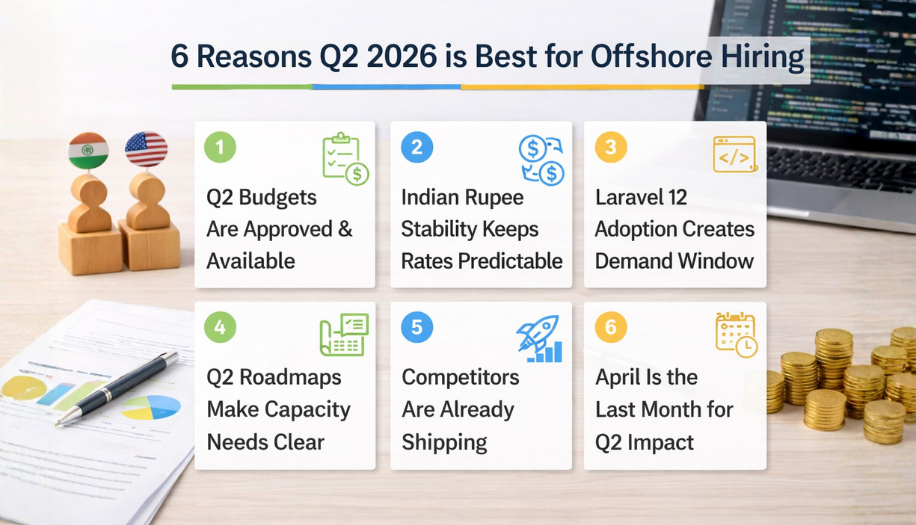
These six factors are specific to the Q2 2026 market. They combine to create conditions that are structurally better for offshore hiring than any other quarter this year.
1 | Q2 Budgets Are Approved and Available Without ReapprovalQ1 hiring decisions often require mid-year budget reapproval for engagements that were not in the original Q1 plan. Q2 engagements that were planned in the Q1 budget process start with budget already available. The approval cycle that delayed Q1 decisions is not a factor in Q2. Data point: Engagements that started in the first 2 weeks of Q2 in previous years averaged 40% faster contract-to-start timelines compared to Q1 engagements requiring mid-cycle budget approval. |
2 | The Indian Rupee Has Maintained Stability, Keeping USD Rates PredictableUSD-INR stability in early 2026 means that the effective dollar cost of a senior Laravel developer from India is predictable and consistent with the rates agreed at the start of the year. Rate volatility in Q3 and Q4 of previous years has created mid-engagement pricing conversations. Q2 locks in rates before that volatility typically appears. Data point: Historically, USD-INR movement in Q3 and Q4 has created rate renegotiation conversations in 15 to 20% of multi-quarter engagements. Q2 locks in rates before that period. |
3 | Laravel 12 Adoption Is Creating a Specific Demand Window for Upgrade ExpertiseLaravel 12 was released in early 2025. By Q2 2026, the adoption curve means a significant number of SaaS products are running on versions 10 or 11 and facing upgrade pressure from dependencies, security patches, and client requirements. Senior Laravel developers with production upgrade experience are in demand, and Q2 is when that demand is highest before Q3 hiring pressure compounds it. Data point: We have seen a 30% increase in Laravel version upgrade project inquiries in Q1 2026 versus Q1 2025. Q2 is when those projects typically start. Early Q2 engagements get the first pick of developers with active upgrade experience. |
4 | Q2 Roadmap Commitments Are Set, Making Capacity Requirements ClearBy the start of Q2, most product teams have committed to a Q2 roadmap. The capacity requirements are known: which features are planned, which skills are needed, how many sprints are in the quarter. This clarity makes the staffing decision specific rather than speculative, which reduces the decision cycle time significantly. Data point: Engagements started with a defined roadmap requirement onboard 25% faster than engagements started before the roadmap is finalised because the first task and sprint scope are already defined. |
5 | Competitor Teams Who Started in Q1 Are Already Shipping. Q2 Is the Last Window to Close the Gap.CTOs who started staff augmentation engagements in Q1 have developers at full velocity by late March or early April. Their Q2 product cycle starts with a fully staffed team. Teams that have not yet added capacity start Q2 with the same capacity constraint and watch competitors ship faster through the quarter. Data point: In our active client pipeline, 40% of Q2 engagements started in April are explicitly described by the CTO as a response to Q1 competitor shipping velocity. Q2 is the catch-up window. Q3 is the fall-further-behind window. |
6 | The 14-Day Onboarding Timeline Makes April the Last Month for Q2 Full ContributionWith a 48-hour deployment and an 11-day path to first production code, an engagement confirmed in the first week of April produces a developer at full sprint velocity by the third week of April. An engagement confirmed in the last week of April produces a developer at full velocity in mid-May. An engagement confirmed in May produces a developer at full velocity in late May or early June, at which point the Q2 product cycle is in its final 4 to 6 weeks. Data point: The 14-day onboarding timeline is not a marketing claim. It is the actual timeline from our delivery data across engagements that followed the preparation framework. Full detail in our 14-day onboarding guide. |
The 5-Question Q2 Decision Framework
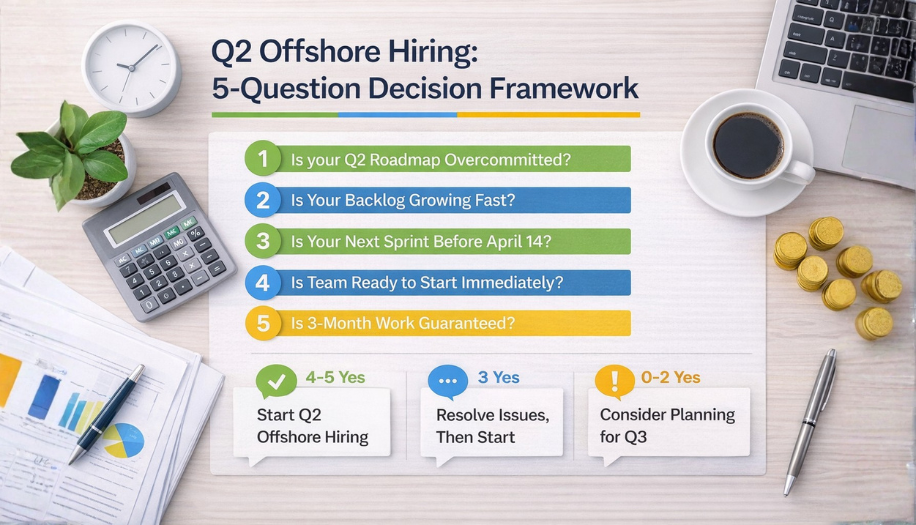
This framework gives you a specific answer to whether adding offshore development capacity in Q2 makes sense for your situation. Answer each question and follow the recommendation.
Question | Yes: what it means | No: what it means |
Does your Q2 roadmap have more committed features than your current team can deliver? | Capacity gap confirmed. Q2 augmentation is justified by roadmap requirement. | No capacity gap. Q2 augmentation would be forward planning for Q3. |
Is your backlog growing faster than your team is clearing it? | The gap is current, not projected. Q2 start is urgent, not optional. | Team is keeping pace. Q2 augmentation could be strategic rather than reactive. |
Do you have a next sprint date within the first 3 weeks of April? | The Q2 window is open. Developer confirmed this week can contribute to that sprint. | Sprint cadence allows 2 to 3 weeks before the next sprint. Q2 window is still achievable. |
Is your team's operational readiness in place (README, access, first task)? | Can start immediately. 14-day timeline to first production code is achievable. | 1 to 3 days of preparation needed. Still achievable within the April window. |
Would a senior Laravel developer added to your Q2 sprint have 3 months of meaningful work? | Engagement length is justified. 3-month minimum is the right structure. | Shorter engagement may be more appropriate. Discuss a project-based scope. |
How to Read Your AnswersAll 5 Yes: Start this week. The Q2 window is open and the conditions are fully aligned. 3 to 4 Yes: Start within the first week of April after resolving the No answers. Still achievable. 2 Yes: Q2 augmentation may be premature. Use April to prepare and start in Q3. 0 to 1 Yes: Q2 augmentation is not aligned with your current situation. Q3 planning is more appropriate. The most important question is Question 3. If your next sprint starts after April 14, the Q2 window is closing. If it starts before April 14, the window is open and the timeline is achievable. |
Q2 Starts in 3 Days. The Window for Full Q2 Contribution Is the Next 14 Days.
Every day after April 1 that the engagement is not confirmed is a day the developer's full velocity slips further into Q2. The roadmap committed to in Q1 planning does not adjust itself to match the hiring decision. The features that were promised in Q2 are still promised. The capacity to deliver them is what is missing. Tell us your Q2 roadmap and your next sprint date. We will tell you exactly what is achievable.
What a Q2 Engagement With Acquaint Softtech Looks Like
We have run Q2 engagement starts for 13 consecutive years. Here is exactly what a Q2 engagement looks like from confirmation to full velocity, based on our 14-day onboarding timeline and our current developer availability.
Day 0 (Today) | Contact us with your stack, team size, and next sprint date. 15-minute conversation. We confirm developer availability and match. |
Day 1 to 2 | Developer confirmed and briefed. Developer profile document sent to you. Pre-Day-1 preparation checklist sent to your team. |
Day 3 (Developer Day 1) | Developer starts. README reviewed before first call. Day 1 call: 30 minutes. First task assigned. Access live. |
Day 5 (Developer Day 3) | First PR submitted and reviewed same day. |
Day 7 (Developer Day 5) | Week 1 check-in call. Developer in sprint. Second task running. |
Day 13 (Developer Day 11) | First production code shipped to staging. Client approval. Production deployment. |
Day 17 (Developer Day 14) | Full sprint velocity. Sprint 2 planned. Developer is a full sprint contributor. |
Week 5 to 6 | Developer has institutional knowledge of the codebase. Sprint estimates are accurate. Delivery rate is consistent. |
Month 3 | Developer knows the product deeply. Institutional knowledge compounds into faster delivery per sprint. |
Q2 Is the Window. April Is the Month. The Decision Is Now.
The conditions that make Q2 the optimal offshore hiring window are specific to this quarter: approved budgets, stable talent availability, pre-Q3 rate conditions, and a 14-day onboarding timeline that puts a developer at full velocity before the May product cycle peak.
Q3 brings higher demand, tighter talent availability, and a hiring decision that produces a Q4 contributor rather than a Q2 one. Q4 brings holiday disruption and year-end budget uncertainty. The seasonal pattern repeats every year. Q2 is consistently the most effective window.
If you have a Q2 roadmap with more committed features than your current team can deliver, the decision is not whether to add capacity. It is whether to add it in time for Q2 or accept that Q2 deliverables will be Q3 deliverables. Tell us your situation and we will tell you what is achievable from where you are today.
Staff Augmentation | Hire Laravel Developers | Hire Remote Developers | Contact Us
Faq's
-
Why is Q2 better than Q1 for offshore hiring?
Three reasons. First, Q2 budgets are typically approved in the Q1 planning process, which means the approval cycle that delays Q1 engagements is not a factor in Q2. Second, talent availability is higher in Q2 than Q1 because Q1 engagement demand has been absorbed and the Q3 hiring surge has not yet started. Third, the Q2 decision window is defined by the quarterly product cycle: decisions made in the first 2 weeks of April produce developers at full velocity before the May product cycle peak. Q1 decisions are compressed by budget approvals and often produce developers who reach velocity in Q2 rather than Q1.
-
How does the 14-day timeline work if my sprint starts in 2 weeks?
A developer confirmed today starts Day 1 in 2 business days. By Day 3 the first PR is submitted. By Day 7 the developer is in the sprint. By Day 14 full sprint velocity is established. If your sprint starts in 2 weeks, a developer confirmed today will be at or near full velocity by the time your next sprint after that begins. The 14-day timeline requires specific preparation from your side before Day 1: a codebase README, access provisioned, and a first task defined. Full detail is in our onboarding timeline guide.
-
What if my Q2 budget has not been approved yet?
This is the most common Q2 timing issue. If Q2 budget approval is pending, the right move is to initiate the technical scoping conversation now, identify the right developer profile, and have the engagement structure ready to confirm immediately when budget approval comes through. A 2 to 3 week budget approval delay at the start of April still leaves time to hit the mid-April full velocity target if the technical preparation work is done in parallel. Contact us and we can hold a developer profile match for 5 to 7 business days while approval completes.
-
What developer profiles are available for Q2 engagement starts?
Our current Q2 available developer profiles include senior Laravel developers with 4 to 8 years of production Laravel experience, Laravel developers with AI integration experience (OpenAI, Anthropic, RAG implementations), Bagisto e-commerce specialists for Laravel-based commerce builds, Statamic CMS developers for enterprise content platform builds, and full-stack Laravel and Vue developers for SaaS product engagements. Profile availability changes week to week. Contact us for a current availability snapshot for your specific requirements.
We’re Acquaint Softtech, your technology growth partner. Whether you're building a SaaS product, modernizing enterprise software, or hiring vetted remote developers, we’re built for flexibility and speed. Our official partnerships with Laravel, Statamic, and Bagisto reflect our commitment to excellence, not limitation. We work across stacks, time zones, and industries to bring your tech vision to life.
Table of Contents
Get Started with Acquaint Softtech
- 13+ Years Delivering Software Excellence
- 1300+ Projects Delivered With Precision
- Official Laravel & Laravel News Partner
- Official Statamic Partner