

Why Laravel 13 Wins as a Backend Framework in 2026?
How does Laravel 13 beat Node and Django in 2026? Discover where startups find ROI with AI-native features, rapid MVP cycles, and elite security protocols.

Acquaint Softtech
Backend Decisions Define A Startup's Success
Choosing a backend is like picking a starting goalkeeper for the 2026 FIFA World Cup. You don't just need someone who can stop the ball; you need someone who organizes the defense, starts the counter-attack, and doesn't crumble under the pressure of 100,000 screaming fans, or in your case, 100,000 concurrent users.
For startup founders, the backend is your "silent partner."
In 2026, the conversation is sharper than ever. Laravel just shipped a game-changing upgrade, version 13. Node.js is still the "cool kid," Django is the Python loyalist's answer, and Express.js is the "I'll decide everything myself" choice.
This article cuts through the noise and explains why Laravel 13 wins as a backend framework.
And somewhere in the chaos of AI features, cost pressures, and developer shortages, a startup founder has to make the call. We compare them honestly in this article.
We call out the tradeoffs clearly and help you match your startup's specific needs to the right backend, not the trendiest one. It helps answer the question: what is the best backend framework for a new startup in 2026?
"The most dangerous phrase in business is 'we've always done it this way.'" — Grace Hopper, computing pioneer
Common Dilemma With Speed, Cost, And Scalability
Every founder wants all three: speed, cost, and scalability. The reality is not always so; you usually only get two of three. If you choose a backend that is too complex, your time-to-market stretches, and your burn rate explodes.
If it’s too "lightweight," you’ll be forced into a painful migration just as your Series A hits the bank. It is important to consider various factors when choosing a backend framework.
Some of the main factors include app size, budget, requirements, skill availability, security, and scalability. In 2026, the stakes are higher. AI integration is the baseline. Your backend must handle vector databases, LLM streaming, and real-time data processing without requiring a 50-person DevOps team.
The backend choice is a CEO-level decision because the choice dictates the cloud bill, the hiring timeline, and the AI roadmap. But is Laravel 13 for startups?
Here's what's actually at stake:
Time-to-Market:
Every week of added complexity in your backend setup is a week your competitor gets ahead. Some frameworks require weeks of configuration before you write a single line of business logic.
Total Cost of Ownership:
The framework isn't just development cost. It's DevOps tooling, package licensing, talent scarcity, and the long-tail cost of maintaining an undocumented, sprawling codebase two years from launch.
Scalability Without Rewrite:
A SaaS company that built on a minimal Node.js/Express setup may find itself undertaking a painful migration at Series A when it needs background jobs, multi-tenancy, and compliance features. A structured framework forces good patterns early.
Security By Default:
In 2025, the average cost of a data breach for a startup hit $4.88 million, according to IBM's Cost of a Data Breach Report. Frameworks with built-in CSRF protection, SQL injection prevention, and secure session handling reduce that exposure from day one.
AI Readiness:
With 78% of tech startups planning to integrate AI features by the end of 2026 (McKinsey Global Survey), your backend must support AI pipelines natively or through clean integration, not as an afterthought.
Choosing a backend is like choosing a co-founder. Pick one that is best suited to your project, not one that is convenient.
"Software is a great combination between artistry and engineering." — Bill Gates
Which Backend Frameworks Are Relevant in 2026?
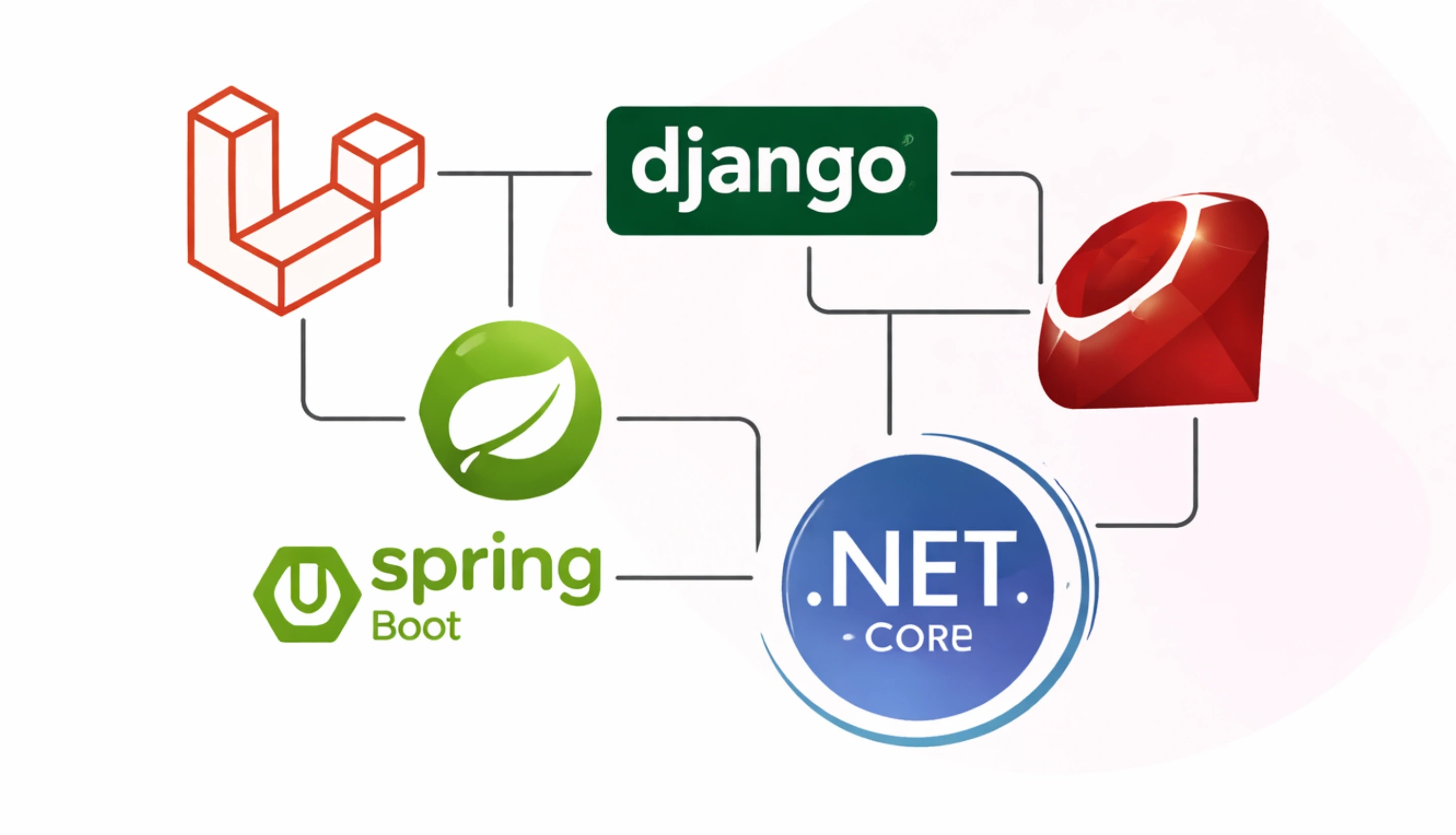
In 2026, backend frameworks are evaluated on AI readiness, scalability, and developer velocity. Leading options include Laravel 13 (AI-native and fast), Django (data-heavy and ML-friendly), Rails (rapid MVPs), ASP.NET Core and Spring Boot (enterprise-grade performance), and Express.js (lightweight real-time APIs).
The right choice depends on business stage, not hype. As we move through 2026, the backend ecosystem has shifted from "cloud-first" to "AI-native." Frameworks are no longer just handling routing and databases.
They are now judged by how seamlessly they manage vector embeddings, LLM streaming, and high-concurrency performance for real-time applications. Here are the popular backend frameworks:
Laravel 13.0
Laravel 13 has officially become the "AI-native" PHP framework. The recent version release justified the statement that ‘Laravel 13 for startups’ is true.
Latest Version: 13.0.x
Release Date: March 17, 2026
Main Laravel 13 features: As one of the AI-native backend frameworks, the key highlights include first-party support for vector databases via Eloquent and an integrated AI SDK for agentic workflows. It utilizes PHP 8.4 property hooks and attributes to drastically reduce boilerplate, making it one of the cleanest development experiences on the market.
Common Applications: Rapidly scaling SaaS platforms, AI-integrated marketplaces, and fintech applications where developer velocity is a competitive advantage.
Django 6.0.4
Django 6.0 remains the titan of Python web development.
Latest Version: 6.0.4
Release Date: Late 2025 (Updated Q1 2026)
Main Features: This version brings fully matured asynchronous support (ASGI) for views and middleware, allowing it to compete with Node.js in high-I/O scenarios. It continues to champion its "batteries-included" philosophy, now including native security protocols for preventing LLM injection attacks.
Common Applications: Data-heavy scientific platforms, content management for global media corporations, and complex backends that require deep integration with Python's machine learning libraries.
Ruby on Rails 8.1.3
Rails 8.1 continues David Heinemeier Hansson’s "No PaaS" mission.
Latest Version: 8.1.3
Release Date: February 2026
Main Features: This version includes "Solid Queue" and "Solid Cache," which allow apps to run entirely on a single VPS or bare-metal server without needing Redis or complex cloud dependencies. It leverages Kamal 2 for simplified zero-downtime deployments.
Common Applications: Startups seeking "The One Person Framework" to build complex MVPs with minimal infrastructure costs and high-productivity e-commerce sites.
ASP.NET Core (.NET 10 LTS)
As a long-term support release, .NET 10 is the enterprise choice for stability.
Latest Version: .NET 10 (LTS)
Release Date: November 2025
Main Features: It introduces "Native AOT" (Ahead-of-Time compilation) as the default for web APIs, resulting in near-instant startup times and significantly lower memory footprints. Its C# 14 integration makes asynchronous code even more readable through improved await patterns.
Common Applications: Large-scale enterprise systems, high-frequency trading platforms, and cloud-native microservices requiring the absolute highest performance on Azure.
Spring Boot 3.5.12
Spring Boot 3.5 focuses on the "Java Renaissance," fully utilizing Project Loom’s virtual threads for effortless scalability.
Latest Version: 3.5.12
Release Date: Q1 2026
Main Features: It has enhanced its "Spring AI" project, making it the premier choice for Java developers to integrate RAG (Retrieval-Augmented Generation) patterns into legacy corporate systems.
Common Applications: Mission-critical banking infrastructure, complex logistics management, and massive multi-tenant systems where security and strict typing are non-negotiable.
Express.js 5.1.0
After years of stability in version 4, Express 5.1 represents the modernized standard for Node.js.
Latest Version: 5.1.0
Release Date: Early 2026
Main Features: It features a completely rewritten router that supports native Promises, eliminating "callback hell" without requiring third-party wrappers. It remains the most unopinionated and lightweight choice, optimized for the latest V8 engine features.
Common Applications: Single-page application (SPA) backends, real-time chat engines, and high-performance API gateways where every millisecond of latency matters.
While Laravel and Rails are optimized for developer happiness and speed-to-market, ASP.NET Core and Spring Boot are currently leading the pack in raw execution speed for massive-scale enterprise deployments. Choose based on your team's expertise and your infrastructure budget.
Confused by the 2026 Framework Paradox?
Choosing between raw performance and developer speed is a high-stakes balancing act. Don't leave your infrastructure to chance.
What's New in Laravel 13: The Competitive Edge
Laravel 13 introduces first-party AI SDKs, native vector database support, passkey authentication, and JSON:API resources. These features eliminate the need for fragmented integrations, reducing development time by 4–6 weeks. For startups, this translates into faster MVP launches, lower engineering overhead, and immediate readiness for AI-driven product features.
Here's what's genuinely different:
First-Party AI SDK that is built In, not bolted on
Native passkey authentication:
Vector search & semantic querying
JSON:API resources — first-party
PHP 8.3 foundation
Why Do Backend Frameworks Matter?
Why Do Backend Frameworks Matter?
Backend frameworks directly impact time-to-market, security, scalability, and total cost of ownership. A strong framework standardizes development, reduces vulnerabilities, and optimizes infrastructure usage. For startups, this means faster launches, lower burn rates, and fewer costly rewrites as the product scales from early users to enterprise-grade demand.
For a CEO or founder, the backend framework is the "silent partner" in your business's scalability. While users only see the interface, the framework you chose determines your Total Cost of Ownership (TCO) and Time-to-Market.
Choosing the right framework matters for three primary reasons:
1. Developer Velocity & Standardization
Frameworks like Laravel 13 provide a "Golden Path." Instead of developers wasting weeks building authentication, routing, or security protocols from scratch, they use battle-tested, built-in tools. This standardization means a new developer can join your team and become productive in hours, not weeks, because the "plumbing" is already standardized.
2. Risk Mitigation & Security
Thousands of contributors maintain top-tier frameworks. They include native protection against common vulnerabilities like SQL injection and Cross-Site Request Forgery (CSRF). For a startup, this is a massive insurance policy; it prevents catastrophic data breaches that could end a company before it scales.
3. Performance & Scalability
As your user base grows from 100 to 100,000, your framework dictates your cloud infrastructure bill. Modern versions, such as Laravel 13 or .NET 10, are optimized for high concurrency and AI integration. A lightweight, efficient framework ensures you aren't overpaying for servers to keep your app from crashing under load.
Your framework choice isn't just a technical decision; it's a strategic one that determines how fast you can pivot and how much it costs to stay alive.
Why the Framework is Your ROI Engine:
Benefit | Impact on Business |
Rapid Prototyping | Go from MVP to Market 30-50% faster. |
Security-by-Default | Avoid the $4.4M average cost of a data breach. |
Hiring Scalability | Access a global pool of talent already trained in the "standard." |
Cloud Optimization | Lower your AWS/Azure burn rate by optimizing resource utilization. |
Key Takeaway
Backend Choice = Strategic Leverage, Not Just Tech Stack
You are always trading between speed, cost, and scalability, optimize for your current stage, not hypothetical scale.
A backend framework directly impacts time-to-market, burn rate, hiring speed, and long-term maintainability.
In 2026, “AI-ready” is no longer optional, your backend must support LLMs, vector databases, and real-time processing natively or cleanly.
Frameworks with strong defaults (security, structure, tooling) reduce technical debt and migration risk at Series A.
The wrong choice leads to expensive rewrites, scaling bottlenecks, and security exposure. The right one compounds ROI over time.
Treat your backend framework like a co-founder; its decisions will shape your product velocity, cost structure, and scalability from day one.
Laravel 13 vs Other Backend Frameworks (2026 Edition)
Choosing a backend in 2026 isn’t about trends; it’s about alignment with your business velocity.
Below is a refined comparison of Laravel 13 vs. leading backend frameworks, updated for today’s startup realities.
Framework Comparison Snapshot:
Framework | Version | Best For | Strengths | Tradeoffs |
Laravel | 13.0 | MVPs, SaaS, marketplaces | Fast dev, cost-efficient, rich ecosystem | Slightly lower raw performance vs compiled languages |
Django | 6.0.4 | Data-heavy apps, AI backends | Secure, batteries-included, Python ecosystem | Slower iteration vs Laravel |
Python (FastAPI/Flask) | 3.12 | AI/ML, microservices | Flexibility, AI integration | Requires more architecture decisions |
Ruby on Rails | 8.1.3 | Rapid prototyping, SaaS | Convention over config, fast MVPs | Scaling requires careful optimization |
ASP.NET Core | .NET 10 (LTS) | Enterprise, fintech | High performance, strong typing | Higher dev cost, steeper learning curve |
Spring Boot | 3.5.12 | Large-scale enterprise systems | Robust, highly scalable | Slow development cycles |
Express.js | Latest | APIs, real-time apps | Lightweight, fast I/O | Less structure, higher maintenance risk |
Here is a strategic breakdown of the backend frameworks:
Development Speed (Time-to-Market):
Fastest: Laravel, Rails
Moderate: Django, Express
Slowest: Spring Boot, ASP.NET
Laravel 13 wins as a backend framework when it comes to development speed because it reduces boilerplate and ships features faster.
Scalability & Performance:
Top-tier: ASP.NET Core, Spring Boot
High: Laravel, Django
Flexible: Express.js, Python
Most startups don’t need extreme scalability on Day 1. They need predictable scaling without overengineering.
Cost Efficiency (Critical for Runway):
Most Cost-Effective: Laravel, Python
Moderate: Django, Rails
Expensive: ASP.NET Core, Spring Boot
Laravel 13 wins as a backend framework for cost efficiency because it reduces:
Development hours
Infrastructure complexity
Hiring costs
Hiring & Talent Availability:
Easiest Hiring: Laravel, Python
Moderate: Node/Express, Django
Hardest: Spring Boot, ASP.NET Core
In competitive hiring markets (US and Europe), this becomes a hidden growth bottleneck.
Flexibility vs. Structure:
Highly Structured: Laravel, Django, Spring Boot
Highly Flexible: Express.js, Python (Flask/FastAPI)
Balanced: Rails
Startups benefit from opinionated frameworks early; they reduce decision fatigue.
Real-World Interpretation:
Let’s simplify this for decision-makers. If your priority is:
Launch Fast + Stay Lean → Choose Laravel 13: This is ideal for MVPs, SaaS, marketplaces, balanced scalability + speed
AI/ML Heavy Product → Choose Python (3.12) or Django: Strong integration with AI ecosystems.
Enterprise Compliance & Performance → Choose ASP.NET Core / Spring Boot: Best for banking, gov-tech.
Real-Time Apps → Choose Express.js: Chat apps, streaming platforms.
Rapid SaaS Prototyping → Rails or Laravel: Laravel wins on cost and hiring in 2026
Hidden Risks Most Founders Ignore
Express.js chaos: Flexibility leads to inconsistent architecture
Spring Boot delays: Overengineering kills speed
ASP.NET costs: Great tech, expensive teams
Python sprawl: Lack of structure slows scaling
Laravel avoids most of these by offering structured flexibility. At the end of the day, the best backend isn’t the most powerful; it’s the one that gets you to market fastest without breaking your budget.
Laravel 13 wins as a backend framework because it consistently delivers:
Faster MVP cycles, making it the best backend for MVP.
Predictable scaling, ensuring timely delivery.
Lower operational risk, ensuring lower cost.
For startups, that combination is hard to beat.
Key Takeaway
Laravel 13 leads where startups actually compete: speed, cost, and predictability
In 2026, backend selection is about business alignment, not hype; choose based on how fast you need to launch and scale.
Laravel 13 dominates in MVP velocity and cost efficiency, making it the most practical choice for startups with limited runway.
High-performance frameworks like ASP.NET Core and Spring Boot excel at scale but introduce higher costs and slower iteration, which early-stage startups rarely need.
Flexible stacks like Express.js and Python offer freedom but often create architectural inconsistency and long-term maintenance risk.
Opinionated frameworks (Laravel, Django) reduce decision fatigue, onboarding time, and technical debt, which is critical in fast-moving teams.
Most startups fail not because their backend couldn’t scale but because they launched too late or burned too much capital getting there. Laravel 13 strikes the optimal balance.
It is fast to build, affordable to scale, and structured enough to avoid chaos, making it the most execution-friendly backend choice for startups in 2026.
Ready to turn your ideas into a functioning product?
Stop comparing and start coding. Consult with our Laravel 13 specialists today and get your MVP to market 30-50% faster than the competition.
Decision Framework for Founders
According to a 2025 Stack Overflow Developer Survey, PHP's ecosystem remains one of the most cost-effective to maintain. For a CEO, this translates to a lower Total Cost of Ownership (TCO).
Startups using Laravel report a 30% faster deployment cycle compared to those using fragmented JavaScript stacks (Source: TrueFirms Tech Trends 2025).
As one of the AI-native backend frameworks, Laravel 13 combines elegant syntax, modern AI capabilities, and proven scalability. It enables CEOs to focus on growth rather than infrastructure headaches.
Choosing a backend is like selecting the foundation for your startup skyscraper; Laravel 13 gives you reinforced concrete with smart elevators already installed.
Use this three-step framework when evaluating backend frameworks for startups:
Define Priorities: List must-have features (AI integration, real-time, and compliance) and non-negotiables (talent pool and budget).
Prototype Quickly: Build a small feature set in two shortlisted options. Measure developer velocity and hosting costs.
Assess Long-Term Fit: Review community support, upgrade path, and partner ecosystem. Laravel 13’s annual cadence and zero-breaking changes score highly here.
This structured approach removes emotion from the decision and aligns technology with business outcomes. This article already does a very good job of comparing Laravel 13 vs. Django 6.0 for AI apps. Use this quick framework to help you decide:
Choose Laravel 13 if:
You need fast MVP development
Budget is a constraint
You want easy hiring
Choose Node.js if:
Real-time features dominate
Choose Django if:
Heavy AI/data processing
Choose Spring Boot if:
Enterprise compliance required
Why Startups Are Choosing Laravel in 2026
Startups are hiring Laravel developers in 2026, and it is well justified. Laravel 13 represents a mature, forward-looking choice among backend frameworks for startups.
Its new AI primitives, developer-friendly upgrades, and ecosystem strength address the precise challenges CEOs and CTOs face in 2026. For organizations seeking expert implementation, partnerships with proven Laravel specialists ensure successful execution.
The framework's track record, combined with strategic access to talent, positions teams for sustainable growth. With over 1.5 million websites powered by Laravel and continued 15%+ YoY adoption growth, the framework has matured into a strategic asset for ambitious startups.
During the 2026 startup funding slowdown, investors are prioritizing:
Faster ROI
Lean teams
Scalable tech
Laravel supports all three; besides, this article also answers a popular question. How Laravel 13 reduces startup costs?
Laravel 13 wins as a backend framework, but choosing Laravel 13 is only half the battle. You need the right artisans to build the masterpiece.
As a Clutch top-rated IT staff augmentation company with a 4.9/5 rating, Acquaint Softtech isn't just a vendor; we are an extension of your team. Our 70+ professionals in India, the UK, and the USA are specialized in Laravel 13.
Hire Laravel developers from Acquaint Softtech; we help you skip the "hiring risk" and move straight to "scaling success."
In the race for digital dominance, the winner isn't the one with the most developers, but the one with the best-aligned team.
Pick the right backend and hire a Laravel partner!
Partner with Acquaint Softtech’s 5-star-rated team to build your Laravel 13 masterpiece today.
Frequently Asked Questions
-
Is Laravel still the best choice for startups in 2026?
Yes. In 2026, Laravel 13 has evolved into an "AI-native" framework. While frameworks like Node.js or Django require fragmented third-party libraries for AI, Laravel 13 provides first-party SDKs for LLM integration and vector search. For startups, this translates to a 30-50% faster time-to-market and significantly lower technical debt.
-
How does Laravel 13 compare to Node.js for high-concurrency apps?
Historically, Node.js led in concurrency, but Laravel 13’s introduction of Reverb, a first-party, high-performance WebSocket server, allows PHP applications to handle thousands of concurrent real-time connections without the overhead of Redis. Combined with PHP 8.4’s performance optimizations, Laravel now competes directly with Node.js while offering better security and faster development.
-
Why is upgrading to Laravel 13 a security requirement?
Laravel 13 requires PHP 8.3 minimum. As of late 2025, PHP 8.1 and 8.2 have reached end-of-life (EOL), meaning they no longer receive security patches. Upgrading to Laravel 13 ensures your application is protected against modern vulnerabilities and includes native Passkey authentication, reducing the risk of password-based data breaches, which currently cost startups an average of $4.88M.
-
What is the "Laravel AI SDK" in version 13?
The Laravel AI SDK is a first-party tool that provides a unified interface for integrating LLMs (OpenAI, Anthropic, Gemini) and vector databases. Unlike manual integrations, it supports semantic caching out of the box. This allows the backend to cache AI responses based on intent, reducing LLM API costs by an average of 25-40% for high-traffic startups.
-
Can Laravel 13 handle vector search for RAG systems?
Yes. Laravel 13 introduces native Eloquent vector support. It integrates directly with PostgreSQL (via pgvector) and other vector stores, allowing developers to perform similarity searches using standard Eloquent syntax. This eliminates the need for separate Python microservices just to handle Retrieval-Augmented Generation (RAG) workflows.
-
Is hiring Laravel developers easier than other frameworks?
In 2026, the Laravel ecosystem remains one of the most accessible for talent. Because the framework is highly opinionated and standardized, new developers can become productive in hours. Compared to the specialized talent required for Rust or Go, Laravel developers offer a much higher ROI for startups looking to scale lean engineering teams.
We’re Acquaint Softtech, your technology growth partner. Whether you're building a SaaS product, modernizing enterprise software, or hiring vetted remote developers, we’re built for flexibility and speed. Our official partnerships with Laravel, Statamic, and Bagisto reflect our commitment to excellence, not limitation. We work across stacks, time zones, and industries to bring your tech vision to life.
Table of Contents
Get Started with Acquaint Softtech
- 13+ Years Delivering Software Excellence
- 1300+ Projects Delivered With Precision
- Official Laravel & Laravel News Partner
- Official Statamic Partner
Related Blog
10 Laravel 13 Features Every Developer Should Know
Laravel 13 introduces 10 game-changing features like PHP Attributes, AI SDK, Cache::touch(), and semantic search—perfect for developers building scalable apps.

Chirag Daxini
March 25, 2026
5 Real-World AI Features You Can Add to Laravel Apps Today
Discover practical AI features in Laravel like chatbots, recommendation engines, and intelligent search to build smarter apps.
Acquaint Softtech
October 7, 2025
Complete Guide to Outsourcing Laravel Development Projects
Outsourcing Laravel development projects is easy when you follow a clear process. See how Acquaint Softtech’s structured outsourcing model ensures fast, secure, and predictable delivery.

Manish Patel
November 18, 2025India (Head Office)
203/204, Shapath-II, Near Silver Leaf Hotel, Opp. Rajpath Club, SG Highway, Ahmedabad-380054, Gujarat
USA
7838 Camino Cielo St, Highland, CA 92346
UK
The Powerhouse, 21 Woodthorpe Road, Ashford, England, TW15 2RP
New Zealand
42 Exler Place, Avondale, Auckland 0600, New Zealand
Canada
141 Skyview Bay NE , Calgary, Alberta, T3N 2K6
Your Project. Our Expertise. Let’s Connect.
Get in touch with our team to discuss your goals and start your journey with vetted developers in 48 hours.