

The Complete Guide to Hiring a DevOps Engineer in 2026: CI/CD, Cloud, Kubernetes, and What It All Costs
Everything you need before hiring a DevOps engineer in 2026. What the role covers, CI/CD to Kubernetes, what it costs in India vs the US, and how to start with a vetted engineer in 48 hours.

Acquaint Softtech
At Acquaint Softtech, a software development partner with 1,300+ projects across 13 years, the DevOps hiring question is one of the most common conversations we have with CTOs and founders. The confusion is understandable. The role covers a wide range of responsibilities, the terminology is inconsistent across job boards and vendor proposals, and the cost difference between a good DevOps hire and a bad one is measured in tens of thousands of dollars. This guide covers everything you need to make the right hiring decision: what the role actually does, what it should cost in 2026, how to vet the person before signing, and how to start a DevOps engagement in 48 hours.

- CTOs and founders evaluating whether and when to hire a DevOps engineer for the first time
- Engineering leads whose developers are doing infrastructure work alongside product development
- Product teams whose cloud bills are growing faster than their user base
- Startups preparing to launch a SaaS product and needing production-grade infrastructure in place before go-live
- Companies that have had a bad DevOps hire and want a structured framework to avoid repeating it
The DevOps market in 2026 is defined by a clear shortage of qualified engineers and a wide range of vendor proposals that use the same terminology to describe very different capability levels. Companies that hire on title alone, without verifying the specific infrastructure experience that matches their stack, consistently ends up with engineers who can manage existing pipelines but cannot design new ones. This guide gives you the framework to avoid that outcome.
The starting point before any hire is understanding which specific DevOps problems your platform has. Acquaint Softtech's hire DevOps engineers service connects companies with vetted DevOps engineers matched to their specific stack and infrastructure stage. This guide explains what to look for before you make that connection.
What a DevOps Engineer Actually Does: The Honest Job Description
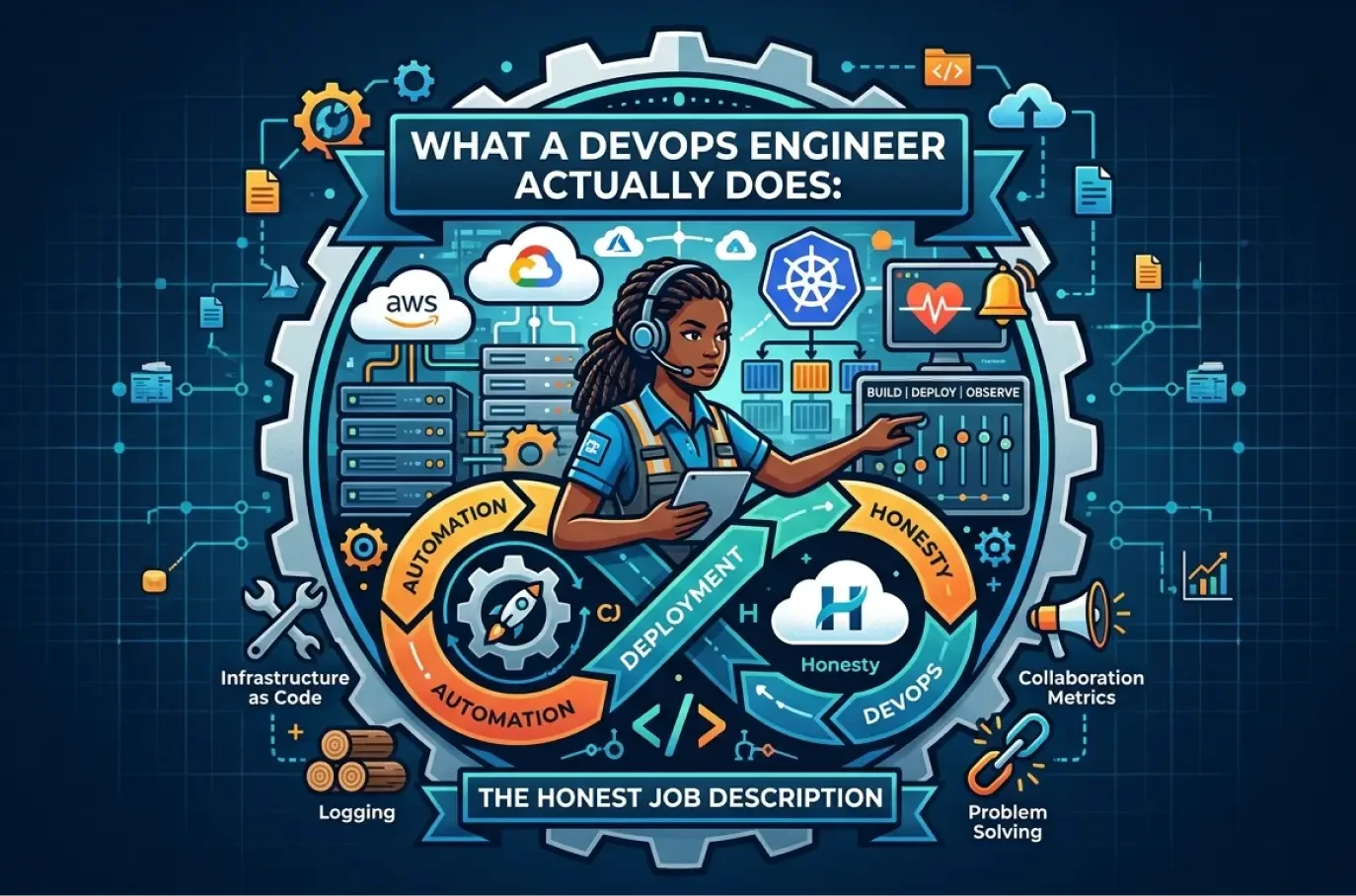
The DevOps role is described inconsistently across the industry. Some job posts treat it as a cloud administrator. Others treat it as a pipeline developer. The most accurate description is: a DevOps engineer is the person who closes the gap between writing code and running code in production at scale, reliably, and without downtime.
CI/CD Pipeline Design and Maintenance |
Building and maintaining the automated pipelines that take code from a developer's commit to production. This includes source control integration (GitHub, GitLab, Bitbucket), build automation, test integration, deployment automation, and environment promotion. A well-designed CI/CD pipeline reduces deployment time from hours to minutes and eliminates manual deployment errors. |
Cloud Infrastructure Architecture and Management |
Designing and managing the cloud environment on AWS, Azure, or GCP. This includes VPC design, compute resource management (EC2, EKS, ECS), database infrastructure, storage, CDN configuration, and load balancing. A DevOps engineer does not just use cloud services. They design the architecture that makes those services cost-efficient and scalable. |
Container Orchestration With Kubernetes |
Building and managing containerised application infrastructure. This includes writing Dockerfiles, designing Kubernetes cluster architecture, managing deployments and services, configuring Helm charts, and handling cluster upgrades. For production platforms, Kubernetes management is one of the highest-value skills a DevOps engineer brings. |
Infrastructure as Code With Terraform |
Writing and maintaining the code that creates and manages infrastructure automatically. Terraform scripts ensure that development, staging, and production environments are identical, that infrastructure changes are tracked and reversible, and that new environments can be spun up in minutes rather than days. |
Monitoring, Logging, and Alerting |
Setting up the observability stack that tells the team what is happening in production before users report problems. This covers metrics collection (Prometheus, CloudWatch), dashboard creation (Grafana), log aggregation (ELK Stack, Grafana Loki), and alerting that fires before an incident becomes an outage. |
Security and Compliance |
Implementing security at the infrastructure level: IAM configuration, secrets management (AWS Secrets Manager, HashiCorp Vault), network security (VPCs, security groups, WAF), and compliance frameworks (GDPR, SOC 2, PCI-DSS where relevant). A DevOps engineer who does not treat security as part of their daily work is a DevOps engineer who will eventually hand you an incident report. |
A DevOps engineer does not build your product. They build the infrastructure that ensures your product runs reliably, deploys quickly, scales under load, and costs the right amount to operate. The ROI of the role shows up in deployment velocity, infrastructure cost reduction, and the absence of production incidents, not in feature output.
Know What a DevOps Engineer Does. Now Find the Right One.
Acquaint Softtech has vetted DevOps engineers across AWS, Azure, and GCP with specific experience in CI/CD, Kubernetes, and Terraform. Tell us your stack and infrastructure stage. We will match you with a suitable profile within 24 hours and have the engineer in your sprint in 48 hours.
DevOps Engineer Cost in 2026: The Honest Rate Breakdown
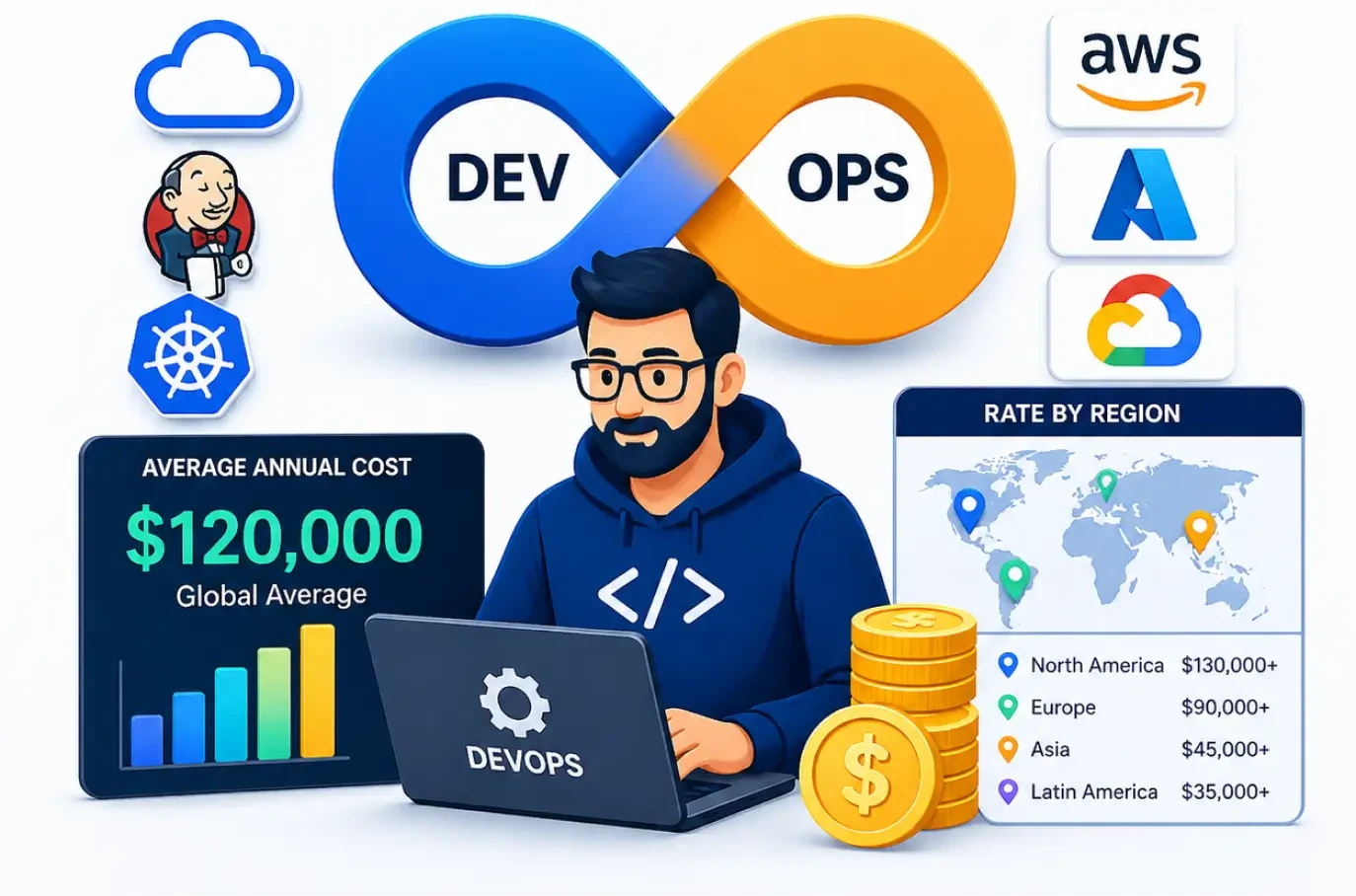
The cost of a DevOps engineer in 2026 varies by region, seniority, and engagement model. The number on a job board or vendor proposal rarely reflects the full cost. Here is the honest breakdown.
Location | Junior (0-2 yrs) | Mid (2-4 yrs) | Senior (4-7 yrs) | Lead (7+ yrs) |
United States | $90K-$120K/yr | $120K-$160K/yr | $160K-$200K/yr | $200K-$260K/yr |
United Kingdom | £55K-£75K/yr | £75K-£100K/yr | £100K-£130K/yr | £130K-£170K/yr |
Eastern Europe | $30-$45/hr | $45-$65/hr | $65-$90/hr | $85-$110/hr |
India (offshore) | $15-$22/hr | $22-$32/hr | $32-$45/hr | $42-$58/hr |
India via Acquaint Softtech | $18-$22/hr | $24-$32/hr | $35-$45/hr | $44-$56/hr |
What the rates above do not include (for in-house hires)
Employer payroll taxes: 12 to 15% of salary
Benefits and healthcare: $8,000 to $18,000/year (US)
Equipment and tooling: $3,000 to $5,000 onboarding + $1,500/year
Recruiting cost: 2 to 4 weeks of CTO time + agency fees of 15 to 20% of first-year salary
Total fully-loaded cost (US senior DevOps): $220,000 to $280,000/year
hire via Acquaint Softtech (senior DevOps, monthly retainer): $3,200/month
All-in. No additional charges. Equipment, management, and infrastructure access included.
The full rate comparison by country with 2026 numbers is in our DevOps engineer hourly rate guide. It covers the breakdown by seniority level and explains what the India-US rate differential actually reflects in terms of experience, output quality, and delivery risk.
Want the Exact Rate for Your Stack and Seniority Requirement?
Tell Acquaint Softtech your technology stack (AWS/Azure/GCP), the Kubernetes and CI/CD tools you use, and whether you need junior, mid, or senior level. We will send you a specific rate card within 24 hours. No commitment required.
CI/CD: What a DevOps Engineer Builds and Why It Matters
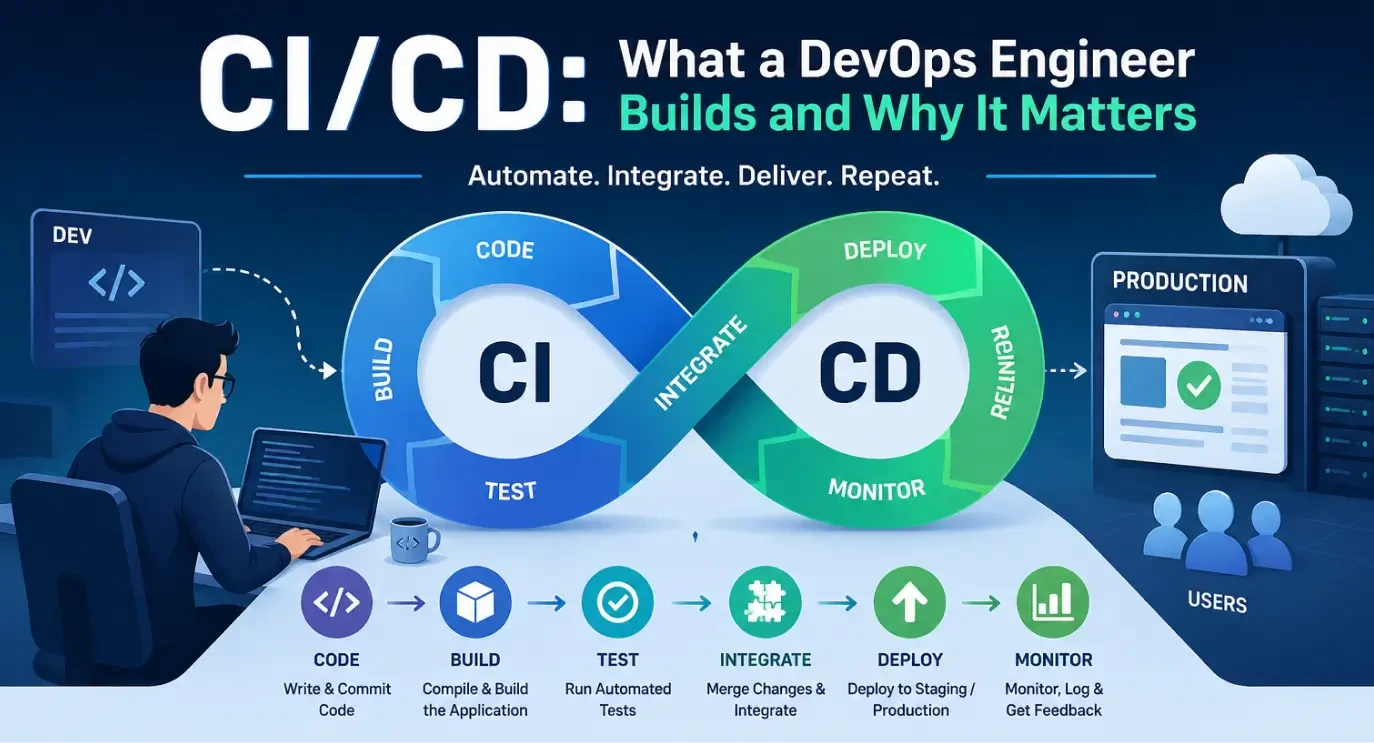
CI/CD is the most commonly cited DevOps responsibility and the one most often misunderstood in hiring conversations. Here is what a well-designed CI/CD pipeline actually includes and what it takes to build one.
Continuous Integration (CI) | The CI stage runs automatically every time a developer pushes code. It executes the build, runs the automated test suite, performs static code analysis (SonarQube or equivalent), and reports pass or fail within minutes. The goal: catch integration problems before they reach staging. A DevOps engineer designs the CI pipeline to run fast enough that it does not slow developer workflow. |
Continuous Delivery (CD) | The CD stage takes code that has passed CI and promotes it through environments: typically development to staging to production. Each promotion is triggered automatically or with a single approval, depending on the team's risk tolerance. A DevOps engineer designs the promotion logic, the rollback mechanism, and the deployment strategy (Blue-Green, Canary, or Rolling). |
Deployment Strategies | Blue-Green deployment runs two identical environments. Traffic shifts from old to new instantly, with an immediate rollback path if problems appear. Canary deployment routes a small percentage of traffic to the new version first. Rolling deployment updates instances one at a time. A DevOps engineer selects the strategy that matches the platform's risk tolerance and traffic patterns. |
Pipeline Tooling | The tools a DevOps engineer uses for CI/CD depends on the platform and existing stack. GitHub Actions, GitLab CI, and Jenkins are the most common. AWS CodePipeline and CodeDeploy suit AWS-native deployments. Azure DevOps is the natural choice for Azure-hosted applications. A skilled DevOps engineer is not attached to a specific tool. They select and implement the one that fits the team's workflow. |
The full cost breakdown for CI/CD pipeline setup, including what different pipeline configurations cost and how long they take to build, is in our CI/CD pipeline setup cost guide. It covers the specific tooling decisions and timeline for each stack type.
Kubernetes: What Your DevOps Engineer Manages and When You Need It
Kubernetes is the container orchestration platform that manages how containerised application run, scale, and recover from failures. Not every platform needs Kubernetes from day one, but most SaaS products scaling beyond 10 to 20 microservices or needing high availability will need it. Here is what a DevOps engineer manages in a Kubernetes environment.
When You Need Kubernetes vs When You Do Not |
You need Kubernetes when: You have multiple microservices that need independent scaling. You need to maintain high availability across availability zones. Your team deploys multiple times per day and needs zero-downtime deployments. You are managing 10+ containerised services. You do not need Kubernetes yet when: You are running a single monolith or a small number of services. You are in early MVP stage where shipping features matters more than infrastructure optimisation. Your traffic is stable and low-volume. AWS ECS or a managed container service handles your scale. |
Acquaint Softtech's DevOps engineers have managed Kubernetes clusters handling 200+ concurrent workloads on AWS EKS and Azure AKS across gaming, sports media, and SaaS platforms. The Kubernetes hiring guide for startups covers when to introduce Kubernetes, what it costs to hire a DevOps engineer to set it up, and what the first 30 days of cluster management looks like.
How to Vet a DevOps Engineer Before Hiring: The 12-Point Checklist
Most DevOps hiring mistakes happen because the interview focused on terminology rather than demonstrable experience. A DevOps engineer who can describe Kubernetes architecture cannot necessarily manage a production cluster under incident conditions. Here is the verification framework.
1. Cloud platform specificity
Ask which specific AWS, Azure, or GCP services they have used in production, not just listed on their resume. The answer should include specific service names, configuration decisions made, and problems solved. Vague answers mean surface-level exposure.
2. CI/CD pipeline ownership
Ask them to describe a pipeline they designed from scratch. The answer should cover the trigger conditions, the stages, the deployment strategy chosen and why, and what happens on failure. Someone who has only maintained existing pipelines gives a different answer than someone who designed one.
3. Infrastructure as code demonstrated
Ask for a sample Terraform module they have written or maintained. If they cannot show code, they have not worked with IaC at the depth a modern DevOps role requires.
4. Kubernetes troubleshooting
Present a scenario: a pod is failing to start, the cluster looks healthy, but one service is down. Walk me through how you diagnose it. The answer reveals whether they understand Kubernetes at an operational level or only at a conceptual one.
5. Incident response experience
Ask about a production incident they handled. The answer should cover: how they detected it, what the immediate mitigation was, what the root cause investigation found, and what infrastructure change prevented recurrence.
6. Monitoring stack knowledge
Ask what observability tools they have set up and configured. Grafana, Prometheus, and ELK are the standard stack. Vague familiarity is different from having configured dashboards and alert rules in a production environment.
The full 12-point technical vetting checklist with specific questions and red flag answers is in our DevOps engineer vetting guide. It covers the technical screen, reference check questions, and the contract terms that protect your engagement.
Engagement Models: Which Structure Fits Your Situation
Choosing the right engagement model for your DevOps hire is as important as choosing the right person. The model determines your cost structure, your management overhead, and how quickly you can adjust capacity.
In-House Full-Time Employee |
Best for: companies with sustained, complex DevOps requirements that justify the fully-loaded cost. Requires: hiring process (4 to 12 weeks), employer overhead, and long-term headcount commitment. Fully-loaded annual cost US: $220,000 to $280,000 for a senior DevOps engineer. |
Staff Augmentation (Monthly Retainer) |
Best for: companies that need dedicated DevOps capacity without the overhead of a full-time hire. The engineer works exclusively in your sprint, under your technical direction, with your tools and communication channels. Acquaint Softtech delivers vetted DevOps engineers at $3,200/month. Start in 48 hours. |
Dedicated DevOps Team |
Best for: companies that need a vendor-managed DevOps function with a technical lead included. The team handles architecture, implementation, monitoring, and incident response under vendor management. Client direction covers priorities and outcomes, not daily tasks. |
Project-Based Fixed Price |
Best for: discrete, well-defined DevOps projects: setting up a CI/CD pipeline for a specific stack, migrating to Kubernetes, implementing a monitoring stack. Scope must be fully defined. Any scope change triggers a change order. |
The detailed comparison between staff augmentation and a dedicated team for DevOps, including which model produces better outcomes at different company stages, is in our DevOps staff augmentation vs dedicated team guide. For teams evaluating individual augmentation alongside a full team model, our dedicated software development teams page covers the team structure and what is included at the engagement level.
What a DevOps Engineer Delivers in the First 30 and 90 Days
Setting the right expectations for the first 30 and 90 days prevents the most common onboarding disappointment, which is measuring a new DevOps engineer's output by the wrong standard at the wrong time. The early weeks is a context-building phase, not a full-velocity delivery phase.
Timeline | What the DevOps engineer delivers |
Days 1 to 7 | Environment and access setup. Repository, cloud console, monitoring tools, CI/CD platform. The DevOps engineer should have read-access to all relevant systems by Day 2 and write-access configured by Day 3. First infrastructure review completed by end of week. |
Days 8 to 21 | Initial assessment and priority identification. The DevOps engineer reviews the existing pipeline, infrastructure architecture, monitoring setup, and security configuration. By the end of week 3, they should present a prioritised list of improvements and risks. |
Days 22 to 30 | First deliverable. A well-scoped initial task: one pipeline improvement, one monitoring dashboard, one infrastructure automation script. This is not full-velocity output. It is the first validation that the context-building phase worked. |
Days 31 to 60 | Steady-state delivery. The DevOps engineer is running independently on sprint tasks. CI/CD improvements, infrastructure automation, monitoring configuration, and security hardening all move forward in parallel. |
Days 61 to 90 | Strategic contribution. The DevOps engineer is now contributing to architectural decisions, flagging technical debt, and proposing improvements that go beyond the immediate sprint. This is the output level the engagement was hired for. |
For teams looking to start even faster, the hire DevOps engineer India 2026 guide covers how Acquaint Softtech gets a vetted engineer into your first standup within 48 hours of profile approval, including what the pre-engagement setup looks like and what the first sprint should contain.
Ready to Hire? Acquaint Softtech Has Vetted DevOps Engineers Available Now.
Acquaint Softtech has pre-vetted DevOps engineers with specific experience across AWS, Azure, and GCP. Engineers with CI/CD, Kubernetes, and Terraform backgrounds covering gaming platforms, SaaS products, and high-traffic media platforms. Tell us your stack and we will send matched profiles within 24 hours. Developer in your sprint in 48 hours.
Frequently Asked Questions
-
What does a DevOps engineer do?
A DevOps engineer closes the gap between software development and production operations by building the infrastructure, automation, and pipelines that allow code to move from a developer's laptop to production reliably, quickly, and at scale. Their core responsibilities cover CI/CD pipeline design, cloud infrastructure management, container orchestration (Kubernetes), infrastructure as code (Terraform), and monitoring and alerting. The role is not a single job function - it is the connective tissue between engineering and operations.
-
What is the difference between a DevOps engineer and a cloud engineer?
A cloud engineer focuses on provisioning and managing cloud infrastructure (AWS, Azure, GCP) but does not necessarily design the CI/CD pipelines or deployment processes. A DevOps engineer does both: they manage the cloud infrastructure AND own the automation pipelines that deploy code to it. In practice, the two roles overlap significantly, but a DevOps engineer is expected to own the full automation lifecycle, not just the infrastructure layer.
-
How do I know if I need a DevOps engineer or a cloud engineer?
If your primary problem is that deployments are slow, manual, or unreliable, you need a DevOps engineer. If your primary problem is that your cloud infrastructure is poorly designed, over-costing, or not scaling properly, and your deployment processes are already automated, a cloud engineer may be the right hire. Most growing SaaS platforms need the DevOps profile because the deployment automation and the infrastructure management are tightly connected.
-
How do I prevent a bad DevOps hire?
Verify specific production experience rather than interviewing on terminology. Ask for examples of pipelines they designed from scratch, Kubernetes clusters they managed under incident conditions, and Terraform code they wrote. Check references with companies of similar infrastructure complexity to yours. The most reliable way to avoid a bad hire is to use a vendor with a structured pre-vetting process - Acquaint Softtech's vetting covers cloud credentials, live technical assessment, and reference checks before any profile reaches the client.
-
How much does a DevOps engineer cost in India in 2026?
a vetted senior DevOps engineer through Acquaint Softtech costs $22/hour or $3,200/month on a full-time dedicated engagement, all-in with no additional charges. This compares to a fully-loaded annual cost of $220,000 to $280,000 for an equivalent US-based in-house hire. For a mid-level engineer, the monthly retainer starts at $3,200/month.
-
How quickly can I start with an offshore DevOps engineer from Acquaint Softtech?
Acquaint Softtech delivers matched DevOps engineer profiles within 24 hours of receiving a brief. Once the client approves a profile, the engineer attends their first standup within 48 hours. The pre-engagement setup, including access configuration and sprint 1 scoping, is handled by Acquaint Softtech before Day 1. From initial brief to first sprint: typically 5 to 7 business days.
-
Is a DevOps engineer from India as good as one from the US or UK?
At the senior level, the capability gap between India, the US, and the UK has largely closed in areas like Kubernetes administration, Terraform automation, and CI/CD design. Acquaint Softtech's DevOps engineers have managed infrastructure for platforms handling millions of users and live traffic spikes across gaming, sports media, and SaaS categories. The meaningful difference is cost, not output quality, when the engineer is properly vetted and matched to the right stack.
We’re Acquaint Softtech, your technology growth partner. Whether you're building a SaaS product, modernizing enterprise software, or hiring vetted remote developers, we’re built for flexibility and speed. Our official partnerships with Laravel, Statamic, and Bagisto reflect our commitment to excellence, not limitation. We work across stacks, time zones, and industries to bring your tech vision to life.
Table of Contents
Get Started with Acquaint Softtech
- 13+ Years Delivering Software Excellence
- 1300+ Projects Delivered With Precision
- Official Laravel & Laravel News Partner
- Official Statamic Partner
India (Head Office)
203/204, Shapath-II, Near Silver Leaf Hotel, Opp. Rajpath Club, SG Highway, Ahmedabad-380054, Gujarat
USA
7838 Camino Cielo St, Highland, CA 92346
UK
The Powerhouse, 21 Woodthorpe Road, Ashford, England, TW15 2RP
New Zealand
42 Exler Place, Avondale, Auckland 0600, New Zealand
Canada
141 Skyview Bay NE , Calgary, Alberta, T3N 2K6