

Dedicated Development Team Pricing: What Does $5,000/Month Actually Buy You in 2026?
Most companies compare dedicated team pricing to a freelancer hourly rate. That comparison doesn't work. Here's what different monthly price points actually include, what they don't, and how to evaluate the real cost.

Mukesh Ram
1,300+ Projects Delivered | 48 hrs Dev Deployment |
Most companies looking at dedicated team pricing make the same comparison: monthly cost versus hourly freelancer rate. That comparison does not work. The products are structurally different, and treating them as equivalent leads to decisions that look right on a spreadsheet and go sideways in production.
A freelancer at $40/hr and a dedicated developer at $5,000/month are not competing for the same role. The freelancer takes a task, completes it, and moves on. The dedicated developer knows your product, sits in your sprint, builds context month over month, and has a vendor behind them with a reputational interest in their performance.
The price looks similar in some cases. The engagement looks nothing alike.
I have been running Acquaint Softtech as a software development partner for 13 years. In that time we have placed developers on 1,300+ projects across the US, UK, and Australia. This article is the pricing breakdown I wish more vendors published before the first sales call.
What 'Dedicated' Actually Means
A dedicated development team means developers who work exclusively on your product during the engagement. Not pulled from a pool when needed. Not split between multiple clients simultaneously. Committed to your sprint, your codebase, your roadmap.
That word exclusively is the one to press on with any vendor before you sign. Here is the test I give clients: ask the vendor directly whether the developer assigned to your project will be working on any other client project at the same time. If the answer hedges, you are not buying dedicated. You are buying a dedicated rate with shared delivery.
The practical difference shows up in sprint 2. A developer who is genuinely dedicated to your product knows your codebase patterns, has context on every decision made in sprint 1, and flags issues before they become blockers. A developer context-switching between clients spends the first 20 minutes of every morning catching up on what happened while they were working on someone else's product.
The sprint delivery difference between these two situations is not small. In our active engagements, developers who start every sprint with full context consistently deliver 30 to 40% more story points per sprint than developers starting from a partial context each time.
What Different Price Points Actually Include
These are real 2026 market figures for offshore dedicated team rates, primarily India-based vendors, which is where the majority of dedicated team engagements run for US and UK clients. Eastern European rates run 30 to 60% higher at each tier. Latin American rates sit between the two.
$2,500 to $3,500/monthMid-level developer. 3 to 5 years of production experience. |
Who this is for: Teams with a strong internal tech lead who needs delivery capacity, not technical strategy. You know what to build. You need someone to build it. Works well when: Your tech lead defines the tasks. The developer executes them with your oversight. QA is either yours or built into the developer's process informally. Does not cover: Independent architectural thinking. Proactive problem surfacing without prompting. Taking a feature brief from concept to PR without multiple clarification rounds. |
$4,500 to $6,500/monthSenior developer. 5 to 8 years of production experience. |
Who this is for: Teams where the tech lead needs to spend less time managing and more time building. The developer you give a problem to, not a task list. Works well when: The developer takes a feature description, breaks it into tasks independently, raises questions before work starts rather than after, and ships PRs that do not bounce at code review. Does not cover: This is not a full team structure. QA is still typically separate. Project coordination is still the client's responsibility unless scoped separately. |
$7,000 to $10,000/monthSenior developer with specialist skills or developer plus part-time QA. |
Who this is for: Products where the technical decisions made in the next 6 months have long-term architecture consequences. AI integration, complex SaaS infrastructure, high-throughput APIs. Works well when: Specialist depth. The developer can own a technical domain, not just execute within one. QA integration means production code is tested before it reaches the client. Does not cover: Still not a full team. A delivery lead or project manager is typically a separate addition. |
$10,000 to $15,000/monthFull team structure: developer, QA, and part-time delivery lead. |
Who this is for: Companies that want to outsource delivery accountability, not just capacity. You define outcomes. The team manages execution. Works well when: The vendor takes accountability for coordination, quality, and delivery consistency. You receive sprint outputs rather than managing a developer day to day. Does not cover: Higher cost per developer because the structure includes management overhead. Not the right model if you want direct control over individual developer direction. |
The Comparison That Actually Matters
A $5,000/month senior developer who requires 1 to 2 hours of your tech lead's time per week costs less in total than a $3,000/month mid-level developer who requires 5 to 6 hours.
The $2,000/month difference disappears when you count your own time. In most cases the senior developer is cheaper when you run the real numbers.
What Is Typically NOT in the Price
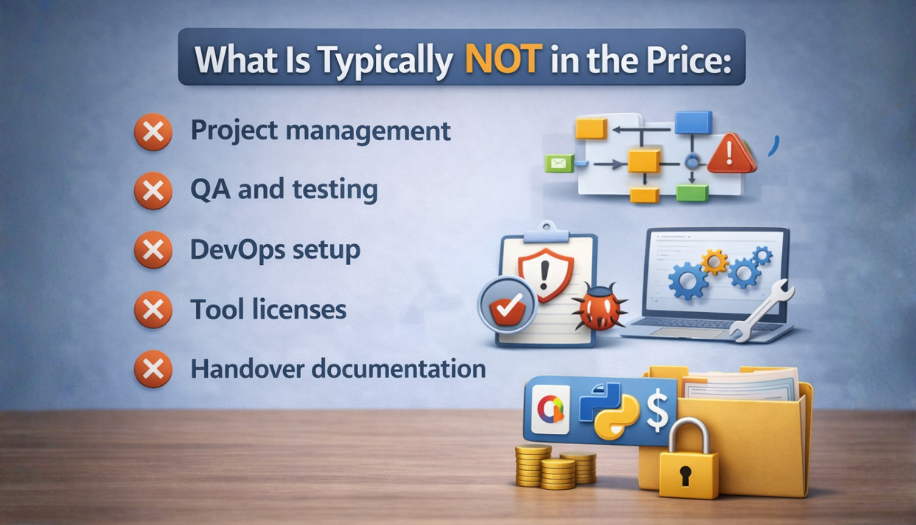
This section is where most pricing guides stop short. Before you compare quotes, confirm the following with every vendor in writing.
Project management | Most dedicated team quotes at the lower tiers assume you are managing the developer. A delivery lead or project manager is a separate line item and adds $800 to $2,000/month depending on the engagement size. |
QA and testing | At the $2.5K to $6.5K tier, testing is either the developer's responsibility or yours. Dedicated QA is a separate resource. Do not assume it is included unless the proposal explicitly states it. |
DevOps setup | CI/CD pipeline configuration, deployment environment setup, cloud infrastructure management. These are typically scoped separately or handled internally by the client. Ask before assuming. |
Tool licences | GitHub seats, Jira licences, Slack workspace costs, and other collaboration tools are usually the client's responsibility unless the vendor specifies otherwise in the contract. |
Handover documentation | When the engagement ends or a developer is replaced, the knowledge transfer process is often left undefined until the moment it is needed. Ask before you sign: who produces handover documentation, what does it cover, and how long does it take. |
Not Sure Which Tier Fits Your Stage?
The right price point depends on three things: how strong your internal tech leadership is, how mature your sprint process is, and what output you are actually hiring for. Get these wrong and the $5K developer either waits for direction or runs in the wrong one. Tell us your team size, stack, and what you are building. We will tell you which tier makes sense and what it produces.
How to Evaluate Value, Not Rate
Do not compare monthly rates across vendors. Compare deliverables per dollar.
A developer at $5,000/month who ships 40 story points per sprint at consistent quality costs less per feature than a developer at $3,000/month who ships 18 story points with regular rework. On a per-feature basis, the cheaper monthly rate is the more expensive developer. That calculation is not abstract. It shows up in your sprint retrospectives.
These are the numbers to ask any vendor for before you sign:
Sprint delivery rate | What percentage of committed story points are actually delivered across their active engagements? If a vendor cannot give you a number, they are not tracking it. That tells you something. |
PR cycle time | How long from PR submission to merge on average? Short cycles with low rejection rates mean clean code that does not go back and forth. Long cycles mean review bottlenecks or code that needs rework before it is production-ready. |
Days to first production code | How many days from contract confirmation to the developer's first commit to a production environment? The answer tells you how well their onboarding process is structured, not how good the developer is. |
Context retention over time | Ask to speak with a client who has had the same developer for 6 months. What does sprint velocity look like in month 6 versus month 1? A developer building institutional knowledge should be getting faster, not staying flat. |
At Acquaint, our average sprint delivery rate across dedicated development teams engagements is 95%. Our average time to first production code is 11 days. That is the result of a structured onboarding process, not developer luck. If you want to see how the onboarding works in detail, the 14-day path to production code covers every step.
Red Flags in Pricing Proposals

These are the warning signs I tell every client to watch for before they commit to any dedicated team engagement.
1. No named developer in the proposal
If the vendor quotes a monthly rate without showing you who you are getting, you are buying a slot, not a person. The developer assigned to your project might have 3 years of experience or 8. The proposal does not tell you. Ask to see the developer profile before you sign, not after.
2. Seniority level not specified
Senior Laravel developer covers a wide range. Ask for years of production experience, specific project types they have worked on, and examples of architectural decisions they made in past engagements. If the vendor cannot answer these questions, the seniority claim is a label, not a measurement.
3. No exclusivity statement
If you ask whether the developer is dedicated to your project and the answer is yes but there is no contractual statement backing it, push for one in writing before signing. A sales statement and a service commitment are different things. You need the second one.
4. Vague replacement policy
Every vendor promises replacement if a developer does not work out. Ask: how long does it take? What does the handover process cover? Is there a cost? If the answers are vague, your replacement guarantee is worth what the contract says. Most contracts say very little on this point.
5. All-inclusive pricing at a rate that does not add up
If a vendor quotes $1,800/month for a dedicated senior developer with QA and project management included, one of those three things is not what it appears to be. Know what market rates look like at each tier before you evaluate whether a proposal is realistic.
Compare What You Are Paying Now Against What a Dedicated Team Produces
If you are currently running on freelancers, a project agency, or a developer who is underutilised, we can run the total cost comparison in a 20-minute call. Real numbers from your specific situation, not a benchmark table. We have done this comparison across 1,300+ projects. We know where the gaps appear and what closes them.
How Acquaint Softtech Structures Dedicated Team Engagements
Our dedicated development team engagements start at $22/hr, which works out to $3,200/month for a full-time developer. Here is the actual structure of what that includes across every engagement. Not a sales page summary. The operational reality.
Before Day 1 | Named developer profile sent to you. NDA and IP assignment included in the contract before the engagement starts. Pre-onboarding checklist covering what your team needs to prepare: codebase README, access provisioning, and first task definition. |
Day 1 | A 30-minute introductory call. The developer has read your README before joining. First task assigned within the first hour. System access live. No one-week getting-started phase. |
Throughout the engagement | Direct Slack or Teams access to the developer. No account manager layer between you and the person building your product. Weekly check-in framework. Vendor monitoring of delivery metrics throughout. |
Replacement guarantee | Free replacement within 48 hours if the developer is not the right fit. The exiting developer participates in a structured codebase handover covering active sprint items, architectural decisions, and known issues. |
What is not included by default | QA engineers, DevOps scoping, and a delivery lead for larger teams. These are available and discussed during the initial scoping call. They are not assumed. |
If you want to see how the dedicated model compares against staff augmentation and freelancer platforms side by side, the model comparison we published covers the trade-offs in detail. For a full cost breakdown against US-based hiring, the real cost comparison article has the actual numbers.
All our developers are full-time Acquaint employees, not freelancers. Before any placement they go through a 15-point technical assessment. You can hire remote developers through us with a 48-hour deployment timeline from the day you confirm.
FAQ's
-
Is $5,000/month a reasonable amount to pay for a developer in 2026?
In context, yes. A mid-level US developer costs $10,000 to $15,000/month in salary before employer taxes, benefits, and overhead. At $5,000/month for a vetted senior offshore developer you are paying roughly 40 to 50% of the US equivalent with zero additional employer cost. The question that matters is not whether $5,000 is a lot. It is what $5,000 produces compared to your next best option.
-
What is the minimum engagement length for a dedicated team?
At Acquaint, the standard minimum is 3 months. Not for lock-in reasons. A developer's output compounds with codebase context. The first 4 to 6 weeks are ramp-up. Month 2 is where sprint velocity starts to accelerate. A 1-month engagement produces a developer who has barely started on your product.
-
Can I start with one developer and expand the team later?
Yes. Most engagements start with a single senior developer and expand based on sprint demand and roadmap requirements. Each addition follows the same onboarding process. We have scaled single-developer engagements to 7-person teams without disrupting sprint delivery, because each addition has a documented onboarding process to follow rather than figuring it out as they go.
-
What happens if the developer assigned to my project leaves your company?
Replacement within 48 hours. The exiting developer participates in a structured knowledge transfer covering the active sprint items, architectural context, known codebase issues, and any outstanding technical decisions. No engagement timeline should be held hostage by individual availability, and ours are not.
-
What is the practical difference between a dedicated team and staff augmentation?
In staff augmentation, the developer integrates into your team under your technical direction. You manage them day to day. In a dedicated team model, the vendor takes more accountability for delivery continuity, including who is on the team, how transitions work, and how consistent the output is across the engagement. In practice, both models use similar developer profiles. The difference is in contract structure, governance, and where the accountability sits when something does not go as expected.
I love to make a difference. Thus, I started Acquaint Softtech with the vision of making developers easily accessible and affordable to all. Me and my beloved team have been fulfilling this vision for over 15 years now and will continue to get even bigger and better.
Table of Contents
Get Started with Acquaint Softtech
- 13+ Years Delivering Software Excellence
- 1300+ Projects Delivered With Precision
- Official Laravel & Laravel News Partner
- Official Statamic Partner