

How to Switch Software Development Vendors Without Losing 3 Months of Progress
By the time you decide to switch dev vendors, you have 4 months of budget invested and no appetite for another 3 months of disruption. The structured handover below cuts the transition from 10 weeks to 3.

Ahmed Ginani
When companies reach out to us at Acquaint Softtech a software development partner about switching vendors, the conversation almost always starts the same way. They have been in a failing engagement for several months. They have identified the replacement vendor. And they are terrified that the transition itself will cost them another quarter of lost progress on top of everything the current vendor failed to deliver.

- CTOs and engineering leads who have decided to switch dev vendors and need a structured transition plan
- Founders who have spotted the warning signs of a failing vendor engagement and want to act before the situation gets worse
- Procurement leads who need to manage a vendor exit with minimal disruption to live product development
- Technical leads at the incoming vendor who need to understand what a good knowledge transfer looks like
That fear of the transition is justified but often overestimated. A badly managed vendor switch does cost 2 to 3 months of disruption. A structured handover cuts that to 2 to 3 weeks. The difference is not the quality of the incoming vendor. It is the process used during the transition. If the same process had been applied on the first day of the failing engagement, the switch might not have been necessary.
If you have not yet decided whether to switch or try to rescue the current engagement, the guide to choosing a software development company covers the evaluation criteria for the replacement vendor. This article focuses on the handover process itself.
Section 1: Signs You Have Already Waited Too Long
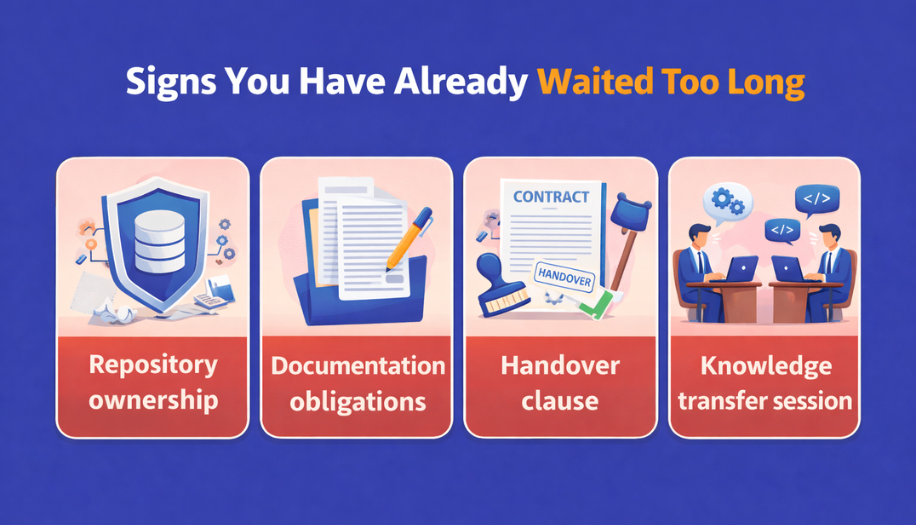
Most companies switch vendors 6 to 8 weeks later than they should. The delay is understandable. There is sunk cost. There is hope that the next sprint will be better. There is uncertainty about whether the new vendor will be worse.
These are the signals that tell you the switch is necessary and that waiting is making it more expensive:
Sprint delivery has been below 70% for three consecutive sprints | Not a one-off. A pattern. Three sprints below 70% delivery is not a bad month. It is the delivery rate settling at a new baseline. That baseline does not recover without a structural change. |
Explanations for missed delivery repeat without change | The same reasons appear in the retrospective: unclear requirements, unexpected complexity, resource constraints. Once is information. Three times is the vendor's operating pattern. |
You have stopped getting proactive updates | A vendor who is delivering confidently communicates proactively. A vendor managing a failing engagement communicates reactively, after you ask. The shift from proactive to reactive is a reliable early signal. |
Code review is producing the same issues repeatedly | If the same categories of issues appear in every PR review, the developer is not incorporating the feedback. This produces technical debt at a rate that compounds the longer the engagement continues. |
You have lost visibility into what is being built | If you cannot describe what is in progress without asking, your delivery process has broken down. |
Section 2: The Structured Handover, Week by Week
This is the process that cuts a 10-week transition to 3. It requires cooperation from the outgoing vendor, which you are entitled to under any properly written engagement contract. If your current contract does not include handover obligations, use this checklist to negotiate them as a condition of the final payment.
Week 1: Codebase audit | Before notifying the outgoing vendor, run an internal audit. Document: current repository structure, active branches, known open issues, any undocumented workarounds, third-party integrations and their authentication credentials. If your access to these is restricted, that is itself information about the health of the engagement. |
Week 1 to 2: Knowledge transfer documentation | The outgoing vendor should produce: a README for every major component, documentation of all architectural decisions made and why, a list of every third-party service used and the integration approach, and known technical debt with severity ratings. This documentation is what makes the incoming vendor functional on Day 1 rather than Day 30. |
Week 2: Outgoing vendor freeze | Stop adding scope to the current engagement. The outgoing vendor should focus exclusively on completing in-progress items, writing documentation, and preparing the handover package. No new features in the final two weeks. |
Week 2 to 3: Incoming vendor overlap | Bring the incoming vendor in during the final week of the outgoing vendor's engagement. The overlap session covers: codebase walkthrough, active issue review, architecture discussion, and any open questions. The incoming vendor's technical lead should attend this session directly. |
Week 3: Transition | The incoming vendor takes over the repository, the environments, and the sprint process. The first sprint of the new engagement should be deliberately modest in scope: time to explore the codebase, run the existing test suite, identify any gaps in the handover documentation, and establish their deployment access. |
Currently Managing a Vendor Transition and Need a Structured Process?
We handle incoming vendor transitions as part of our engagement start. Our onboarding process includes a dedicated codebase review session, a handover documentation checklist, and a first sprint scoped for transition rather than feature delivery. Tell us where you are in the process and we will tell you what the next step looks like.
Section 3: What to Demand From the Outgoing Vendor
Your contract should give you the right to a structured handover. If it does not, most vendors will still cooperate if you frame the handover process as a condition of the final payment. Here is what to ask for specifically:
Complete source code access in your own repository before the final invoice is paid
All environment credentials: production, staging, CI/CD pipeline, cloud infrastructure
Third-party service credentials or written confirmation of transfer process for each service
Architecture documentation: database schema, key design decisions, known limitations
Open issue log with severity and reproduction steps for all known bugs
Code comments on any non-obvious implementation decisions in the codebase
A 2-hour walkthrough session with the incoming vendor's technical lead
Any vendor who refuses these items after the engagement ends was not operating in good faith during it. These are not extraordinary requests. They are the baseline conditions for a professional handover. Our dedicated development team engagements include all of these as standard in the termination clause, so clients never have to negotiate for them when the engagement ends.
Section 4: How to Set Up the Incoming Vendor for Success
The first sprint of a new vendor engagement is the highest-risk sprint of the relationship. The developer is learning the codebase, the client is watching nervously, and every small problem looks bigger than it is because trust has not been established yet. Here is how to structure it well.
Scope the first sprint for exploration, not delivery | A first sprint with 40 story points of feature delivery is a first sprint that will disappoint, not because the developer is slow but because codebase onboarding always takes longer than both sides expect. Scope the first sprint at 50 to 60% of your normal velocity and use the freed capacity for documentation review and architecture discussion. |
Give them the full README before Day 1 | The handover documentation from the outgoing vendor, combined with whatever internal product documentation you have, should arrive to the incoming developer before their first day. A developer who reads the README on Day 1 during work time is a developer starting at zero. |
Set up a direct communication channel immediately | Direct Slack or Teams access from day one. No account manager relay. The developer should be able to ask a question and get an answer from your team within a reasonable async window. |
Run a live codebase walkthrough in the first week | Even with good documentation, a 60-minute walkthrough of the codebase with your technical lead or product owner produces context that written documentation cannot. The developer asks questions. You understand what they have and have not absorbed. |
For interviewing and evaluating the incoming developer before the transition, the remote developer interview framework covers the specific questions that predict real production performance. And the in-house vs staff augmentation comparison covers the broader model question if you are re-evaluating whether the outsourced structure is still right for your team.
Ready to Start the Transition to Acquaint?
Our transition onboarding takes the incoming codebase seriously. The first two weeks are dedicated to documentation review, architecture understanding, and a first sprint scoped for transition. We have managed this process as the incoming vendor across dozens of engagements. Tell us your current situation and we will walk you through exactly what the first 3 weeks look like.
Section 5: The Contract Terms That Prevent This Happening Again
The best time to negotiate handover terms is before the engagement starts, not after it fails. These are the clauses to include in any new development vendor contract to ensure the transition is never this difficult again.
Repository ownership | All code committed to your repository from Day 1. Not transferred at termination. Always in your repository. |
Documentation obligations | The vendor maintains a README and architecture documentation as a standing deliverable, updated at each major milestone. |
Handover clause | If the engagement ends for any reason, the vendor is obligated to produce a handover package covering all items in Section 3 above within 10 business days of termination notice. |
Knowledge transfer session | A minimum 2-hour knowledge transfer session with a designated client technical contact is included as part of the termination process. |
Credential handover | All environment credentials, third-party service access, and CI/CD pipeline configurations must be transferred within 5 business days of termination. |
For the technical quality side of managing an ongoing external dev team after the transition, the COO guide to managing external dev teams covers the KPIs and red flag framework you need to catch problems before them escalate to a switch.
Switching Vendors and Need a Team That Will Not Put You Through This Again?
Our standard contract includes repository ownership from Day 1, documentation obligations, and a defined handover clause. If the engagement does not work out, the exit is structured and the knowledge is yours. Tell us your stack and what you are building.
Frequently Asked Questions
-
How long does a proper software development vendor transition take?
With a structured handover process, 2 to 3 weeks. Without one, 6 to 10 weeks. The difference is almost entirely in the documentation and overlap process. A vendor who has been maintaining proper documentation throughout the engagement cuts their own handover time significantly. A vendor who has not produces a transition that is proportional to how much undocumented context sits in the departing developer's head.
-
Can I run two vendors simultaneously during the transition?
Yes, and for complex engagements it is often the right approach. The outgoing vendor continues maintenance on live systems while the incoming vendor ramps up on new feature work. The overlap period typically runs 2 to 4 weeks. The cost of running both vendors simultaneously is almost always lower than the cost of a context gap if the transition is too abrupt.
-
What if the outgoing vendor refuses to cooperate with the handover?
Check your contract first. If the contract includes handover obligations (it should), non-cooperation is a contract breach and you have leverage. The most effective lever is withholding final payment until handover obligations are met. If the contract does not include handover terms, you are negotiating rather than enforcing. Most vendors will cooperate when the alternative is a dispute and a damaged reputation. Frame it as a professional separation rather than an adversarial exit.
-
How do I preserve sprint velocity during the transition?
Expect a 30 to 40% reduction in velocity during the first sprint of a new engagement. Plan for it rather than promising stakeholders a seamless transition. The velocity recovers in sprint 2 to 3 as context builds. Trying to maintain full velocity through the transition by skipping onboarding steps almost always produces a longer-term velocity problem, not a shorter one.
-
What should I prioritise in the first sprint with a new vendor?
Codebase exploration over feature delivery. A developer who understands your architecture by the end of the first sprint will outperform one who shipped features in sprint 1 but built them on incorrect assumptions for the next six sprints. The investment in the first sprint pays back from sprint 2 onwards.
-
How do I prevent needing to switch vendors again?
Three things prevent repeat vendor failures. First, start with better vendor selection using the criteria in the 15-point vetting checklist. Second, include contract terms that create accountability throughout the engagement, not just at the end. Third, track delivery metrics from sprint 1 and address underperformance proactively when the pattern first appears rather than waiting for it to become a crisis.
I help agencies and founders scale their tech teams with the right developers at the right time. At Acquaint Softtech, I focus on building long term partnerships and making remote hiring simple, predictable, and results driven. My goal is straightforward to help businesses grow faster with reliable dedicated developers.
Table of Contents
Get Started with Acquaint Softtech
- 13+ Years Delivering Software Excellence
- 1300+ Projects Delivered With Precision
- Official Laravel & Laravel News Partner
- Official Statamic Partner
Related Reading

How to Interview a Remote Developer
Most remote developer interviews test syntax. The developer who passes a syntax test and the developer who delivers in production are not always the same person. Here is the interview framework that predicts real performance.
Ahmed Ginani
April 8, 2026
How to Choose a Software Development Company in 2026
Every software development company proposal looks good on page one. The rate is reasonable. The timeline sounds achievable. The case studies are polished. Here is the framework that tells you what is actually behind it.
Ahmed Ginani
April 6, 2026
Why Agencies Prefer Hiring Laravel Developers Over Freelancers
Agencies often start with freelancers to save cost but face delays and rework. See why dedicated laravel developers deliver faster, steadier, and more scalable results.
Ahmed Ginani
November 11, 2025India (Head Office)
203/204, Shapath-II, Near Silver Leaf Hotel, Opp. Rajpath Club, SG Highway, Ahmedabad-380054, Gujarat
USA
7838 Camino Cielo St, Highland, CA 92346
UK
The Powerhouse, 21 Woodthorpe Road, Ashford, England, TW15 2RP
New Zealand
42 Exler Place, Avondale, Auckland 0600, New Zealand
Canada
141 Skyview Bay NE , Calgary, Alberta, T3N 2K6