

How to Hire a Laravel Developer in 2026: The Complete Buyer's Guide
A dedicated Laravel developer from India costs $22 to $55 per hour in 2026 compared to $80 to $180 per hour in the US or UK. Offshore hiring through a verified Laravel Partner gives access to a larger talent pool at 70% to 80% lower cost.

Mukesh Ram
You've decided your next product needs to be built in Laravel. Now comes the harder question: who builds it, where they are, what they cost, and how you ensure it actually gets done properly.
This guide gives you a complete, honest answer. Whether you're a CTO evaluating dedicated Laravel developers, a founder comparing freelancers against staff augmentation models, or a product manager justifying the hiring budget — every decision you face is covered here, in plain language, with real 2026 numbers.
Acquaint Softtech has been placing Laravel developers for 13 years. We are an Official Laravel Partner and laravel news partner with 70+ vetted developers working across SaaS, e-commerce, FinTech, healthcare, and enterprise platforms for clients in the US, UK, and beyond. This guide comes from that experience, not from a content farm.

- Why Businesses Choose Laravel in 2026
- How Much Does It Cost to Hire a Laravel Developer? (2026 Pricing)
- Engagement Models: Freelance, Dedicated, Agency & Staff Augmentation
- Offshore vs Onshore vs Nearshore: Which Model Fits Your Business?
- What Skills Should Your Laravel Developer Have?
- Industry-Specific Laravel: SaaS, E-commerce, FinTech & More
- How to Vet, Interview, and Select the Right Developer
- Legal, IP, and Contract Essentials Before You Sign
- Onboarding, Managing, and Maximising Output
- ROI and Business Impact: What to Expect
- Why Acquaint Softtech Is the Right Partner
Why Businesses Worldwide Choose Laravel in 2026
Laravel is not simply a popular PHP framework. It is the dominant choice for backend web application development globally — and that dominance has grown, not shrunk, in 2026. If you are evaluating whether Laravel is the right technology before committing to a hiring decision, the answer for most business application types is an unambiguous yes.
Laravel's Market Position and Talent Pool
Laravel holds the top position among PHP frameworks in developer surveys, package ecosystem depth, and GitHub activity. The framework has over 75,000 GitHub stars and is actively maintained by a core team backed by Laravel LLC. More practically for hiring: the global Laravel talent pool is enormous.
Hundreds of thousands of trained Laravel developers are actively working across South Asia, Eastern Europe, Southeast Asia, and Latin America. This means you can hire Laravel developers from a genuinely large pool — which directly impacts your hiring cost, speed, and quality options.
What Makes Laravel the Right Framework for Your Business
From a business decision-making perspective, Laravel's advantage is speed of delivery. The convention-over-configuration philosophy means a skilled developer spends far less time on infrastructure setup and far more time building your product.
First-party tools — Forge (server management), Vapor (serverless deployment), Horizon (queue monitoring), Nova (admin panels), and Telescope (debugging) — compress what would be months of custom development into days. Combined with AI-powered development workflows, which our team actively uses, the delivery speed advantage over other frameworks is measurable and compounding.
Laravel is the right choice when you need a skilled team quickly, a large package ecosystem, and a framework with a 15-year track record of production stability. |
→ Ready to hire? View our vetted Laravel developer profiles →
How Much Does It Cost to Hire a Laravel Developer? (Full 2026 Pricing)
Cost is the first question every business asks, and it deserves a direct, complete answer. Laravel developer pricing in 2026 varies by region, seniority level, and the engagement model you choose. Below are real numbers, not aspirational figures.
Hourly Rates by Region—US, UK, India, Eastern Europe
Region | Junior ($/hr) | Mid-Level ($/hr) | Senior ($/hr) |
India (South Asia) | $12–$22 | $22–$38 | $38–$55 |
Eastern Europe | $30–$45 | $45–$65 | $65–$90 |
Southeast Asia | $10–$20 | $20–$35 | $35–$50 |
Latin America (Nearshore) | $25–$40 | $40–$60 | $60–$80 |
United Kingdom (Local) | £60–£75 | £75–£100 | £100–£130 |
United States (Local) | $80–$100 | $100–$140 | $140–$180 |
Acquaint Softtech (India) | $15–$22 | From $22/hr | From $35/hr |
Acquaint Softtech note: Our rates start at $22/hr and reflect the upper tier of Indian Laravel talent developers with 3+ years of framework experience, strong English communication, and tested technical skills. Compare our developer profiles and pricing here.
Monthly Dedicated Developer Cost by Seniority Level
Experience Level | Offshore (India) | Nearshore (E. Europe) | Onshore (UK/US) |
Junior Developer | $1,500–$2,500/mo | $3,500–$5,000/mo | $8,000–$12,000/mo |
Mid-Level Developer | $2,500–$4,000/mo | $5,000–$8,000/mo | $12,000–$16,000/mo |
Senior Developer | $4,000–$6,500/mo | $8,000–$12,000/mo | $16,000–$22,000/mo |
These are all-inclusive rates with zero additional employer overheads when hiring through our dedicated software teams model — no payroll taxes, no benefits, and no recruitment fees beyond the monthly retainer.
Cost by Engagement Model — Freelance, Dedicated, Agency
Model | Typical Cost | Accountability | Best For |
Freelancer (Upwork etc.) | $15–$80/hr (wide variance) | Low — individual only | Short isolated tasks |
Dedicated Developer | $2,500–$6,500/mo all-in | High — agency-backed | Ongoing product development |
Project-Based Agency | $8,000–$60,000+ per project | Medium — project scope only | Fixed-scope builds |
Staff Augmentation | $3,000–$8,000/mo | Shared responsibility | Team capacity expansion |
Software Outsourcing | Project or retainer | Full delivery ownership | End-to-end product builds |
The cheapest quoted rate is rarely the lowest total cost. A $15/hr freelancer who requires 2× the hours, produces 3× the bugs, and needs replacing after 8 weeks costs significantly more than a $35/hr dedicated developer who delivers consistently for 12 months. |
→ Compare engagement model pricing: Talk to our team about the right model for your budget →
Engagement Models: Freelance, Dedicated, Agency & Staff Augmentation
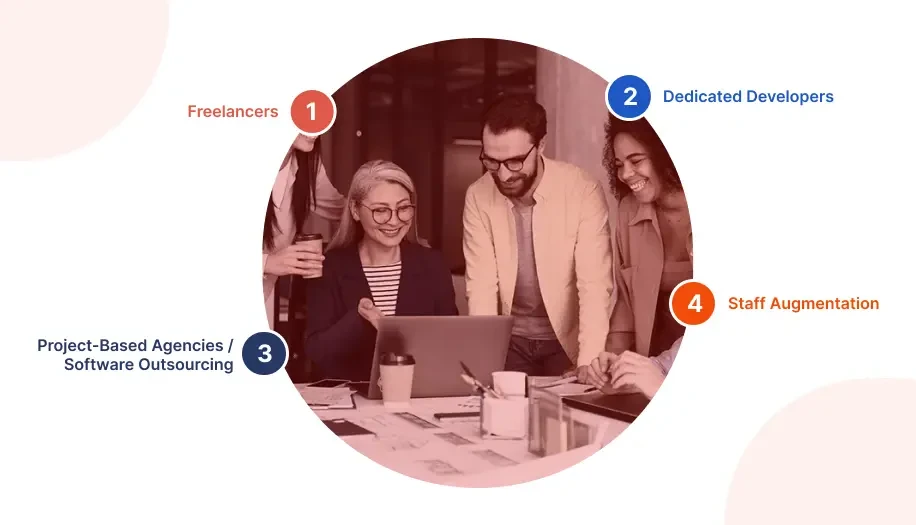
Choosing the right engagement model is as consequential as finding the right developer. Each model carries a different risk profile, accountability structure, and cost-efficiency curve over time.
Freelancers
Freelancers offer maximum flexibility and no long-term commitment. They work well for isolated tasks or short-duration projects with a constrained budget. The risks for ongoing product development are significant: availability is never guaranteed, deep product knowledge never accumulates, and when a freelancer disappears, you have no contractual recourse.
Dedicated Developers
A dedicated developer is a full-time team member placed by a partner company — who manages employment, payroll, and HR — while the developer works exclusively on your product under your direction every working day. This is the core of our dedicated software development teams service.
The dedicated model gives you the productivity of a full-time employee without direct employment overhead. The developer accumulates deep product knowledge, your delivery velocity improves month over month, and you have a named account manager as a contractual escalation point if performance slips.
Project-Based Agencies / Software Outsourcing
Agencies take full scope-to-delivery ownership. Our software development outsourcing service covers this model — you share requirements, we assemble the right team, and we deliver. This works well for fixed-scope builds. The risk: once the project ends, knowledge exits with the agency team. For ongoing iterative development, dedicated is almost always the better value.
Staff Augmentation
Staff augmentation sits between dedicated development and agency. Our staff augmentation service lets you bring one or more Laravel developers into your existing team structure, under your technical leadership. This suits companies with in-house technical leads who need additional delivery capacity fast.
Which Engagement Model Fits Your Project?
Your Situation | Recommended Model | Acquaint Softtech Service |
Building an ongoing SaaS or product | Dedicated Developer | Dedicated Software Teams |
Fixed-scope project or MVP | Outsourcing / Fixed-Price | Software Development Outsourcing |
Need one specialist for a feature | Staff Augmentation | Staff Augmentation |
Scaling an existing team fast | Staff Augmentation | Staff Augmentation |
White-label development for agency | White-Label Development | White Label Development Services |
Need a tech leader to steer the team | Virtual CTO | Virtual CTO Services |
→ Not sure which model fits? Book a free 30-min advisory call — we'll recommend the right structure →
Offshore vs Onshore vs Nearshore: Which Model Fits Your Business?
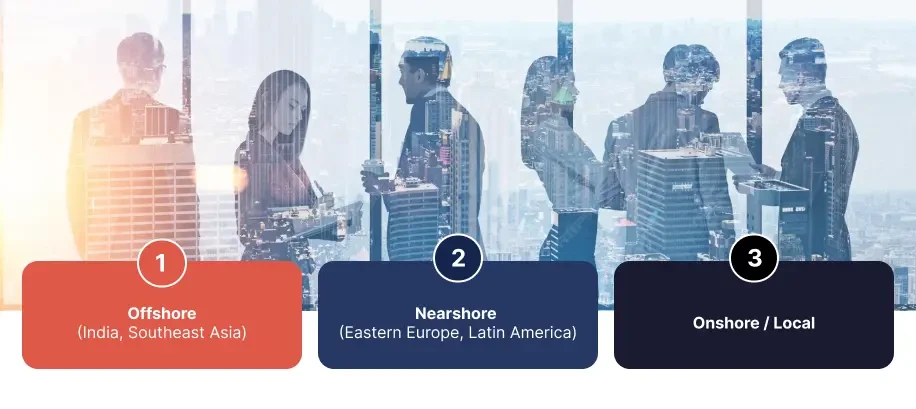
Geographic hiring strategy is, for most businesses, the single largest lever on total development cost. Understanding the practical realities — beyond the obvious rate difference — is essential before making this decision.
Offshore (India, Southeast Asia)
Offshore remains the highest-value option for most UK and US businesses. A senior Laravel developer in India at $40/hr delivers equivalent technical output to a local developer at $140/hr for most project types. That 3.5× cost difference is the difference between hiring one developer and hiring three. All of our hire Laravel developer engagements are offshore-based — from our Ahmedabad development centre.
The honest concerns about offshore: Time zone overlap is real but manageable. UK morning overlaps with India afternoon for 3–4 hours — enough for daily standups and sprint planning. Communication tools (Slack, Notion, Loom, Linear) bridge the gap. The communication friction of 2020 is largely resolved for companies working with professional offshore partners like Acquaint Softtech.
Nearshore (Eastern Europe, Latin America)
Nearshore trades some cost advantage for better time zone overlap. Eastern European developers overlap with UK hours almost completely. Rates are 40–60% below local rather than the 70–80% offshore advantage — but collaboration friction is lower for teams that need synchronous communication throughout the day.
Onshore / Local
Local hiring remains right in specific scenarios: regulated industries requiring physical security clearance, projects involving classified data, or team cultures where in-person collaboration is foundational. For standard SaaS, e-commerce, and API development, the cost premium of local hiring is hard to justify in 2026.
Dimension | Offshore (India) | Nearshore (E. Europe) | Onshore (UK/US) |
Cost Saving vs Local | 70–80% | 40–60% | — |
Time Zone Overlap (UK) | 3–4 hrs/day | Full overlap | Full |
English Proficiency | High (top-tier) | High | Native |
Talent Pool Size | Very large | Medium | Limited |
IP/Legal Protection | Contractual (strong) | Low risk | Very low |
Acquaint Softtech Coverage | ✓ Primary market | — | — |
Offshore hiring in 2026 is not a risk-tolerance question — it is a strategic efficiency question. Businesses that treat it as a cost-only lever miss the deeper advantage: access to a far larger pool of experienced Laravel talent than any local market can offer. |
→ Explore offshore Laravel hiring: View our developer team and credentials →
What Skills and Expertise Should Your Laravel Developer Have?
Not every PHP developer is a Laravel developer — and not every Laravel developer has the skills your specific project requires. Here is the practical skills framework to apply before, during, and after your interview process.
Core Technical Skills and Framework Proficiency
Every professional Laravel developer in 2026 must demonstrate solid command of:
PHP 8.x and object-oriented programming — interfaces, abstract classes, traits, and dependency injection.
Laravel core architecture — routing, controllers, middleware, service container, and service providers.
Eloquent ORM — model relationships, query scopes, eager loading, and efficient database design.
RESTful API design — resource structuring, versioning, Sanctum/Passport/OAuth2 authentication, and rate limiting.
Blade templating or integration with Vue.js, React, or Livewire for reactive front-end work.
Queue systems, event broadcasting, and notification channels for asynchronous processing.
Testing, DevOps, and Deployment Awareness
Strong Laravel developers write tests as part of the development process — not as an afterthought. Non-negotiable standards:
PHPUnit or Pest for unit and feature testing, with meaningful coverage targets.
CI/CD pipeline familiarity — GitHub Actions, GitLab CI, or Bitbucket Pipelines.
Laravel Forge or Vapor for deployment. See how our version upgrade services use these tools to modernise legacy systems.
Docker for local development consistency and environment parity.
Git workflow discipline — conventional commits, PR reviews, and meaningful branching strategies.
A developer who cannot write tests cannot guarantee the quality of their own code. Make testing proficiency a non-negotiable requirement, not a nice-to-have. |
Beyond technical skills, the non-technical signals matter equally. Does the developer communicate proactively? Do they flag blockers early? Do they push back on technically flawed requirements rather than building quietly and delivering something broken? These soft skills are what our vetting process tests for — and what distinguishes a productive team member from a capable but difficult developer.
Industry-Specific Laravel: SaaS, E-commerce, FinTech & More
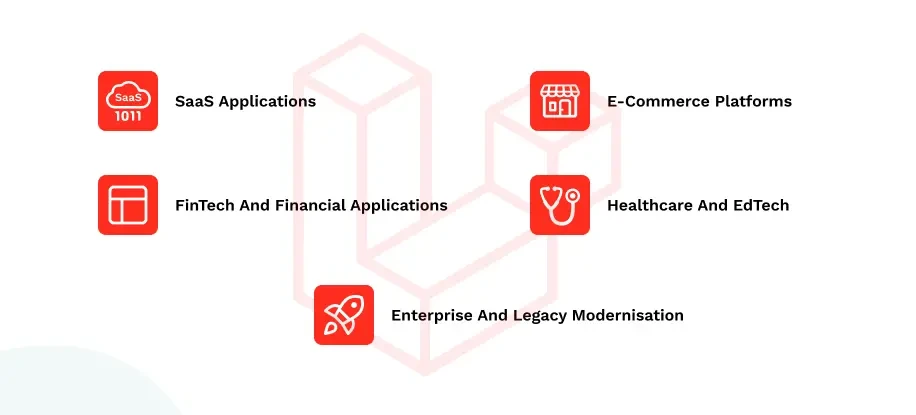
Laravel's versatility is one of its strongest selling points — but 'versatile' should not mean 'any developer works for any project'. Industry-specific requirements demand industry-specific experience.
SaaS Applications
SaaS is Laravel's strongest use case. Multi-tenancy architecture (single database, separate databases, or schema-based isolation), subscription billing via Laravel Cashier (Stripe or Paddle), feature flagging systems, usage metering, and API-first architecture are the defining SaaS-specific skills. Our software product development team has built multi-tenant SaaS platforms for US and UK clients from seed stage to Series B.
E-commerce Platforms
Custom e-commerce development in Laravel outperforms Shopify or WooCommerce for businesses with complex inventory logic, custom pricing rules, multi-warehouse fulfilment, or marketplace features. Look for experience with payment gateway integration, PCI-DSS awareness, and order lifecycle management. We also provide specialist WooCommerce developers where a platform-based approach is the right call.
FinTech and Financial Applications
FinTech Laravel development demands security-first engineering. Encryption at rest and in transit, audit logging, tamper-evident records, role-based access control, and regulatory compliance awareness (PCI DSS, FCA, GDPR) are minimum requirements. These skills need demonstration through past projects, not CV claims.
Healthcare and EdTech
Healthcare applications require HIPAA compliance awareness (US) or NHS/GDPR data handling standards (UK), PHI handling practices, audit trails, and HL7/FHIR API integration. EdTech platforms need LMS architecture, progress tracking at scale, and video delivery integration.
Enterprise and Legacy Modernisation
For large-scale enterprise systems or migration projects, our version upgrade services and support and maintenance teams handle everything from PHP 5 → Laravel 11 migrations to API layer refactoring and full platform modernisations. View our case studies for specific industry examples.
→ See real client outcomes across SaaS, FinTech, and enterprise: Browse our case study and real client review on clucth →
How to Vet, Interview, and Select the Right Laravel Developer
The hiring process for a Laravel developer should be structured, multi-stage, and calibrated to your project's technical demands. Here is the process that works even for non-technical buyers.
Stage 1: Portfolio and GitHub Review
Before any interview, review the developer's portfolio for project complexity, code quality signals, and industry relevance. On GitHub, examine commit history, PR review participation, code comment quality, and evidence of testing. Sparse or entirely private repositories are a signal worth probing.
Stage 2: Technical Assessment
A practical code test is essential. Keep it to 3–4 hours maximum, provide a clear brief, and define evaluation criteria before reviewing any submission. The best Laravel assessments test real-world problem-solving: build a small authenticated API endpoint with validation and tests. Evaluate for code structure, error handling, test coverage, and readability.
Stage 3: Technical Interview
Cover three areas: core framework knowledge (service container, Eloquent relationships, queue handling), architecture decision-making (how would you design X?), and past project deep-dive (what was the most technically complex system you've built?). Even as a non-technical buyer, you can distinguish depth of thinking from surface familiarity.
Stage 4: Communication and Culture Assessment
Real scenario questions reveal character: 'Walk me through a situation where requirements changed mid-project. What did you do?' and 'Tell me about a time you disagreed with a product decision. How did you handle it?' These reveal ownership mindset, communication style, and how the developer will behave under real working conditions.
Red Flags That Should Stop Any Hire
Unable to explain technical decisions in plain language when asked by a non-technical buyer.
No tests in portfolio code samples — or a dismissive attitude toward testing.
Reluctance to provide references or allow verification of past project claims.
Immediately agreeable to all requirements without technical questions or pushback.
Vague or evasive answers to specific questions about past project challenges.
Acquaint Softtech pre-screens every developer through a 3-stage technical assessment before they appear on any client shortlist. You interview from a pool that has already passed. |
Legal, IP, and Contract Essentials Before You Sign
Most buyers focus all of their due diligence on finding the right developer — and almost none on the contract that governs the relationship. That is where expensive mistakes happen.
Code Ownership — The Question That Must Be Answered First
The default in most freelance arrangements is that the developer retains copyright until explicitly transferred. Your contract must include a work-for-hire clause that assigns all intellectual property developed during the engagement to you, the client. This includes code, documentation, API designs, and database schema.
The clause should also address pre-existing IP — any libraries or components the developer brings into your project. You need an explicit perpetual, irrevocable licence to use those components within your product.
NDA and Confidentiality
An NDA should be signed before any discovery conversation — not after the contract is agreed. At Acquaint Softtech, our NDA is signed before the first scoping call, without exception. The NDA should define confidential information clearly, set a survival period (typically 2–5 years post-engagement), and specify permitted disclosure exceptions.
The Contract Clauses That Protect You
Scope definition and change request process: Ambiguity in scope is the primary cause of developer project disputes.
Milestone-based payment with holdback: Never pay 100% upfront. Milestone payments tied to deliverables protect both parties.
Termination provisions: Cure periods, notice lengths, and final deliverable obligations on exit.
Non-solicitation clauses: Preventing the developer or agency from approaching your team members directly.
Warranty and bug fix obligations: A minimum post-delivery warranty period for defects in delivered code.
Data processing agreement: Essential for any system handling EU user data under GDPR.
→ Our contracts are built to be client-protective by design. Request a sample contract from our team →
Onboarding, Managing, and Maximising Your Developer's Output
The quality of your onboarding process directly determines how quickly your developer reaches full productivity. A poorly onboarded developer — even a highly skilled one — will spend their first three weeks asking for access and documentation that should have been ready on day one.
What Must Be Ready Before Day One
Repository access with correct branch permissions and a documented branching strategy.
Local environment setup documentation — step-by-step, tested, and accurate.
Architecture overview: what the system does, how major components relate, and the reasons behind key design decisions.
Product backlog ordered by priority in your project management tool.
Communication channel setup: Slack, video call access, and ticket assignment ready.
The 30-60-90 Day Milestone Framework
Milestone | Primary Goal | Success Indicator |
Day 30 | Full environment setup, first PR merged, architecture understood | Independent contributions without setup questions |
Day 60 | First sprint owned independently, backlog contribution active | PR approval rate >90%, sprint completion >80% |
Day 90 | Architectural input, knowledge shared with team | Proactive technical suggestions, documentation contributed |
Managing Without Micromanaging
Set clear KPIs before the engagement begins — sprint velocity, PR frequency, bug injection rate, and test coverage targets. Review them in structured bi-weekly calls. Between those calls, let the developer work.
Micromanagement is the fastest way to lose a talented developer. Track outcomes, not activities. If you need dedicated project management support alongside your developer — our dedicated project manager hire service covers exactly this.
When You Need More Than a Developer
If your project needs technical leadership alongside execution, consider our Virtual CTO service — a fractional technical leader who owns architectural decisions, manages the development team, and reports directly to the business. Alternatively, our discovery workshop is the right starting point if your requirements are not yet clearly defined.
ROI and Business Impact: What to Expect After Hiring
The return on a Laravel developer hire is not simply 'code gets written faster.' The compounding business impact across a 12-month dedicated engagement is significantly larger than most buyers model in advance.
3–4× Feature Velocity Gainvs Freelance Rotation | 40–70% Bug Rate ReductionWith TDD Practices | 12–16wk Typical Break-EvenPoint on Hiring Cost | 2.1× Average OutputMonth 6 vs Month 1 |
Phase 1 (Months 1–2): Investment and Foundation
The first two months are the highest-cost, lowest-output phase. Onboarding, codebase familiarisation, and process alignment consume initial capacity. Set expectations internally: the first 30 days are investment, not return. Our structured onboarding process reduces this ramp period significantly compared to self-managed hiring.
Phase 2 (Months 3–6): Acceleration
By month three, a well-onboarded dedicated developer is at full velocity. The accumulation of product knowledge means features that took 2 weeks in month one take 4–5 days in month four. This compounding productivity is the core ROI mechanism of the dedicated model — and it does not exist with freelancers, who reset the curve with every engagement.
Phase 3 (Months 6–24): Strategic Partnership
Beyond six months, a dedicated Laravel developer becomes a strategic asset. Their input on feature scoping, architecture, and technical risk improves product outcomes beyond pure delivery speed. Review our client testimonials and case studies to see documented ROI examples from US and UK clients across SaaS, FinTech, and e-commerce.
Business KPIs That Improve After a Dedicated Hire
Time-to-market: Features ship faster as product knowledge accumulates.
Customer satisfaction (NPS): Fewer production bugs translate directly to fewer complaints.
Churn reduction: Product reliability improvements reduce churn for subscription businesses.
Engineering cost per feature: The per-feature cost falls consistently as developer velocity grows.
Why Acquaint Softtech Is the Right Laravel Hiring Partner
We are not a generic development marketplace. Acquaint Softtech is an Official Laravel Partner and laravel news partner one of a small number of agencies globally to hold this credential. With 13 years of continuous Laravel development and 70+ vetted developers working on client products in the US, UK, Europe, and beyond.
Credential | Detail |
Official Laravel Partner | Recognised by Laravel LLC for technical excellence and framework expertise |
Laravel News Partner | Featured partner on the world's leading Laravel news and community platform |
Clutch Top Rated | Verified client reviews with top-rated status on Clutch.co |
G2 Reviews | Active seller profile with verified client ratings on G2 |
Statamic Partner | Certified Statamic CMS partner for headless and flat-file CMS projects |
Bagisto Partner | Official Bagisto e-commerce partner for Laravel-based shop builds |
13+ Years Active | Continuous Laravel development since the framework's early growth stage |
70+ Active Developers | Full-time, pre-vetted developers across all seniority levels and specialisms |
48-Hour Match Guarantee | Qualified developer profiles delivered within 48 hours of requirement submission |
30-Day Satisfaction Guarantee | No-cost developer replacement within first 30 days if not satisfied |
Industries | SaaS, E-commerce, FinTech, Healthcare, EdTech, Real Estate, Enterprise |
Primary Client Regions | US (60%), UK (25%), Europe and Rest of World (15%) |
How the Process Works
You share your requirements — team size, seniority level, technical focus, and timeline.
Within 48 hours, we deliver matched developer profiles with portfolio samples and assessment results.
You interview the candidates. We facilitate.
You select. We begin onboarding immediately.
The first 30 days include a no-cost replacement guarantee.
Ready to Hire a Dedicated Laravel Developer?
Book a free 30-minute discovery call. We understand your requirements, match you with a qualified developer within 48 hours, and guide you from selection to first sprint — with a 30-day guarantee.
Conclusion: The Right Developer Changes the Trajectory of Your Product
Hiring the right Laravel developer is not a procurement decision — it is a product decision. The developer you choose will shape the architecture of your system, the quality of your codebase, the speed of your delivery, and ultimately the experience your users have with your product.
The frameworks in this guide — for evaluating cost, selecting an engagement model, geographic hiring strategy, vetting candidates, and structuring contracts — come from 13 years of Laravel developer placements and client relationships across every industry and product type. Read our client case studies and testimonials to see the documented outcomes.
The short version: hire dedicated over freelance for ongoing development; hire offshore through a verified partner for the best cost-to-quality ratio; vet technically and behaviourally before signing; protect your IP contractually from day one; and measure developer output against business KPIs, not hours worked. If you need help navigating any of this, our team is available for a free 30-minute advisory call — no sales pressure, just honest guidance.
FAQ's
-
How do I hire a Laravel developer in 2026?
The most efficient route is to work with an Official Laravel Partner agency. Define your requirements (seniority level, hours per week, domain expertise, and budget), receive matched developer profiles within 48 hours, conduct a two-stage interview, and begin with a structured onboarding process.
-
What does a dedicated Laravel developer cost per month in 2026?
A mid-level dedicated Laravel developer from India costs $2,500–$4,000 per month all-inclusive. A senior developer costs $4,000–$6,500 per month. These rates include zero additional employer overheads — no payroll taxes, benefits, or recruitment fees. Acquaint Softtech rates start at $22/hr.
-
Is offshore Laravel development reliable?
Yes — when structured correctly. Reliability comes from the contract (IP ownership, NDA, deliverable clauses), the partner (Official Laravel Partner credentials and client references), and the process (structured onboarding, KPI tracking, and defined escalation paths). View client testimonials →
-
What is the difference between staff augmentation and a dedicated developer?
Staff augmentation embeds a developer into your existing team structure, working under your technical lead. A dedicated developer is a full-time placement who works exclusively on your product under your direction, managed by the partner agency for HR and performance. Acquaint Softtech offers both.
-
How long does it take to onboard a new Laravel developer?
With proper preparation — repository access, environment documentation, architecture overview, and an ordered backlog — a developer reaches independent contribution within 2 weeks and full sprint velocity by week 6–8. Our onboarding framework compresses this timeline significantly.
-
Who owns the code built by the Laravel developer?
Under a properly structured contract, the client owns 100% of all code, documentation, and IP developed during the engagement. Acquaint Softtech's standard contract includes a full work-for-hire clause and IP assignment agreement. The NDA is signed before any discovery conversation begins.
-
Can I hire a Laravel developer for a short-term or trial engagement?
Yes. Acquaint Softtech offers a 2-week paid trial structure for clients who prefer to evaluate output before committing to a longer retainer. The trial is fully paid at the standard rate and includes a replacement option.
-
What other developers can Acquaint Softtech provide alongside Laravel?
React Native developers, MERN Stack developers, MEAN Stack developers, Django developers, DevOps engineers, WordPress developers, WooCommerce developers, and Project Managers. All are available through the same vetted dedicated model.
-
What is an Official Laravel Partner, and why does it matter?
The Official Laravel Partner status is awarded by Laravel LLC to a small number of agencies worldwide that meet technical quality, team expertise, and community contribution standards. It is the most credible third-party validation of genuine Laravel expertise available. Verify our partner status →
I love to make a difference. Thus, I started Acquaint Softtech with the vision of making developers easily accessible and affordable to all. Me and my beloved team have been fulfilling this vision for over 15 years now and will continue to get even bigger and better.
Table of Contents
Get Started with Acquaint Softtech
- 13+ Years Delivering Software Excellence
- 1300+ Projects Delivered With Precision
- Official Laravel & Laravel News Partner
- Official Statamic Partner