

Laravel Development Services for SaaS Platforms
Why Laravel is the dominant framework for SaaS product development - subscription billing with Cashier, feature flags with Pennant, tenant onboarding automation, usage metering, and what must be built differently vs a standard web application.

Mukesh Ram
Laravel is the most widely used PHP framework for building SaaS products, and the reason is not the framework's general capabilities - it is the specific set of first-party and ecosystem packages that address the recurring problems every SaaS product must solve: subscription billing, multi-tenancy, tenant onboarding, feature gating, and usage metering.
Building a SaaS product on Laravel is not the same as building a standard web application on Laravel. The architectural decisions are different, the failure modes are different, and the scope grows in directions that standard application patterns do not anticipate. This article covers what needs to be built differently and why.
For a deeper understanding of scalability and why Laravel is a top choice, read our blog, Why Businesses Choose Laravel for Scalable Applications.

- Laravel's first-party SaaS stack: Cashier for subscription billing, Pennant for feature flags, Octane for high-throughput tenant request handling, and Sanctum for API token authentication.
- Multi-tenancy strategy - single database, schema-per-tenant, or database-per-tenant - is the foundational architecture decision every SaaS Laravel build must make before writing application code.
- Tenant onboarding automation (provisioning, welcome flows, trial management) is unique to SaaS and must be a first-class system, not an afterthought.
- Usage metering - tracking per-tenant consumption and tying it to billing - requires an append-only event log, not a mutable counter.
- Feature flagging with Laravel Pennant enables per-tenant plan features, beta releases, and A/B testing without code branches.
What Makes SaaS Architecturally Different From Standard Web Applications
Laravel is well-suited for SaaS platform development because of four purpose-built tools: Laravel Cashier (Stripe/Paddle subscription billing with plan management, trial periods, and invoicing), Laravel Pennant (feature flags for per-tenant plan gating and staged rollouts), Laravel Sanctum (API token authentication for multi-client access), and the Tenancy for Laravel package (stancl/tenancy) for database-level multi-tenant isolation. These solve the recurring SaaS problems that standard web application patterns do not address.
Three things are architecturally distinct about SaaS applications.
First, data isolation: every piece of data belongs to a tenant, and tenants must never see each other's data. This is not a permission system - it is an isolation guarantee.
Second, billing is a first-class system, not an integration: subscription state drives feature access, and billing events (upgrade, downgrade, cancellation, trial expiry) trigger application behaviour.
Third, every operation must be attributable to a tenant for billing, usage tracking, and support purposes.
The SaaS Architecture Stack in Laravel
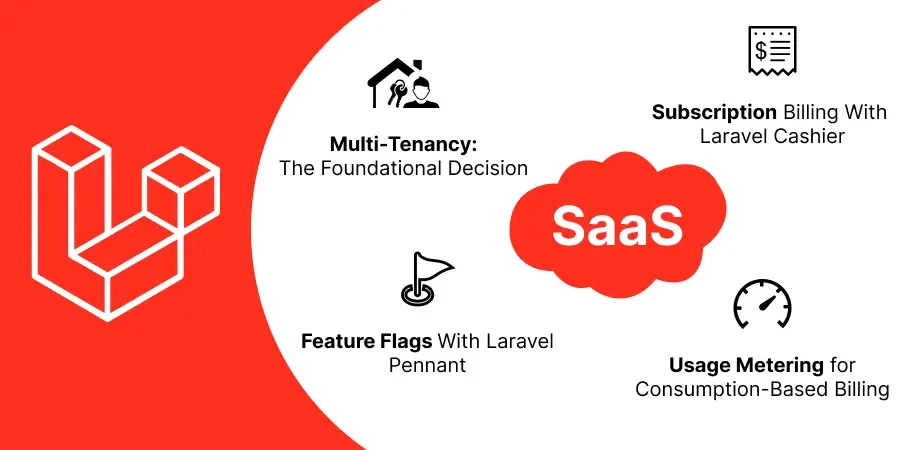
Multi-Tenancy: The Foundational Decision
The multi-tenancy strategy determines the data isolation model, migration management complexity, and database cost at scale. Three options exist in Laravel. Row-level isolation: all tenants share one database, with a tenant_id column on every tenant-scoped table and global query scopes enforcing isolation. Schema-per-tenant: each tenant has a dedicated database schema with identical table structure, provisioned on signup. Database-per-tenant: each tenant has an entirely separate database, provisioned on signup.
The Tenancy for Laravel package (stancl/tenancy) implements all three models with automatic tenant context switching, per-tenant migrations, and tenant-aware queue processing. For the detailed trade-off analysis and decision framework for each model, see Article 39 in this series.
Subscription Billing With Laravel Cashier
Laravel Cashier is the official Laravel package for Stripe and Paddle subscription billing. It handles: plan subscriptions and upgrades, trial period management, proration on mid-cycle plan changes, metered billing for usage-based pricing, invoice generation and PDF download, tax rate management, and webhook processing from Stripe or Paddle. Cashier's billable trait attaches to any Eloquent model (typically the Team or Organisation model in a multi-tenant SaaS).
Critical implementation note: billing state must drive feature access in the application. A subscription that lapses must gate features immediately, not on the next cache refresh. Use an event listener on Cashier's subscription events (SubscriptionCanceled, SubscriptionExpired) to update a cached subscription state that middleware checks on every request.
Feature Flags With Laravel Pennant
Laravel Pennant, released as a first-party package in Laravel 10, provides feature flag management with per-user and per-tenant scoping. Use cases in SaaS: gate features by subscription plan (Pro plan users see feature X, Starter plan users do not), roll out new features to a percentage of tenants before full release, run A/B tests across tenant cohorts, and grant beta access to specific tenants without a plan change.
Pennant flags are evaluated in middleware, Blade components, and service classes. Flag definitions live in a Feature class with a definition method that returns a boolean or segmented value. Flags are stored in the database or in an in-memory store for development.
Usage Metering for Consumption-Based Billing
SaaS products with per-seat, per-API-call, or per-GB pricing need a usage metering system. The correct pattern is an append-only usage events table: each billable event is inserted as an immutable row with tenant_id, event_type, quantity, and timestamp. At billing time, aggregate the events for the billing period. Never use a mutable counter column for metered billing - concurrent requests create race conditions, and you lose the audit trail.
Laravel Cashier's Stripe Meters integration provides server-side usage reporting directly to Stripe, which handles metered billing calculation and invoice generation. For Paddle or custom billing, implement the aggregation in a scheduled artisan command that reports usage totals to the billing provider.
Tenant Onboarding Automation

Tenant onboarding is the sequence of operations that runs when a new customer signs up: create the tenant record, provision the tenant database or schema, seed initial data, create the admin user, send the welcome email, start the trial period in the billing system, and queue any async provisioning steps. This sequence must be atomic - a failed step at position four of eight must not leave a half-provisioned tenant in an inconsistent state.
Implement onboarding as a pipeline or a series of queued jobs with dependent chains. Laravel's Bus::chain() executes jobs in sequence with automatic failure handling. Each job handles one step; failure rolls back or marks the tenant as pending-provisioning with a retry mechanism.
SaaS-Specific API Design Considerations
SaaS APIs serve multiple consumer types: the SaaS's own frontend, mobile apps, and potentially third-party developers. Design the API with tenant context in every request. The tenant is identified by the authenticated token's associated account - never by a URL parameter that a malicious tenant could manipulate.
Rate limiting in a SaaS API must be per-tenant, not per-IP. A corporate customer with 50 users behind a single NAT IP should not hit rate limits designed for individual users. Configure Laravel's RateLimiter with tenant-ID-based keys and plan-appropriate limits (higher-tier plans get higher rate limits).
Monitoring Tenant Health in Production
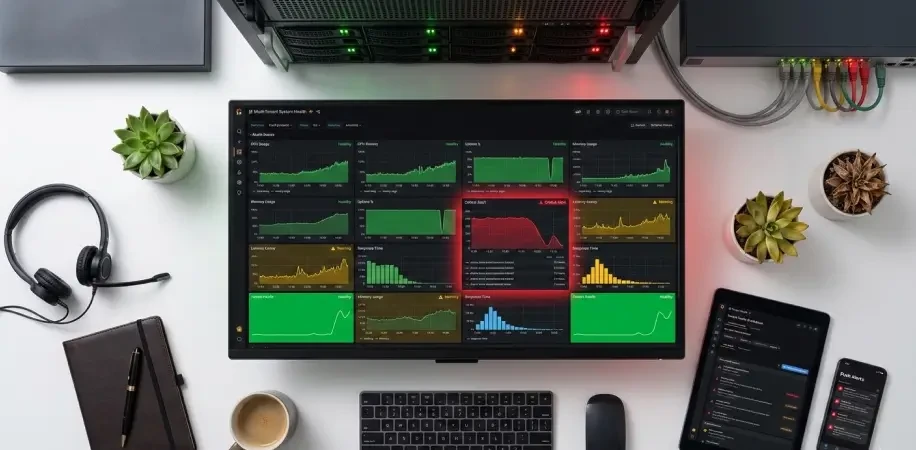
In a multi-tenant SaaS, a single misbehaving tenant can affect other tenants through shared infrastructure. Monitor per-tenant: request rate, error rate, queue job count, database query volume, and storage consumption. Tenants exceeding thresholds can be throttled or flagged for account review without affecting other tenants. New Relic and Datadog both support custom attributes that enable per-tenant filtering in dashboards.
How Acquaint Softtech Builds SaaS on Laravel
At Acquaint Softtech, our Laravel development services have delivered SaaS platforms across project management, HR, logistics, and fintech verticals. Our standard SaaS architecture includes stancl/tenancy for multi-tenant isolation, Laravel Cashier for subscription billing, Pennant for feature gating, and Horizon for tenant-aware queue processing. Architecture decisions are documented in Architecture Decision Records (ADRs) and handed over with the codebase.
Conclusion
Building a SaaS product on Laravel with the right architecture from day one - multi-tenant isolation, Cashier-managed billing, Pennant feature gating, and onboarding automation - prevents the category of architectural rework that kills SaaS product velocity in year two. Our Laravel development services include SaaS architecture design as a project phase with documented ADRs, not as ad hoc decisions made during development.
FAQ's
-
Is Laravel good for building SaaS applications?
Yes. Laravel's first-party SaaS toolkit - Cashier for subscription billing, Pennant for feature flags, Sanctum for API authentication, and the Tenancy for Laravel ecosystem package for multi-tenant isolation - addresses the recurring architectural problems every SaaS product must solve. Laravel powers SaaS products across fintech, HR, logistics, and project management verticals at significant scale.
-
How does Laravel handle multi-tenancy in SaaS applications?
Three approaches: row-level isolation (tenant_id column with global query scopes), schema-per-tenant (each tenant gets a dedicated database schema), and database-per-tenant. The Tenancy for Laravel package (stancl/tenancy) implements all three with automatic context switching, per-tenant migrations, and tenant-aware queue processing. Row-level isolation is simplest to operate; database-per-tenant provides the strongest isolation at higher infrastructure cost.
-
What does Laravel Cashier do for SaaS billing?
Laravel Cashier handles Stripe and Paddle subscription management: plan subscriptions, upgrades, downgrades, trial periods, proration on mid-cycle changes, metered usage billing, invoice PDF generation, and webhook processing from the payment provider. It attaches to any Eloquent model via a billable trait and provides a clean PHP API for all billing operations without direct Stripe API calls in application code.
-
How much does it cost to build a SaaS platform with Laravel?
A Laravel SaaS MVP can cost $40,000–$80,000, while a more advanced platform may reach $80,000–$150,000+, depending on its features and complexity. Acquaint Softtech starts fixed-project MVP development at $5,000, offering a practical starting point before investing in a larger SaaS build.
I love to make a difference. Thus, I started Acquaint Softtech with the vision of making developers easily accessible and affordable to all. Me and my beloved team have been fulfilling this vision for over 15 years now and will continue to get even bigger and better.
Table of Contents
Get Started with Acquaint Softtech
- 13+ Years Delivering Software Excellence
- 1300+ Projects Delivered With Precision
- Official Laravel & Laravel News Partner
- Official Statamic Partner