

Reactive Laravel apps, without a separate JavaScript framework.
Livewire 3, Alpine.js, Volt, and Flux UI. Production grade reactive interfaces built in PHP and Blade, without the maintenance cost of running a parallel JavaScript application alongside your Laravel codebase.
- Livewire 3 with Alpine.js bundled and Volt single file components
- Flux UI for production grade components, or custom Tailwind design systems
- Real time updates through Laravel broadcasting, Reverb, and wire:poll
- One codebase, one runtime, one mental model for the whole team
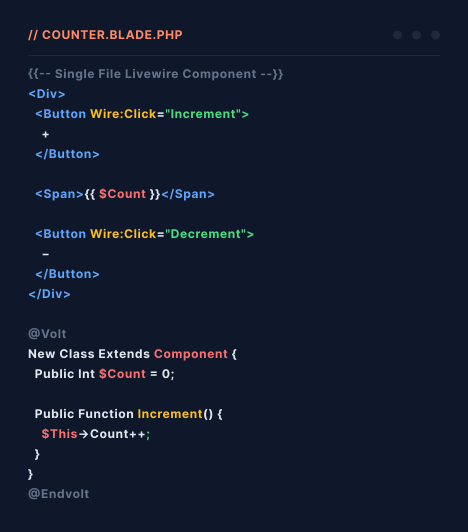








Reactivity without leaving PHP.
Livewire, in plain terms.
Livewire is a full stack framework for Laravel that lets you build dynamic, reactive interfaces using PHP and Blade templates instead of writing a separate JavaScript framework. Component state lives on the server. Each user interaction triggers a small XHR back to the component, the server returns only the changed DOM, and Livewire morphs that into the page. Alpine.js handles small client side interactions (open, close, focus) so not every interaction has to touch the network.
The result is the developer experience of building a server rendered Laravel app with the user experience of a single page app, without React, Vue, or a separate frontend build pipeline. Livewire 3 (released in 2023) bundles Alpine.js by default, has a smaller wire payload, and introduces Volt for single file components in Blade.
Signals your project is a good Livewire candidate.
Livewire is not the right answer for every Laravel application. It excels at server rendered, form heavy, dashboard style interfaces. It is not the right call for offline first apps, mobile applications, or canvas heavy interfaces. If three or more of these apply, Livewire is likely the right choice.
Your team is already strong in Laravel and PHP, and you do not want to maintain a parallel JavaScript codebase. The application is mostly forms, tables, dashboards, and CRUD interfaces rather than canvas heavy or animation rich. You want one mental model for the team rather than splitting frontend and backend skills. The interface needs to be SEO friendly without SSR complexity. You are building internal SaaS dashboards, admin panels, customer portals, or back office tooling. You want to ship faster than a separate React or Vue frontend would let you.
Livewire is a tool, not a religion.
We build with Livewire when it fits, and with React or Vue (through Inertia) when those fit. Here is how we draw the line, instead of forcing every project into the same toolchain.
When Livewire is the right call
Server rendered, form heavy, dashboard style Laravel applications where the team prefers to stay in PHP and Blade and the user experience does not need a heavy client side state machine.
Best for
- SaaS dashboards and admin panels
- Customer portals and account areas
- Internal tools and back office software
- CRUD interfaces with complex forms
- Filament admin extensions
- Multi page applications with reactive widgets
When a JavaScript framework is the right call
When the frontend needs offline support, a heavy client side state machine, native mobile parity, or your team is already strong in React or Vue. Usually delivered through Inertia.js for a Laravel backend.
Best for
- Native mobile parity (React Native, Vue Native)
- Offline first applications
- Canvas heavy or animation rich interfaces
- Complex client side state across many pages
- Teams with strong React or Vue skills already
- Headless commerce frontends
The honest rule: Livewire wins when the interface state belongs on the server. React or Vue wins when the interface state belongs on the client. Most internal SaaS dashboards, admin panels, and customer portals belong in the first category, which is why Livewire has become our default for that work since 2020.
Everything a Livewire application needs.
Not just components. The full toolkit that takes a Livewire application from architecture to production with predictable performance.
Component architecture
Clear component boundaries, full page Livewire components for routes, partial components for reactive widgets, and a sensible state model documented in the codebase.
Volt single file components
Volt for fast iteration on small components, traditional class plus Blade for larger components. We choose the right form per component, not a blanket rule.
Flux UI or custom design system
Flux UI for production grade components out of the box, or a custom Tailwind design system when the brand demands it. Accessible by default, responsive by default.
Real time updates
Livewire integration with Laravel broadcasting and Reverb for live updates. Polling for cases where broadcasting is overkill. Sub 100ms latency from server event to UI.
Alpine.js client interactions
Alpine.js for small client side interactions (toggles, modals, tooltips, dropdowns) without round tripping to the server. Bundled with Livewire 3 by default.
Performance audit & bundle optimisation
API keys stored in AWS Secrets Manager, HashiCorp Vault, or encrypted environment variables. Never in the database or repository. Secret rotation procedures documented.
Pest tests for every component
Component tests covering happy path, validation, auth, and edge cases. Livewire's test helpers make assertions about state and DOM straightforward.
Monitoring & observability
Pulse for real time performance, Telescope for component request tracing, Sentry for errors, and structured logging for the wire payload size of high traffic components.
Named senior engineers on every project.
Our Livewire work is led by project managers who actually build with the framework day to day, not generalists treating it as a niche.
Chirag Daxini
Project Manager, Livewire & Filament Lead
Six steps from component map to launch.
Component architecture in week one. Two week build sprints with working demos. Performance audit before launch. The discipline shows up in the wire payload sizes of every shipped component.
Discovery & Component Architecture
Map user journeys, identify component boundaries, decide between Livewire full page components and partial components in Blade. Output is a component map and state model signed off before kick off.
Design & Wireframes
Figma wireframes for the core flows, focusing on the interactions that benefit most from Livewire reactivity. Locked before the build sprint starts.
Component Build with Pest Tests
Engineers build Livewire components in two week sprints with Pest tests for every component method and Larastan static analysis on every PR.
Flux UI or Custom System
Apply Flux UI for production grade components out of the box, or build a custom design system on Tailwind CSS where the brand demands it.
Performance & Bundle Audit
Audit Livewire payload sizes, lazy load components below the fold, optimise large lists with Livewire pagination, and verify Core Web Vitals before launch.
Deploy & Monitor
Deploy through Forge or Vapor with Pulse for performance monitoring, Telescope for component request tracing, and Sentry for error tracking.
The tools we use for production Livewire apps.
Production tested across SaaS dashboards, customer portals, and admin panels. Mature, supported, and well documented.
Livewire core
UI & styling
Real time
Auth & admin
Testing & QA
Hosting & monitoring
A Livewire application we shipped.
One detailed snapshot from Livewire work across our 1,300 plus delivered projects. Full case studies sit in our portfolio.
B2B customer portal rebuilt from Vue 2 SPA to Livewire 3 in five months
"We had a Vue 2 SPA we could no longer afford to maintain alongside our Laravel backend. Acquaint rebuilt the entire portal on Livewire 3 in five months. Our maintenance cost dropped, our team can finally make changes without a context switch, and the page speed actually improved on every metric."
A B2B SaaS company serving 4,000 plus business customers had a customer portal built on Vue 2 fronting a Laravel API. The Vue 2 codebase had not been actively maintained for two years, the team had no Vue specialists left, and any frontend change required context switching between two completely different mental models. Migrating to Vue 3 was rejected because it would have required rewriting half the components anyway, and the team's strength was Laravel and PHP, not modern frontend frameworks.
Five month rebuild on Livewire 3 with Flux UI for the component library, Reverb for real time order updates, and Alpine.js for small client interactions. We kept the existing Laravel API for partner integrations and built the portal as a fresh Livewire application consuming the same domain models. Component architecture mapped 120 plus Vue components onto 64 Livewire components, simplified by removing client side state that did not need to be there. Pest tests covered every component method, Larastan ran on every PR, and Filament powered the back office admin for support staff. Cutover happened tenant by tenant over four weeks with no support tickets on launch days.
Three ways to engage on a Livewire build.
Most clients run Fixed Price for the initial build, then switch to Dedicated Developer for ongoing iteration once the application is in production.
Dedicated Developer
- Full time, exclusive to your product
- 176 hours per month per engineer
- 5 day developer replacement clause
- Direct Slack and email access
Fixed Price Build
- Discovery, design, build, QA, launch
- Project lead, Livewire engineers, QA included
- Two week sprint demos throughout
- Post launch handover with docs
Time & Material
- Hourly billing, weekly invoices
- Scale team up or down on demand
- Effective rate from $18 per hour long term
- Full transparency on hours worked
Questions teams ask before starting a web app project.
Cannot find your answer here? Speak directly to our team. No sales pitch.
-
What is a Laravel web application?
A Laravel web application is a server rendered or hybrid web app built using the Laravel PHP framework. It can serve interactive dashboards, multi tenant SaaS products, customer portals, internal business systems, marketplace platforms, or anything that needs structured server side logic with a polished user interface. Laravel handles routing, database access, authentication, queues, real time events, and testing out of the box, so engineering teams ship faster than writing raw PHP and end up with code that is much easier to maintain over the years.
-
How long does it take to build a web application with Laravel?
A focused MVP usually ships in 6 to 10 weeks with two engineers. A mid sized business application with several modules, third party integrations, and a polished admin lands in 3 to 5 months. Enterprise web platforms with multi tenancy, compliance work, and heavy custom logic typically run 6 to 12 months. The timeline depends on feature scope, decision speed, and how complete the specification is on day one. We share a week by week estimate after the discovery call.
-
What types of web apps can be built with Laravel?
Almost any server backed web product. The common types we ship are multi tenant SaaS platforms, internal business systems, customer portals, marketplace and listing platforms, content management systems, fintech and payment backends, learning platforms, healthcare and telehealth tools, real time dashboards, and APIs that power mobile apps. Laravel scales from a single founder MVP all the way to enterprise grade systems running across multiple servers.
-
Is Laravel suitable for large web applications?
Yes. Laravel is used in production by FedEx, Disney Hotstar, BBC, Razorpay, and Pfizer, all of which run very large web applications. For scale, we use queue workers with Horizon, Redis caching, read replicas, horizontal scaling on Forge or Vapor, and asynchronous job processing. We have shipped Laravel platforms serving 40,000 plus concurrent users and 80,000 plus loan applications per month on a single architecture.
-
Does Laravel work for real time web applications?
Absolutely. Laravel ships with native real time support through Reverb (the official WebSocket server), broadcasting events through Pusher or Ably, and Livewire 3 for reactive UI without a separate SPA. Common real time features we build include live notifications, collaborative dashboards, chat, live order tracking, and presence indicators. For deeper real time work we pair Laravel with Livewire and Alpine.js. More on our Livewire development page.
-
How much does Laravel web application development cost?
A focused Laravel web app MVP starts around $12,000 to $20,000. Most mid sized business apps land between $30,000 and $90,000. Enterprise platforms with multi tenancy, compliance, and integrations typically run $80,000 to $250,000. Dedicated Laravel developers at Acquaint Softtech start at $22 per hour or $3,200 per month full time. A full breakdown sits on our Laravel development cost page.
-
How do you scale a Laravel web application?
Scaling Laravel is well understood. We profile bottlenecks with Telescope and Pulse, move heavy work to queues processed by Horizon, cache aggressively with Redis, introduce read replicas for the database, and horizontally scale the application layer through Forge or Vapor. For very large workloads we add CDN caching, edge functions, and asynchronous event driven flows. We have taken Laravel applications from a 12 second cold start to sub second response times in three sprints.
-
Web application vs website in Laravel, what is the difference?
A website is mostly informational with limited interactivity. A web application has logged in users, data that persists, business logic, and workflows. Both can be built with Laravel, but a web application uses Laravel's full strength (authentication, authorisation, database modelling, queues, events, real time, testing) while a website often runs on a much lighter setup. If you log in, perform actions, and the system remembers state, you are looking at a web application.
-
Do you build greenfield web apps or also rebuild existing ones?
Both. Roughly 60 percent of our Laravel work is greenfield, where we take a fresh idea or specification and ship the first production version. The other 40 percent is replatform work, where we modernise legacy PHP or migrate from CodeIgniter, WordPress, or older Laravel versions. For replatform projects we maintain feature parity, run shadow testing, and cut over with zero data loss. More on our migration services page.
What teams usually pair with Livewire.
Livewire is one part of the Laravel ecosystem. Most clients combine the core build with one or more of these.
Filament Development
Admin panels built on Livewire with the Filament framework, common pairing.
Inertia Development
React or Vue frontends with Laravel backend through Inertia, when SPA is the right call.
Nova Development
Laravel Nova admin panels with custom Livewire and Vue resources.
SaaS Development
Multi tenant SaaS dashboards built on Livewire with Cashier billing.
Web App Development
Full stack Laravel web applications including Livewire reactive surfaces.
Custom Development
Bespoke Livewire features and custom component libraries built for your brand.
Laravel Development Cost
Pricing breakdown by project type, region, and engagement model.
All Laravel Services
Browse our full Laravel development service catalog.
India (Head Office)
203/204, Shapath-II, Near Silver Leaf Hotel, Opp. Rajpath Club, SG Highway, Ahmedabad-380054, Gujarat
USA
7838 Camino Cielo St, Highland, CA 92346
UK
The Powerhouse, 21 Woodthorpe Road, Ashford, England, TW15 2RP
New Zealand
42 Exler Place, Avondale, Auckland 0600, New Zealand
Canada
141 Skyview Bay NE , Calgary, Alberta, T3N 2K6
Your Project. Our Expertise. Let’s Connect.
Get in touch with our team to discuss your goals and start your journey with vetted developers in 48 hours.