

MERN MVP development: ship in 8 to 12 weeks, not eight months.
Lean MERN MVP development for founders who need to put a real product in front of real users without burning the seed round on a gold-plated v1. Whether you are scoping fixed price MERN MVP builds, MERN MVP services for a first-time founder, startup MVP MERN engagements, MVP development MERN stack projects, or a MERN stack MVP with AI features (MongoDB Atlas Vector Search + LangChain.js) wired in from day one, Acquaint has shipped 40+ MVPs. Scope locked week one. Working demo every two weeks. Payments live before launch day.
- Two-week discovery sprint locks scope before any code is written. No scope creep.
- Working demo every fortnight. You see running MERN code, not status reports.
- MERN's single-language stack means 2 engineers deliver what takes 4 elsewhere
- Post-MVP roadmap handed over at launch. Deferred features are not lost, just sequenced.








A MERN MVP is the smallest product that proves the idea to real users.
A MERN MVP is the smallest version of your product that proves the core value proposition, built on MongoDB, Express.js, React, and Node.js. It is not a feature-complete product. It is the focused MERN build that lets you put something real in front of users and investors before burning the seed round on a gold-plated v1.
MERN is one of the strongest stacks for MVP development because the single-language architecture means a 2-engineer team can move across every layer of the product without handoff overhead. MongoDB's flexible document model handles the schema changes that happen every sprint in an early product without migrations. In a relational database, a schema change mid-MVP means a migration file, coordination, and downtime risk. In MongoDB, you add a field to the document and move on.
React with Next.js handles both the marketing site and the authenticated MVP application in one codebase. One team, one language, one deployment pipeline. For a founder on a fixed runway, the time saved on coordination and integration is the time that goes into building what makes the product unique.
Most failed MVPs do not fail because the engineering was wrong. They fail because the scope was too generous. Every founder we work with comes in with a wishlist. Our job in week one is to push back on that wishlist, find the one user journey that proves the idea, and protect the launch window by deferring everything else to a written post-MVP roadmap.
What goes in the MERN MVP, and what waits.
The single biggest reason MVPs miss their launch window is scope creep. Founders ask us to add things constantly, and we push back constantly, because the gold-plated MVP that ships in month nine is no longer an MVP. Here is how we draw the line on every MERN MVP development engagement.
- The core user journey that proves your value proposition end-to-end
- Email plus password authentication, password reset, basic account model
- Stripe subscription billing with plans, trials, webhook handling, and dunning
- One admin dashboard so your team can operate the product after launch
- Transactional email via Resend or SendGrid (verification, receipts, password reset)
- AWS or Vercel production deployment with Sentry and Atlas monitoring from day one
- Mobile-responsive React frontend, no separate native apps yet
- Jest tests on the core paths, TypeScript strict mode on every pull request
- Native iOS and Android applications
- SSO via SAML, OIDC, Google Workspace, or Microsoft 365
- Multi-tenant white-labelling and custom domain support
- SOC 2 readiness and ISO 27001 alignment work
- Advanced analytics dashboards and BI reporting
- Marketing automation, drip campaigns, and CRM integration
- Internationalisation and multi-currency support
- Complex referral and affiliate programmes
- Multiple payment gateways (Stripe first, others in v1)
- GraphQL API for third-party consumers
How we say no to scope additions during the build
We do not say no by being unhelpful. Every feature request during the MERN MVP build either fits the locked scope or moves to a written post-MVP roadmap that we maintain and hand over at launch. Founders see the roadmap evolving in real time, so features being deferred are not lost, just sequenced. That discipline is what gets the MERN MVP out the door on time.
Everything a MERN MVP needs to launch and learn from real users.
Not just the application. The full toolkit that gets your MERN MVP from idea to first paid signup without missing what early users and investors actually care about.
MVP scope document and sprint plan
Written scope with success metrics, sprint-by-sprint plan with demo dates, and a post-MVP roadmap so deferred features are documented and sequenced. Signed off before any code is written. The scope document is what protects the launch window from creep.
Figma wireframes and high-fidelity designs
Wireframes for the core user journey followed by high-fidelity designs, locked before the build sprint starts. No design changes mid-sprint. Design and engineering run in parallel on non-core screens to protect the timeline.
MERN application build
Core user journey, JWT authentication, account model, MongoDB schema per the discovery sprint, Express.js API with Zod validation, React frontend with TypeScript strict mode, and the smallest admin dashboard your team needs to operate the MVP after launch.
Stripe subscription billing
Stripe integration in the Node.js backend: plans, trials, proration, dunning (automatic failed payment recovery), webhook handling with idempotency keys, and Stripe Tax for regional tax compliance. PCI compliance handled through gateway tokenisation. Billing built in the same sprint as the account model, not added after launch.
Working demos every two weeks
Two-week sprints with a working demo at the end of every fortnight. No vaporware. No "ready for review next sprint" deferrals. You see running MERN code in a real browser at the end of every sprint from week five onwards. Founders attend a Friday demo call every two weeks.
Production deployment with monitoring
AWS or Vercel deployment with GitHub Actions CI pipeline gating every merge. Sentry error tracking on both the React frontend and the Node.js backend from the first deployment. MongoDB Atlas Performance Advisor configured to surface slow queries. You do not discover problems from user complaints.
Transactional email
Email verification, password reset, welcome email, subscription confirmation, payment receipt, and failed payment notification, all via Resend or SendGrid. Email deliverability tested and DKIM/SPF/DMARC configured before launch. Founders are surprised how many MVPs launch without working transactional email.
Full handover and post-MVP roadmap
Repository access on your own GitHub organisation (not ours), environment guides, deployment runbooks, MongoDB Atlas access, Sentry access, Stripe dashboard access. Written post-MVP roadmap signed off at handover, covering the features deferred from scope in priority order. This is the backlog for the dedicated developer engagement that follows.
MERN MVP development needs pragmatic decisions made fast. Not handlers relaying messages.
Manish Patel, CIO
MERN MVP Lead · 100+ MVPs shipped since 2013
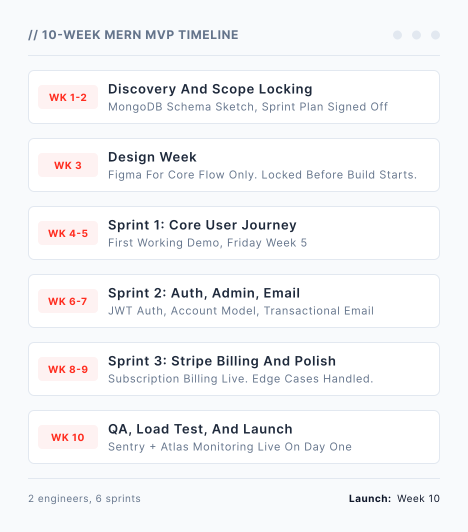
Six steps from idea to a live MERN MVP with paying users.
Scope locked in week one. Working demo every fortnight. Stripe billing live before launch day. The discipline is in saying no to the wrong work, not just doing the right work fast.
Discovery and Scope Locking
Two-week discovery covering target users, core user journey, MongoDB schema sketch, integration count, and success metrics. Output is a scope locked MERN MVP plan, sprint schedule, and post-MVP roadmap signed off before any code is written. Scope changes after this point require a formal change request.
Design Week
Figma wireframes and high-fidelity designs for the core user journey only. Reviewed and locked before the build sprint starts. No design changes mid-sprint. Design and engineering run in parallel on non-core screens.
Build Sprints 1 and 2
Four weeks building the core MERN MVP: user journey, JWT authentication, MongoDB schema, Express API, React frontend. TypeScript strict mode from day one. Jest tests on every endpoint. Working demo at the end of every fortnight.
Stripe Billing and Polish
Stripe subscription billing with webhook handling, dunning, and Stripe Tax. Polish on the core user journey, edge case handling, transactional email via Resend, and mobile responsiveness check across tested devices.
QA and Launch
Jest and Playwright regression testing, load testing at 3x expected launch traffic, production deployment on AWS or Vercel with Sentry and Atlas Performance Advisor active from day one. Soft launch, then full launch.
Handover and Post-MVP Plan
Repository on your GitHub, runbooks, environment guides, Stripe and Sentry access. Written post-MVP roadmap covering deferred features in priority order. Transition to Dedicated Developer or maintenance tier for ongoing iteration.
Boring, supported, and well-documented. The MERN MVP stack that scales past the MVP.
We pick the tools that scale past the MVP, not the ones that look impressive on a slide deck. Every tool below has been used in production MERN MVPs that have grown to Series A products without a rewrite.
MERN core
Frontend
Auth and billing
Email and async
Hosting and CI
Monitoring and QA
One MERN MVP in detail. Full portfolio at /portfolio/.
FinTech SaaS MVP: from a Figma file to 80 paying customers and a seed term sheet in 11 weeks.
"We came to Acquaint with a deck and a Figma file. Eleven weeks later we had a working product, 80 paying customers, and the term sheet for our seed round. The scope discipline they brought was worth more than the code in the end. Three agencies before them quoted six months. Acquaint shipped in eleven weeks because they cut our scope in half in week one and were right to do it."
Two founders had identified a gap in expense management for small UK accounting firms. They had a Figma file with 47 screens, six months of runway, and no engineering team. Investors wanted to see live signups before committing to a seed round. Three previous agencies had each quoted six months and six-figure budgets for what was effectively a v1, not an MVP. The product needed to ship in time for a major UK accounting conference where the founders had a speaking slot.
A two-week MERN MVP discovery sprint cut the scope from 47 screens to the 14 that proved the value proposition. MongoDB Atlas for the data model (expense records, firm accounts, user roles), Express.js REST API with Zod validation, React frontend with Next.js for the marketing site and Vite for the authenticated application, and Node.js with BullMQ for background processing (PDF generation for expense reports, email delivery via Resend). Stripe subscription billing with webhook handling in sprint three. TypeScript strict mode throughout. Jest tests on every critical endpoint. Playwright E2E on the signup, billing, and expense submission flows. Five two-week sprints with Friday founder demos. Production deployed on AWS with Sentry and Atlas Performance Advisor from week eight. Launched at the accounting conference in week 11.
Three MERN MVP engagement models. Most founders start with Fixed Price.
Most MERN MVP clients run Fixed Price for the initial build, scope locked in week one, then switch to Dedicated Developer for ongoing iteration after launch. Fixed Price gives a predictable budget for the MVP. Dedicated Developer gives momentum for what comes next. We suggest the model that fits your stage. You decide.
Dedicated Developer
- Post-MVP iteration with a live MERN product and paying users
- Founders who need continuous MERN engineering momentum after launch
- Products where the post-MVP roadmap is long and evolving
- Startups past seed who need a dedicated MERN engineer, not an agency
Fixed Price MERN MVP
- Founders who need a fixed budget for investor or runway planning
- MVPs with a clear core user journey that can be locked in discovery
- First MERN MVP engagement to test our delivery before committing longer
- Most common budget range across 54 Clutch reviews: $15,000-$35,000
Time and Material
- MVPs where the core user journey is still being discovered through research
- Products with significant third-party integrations where scope depends on the API
- Founders with flexible budgets who value iteration over predictability
- R&D or exploratory MERN builds before a formal product spec
Questions founders ask before starting a MERN MVP development project.
These come from actual pre-sale conversations with founders evaluating our MERN MVP development services, most of them on a fixed runway with a hard launch deadline. If your question is not here, the discovery call is the right place for it.
-
What is a MERN MVP?
A MERN MVP is the smallest version of your product that proves the core value proposition to real users, built on MongoDB, Express.js, React, and Node.js. It is not a feature-complete product. It is the focused MERN build that lets you put something real in front of users and investors before burning the seed round on a gold-plated v1. At Acquaint Softtech our MERN MVP development team ships in 8 to 12 weeks by locking scope in week one and pushing back on everything that does not belong in the first version.
-
How long does a MERN MVP take to build?
A focused MERN MVP ships in 8 to 12 weeks with two engineers. The first two weeks go into discovery and scope locking. Sprints 1 to 4 build the core MERN product over eight weeks. Sprint 5 handles Stripe billing, polish, and edge cases. The final sprint covers QA, load testing, and production deployment. Timeline is protected by locking scope in week one. We do not give a timeline before seeing what you actually want to build.
-
How much does MERN MVP development cost?
A focused MERN MVP costs $15,000 to $35,000 and ships in 8 to 12 weeks. A mid-sized MERN MVP with multi-tenancy, subscription billing, feature flags, and a polished admin lands between $35,000 and $70,000. Our MERN developers start at $22/hr. Scope is the single biggest cost driver, which is why we lock it in week one. See our full MERN development cost breakdown.
-
What should be in a MERN MVP scope?
Three things only: the core user journey that proves the value proposition end-to-end, the smallest authentication and account model that works (email plus password, no social SSO yet), and the minimum admin dashboard your team needs to operate the product after launch. Everything else moves to a written post-MVP roadmap. We push back on scope additions during the MERN MVP build because the gold-plated MVP that ships in month nine is no longer an MVP.
-
Why use MERN for MVP development?
Three reasons. First, MERN's single-language architecture means a 2-engineer team does what takes 4 in a mixed-stack environment. For a founder on a fixed runway, that matters. Second, MongoDB's document model handles the schema changes that happen every sprint in an early product without migrations. Third, React with Next.js handles both the marketing site and the authenticated application in one codebase. One team, one language, one deployment pipeline.
-
Can you build a SaaS MVP with MERN?
Yes. SaaS MVPs are one of our most common MERN engagements. The MVP stack uses MongoDB with a shared-database tenancy pattern (simplest to ship, easiest to operate), Stripe subscription billing with webhook handling and dunning, JWT authentication with refresh token rotation, and a React admin dashboard. Multi-tenancy white-labelling, SSO, and compliance features move to the post-MVP roadmap unless the product cannot launch without them. See our MERN SaaS development page for full SaaS architecture detail.
-
Can the MERN MVP scale after launch?
Yes. The MERN MVP is built with the scaling path in mind from week one. MongoDB Atlas lets you upgrade cluster tiers and add read replicas as query load grows. Node.js cluster mode handles concurrency scaling without a rewrite. Redis caching is added as traffic grows. React with Next.js supports incremental static regeneration for marketing pages. The architecture decisions in the discovery sprint protect against expensive refactors that come from an MVP built without a growth plan.
-
How do you prevent scope creep on a MERN MVP?
Every feature request during the MERN MVP build either fits the locked scope or moves to the written post-MVP roadmap that we maintain in real time. Founders can see the roadmap growing as features are deferred. Scope changes to the locked MVP scope require a formal change request that re-prices and re-timelines the build. Most founders stop asking after seeing the roadmap grow in real time, because the deferred features are not lost. The discipline is what gets the MVP out the door on time.
What MERN MVP founders usually pair with this.
MERN MVPs rarely end at launch. Most founders who choose our MERN MVP development services combine the initial build with one or more of these as the product grows.
MERN MVP + AI Integration
Wire RAG, Vector Search, or an AI copilot into your MERN MVP from day one. LangChain.js orchestration, MongoDB Atlas Vector Search, cost caps enforced. From $30K production RAG.
MERN AI Chatbot MVP
Ship an AI-native MVP with a production LangChain.js chatbot. Streaming React chat UI, MongoDB memory, guardrails. From $20K.
MongoDB Schema Design
Two-week schema sprint before the MVP build starts. Get the polymorphic patterns right or pay 10x to fix them at Series A. From $8K.
MERN SaaS Development
Multi-tenant SaaS on MERN when the MVP validates. Tenancy patterns, billing, feature flags, admin panels.
Hire MERN Developers Post-MVP
Post-launch iteration with dedicated MERN engineers deployed in 48 hours. From $3,200/month.
MERN MVP Cost
Real cost ranges by MVP type: bare $15K, standard $25K, AI-enabled $30K to $50K. Includes 2026 AI infrastructure costs.
MERN for Startups
Pre-seed to Series A. One MERN stack, no rewrite when traction lands, runway-conscious pricing.
Real-Time MERN MVP
Socket.io and MongoDB change streams if your MVP needs live features (dashboards, chat, collaboration).
India (Head Office)
203/204, Shapath-II, Near Silver Leaf Hotel, Opp. Rajpath Club, SG Highway, Ahmedabad-380054, Gujarat
USA
7838 Camino Cielo St, Highland, CA 92346
UK
The Powerhouse, 21 Woodthorpe Road, Ashford, England, TW15 2RP
New Zealand
42 Exler Place, Avondale, Auckland 0600, New Zealand
Canada
141 Skyview Bay NE , Calgary, Alberta, T3N 2K6
Your Project. Our Expertise. Let’s Connect.
Get in touch with our team to discuss your goals and start your journey with vetted developers in 48 hours.