

Multi-tenant SaaS, built on MERN: ship cleanly, bill reliably, scale without a rewrite.
From a pre-seed MVP to a Series A platform serving thousands of tenants, our MERN SaaS development team builds MERN SaaS platforms that handle multi tenant SaaS MERN architecture, MERN subscription SaaS billing with Stripe, feature flags, and real-time updates without the architectural debt that catches most products in year two. Whether you are shipping a MERN B2B SaaS, an internal-tool SaaS, or a SaaS development MERN engagement with AI features (MongoDB Atlas Vector Search + LangChain.js) built in from day one, MERN stack SaaS is the foundation we have shipped across 40+ production tenants.
- Three tenancy patterns supported: shared DB, schema-per-tenant, DB-per-tenant. We pick the right one in week one.
- Stripe subscription billing with webhook handling, dunning, proration, and tax compliance
- Feature flags for per-tier gating, gradual rollouts, and per-tenant enterprise overrides
- 40+ MERN SaaS products shipped since 2013. 54 Clutch reviews. 4.9/5.
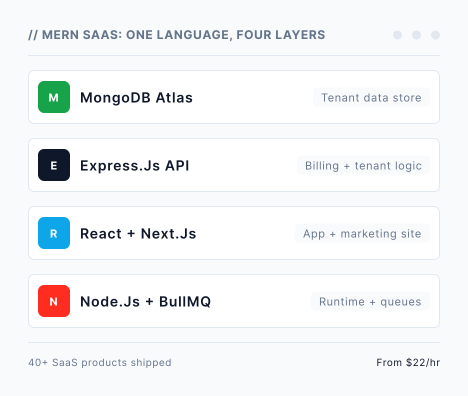








The MERN stack that quietly powers a lot of SaaS today.
A MERN SaaS is a multi-tenant software product where multiple customers share one application while keeping their data, users, and configuration isolated. Multi-tenant MERN SaaS architecture is the single most important early decision in any SaaS build. MERN is one of the strongest stacks for SaaS because the full-stack JavaScript architecture (MongoDB, Express, React, Node.js) lets one team move across every layer without handoff overhead.
MongoDB's document model handles the flexible, rapidly-changing schemas that SaaS products require during early growth. In a relational database, adding a new tenant attribute means a schema migration. In MongoDB, you add a field to the document. For a SaaS in its first two years, that difference is worth several weeks of engineering time.
Node.js handles the concurrent tenant connections that SaaS products generate. A SaaS with 500 tenants and 10 concurrent users each generates 5,000 simultaneous connections at peak. Node.js's event loop manages this without the thread overhead of a traditional server model.
React with Next.js handles both the marketing site (SEO-critical, SSR) and the authenticated SaaS application in one codebase. No separate frontend team, no separate deployment pipeline, no React props versus server-side rendering confusion at 2am on a Saturday.
You are building multi-tenant from day one
Multiple customers, isolated data, per-tenant configuration. You already know this is a SaaS, not a web app with accounts.
You need recurring billing before launch
Stripe plans, trials, proration, and dunning are part of the MVP scope, not a post-launch addition.
Your schema changes every sprint
MongoDB's flexible document model means new tenant attributes, new plan features, and new data shapes land without migrations.
Your team needs to ship marketing pages and app from one codebase
Next.js covers both. SSR for the marketing site, client-side React for the authenticated dashboard. One team, one deployment.
You plan to add enterprise tier features later
SSO, custom domains, per-tenant feature gating, white-labelling. These are architected in from week one, not bolted on in year two.
You want to keep the team small and full-stack
MERN's single-language discipline means 2 engineers do what takes 4 in a mixed-stack environment. For a SaaS MVP on a fixed runway, that matters.
Three MERN SaaS tenancy patterns. We pick the right one in week one.
Multi-tenancy is the single most important architecture decision in a MERN SaaS. Every multi-tenant MERN SaaS engagement at Acquaint starts with a tenancy decision document, signed off before the first line of code. Get it wrong in week one and you will spend year two migrating. We lock the tenancy pattern in the discovery sprint, before any code is written, because changing it after launch is one of the most expensive refactors in SaaS engineering.
Shared Database, Tenant Field
- MVP and early-stage MERN SaaS
- Hundreds to thousands of tenants
- Low to medium compliance requirements
- Teams that want to ship fast and iterate
- Fastest to build, cheapest to run
Separate Database per Tenant
- Mid-stage MERN SaaS with growing enterprise customers
- Healthcare, fintech, regulated verticals
- Tenants who require their data in isolation by contract
- Easier per-tenant backup, restore, and data export
- Customers asking for GDPR or SOC 2 data isolation
Isolated Atlas Cluster per Tenant
- Enterprise tier of an existing MERN SaaS
- SOC 2, HIPAA, GDPR data residency requirements
- Customers who need a contractual data isolation guarantee
- Financial institutions and healthcare providers
- Tenants with large data volumes needing dedicated resources
Everything a MERN SaaS needs to ship and bill cleanly.
Not just the application. Our MERN SaaS development services cover the full engineering stack that takes a product from architecture decision to paid signups, including the billing, auth, and monitoring infrastructure that most teams regret not building in from the start.
Multi-tenant architecture
Tenant resolution in Express middleware on every request, data isolation enforced at the Mongoose model layer, subdomain routing, custom domain support, and tenant boundary tests on every pull request from sprint one.
Subscription billing via Stripe
Stripe integration through a custom Node.js billing service: plans, trials, proration, coupons, invoicing, dunning (automatic failed payment recovery), webhook handling with idempotency, and Stripe Tax for regional tax compliance. For international SaaS products wanting merchant-of-record, we integrate Paddle as an alternative.
Feature flags
Boolean switches controlling feature visibility per tenant, per pricing tier, or per user group, without a code deployment. Built into Express middleware so flag evaluation happens before any handler runs. Use cases: gradual rollouts to 10% of tenants, per-tier gating (Basic vs Pro vs Enterprise), A/B tests, kill switches, and per-tenant enterprise overrides. Stored in MongoDB with Redis cache for sub-millisecond evaluation.
Self-serve signup and onboarding
Marketing site signup form, email verification with resend handling, trial activation with countdown, onboarding checklist with completion tracking, billing setup flow, and the first-value moment designed into the user journey. Most SaaS products lose 40% of signups in onboarding. We design the onboarding flow in the discovery sprint, not as an afterthought.
Tenant admin and SaaS metrics dashboard
Internal admin interface for managing tenants, plans, MRR, churn rate, trial conversions, feature flag rollouts, and usage per tenant. Built on React with a dedicated Express API route group, protected behind role-based access control. MRR, ARR, and churn are calculated from the Stripe webhook event stream, not from manual queries.
SSO and enterprise authentication
SAML 2.0, OIDC, Google Workspace, Microsoft 365 (Azure AD), and Okta SSO for enterprise tenants. Each tenant can configure their own identity provider in their account settings. JWT for the standard session layer with refresh token rotation and secure HttpOnly cookie storage. Per-tenant session timeout policies for compliance requirements.
Queue processing and real-time updates
BullMQ with Redis for background jobs: email delivery, PDF generation, data exports, third-party sync, scheduled reports. Socket.io for real-time features in the SaaS application: live notifications, dashboard data refresh, collaborative editing. MongoDB change streams for database-level event propagation where the source of truth is the database, not the application layer.
SaaS metrics and observability
MRR, ARR, churn rate, trial conversion rate, feature usage per tenant, and plan distribution: calculated from the Stripe webhook stream and stored in MongoDB for fast dashboard queries. Sentry for error tracking across tenant boundaries (with tenant context on every error). MongoDB Atlas Performance Advisor for slow query detection. Structured logging with tenant ID on every log line so debugging a specific tenant's issue takes minutes, not hours.
MERN SaaS architecture decisions get made well, or they get made over.
Manish Patel, CIO
MERN Architecture Lead · 40+ SaaS products shipped
Six steps from idea to paid signups on a MERN SaaS.
Tenancy decision locked in week one. MVP in 8 to 12 weeks. Stripe billing live before launch day. The discipline is what keeps the MERN SaaS architecture clean through year two and beyond.
Discovery and SaaS Architecture
Map target tenants, pricing model, tenancy pattern, billing approach (Stripe vs Paddle), and feature flag strategy. Output is an architecture document and tenancy decision signed off before any code is written. This step is non-negotiable.
MVP Scope and Sprint Plan
Lock the smallest feature set that proves the product. Break into two-week sprints with working demos at the end of every cycle. Scope changes after this point require a formal change request, not a conversation in Slack.
Build with Tenant Isolation
Every module is built tenant-aware from the first line. TypeScript strict mode throughout. Jest tests on every tenant boundary. Every pull request includes a tenancy boundary check before merge. No shortcuts in Sprint Zero.
Billing, Feature Flags and Admin
Stripe subscription billing built in the same sprint as tenant onboarding. Feature flags in Express middleware. Admin dashboard for tenant management and MRR visibility. These are built in parallel with core product features, not after launch.
Launch with Instrumentation
Deploy on AWS or Vercel. Sentry error tracking across tenant boundaries with tenant context on every error. MongoDB Atlas Performance Advisor. Structured logging. Nothing goes to production without monitoring in place. We do not hand over a repo and disappear.
Scale as Tenants Grow
Post-launch: Redis caching layers for hot data, BullMQ workers for background processing, read replicas as query load grows, and Atlas cluster tier upgrades on a plan aligned with tenant growth. Enterprise-tier customers get moved to stronger isolation patterns when the business case arrives.
Production-tested across 40+ MERN SaaS products.
These are the tools our MERN SaaS engineers use in actual client production systems. We pick the simplest tool that solves the problem. None of this is on the list to look impressive on a proposal.
Multi-tenancy
Billing and subscriptions
Feature flags and auth
Frontend (React + Next.js)
Async, queues and real-time
Infrastructure and observability
One MERN SaaS project in detail. Full portfolio at /portfolio/.
Neo Bank platform: audit-complete MERN SaaS serving enterprise financial clients with real-time transaction visibility.
"They worked as an extension of an internal engineering team as opposed to an external vendor. The ability to provide security and depth of auditing did not impact the speed of the system. Each of our enterprise clients can see exactly what happened to their data, when, and why."
XOALA, a Neo Bank operating in Sweden, needed a MERN SaaS platform that could serve multiple enterprise financial clients (tenants) while providing each tenant with complete, regulatorily-defensible audit trails for every transaction event. The core tension: enterprise clients needed real-time visibility into transaction data across large portfolios, but audit trail completeness could not be sacrificed for speed. A standard shared-database tenancy approach would not satisfy the data isolation requirements of enterprise financial clients. A database-per-tenant approach needed to be fast enough for real-time dashboards.
A MERN SaaS platform on Pattern 03: isolated MongoDB Atlas cluster per enterprise tenant, provisioned programmatically through the Atlas Admin API on tenant signup. Each tenant's financial event data lives in their own cluster, satisfying isolation requirements without compromising on real-time query performance. MongoDB change streams push transaction events to the Node.js API layer, which then broadcasts to the tenant's authenticated React dashboard via Socket.io. The audit trail is immutable: every write operation logs to a separate append-only MongoDB collection within the tenant cluster, with field-level encryption on sensitive financial fields. BullMQ handles the heavy operations: compliance report generation, bulk transaction exports, and scheduled reconciliation jobs that cannot block the main request thread.
Three MERN SaaS engagement models. Most clients start with Fixed Price MVP.
Most MERN SaaS clients start with a Fixed Price MVP to test delivery before committing to a longer engagement. Once paying customers are live and the roadmap is clear, they switch to Dedicated Developer for ongoing feature work. We suggest the model that fits your stage. You decide.
Dedicated Developer
- MERN SaaS products post-MVP with paying customers
- Teams extending capacity without hiring full-time
- Long-term feature iteration, 12+ month engagements
- SaaS founders who want a consistent engineer on the product
Fixed Price SaaS MVP
- MERN SaaS MVPs with a clear spec or one we lock in discovery
- Budget-certain builds where scope can be fixed in week one
- First engagements to test delivery before committing longer
- Most common range across 54 Clutch reviews: $20,000-$45,000
Time and Material
- MERN SaaS products with requirements still being discovered
- Maintenance and iteration alongside a live SaaS codebase
- Enterprise MERN SaaS builds with multiple parallel workstreams
- R&D or exploratory builds before a formal product spec
Questions SaaS founders ask before starting a MERN SaaS project.
These come from actual pre-sale conversations with founders evaluating our MERN SaaS development services. If your question is not here, the discovery call is the right place for it.
-
Is MERN good for SaaS development?
Yes. MERN is one of the strongest choices for SaaS today because the full-stack JavaScript architecture lets one team move across every layer without handoff overhead. MongoDB's document model handles the flexible schemas SaaS products require during early growth. Node.js handles concurrent tenant connections efficiently. React with Next.js covers both the marketing site and the authenticated application in one codebase. At Acquaint Softtech we have shipped 40+ MERN SaaS products since 2013, across EdTech, FinTech, B2B, and marketplace verticals.
-
What is multi-tenancy in a MERN SaaS?
Multi-tenancy means serving multiple customers (tenants) from a single MERN application while keeping their data, users, and configuration isolated. We use three patterns: shared database with a tenant field (fastest to ship, best for early-stage), separate database per tenant on a shared Atlas cluster (for mid-stage products with compliance requirements), and isolated Atlas cluster per tenant (for enterprise tier, SOC 2, HIPAA, data residency). We lock the tenancy pattern in week one because changing it post-launch is one of the most expensive refactors in SaaS engineering.
-
How do you build subscription billing in a MERN SaaS?
We integrate Stripe directly into the Node.js backend: plans, trials, proration, coupons, invoicing, dunning (automatic failed payment recovery), webhooks with idempotency keys, and Stripe Tax for regional compliance. Every Stripe webhook is handled idempotently, so duplicate events from Stripe's retry mechanism never create double charges or double provisioning. For international SaaS products that want a merchant-of-record model (Paddle handles VAT and sales tax automatically), we integrate Paddle as an alternative to Stripe. Billing is built in the same sprint as tenant onboarding, not added after launch.
-
How much does MERN SaaS development cost?
A focused MERN SaaS MVP costs $20,000 to $45,000 and ships in 8 to 12 weeks with two engineers. A mid-sized MERN SaaS with multi-tenancy, billing, feature flags, admin, and analytics lands between $50,000 and $130,000 over 4 to 6 months. Our MERN developers start at $22/hr. Scope is the single biggest cost driver, which is why we lock it in week one before any code is written. See our full MERN development cost breakdown for a detailed breakdown by project type and region.
-
How long does it take to launch a MERN SaaS?
A focused MERN SaaS MVP launches in 8 to 12 weeks with two engineers. A mid-sized MERN SaaS with multi-tenancy, Stripe billing, feature flags, and a polished admin panel lands in 4 to 6 months. Enterprise MERN SaaS with SSO, custom domain support, compliance features, and white-labelling runs 8 to 14 months. Timelines are protected by locking scope in week one. We do not give timelines before seeing the spec.
-
Can a MERN SaaS scale to thousands of tenants?
Yes. We have shipped MERN SaaS platforms serving 40,000+ active users across thousands of tenants on a shared-database architecture. The standard scaling toolkit: proper MongoDB indexing on the tenant field across all collections, Redis caching for hot tenant data, BullMQ workers for background processing that would otherwise block the Node.js event loop, read replicas on Atlas when read query load grows, and Node.js cluster mode for horizontal CPU scaling. Tenants with large data volumes or strict compliance requirements get moved to isolated Atlas clusters as their needs justify it.
-
What are feature flags in a MERN SaaS?
Feature flags are Boolean switches controlling which features are visible to which tenants or tiers, without a code deployment. We implement them in Express middleware, evaluated before any handler runs. Flag configurations are stored in MongoDB with a Redis cache for sub-millisecond evaluation at the request level. Use cases: gradual rollouts to 10% of tenants, per-tier feature gating (Basic vs Pro vs Enterprise), A/B tests across tenant cohorts, kill switches for unstable features, and per-tenant enterprise overrides for negotiated custom plans.
-
Do you handle SSO and enterprise authentication?
Yes. We integrate SAML 2.0, OIDC, Google Workspace, Microsoft 365 (Azure AD), and Okta SSO for enterprise tenants. Each tenant can configure their own identity provider in their account settings. JWT for the standard session layer with refresh token rotation and secure HttpOnly cookie storage. Per-tenant session timeout policies for regulated-industry compliance requirements. We have implemented enterprise SSO for fintech and banking technology MERN SaaS clients including XOALA (Sweden) and MAP FinTech (Cyprus).
-
What is the architecture of a production MERN SaaS?
Six layers: (1) Routing and middleware in Express, handling tenant resolution on every request, JWT authentication, rate limiting per tenant, and Zod request validation. (2) Tenancy layer, enforcing data isolation based on the agreed pattern. (3) Billing layer, Stripe webhook handling, plan entitlement checks before feature access, and dunning state management. (4) Feature flag layer, evaluated in middleware before any handler executes. (5) Application layer, the core business logic in Express route handlers with Mongoose. (6) React frontend with Next.js, consuming the API and respecting tenant theming, feature visibility, and plan-tier access controls.
-
Who owns the source code and IP for our MERN SaaS?
You own 100% of the source code, MongoDB schemas, API designs, and all intellectual property from the first commit. IP transfer is agreed in writing before kick-off. The NDA is signed before any technical discussion, not after. We never hold code over payment disputes. All three engagement models (dedicated, fixed price, T&M) carry the same IP terms.
What MERN SaaS clients usually pair with this.
MERN SaaS development rarely lives alone. Most clients combine the core SaaS build with one or more of these.
MERN SaaS + AI Integration
Add RAG, semantic search, or an AI copilot to your SaaS. LangChain.js orchestration, MongoDB Atlas Vector Search, cost caps per tenant. From $30K production RAG.
SaaS AI Chatbot Development
Production LangChain.js chatbots for your SaaS: customer support, in-app assistants, agents. Per-tenant memory in MongoDB. From $20K.
Multi-Tenant MongoDB Schema
Two-week schema sprint for shared-schema, database-per-tenant, or collection-per-tenant patterns. Get it right at MVP or rebuild at 100 tenants.
MERN SaaS Development Cost
Real cost ranges: MVP $15K to $40K, production SaaS $35K to $80K, enterprise $80K+. Now with per-tenant AI infrastructure cost breakdown.
Multi-Tenant MERN SaaS
The Schema Sprint is the standard prerequisite for SaaS builds. Ensures tenancy model is right before you scale to Series A.
MERN Real-Time SaaS
Socket.io and MongoDB change streams for live SaaS dashboards, notifications, and collaboration features. Sub-200ms latency proven.
Hire MERN SaaS Engineers
Dedicated MERN SaaS engineers deployed in 48 hours. All seniority levels. From $3,200/month full-time.
MERN SaaS for Enterprise
Enterprise MERN SaaS with SSO, RBAC, per-tenant encryption, and ISO 27001 aligned governance. For B2B and regulated markets.
India (Head Office)
203/204, Shapath-II, Near Silver Leaf Hotel, Opp. Rajpath Club, SG Highway, Ahmedabad-380054, Gujarat
USA
7838 Camino Cielo St, Highland, CA 92346
UK
The Powerhouse, 21 Woodthorpe Road, Ashford, England, TW15 2RP
New Zealand
42 Exler Place, Avondale, Auckland 0600, New Zealand
Canada
141 Skyview Bay NE , Calgary, Alberta, T3N 2K6
Your Project. Our Expertise. Let’s Connect.
Get in touch with our team to discuss your goals and start your journey with vetted developers in 48 hours.