

Table of Contents
What Type of Projects is Laravel Best Suited For?
Introduction
Laravel is best suited for custom, data-driven web applications that need a solid architectural structure, complex business logic, and the ability to scale. Because it includes built-in tools for authentication, background jobs, database management, and security, it lets developers build feature-rich platforms without starting from scratch.
The clearest fits are enterprise apps, SaaS products, custom e-commerce, content systems, and API-first backends, which is the kind of work Acquaint Softtech does most.
Laravel is a PHP framework, not a Java one; developer communities like Reddit point to these same project types, and you will find its starter kits and thousands of open-source packages on GitHub.
The short version: if your idea is a real product with users, data, and business logic, Laravel is very likely a strong fit.
Laravel is a PHP framework for building robust applications for various small-scale and large-scale businesses. Because of its growing community, Laravel development services have increased drastically. Thanks to Laravel's features, it's the best choice to take any business online. Let's explore the types of projects Laravel is well-suited for.
What is Laravel, and what is it used for?
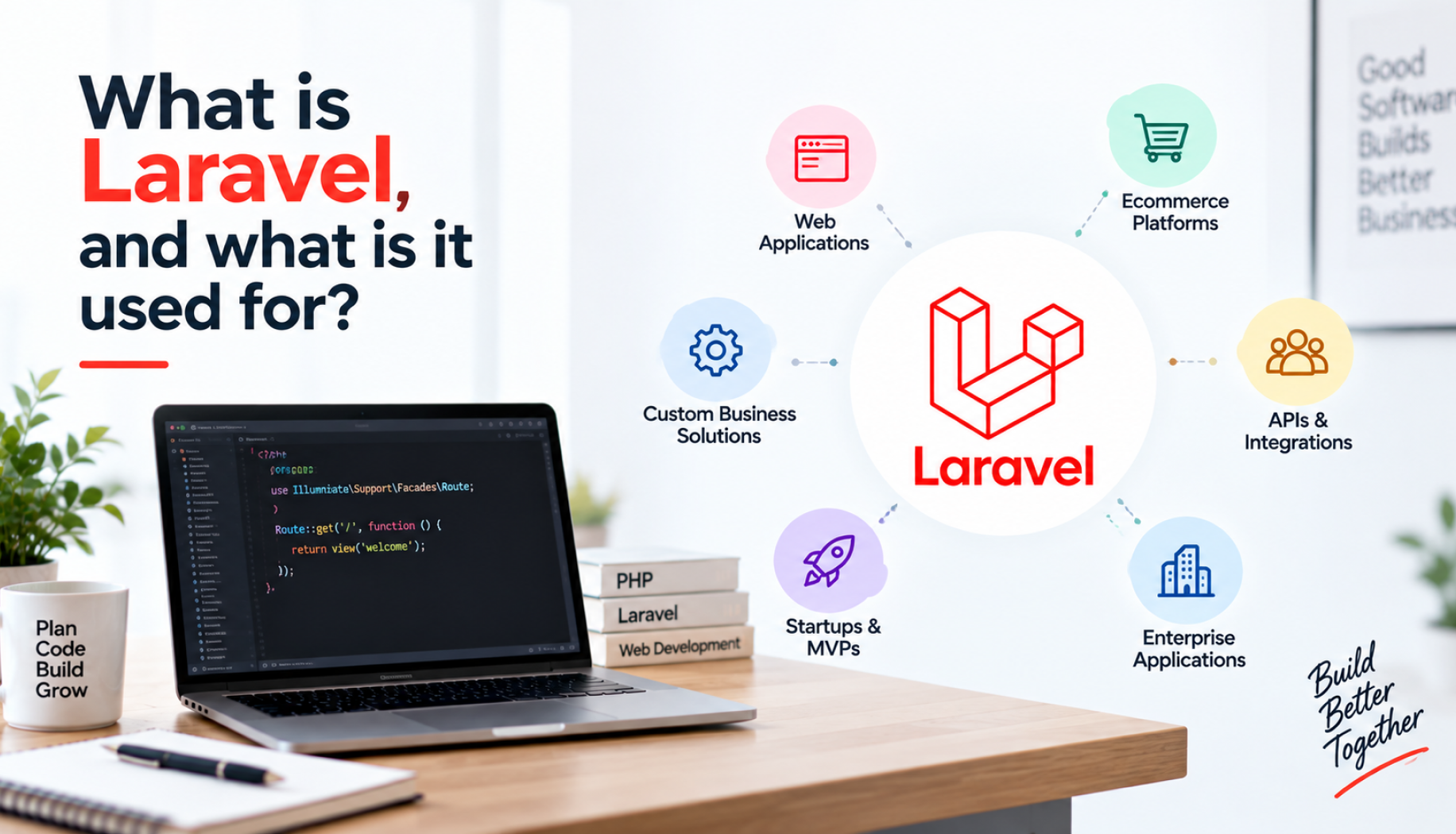
Laravel is an open-source PHP framework used to build web applications and APIs. In practice, it is used for custom, database-backed platforms rather than simple static pages anything with users, data, and business logic behind it. Its elegant syntax, MVC structure, and rich ecosystem are why teams reach for it across so many project types.
It powers everything from small business sites to high-traffic platforms, which is why it appears across nearly every category below. The Types of web applications you can get built with Laravel give the full picture of what it can produce.
Types of projects Laravel is best suited for
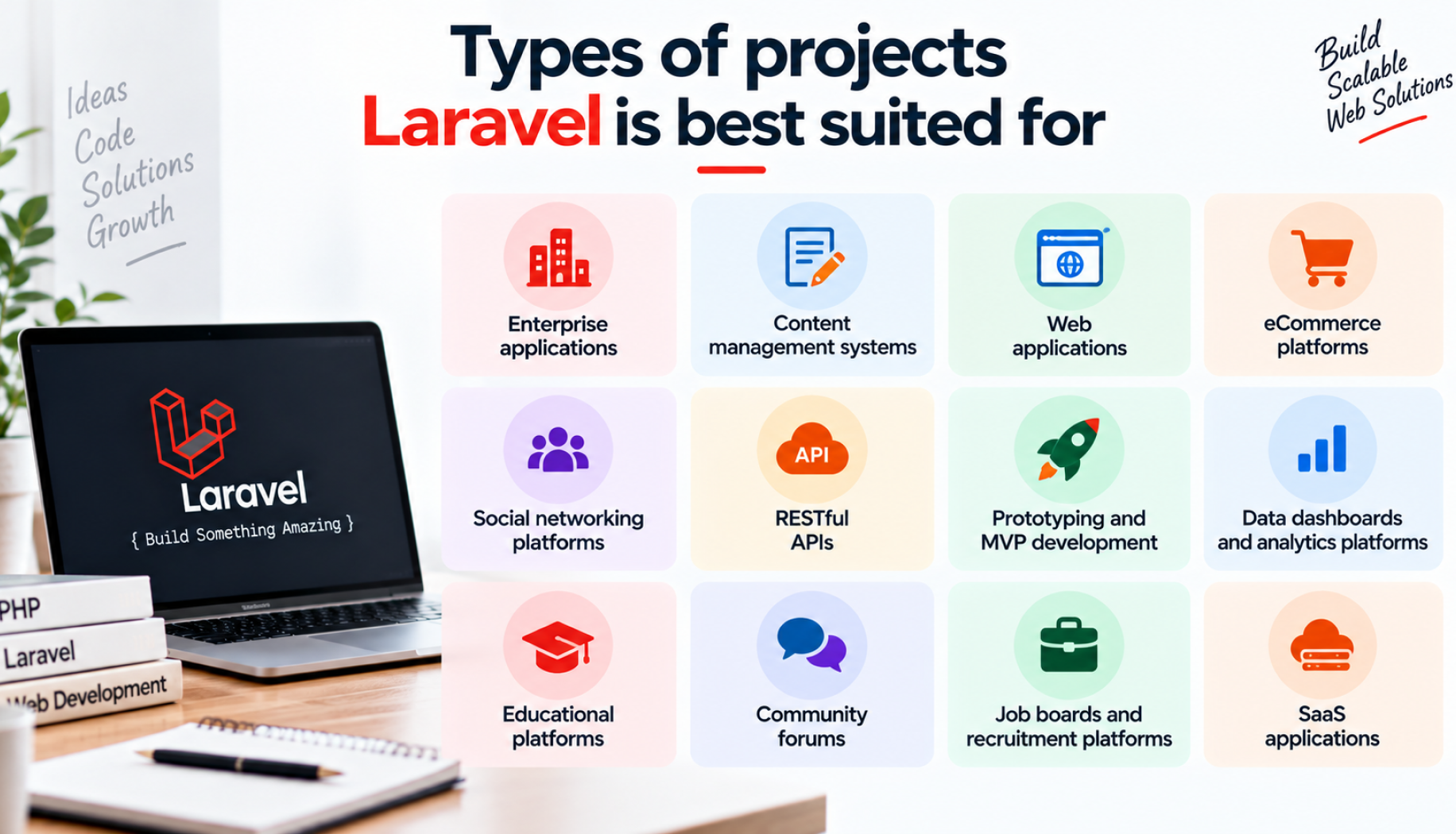
Laravel fits a wide range of custom projects. Acquaint Softtech has delivered most of the types below, and each one plays to a different strength of the framework.
1. Enterprise applications
An enterprise application is software designed to handle and support large organizations, a robust, scalable, and secure solution that streamlines and automates business processes. Big companies rely on enterprise systems like SAP and ERP to manage departments, resources, supply chains, finances, and customer relationships.
Laravel suits this well because it streamlines the development and maintenance of complex systems, provides secure user management and access control for sensitive data, handles large volumes of data and complex workflows, and integrates with existing enterprise systems and APIs.
Its long-term support and version stability also keep enterprise-grade apps cost-effective to maintain, which is the core of Acquaint Softtech's Laravel enterprise development.
2. Content management systems
A CMS is a software application that allows users to create, manage, and modify digital content effortlessly, handling tasks like publishing and updating website content.
For media companies or enterprises that outgrow WordPress, Laravel offers a structured way to build custom content tools with complex user roles and heavy databases.
The benefits are customisable solutions tailored to specific requirements, user-friendly administration for content and settings, support for many content types, and a scalable architecture that handles large amounts of content. A common route is Statamic CMS development, a CMS built on Laravel.
3. Web applications
A web application runs on a web server and is accessed through a browser, letting users perform tasks and access information online, from shopping platforms and social sites to productivity and collaboration tools.
Laravel speeds this up with ready-made routing, authentication, and database tools, enabling faster development that brings ideas to market quickly, scalable and high-performing apps, cost-effective maintenance and upgrades, and access to a thriving community and long-term security updates. That is the focus of Laravel web application development.
4. eCommerce platforms
eCommerce platforms let businesses set up and run online stores, handling the buying and selling of products or services over the Internet, as Amazon does at scale. When off-the-shelf tools are too rigid, Laravel is used to build custom stores with flexible catalogues, carts, and payments.
The benefits include scalable platforms that handle a growing number of products and users, secure and reliable transaction processing, customisable front-end templates with an intuitive back-end, and integration with popular payment gateways. A common open-source foundation is Bagisto Development Company, a Laravel-based eCommerce framework.
5. Social networking platforms
Social networking platforms let users connect and communicate remotely over the Internet, as Instagram and Facebook do. These apps need an organised, scalable codebase, secure user management and authentication, real-time communication for messaging and notifications, and efficient data handling with the Eloquent ORM.
Laravel provides all of this, along with clean URLs for SEO and integration with modern front-end frameworks, and interactive interfaces come together quickly with Livewire development.
6. RESTful APIs
A RESTful API is a web service that follows REST principles to provide a standardized way of interacting with server resources, letting different systems communicate. Laravel excels here, with a full set of tools to design, implement, and version APIs, secure authentication and authorization for API access, smooth integration with various client applications, and effective data transformation and serialisation. It pairs cleanly with JavaScript frontends or mobile apps through Laravel API development.
7. Prototyping and MVP development
Prototyping creates a preliminary version of a product to visualise layout, features, and user experience, and once validated, MVP development builds a simplified, functional version with core features to test the market with minimal investment.
Laravel is ideal for this: it lets teams validate ideas quickly before investing heavily, supports efficient development and iteration cycles, and offers a smooth transition from prototype to a scalable, production-ready application. That makes it a common choice for Laravel for startups.
8. Data dashboards and analytics platforms
Data dashboards present information visually with charts, graphs, and reports, giving businesses real-time insight to track metrics and make informed decisions.
Laravel handles the large datasets these tools need, with simplified database management, improved performance through caching and optimised data retrieval, automation of background processes, and integration with external APIs for data aggregation. Admin panels and dashboards come together quickly with Filament development.
9. Educational platforms
Educational platforms facilitate learning by giving professors and students a digital space, often with multimedia content, discussion forums, progress tracking, and assessments.
Laravel supports feature-rich, scalable learning platforms that handle increasing numbers of users and courses, with secure and reliable built-in protection, customisation for the specific needs of an institution, and integration with real-time communication tools for interactive learning.
Its version stability keeps these platforms maintainable over the long term. Overall, Laravel gives educational products a secure, scalable base that can grow with the institution.
10. Community forums
Community forums are online spaces where people with shared interests discuss topics, share knowledge, and seek help. Laravel builds these efficiently, with faster development thanks to its expressive syntax, scalable and high-performing forums for growing user bases, secure user management with authentication, real-time discussions through Echo and Pusher, and efficient handling of forum data using the Eloquent ORM.
Customisable views with the Blade templating engine and ongoing community support round it out. The result is a fast, secure forum that scales as the community grows.
11. Job boards and recruitment platforms
Job boards connect job seekers with employers, letting companies post openings and candidates search and apply, which streamlines hiring.
Laravel suits them with faster time-to-market, a scalable architecture for many listings and registrations, customisable features for managing job listings, applications, and profiles, secure user management and access control, integration with payment gateways to monetise the platform, and real-time notifications for better engagement.
12. SaaS applications
SaaS (Software as a Service) is a model where applications are hosted and provided over the Internet, usually subscription-based, covering tools like CRM, project management, or collaboration.
Laravel is an industry favourite here: it supports efficient development of scalable, customisable, multi-tenant solutions, cost-effective maintenance, robust security for sensitive customer data, and rapid deployment, with official starter kits and the Cashier billing engine speeding up subscription billing. Acquaint Softtech builds these as Laravel SaaS platforms.
Not sure which project type fits your idea?
Acquaint Softtech, an official Laravel partner, can help you choose the right approach and build it. Book a free 30-minute consultation, no sales pitch, just honest advice.
When should you choose or avoid Laravel?
Choose Laravel when you want fast deployment, strong security defaults, and a structured MVC workflow, and when your app needs heavy database work, API integrations, or scheduled tasks. Avoid it for a simple standard blog, where a turnkey CMS like WordPress saves time and money, or for apps built around real-time features like massive multiplayer games or live chat, where Node.js or Go are naturally faster.
Our Laravel vs MERN stack comparison covers that JavaScript trade-off in detail. In short, choose Laravel if your app requires heavy database interactions, API integrations, or scheduled tasks, and reach for another tool only when a simple site or a real-time-first product genuinely calls for it.
Is Laravel a backend or frontend framework?
Laravel is a backend framework. It runs the server side, such as routing, business logic, databases, authentication, and APIs, while the frontend is built with Blade or a JavaScript layer like Vue, React, or Livewire.
So when you plan any of the project types above, treat Laravel as the backend and choose a frontend to pair with it. In many modern builds, Laravel serves a JSON API while a separate JavaScript app handles the interface, so the same backend can power a website and a mobile app at once.
Is Laravel still relevant, or is PHP Laravel outdated?
Laravel is not outdated. It ships a major version every year; Laravel 13 arrived in March 2026 on PHP 8.3, and it has a large, active community, so it clearly has a future. For the project types above, it remains one of the safest, most productive choices, which is a big part of why teams still use Laravel for web development.
Its yearly releases, funded core team, and steady adoption across startups and enterprises are the clearest signs that Laravel will remain a dependable choice well beyond 2026.
Where to learn Laravel
If you are new to it, start with the official Laravel documentation, which is thorough and kept current; beginner tutorials on sites like W3Schools can help too. From there, a small project is the fastest way to see which of the types above fits your idea.
Once you are comfortable, the documentation also covers deployment, testing, and the ecosystem tools that make each project type above easier to build.
To Wrap Up
Laravel is well-suited for every type of project. Whether it's a small-scale product or a large-scale one, Laravel fits it all. With Laravel, you can make a secure, scalable, future-proof website that is easy to maintain. For the data-driven, custom builds it does best, a partner like Acquaint Softtech can take you from idea to launch.
India (Head Office)
203/204, Shapath-II, Near Silver Leaf Hotel, Opp. Rajpath Club, SG Highway, Ahmedabad-380054, Gujarat
USA
7838 Camino Cielo St, Highland, CA 92346
UK
The Powerhouse, 21 Woodthorpe Road, Ashford, England, TW15 2RP
New Zealand
42 Exler Place, Avondale, Auckland 0600, New Zealand
Canada
141 Skyview Bay NE , Calgary, Alberta, T3N 2K6