

Bagisto vs Shopify vs WooCommerce: Which Platform Wins for Growing Brands in 2026?
Shopify fees scale with your revenue. WooCommerce complexity scales with your ambition. Bagisto gives growing brands full ownership without the platform tax. Here is how the 3 actually compare in 2026.

Acquaint Softtech
The Platform Decision That Determines Your Margin
Your e-commerce platform is not a technical decision. It is a financial one. The platform you choose determines how much of every sale you keep, how much it costs to add a new feature, how long it takes to move when the market shifts, and whether your business is sitting on an asset or renting space in someone else's ecosystem.
Acquaint Softtech is an Official Bagisto Partner and Official Laravel Partner. We have built and scaled e-commerce platforms across all three of the options in this article. We have a financial interest in Bagisto engagements. We are disclosing that upfront because this article is going to tell you when Shopify and WooCommerce are the better fit for your situation. Credibility requires honesty about the trade-offs.
This article covers the true cost of each platform, where each one breaks down at scale, and a scenario-based decision framework that maps your situation to the right choice.

- Founders of growing e-commerce brands evaluating platform migration or initial platform selection in 2026
- CTOs and COOs assessing total cost of ownership across platform options
- Brands currently on Shopify who are feeling the margin compression from transaction fees and app costs
- Brands on WooCommerce who are hitting the ceiling of what the platform can handle without significant developer overhead
- Decision-makers considering a custom Laravel-based solution and wanting to understand how Bagisto fits that picture
The Platform Landscape in 2026
Three platforms dominate the conversation for growing e-commerce brands. Each one represents a fundamentally different philosophy about ownership, flexibility, and cost.
Bagisto: Open-source Laravel-based e-commerce framework. Full code ownership, no platform fees, unlimited customisation. Built for businesses that want to own their infrastructure and control their cost base as they scale.
Shopify: Hosted SaaS platform. Fastest time-to-launch, lowest barrier to entry, largest app ecosystem. Built for speed and simplicity. Costs scale with revenue through transaction fees, app subscriptions, and plan tiers.
WooCommerce: WordPress-based open-source e-commerce plugin. Wide plugin ecosystem, familiar content management layer, low initial cost. Complexity and developer dependency increase significantly at scale.
Each Platform Honestly Assessed
Bagisto | Open-source Laravel e-commerce. Full ownership, no platform tax.
Best for | Growing brands that have outgrown Shopify's fee structure or WooCommerce's development overhead. Multi-store, multi-currency, multi-warehouse operations. Businesses that need deep customisation of checkout, pricing rules, or fulfilment workflows. Any brand where the e-commerce platform is a competitive differentiator rather than a commodity. |
Weaknesses | Requires a Laravel development team to implement and maintain. Not suitable for non-technical founders who need to launch in 2 weeks without developer support. Initial setup takes longer than Shopify. Smaller app/plugin ecosystem compared to Shopify and WooCommerce. |
True monthly cost | $200 to $800/month: hosting, maintenance, and development retainer. Zero transaction fees on any payment gateway. Zero platform subscription fees. True total cost of ownership is significantly lower at scale compared to Shopify. |
Hidden cost | Developer dependency is the primary risk. A Bagisto store without ongoing access to a Laravel developer is a store that cannot evolve. The mitigation is a reliable development partner rather than trying to manage the platform without technical support. |
Honest verdict | The strongest choice for growing brands where platform fees are compressing margins and customisation needs are outgrowing what Shopify and WooCommerce can deliver cost-effectively. Not the right choice for a solo founder launching a first store in 30 days. |
Shopify | Hosted SaaS. Fastest launch, predictable pain at scale.
Best for | Brands launching their first store who need to be live within weeks. Small to mid-size businesses with straightforward product catalogues and standard checkout requirements. Businesses where the team has no developer capacity and needs a fully managed platform. Any brand where the transaction fee model is acceptable given their margin profile. |
Weaknesses | Transaction fees (0.5% to 2% per transaction unless using Shopify Payments, which has geographic restrictions). App subscription costs stack quickly: email marketing, reviews, loyalty, subscriptions, and bundles each add $20 to $100/month. Limited customisation of checkout flow on non-Plus plans. Storefront ownership is illusory: you are building on Shopify's infrastructure, not your own. |
True monthly cost | Basic plan: $39/month + 2% transaction fees. |
Hidden cost | App dependency is the compounding cost that most brands underestimate at launch. The average mid-size Shopify store runs 12 to 20 paid apps. At $50/month average per app, that is $600 to $1,200/month in addition to the plan cost and transaction fees. The total platform cost at scale is rarely what it looked like on launch day. |
Honest verdict | Excellent for launch and early growth. Becomes expensive at scale relative to alternatives. The moment transaction fees and app costs exceed $1,500/month, the case for migration to an owned platform strengthens significantly. |
WooCommerce | WordPress-native. Low entry cost, high complexity ceiling.
Best for | Brands already operating on WordPress who need basic e-commerce functionality. Content-heavy stores where blog and SEO management are as important as the shopping experience. Businesses with an existing WordPress developer who can manage the technical overhead. |
Weaknesses | Plugin conflicts are endemic at scale. Performance degrades significantly as product catalogue and order volume grows without dedicated optimisation. Security maintenance burden is substantial: WordPress, WooCommerce, and each plugin require separate update cycles. Checkout customisation requires significant developer time. Hosting costs increase non-linearly with traffic. |
True monthly cost | $50 to $300/month: hosting (increases with traffic), premium plugins, and security tools. No transaction fees from the platform itself, though payment gateway fees apply. Developer maintenance retainer at scale: $500 to $1,500/month for a store with significant customisation. |
Hidden cost | Plugin dependency is the largest hidden cost. Premium plugins for subscriptions, memberships, bookings, and advanced inventory each cost $100 to $300/year. A mid-scale WooCommerce store with 8 to 12 premium plugins has $800 to $3,600/year in plugin costs before considering developer maintenance time. |
Honest verdict | A strong choice for content-first businesses with modest e-commerce needs. A poor choice for brands where e-commerce performance, customisation depth, and scale are primary requirements. WooCommerce complexity grows faster than revenue at mid-scale, which is the point where Bagisto becomes the better long-term foundation. |
The Master Comparison

This table covers every dimension relevant to a growing brand's platform decision. Read across each row to see how the platforms differ on criteria that affect your daily business operations and long-term cost base.
Criteria | Bagisto | Shopify | WooCommerce |
Platform model | Open-source (owned) | SaaS (licensed) | Open-source plugin |
Code ownership | 100% yours | Shopify's infrastructure | 100% yours |
Transaction fees | None | 0.5% to 2% per order | None |
Monthly platform cost | $0 (hosting only) | $39 to $2,300+ | $0 (plugins extra) |
Customisation depth | Unlimited (Laravel) | Limited on lower plans | High (with dev time) |
Multi-store capability | Native | Shopify Plus only ($2,300+) | Plugin-dependent |
Multi-currency | Native | Built-in | Plugin-dependent |
B2B / wholesale | Native | Shopify Plus only | Plugin-dependent |
Checkout customisation | Full control | Restricted on basic plans | Requires developer |
Performance at scale | High (Laravel + Redis) | Managed (Shopify controls) | Degrades without work |
Developer requirement | Required | Optional | Increases with scale |
App/plugin ecosystem | Growing | 7,000+ apps | 59,000+ plugins |
Best revenue range | $500K to $50M+ GMV | $0 to $2M GMV | $0 to $1M GMV |
Migration difficulty | Medium | Medium to high (lock-in) | Medium |
The True Cost Comparison at Scale
The stated platform costs mask the true total cost of ownership. This comparison shows what a growing brand actually spends at two revenue levels.
At $500K Annual GMV
Cost Element | Bagisto | Shopify | WooCommerce |
Platform fee | $0 | $1,260/yr (Shopify plan) | $0 |
Transaction fees | $0 | $5,000/yr (1% avg) | $0 |
App/plugin costs | $1,200/yr est | $7,200/yr (12 apps avg) | $2,400/yr (8 plugins avg) |
Hosting | $1,800/yr | $0 (included) | $1,200/yr |
Developer maintenance | $6,000/yr | $0 to $3,600/yr | $4,800/yr |
Total annual platform cost | $9,000 | $13,460 to $17,060 | $8,400 |
At $2M Annual GMV
Cost Element | Bagisto | Shopify | WooCommerce |
Platform fee | $0 | $4,788/yr (Advanced plan) | $0 |
Transaction fees | $0 | $10,000/yr (0.5% avg) | $0 |
App/plugin costs | $2,400/yr est | $14,400/yr (20 apps avg) | $3,600/yr (12 plugins avg) |
Hosting | $3,600/yr | $0 (included) | $3,000/yr |
Developer maintenance | $12,000/yr | $6,000/yr | $12,000/yr |
Total annual platform cost | $18,000 | $35,188 | $18,600 |
- At $500K GMV: Bagisto and WooCommerce are similar in total cost. Shopify is 50% to 90% more expensive when transaction fees and apps are included.
- At $2M GMV: Bagisto is roughly half the total cost of Shopify. The gap widens further at higher revenue because Shopify's transaction fees scale linearly with volume.
- The developer cost in Bagisto is predictable and controllable. Shopify's app costs are fragmented across many vendors and tend to increase without an active audit.
- Shopify Plus ($2,300/month) eliminates transaction fees and unlocks checkout customisation, but at $27,600/year in platform fees alone before apps, hosting, or developers.
Section 5: Which Platform for Your Situation
Platform choice depends on your specific situation, not on which platform is objectively best. Here is the scenario-based decision framework we use when advising e-commerce brands.
Scenario: You are launching a first store in the next 30 days with no developer on the team Best platform: Shopify Why: Speed and simplicity win for a first store. Shopify's managed infrastructure removes the technical overhead that would delay a developer-free launch. Accept the transaction fees as the cost of speed and revisit the platform decision at $300K to $500K GMV. |
Scenario: You are on Shopify and your transaction fees plus apps now exceed $1,500/month Best platform: Bagisto Why: The migration economics now favour a one-time migration investment that reduces your ongoing platform cost by $15,000 to $30,000/year. The breakeven on a well-scoped Bagisto migration is typically 6 to 12 months. Every year after breakeven is pure margin improvement. |
Scenario: You need multi-store, B2B wholesale pricing, and complex fulfilment rules Best platform: Bagisto Why: These features are native to Bagisto and require Shopify Plus (at $2,300/month) or multiple expensive WooCommerce plugins. Bagisto's Laravel foundation makes custom pricing rules, multi-warehouse logic, and B2B account management implementable without platform upgrades. |
Scenario: You run a content-first business (blog, media, editorial) with modest product sales Best platform: WooCommerce Why: If your WordPress site is already driving significant organic traffic and your e-commerce needs are secondary to content management, WooCommerce integrates without disrupting what is working. Migrate when e-commerce revenue justifies the investment in a dedicated platform. |
Scenario: You need to white-label an e-commerce platform for your clients or SaaS product Best platform: Bagisto Why: Bagisto's open-source Laravel architecture makes it the only option of the three that can be white-labelled, embedded into a SaaS product, or deployed as a multi-tenant platform. Shopify and WooCommerce cannot be embedded or resold as your own product. |
Scenario: You need to be fully operational in 6 weeks and can afford a Laravel developer Best platform: Bagisto Why: Acquaint Softtech deploys Bagisto stores within 4 to 6 weeks for standard catalogue configurations. The timeline advantage over Shopify is smaller than most people assume once the theme and app configuration work on Shopify is included. The cost advantage is immediate from day one. |
Why Acquaint Softtech for Bagisto Development
Acquaint Softtech is an Official Bagisto Partner and Official Laravel Development Partner. We have built Bagisto implementations across retail, wholesale, multi-store, and marketplace configurations. Our Laravel expertise means the underlying framework is as well-maintained as the e-commerce layer.
Bagisto implementation from scratch | Full e-commerce platform built on Bagisto, configured for your product catalogue, pricing model, and fulfilment workflow. Standard implementations completed within 4 to 8 weeks depending on catalogue complexity. |
Shopify to Bagisto migration | Complete migration including product data, customer records, order history, and URL redirects for SEO preservation. Migration timeline 6 to 10 weeks depending on data volume and custom features. |
Custom Bagisto extensions | Custom modules built in Laravel for pricing rules, B2B account management, multi-warehouse logic, marketplace seller accounts, and any business logic that the standard Bagisto core does not cover. |
Ongoing Bagisto maintenance | Version upgrades, security patches, performance optimisation, and feature development through our staff augmentation model. Pre-vetted senior Laravel developers deployed within 48 hours. |
The Platform Decision Is a Business Decision
Shopify is not a bad platform. It is an excellent platform for what it is designed for: fast launch, low technical overhead, and simple operations at early scale. The problem is not the platform. It is using the platform past the point where its fee structure is competitive with alternatives.
At the point where your Shopify bill (transaction fees, apps, plan cost) exceeds $1,500 to $2,000/month, the case for a Bagisto migration becomes financially compelling. The migration is an investment, not an overhead. The return is permanent margin improvement on every transaction from the point of migration onwards.
If you want to model the specific cost comparison for your store, we offer a free 30-minute Bagisto migration scoping call. We will run your current Shopify costs against a Bagisto implementation cost and give you a specific breakeven date, not a generic estimate.
FAQ's
-
What is Bagisto and how is it different from Shopify?
Bagisto is an open-source e-commerce platform built on the Laravel PHP framework. Unlike Shopify, which is a hosted SaaS platform that charges transaction fees and monthly subscription costs, Bagisto is self-hosted software that you own and control completely. There are no transaction fees, no platform subscription costs, and no restrictions on customisation. The trade-off is that Bagisto requires a Laravel development team to implement and maintain, whereas Shopify can be managed by non-technical users.
-
How much does it cost to migrate from Shopify to Bagisto?
A standard Shopify to Bagisto migration at Acquaint Softtech costs between $8,000 and $25,000 depending on catalogue size, custom features required, and data migration complexity. The migration includes product data, customer records, order history, SEO URL redirects, and custom configuration. Breakeven against Shopify fees typically occurs within 6 to 18 months depending on your current Shopify costs.
-
Is Bagisto suitable for large e-commerce operations?
Yes. Bagisto is built on Laravel, which scales horizontally using Redis queuing, load-balanced application servers, and CDN-distributed assets. Bagisto has been deployed for multi-store, multi-currency, and multi-warehouse operations handling hundreds of thousands of orders. The architectural ceiling of Bagisto is significantly higher than WooCommerce and comparable to Shopify Plus, at a fraction of the platform cost.
-
What is the difference between Bagisto and WooCommerce?
Both are open-source platforms with no transaction fees. The key differences are the underlying technology and architecture. WooCommerce is a WordPress plugin, which means it inherits WordPress's performance limitations and plugin conflict risks at scale. Bagisto is a standalone Laravel application with a purpose-built e-commerce architecture, which produces better performance at scale and greater flexibility for complex business logic. Bagisto requires Laravel development expertise; WooCommerce requires WordPress and PHP expertise.
-
How long does a Bagisto implementation take with Acquaint Softtech?
A standard Bagisto implementation with a defined product catalogue, standard payment gateway integrations, and basic customisation takes 4 to 6 weeks. Complex implementations with multi-store configuration, B2B pricing, or marketplace seller management take 8 to 14 weeks. We deploy pre-vetted senior Laravel developers within 48 hours of engagement confirmation, which means the implementation clock starts immediately rather than after a recruitment period.
We’re Acquaint Softtech, your technology growth partner. Whether you're building a SaaS product, modernizing enterprise software, or hiring vetted remote developers, we’re built for flexibility and speed. Our official partnerships with Laravel, Statamic, and Bagisto reflect our commitment to excellence, not limitation. We work across stacks, time zones, and industries to bring your tech vision to life.
Table of Contents
Get Started with Acquaint Softtech
- 13+ Years Delivering Software Excellence
- 1300+ Projects Delivered With Precision
- Official Laravel & Laravel News Partner
- Official Statamic Partner
Related Reading

Staff Augmentation vs Upwork vs Agency: Real Cost Breakdown for CTOs in 2026
Staff augmentation, Upwork, or a dev agency? The real cost difference in 2026 is bigger than most CTOs expect. Here are the actual numbers with zero fluff.
Acquaint Softtech
March 8, 2026.webp "Why Develop Your E-commerce Website With Laravel Bagisto?")
Why Develop Your E-commerce Website With Laravel Bagisto?
Bagisto is a free, open-source e-commerce platform built on the Laravel PHP framework and Vue.js. Created by Webkul, it lets developers and merchants build highly customizable online stores, multi-vendor marketplaces, and headless commerce with minimal setup. Because it leverages Laravel, you get a robust ecosystem, rapid deployment tools, and huge flexibility for custom enterprise applications, which is why it is a top choice for an e-commerce website with Laravel Bagisto.

Mukesh Ram
April 29, 2022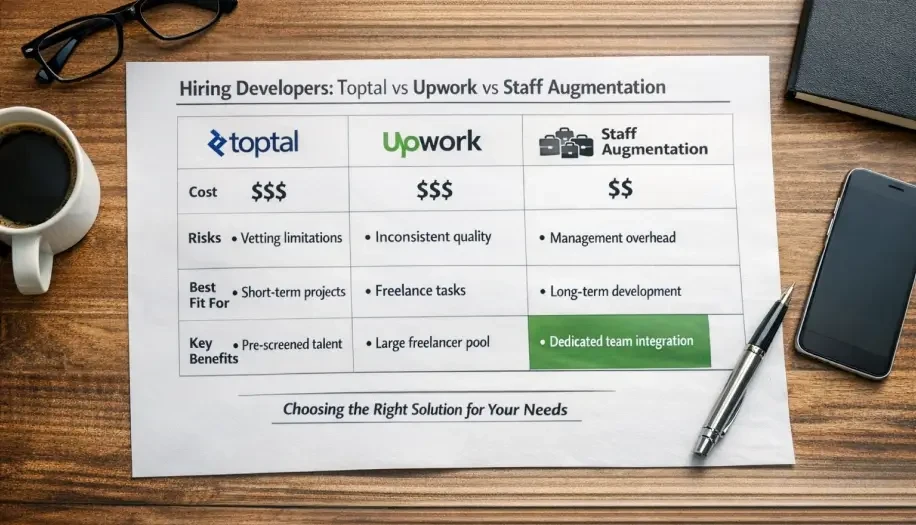
Toptal vs Upwork vs Staff Augmentation: An Honest CTO's Guide for 2026
Toptal, Upwork, and staff augmentation each solve a different problem. This honest vendor-side guide covers what each model actually costs, where each one breaks down, and which fits your situation.
Acquaint Softtech
March 16, 2026India (Head Office)
203/204, Shapath-II, Near Silver Leaf Hotel, Opp. Rajpath Club, SG Highway, Ahmedabad-380054, Gujarat
USA
7838 Camino Cielo St, Highland, CA 92346
UK
The Powerhouse, 21 Woodthorpe Road, Ashford, England, TW15 2RP
New Zealand
42 Exler Place, Avondale, Auckland 0600, New Zealand
Canada
141 Skyview Bay NE , Calgary, Alberta, T3N 2K6