

The Developer Hiring Decision Tree: 12 Questions That Tell You Exactly Which Model to Use
After 1,300 projects the hiring model decision follows a predictable pattern. 12 questions map your situation to the right model. The decision takes 5 minutes when you have the right framework.

Mukesh Ram
I run Acquaint Softtech as a software development partner for companies that need developers without the overhead of a full in-house hiring process. After 1,300 projects and 13 years of these conversations, the hiring model decision follows a pattern. Not a complicated one. A pattern I can usually identify in 5 minutes of context. This article gives you the 12 questions that reveal that pattern for your specific situation.

- Founders and CTOs deciding between in-house hiring, staff augmentation, and dedicated teams
- Engineering leads who need more development capacity and are not sure which structure fits
- Procurement leads building a developer acquisition framework for a growing product company
- Anyone who has received conflicting advice about which hiring model is right and needs a structured way to decide
There is three main models for adding developer capacity to a product company: direct in-house hiring, staff augmentation where a vetted developer joins your team under your direction, and a dedicated development team where a vendor owns the structure and continuity of the team. Each one is the right answer in a specific set of circumstances. The decision tree below finds that set of circumstances for your situation.
The vendor selection guide covers the evaluation process once you know which model you need. This article is the step that comes before it.
The 3 Models: What Each One Actually Provides
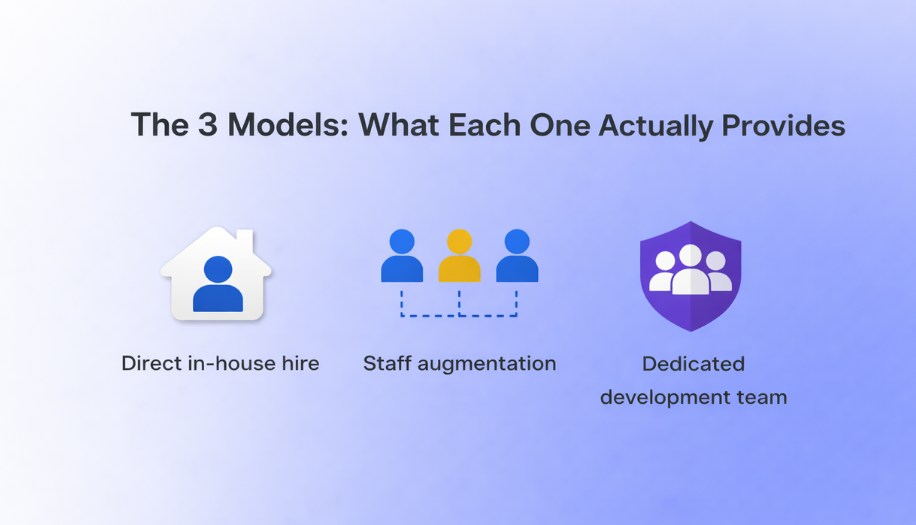
Before the questions, a plain-language description of what each model delivers. The terminology gets used interchangeably by vendors. The definitions below are what matters in practice.
Direct in-house hire |
You recruit, employ, and manage the developer. Full-time salary, employer costs, benefits. Developer is on your payroll, under your culture, building long-term institutional knowledge. Right when: the role is permanent, deeply embedded in your culture and product, and your organisation has the HR infrastructure to support it. |
Staff augmentation |
A vetted developer joins your team under your technical direction. Employed by the vendor. You manage their day-to-day work. Billed monthly. No employer costs, no recruitment overhead. Right when: you need capacity fast, the scope is ongoing but not indefinite, and you have the internal technical leadership to direct the developer. |
Dedicated development team |
A team structure owned by the vendor. Vendor handles composition, continuity, and quality standards. You direct the product. Right when: you want to hand over delivery accountability rather than manage developers day to day. |
Section 1: The 12 Question Decision Tree
Answer each question and note the model it points toward. The model that appears most often across all 12 is the right fit for your current situation.
Q1: How urgently do you need the developer? |
A: Within 2 to 4 weeks B: 3 to 6 months is acceptable C: 2 to 6 months is fine Insight: Urgency eliminates in-house hiring as an option for most companies. Staff augmentation deploys in 48 hours. In-house recruitment averages 8 to 14 weeks at best. |
Q2: Is this a permanent role or capacity for a defined period? |
A: Ongoing permanent role B: 6 to 24 months C: Project or phase-based Insight: Permanent roles with deep culture and product embedding are the strongest case for direct hiring. Fixed-period needs are the strongest case for staff augmentation or dedicated teams. |
Q3: Do you have a strong internal tech lead who can direct the developer daily? |
A: Yes, fully capable B: Partially capable C: No dedicated technical leadership Insight: Staff augmentation requires strong internal direction. Without a capable tech lead, a staff-aug developer quickly becomes under-managed. Dedicated teams shift the management accountability to the vendor. |
Q4: What is your monthly budget for this capacity? |
A: Over $12,000/month B: $3,500 to $12,000/month C: Under $3,500/month Insight: In-house hiring in the US or UK starts at $12,000/month in salary alone before employer costs. Staff augmentation in India runs $3,500 to $9,000/month all-inclusive. Budget shapes the option set before anything else does. |
At this point in the framework, the first four questions usually establish a clear front-runner. If all four point in the same direction, the remaining questions confirm it. If they split, the remaining eight break the tie. Our staff augmentation model covers all three engagement types depending on which outcome the framework produces. The 5-minute self-assessment version of this framework is also available if you want a faster read before going through all 12.
Q5: How important is cultural fit and long-term institutional knowledge? |
A: Critical to the role B: Useful but not essential C: Secondary to speed and cost Insight: Roles requiring deep product ownership and long-term cultural alignment favour in-house. Roles focused on delivery output where context is documented and transferable are good candidates for augmentation. |
Q6: How defined is the scope of work? |
A: Fully defined sprint tasks B: Evolving but generally clear C: Unclear and still forming Insight: Augmented developers work best with defined tasks under a clear technical lead. A developer joining without clear task definition and without strong direction will underperform regardless of their capability. |
Q7: Do you need the developer on-site or can they work fully remote? |
A: On-site required B: Hybrid preferred C: Fully remote is fine Insight: On-site requirements eliminate offshore augmentation. Hybrid is achievable in some time zone configurations. Fully remote opens the full global talent market. |
Q8: What happens to this role in 12 months? |
A: Still needed, probably expanded B: Unclear C: Likely complete or reduced Insight: A role with a clear 12-month expansion trajectory is worth the in-house investment. A role that might not exist in 12 months is a strong case for augmentation over hiring. |
Already Have a Strong Sense of Which Model? Let Us Confirm It.
Tell me your team size, your urgency, and your budget range. I will tell you which model the decision tree points to for your situation and which Acquaint engagement structure matches it. This conversation takes 15 minutes and produces a specific recommendation, not a product pitch.
Section 2: The Final 4 Questions to Break Ties
If the first 8 questions split evenly between two models, these final 4 break the tie. They are the questions that reveal the highest-leverage variable in your specific situation.
Q9: What is your tolerance for employer-side risk and administration? |
A: Low: want full employer infrastructure B: Medium: willing to manage some HR C: Zero: want pure output relationship Insight: In-house hiring creates full employer relationship: compliance, benefits, performance management, termination process. Augmentation moves most of this to the vendor. Dedicated teams move all of it. |
Q10: How much management bandwidth can you dedicate to this developer? |
A: 5+ hours per week available B: 1 to 3 hours per week C: Near zero: need self-managing Insight: Augmented developers under a strong internal tech lead work with 1 to 3 hours of management per week. Without that bandwidth, a dedicated team model where the vendor carries the management function is more realistic. |
Q11: Have you had a bad experience with a specific model before? |
A: Yes, bad in-house hire B: Yes, bad augmentation experience C: No previous experience Insight: A bad in-house hire is usually a hiring process problem. A bad augmentation experience is usually a vendor selection or onboarding problem. The model is rarely the issue. Diagnosing what went wrong is more useful than avoiding the model entirely. |
Q12: What does success look like in 90 days? |
A: Deep product ownership and architecture thinking B: Specific features delivered on time C: Team operating at velocity with minimal management Insight: Each 90-day success definition maps to a different model. Augmentation excels at feature delivery with directed management. Dedicated teams excels at sustained velocity. In-house excels at long-term product ownership. |
Section 3: Reading Your Results

Count which model each question pointed toward. The model that appears most often is the right fit for your current situation. Here is what each outcome means in practice.
Mostly in-house |
Your situation calls for permanent, embedded talent. Budget for it properly: full employer cost model (salary + 50 to 80% for taxes, benefits, and recruitment) and a 12 to 16 week timeline to hire. Do not use augmentation as a shortcut because it will cost more in the medium term if the role is genuinely permanent. |
Mostly staff augmentation |
You need capacity fast, your scope is defined, and your technical leadership can direct the developer. This is the most common answer for growth-stage SaaS and digital product companies. Deployment in 48 hours, monthly billing, no employer overhead. |
Mostly dedicated team |
You need the vendor to own the structure of delivery rather than managing developers directly. Right when the internal tech lead capacity is limited or when you want the vendor to handle team continuity and quality management rather than carrying that yourself. |
Split result |
Your situation is between stages. The most common split is augmentation vs dedicated team, which usually means you need augmentation now with a plan to evaluate the dedicated team model in 3 to 6 months as the engagement matures. |
For the detailed side-by-side of what in-house hiring actually costs versus the augmentation model, the in-house vs augmentation cost comparison covers every line item. And if you want to see how a dedicated development team structure differs from individual augmentation in terms of what the vendor owns versus what you own, the comparison is in the dedicated teams service page.
Section 4: The Shortcuts That Cost More Than the Decision
Three patterns come up repeatedly when companies make the hiring model decision for the wrong reasons. Each of them saves time in the short term and cost significantly more over the following 6 to 12 months.
Using augmentation when you need in-house
Augmentation works for ongoing capacity needs. It is not a substitute for a permanent role that requires years of product context, cultural embedding, and long-term technical ownership. If you need a technical co-founder or a long-term CTO equivalent, augmentation delays the inevitable hire at an ongoing cost.
Hiring in-house because it feels more committed
A full-time hire is not a sign of commitment. It is a cost structure decision. If the role does not need permanent full-time presence, the in-house hire produces the same output at 2 to 3x the total cost. The commitment signal can be sent through contract length and engagement depth without the employer overhead.
Choosing the cheapest model rather than the right one
The cheapest augmentation option is not the same product as a well-structured engagement. An augmented developer without a proper onboarding process, clear task definition, and direct access to your tech lead will underperform regardless of their hourly rate. The model is right; the execution is what determines whether it delivers.
When you are ready to brief vendors, hire remote developers through a structured vendor with 48-hour deployment. The framework above tells you which model to request. The vendor evaluation guide covers how to evaluate the vendor once you know what you need.
Take the Decision Tree. Then Talk to Us.
If you have run through all 12 questions and want a second opinion on whether the result fits your actual situation, send me the answers. I read every message personally. If the model the decision tree produced is wrong for a specific reason in your context, I will tell you why and what the right answer is.
Frequently Asked Questions
-
Which developer hiring model is most popular for SaaS product companies in 2026?
Staff augmentation is the most common model for growth-stage SaaS companies with existing technical leadership. It provides deployment speed, cost predictability, and flexibility without the employer overhead of direct hiring. Dedicated team structures are common for companies that have grown past having an internal tech lead manage individual developer direction. Direct in-house hiring remains dominant for senior roles that require deep long-term product ownership.
-
How do I know if my team has enough technical leadership capacity for staff augmentation?
A useful test: can your tech lead define clear sprint tasks for an additional developer and review their PR output within one working day per week? If yes, augmentation is viable. If your tech lead is already at capacity managing the existing team, adding an augmented developer without additional management structure produces a developer without sufficient direction. The symptom is usually slow velocity despite adding headcount.
-
Is a dedicated development team more expensive than staff augmentation?
At equivalent seniority levels, dedicated team structures run 10 to 20% higher than individual augmentation because the vendor takes on delivery management overhead. The comparison changes when you factor in the client's internal management time. If managing an augmented developer requires 4 to 6 hours per week of your tech lead's time, the loaded cost of augmentation often exceeds the dedicated team rate. The right comparison is total cost including internal overhead, not invoice rate alone.
-
Can I switch models mid-engagement if my needs change?
Yes. Most well-structured vendors allow model transitions between engagements. Moving from individual augmentation to a dedicated team structure typically happens at the start of a new billing cycle with a 2 to 4 week transition period. The reverse is also possible. The key is choosing a vendor whose contract structure allows this flexibility rather than one who locks you into a fixed model for 12 months.
-
What is the minimum team size that justifies a dedicated development team model?
A dedicated team model makes sense when you need at least 2 to 3 developers with sustained delivery accountability over 6 months or more. Below that threshold, individual augmentation is simpler and more cost-effective. Above 5 developers, the management overhead of running individual augmented developers under your internal direction typically exceeds the cost premium of a dedicated team model with vendor-managed structure.
-
Does the hiring model affect IP ownership?
The hiring model determines the default IP ownership structure if you do not specify otherwise in the contract. In-house employees produce work owned by the employer by default. Augmented developers and dedicated teams require explicit IP assignment clauses in the vendor contract. Any reputable vendor includes IP assignment as a standard term. If a vendor treats IP assignment as a negotiation point rather than a default, that is a red flag worth investigating before signing.
-
How long does it typically take to see results from each model?
Direct in-house: 12 to 18 weeks to first full productivity (including recruitment, notice period, and onboarding).
Staff augmentation with a structured vendor: 2 to 3 weeks to first sprint delivery, full velocity by week 6 to 8.
Dedicated team: similar to augmentation at the individual developer level, with the added 2 to 4 week period for the team structure to establish its rhythm.
The urgency variable alone eliminates direct hiring for most growth-stage companies with a quarterly delivery target.
I love to make a difference. Thus, I started Acquaint Softtech with the vision of making developers easily accessible and affordable to all. Me and my beloved team have been fulfilling this vision for over 15 years now and will continue to get even bigger and better.
Table of Contents
Get Started with Acquaint Softtech
- 13+ Years Delivering Software Excellence
- 1300+ Projects Delivered With Precision
- Official Laravel & Laravel News Partner
- Official Statamic Partner
Related Reading
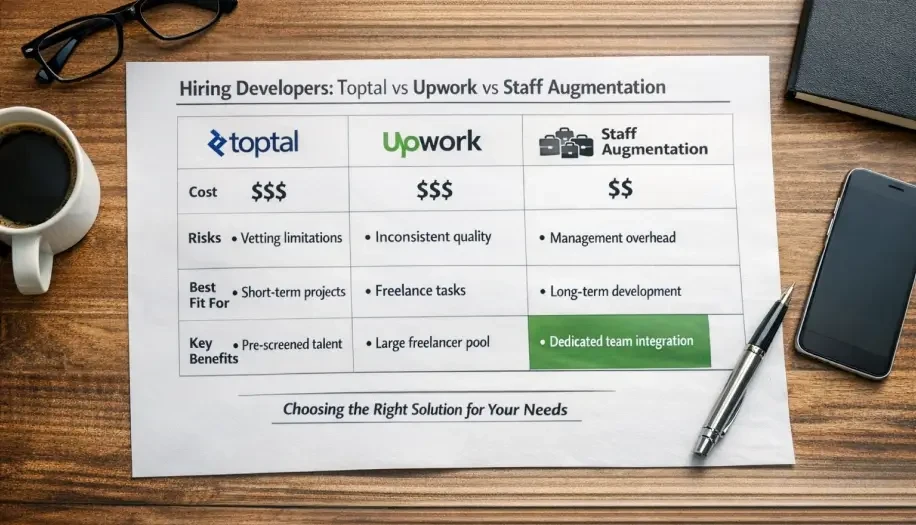
Toptal vs Upwork vs Staff Augmentation: An Honest CTO's Guide for 2026
Toptal, Upwork, and staff augmentation each solve a different problem. This honest vendor-side guide covers what each model actually costs, where each one breaks down, and which fits your situation.

Acquaint Softtech
March 16, 2026
Still Thinking About Staff Augmentation? Take This 5-Minute Self-Assessment
Most CTOs who are still thinking about staff augmentation after 3 months are not missing information. They are missing one decision. This 10-question self-assessment identifies exactly which one.
Acquaint Softtech
March 30, 2026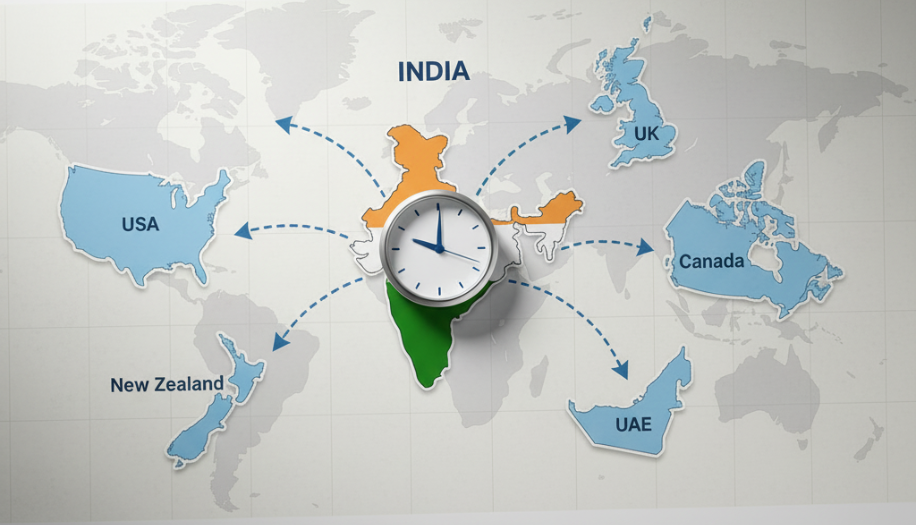
Why India Still Leads Staff Augmentation in 2026 And Why Timezone Objections Are Outdated
The timezone objection to Indian dev teams is outdated. In 2026, structured async workflows and overlap windows make it a non-issue. Here is what the data actually shows.
Acquaint Softtech
March 11, 2026India (Head Office)
203/204, Shapath-II, Near Silver Leaf Hotel, Opp. Rajpath Club, SG Highway, Ahmedabad-380054, Gujarat
USA
7838 Camino Cielo St, Highland, CA 92346
UK
The Powerhouse, 21 Woodthorpe Road, Ashford, England, TW15 2RP
New Zealand
42 Exler Place, Avondale, Auckland 0600, New Zealand
Canada
141 Skyview Bay NE , Calgary, Alberta, T3N 2K6