

Still Thinking About Staff Augmentation? Take This 5-Minute Self-Assessment
Most CTOs who are still thinking about staff augmentation after 3 months are not missing information. They are missing one decision. This 10-question self-assessment identifies exactly which one.

Acquaint Softtech
The Average CTO Thinks About This for 3 Months Before Acting
We track the gap between a first inquiry and an engagement start. Across our pipeline the average is 11 weeks. That is 11 weeks of a capacity gap that the team worked around, a backlog that grew faster than the team could clear it, and sprint commitments that were scaled down to match an understaffed team.
The decision is not complicated. Most CTOs who are still thinking about it after 3 months are not missing information. They are missing one specific thing: the clarity to make the call.
This self-assessment is designed to produce that clarity in 5 minutes. Ten questions. A scored result that tells you exactly where you are, what is actually blocking the decision, and what to do next. If you want the full cost comparison before starting, read our staff augmentation vs Upwork vs agency breakdown first. If you already know the costs and are still thinking, start here.

- Answer each question based on your situation right now, not the ideal situation you are planning for.
- Add up your points as you go. There is a scoring key at the end.
- The result is a starting point for a conversation, not a contract. But it is a more honest starting point than another week of thinking about it.
- Total time: approximately 5 minutes.
The 10-Question Self-Assessment
Score each question as directed. Keep a running total.
Question 1: Does your current team have a backlog that is growing faster than it is being cleared? |
YES (+3 points) Capacity gap confirmed: The backlog is growing because your team does not have enough capacity to clear it at the rate the business is generating requirements. This is the primary signal that augmentation is warranted. |
NO (+0 points) Backlog is stable or shrinking: Your current team may have sufficient capacity. The decision about staff augmentation should be based on future roadmap requirements, not current capacity. |
Question 2: Have you scaled down sprint commitments in the last 2 months to match team capacity rather than roadmap requirements? |
YES (+3 points) Sprint scope reduced to fit team: Reducing sprint commitments is a signal that the team is already at capacity and the backlog is growing. You are managing the symptom rather than the capacity gap. |
NO (+0 points) Sprint scope reflects roadmap: Your sprint commitments are meeting the roadmap requirements. Augmentation may be forward-looking rather than reactive. |
Question 3: Is there a specific feature, integration, or technical capability that your team lacks and that is delaying a business-critical deliverable? |
YES (+2 points) Specific skill gap identified: A skill gap delaying a specific deliverable is a targeted augmentation need. You know exactly what you need and why, which makes the decision straightforward. |
NO (+1 points) No specific skill gap: You may be considering augmentation for general capacity rather than a specific skill gap. Both are valid but require different engagement structures. |
Question 4: Do you have a sprint process, a defined definition of done, and a code review standard currently in place? |
YES (+2 points) Process is in place: A structured development process makes it significantly faster to onboard a new developer. They have a process to follow from Day 1. Without this, augmentation adds a developer who has no system to operate within. |
NO (+1 points) Process is informal or undocumented: Before augmenting, spend 2 to 3 days documenting your process. A developer onboarding into an undocumented process will slow your team down for the first 3 weeks rather than accelerating it. |
Question 5: Can you define the first sprint task for a new developer right now, with written acceptance criteria, in 30 minutes or less? |
YES (+2 points) First task ready to assign: The ability to scope and assign a first task immediately is a strong signal of operational readiness. It means the developer can start contributing from Day 1 rather than from Day 5 after you figure out what to give them. |
NO (+1 points) First task would take significant planning: Spend time defining the first task and its acceptance criteria before you start the engagement. The first task is the most important factor in the 14-day to first production code timeline. |
Question 6: Is your hesitation about staff augmentation primarily driven by budget concerns? |
YES (+0 points) Budget is the primary hesitation: Budget concern is a resolvable objection, not a disqualifying one. The average staff augmentation developer at Acquaint costs $22 to $35 per hour versus $80 to $150 for a US-based hire. The cost comparison is not close. If budget is the concern, the right next step is a specific cost comparison for your situation, not continued evaluation. |
NO (+2 points) Budget is not the primary concern: Your hesitation is operational or strategic rather than financial. The questions below identify the specific operational concern. |
Question 7: Have you previously worked with a remote or offshore developer on any engagement? |
YES (+1 points) Yes, previous offshore experience: Previous experience with remote or offshore developers significantly reduces the operational uncertainty. You know what onboarding looks like, what the communication patterns need to be, and what to watch for in the first sprint. |
NO (+2 points) No previous offshore experience: First-time offshore engagement adds learning curve to the operational decision. Not a reason not to proceed, but a reason to be more deliberate about the onboarding preparation (README, access, first task) before Day 1. |
Question 8: Is your next major product milestone (launch, investor demo, major client delivery) within the next 90 days? |
YES (+3 points) Major milestone within 90 days: A 90-day deadline changes the calculation. With a 48-hour deployment and an 11-day path to production code, a developer started today can make a meaningful contribution to a 90-day milestone. A developer started in 6 weeks cannot. |
NO (+1 points) No major milestone within 90 days: Without a near-term milestone, the urgency is lower but the compound cost of delay is still real. Every sprint that runs understaffed is a sprint that cannot be recovered. |
Question 9: Has your internal team mentioned capacity, workload, or sprint pressure as a concern in the last month? |
YES (+2 points) Team has raised capacity concerns: Your team is signalling the capacity constraint directly. Engineers who raise workload concerns without a resolution are engineers who are beginning to look at alternatives. The cost of replacing an engineer who burns out is 3 to 6 months of team productivity. |
NO (+0 points) No capacity concerns raised internally: Either your team has sufficient capacity or they are absorbing the pressure without raising it. Worth a direct conversation before assuming the latter. |
Question 10: If you were told that a vetted senior Laravel developer could be in your sprint in 48 hours, would you say yes right now? |
YES (+3 points) Yes, I would move immediately: This is the clearest signal of all. If the only thing between you and an engagement start is the logistics, the decision is already made. The logistics take 48 hours. |
NO (+1 points) No, I still have questions: The questions remaining after this assessment are operational, not informational. The most common ones: how do I onboard them, what do I give them first, and how do I know if they are performing. All are answerable before Day 1. |
Your Score: What It Means and What to Do
Add up your points from all 10 questions. Maximum possible score: 21 points.
16 to 21 Points | The decision is already made. You are in the research phase for a decision you have already reached.Every indicator points to a genuine, current capacity gap with the operational readiness to address it. The research phase is costing you sprint cycles. The backlog is growing. The team is absorbing pressure. The developer who could have been in production 3 weeks ago still is not there. Next step: Contact Acquaint Softtech today. Tell us your stack, your team size, and your next sprint date. We deploy in 48 hours. |
10 to 15 Points | Ready with 1 or 2 things to resolve first.You have a genuine capacity need and most of the operational readiness in place. One or two specific gaps are creating hesitation. The most common: process documentation is incomplete, or the first task for a new developer is not defined yet. Both are 1 to 2 day fixes, not reasons to delay the engagement. Next step: Identify the specific gap from your lowest-scoring questions. Fix that one thing. Then start the engagement. Do not wait for everything to be perfect. |
5 to 9 Points | Capacity need is real but operational readiness needs attention.The capacity gap exists but the team or process is not yet set up to extract value from an augmentation developer quickly. Without preparation, the developer will slow the team down for 2 to 3 weeks rather than accelerating it. The right move is to prepare the onboarding environment first, then start the engagement. Next step: Spend 1 week writing the README, defining the first sprint tasks, documenting your code review standards. Then re-take this assessment. You will score higher. |
0 to 4 Points | Staff augmentation is probably not the right immediate answer.Either the capacity gap is not significant enough to justify a new engagement, or the process and operational infrastructure needed to support it are too undeveloped. Augmenting into an unstructured team typically produces 3 weeks of overhead for every developer added. The investment in process documentation and team structure first will produce more output than adding a developer to the current state. Next step: Focus on process and capacity measurement first. Return to this assessment in 30 days after implementing structured sprints and a defined onboarding process. |
You Have the Score. Here Is What to Do With It.
If you scored 10 or above, the remaining questions are operational, not informational. We can answer them in a 15-minute conversation: who you get, what they know on Day 1, what the first sprint looks like, and what happens if they are not the right fit. That conversation costs nothing and closes the remaining gap between your score and your start date.
The Cost of Each Month You Wait
Decision delay is not neutral. Every month the engagement does not start has a compounding cost across three dimensions. This table makes that cost specific.
Month of Delay | Backlog Accumulation | Competitor Advantage | Internal Team Cost |
Month 1 | 2 to 4 sprints of deferred features | Competitors ship 1 to 2 additional cycles while you plan | Team absorbs 10 to 20% more pressure per sprint. No visible consequence yet. |
Month 2 | 4 to 8 sprints of deferred features | Competitor differentiation begins to compound. Features you deferred are now in their product. | Engineer overtime or scope reduction becomes routine. First retention risk signals appear. |
Month 3 | 6 to 12 sprints of deferred features | A competitor has shipped what your roadmap promised 3 months ago. Recovery requires 2x the effort. | High performer begins passive job search. If they leave, replacement cost is 3 to 6 months of productivity. |
The Number Most CTOs Underestimate
The average cost of replacing a senior engineer who burns out or leaves due to sustained overwork: 3 to 6 months of team productivity lost, plus $15,000 to $40,000 in recruiting and onboarding cost.
The cost of a staff augmentation developer for 3 months to prevent that burnout: $8,000 to $15,000.
The economics are not close. The comparison is rarely made because the engineer departure and the augmentation decision feel like separate problems. They are the same problem viewed from different points in time.
The 5 Objections That Keep CTOs Stuck
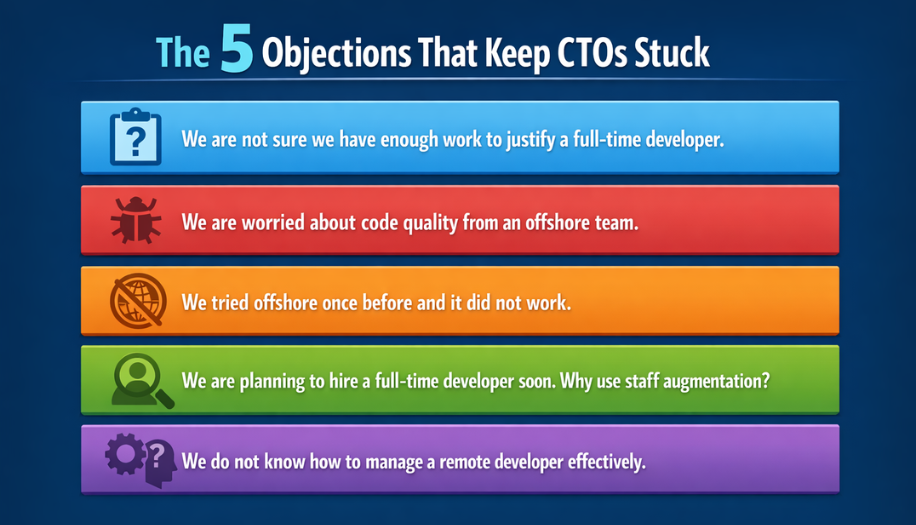
These are the five most common objections we hear from CTOs who have been thinking about staff augmentation for more than 6 weeks. Each one has a specific answer.
We are not sure we have enough work to justify a full-time developer.
You do not need a full-time developer. Staff augmentation is flexible by design. A part-time engagement (20 hours per week) or a 3-month engagement for a specific deliverable is a standard model. If you have a backlog growing by 2 or more sprint tasks per week, you have enough work to justify at least a part-time augmentation.
We are worried about code quality from an offshore team.
Code quality from an offshore team is a function of the vendor's hiring and review standards, not the offshore location. Acquaint Softtech maintains a 15-point technical assessment before any developer is placed. Our code review standards are documented and applied to every engagement. The offshore location affects the timezone and the rate. It does not affect the engineering discipline of the developer you receive.
We tried offshore once before and it did not work.
The most common reasons a previous offshore engagement failed: no structured onboarding process, first task too complex, PR review too slow, sprint scope undefined. None of these are inherent to offshore development. All of them are avoidable with the right preparation. If you can identify which of these caused the previous failure, we can show you specifically how the current engagement would be different.
We are planning to hire a full-time developer soon. Why use staff augmentation?
Two reasons. First: the average time from job posting to offer acceptance for a senior developer in 2026 is 6 to 12 weeks. That is 6 to 12 more weeks of an understaffed team. Staff augmentation fills that gap in 48 hours. Second: the staff augmentation developer produces institutional knowledge and sprint history that accelerates the onboarding of the full-time hire. These are complements, not alternatives.
We do not know how to manage a remote developer effectively.
You do not need to learn a new management system. Staff augmentation with Acquaint integrates the developer directly into your existing sprint process. They attend your standups, work in your Jira, commit to your GitHub, and communicate in your Slack. The management approach is the same as managing any sprint contributor. We provide a Week 1 check-in and ongoing support if specific management questions arise.
The Objection That Is Still in Your Head Is the One We Have Heard Most Often.
After 13 years and 1,300+ projects, every objection in this article has been raised with us before. Most of them have been raised by the same CTO who later said the engagement was one of the best decisions they made that quarter. Tell us the specific concern that is still unresolved. We will give you a direct answer, not a sales response.
What Operational Readiness Actually Looks Like
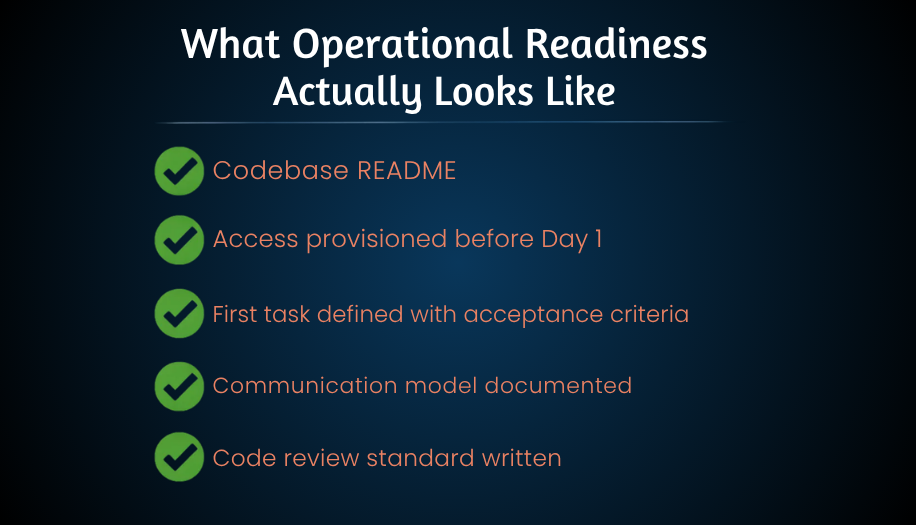
If your assessment score was 10 to 15 and the gap is operational readiness, here is the specific list of what needs to be in place before Day 1. The full week-by-week onboarding framework is in our remote Laravel developer onboarding checklist. This section covers the minimum viable readiness for the engagement to start successfully.
Codebase README | A step-by-step local setup guide, key dependencies and versions, how to run tests, how to deploy to staging, and any non-obvious architecture patterns. Time to write: 2 to 4 hours. Time saved: 2 to 4 days of ramp-up. |
Access provisioned before Day 1 | GitHub with appropriate branch permissions, Jira or Linear with active sprint visible, Slack with relevant channels, staging environment URL and credentials. All of this before the developer's first working hour, not during it. |
First task defined with acceptance criteria | A specific, completable task for the first 2 days. Not an exploration task. Not a full feature build. A bug fix with a clear expected behaviour or a small well-scoped feature addition with written acceptance criteria. |
Communication model documented | Standup format (written or video), time, channel, and blocker escalation path. One paragraph. Sent to the developer before Day 1. |
Code review standard written | Your conventions for PR structure, naming, testing expectations, and what constitutes a merge-ready PR. Referenced in the first PR review. Prevents the most common first-sprint friction. |
The 5-Minute Assessment Has Taken 10 Minutes. That Is Already Progress.
If you have read this far and you scored 10 or above, the decision is not complicated. It is just not yet made. The backlog is growing while it is not made. The sprint commitments are being scaled down to match an understaffed team while it is not made.
Acquaint Softtech deploys pre-vetted senior Laravel developers within 48 hours. The developer arrives briefed on your company and stack from our scoping call. The first PR target is Day 3. Production code by Day 11. Full sprint velocity by Day 14. The process is already built. You bring the README and the first task. We bring the rest. Start with our contact page.
Staff Augmentation | Laravel Development Services |
FAQ's
-
How is staff augmentation different from hiring a freelancer?
Staff augmentation through a vendor like Acquaint Softtech provides a full-time employed developer who integrates directly into your sprint process. The developer is not managing multiple clients simultaneously. They are dedicated to your engagement during the engagement period. They are backed by a vendor who manages performance, handles replacement if needed, provides the legal and operational structure of a B2B contract, and maintains the delivery standards across the engagement. A freelancer on Upwork or a similar platform is self-employed, managing their own client load, and operating without the vendor infrastructure that supports quality consistency.
-
How quickly can a staff augmentation developer actually be productive?
With the correct onboarding preparation (README ready before Day 1, access provisioned, first task defined with acceptance criteria), the first PR is typically submitted by Day 3 and the first production code ships by Day 11. Full sprint velocity is established by Day 14. Without that preparation, the timeline extends to 3 to 5 weeks for the same outcome. The preparation is the variable, not the developer.
-
What if the developer is not the right fit?
Replacement is initiated within 48 hours at no additional cost. The replacement developer receives a full briefing from the exiting developer on codebase context, sprint history, and known technical decisions. We have done this. It has not damaged a single client relationship when handled with the process we have in place. The risk of a first developer not being the right fit is real but manageable. It is significantly lower than the risk of 12 more weeks of an understaffed team.
-
Is there a minimum engagement length?
Our standard minimum is 3 months. This is because the compounding value of staff augmentation grows with engagement duration. A developer at month 1 has learned the codebase. A developer at month 3 has institutional knowledge, established relationships with your internal team, and a sprint history that makes every subsequent sprint faster. Engagements shorter than 3 months can be arranged for specific project needs but the per-sprint value is lower because onboarding is a larger proportion of the engagement.
We’re Acquaint Softtech, your technology growth partner. Whether you're building a SaaS product, modernizing enterprise software, or hiring vetted remote developers, we’re built for flexibility and speed. Our official partnerships with Laravel, Statamic, and Bagisto reflect our commitment to excellence, not limitation. We work across stacks, time zones, and industries to bring your tech vision to life.
Table of Contents
Get Started with Acquaint Softtech
- 13+ Years Delivering Software Excellence
- 1300+ Projects Delivered With Precision
- Official Laravel & Laravel News Partner
- Official Statamic Partner
Related Reading

Staff Augmentation vs Upwork vs Agency: Real Cost Breakdown for CTOs in 2026
Staff augmentation, Upwork, or a dev agency? The real cost difference in 2026 is bigger than most CTOs expect. Here are the actual numbers with zero fluff.
Acquaint Softtech
March 8, 2026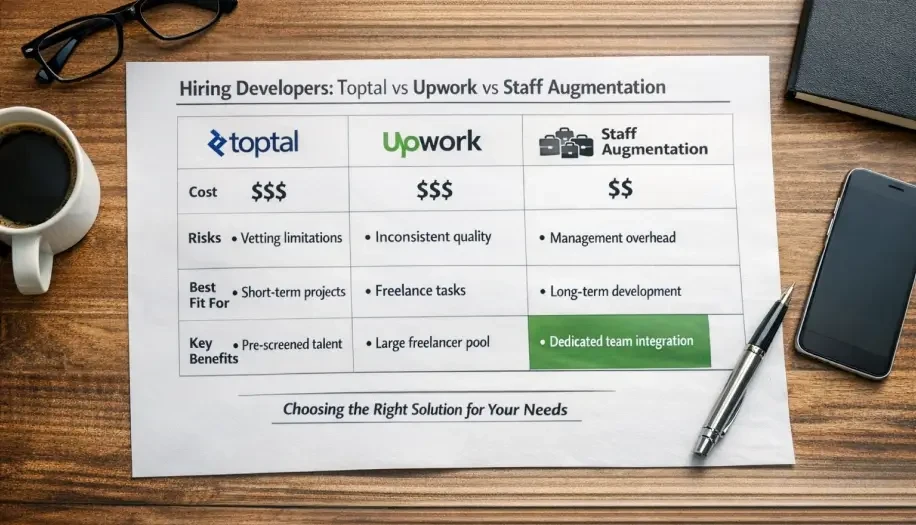
Toptal vs Upwork vs Staff Augmentation: An Honest CTO's Guide for 2026
Toptal, Upwork, and staff augmentation each solve a different problem. This honest vendor-side guide covers what each model actually costs, where each one breaks down, and which fits your situation.
Acquaint Softtech
March 16, 2026
How to Guarantee Code Quality From an Offshore Dev Team: The 6-Layer QA Process
Offshore teams do not write bad code because they are offshore. They write bad code because the quality process was never defined. This 6-layer QA framework fixes that before the first line is written.