

The Complete Guide to E-Commerce & D2C Software Development in 2026
Custom e-commerce software is not a more expensive version of Shopify. It is an entirely different accountability and ownership structure, with different economics and a different ceiling on what your platform can do. This guide explains every architecture type, every cost variable, and every decision checkpoint so you build the right thing in 2026.

Acquaint Softtech
This guide resolves that. It maps the full e-commerce software product development landscape for 2026, compares every major architecture with specific cost ranges and decision triggers, and gives you the exact framework to choose, build, or outsource the right platform for your business stage.
As a software development and staff augmentation partner with over 1,300+ projects delivered across 13 years, Acquaint Softtech has guided D2C (Direct-to-Consumer) brands and online retailers through every stage of e-commerce platform decisions, from initial SaaS evaluation to full custom re-platforming. The problem most founders and CTOs face is not a shortage of options. It is a shortage of clarity: they compare platforms that operate on entirely different economic and technical models, and the frameworks for making that choice are either oversimplified or vendor-biased.

- Founders building travel marketplaces, OTAs, or hotel booking platforms.
- CTOs evaluating custom booking engines vs SaaS travel solutions.
- Hospitality businesses upgrading legacy PMS or reservation systems.
- Agencies and tech teams are migrating travel platforms to cloud-native architecture.
Problem:
Most e-commerce founders choose a platform based on brand recognition or peer recommendation, without a structured framework for their business model, transaction volume, or growth trajectory.
Agitate:
That initial choice becomes a technical ceiling: limited APIs, rigid checkout flows, per-transaction fees that compound at scale, and migration costs that effectively double your original platform investment to exit.
Solution:
A structured decision framework, calibrated to your specific business model and scale, so you choose the right architecture once, build it correctly the first time, and scale without re-platforming.
The e-commerce software category is routinely misrepresented in two directions. SaaS platform vendors present custom development as risky and reserved for enterprise-scale businesses, while many agencies push custom builds to prospects who would be better served by a mid-tier SaaS tool. Neither framing serves the buyer. A well-structured e-commerce software development guide makes it clear that the right architecture is not determined by budget or ambition alone.
It is determined by the nature of your business model, the complexity of your product catalog, your customer relationship structure, and your growth trajectory over the next 24 months. Those four variables, evaluated against correct cost and timeline data, produce a defensible answer every time.
What E-Commerce Software Actually Is in 2026
E-commerce software is not a single product category. It is five distinct architecture types that share a storefront interface but differ fundamentally in ownership, extensibility, and cost structure. Treating them as variants of the same thing is the root of most bad platform decisions.
E-commerce software, defined precisely, is any technology system that enables the complete purchase cycle: product discovery, cart management, checkout, payment processing, order fulfillment, and post-purchase customer management. For teams beginning from a product idea, MVP development services provide a structured path to production-grade e-commerce without over-engineering the initial build.
Storefront Layer
The storefront is the customer-facing interface where products are browsed, filtered, and added to the cart. In SaaS platforms, it is templated and configurable within defined parameters. In custom-built platforms, the storefront is a purpose-built React or Next.js frontend with no template ceiling on performance, UX, or conversion optimization. The storefront layer determines your Core Web Vitals score, page load speed, and mobile checkout experience. Product image quality plays an equally important role, the ability to quickly remove object from photos ensures product shots are clean and distraction-free before they go live on the store.
Commerce Engine Layer
The commerce engine handles catalog management, pricing logic, inventory allocation, cart state, and checkout flow. In Shopify, this engine is managed by the platform vendor, meaning the client inherits the vendor's logic for multi-currency, discount stacking, and checkout customization. In a custom platform, the commerce engine is written to specification. Complex pricing models, subscription logic, and multi-warehouse inventory allocation are native, not workaround-dependent.
Integration and API Layer
Every e-commerce operation requires integrations: ERP (Enterprise Resource Planning), CRM (Customer Relationship Management), payment gateways, shipping carriers, and marketing automation. SaaS platforms offer pre-built connectors, but each carries a per-month cost and an API rate limit ceiling. Custom platforms integrate at the database level, which means no rate limit overhead and no per-integration subscription cost compounding at scale.
Data and Analytics Layer
Who owns your customer data and how it is structured determines your ability to personalize, segment, and optimize. SaaS platforms store data in their infrastructure under their schema with export limitations. Custom platforms write data to client-owned databases, queryable in any format, with no vendor data lock-in. For D2C brands running AI-powered recommendation systems, data ownership is a product requirement.
Admin and Operations Layer
The admin panel is where your team manages orders, products, customers, promotions, and reports. Generic admin panels cover 80% of operations adequately. The gap emerges at scale: bulk product operations, role-based access for large teams, custom reporting dashboards, and integrated returns management. Custom admin panels built to the operations team workflow reduce training time and error rates in high-volume environments.
The E-Commerce Platform Landscape: 5 Architecture Types
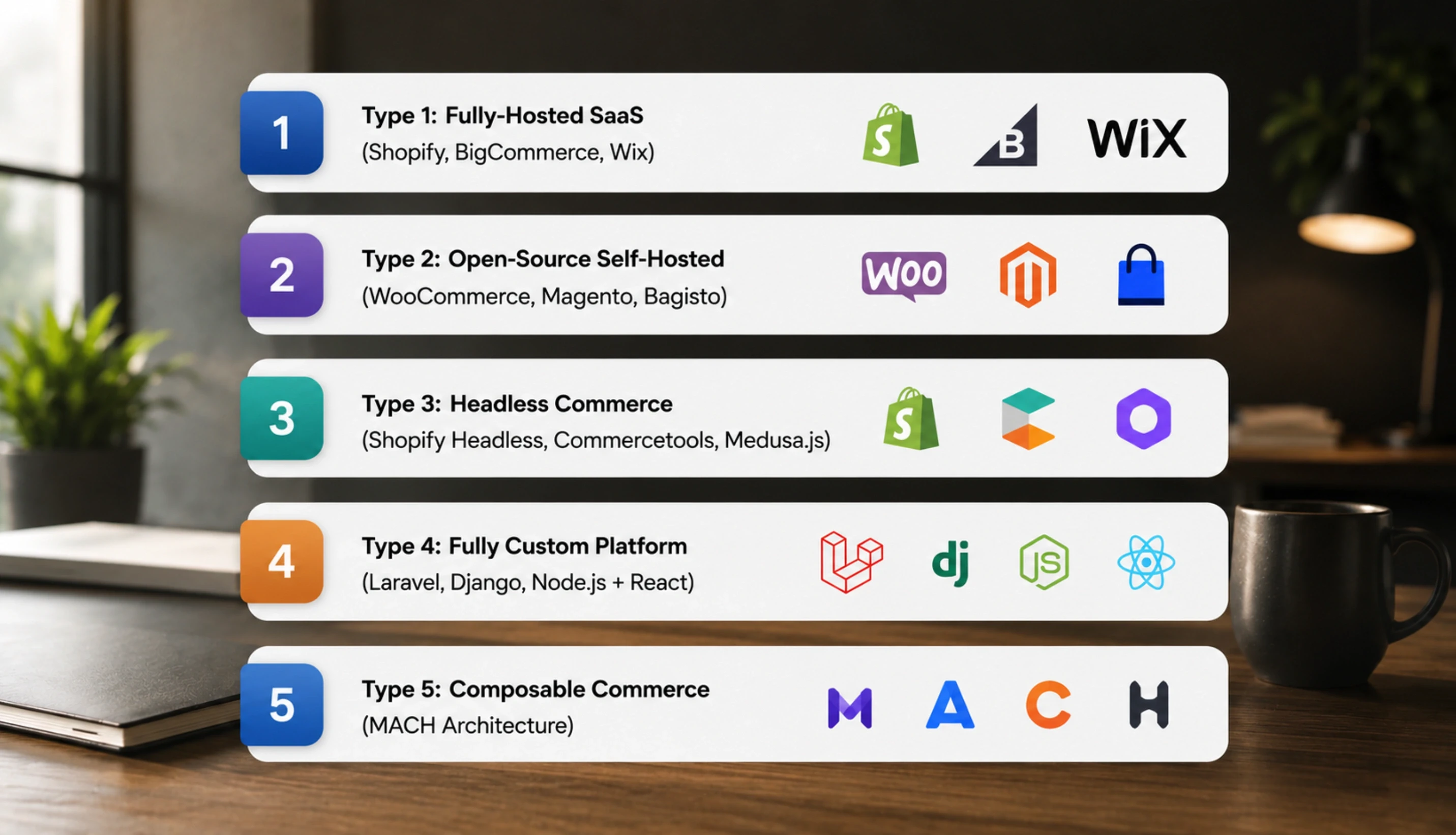
The right model is determined by business model requirements and the growth trajectory over the next 24 months. Dedicated Laravel developers bring the deepest e-commerce ecosystem for PHP-based builds, and white label development partnerships provide an additional model for agencies building stores on behalf of clients.
Type 1: Fully-Hosted SaaS (Shopify, BigCommerce, Wix)
The platform vendor manages everything, including hosting, security, and infrastructure, so the business does not need technical handling. The client pays a monthly subscription fee plus around 0.5% to 2% of GMV, and the setup time is usually 2 to 8 weeks, which makes it a quick launch option. But there is a limitation because the platform depends on the vendor’s roadmap, so customization is restricted, and businesses must adjust according to available features. This model is best for businesses under $2 million annual GMV that sell standard products without complex pricing or workflows, making it suitable for startups and small businesses. For a better understanding of e-commerce regulations and online business guidelines in the US, you can refer to resources from the U.S. Small Business Administration.
Type 2: Open-Source Self-Hosted (WooCommerce, Magento, Bagisto)
The software is open-source, hosted on the client infrastructure, and fully extensible. Build cost is $15,000 to $60,000. Best fit: businesses with existing WordPress infrastructure (WooCommerce) or D2C brands wanting Laravel-native e-commerce with full code ownership (Bagisto). Acquaint Softtech is an Official Bagisto Partner.
Type 3: Headless Commerce (Shopify Headless, Commercetools, Medusa.js)
The commerce engine and storefront are decoupled. The storefront is a custom React or Next.js application consuming commerce APIs. Build cost is $40,000 to $120,000. Best fit: brands with strong frontend requirements but commerce logic that fits within a managed platform.
Type 4: Fully Custom Platform (Laravel, Django, Node.js + React)
Every component is purpose-built. The client owns the full stack: database schema, commerce engine, admin panel, and storefront. The development timeline is 4 to 9 months. Build cost starts at $60,000. Best fit: non-standard catalog structures, complex pricing models, or multi-vendor requirements.
Type 5: Composable Commerce (MACH Architecture)
MACH stands for Microservices, API-first, Cloud-native, and Headless architecture, where each component is built and deployed independently, giving high flexibility, scalability, and faster updates. This approach allows businesses to customize every part of their e-commerce system and integrate with multiple services easily, but it also increases complexity and requires strong technical expertise. The build cost usually exceeds $200,000, making it a high investment option.
It is best suited for enterprise retailers that have dedicated engineering teams and handle high transaction volumes, where performance, scalability, and full control over the system are critical. For more understanding of enterprise technology standards and digital architecture practices in the US, you can refer to resources from the National Institute of Standards and Technology.
Not Sure Which Architecture Fits Your Business?
Acquaint Softtech delivers a structured platform recommendation, including cost comparison between your current setup and a custom build, within 48 hours of a brief. You review developer profiles and the architecture proposal before any engagement begins.
Custom vs Shopify vs WooCommerce: The Structural Comparison
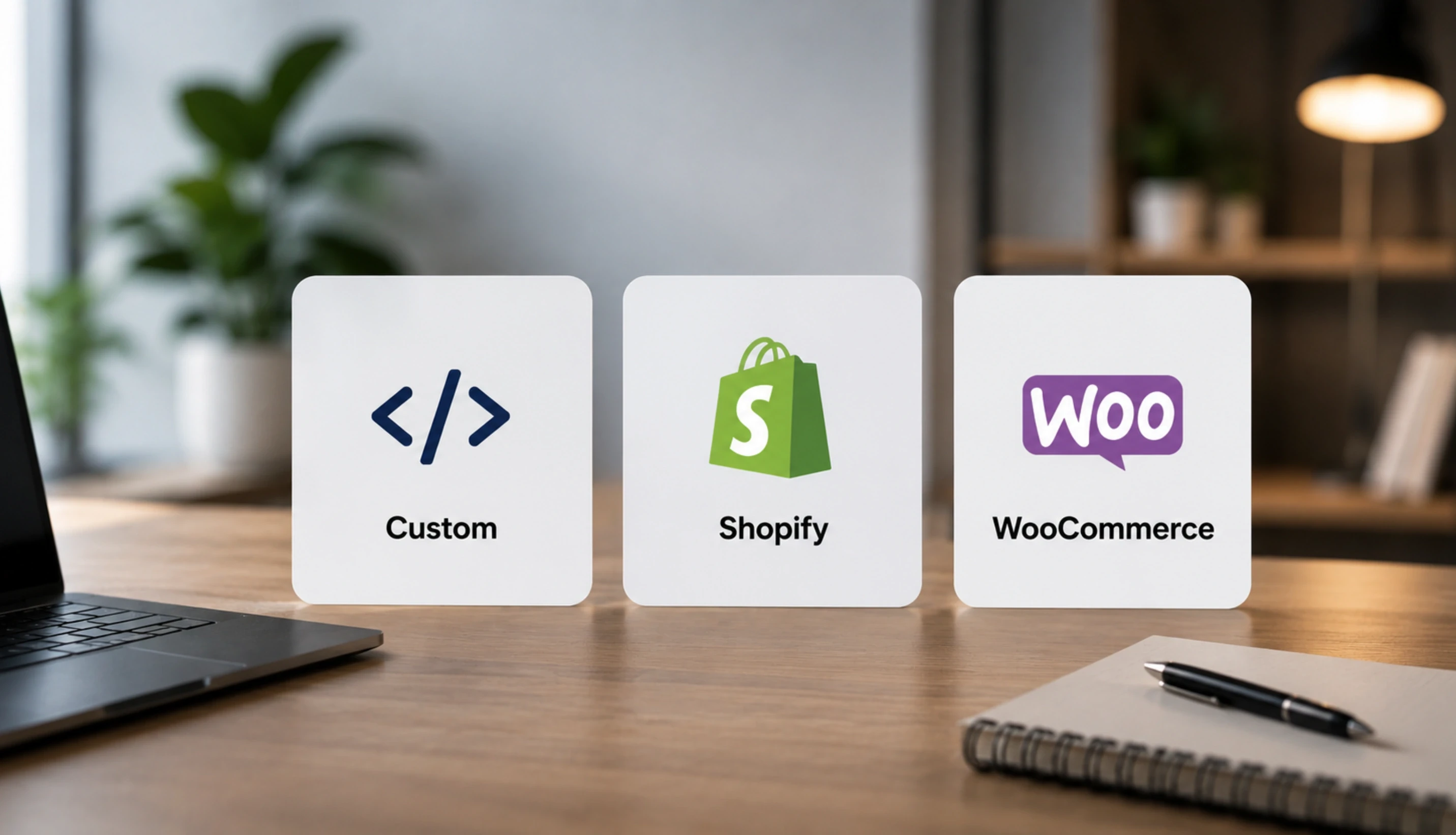
The comparison fails when reduced to a monthly fee. For businesses that have outgrown their current platform, WooCommerce developers handle migration and customization, while a dedicated software development team delivers the full custom build when the business model requires it.
Dimension | Custom Platform | Shopify (Plus) | WooCommerce |
Checkout ownership | Client controls 100% of checkout flow. No vendor restrictions. | Shopify controls checkout. Plus allows extensibility but not full replacement of core logic. | Extensible via hooks but subject to plugin compatibility constraints. |
Data ownership | Client owns the database, schema, and all customer data. No export restrictions. | Data on Shopify servers. CSV exports only. No direct database access. | The client owns a WordPress database. Full access but shared with plugin tables. |
Transaction fees | Zero platform fees. Only payment gateway fees (1.4% to 2.9%). | 0.5% to 2% per transaction unless using Shopify Payments. | No platform transaction fees. Gateway fees only. |
Pricing complexity | Unlimited: tiered pricing, group pricing, subscriptions, dynamic bundles, all native. | Standard pricing; B2B at Plus tier. Complex rules require apps at an added cost. | Plugin-based pricing rules. Conflict risk grows with store complexity. |
Initial investment | $60,000 to $200,000+, depending on scope and team model. | $29 to $2,000+/month. Shopify Plus starts at $2,300/month. | $0 software. $15,000 to $60,000 for a professional build. |
3-year TCO at $3M GMV | $80,000 to $130,000 total, including build, maintenance, and hosting. | $180,000+ (plan fees + apps + agency + transaction fees combined). | $60,000 to $100,000, including hosting, plugins, and maintenance. |
Best fit | Businesses above $2M GMV with complex catalog or D2C fulfillment requirements. | Businesses under $2M GMV with standard products and no complex requirements. | Businesses with existing WordPress presence and moderate complexity needs. |
Key finding: At $3M GMV over 3 years, a custom platform typically costs $50,000 to $100,000 less than Shopify Plus when all fees, app subscriptions, and agency customization costs are included. The crossover point is approximately $1.5M to $2M in annual GMV. |
Want the Exact Cost Comparison for Your GMV?
Share your current GMV, app stack, and platform plan. Acquaint Softtech will send a precise 3-year TCO (Total Cost of Ownership) comparison between your current platform and a custom build within 48 hours. You interview developers before any engagement starts.
D2C Platform Technology: What Direct-to-Consumer Brands Need

D2C e-commerce is a customer relationship architecture. Acquaint Softtech's work with Enrico Trombini, Founder of Lampoo, demonstrated how purpose-built D2C architecture directly reduced cart abandonment and improved site speed. The delivery model is documented in the fashion resale marketplace case study.
For D2C brands requiring AI-powered personalization, custom AI development services integrate recommendation engines and behavioral data pipelines natively into the platform architecture.
Customer Identity and First-Party Data Architecture
D2C brands compete on customer lifetime value (LTV), not product margin. A custom first-party data infrastructure stores customer interactions in client-owned databases structured for CRM, email automation, and AI personalization. SaaS-hosted customer data supports 5 to 15 audience segments. A custom first-party database supports 500 or more, enabling cohort-level personalization that directly affects retention economics.
Subscription and Recurring Revenue Module
Subscription billing requires: recurring charge authorization, dunning management (failed payment retry logic), pause and skip functionality, and subscription tier management. A custom D2C platform builds the subscription engine natively, eliminating app conflicts, reducing failed charge rates, and enabling complex configurations like subscribe-to-replenish alongside standard catalog purchases in a single checkout flow.
Loyalty and Retention Engine
The platform must support: points accumulation, reward redemption, referral program logic, and VIP tier management. Third-party loyalty apps introduce API rate limit constraints, causing points-calculation delays and data fragmentation between the loyalty app and the core customer profile. A native loyalty engine eliminates both problems and reduces per-loyalty-transaction cost to near zero at scale.
AI-Powered Recommendation Engine
A recommendation engine that ingests behavioral data (browse history, purchase history, wishlist additions) and generates ranked product suggestions per customer in real time increases recommendation-to-purchase conversion by 15% to 40% based on delivery benchmarks across the Acquaint Softtech e-commerce portfolio.
Owned Fulfillment and Returns Technology
A self-service return portal with automated authorization and exchange logic reduces customer service contact volume by 30% to 50% in high-volume D2C operations. These are custom operational modules built to the brand-specific fulfillment workflow, carrier relationships, and return policy rules.
The 2026 E-Commerce Tech Stack Guide
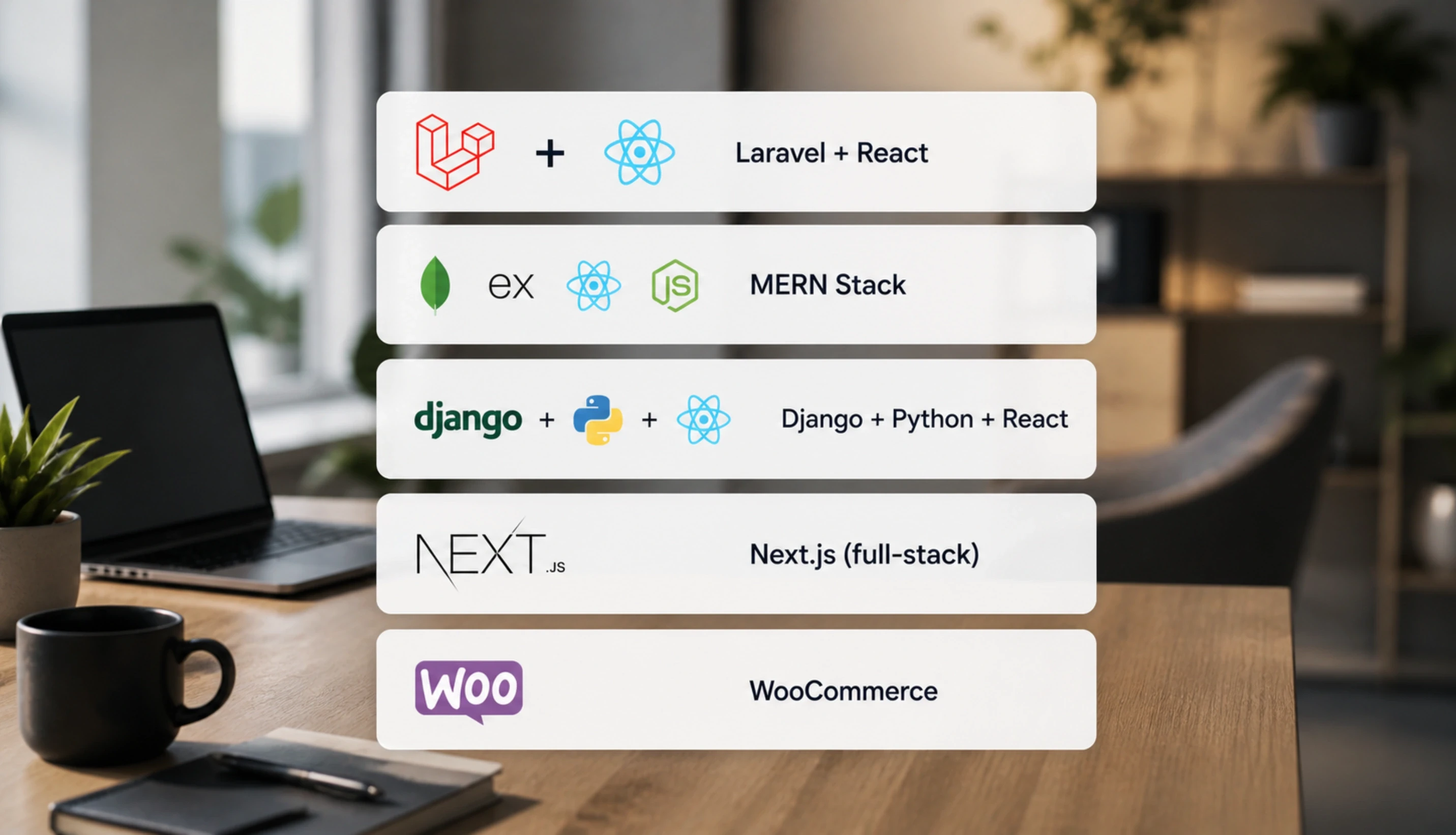
The right tech stack for e-commerce is not the most popular. It is the stack that matches your catalog complexity, your team's existing expertise, and your platform's performance requirements under your specific traffic and transaction patterns.
Technology choices in e-commerce carry a 3-to-5-year commitment. Teams evaluating the MERN stack for marketplace builds can hire dedicated MERN stack developers from Acquaint Softtech within 48 hours, and teams building data-intensive D2C platforms can hire Python developers with e-commerce and AI integration experience.
Stack | Best For | E-Commerce Strengths | Key Consideration |
Laravel + React | Mid-market to enterprise custom platforms, Bagisto D2C stores | Mature ORM for complex catalog queries. The queue system handles order processing at scale. Official Laravel Partner ecosystem and Bagisto-based. | PHP expertise required in hiring. |
MERN Stack | Multi-vendor marketplaces, real-time inventory, high-concurrency stores | MongoDB document model handles variant-heavy catalogs. Node.js non-blocking I/O suits high-concurrency checkout events. | MongoDB requires careful schema design for relational data. |
Django + Python + React | Data-intensive platforms, AI-personalized D2C stores | Python data science ecosystem enables native ML integration for recommendations and demand forecasting. | Python e-commerce developers are a narrower hiring pool. |
Next.js (full-stack) | Headless commerce frontends, performance-critical storefronts | Sub-1-second page loads via SSR and static generation. Strong SEO performance out of the box. | Backend commerce logic requires a separate service. Architecturally complex. |
WooCommerce | Existing WordPress presence, content-heavy e-commerce | Fastest time-to-market for WordPress teams. Large plugin ecosystem. Strong SEO heritage. | Performance degrades above 10,000 SKUs without significant optimization. |
2026 Recommendation: Laravel + React for most mid-market builds. MERN for marketplace architectures. Django + React when AI personalization is a first-class product requirement. Stack choice should follow the data model and the team, not the trend.
Need a Specific Stack for Your E-Commerce Platform?
Acquaint Softtech deploys Laravel, MERN, Django, and Next.js engineers with verified e-commerce delivery experience. We send a team structure and developer profiles within 48 hours of your brief. You conduct technical interviews before any engagement starts.
What Does Custom E-Commerce Development Cost in 2026?

The cost range for custom e-commerce development spans $18,000 to $250,000 for the initial build, with maintenance costs of $3,000 to $30,000 per month after launch. The specific number depends on five variables that are all quantifiable before a single line of code is written.
The five cost variables are: catalog complexity, transaction volume, integration count and complexity, admin requirements, and team model. Acquaint Softtech's IT staff augmentation services allow clients to start lean and scale without changing vendors. For platforms requiring production-grade DevOps from day one, dedicated DevOps engineers are available within the same 48-hour deployment window.
Engagement Tier | Build Cost | Timeline | Monthly Maintenance | Typical Team |
Small Platform | $18,000 to $45,000 | 10 to 16 weeks | $3,000 to $6,000/month | 2 to 3 developers + QA |
Mid-Market Platform | $50,000 to $110,000 | 18 to 28 weeks | $7,000 to $14,000/month | 4 to 6 developers + QA + PM |
Enterprise Platform | $120,000 to $250,000+ | 32 to 52 weeks | $15,000 to $30,000/month | 7 to 12 developers + QA + PM + DevOps |
What the Monthly Rate Includes at Acquaint Softtech
Full-time dedicated engineers with e-commerce domain experience, deployed within 48 hours of contract start
Sprint planning, standup facilitation, and retrospective management by the vendor tech lead
QA and regression testing on every release cycle, with test case documentation maintained in the client repository
Code review, performance monitoring, and security patch management are included in standard delivery
Team replacement coordination managed by Acquaint Softtech with no disruption to sprint continuity
NDA (Non-Disclosure Agreement) and IP (Intellectual Property) assignment from day one of engagement
Direct client access to the tech lead for architecture decisions at 1 to 2 hours per week overhead maximum
No additional employer overhead, no benefits cost, no hardware provisioning. That structural difference produces the 40% cost saving versus equivalent in-house hiring that Acquaint Softtech clients consistently achieve across its 1,300+ project delivery history. The savings are not a marketing claim. It is the predictable result of the offshore dedicated team model applied to markets where senior developers cost $120,000 to $180,000 per year, fully loaded.
Build Your E-Commerce Team at 40% Less Than In-House Hiring
Developer deployed within 48 hours. You interview the team before any engagement begins. NDA and IP assignment included from day one. QA, sprint management, and code review included. No per-transaction or hidden platform fees ever. 24+ months average team tenure across active Acquaint Softtech projects.
The 6 Questions That Tell You Whether to Build Custom or Use SaaS
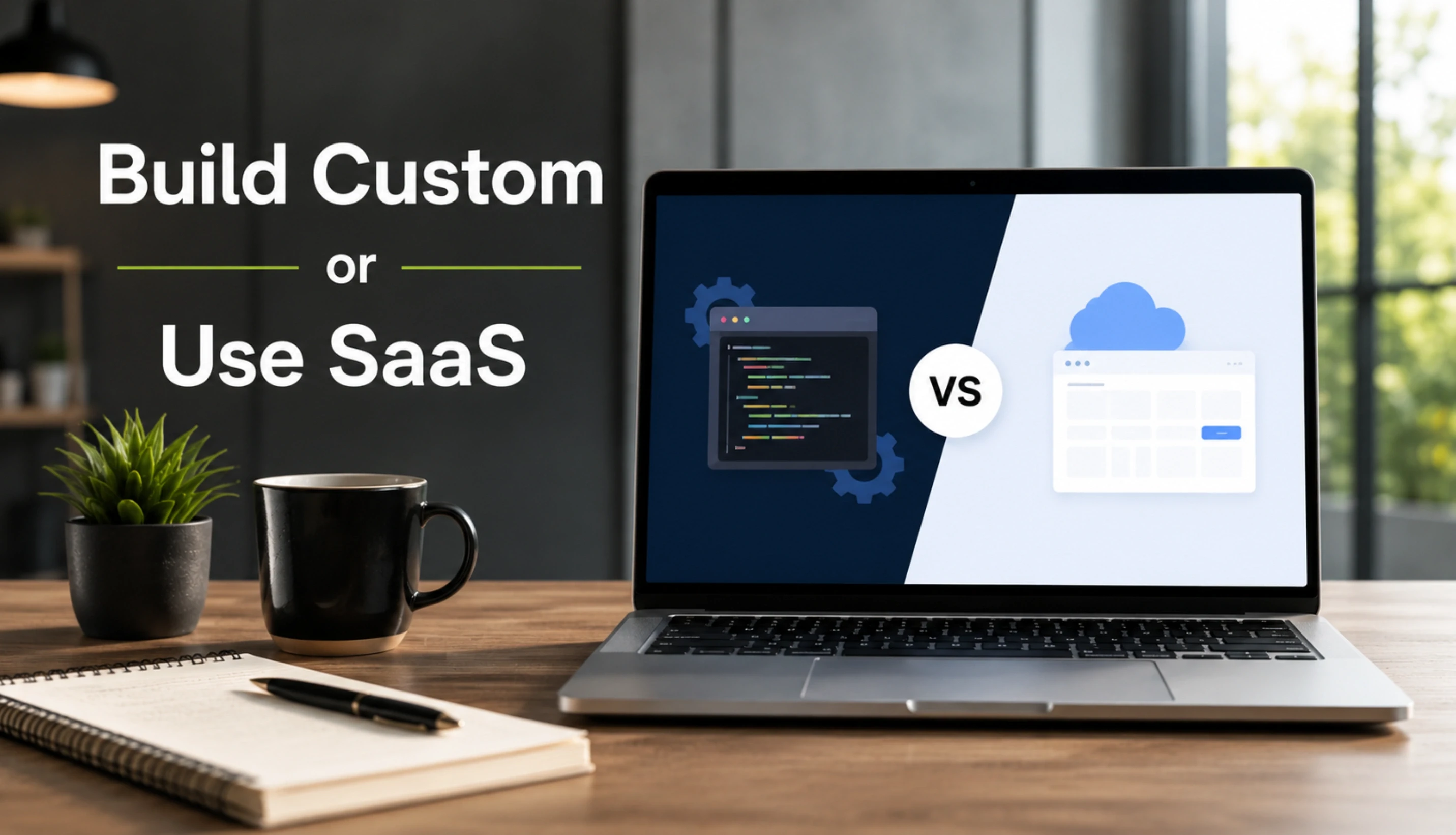
Every e-commerce platform decision reduces to six questions. A product discovery workshop at Acquaint Softtech covers all six in a structured session and produces a documented platform recommendation with a cost model attached.
Does your pricing model require logic that no SaaS platform supports natively (customer-group pricing, dynamic bundles, complex subscription rules)? |
YES: Custom Platform. Complex pricing logic built on app dependencies introduces compounding failure risk. A native pricing engine is the only reliable architecture. NO: SaaS is sufficient. Standard pricing models are well-handled. Development capital goes to marketing and conversion optimization. |
Will your GMV exceed $2 million within 18 months, making per-transaction platform fees a material cost line? |
YES: Custom wins on TCO. The custom platform's 3-year TCO is lower than Shopify Plus at this GMV scale. The economics improve further as GMV rises. NO: SaaS is more efficient. Transaction fees are manageable below $2M GMV. Development capital produces more returns invested in product and marketing. |
Do you have integration requirements with 5 or more external systems, or any legacy ERP without a pre-built connector in the SaaS platform app store? |
YES: Custom API layer. SaaS integrations at this complexity introduce rate limit bottlenecks and compounding monthly costs that exceed custom development within 18 to 24 months. NO: App marketplace covers it. Standard integration requirements are met without custom development overhead. |
Is customer data architecture a product differentiator, with personalization, AI recommendations, or behavioral cohort analysis core to your retention strategy? |
YES: Custom data infrastructure. First-party data at the database level, structured to your analytical requirements, is incompatible with SaaS-hosted data models. NO: SaaS analytics sufficient. Standard email segmentation and basic analytics are adequately supported at this stage. |
Does your catalog exceed 50,000 SKUs, include deep variant structures, or require a custom search and filtering SaaS platform that search cannot support? |
YES: Custom search architecture. Search and filter performance at this catalog depth requires a dedicated search engine (Elasticsearch or Algolia) and a custom product information model. NO: Native search is adequate. SaaS platform catalog management handles up to 50,000 SKUs adequately for most browse and filter use cases. |
Is your fulfillment model non-standard (multi-vendor, dropship, subscription box, same-day regional delivery) requiring logic that the SaaS platform cannot configure? |
YES: Custom fulfillment engine. Non-standard fulfillment logic cannot be reliably implemented through SaaS customization without significant brittleness as operations evolve. NO: Standard integrations work. Standard SaaS fulfillment integrations cover your requirements without custom development. |
The scoring rule: 3 or more Yes answers indicate that a custom platform delivers a better business outcome within a 3-year TCO horizon. 1 to 2 Yes answers indicate a hybrid approach: SaaS platform plus custom extensions, or a well-configured WooCommerce build with targeted customization. Zero Yes answers indicate that a SaaS platform is the correct choice at your current stage.
Yes answers indicate the custom platform delivers better business outcomes within a 3-year TCO horizon. 1 to 2 Yes answers indicate a hybrid approach. Zero Yes answers indicate SaaS is the correct choice at your current stage.
Common Misconceptions About E-Commerce Software Development
Four misconceptions cause more bad platform decisions than any other single factor. Each one has a specific correction with a concrete mechanism or number that changes the analysis for buyers who hold it.
These misconceptions appear consistently in conversations Acquaint Softtech has with prospective clients before platform decisions are made. They are not edge cases. They represent the mainstream understanding of custom e-commerce development among non-technical buyers, and each one is correctable once the specific mechanism behind the confusion is named. Software development outsourcing for e-commerce, when structured correctly, eliminates three of the four misconceptions by design.
Misconception | Reality |
|---|---|
Custom e-commerce is only for enterprise brands with $10M+ GMV | Custom development often becomes more cost effective at $1.5M to $2M annual GMV due to rising platform and app costs. |
Shopify migration causes data loss and SEO damage | A properly planned migration preserves customer data, order history, and SEO structure with minimal risk. |
Custom platforms require a large in-house engineering team | Most production platforms can be maintained by 1 to 3 engineers, including dedicated offshore teams. |
Headless commerce always performs better | Poorly implemented headless setups can increase latency and cost, while optimized traditional architecture can still achieve excellent performance. |
Ready to Build the Right E-Commerce Platform for Your Business?
Tell us your catalog size, transaction volume, and key requirements. We send a platform recommendation, team structure, and cost range within 48 hours. You interview the development team before any engagement starts.
Frequently Asked Questions
-
How much does custom e-commerce development cost in India in 2026?
Custom e-commerce development costs typically range from $18,000 to $45,000 for small platforms, $50,000 to $110,000 for mid-market solutions with custom integrations, and $120,000+ for enterprise-grade platforms with advanced features like AI personalization and headless architecture.
-
Is custom e-commerce better than Shopify for a D2C brand in 2026?
Custom e-commerce becomes the superior choice when three or more of these conditions are true: annual GMV exceeds $1.5 million, pricing logic requires configuration beyond Shopify's native capabilities, the brand data strategy requires owned first-party data at the database level, fulfillment is non-standard, or the catalog exceeds 50,000 SKUs.
-
What is the best tech stack for e-commerce in 2026?
The best stack depends on catalog complexity, team expertise, and performance requirements. Laravel plus React is the strongest choice for most mid-market custom builds. The MERN stack is better suited to multi-vendor marketplaces. Django plus Python is the right choice when AI personalization is a first-class product requirement. The principle: match the stack to the data model and the team, not to the trend.
-
How long does it take to build a custom e-commerce platform from scratch?
A small platform takes 10 to 16 weeks. A mid-market platform takes 18 to 28 weeks. An enterprise platform takes 32 to 52 weeks. These timelines assume a dedicated team working full-time, not an agency rotating engineers across multiple client projects. At Acquaint Softtech, developers are deployed within 48 hours of contract start, and the first sprint begins in the same week.
-
What happens to my codebase and customer data if the development engagement ends?
The client retains full ownership of the codebase and data from day one. All projects operate under NDA and IP assignment agreements, with complete repository access and handover documentation provided if the engagement ends.
-
What is the structural difference between D2C and marketplace e-commerce architecture?
D2C and marketplace e-commerce differ on four architectural dimensions. Seller model: D2C has a single seller with centralized inventory; a marketplace has multiple sellers with independent inventory and a commission routing engine. Data model: D2C prioritizes a deep customer profile for LTV optimization; marketplace prioritizes seller and product discovery at scale. Fulfillment: D2C fulfillment is centralized or via a single 3PL; marketplace fulfillment is seller-managed.
-
What is the difference between staff augmentation and a dedicated development team?
Staff augmentation adds developers to a client managed team, while a dedicated development team is fully managed by the vendor, including tech leadership and QA. For e-commerce projects without an internal engineering lead, the dedicated team model is usually the better choice.
-
Can a remote offshore development team handle a complex e-commerce platform with multiple integrations?
Yes, with the correct team model. The critical requirement is e-commerce domain experience, not simply general full-stack expertise. At Acquaint Softtech, engineers are technically interviewed by the client before the engagement starts, covering both technical depth and domain experience in the relevant integration types. A dedicated team with codebase continuity handles integration complexity more reliably than a project-based agency rotation, because integration debugging requires deep familiarity with system state across every layer.
We’re Acquaint Softtech, your technology growth partner. Whether you're building a SaaS product, modernizing enterprise software, or hiring vetted remote developers, we’re built for flexibility and speed. Our official partnerships with Laravel, Statamic, and Bagisto reflect our commitment to excellence, not limitation. We work across stacks, time zones, and industries to bring your tech vision to life.
Table of Contents
Get Started with Acquaint Softtech
- 13+ Years Delivering Software Excellence
- 1300+ Projects Delivered With Precision
- Official Laravel & Laravel News Partner
- Official Statamic Partner
Related Reading
-in-2026-which-to-choose.webp "Drupal Commerce vs Magento")
Drupal Commerce vs Magento (Adobe Commerce) in 2026: Which to Choose
Choose Drupal Commerce when content comes first, and commerce is secondary, such as a publisher, membership site or content-heavy brand that also sells. Choose Magento, now called Adobe Commerce, when commerce comes first, and you need deep catalogue, checkout and B2B features out of the box. Drupal Commerce is a commerce layer on a content platform; Adobe Commerce is a dedicated commerce platform. The names have changed since 2019, and for many mid-market stores, WooCommerce or Shopify is now the more sensible option than either.

Mukesh Ram
April 15, 2019.webp "Why Develop Your E-commerce Website With Laravel Bagisto?")
Why Develop Your E-commerce Website With Laravel Bagisto?
Bagisto is a free, open-source e-commerce platform built on the Laravel PHP framework and Vue.js. Created by Webkul, it lets developers and merchants build highly customizable online stores, multi-vendor marketplaces, and headless commerce with minimal setup. Because it leverages Laravel, you get a robust ecosystem, rapid deployment tools, and huge flexibility for custom enterprise applications, which is why it is a top choice for an e-commerce website with Laravel Bagisto.
Mukesh Ram
April 29, 2022
6 E-commerce Strategies to Increase Sales in 2026
The six e-commerce strategies that reliably increase sales are building mobile-first, adding AI-powered chat, using product video, enabling visual and image search, streamlining checkout, and getting the fundamentals of speed and trust right. The one that returns the most for the least effort is checkout: most online stores lose the majority of their carts at the final step, so removing friction there recovers sales you have already paid to attract.
Mukesh Ram
March 23, 2019India (Head Office)
203/204, Shapath-II, Near Silver Leaf Hotel, Opp. Rajpath Club, SG Highway, Ahmedabad-380054, Gujarat
USA
7838 Camino Cielo St, Highland, CA 92346
UK
The Powerhouse, 21 Woodthorpe Road, Ashford, England, TW15 2RP
New Zealand
42 Exler Place, Avondale, Auckland 0600, New Zealand
Canada
141 Skyview Bay NE , Calgary, Alberta, T3N 2K6