

EHR vs EMR: What's the Actual Difference and Which Should You Build
Most people use EHR and EMR interchangeably. They are not the same system. One is a digital filing cabinet for a single practice. The other is a longitudinal health record that follows the patient across their entire care journey. Picking the wrong one costs founders 9 to 14 months of rework. Here is how to choose correctly the first time.

Ahmed Ginani
As Head of Partnerships at Acquaint Softtech, a software development partner with 1,300-plus projects delivered across 13 years, I sit in on more than 40 HealthTech discovery calls a year. The single most common misuse of a term in those calls is the EHR vs EMR difference.

- Clinic owners choosing between custom and off-the-shelf EMR systems.
- HealthTech founders planning the right healthcare product from day one.
- CTOs evaluating unified EHR platforms for multi-site healthcare groups.
- Hospital procurement teams preparing clear healthcare software RFPs.
Founders ask for an Electronic Medical Record (EMR) and describe an Electronic Health Record (EHR). Clinic owners ask for an EHR and describe an EMR. Both groups assume the systems are interchangeable.
They are not, and the decision between them shapes the database schema, the integration cost, the team composition, and the regulatory burden from sprint one. This article explains the real difference, names the decision points that matter, and shows how custom healthcare software product development changes depending on which one you actually need.
The Problem → Agitation → Solution
Problem: Founders commission a product using the wrong term, and the development team builds what was said, not what was needed.
Agitation: Eight months in, the first integration request exposes the mismatch. The system cannot share data with referring providers. The database schema is locked to a single practice. The rebuild starts. Budget doubles. Launch slips by a year.
Solution: Make the EHR vs EMR decision with a five-question diagnostic before a single architecture diagram is drawn. This article walks through the diagnostic, the structural differences, the cost reality, and the decision framework Acquaint Softtech uses to guide HealthTech clients across the United States, the United Kingdom, Australia, and the United Arab Emirates.
The confusion exists because the two terms were used interchangeably by software marketing teams for nearly a decade. That marketing conflation is now permanent in the vocabulary of the industry, but the underlying systems diverged long ago.
An EMR is the digital replacement for a paper chart within a practice. An EHR is a longitudinal patient record designed from the beginning to move between practices, hospitals, laboratories, and pharmacies. The master guide to healthcare software development in 2026 places this decision in the broader context of clinical system architecture. This sub-pillar zooms in on the choice itself.
The first section below is the definitional reset. Skipping it is the reason most teams get the rest wrong, so it earns a full section before anything else. Teams already clear on definitions and looking for implementation details can also see our custom EHR development guide for practices outgrowing off-the-shelf systems.
The Definitional Reset: EMR and EHR Are Not Synonyms
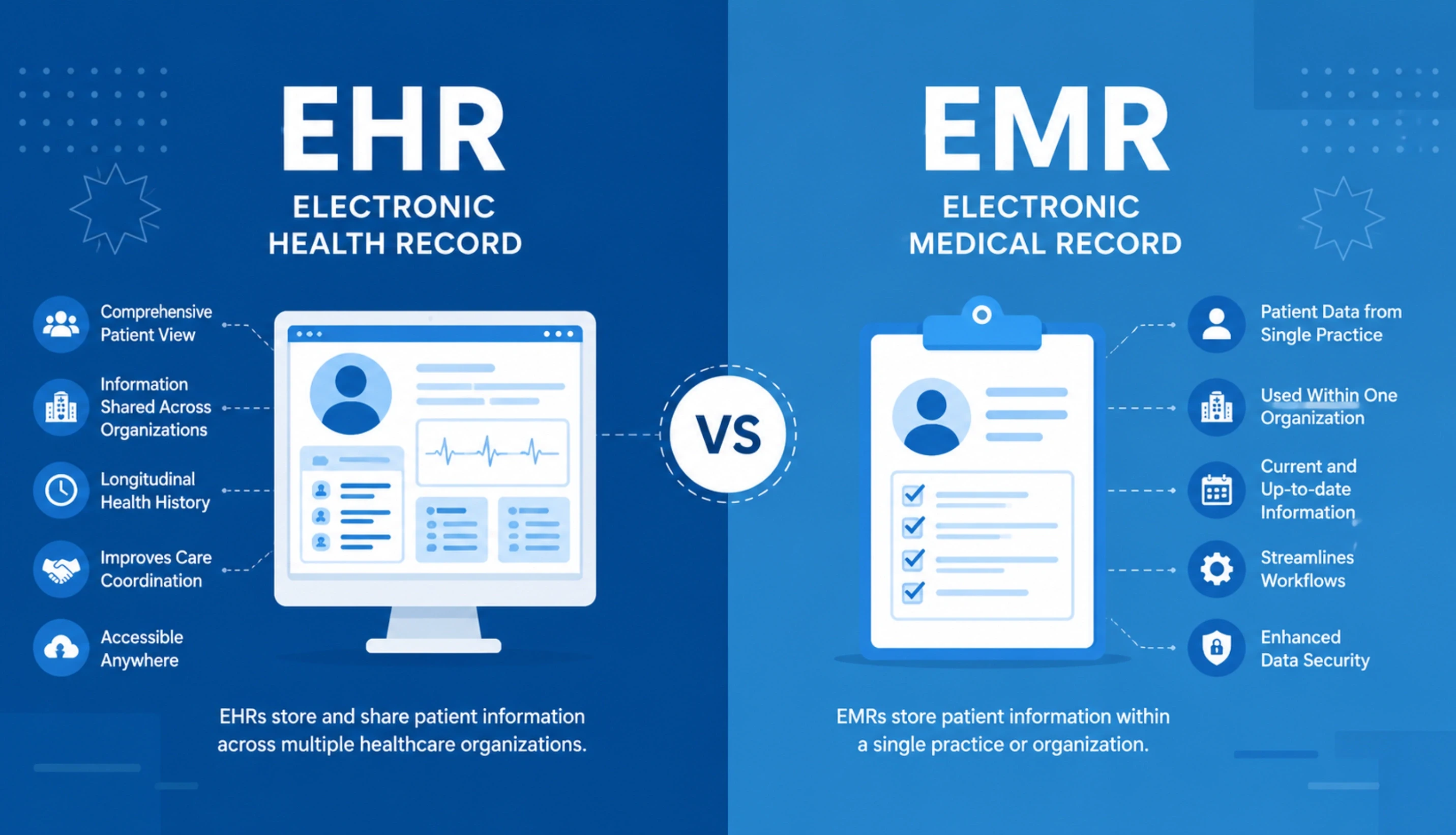
The Office of the National Coordinator for Health Information Technology (ONC), the United States federal body that defines these terms, draws a clear line between the two. Ignoring that line is what produces the wrong build. The definition below is the one regulators, payers, and certification bodies actually use.
What an EMR is
Electronic Medical Record (EMR)
An Electronic Medical Record (EMR) is a digital version of the traditional paper chart used within a single healthcare practice. It stores a patient's medical history, diagnoses, medications, treatment plans, and other clinical information created by one provider or one practice. An EMR is designed for use only within the practice that created it, making it useful for managing patient care internally. However, it does not travel well between different healthcare organizations. Moving data out of an EMR is considered an export, not an interoperability event.
What an EHR is
Electronic Health Record (EHR)
A longitudinal patient record designed to move between authorized providers, laboratories, pharmacies, hospitals, and payers. Built on interoperability standards (Fast Healthcare Interoperability Resources, FHIR) from day one. The patient is the axis of the data model. One patient may have many providers over a lifetime, and the EHR holds that continuity.
The one-line test
If you want to know which system a prospect needs, ask one question: Will this record need to travel to another provider or facility during the patient's care? If the answer is no, they need an EMR. If the answer is yes, or maybe, or in version 2, they need an EHR. The cost of retrofitting an EMR into an EHR is 1.8 to 2.4 times the cost of building an EHR from the start. That number is based on Acquaint Softtech's delivery data across healthcare rebuilds.
Why did the terms get tangled?
Between 2010 and 2018, the United States Meaningful Use incentive programs used both terms in different funding tranches. Vendors adopted whichever label the incentive pool preferred that quarter. The marketing residue never got cleaned up. The technical distinction stayed real.
Side-by-Side: EMR vs EHR at a Glance
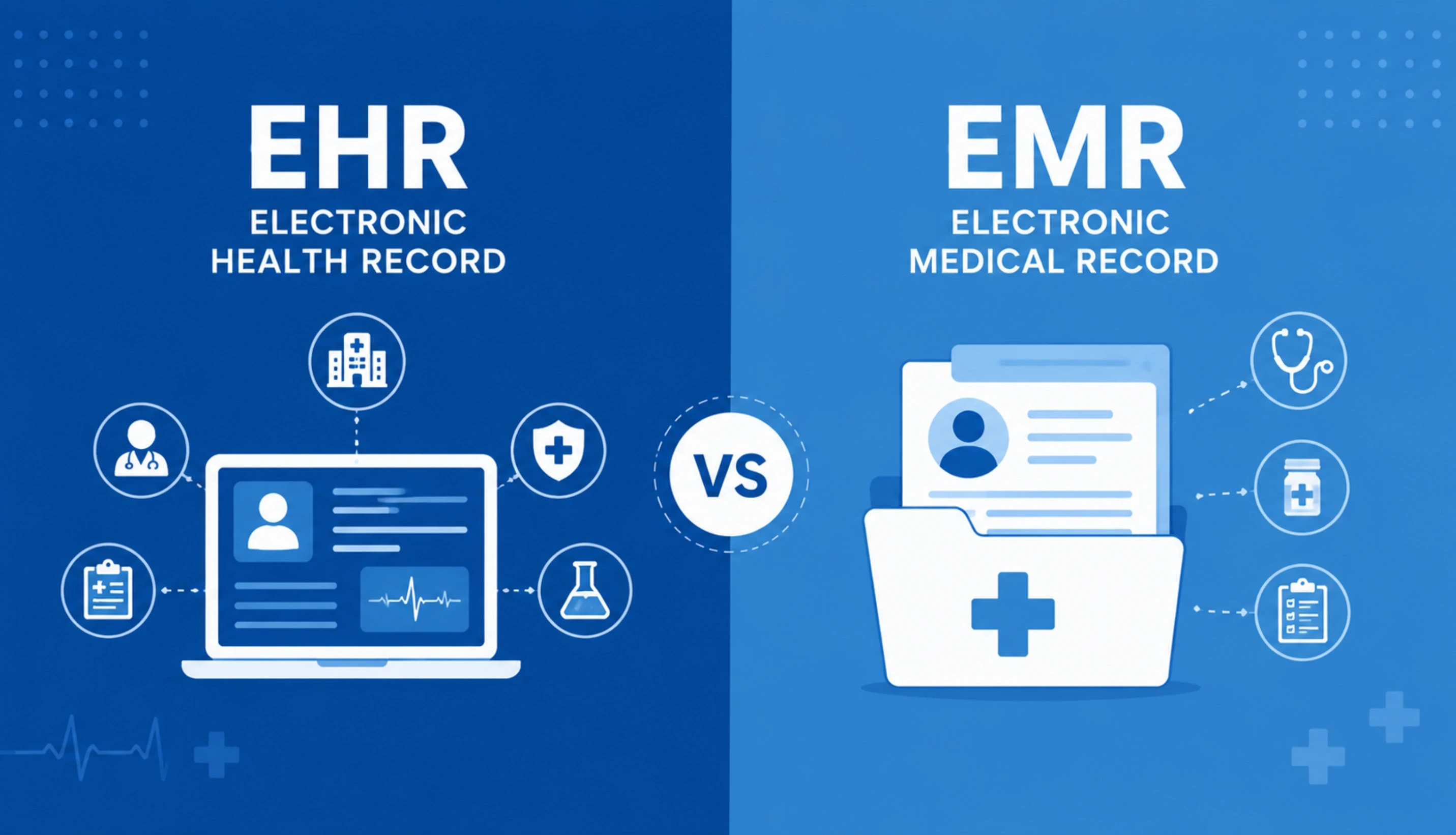
Before getting into architecture, here is the shape of each system in plain terms. This comparison is the one to share with non-technical stakeholders in the boardroom.
EMR | EHR |
✓ Scope: single practice, single provider group ✓ Data lives in: one database, one owner ✓ Built for: replacing paper charts ✓ Interoperability: export and import, not native ✓ Target user: one practice's clinicians ✓ Typical cost: lower to build, lower to maintain ✓ Certification: basic practice-level ✓ Best fit: solo practice, specialty clinic, small group | ✓ Scope: multi-provider, multi-facility, longitudinal ✓ Data lives in: FHIR-structured, shareable, patient-indexed ✓ Built for: continuous patient care across the ecosystem ✓ Interoperability: native, API-first, HL7 FHIR from the start ✓ Target user: patient plus every authorized provider ✓ Typical cost: higher to build, scales better ✓ Certification: ONC Health IT (US), equivalent EU/UK/AU ✓ Best fit: hospital group, network, HealthTech platform |
One consequence worth naming: an EMR can be built on a conventional Laravel or Node.js stack with a single PostgreSQL database and a standard Create, Read, Update, Delete (CRUD) layer. An EHR requires a FHIR-native data layer from day one and usually a message bus. When clients need senior backend talent for either pattern, they tend to hire Laravel developers for EMR builds and a mixed Python plus Node team for EHR builds. The choice flows from the architecture, not the other way around.
The Structural Differences That Change the Build
The comparison above is the surface. Below are the structural differences that actually change what developers build. Understanding these is what separates a well-scoped HealthTech project from one that hemorrhages budget in month seven.
Dimension | EMR Build | EHR Build |
Data model | Relational, practice-scoped tables (patients, visits, notes) | FHIR R4 resources (Patient, Encounter, Observation, Condition, MedicationRequest) |
Primary identity | Local patient ID inside the practice | Global patient identifier with Master Patient Index (MPI) logic |
Access pattern | One practice reads and writes | Many authorized parties read, a smaller set writes, with explicit consent |
Audit burden | Practice-level logs, standard HIPAA controls | Per-resource, per-actor logs are replayable across the patient's lifetime |
Integration surface | Optional: lab orders, billing | Mandatory: FHIR APIs, HL7 v2 feeds, referral networks, pharmacy, payer |
Team composition | 3-5 engineers, 1 QA | 6-10 engineers, 1-2 QA, dedicated integration engineer, security reviewer |
Regulatory scope | HIPAA basic, state medical records | HIPAA plus ONC certification plus payer-specific rules |
Failure blast radius | One practice offline | Regional or network-wide clinical outage |
The closing principle for this section: the structural difference is not a preference. It is a consequence of whether the system will hold one practice or many. Teams evaluating the integration side in depth should read our FHIR API integration guide for healthcare developers before finalizing the architecture.
Not Sure Which One Your Product Is?
Share a one-page description of your use case (patient volume, provider count, target regions, expected integrations) and our HealthTech architects will return a written recommendation with the EMR or EHR call, rationale, and a sample team structure within 48 hours. No commitment, no boilerplate.
The 5-Question Diagnostic: Which One Do You Actually Need?
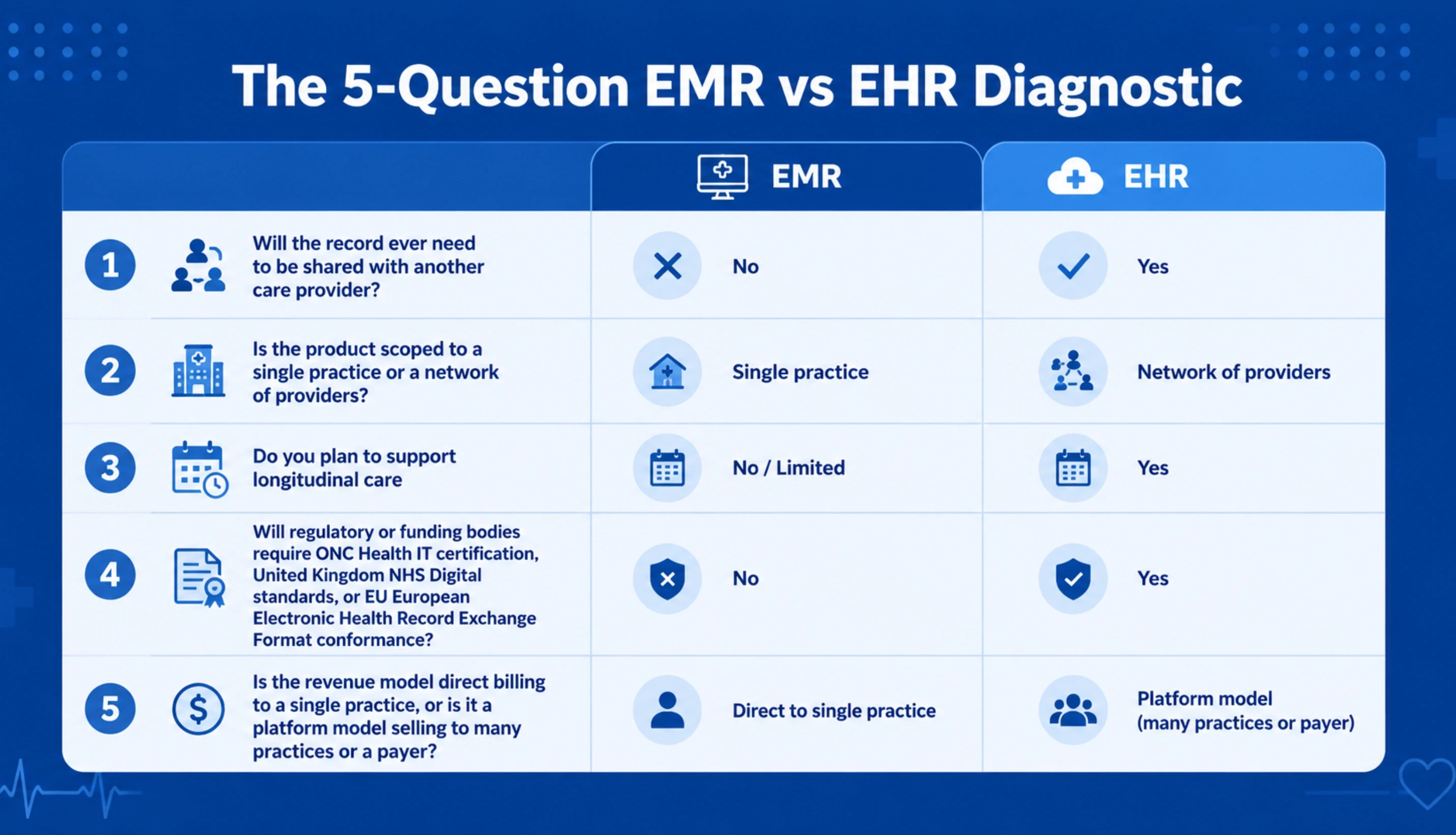
Below is the exact diagnostic that Acquaint Softtech's HealthTech partnerships team runs in discovery calls. It takes 15 minutes and produces an unambiguous answer. If your current development partner has not asked these five questions, they are guessing.
The 5-Question EMR vs EHR Diagnostic
1. Will the record ever need to be shared with another care provider?
Yes = EHR. No = EMR. If the answer is 'not right now but maybe later,' treat it as yes, because retrofitting interoperability costs 1.8 to 2.4 times building it natively.
2. Is the product scoped to a single practice or a network of providers?
Single practice = EMR candidate. Network, federation, or multi-tenant platform = EHR. HealthTech platforms for rent to clinics are always EHR, even if each tenant feels like one practice.
3. Do you plan to support longitudinal care (chronic disease management, preventive care, long-term cohorts)?
Yes = EHR. No = EMR is sufficient. Longitudinal care demands the patient-indexed data model, which an EMR does not provide without major rework.
4. Will regulatory or funding bodies require ONC Health IT certification, United Kingdom National Health Service (NHS) Digital standards, or EU European Electronic Health Record Exchange Format conformance?
Yes = EHR. Certification programmes assume FHIR-native architecture. An EMR cannot pass certification through feature additions.
5. Is the revenue model direct billing to a single practice, or is it a platform model selling to many practices or a payer?
Direct to one practice = EMR. Platform, payer, or network model = EHR. The revenue model reflects who the system serves, and the system must match that service boundary.
✅ Three or more yes answers
If three or more answers point to EHR, build an EHR. Do not negotiate. The marginal cost of building correctly on day one is far smaller than the cost of the mid-build pivot, which averages 14 weeks of lost time in our engagement data
Real Build Cost: EMR vs EHR in 2026
The ehr healthcare development cost vs emr question is where stakeholders stop guessing and start negotiating. Below are the 2026 cost ranges Acquaint Softtech quotes for clients across the US, UK, Australia, and the UAE. The ranges assume a dedicated team model, production-grade delivery, and a 90-day post-launch support window.
Build Tier | Scope Highlights | Timeline | Investment (USD) |
EMR MVP (single specialty) | One practice, patient chart, scheduling, basic billing, notes | 3-4 months | $35,000 - $70,000 |
EMR Production | Specialty workflows, e-prescribe, lab orders, patient portal | 5-7 months | $95,000 - $180,000 |
EHR MVP (multi-provider) | FHIR-native, MPI, consent, 1-2 integrations | 5-6 months | $110,000 - $200,000 |
EHR Production | Multi-facility, ONC-track, full integration suite, analytics | 9-14 months | $260,000 - $620,000 |
EHR Enterprise | Multi-tenant, multi-region, AI layer, payer integration | 14-22 months | $620,000 - $1,400,000 |
What the Acquaint Softtech EMR/EHR engagement always includes
A discovery phase that produces the EMR-or-EHR decision in writing, with a rationale document that both technical and business stakeholders sign off on, supported by a structured discovery workshop.
A dedicated team led by a HealthTech-experienced tech lead who owns composition, velocity, and continuity.
A FHIR-native data layer from sprint one for EHR builds, with a reference implementation using HAPI FHIR or equivalent.
Integration stubs for lab, pharmacy, payer, and EHR vendor sandboxes validated by the end of sprint two, not month nine.
An audit log service, a consent service, and a role-based access control (RBAC) implementation shipped in the first production release.
Infrastructure as Code (Terraform) in a HIPAA-eligible cloud account owned by the client.
Source code, runbooks, and architectural decision records were handed over at engagement closure with no retention clause.
The rate the client pays is the rate. No additional employer overhead on top. Based on Acquaint Softtech's delivery operations across 1,300 plus projects, clients typically save 40 percent versus equivalent in-house builds in the US or UK at senior-level quality. For a single practice exploring a budget-constrained path, our MVP development services for healthcare offer a structured entry.
Want a Line-Item Cost for Your EMR or EHR Build?
We will produce a detailed proposal, a week-by-week delivery plan, and a fixed weekly team rate based on your feature list within 48 hours of receiving your brief. Every proposed developer is interviewable before the engagement starts. No recruitment fees, no retainer traps.
Feature Matrix: What Each System Must Include
A production EMR and a production EHR share some core features and diverge on others. This matrix is the checklist Acquaint Softtech's product managers use to close the scope conversation in discovery.
Feature | EMR (required) | EHR (required) |
Patient demographics and identity | Yes | Yes, with the Master Patient Index |
Visit and encounter notes | Yes | Yes, FHIR Encounter resource |
Problem list and diagnoses (ICD-10) | Yes | Yes, FHIR Condition |
Medication list and e-prescribing | Yes | Yes, FHIR MedicationRequest |
Lab ordering and results | Optional | Yes, FHIR ServiceRequest + Observation |
Imaging ordering and viewing | Optional | Yes, DICOM + FHIR ImagingStudy |
Patient portal and self-service | Optional | Yes |
Clinical decision support (CDS) | Optional | Yes, CDS Hooks are ready |
Interoperability (FHIR APIs) | Read-only export | Read and write, versioned |
Consent management | Basic | Versioned, dedicated service |
Audit log (6-year retention) | Yes | Yes, append-only, replayable |
Role-based access control | Practice-level | Granular, cross-organization |
Billing and claim submission (X12) | Optional | Yes |
Analytics and reporting | Practice-level | Cross-patient, cross-facility |
The matrix exists to prevent the worst scoping failure in healthcare projects: the 'we can add that later' decision. In HealthTech, 'later' features often require foundational changes to the schema and the integration layer. Design for the likely 24-month horizon on day one. For teams building clinician-facing templates, our guide on EHR template customization engines that let clinicians design their own forms is a useful companion.
Need a Feature Scope Review Before You Commission?
Send us your current feature list or product requirements document. Our HealthTech product team will mark up what is EMR-only, what is EHR-only, what is optional, and what is structurally required before sprint one. Turnaround: 48 hours. No charge for the review.
Migration Paths: EMR to EHR, and the Hidden Gotchas
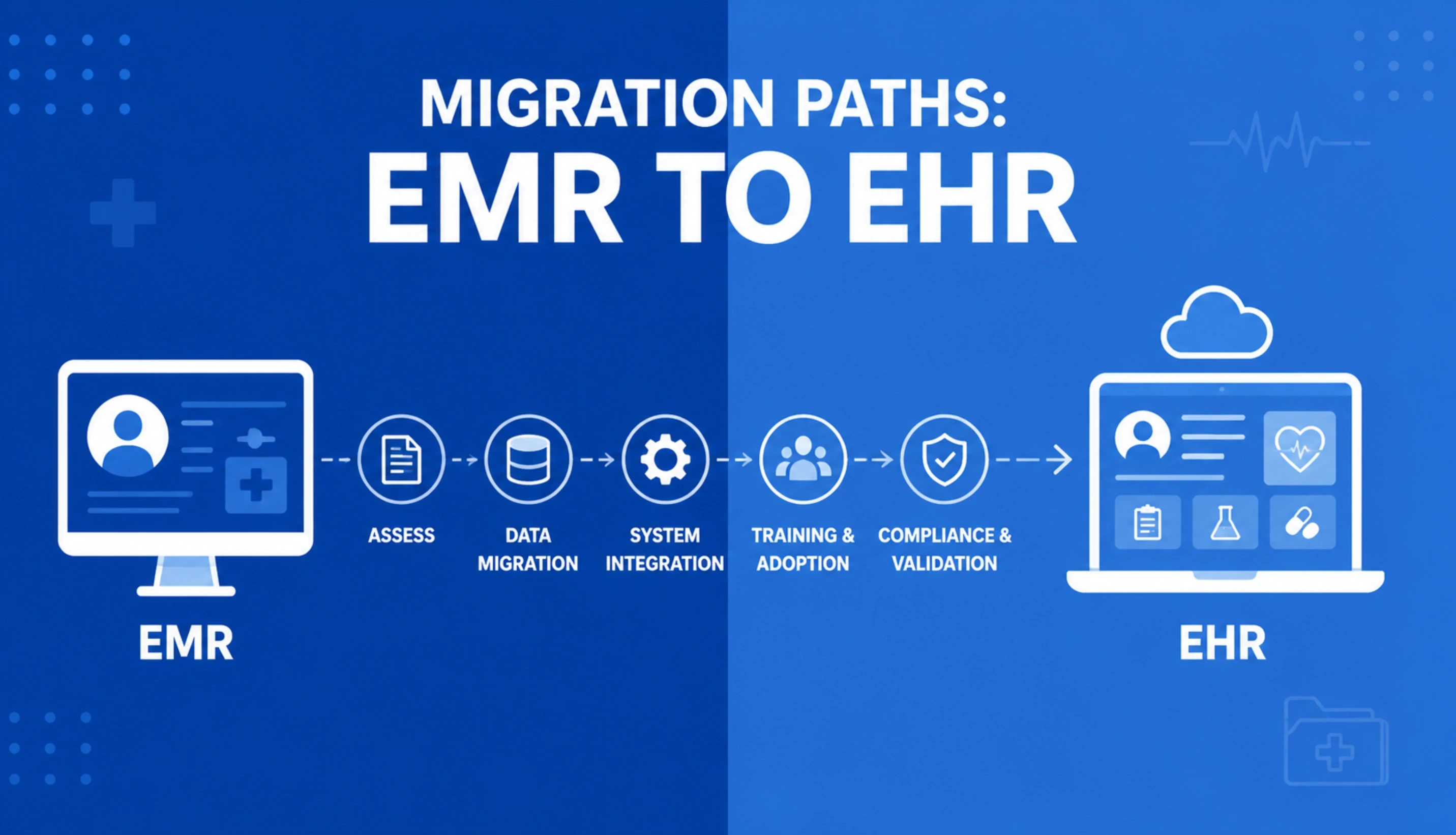
The question Acquaint Softtech receives most often in year-two conversations is: " We built an EMR. We now need it to behave like an EHR. How? The answer is one of three paths, each with its own cost structure and its own failure mode.
Path A: Wrap and expose
Keep the existing EMR database. Add a FHIR API facade on top that translates EMR tables into FHIR resources on read. Cheapest option, 6 to 10 weeks of work. Works for small-scale. Breaks at write time because two-way synchronization with external systems is fragile. Best fit when the EMR stays authoritative, and the external FHIR surface is read-heavy.
Path B: Parallel migration with dual-write
Build a new FHIR-native EHR data layer alongside the existing EMR. Write to both for a cutover period. Read from the EHR. Retire the EMR once parity is confirmed. 4 to 8 months of work. Medium risk. Works for single-practice to network transitions. Requires a disciplined data mapping effort and a strong Extract, Transform, Load (ETL) practice.
Path C: Greenfield rebuild with staged cutover
Build the EHR from scratch. Migrate historical records in tranches by specialty or by patient cohort. Keep the EMR read-only as an archive. 9 to 14 months of work. Highest investment, cleanest outcome. Recommended when the EMR schema is poorly documented, when the migration will need to be repeated later, or when the team capacity has changed substantially since the original EMR was built.
The 6 Hidden Migration Gotchas (Learned the Hard Way)
1. Historical note free-text is unstructured
Paper-era notes typed into the EMR rarely have structured Subjective, Objective, Assessment, Plan (SOAP) fields. FHIR DocumentReference can absorb them, but clinical decision support cannot query them. Plan for a Natural Language Processing (NLP) pass if CDS matters.
2. Patient identity collisions across practices
When merging patient records from multiple EMRs, the same patient appears as different identifiers. A Master Patient Index resolver is required before migration begins, not after.
3. Prescription histories rarely map cleanly
RxNorm coding in legacy EMRs is incomplete. A medication normalization step is mandatory, and it is manual for the top 20 percent of edge cases.
4. Timestamps lie
EMR entries often record the time of data entry, not the time of the clinical event. The EHR needs both, and reconstructing the clinical timestamp from paper notes is partial at best.
5. Consent history is usually absent
If the original EMR never captured consent events explicitly, the migrated EHR has no consent audit trail for historical data. A legal retention policy must be agreed upon before migration, not after.
6. Integration vendors will not migrate for you
Laboratory providers, pharmacy networks, and payer clearinghouses do not migrate historical integrations. Every integration is rebuilt against the new EHR. Scope for this separately.
The migration principle Acquaint Softtech applies to every EMR-to-EHR engagement: do not migrate what you cannot structure. Everything that lands in the EHR must be queryable, attributable, and auditable. Everything that is not can stay in the EMR as a read-only archive. For deeper operational guidance, see our EHR data migration guide: moving patient records without losing anything and the HL7 to FHIR migration approach for legacy health data systems.
Planning an EMR to EHR Migration?
Our team has shipped Path A, B, and C migrations across the US, UK, Australia, and the UAE. Send us your current EMR schema and a rough estimate of the record volume, and we will return a path recommendation plus a phased migration plan within 48 hours.
Case Snapshot: How Acquaint Helped a Clinic Group Choose Correctly
A mid-sized primary care group in the United States, eight locations, 45 providers, approached Acquaint Softtech with a brief: 'We need to replace our EMR with something cheaper and faster.' On the discovery call, the five-question diagnostic returned four yes answers. They did not need a cheaper EMR. They needed an EHR, and they had been hiding the complexity from themselves for two budget cycles.
What we did
Acquaint produced a written diagnostic recommending an EHR rather than a like-for-like EMR replacement. The board resisted initially because the EHR build estimate was 1.7 times the EMR estimate. The partnerships team then modelled the five-year total cost of ownership (TCO), including the inevitable interoperability rebuild if they chose the EMR path. The TCO for the EHR path came in 22 percent lower over 60 months. The board approved.
How the build ran
A seven-person Acquaint team was deployed within 48 hours. Sprint one delivered the FHIR data layer with HAPI FHIR, an authentication service, and consent service scaffolding. Sprints two and three added the Master Patient Index, the clinician dashboard skeleton, and the first two integrations (lab and e-prescription sandbox). Sprint nine went live for the first pilot location. The full rollout across all eight locations was completed in month 11.
Measurable outcomes (month 13 post-launch)
• Provider documentation time per encounter: 18 minutes → 11 minutes
• Cross-location record sharing latency: 'we email each other' → under 3 seconds
• Patient no-show rate (tied to portal visibility): 19% → 12%
• Quarterly claim denial rate: 8.4% → 3.1%
• Five-year projected TCO vs the original EMR replacement path: 22% lower
• ONC certification: passed at the first audit cycle
The principle this engagement illustrates: the EMR vs EHR decision is not a tech question disguised as a business question. It is a business question with a tech consequence. Get it right on day one. For a similar decision pattern in a different regulated industry, our case study on aviation safety software development for ASQS shows how scoping discipline up front saved months of rework in an entirely different compliance regime.
Ready to Make the EMR or EHR Decision With Confidence?
Acquaint Softtech has shipped both EMR and EHR platforms for clinics, hospital groups, and HealthTech startups across the US, UK, Australia, and the UAE. Average team tenure on HealthTech accounts is 24 plus months. Developer deployment within 48 hours. You interview before you commit.
Frequently Asked Questions
-
Which is better, EHR or EMR, for healthcare?
Neither is universally better. The right answer depends on whether the record will need to move between providers. An Electronic Medical Record (EMR) is the correct choice for a single practice that does not share records externally. An Electronic Health Record (EHR) is the correct choice when data must travel between providers, facilities, laboratories, and pharmacies, and when longitudinal care across time is part of the product promise. Picking an EMR when you need an EHR is the single most expensive scoping mistake in HealthTech. Treat the 5-question diagnostic as non-negotiable before commissioning any build.
-
What are the pros and cons of EHR vs EMR?
An EMR is cheaper to build, simpler to operate, and sufficient for a single practice, replacing paper charts. Its main downside is that it does not interoperate natively, so once the product needs to share data, the retrofit cost is 1.8 to 2.4 times the original build.
An EHR is more expensive up front, demands a Fast Healthcare Interoperability Resources (FHIR) native data layer, and carries a heavier compliance burden. Its upside is that it scales across providers and facilities, satisfies certification programmes, and does not need to be rebuilt when the product grows.
-
Is an EHR more secure than an EMR for medical apps?
An EHR is not inherently more secure than an EMR, but it is forced to meet stricter security controls by regulation. EHRs typically require granular role-based access control, cross-organization audit logs, versioned consent, and ONC Health IT certification in the United States.
EMRs are bound by the Health Insurance Portability and Accountability Act (HIPAA) baseline security but have fewer mandatory surface controls. A well-built EMR can be as secure as a poorly-built EHR. Security is an engineering posture, not a system category.
-
How much does EHR development cost compared to EMR in 2026?
Healthcare Platform Type
Estimated Cost
Timeline
EMR MVP
$35,000 to $70,000
3 to 4 months
Production EMR
$95,000 to $180,000
5 to 7 months
EHR MVP
$110,000 to $200,000
5 to 6 months
Production EHR
$260,000 to $620,000
9 to 14 months
The higher EHR cost is mainly driven by FHIR native architecture, Master Patient Index implementation, and healthcare integration requirements.
-
Can I start with an EMR and upgrade to an EHR later?
You can, but the upgrade cost is 1.8 to 2.4 times the cost of building an EHR from the start. The main reason is that EMR data models are practice-scoped, and converting them into patient-indexed FHIR resources requires a data migration, an integration rebuild, and usually a re-architecture of the access control layer.
If there is any realistic chance the product will need EHR behaviour within 36 months, building the EHR foundation on day one is the cheaper path. Acquaint Softtech's delivery data makes this conclusion consistent across engagements.
-
Do I need ONC certification for my EHR?
If the system will be sold to United States providers who participate in Medicare or Medicaid programmes, ONC Health IT certification is effectively mandatory because it is tied to reimbursement eligibility.
If the system is sold outside the United States, or only to providers outside those programmes, certification is not required but may still be a commercial expectation. EMRs typically do not require ONC certification. EHRs do, if they will operate inside the United States reimbursement ecosystem. Acquaint Softtech's EHR builds are certification-track by default.
-
Which tech stack is best for building an EHR in 2026?
Acquaint Softtech’s standard EHR stack includes Python Django or Node.js for backend services, PostgreSQL for operational data, React and TypeScript for clinician dashboards, React Native for patient apps, and AWS HIPAA eligible infrastructure. The architecture may adjust for region specific compliance or sovereign cloud requirements.
-
What happens to our code and data if the EHR project ends?
Every Acquaint Softtech engagement gives the client full ownership of the source code, infrastructure definitions, documentation, and system architecture from day one. The final handover includes repository access, documentation transfer, and post delivery support to ensure the client can operate the platform independently.
I help agencies and founders scale their tech teams with the right developers at the right time. At Acquaint Softtech, I focus on building long term partnerships and making remote hiring simple, predictable, and results driven. My goal is straightforward to help businesses grow faster with reliable dedicated developers.
Table of Contents
Get Started with Acquaint Softtech
- 13+ Years Delivering Software Excellence
- 1300+ Projects Delivered With Precision
- Official Laravel & Laravel News Partner
- Official Statamic Partner
India (Head Office)
203/204, Shapath-II, Near Silver Leaf Hotel, Opp. Rajpath Club, SG Highway, Ahmedabad-380054, Gujarat
USA
7838 Camino Cielo St, Highland, CA 92346
UK
The Powerhouse, 21 Woodthorpe Road, Ashford, England, TW15 2RP
New Zealand
42 Exler Place, Avondale, Auckland 0600, New Zealand
Canada
141 Skyview Bay NE , Calgary, Alberta, T3N 2K6