

MCP vs. MLP vs. MVP: Right Launch Strategy for a Fintech SaaS in 2026
How do you choose MCP, MLP, or MVP for your US fintech SaaS in 2026? Learn which launch strategy saves time, cuts costs, and drives real growth.

Acquaint Softtech
The Launch Strategy Mistake CEOs Keep Making
In 2026, launching a fintech SaaS is no longer about “moving fast and breaking things.” It’s about moving smart and scaling safely.
Just this week, the world watched the Artemis II mission launch toward the Moon, a reminder that complex systems don't succeed on speed alone. They succeed in precision, phased execution, and calculated risk.
If we breakdown the Artemis mission, it is very similar to first considering a minimal product. Where Artemis I, II, III = MVP Evolution:
Artemis I: An uncrewed mission to test launch systems, navigation, and re-entry with no human risk. It's like the "technical MVP."
Artemis II: A crewed mission that does not land with humans but instead just orbits the Moon with them. It is equivalent to an advanced MVP.
Artemis III: Full mission execution with humans landing on the Moon. Mission with high stakes, zero tolerance for failure. Similar to the "Full Product Launch (MCP)."
Most founders try to jump straight to “Artemis III.” That’s where things break
CEOs often choose the wrong launch strategy; they either
Launch too early → lose credibility
Launch too late → lose market opportunity
And in fintech, where trust = revenue, this decision can make or break your company. Let’s decode the three dominant strategies, MVP vs. MLP vs. MCP for a Fintech solution.
This article helps you choose the right one to help you create your best fintech SaaS launch strategy in 2026.
What MCP, MLP, and MVP Actually Mean
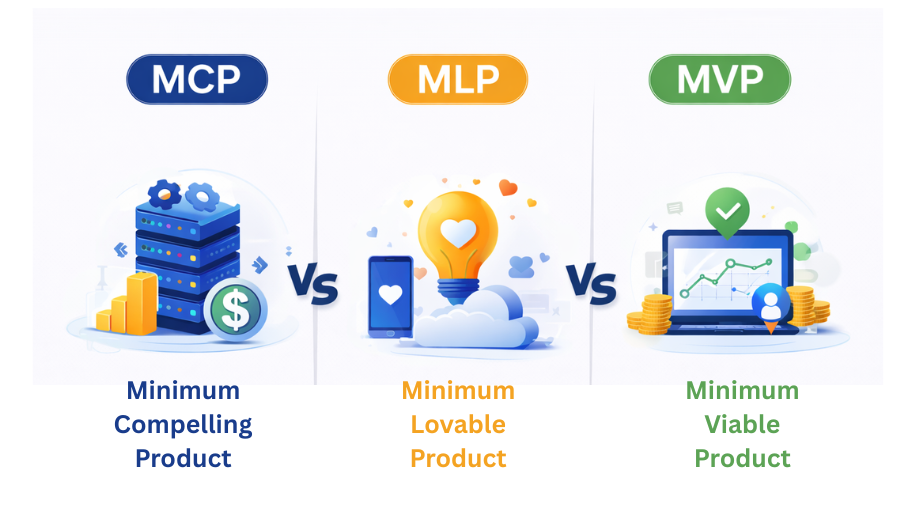
There are several acronyms US fintechs can't ignore, such as MCP, MLP, and MVP. The obvious question here is, "What do all these acronyms mean?"
An MVP tests your idea. An MLP earns trust. An MCP builds a business. Choose based on what you need most: validation, love, or scale. Let's cut through the acronyms.
Minimum Viable Product (MVP):
What is MVP: The MVP is the classic "Lean Startup" approach. It's the bare-bones version of your product, used to validate a core hypothesis with minimal effort.
Answers the question: “Does this solve the core problem?” It ships the bare essentials for real-user feedback at the lowest cost and fastest speed.
Best For: Startups with highly disruptive, never-before-seen tech.
The Goal: Fast feedback and burn-rate preservation.
The Risk: In 2026, a "bare-bones" fintech app looks like a security risk to US consumers.
Example: When Uber launched, it was a simple SMS-based service for black cars in San Francisco. It wasn't pretty, but it solved a massive pain point.
Minimum Lovable Product (MLP):
What is MLP: An MLP focuses on the user experience (UX) and emotional resonance. It’s not just about solving the problem; it’s about making the user feel good while doing it.
Asks: “Will users actually enjoy and stick with this?” It adds thoughtful design, micro-interactions, and delight so early adopters become advocates.
Best For: Consumer-facing apps (B2C) where brand loyalty is everything.
The Goal: High retention and "viral" organic growth.
The CEO Perspective: It reduces the Cost Per Acquisition (CPA) because happy users become advocates
Example: (Fintech) Robinhood didn’t just offer trading; it made it simple, elegant, and addictive.
Minimum Compelling Product (MCP):
What is MCP? This is where the 2026 winner lies. A minimum compelling product is designed to enter a market with established players. It doesn't just "work"; it offers a specific edge that makes it better than the status quo.
Asks, "Does this drive immediate interest, engagement, and action?” It balances a lean build with enough polish and proven value to convert users and attract early revenue.
Why now? With the rise of agentic AI and real-time payments (FedNow), a simple MVP won't stand a chance against incumbents.
The Framework: Identify the "table stakes" (features everyone has) and add one "power feature" that incumbents are too slow to implement.
Industry Insight: For a US Fintech, an MCP must include high-level security and compliance (SOC 2/GDPR) from the outset. Anything less isn't "competitive."
Example: Stripe API Launch - Stripe didn’t launch a half-baked payments system. It launched a complete, developer-ready API ecosystem.
These are not interchangeable. In the competitive US fintech landscape, each serves a distinct purpose.
MVP vs. MLP vs. MCP: Head-to-Head Comparison
MVP vs. MLP vs. MCP ultimately comes down to your runway, competition level, and compliance pressure. In 2026, US fintech pure MVPs often fail because users compare them to polished incumbents.
The stage also plays a big role. Early? MVP. Niche dominance? MCP. Market grab? MLP. Fintechs using structured launches see 3x ROI (Source: McKinsey Fintech Report 2025).
The table below is a strategic comparison of MCP vs. MLP vs. MLP to help you create your fintech SaaS launch strategy in 2026.
Dimension | MVP | MLP | MCP (Minimum Compliant Product) |
Primary Goal | Validate the hypothesis. | Win emotional loyalty | Ensure legal operability |
Core Focus | Core feature set only | UX delight + core features | Compliance + security architecture |
Time to Build | 8–14 weeks | 12–18 weeks | Adds 4–8 weeks to any strategy |
Typical Cost (2026) | $55K–$140K | $80K–$180K | +$30K–$80K compliance overhead |
Best For | Idea validation, pre-seed | Crowded SaaS markets | US fintech, healthcare, lending tech |
Failure Mode | Building what no one wants | Over-designing too early | Skipping it and getting shut down |
Example | Dropbox demo video | Superhuman email | Stripe's initial API launch |
At Acquaint Softtech, fintech MVP development starts from $5,000 for fixed projects, offering startups a more cost-effective way to validate their ideas before investing in a full-scale MVP, MLP, or MCP. The final cost depends on the product scope, features, compliance requirements, integrations, and development complexity. Acquaint Softtech offers a more cost-effective option without compromising development quality.
Which Strategy Fits Your Fintech SaaS in 2026?
There's no universal answer. But there is a decision framework, and 15 years of building SaaS products has taught us how to apply it. Here’s a practical decision model for MVP vs. MLP vs. MCP we use at Acquaint Softtech.
Choose MVP + MCP When:
You're pre-seed, bootstrapped, or still validating core demand
You have a genuinely novel hypothesis that the market hasn't seen before
You're targeting regulated US markets (lending, payments, banking infrastructure)
Your runway is under 12 months, and speed-to-learning is critical
Choose MLP + MCP When:
You're entering a crowded market (budgeting tools, expense management, SMB payments)
You have seed funding and need early retention, not just activation
Your early adopters are design-conscious professionals (finance teams, CFOs, treasury)
You're competing with polished incumbents like Brex, Ramp, or Mercury
Choose the Full MCP Layer Regardless of Strategy When:
You're processing transactions over $10,000.
You're partnering with a bank or BaaS provider.
You're targeting regulated sectors: lending, insurance, and investment management.
You need SOC 2 attestation or PCI DSS compliance to close enterprise deals.
It involves market uncertainty.
You need to launch in 3 months.
If it involves regulatory pressure like KYC, AML, or PCI-DSS.
Choose MLP
If user retention is a requirement.
You need to launch in 6–9 months.
Choose MCP
Trust & compliance are your basic requirements.
You need to launch in 12+ months.
The following table explains it better:
Feature | MVP | MLP | MCP |
Focus | Functionality | Delight/UX | Competitive Edge |
Market | New/Blue Ocean | Saturated B2C | Established B2B/Fintech |
Time to Market | 2–3 Months | 4–6 Months | 5–7 Months |
Primary Risk | User Rejection | High Dev Cost | Over-Engineering |
Addressing CEO Pain Points: Risk, Cost, and Time-to-Market
As a CEO, your biggest fear isn't the tech; it's the opportunity cost. Here are some of the main challenges businesses face:
Scaling Teams: Don't waste 6 months hiring. Use IT staff augmentation to get senior Laravel or mobile developers in days, not months.
Hiring Risks: At Acquaint Softtech, our 5/5 Clutch rating reflects our "Zero-Risk" delivery model. We’ve been doing this for 15 years.
Cost Efficiency: Using a Laravel-based MCP lets you leverage existing packages, saving up to 40% on initial dev costs compared to building from scratch.
Speed is the new currency of business, but precision is the vault that keeps it safe.
Real-World MCP, MLP & MVP Wins
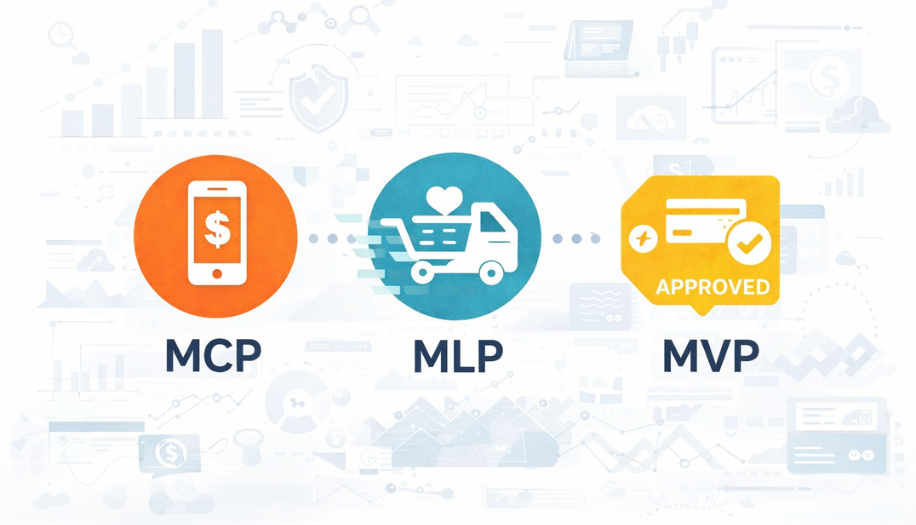
Several firms around the world found the ideal strategy and succeeded. Here are some of the real-world firms that succeed in doing so. This is a good example for businesses creating their fintech SaaS launch strategy in 2026.
Airbnb → MVP Strategy
Started with a simple website renting air mattresses. Validated demand quickly.
Revolut → MLP Strategy
Focused on sleek UX + global banking features. Built loyalty through experience.
PayPal → MCP Strategy
Ensured secure, complete payment flows before scaling. Built trust first, then expanded.
Stripe (MVP + MCP): The Compliance-First API
When Stripe launched in 2011, its MVP was a seven-line API for payment processing. But critically, they built PCI compliance into the core architecture from launch day. Developers loved the simplicity (MLP quality). Businesses trusted the compliance (MCP foundation); the result: a $95 billion valuation.
Robinhood (MLP): Disruption Through Delight
Robinhood's 2013 waitlist-first launch was textbook MLP; before their app was ready, they had 500,000 people waiting. They sold the feeling of democratized investing before the product existed. The emotional resonance outweighed feature gaps. Then critical compliance failures in 2020 cost them $65 million in FINRA fines. The lesson: MLP without MCP is a ticking clock.
Brex (MCP + MVP): Compliance as Competitive Moat
Brex launched a corporate card for startups in 2017 with a compliance-first approach. They built their underwriting model directly into the product architecture, bypassing FICO scores. The MCP layer wasn't a burden; it was their competitive differentiation. They reached a valuation of $12.3 billion by 2022.
How Staff Augmentation Turns Your Chosen Strategy into Reality
Hiring full-time developers in the US carries risk like high salaries, long onboarding, and talent shortages. Most startups don’t fail because of bad ideas; they fail because they launched the right idea the wrong way Hire remote developers from Acquaint Softtech. Our model eliminates failure due to the model. As a Laravel Partner with offices in the USA (plus the UK, New Zealand, and Canada), not to mention India, we provide pre-vetted experts who integrate seamlessly.
Clients save up to 40% versus local hiring while maintaining full control. We earned Upwork’s 2025 recognition for consistent delivery, TrueFirms recognition for IT staff augmentation, and a perfect 5/5 Clutch rating.
An MVP gets you users. An MLP gets you believers. An MCP gets you investors. Whether you need Laravel SaaS architecture for your MVP, polished UI for MLP, or compliant features for MCP, our team accelerates your fintech SaaS launch strategy in 2026 without compromise
Navigating Your Moonshot - Launch Smart & Scale Faster
The Artemis II mission is a testament to what happens when vision meets rigorous execution. As you plan your fintech launch for 2026, ask yourself: Am I building a product that exists or a product that wins?
MCP, MLP, & MVP are not the only acronyms that matter. There are several others that matter, like MMP (minimum marketable product), MMR (minimum marketable release), MMR (minimum marketable feature), MDP (minimum delightful product), MAP (minimum awesome product), and many more. Get in touch with the experts at Acquaint Softech; we can help pick the best strategy.
At Acquaint Softtech, we don’t just write code; we build engineering partnerships. Whether you need to augment your team with our 70+ experts or build a full-scale MCP, we have the 13+ years of experience to ensure you don't just launch, you soar.
Launch a Winning Fintech Solution
Ideas are everywhere; execution is rare, and that’s where real fintech winners emerge. Whether you're validating with an MVP or scaling with an MLP, your tech foundation must be rock solid. Augment your team with specialists who understand fintech complexity inside-out.
Frequently Asked Questions
-
Is an MVP enough to launch a fintech SaaS in the US in 2026?
No, not by itself. US fintech requires compliance baked into your architecture from day one. An MVP must include what we call the MCP (Minimum Compliant Product) layer: SOC 2 readiness, KYC/AML workflows, and data handling under GLBA. A bare-bones MVP without compliance isn't viable in regulated fintech markets.
-
What's the difference between MLP and MVP in simple terms?
An MVP proves your product solves a real problem. An MLP proves your product is something users actually want to keep using. MVP is about validation; MLP is about retention. In crowded US fintech markets, you usually need both.
-
Can I start with MVP and add compliance later?
Technically yes, strategically no. Retrofitting compliance into a fintech platform is far more expensive and time-consuming than building it in from the start. More importantly, you may not be legally permitted to onboard real users (especially for payment processing) without meeting baseline compliance requirements. Build it right the first time.
-
How does Acquaint Softtech support fintech SaaS launches?
We offer end-to-end support: from discovery workshops to define your MVP/MLP/MCP scope to staff augmentation for rapid team scaling to post-launch maintenance. Our engineers are compliance-aware Laravel and full-stack specialists and can onboard in 48 hours. We've supported FinTech, PropTech, and EdTech products across the US, UK, and beyond.
-
What's a Minimum Compliant Product (MCP) for a US lending platform?
For a US lending SaaS, the MCP includes: GLBA-compliant data architecture, AML/KYC integrated at the API level, SOC 2 audit logging from launch, an AI explainability engine if using ML for credit decisions (per the 2025 AI Fairness Act), and multi-region resilience planning. Skipping any of these can result in regulatory action from the CFPB or OCC.
We’re Acquaint Softtech, your technology growth partner. Whether you're building a SaaS product, modernizing enterprise software, or hiring vetted remote developers, we’re built for flexibility and speed. Our official partnerships with Laravel, Statamic, and Bagisto reflect our commitment to excellence, not limitation. We work across stacks, time zones, and industries to bring your tech vision to life.
Table of Contents
Get Started with Acquaint Softtech
- 13+ Years Delivering Software Excellence
- 1300+ Projects Delivered With Precision
- Official Laravel & Laravel News Partner
- Official Statamic Partner
Related Blog
Post-Migration Performance Optimization in Python 2026
Python application running slow after migration? The 2026 playbook for profiling, optimizing database queries, caching, async patterns, and stable production.
Acquaint Softtech
June 11, 2026
Eliminate Software Budget Overrun: #11 Budget Management Strategies
Develop a next-generation software solution with the best budget management strategies. Read this article to learn about them.

Mukesh Ram
July 9, 2024
Healthcare Data Warehouse Architecture: Building an Enterprise Clinical Data Repository
A healthcare data warehouse (HDW) centralizes patient, clinical, financial, and operational data for analytics and reporting. A modern HDW uses FHIR-based data pipelines and typically costs $70,000–$1,000,000 depending on complexity.

Manish Patel
July 22, 2026Your Project. Our Expertise. Let’s Connect.
Get in touch with our team to discuss your goals and start your journey with vetted developers in 48 hours.