

MVP Chapter #1: What Is a Minimum Viable Product (MVP)? (2026 Update)
A minimum viable product (MVP) is the simplest version of a new product that has just enough core features to satisfy early users. It lets teams test a business idea in the real market and learn what customers want without spending time and money on a full build. In software, an MVP means shipping only the key features that solve one core problem, launching to real users, then improving with their feedback.

Mukesh Ram
Introduction
Just like everywhere else, in the startup world, "Rome isn't built in a day." What I mean by that is that the hero products or services you see today were not in the same form earlier. It was their continuous evolution with people's feedback that made them succeed in the market.
A common mistake that many startups make is that they start way too ambitiously and spend extravagantly on developing their product without even first testing it in the market. For this reason and many others, developing an MVP is important.
As the Founder and CEO at Acquaint Softtech, a leading software product development and MVP development company, I have guided founders across the USA, UK, Europe, Australia, and New Zealand to validate ideas the smart way.

- You want a clear MVP meaning in software and business.
- You are a founder, CEO, or CTO validating a new product idea.
- You want to know the MVP process and how many iterations it takes.
- You need an MVP example and the difference between MVP, MMP, and PoC.
- You want real MVP cost and how to launch it.
- You want a proven partner to build your MVP fast.
If you are drawing a blank on your mind about MVP, then you are in the right place. Here, you are going to learn about MVP, its purpose, and how to define it for your idea. Read on.
What is an MVP (Minimum Viable Product)?
.webp "What is an MVP (Minimum Viable Product)?")
Who knows about MVP better than Eric Ries, author of The Lean Startup? He states in a blog post on MVP, "The minimum viable product is that version of a new product which allows a team to collect the maximum amount of validated learning about customers with the least effort."
Let's make it simpler for you. The actual reality of the market is often different than what you "think" it is. And this is why many businesses doom even before they take off: they fail to understand the market and the needs of their audience (or, in some cases, even who their audience is!). Thus, an MVP is developed first. An MVP is the simplest form of your product that is enough to provide the basic value it was meant to give.
For example, Groupon. Its founders used to manually post deals on their website and send a PDF document via email to the users who signed up to get a particular deal. The idea was validated and soon gathered enough traction to proceed further.
If you're validating an idea and need to distribute proposals, reports, or other documents to early users, a simple way to share PDF files can help you gather feedback and gauge interest before investing more resources into development. But an MVP has the potential to offer you a lot more than this.
Key Goals of an MVP
An MVP has four key goals: test ideas fast, learn what users want, save money, and guide future updates with real data. These goals are why smart teams build an MVP before a full product.
Test ideas fast with real users, not assumptions.
Learn what people like or dislike about your product.
Save money by avoiding unneeded work and features.
Guide future updates using real user data, not guesses.
How the MVP Process Works
The MVP process has five simple steps, from finding the core problem to gathering feedback. Most MVPs need several build-measure-learn iterations, so treat it as a loop, not a one-time launch.
Find the core problem your product aims to fix.
Pick only the key features needed to solve that problem.
Build the basic version quickly.
Launch it to early users.
Gather feedback and plan the next steps.
This build-measure-learn loop is at the heart of our discovery workshop services, where we turn a rough idea into a tested MVP plan.
What is the purpose of MVP?
An MVP serves many other purposes apart from collecting market data. Here are some of the other prime reasons to build an MVP for your product.
Release your product quickly.
Test an idea before investing a large amount of money into it.
Learn about the behavior of your target audience.
Easily build a marketing strategy.
Start building a brand early.
Now that you know the positives of developing an MVP, let's address how you can define an MVP for your product or service idea. When you are ready to build, you can hire remote developers from Acquaint Softtech, onboarded within 48 hours.
How do you define your MVP?
Defining your MVP comes down to clarity of the idea and prioritization of the features in it. The clearer you are, the better you can build your MVP.
You may aspire for your idea to provide an all-in-one solution, but it may go against you, at least initially, because it will make things more complex for you. This is where prioritization will come to your rescue. It will help you to focus on the vital few features of your MVP.
Here is how you can define your MVP:
Step 1: Identify your target audience.
Identifying a clear target audience goes a long way in strategizing your efforts for your idea's success. Unfortunately, this is a common mistake I see with many startups. They try to target everyone and end up with no one.
Step 2: Identify the exact problem you are trying to solve with your product or service.
Write down the exact problem statement you are trying to solve for your target audience. You may be surprised by the clarity the first two steps can give you.
Step 3: Brainstorm its core features.
At first, you may have a lot of ideas about the functionalities of your idea. Good! Now dump 99% of these ideas and focus on the top 1-3 core features that are enough to solve the above problem statement. If you need extra hands to build those features, you can hire dedicated developers for your MVP.
MVP vs MMP vs PoC
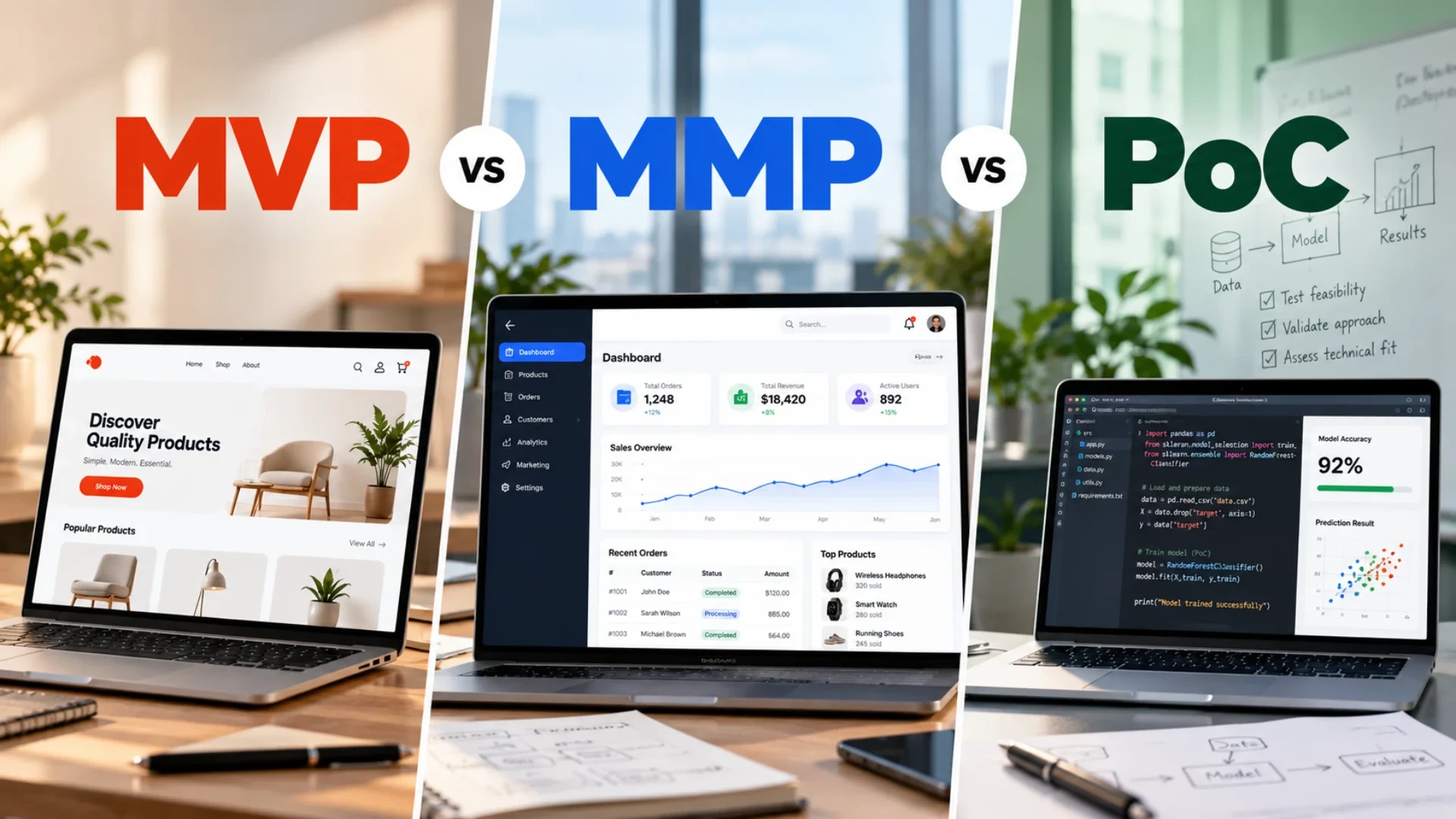
An MVP tests an idea in the market, an MMP is a more complete, market-ready product, and a PoC only checks if an idea is technically possible. They come at different stages, and knowing the difference saves money.
Term | What It Is | When It Comes |
PoC | Proof that an idea is technically possible | First, before building |
MVP | Simplest usable product to test the market | After PoC |
MMP | Minimum marketable product, more polished | After MVP succeeds |
So what comes first, PoC or MVP? A PoC usually comes first, because it confirms the idea can be built, then the MVP tests whether people actually want it. The MMP comes later, once the PoC has proven demand and you are ready to scale.
How Much Does It Cost to Build an MVP?
An MVP typically costs $5,000 to $15,000 for a simple version, $15,000 to $40,000 for a mid-complexity build, and more for advanced products. At Acquaint Softtech, fixed-price MVP development starts at $5,000, giving you an affordable way to validate your idea before building the full product.
MVP Type | Estimated Cost (2026) | Typical Timeline |
Simple MVP | $5,000 to $15,000 | 4 to 8 weeks |
Mid-complexity MVP | $15,000 to $40,000 | 2 to 4 months |
Advanced MVP | $40,000+ | 4 to 6 months |
You can keep MVP costs low without losing quality by outsourcing software development to a vetted team instead of hiring locally.
How to Launch Your MVP
Launch your MVP by shipping the core features to a small group of real users, then measuring and improving. A clean, focused launch beats a big, buggy one.
Define success metrics: decide what signals prove the idea works (signups, usage, retention).
Ship to early users: release to a small, relevant audience rather than everyone.
Collect feedback: gather reviews, usage data, and direct comments.
Iterate quickly: fix what matters, drop what does not, and improve the core.
Plan the next version: use real data to prioritize the next features.
Keeping the MVP stable after launch is where our support and maintenance services help, with monitoring and fast fixes.
Want your MVP built for just $5,000 to start?
Tell Acquaint Softtech your core features, and we will scope a fixed-price MVP, a timeline, and a launch plan within 48 hours, so you can validate fast.
Case Study: A Verified MVP-Style Build
The best MVPs ship fast, work reliably, and prove demand. Acquaint Softtech built a lean, focused product for a client, delivering core features quickly with a clean, scalable foundation to grow from. This account reflects our verified reputation on Clutch.
Client | A founder needing a fast, focused MVP to validate an idea. |
What we built | A lean product with core features, a clean UI, and a foundation ready to scale. |
MVP relevance | Core features first, quick launch, and room to iterate from real feedback. |
Outcome | A validated product delivered fast and on budget, ready for the next version. |
Delivery | A dedicated team with a transparent, responsive process and ongoing support. |
Company-wide proof: Acquaint Softtech has delivered 1,300+ projects over 13+ years with 70+ in-house engineers and a 5-star Clutch rating across 60+ reviews, as an Official Laravel Partner.
You can explore more MVP, SaaS, and fintech builds on the Acquaint Softtech case studies page.
Why Choose Acquaint Softtech to Build Your MVP
Choose a partner with public proof, an in-house team, and affordable MVP pricing, and Acquaint Softtech offers all three. Most clients save 60 to 75% versus hiring equivalent talent in the US, UK, or Australia, without cutting quality.
Affordable MVPs: fixed-price MVP development starts at $5,000.
Verified trust: 5-star Clutch rating across 60+ reviews and 1,300+ delivered projects.
In-house talent: 70+ full-time engineers, deployable within 48 hours.
Global reach: serving founders across the USA, UK, Europe, Australia, and New Zealand.
If you only need extra specialists on your own team, our IT staff augmentation services place vetted engineers within 48 hours.
To Sum Up
Now that you know what an MVP is and have defined it for your business idea, you have taken the first step toward building your MVP. By the way, we are an MVP development company that has already served clients all over the world and from various industries.
So, get in touch with us if you also want to skip ahead and give birth to your product quickly. That is exactly the kind of work the team at Acquaint Softtech enjoys.
Ready to give birth to your product quickly?
Talk directly with Acquaint Softtech's founder in a free 30-minute session. You will leave with a clear MVP scope, a fixed budget from $5,000, and honest advice on your idea.
Frequently Asked Questions
-
What is MVP?
MVP stands for Minimum Viable Product. It is the simplest version of your product built just enough to provide its core service so you can test its need, determine the market need, and gather feedback from your target audience.
-
What is MVP with an example?
An MVP is a basic product that tests an idea. A classic example is Groupon, whose founders manually posted deals and emailed PDF vouchers to early users. It validated demand before they built a full platform.
-
What's the difference between an MVP and MMP?
An MVP (minimum viable product) is the simplest version used to test an idea. An MMP (minimum marketable product) is more complete and polished, built to sell once the MVP has proven demand.
-
What comes first, PoC or MVP?
A PoC (proof of concept) usually comes first, to confirm the idea is technically possible. The MVP comes next, to test whether real users actually want it in the market.
-
How much does it cost to build an MVP?
An MVP typically costs $5,000 to $40,000+ depending on complexity. At Acquaint Softtech, fixed-price MVP development starts at $5,000, an affordable way to validate your idea before the full build.
-
Which technologies should I use to build an MVP?
At this stage, it is most likely that you won't have a lot of money to invest. Thus, you should pick technologies that help you develop your MVP quickly because faster development means lesser to cost you. One such technology you can pick is Laravel. Laravel ecosystem has pre-built libraries of code to help you build your website quickly.
-
Why should I develop an MVP first?
MVP development helps you launch faster, reduce development costs, and minimize risk. At Acquaint Softtech, fixed-price MVP development starts at $5,000, giving you an affordable way to validate your idea before building the full product.
-
What are the benefits of developing an MVP?
Developing an MVP helps you in many ways, such as: determining the feasibility of your idea, understanding the market, developing business and marketing strategy, and gathering feedback from your target audience.
-
What are the 7 stages of product development?
A common view is: idea generation, idea screening, concept development and testing, business analysis, product development (including the MVP), test marketing, and commercialization. The MVP sits in the build-and-validate stage.
-
How to start building an MVP?
MVP needs to be of high quality because a poor MVP means a missed opportunity to gather your initial customers. Thus, I recommend that you contact an MVP development company like Acquaint Softtech Private Limited and get a free consultation to build your MVP.
I love to make a difference. Thus, I started Acquaint Softtech with the vision of making developers easily accessible and affordable to all. Me and my beloved team have been fulfilling this vision for over 15 years now and will continue to get even bigger and better.
Table of Contents
Get Started with Acquaint Softtech
- 13+ Years Delivering Software Excellence
- 1300+ Projects Delivered With Precision
- Official Laravel & Laravel News Partner
- Official Statamic Partner
Related Blog
.webp "MVP Chapter #2: What Is the Difference Between POC and MVP? (2026 Update)")
MVP Chapter #2: What Is the Difference Between POC and MVP?
A Proof of Concept (PoC) tests whether an idea or technology can be built. A Minimum Viable Product (MVP) is a functional, bare-bones version of a product released to real users to test market demand and business viability. In short, a PoC answers "Can we build this?" while an MVP answers "Should we build this, and do people want it?" You usually build a PoC first, then an MVP once feasibility is confirmed.
Mukesh Ram
July 20, 2022.webp "MVP Chapter #3: Why Is an MVP Important?")
MVP Chapter #3: Why Is an MVP Important?
An MVP (Minimum Viable Product) is important because it lets you test a core idea in the real market with the least time, money, and effort. It helps you learn if people actually want your product before you spend a lot to build the full version. In short, an MVP saves money, saves time, validates demand, gathers real feedback, and reduces risk.
Mukesh Ram
July 28, 2022.webp "How To Hire a Top On-Demand App Development Company (2026 Guide)")
How To Hire a Top On-Demand App Development Company (2026 Guide)
An on-demand app development company builds custom software that connects users with instant services, goods, or transport through real-time digital platforms. These agencies handle the multi-sided architecture behind customer apps, service-provider dashboards, and admin panels. To hire the right one, research the market, set your priorities, make inquiries, check credentials, and choose the apt partner. Core features include real-time GPS tracking, secure payments, push notifications, and admin dashboards.
Mukesh Ram
October 24, 2019India (Head Office)
203/204, Shapath-II, Near Silver Leaf Hotel, Opp. Rajpath Club, SG Highway, Ahmedabad-380054, Gujarat
USA
7838 Camino Cielo St, Highland, CA 92346
UK
The Powerhouse, 21 Woodthorpe Road, Ashford, England, TW15 2RP
New Zealand
42 Exler Place, Avondale, Auckland 0600, New Zealand
Canada
141 Skyview Bay NE , Calgary, Alberta, T3N 2K6