

Transportation Management Systems: Carrier Selection, Rate Shopping & Load Optimization
A Transportation Management System is not a tracking map with extra buttons. It is a structured freight operations platform that owns carrier selection, rate negotiation, load planning, dispatch, and proof-of-delivery capture in one governed workflow.

Manish Patel
As Head of Technology and Client Success at Acquaint Softtech, I have worked across 1,300+ projects over 13 years, and TMS builds fail more often in the planning room than in development. The reason is almost always the same: teams design for visibility, not control.
A TMS is not a tracking dashboard. Any serious software product development company will make that distinction before a single module is scoped. It is a decision and execution engine that determines which carrier takes the load, at what rate, through which lane, against which SLA (Service Level Agreement) commitment. Shippers who miss that distinction end up with a platform that shows them what happened. This guide covers what should happen next and how a well-built TMS makes that call automatically.

- Logistics leaders deciding between custom TMS or commercial platforms.
- CTOs designing freight SaaS and TMS architecture from scratch.
- 3PLs and shippers needing carrier rate shopping and load automation.
- Founders building logistics startups, defining MVP vs post-launch TMS features.
This guide breaks down how a Transportation Management System actually works: the carrier selection logic, and the tender confirmation is sent to the carrier via EDI 204 or API. The carrier responds with EDI 990 (accept/decline). If declined, the TMS automatically re-tenders to the next carrier on the list. Every carrier in the selection pool must hold active operating authority before a tender is issued, a compliance check that production TMS platforms automate by querying the FMCSA Getting Started with Registration database, which governs safety and commercial operating authority for all interstate freight carriers in the US.
THE PROBLEM
Most TMS builds fail because teams design for visibility, not control. The operations team describes what the system should display, not what it should decide.
THE AGITATION
A tracking dashboard shows what happened. A real TMS decides what happens next: carrier, rate, lane, and SLA. That gap is where budgets disappear, and timelines collapse without a working dispatch system.
THE SOLUTION
Maps exactly how TMS software works: carrier selection, rate shopping, load optimisation, dispatch, integrations, build cost, and build-vs-buy signals. If you are scoping a custom TMS project, this is the technical and commercial map you need before the first architect conversation.
What a TMS Actually Is and Is Not
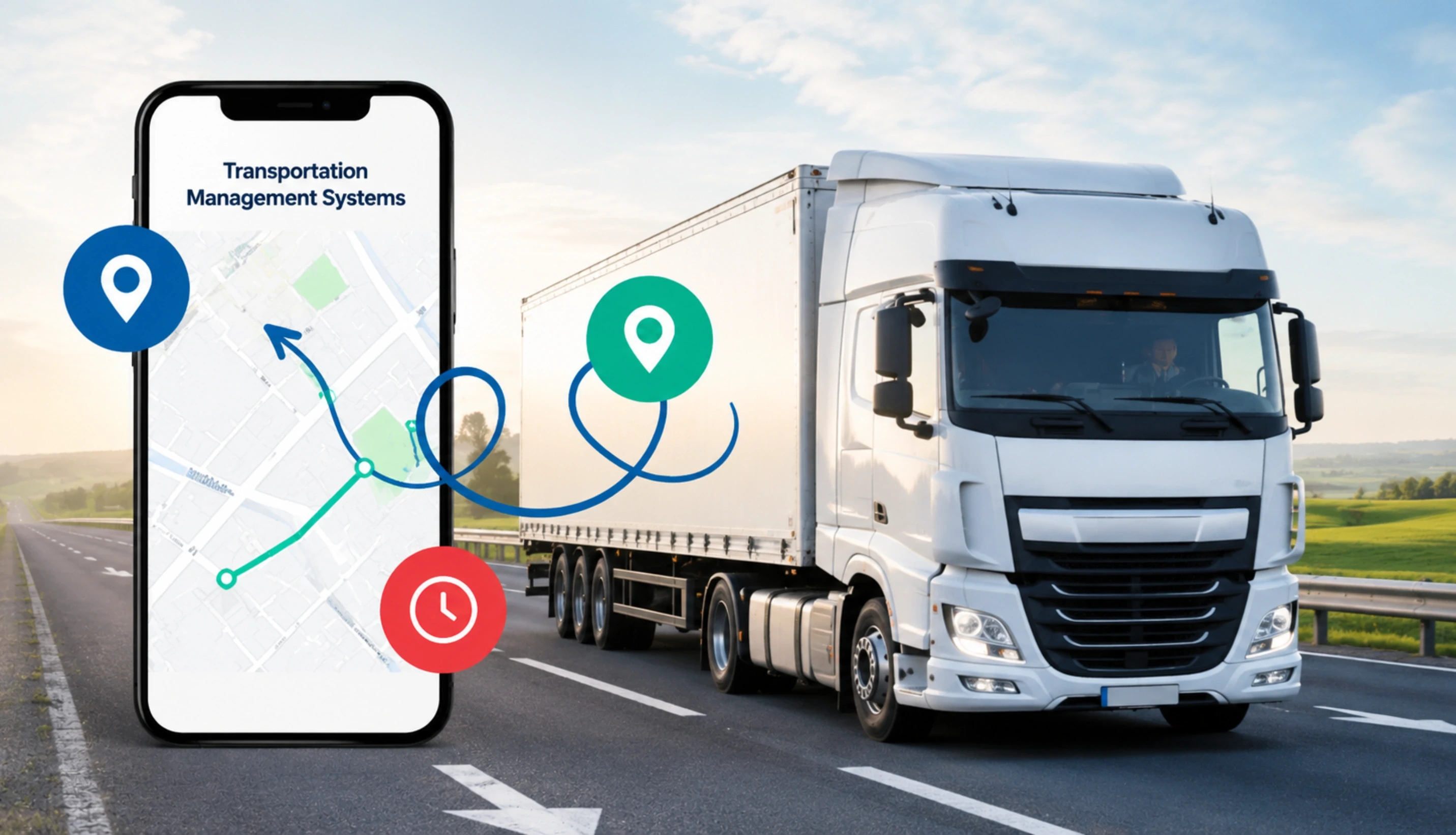
A Transportation Management System is a software platform that controls the movement of freight between facilities: from the shipper origin to the final delivery point. It owns carrier selection, freight rate management, load planning, dispatch, shipment tracking, and proof of delivery (POD) capture. It does not manage inventory inside a warehouse. It does not manage fleet maintenance schedules. It does not own the carrier relationship; the TMS automates the execution of that relationship.
Precision Definition
A TMS owns three freight decisions: WHO moves the load (carrier selection), HOW MUCH it costs (rate management and freight audit), and WHEN and HOW it moves (load planning, dispatch, and exception management). Every module in the system serves one of these three decisions.
A TMS is not a fleet management system
A fleet management system tracks vehicles owned by the operator: GPS location, driver hours, fuel consumption, and maintenance schedules. A TMS manages freight contracts with external carriers. The boundary is asset ownership: fleet management = your vehicles; TMS = carrier relationships. An operation that owns its own trucks needs both. An operation that relies entirely on contracted carriers may need only a TMS.
A TMS is not a WMS
A WMS manages inventory inside a facility. A TMS manages freight between facilities. The handoff point is the dock door: when a pallet leaves the warehouse dock outbound, it exits WMS jurisdiction and enters TMS jurisdiction. The two systems must integrate at that handoff point — the WMS sends the shipment manifest to the TMS, the TMS sends the carrier booking confirmation back to the WMS, and both systems record the event timestamp for audit.
A TMS is not a track-and-trace portal
Track-and-trace portals show the current location of a shipment. A TMS generates the shipment, selects the carrier, negotiates the rate, creates the booking, tracks execution, and triggers exception alerts when the shipment deviates from plan. Track-and-trace is one output of a TMS. Confusing the two leads to operations teams buying a visibility tool when what they need is an execution platform.
How Carrier Selection and Rate Shopping Really Work

Carrier selection and rate shopping are the core intelligence of any TMS. Most operators believe this is a simple price comparison. It is not. The rate shopping engine is a multi-variable optimisation that balances cost, transit time, service reliability, carrier capacity, lane availability, and compliance constraints simultaneously.
How the TMS Rate Shopping Engine Works: Step by Step
Shipment parameters are defined: origin, destination, weight, dimensions, commodity type, service requirements (temperature, hazmat, white glove), and required delivery window.
The TMS queries its carrier rate database: contracted rates stored in the rate management module, updated via EDI (Electronic Data Interchange) 204/990/214 transactions or carrier API (Application Programming Interface) connections.
Real-time spot rate queries are sent to carrier APIs or load boards for lanes where contracted rates are not available or where spot rates are currently lower than contracted rates.
The engine applies filtering rules: carrier compliance status, lane performance score, capacity availability flag, and any customer-specific carrier preferences or exclusions.
A ranked shortlist is returned: typically the lowest-cost option, the fastest-transit option, and the carrier with the highest lane reliability score for that O&D (Origin-Destination) pair.
The dispatcher selects from the shortlist or the TMS auto-tenders if auto-tender rules are configured (e.g., 'Auto-tender to lowest-cost carrier if transit time is within SLA and carrier score is above 85').
Tender confirmation is sent to the carrier via EDI 204 or API. The carrier responds with EDI 990 (accept/decline). If declined, the TMS automatically re-tenders to the next carrier on the list.
What Separates a Real Rate Engine from a Basic Comparison
The difference between a basic rate comparison and a production TMS rate engine is the scoring layer. A basic comparison returns the cheapest rate. A production engine scores each carrier on transit reliability, historical damage rate, on-time delivery percentage for that lane, and current capacity signal, then weights those scores against the shipment's SLA requirements. Building that scoring layer is where most custom TMS projects spend 30% to 40% of their engineering budget.
Load Planning and Optimisation: The Engine Behind Freight Efficiency

Load planning determines how freight is grouped into shipments, how shipments are sequenced for pickup and delivery, and how trailer space is allocated. A poor load plan adds cost directly: partial trailer loads, unnecessary multi-stop routes, and mismatched freight weights all translate into avoidable spend.
The three load optimisation problems a TMS solves
Consolidation
Grouping multiple smaller shipments headed to the same region into a single truckload movement. The TMS identifies consolidation opportunities across open orders, calculates the cost savings versus individual shipments, and presents the option to the dispatcher. Effective consolidation typically reduces freight spend by 12% to 22% on dense trade lanes.
Load Building (3D bin packing)
Determining how freight units fit inside a trailer to maximise cubic utilisation and comply with weight distribution rules. The TMS applies a 3D bin packing algorithm against the declared dimensions and weights of each shipment, generates a load plan, and flags any configuration that exceeds axle weight limits for the route.
Multi-Stop Route Optimisation
For LTL (Less than Truckload) and last-mile operations with multiple delivery stops, the TMS applies a VRP (Vehicle Routing Problem) algorithm to sequence stops for minimum total travel distance, subject to delivery window constraints. This is the same class of algorithm used in last-mile delivery optimisation, applied at the regional freight level.
AI in Load Optimisation
In 2026, AI-powered load optimisation, using reinforcement learning to continuously improve the consolidation and routing model based on historical freight data, delivers 8% to 15% better trailer utilisation than rule-based algorithms alone. Acquaint Softtech's AI development services for route optimisation incorporate ML model training pipelines that improve with every shipment event recorded by the TMS.
The TMS Module Map: What Each Component Owns
The table below maps each TMS module to its operational domain, the data it manages, and the systems it connects to. This is the scope reference Acquaint Softtech uses when building a TMS product brief with a new client.
TMS Module | Operational Domain | Key Data Managed | Primary Integrations |
Carrier Management | Carrier onboarding, compliance, performance scoring, capacity flags | DOT numbers, insurance certs, lane performance scores, capacity availability | FMCSA carrier database, carrier portals, internal compliance records |
Rate Management | Contracted rate storage, spot rate queries, accessorial charges, fuel surcharge calculation | Rate tariffs, lane-specific rates, carrier contracts, fuel indices | Carrier EDI rate feeds, load board APIs, and internal contract database |
Order Management | Freight order intake, consolidation, shipment creation | Order details, commodity data, packaging dimensions, and delivery windows | ERP purchase orders, WMS dispatch events, customer portals |
Load Planning | Shipment consolidation, load building, route sequencing | Load plans, trailer configurations, weight calculations, stop sequences | WMS dock scheduler, route optimisation engine, driver assignment module |
Dispatch | Carrier tendering, acceptance tracking, driver assignment, load board posting | Tender records, EDI 204/990, driver assignments, BOL (Bill of Lading) generation | Carrier APIs, EDI networks, driver mobile app, and dock management |
Track & Trace | Shipment location, milestone event capture, ETA (Estimated Time of Arrival) calculation, exception alerting | GPS events, carrier check-calls, EDI 214 updates, and delivery confirmations | Carrier tracking APIs, GPS telematics providers, and a customer notification system |
POD Management | Proof of delivery capture, document storage, signature verification, and delivery exception recording | POD images, driver signatures, delivery timestamps, exception notes | Driver mobile app, document management system, customer portal |
Freight Audit & Pay | Carrier invoice matching, accessorial dispute, payment approval, freight GL coding | Carrier invoices, rate confirmations, accessorial logs, GL codes | ERP accounts payable, carrier billing portals, and an internal finance system |
Reporting & Analytics | Freight spend analysis, carrier performance reports, lane cost benchmarking, and CO2 emissions tracking | Spend by lane/carrier/mode, on-time delivery rates, cost per unit, emissions data | BI tools (Power BI, Tableau), finance systems, and sustainability reporting |
The modules that carry the highest engineering complexity in a custom TMS build are the Rate Management engine (specifically the scoring layer that weights carrier performance against cost) and the Freight Audit and Pay module (which must match carrier invoices against confirmed rates, including all accessorial charges, with minimal manual intervention).
These two modules are also where commercial TMS platforms have the weakest configurability for non-standard freight models. If your operation has unusual accessorial charge structures, multi-modal rating requirements, or freight contracts that differ significantly from standard tariff formats, a custom TMS development engagement is almost always the better investment over 3 years.
Want a TMS Module Scope Built for Your Freight Operation?
Acquaint Softtech maps your freight workflow to a TMS module scope within 48 hours of your project brief. We identify which modules to build first, which integrations are critical to launch, and what a phased delivery timeline looks like for your volume. You review the team profiles and interview the engineers before any engagement starts.
How a TMS Integrates With WMS, ERP, and Carrier Networks
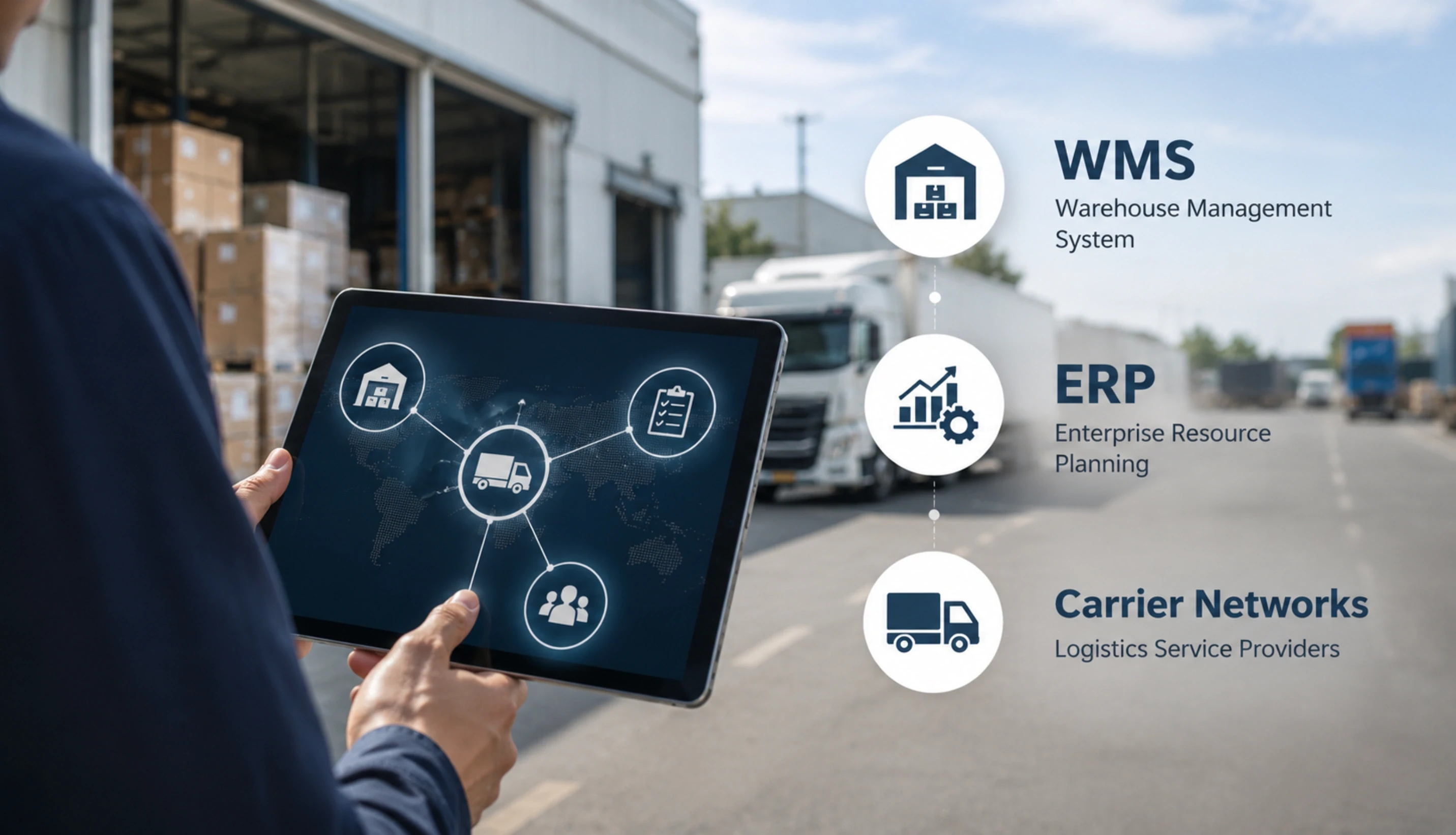
A TMS does not operate as a standalone system. Its value depends on the quality of its integration with the WMS that hands off freight, the ERP that manages purchase orders and freight cost accounting, and the carrier network that executes the movement. Poor integrations are the most common cause of TMS go-live failures.
TMS–WMS Integration: The Dock Handoff
The WMS sends a shipment manifest to the TMS when a load is staged at the dock door: ship-from location, destination, pallet count, weight, commodity, and required delivery window. The TMS returns the carrier booking confirmation, the BOL number, and the driver/trailer details. The integration must be real-time: a batch integration at this point means dock workers wait for system confirmation before releasing the load, which adds 20 to 40 minutes per trailer to dock cycle time.
The integration must be real-time: a batch integration at this point means dock workers wait for system confirmation before releasing the load, which adds 20 to 40 minutes per trailer to dock cycle time. For logistics startups validating this integration before committing to a full build, an MVP development company can scope a working dock-handoff prototype in 6 to 8 weeks without building the full rate engine first.
TMS–ERP Integration: Freight Cost Accounting
The ERP sends purchase order data to the TMS to trigger inbound freight planning: expected shipment volume, vendor location, and contracted delivery terms. After delivery, the TMS sends freight cost actuals back to the ERP for GL (General Ledger) coding against the purchase order. The freight audit and pay module must reconcile carrier invoices against confirmed rates before the ERP receives the posting; otherwise, the ERP carries uninvestigated freight cost variances.
TMS–Carrier Integration: EDI and API
Carrier integration operates through two channels. EDI is the traditional channel: EDI 204 (load tender), EDI 990 (tender accept/decline), EDI 214 (shipment status), and EDI 210 (freight invoice) are the standard transactions. API-based integration is increasingly common for carriers that offer REST or GraphQL APIs for real-time tendering and tracking. The TMS must support both, because the carrier mix in most freight operations includes large carriers with full EDI capability and regional carriers with API-only or even portal-only integration.
If you need to hire Python developers for carrier API integration, the integration layer is where Python's async capabilities, particularly for handling high-volume concurrent carrier API calls, provide a measurable advantage over synchronous frameworks.
Integration Point | Protocol | Data Direction | Latency Requirement |
WMS → TMS (shipment manifest) | REST API or message queue (RabbitMQ/Kafka) | WMS to TMS | Real-time (< 2 seconds) |
TMS → WMS (carrier confirmation) | REST API or message queue | TMS to WMS | Real-time (< 2 seconds) |
ERP → TMS (purchase orders) | REST API or EDI 850 | ERP to TMS | Near-real-time (< 5 minutes) |
TMS → ERP (freight cost actuals) | REST API or EDI 210 | TMS to ERP | Daily batch is acceptable |
TMS → Carrier (load tender) | EDI 204 or REST API | TMS to Carrier | Real-time (< 30 seconds) |
Carrier → TMS (status updates) | EDI 214 or webhook | Carrier to TMS | Event-driven (< 5 minutes per milestone) |
Carrier → TMS (freight invoice) | EDI 210 or API | Carrier to TMS | Daily batch is acceptable |
What a Custom TMS Build Costs in 2026

The cost of a custom TMS build is driven by three variables: the number of carrier integrations (EDI and API), the complexity of the rate management and scoring engine, and the number of freight modes the system must support (FTL, LTL, parcel, ocean, air). The figures below are based on Acquaint Softtech's delivery operations across logistics SaaS and freight platform clients.
Engagement Size | Scope | Monthly Team Rate | Equivalent In-House Cost | Annual Saving |
Small | Core rate shopping, single-mode (FTL or LTL), 2 to 4 carrier EDI/API integrations, basic track-and-trace. | $9,000 to $14,000/month | $24,000 to $30,000/month (3 FTE) | $120,000 to $192,000/year |
Medium | Multi-mode (FTL + LTL + parcel), 5 to 10 carrier integrations, freight audit module, performance scoring. | $15,000 to $24,000/month | $38,000 to $52,000/month (5 to 6 FTE) | $276,000 to $336,000/year |
Large | Full multi-modal, 10+ carriers, AI-driven rate optimisation, international customs integration, and CO2 reporting. | $26,000 to $42,000/month | $60,000 to $85,000/month (8 to 10 FTE) | $408,000 to $516,000/year |
What the Monthly Rate Includes at Acquaint Softtech
Full-stack engineering: backend (Python or Laravel), frontend (React), mobile (React Native for driver app), QA, and DevOps. For operations that need to scale engineering capacity quickly without a long-term headcount commitment, IT staff augmentation allows freight teams to add specialist carrier integration engineers to an existing development team on a sprint-by-sprint basis.
Carrier EDI integration development, all standard transaction sets (204, 990, 214, 210) included in the scope
AWS or Azure infrastructure setup and ongoing management
Sprint-based delivery with client demos every 2 weeks; 95% first-sprint delivery rate across 1,300+ projects
Codebase, API documentation, and full IP (Intellectual Property) ownership transferred to the client
48-hour team deployment from engagement confirmation, no 6-week onboarding delay
Support and maintenance engagement available post-launch to cover carrier API changes and system updates
The rate the client pays is the rate. No employer overhead. No per-seat licensing. No infrastructure markup. Acquaint Softtech is an Official Laravel Partner with 70+ multi-stack engineers, deployable within 48 hours.
Need a TMS Cost Estimate Tailored to Your Carrier Mix?
Share your freight modes, carrier count, and integration requirements. Acquaint Softtech returns a detailed team structure and monthly cost breakdown within 48 hours. You interview the developers before a single sprint begins. No commitment required to receive the estimate — and no sales pitch attached.
Build vs Buy: The Six Signals That Tell You Which Path to Take

This framework is used inside Acquaint Softtech's technical discovery workshop for TMS projects. Answer each signal honestly. Four or more signals pointing to 'build' indicate that a commercial TMS will not serve your operation at its current complexity level.
Signal 01: Your carrier mix includes regional carriers not supported by major TMS vendors' EDI networks.
Build: Custom carrier integration is a core engineering task, not an exception. A custom TMS carries the integration as a native module.
Buy: If all your carriers are supported by the commercial TMS's standard EDI library, the integration cost is near zero.
Signal 02: Your freight rate model includes non-standard accessorial charges, volume rebates, or mode-specific pricing tiers that require custom rating logic.
Build: Commercial TMS rate engines are built for standard tariff structures. Non-standard pricing logic requires custom development that is easier on a clean codebase than on a commercial product's configuration layer.
Buy: Standard LTL and FTL tariff structures with published accessorials are well-supported by commercial TMS products.
Signal 03: Your operation manages freight across more than two modes (e.g., ocean + air + parcel + FTL).
Build: Multi-modal rate comparison and load planning require a unified data model across modes. Commercial TMS products often have mode-specific modules that do not share a common rate and routing engine.
Buy: Single-mode or dual-mode operations (FTL + LTL) are well-served by commercial TMS products without custom development.
Signal 04: You need to embed TMS functionality inside an existing logistics platform, shipper portal, or 3PL client-facing product.
Build: Commercial TMS products do not offer white-label embedding or SDK-level integration. If TMS capability must appear inside your product, it must be built as a module of your product.
Buy: If TMS is a standalone internal tool for your own freight team, a commercial product with API access is sufficient.
Signal 05: You process more than 1,000 shipments per day or manage more than $5 million per month in freight spend that requires an automated freight audit.
Build: At this volume, freight audit automation (invoice matching, dispute flagging, GL coding) provides a measurable ROI on a custom-built engine. Commercial products' audit modules typically require significant manual intervention above this threshold.
Buy: Below 500 shipments per day, commercial TMS freight audit modules are sufficient without custom automation.
Signal 06: Your compliance environment requires customs integration, IMDG (International Maritime Dangerous Goods) documentation, or CTPAT (Customs-Trade Partnership Against Terrorism) tracking for international freight.
Build: Regulatory compliance modules for international freight are highly jurisdiction-specific. Custom builds can be scoped to exact regulatory requirements; commercial products often provide partial compliance coverage that leaves manual gaps.
Buy: Domestic-only operations without hazmat or controlled-goods requirements are well-covered by commercial TMS compliance modules.
Operations that identify four or more build signals should engage a logistics software development partner with TMS experience before evaluating commercial products. The dedicated software development team model, a fixed team, fixed monthly rate, full IP ownership, is the lowest-risk structure for a custom TMS build because the client controls the codebase from day one and is not dependent on a vendor's roadmap.
Operations that need a Laravel-based TMS backend should hire Laravel developers with freight platform experience specifically, as TMS rate engine logic on Laravel requires familiarity with complex query optimisation patterns that differ significantly from standard web application development.
Identified Four or More Build Signals? Let Us Scope Your TMS.
Acquaint Softtech builds a TMS product scope, module list, integration map, team structure, and phased delivery timeline, within 48 hours of your project brief. Our team of 70+ engineers has delivered logistics and freight platforms for clients across the US, UK, Australia, and the UAE. You interview the team before a single sprint begins.
Four Misconceptions That Derail TMS Projects
These four misconceptions appear in almost every TMS scoping conversation. Correcting them before a project starts saves 3 to 6 months of wasted development.
Misconception: A TMS is primarily a shipment tracking tool.
Reality: Shipment tracking is one output of a TMS, the visibility layer that shows where a load is right now. The actual function of a TMS is upstream of tracking: it decides which carrier gets the load, at what rate, through which route, and on what timeline. Operations teams that build 'a TMS' when they actually mean 'a tracking portal' end up with a system that shows them what happened rather than a system that controls what happens next. The carrier selection and rate management modules are the heart of a TMS, not the map view.
Misconception: EDI is outdated — we can build our TMS with API integrations only.
Reality: In 2026, the majority of mid-to-large freight carriers still require EDI for load tendering and invoice exchange. API-only TMS builds that omit EDI support are locked out of a significant portion of the available carrier network. The U.S. DOT's Electronic Freight Management Initiative, a federally sponsored research programme, specifically identified EDI as the foundational data exchange standard for supply chain partners, a position that continues to shape how carrier networks expect freight transactions to be structured. Modern TMS builds maintain both EDI and API integration capability, with EDI handling carrier transaction compliance and API handling real-time tracking and rate queries.
Misconception: A commercial TMS can be customised to handle any freight model.
Reality: Commercial TMS products have a configuration boundary. Standard FTL and LTL operations with published tariffs, standard accessorials, and major carrier EDI connections sit inside that boundary. Non-standard freight models, multi-modal rating, custom accessorial structures, volume rebate programs, and embedded 3PL client portals sit outside it. The configuration workarounds used to handle non-standard requirements on a commercial TMS platform create technical debt that compounds with every carrier addition and freight model change.
Misconception: Freight audit and pay can be handled manually until volume justifies automation.
Reality: At 200 or more shipments per day, a manual freight audit creates a backlog that is structurally impossible to clear. A carrier invoices within 30 days. The shipper's window to dispute an accessorial charge is typically 15 to 30 days from invoice receipt. Without automated invoice matching, accessorial disputes are missed, overbillings are paid, and freight cost actuals in the ERP carry systematic variances. The freight audit module should be scoped from day one of a TMS build, not added after volume proves the need.
One additional pattern worth naming: the assumption that a TMS can be replaced quickly if the build or vendor does not deliver. Replacing a TMS mid-operation, re-tendering active shipments, migrating rate tables and carrier integrations, retraining dispatch teams, is a 3 to 6-month project with direct freight operational risk.
Vendor and architecture selection matters before the first carrier integration is written. For a reference on how Acquaint Softtech approaches outsourced logistics development with full transparency, read our blog on red flags to watch when outsourcing logistics software development.
Ready to Build a TMS That Controls Your Freight: Not Just Tracks It?
Acquaint Softtech delivers a dedicated TMS development team, backend engineers, a frontend developer, a QA engineer, and a DevOps specialist, within 48 hours of your project brief. Average team tenure is 24+ months. First-sprint delivery rate is 95%. You own the codebase, the IP, and the carrier integrations from day one.
Frequently Asked Questions
-
What does a TMS actually do?
A Transportation Management System controls the end-to-end freight movement workflow: carrier selection, rate shopping, load tendering, dispatch, shipment tracking, proof of delivery capture, and freight invoice audit. It does not manage inventory inside a facility (that is, a WMS), and it does not manage owned vehicles (that is, a fleet management system).
The defining function of a TMS is that it makes freight decisions, which carrier, at what rate, on which route, and then executes and audits those decisions. A track-and-trace portal shows you where freight is; a TMS decides and executes how freight gets there.
-
How does a TMS select carriers?
A TMS selects carriers through a multi-variable scoring engine that queries the carrier's contracted rate for the lane, checks the carrier's capacity availability signal, retrieves the carrier's historical on-time delivery percentage and damage rate for that lane, and compares the contracted rate against available spot rates.
The engine returns a ranked shortlist based on configurable weighting rules: lowest cost, fastest transit, or highest reliability. The dispatcher selects from the shortlist or the TMS auto-tenders if auto-tender rules are configured. If the selected carrier declines the tender, the TMS automatically re-tenders to the next carrier on the ranked list.
-
What are the core modules of a TMS?
The core TMS modules are: Carrier Management (onboarding, compliance, performance scoring), Rate Management (contracted rates, spot rate queries, fuel surcharge calculation), Order Management (freight order intake and shipment creation), Load Planning (consolidation, load building, route sequencing), Dispatch (tendering, BOL generation, driver assignment), Track and Trace (shipment location, ETA calculation, exception alerting), POD Management (proof of delivery capture and storage), Freight Audit and Pay (invoice matching, dispute management, GL coding).
-
How much does TMS development cost?
Custom TMS development through Acquaint Softtech costs between $9,000 and $42,000 per month, depending on team size, carrier integration count, and freight mode complexity. A small FTL or LTL operation with 2 to 4 carrier integrations runs $9,000 to $14,000 per month.
A full multi-modal platform with 10 or more carrier integrations, an AI-driven rate optimisation engine, and international customs compliance runs $26,000 to $42,000 per month. These rates include the full team, backend, frontend, mobile, QA, DevOps, and all carrier EDI integration development. The client owns the codebase and IP at all times. There is no per-user licensing, no infrastructure markup, and no vendor lock-in.
-
How long does it take to build a custom TMS?
A core TMS, rate shopping, carrier tendering via EDI, dispatch, and basic track-and-trace, typically takes 4 to 6 months to build to a production-ready state. Adding a freight audit module adds 6 to 10 weeks. Adding AI-driven rate optimisation or load planning adds 8 to 16 weeks, depending on the complexity of the training data pipeline.
International customs integration for multi-modal operations adds 10 to 20 weeks. Acquaint Softtech uses a phased delivery model: the core dispatch and rate modules are live at month 4, and freight audit, analytics, and optimisation layers are deployed in subsequent sprints on a running codebase.
-
What EDI transactions does a TMS need to support?
The standard EDI transaction set for a TMS covers six transaction types: EDI 204 (Motor Carrier Load Tender, the TMS sends a load offer to the carrier), EDI 990 (Response to a Load Tender, the carrier accepts or declines), EDI 214 (Transportation Carrier Shipment Status Message, the carrier sends location and milestone events), EDI 210 (Motor Carrier Freight Details and Invoice, the carrier sends the freight invoice for audit), EDI 850 (Purchase Order, received from ERP to trigger inbound freight planning), and EDI 856 (Ship Notice or Manifest, sent from WMS to TMS at dock handoff). Operations with international freight add ocean-specific EDI sets. Acquaint Softtech includes all standard EDI transaction sets in the base TMS scope.
-
What happens to my TMS codebase if the Acquaint engagement ends?
The client owns the codebase, the database schema, the carrier integration configurations, the API documentation, and all related intellectual property from day one of the engagement. This is a contract term in every Acquaint Softtech engagement, not a negotiation point.
At engagement end, the full codebase is handed over with technical documentation, environment configuration, and a handover session. The client can deploy the system internally, transfer it to another vendor, or continue with internal development without any licensing dependency on Acquaint Softtech.
-
Should I build my TMS on Laravel or Python?
The backend framework choice depends on two factors: team expertise and AI integration requirements. Python (Django or FastAPI) is the preferred choice when the TMS includes AI-driven rate optimisation, ML-based demand prediction, or a reinforcement learning load planning engine, because the ML toolchain is native to the Python ecosystem.
Laravel (PHP) is preferred when the TMS is part of a larger Laravel platform, when the team has existing Laravel capability, or when rapid module development on a structured MVC framework is the priority. Acquaint Softtech builds TMS platforms on both stacks and can recommend the right choice based on your existing infrastructure. See our guide on the right stack for logistics SaaS for a detailed comparison.
I lead technology and client success at Acquaint Softtech with one goal in mind. Deliver work that feels personal, reliable, and worthy of long term trust. I stay close to both our clients and our developers to make sure every project moves with clarity, quality, and accountability.
Table of Contents
Get Started with Acquaint Softtech
- 13+ Years Delivering Software Excellence
- 1300+ Projects Delivered With Precision
- Official Laravel & Laravel News Partner
- Official Statamic Partner
Related Blog
.webp "Warehouse Inventory Management Solution")
Warehouse Inventory Management Solution
A Warehouse Management System (WMS) is software that controls and tracks inventory, storage locations, and daily movements from the moment goods arrive until they ship. Its core functions are receiving and put-away, real-time tracking with barcodes or RFID, picking and packing, and shipping. Popular options range from Odoo and Zoho Inventory for growth, to Katana for manufacturing, to Manhattan Active WMS for enterprise and 3PL.

Mukesh Ram
December 14, 2022India (Head Office)
203/204, Shapath-II, Near Silver Leaf Hotel, Opp. Rajpath Club, SG Highway, Ahmedabad-380054, Gujarat
USA
7838 Camino Cielo St, Highland, CA 92346
UK
The Powerhouse, 21 Woodthorpe Road, Ashford, England, TW15 2RP
New Zealand
42 Exler Place, Avondale, Auckland 0600, New Zealand
Canada
141 Skyview Bay NE , Calgary, Alberta, T3N 2K6