

Warehouse Inventory Management Solution
A Warehouse Management System (WMS) is software that controls and tracks inventory, storage locations, and daily movements from the moment goods arrive until they ship. Its core functions are receiving and put-away, real-time tracking with barcodes or RFID, picking and packing, and shipping. Popular options range from Odoo and Zoho Inventory for growth, to Katana for manufacturing, to Manhattan Active WMS for enterprise and 3PL.

Mukesh Ram
As the Founder and CEO at Acquaint Softtech, a leading custom software development company, I have helped logistics and retail businesses across the USA, UK, Europe, Australia, and New Zealand modernize their operations. Managing a warehouse is not an easy task, especially for a large company. It is a good practice to use an expert system, especially in this digital age where the use of electronic devices and systems is on the rise. A warehouse management system is essentially a software solution that makes the process of organizing, controlling, and administering a warehouse simpler.
Several industries require an inventory system, such as agriculture, manufacturing, logistics, etc. The basic purpose of a warehouse is to ensure one can store their goods in a safe and secure manner; this includes raw materials as well as finished goods. It is also vital that the business is aware of where each item or product is located, what is in stock, and if there is any space available.

- You want to build a warehouse inventory management solution.
- You are a CEO, COO, or CTO in logistics, retail, or manufacturing.
- You want the core functions, features, and top WMS software options.
- You want to compare warehouse management systems.
- You want to know what a custom WMS costs to develop.
- You want a proven partner to build a scalable WMS.
This is especially true in large warehouses, which are harder to manage. This article provides more information on a warehouse management solution.
Whether you need a warehouse inventory management solution template, a free tool to start, or a full custom platform, the goal is the same: know exactly what you have, where it is, and how fast it can ship. That is what separates a smooth operation from a costly one.
If you want expert help scoping the build, our discovery workshop services turn your warehouse goals into a clear, build-ready plan in days.
Significance Of Warehouse Inventory Management Solution

There is more to a warehouse than simply stacking the shelves and retrieving items when necessary. A warehouse can differ in size depending on the type of business; however, it isn't something that can be managed efficiently without a decent system in place.
Here are a few reasons it is important to design a custom system for your business:
It helps streamline the order fulfillment process and avoids delays by ensuring everything is fully organized.
Implementing a system with advanced technologies helps improve accuracy and fulfill orders more accurately by reducing human error and automating tasks.
Considering the size of a warehouse, performing daily tasks like recording, scanning, and retrieving items can be quite an ordeal. Implementing an intelligent system can help boost productivity to a great extent through the automation of routine tasks and speeding up all other processes.
This type of system will allow you to process tasks faster, thus allowing you to get through more orders and increase efficiency and profits in the process.
It can help one expand their business and engage in more complicated processes like automating order processing, splitting inventory across several centers, and optimizing the process of last-mile delivery.
Implementing this type of process is key to saving money.
A system like this is very efficient, helps remove any hitches, and ensures the products are delivered to the customers promptly. Customer satisfaction is essential; in fact, it is vital for the success of any business.
The cost of human error tends to build up. Errors often occur while shipping goods, manual data input, etc. Automating tasks helps eliminate this and also helps reduce labor costs.
Theft, loss of goods, or misplacing items often cost this type of business a great deal; this can be eliminated by a custom solution.
Here are a few statistics that suggest the same:
Over 5 billion people are actively using the Internet, which is equivalent to 62.5% of the world's population.
92.1% of people use their mobile devices to access the Internet.
The number of social media users around the world as of June 2022 is 4.7 billion.
The warehousing and storage industry is a $22 billion industry in the USA.
The average size of a warehouse in 2000 was 65,000 square feet, while that in 2017 was 181,370 square feet.
An increase in eCommerce sales is driving the need for bigger and more efficient warehouses.
Core Functions of a WMS
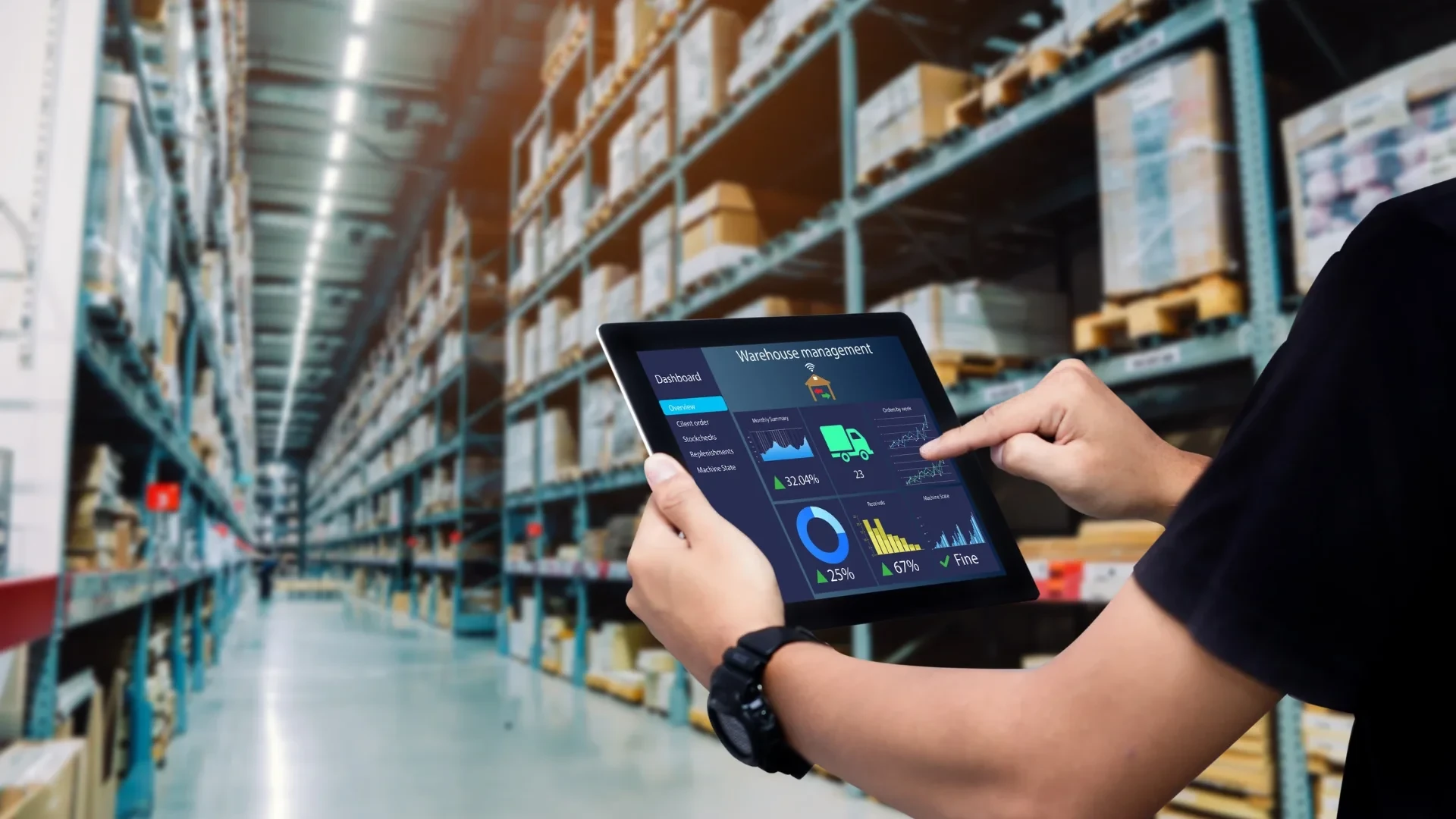
A WMS tracks inventory from the moment goods arrive until they ship, across four core functions.
Receiving and put-away: checks incoming goods, verifies quantities, and assigns efficient storage spaces.
Real-time tracking: monitors stock levels and exact bin or shelf locations using barcodes or RFID.
Picking and packing: optimizes staff routes to pull items for orders quickly and accurately.
Shipping: generates packing lists, invoices, and tracking notifications automatically.
Building these functions into a reliable system is where our dedicated software development teams add the most value.
Process of a Warehouse Inventory Management System
The operation of a warehouse involves several complex procedures. However, there are two main processes: inbound and outbound. The inbound process involves receiving the goods and processing the inbound request. It also includes scanning, inspecting for quality, and assigning a location for it to be stored. Similarly, an outbound process involves locating the item in the store and picking it up. Each outbound item goes through the process of finding the correct size box and packaging material. It also needs to be weighed, scanned, and processed for shipping prior to shipping it.
The process of the warehouse might seem quite simple; however, there is more to it than meets the eye. There are many types of warehouses, the most popular ones being those that stock items for sale. The task of processing inbound items will usually mean having to deal with a truckload of items, if not multiple truckloads. The warehouse will have to process each inbound item, which involves unpacking it, registering it in the system, and storing it. This process needs to be completed as fast as possible to ensure it can be made available for sale.
Attempting to accomplish such a job manually is time-consuming, and trying to speed up the process can very easily result in human errors. A single error at any stage of this process will affect the entire supply chain process; hence, this is something businesses cannot afford. This is where a warehouse management system comes in. It can help automate the entire process and improve efficiency.
This process can be handled very easily using a warehouse inventory management system. The way such a system would work is that all items are opened and taken directly into inventory at the click of a button. Doing so automatically updates the stock levels of the item and makes it available for sale. It also records the location where it is to be stored.
How it Works?
The reason this process can be better implemented using a system like this instead of using paper or a filing system is that there are several factors to consider during each stage. Listed here are the factors to consider:
Check if there is any space available to store the item.
Find the best place to store it based on how it fits, the demand, and how fast it can be retrieved.
Assign the task of stocking the item promptly.
Keep a record of the timestamps at every stage, like arrival, scanning, and stocking.
Each item is also labeled correctly before putting it away.
The inventory needs to be updated, and in the case of an eCommerce store, so does the store database, to ensure it is available for sale.
It also involves a verification process.
The system will also optimize the picking system to speed up the process; this is useful when there are many orders. It works by analyzing which order to process first.
It can also further optimize the system by implementing a batch pickup instead of a single pickup. This is relevant in the case of multiple orders, and the pickup is to be made from the same location in the warehouse.
A system like this will also have an extensive database of the different types of boxes (various sizes and thicknesses) as well as packaging material. Businesses using Custom Printed Boxes can further streamline box selection, improve brand consistency, and optimize packaging workflows to save a considerable amount of time. The product data will also already contain all information about the product, like weight and other specifications.
Report generation is an integral part of a system like this as well. Vital reports pertaining to the pricing, sales, worker efficiency, best-selling products, etc., are generated periodically or on demand to help a business optimize its operations and make better decisions.
Main Features
A warehouse system like this that is meant to handle inventory and reduce the time and effort spent on all processes will have several innovative features. A good web development firm like Acquaint Softtech can develop a customized system to suit your requirements. Listed here are some of the common features of such a system:
Inventory tracking in real-time.
Automate the processes of order picking.
Generate a wide range of reports, such as inventory reports.
Optimize inventory levels and conduct inventory audits with ease.
Practice the picking and packing process to ensure the least possible delays.
Smart reporting to track and control inventory in real time and optimize the process based on stock and trends.
Batch scanning, tagging, and barcodes that capture essential details like SKU, etc.
For businesses with warehouses spread across various locations, the system can include multiple languages, currencies, and location features.
Receive smart alerts regarding stock and track packages for real-time updates.
Stock and ownership management.
Optimized the shipping process by generating bills, invoices, packing lists, shipment notifications, etc.
Monitor and track labor performance and manage their tasks efficiently.
Dock management system to assist truck drivers with the purpose of optimizing all inbound and outbound logistics.
Search for items or products based on specific criteria.
Top Warehouse Management Software Options
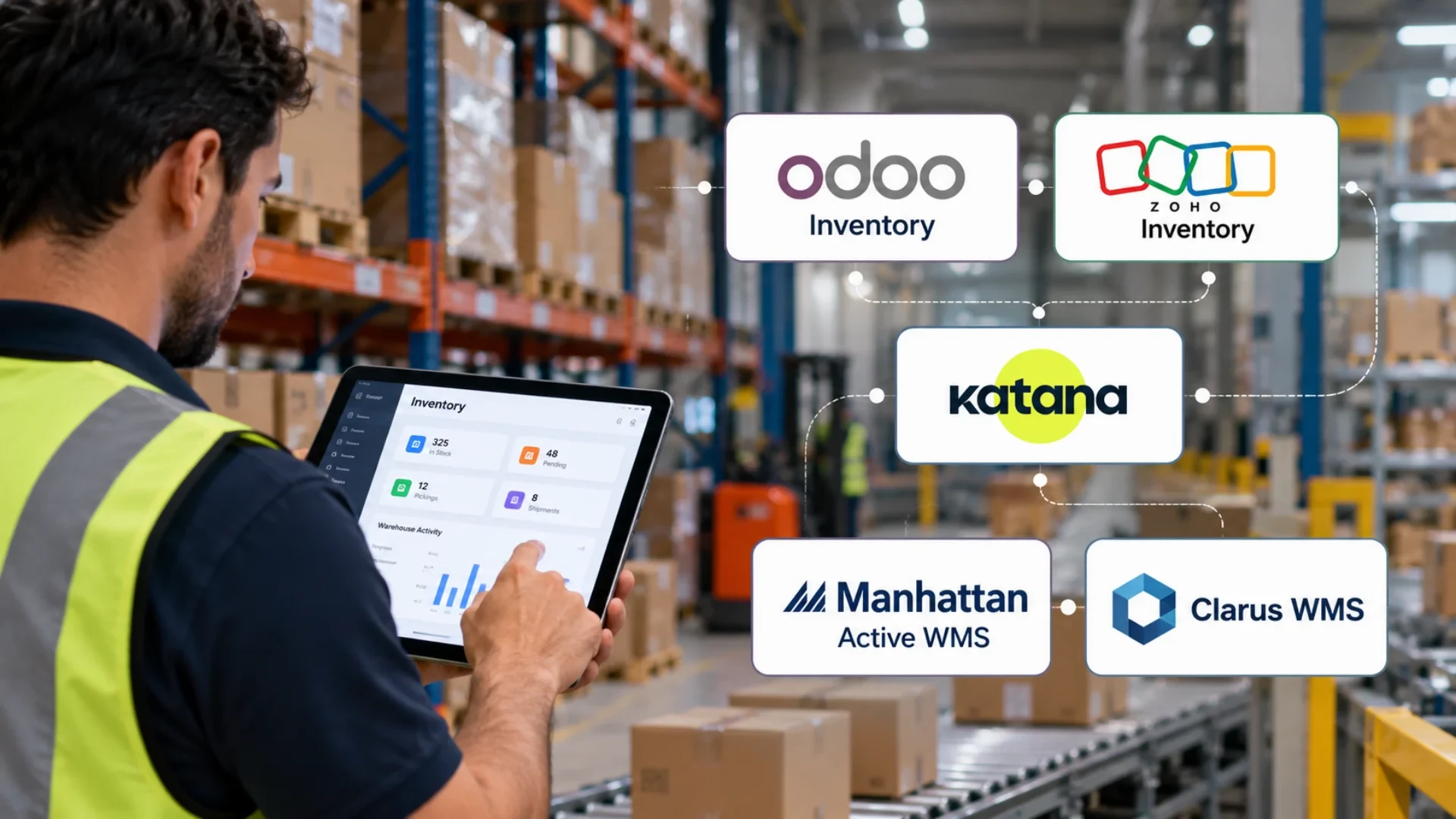
If you are compiling a list of warehouse management software or the top WMS systems, the best fit depends on your size and industry. Here are common warehouse management system examples by tier.
Tier | Software | Best For |
Small business & growth | Odoo Inventory, Zoho Inventory | Multi-warehouse tracking, alerts |
Manufacturing | Katana | Raw materials, auto-allocation |
Enterprise & 3PL | Manhattan Active WMS, Clarus WMS | Complex, large-scale logistics |
Off-the-shelf tools like these are a fine start, especially in logistics, but a custom warehouse management system fits your exact workflow, integrates with your ERP or CRM, and scales without per-seat limits. That is where custom development pays off.
For a data-heavy or AI-driven WMS, you can hire Python developers from Acquaint Softtech, onboarded within 48 hours.
Off-the-shelf not enough?
Tell Acquaint Softtech your warehouse workflow, and we will scope a custom WMS, the right integrations, a timeline, and a cost within 48 hours.
Benefits of Inventory Management Solution
New technologies are released every year and help create bigger and better systems. Implementing these technologies in custom solutions helps improve your business productivity and sales. Listed here are some of the benefits of developing a warehouse inventory system:
It can help increase space efficiency by increasing storage density and simplify the process of managing multiple locations.
Implementing a new system like this can be done with ease without having to make drastic changes to the existing warehouse system.
Increase sales by implementing the system to handle multiple inventory tasks simultaneously.
It provides greater visibility of the current inventory levels and helps one make more accurate decisions.
Tracking inventory items is often a big ordeal and a very time-consuming process. This can be greatly simplified by developing an interactive inventory system.
Having a system in place to make warehouse management more efficient helps increase the efficiency of other processes of your business. It helps optimize your supply chain. For those developing a custom system, there is high potential to integrate with other systems like an ERP or CRM, thus increasing the level of automation and efficiency.
It is highly beneficial for your customers since it ensures your business is able to serve them more efficiently. This is vital since, at the end of the day, customer satisfaction matters the most. It also helps improve customer service.
Technological advancements allow one to create more dynamic systems. Hence, one can tweak and configure the systems as per their requirement and future needs.
Important Factors to Consider

Acquaint Softtech can help with the development process of a warehouse inventory management system. It can help a business in many ways, like automation of systems, increasing productivity, and making better business decisions. However, there are several factors one must consider when developing such an application:
It is important to assess the level of customization necessary for the automation of the workflow and how to best leverage other technologies.
Consider database compatibility issues, especially if you have an existing application to manage other systems. Creating a unified system might be a smart option.
There is immense potential to expand operations when it comes to warehouses. Keep this in mind and develop a scalable solution to ensure it is suitable for future applications as well.
Analyze your business operations to find the type of application that will suit your business the most, like an online web portal or a mobile application for iOS and Android devices.
It will work in your favor to spend some time researching how to minimize human interaction and increase the level of automation.
The larger the warehouse, the higher the complexity of the solution; this is exactly why enterprises need data analytics more than ever, and AI-powered analytics software addresses this need directly by continuously monitoring your systems, forecasting demand, and triggering actions automatically.
It is important to consider the cost of developing such an application; however, it is also important to weigh the benefits of implementing one.
Several advanced technologies can be used to create better and more efficient solutions. For example, implementing cloud computing technology and storing your data in the cloud is a good idea. Doing so will allow one to run the operations remotely as well. Opting for SaaS (software as a service) can also eliminate the need to invest in the high development cost of custom systems.
The UI/UX should be designed keeping in mind the type of users expected to use the system.
Consider the role and responsibilities of the users. This can vary depending on the type of industry and business itself, since not every organization has a similar inventory management system.
Develop a system that has a low learning curve and requires the least training.
Consider implementing other technologies like RFID, Blockchain, etc.
Security is an important factor to consider to protect yourself from cyber-attacks and internal hacks.
Ideal Platform and Tech Stack
The two most popular platforms for developing a warehouse inventory management system are a web-based system and a mobile application. Some common technologies used for this include Laravel, PHP, iOS, Android, Flutter, React Native, IoT, AI/ML, and VR/AR.
Laravel is a very popular PHP framework that has immense potential when it comes to developing large applications. It works with several other UI frameworks to ensure you can develop a stunning interface. It also works well with other technologies, allowing one to develop a feature-rich mobile application. Some of the advanced technologies, like AI/ML and AR/VR, can also be implemented using Laravel to develop an advanced and efficient solution. It simplifies including features like stock maintenance, profit and sales, OTP verification, unpaid and purchase invoices, managing bills, report generation, and automating the stocking and retrieval process.
At Acquaint Softtech, we have extensive experience developing large applications using Laravel, including warehouse management systems. You can hire our dedicated team on an hourly basis at highly affordable rates.
We have the expertise to develop a customized Laravel solution and an enterprise solution. We can also help with data migration, eCommerce and CRM development, Laravel extension development, and much more, and our team offers support and maintenance for these projects.
Warehouse Inventory Best Practices (KPIs and the 80/20 Rule)
To do inventory management in a warehouse, track everything in real time, use barcodes or RFID, organize by demand, count regularly, and measure the right KPIs.
The 5 KPIs for a warehouse: inventory accuracy, order picking accuracy, on-time shipping, order cycle time, and inventory turnover.
The 80/20 rule in inventory: roughly 80% of your sales or value comes from about 20% of your items, so store those fast-movers where they are quickest to pick.
Cycle counting: count small portions of stock often rather than one huge annual count, to keep records accurate.
How Much Does a Warehouse Management System Cost?

A custom warehouse inventory management solution typically costs $25,000 to $150,000+, depending on features, integrations, scale, and platforms. Off-the-shelf SaaS tools charge monthly per user, which is cheaper to start but costly at scale and less flexible. Starting with an MVP keeps the initial custom cost low.
Approach | Relative Cost | Best For |
SaaS subscription | Low monthly | Small, standard needs |
Custom MVP | Medium | Testing a tailored fit |
Full custom WMS | Higher | Large, complex operations |
You can lower the cost of a custom build by outsourcing software development to a vetted team instead of hiring locally.
Prefer to keep control in-house? Our IT staff augmentation services place vetted engineers within 48 hours.
Case Study: A Verified Enterprise Build
A WMS is only as good as the team behind it. As an Official Laravel Partner, Acquaint Softtech builds large, scalable business systems with real-time data, dashboards, and integrations for clients worldwide.
Client | A business needing a scalable inventory and operations system. |
What we built | A Laravel web platform with real-time tracking, reporting, and roles. |
Why it matters | Automated inbound and outbound flow, fewer errors, and clear reporting. |
How we worked | A dedicated team, transparent process, and 24x7 support. |
Result | A stable, scalable system delivered on time and built to grow. |
Company-wide proof: Acquaint Softtech has delivered 1,300+ projects over 13+ years with 70+ in-house engineers and a 5-star rating across 60+ reviews on Clutch, as an Official Laravel and Statamic Partner. Explore more enterprise builds on the case studies page.
Why Choose Acquaint Softtech
At Acquaint Softtech, we have a highly experienced team with experience in a wide range of technologies. The applications we develop are highly scalable, so you can consult us whether you are a small, medium, or large business, or even a startup, and we also develop an MVP if it serves your purpose.
Scalable solutions: built for small, medium, large, and enterprise operations.
Verified trust: 5-star Clutch rating across 60+ reviews and 1,300+ delivered projects.
In-house talent: 70+ full-time engineers, deployable within 48 hours, with 24x7 support.
Global reach: serving founders across the USA, UK, Europe, Australia, and New Zealand.
Agencies that want to resell a finished WMS can use our white label software development to launch under their own brand.
To Sum Up
A warehouse is crucial to the successful operation of many types of industries. Several tasks need to be performed on a daily basis, some of which are time-sensitive as well. Businesses can benefit from developing a web and mobile platform for their project. There are many options when it comes to developing such a system.
It can be either developed as a simple system that exclusively handles the inventory or as an integrated system that also manages other sections of the warehouse, like an ERP, CRM, or SCM (supply chain management). Opt to develop such a system for your business to optimize common tasks in the warehouse. Doing so will help save a considerable amount of time and money; it will also help increase profits and grow your business. Acquaint Softtech has the ideal solution for developing a warehouse inventory management system. Get in touch with us to get more information.
Frequently Asked Questions
-
How to do inventory management in a warehouse?
Track all stock in real time, use barcodes or RFID for accuracy, organize items by demand so fast-movers are easy to pick, count stock regularly with cycle counting, automate inbound and outbound flow, and measure KPIs. A warehouse management system makes all of this reliable at scale.
-
What is the best inventory management software for a warehouse?
There is no single best; it depends on your size and industry. Odoo and Zoho Inventory suit growing businesses, Katana suits manufacturing, and Manhattan Active WMS or Clarus WMS suit enterprise and 3PL. For an exact fit, a custom WMS built by a team like Acquaint Softtech is often the best long-term choice.
-
What are the 5 KPIs for a warehouse?
Five core warehouse KPIs are inventory accuracy, order picking accuracy, on-time shipping rate, order cycle time, and inventory turnover. Tracking these shows how healthy and efficient your operation is.
-
What is the 80/20 rule in inventory?
The 80/20 rule (Pareto principle) says roughly 80% of your sales or value comes from about 20% of your items. In a warehouse, you store those top 20% fast-movers in the most accessible spots to speed up picking.
-
What are the benefits of a warehouse inventory management system?
It helps reduce the time and effort spent on common tasks and speeds them up. It reduces operating costs and increases efficiency by reducing human errors. All processes of the warehouse can easily be monitored, items can be tracked, and the system can be optimized for specific goals.
-
What are the main features of a warehouse inventory management system?
Real-time inventory tracking, low-stock alerts, purchase and supply management, a simplified inbound process (scanning, storage-location analysis, assigning a person to stock), a faster outbound process (automating box and package selection, product retrieval, and shipping), and report generation to optimize the system and make better decisions.
-
Which technologies are implemented in a warehouse inventory management system?
Several advanced technologies and tools are used, like IoT, AI/ML, AR/VR, PHP, JavaScript, and more. They are used to develop either a website or a feature-rich mobile app.
-
How does a warehouse management system work?
It keeps track of all the products stocked along with their details, streamlines the inbound and outbound processes, and ensures all products registered on the system are processed for shipping swiftly.
I love to make a difference. Thus, I started Acquaint Softtech with the vision of making developers easily accessible and affordable to all. Me and my beloved team have been fulfilling this vision for over 15 years now and will continue to get even bigger and better.
Table of Contents
Get Started with Acquaint Softtech
- 13+ Years Delivering Software Excellence
- 1300+ Projects Delivered With Precision
- Official Laravel & Laravel News Partner
- Official Statamic Partner
Related Blog

Types of web applications you can get built with Laravel
Laravel is an open-source PHP web framework for building custom web applications quickly, securely, and with clean code. It can build almost any type of web app: ERP and CRM systems, workflow tools, B2B and B2C eCommerce, multi-vendor marketplaces, subscription SaaS, secure customer portals, e-learning and LMS platforms, healthcare portals, booking systems, custom CMS, and social or forum apps.
Mukesh Ram
December 1, 2022
How much will your web app development cost?
Web application development cost typically ranges from $15,000 to $200,000+ globally (roughly £15,000 to £150,000+ in the UK), depending on scope, features, and team location. A simple MVP runs $10,000 to $50,000, a mid-scale business web app $50,000 to $150,000, and a complex or enterprise platform $150,000 to $300,000+. Hiring a remote team can cut labor costs sharply, and at Acquaint Softtech, an MVP can reduce your project cost by up to 60%.
Mukesh Ram
November 11, 2022
Is Laravel Fit For Your Web Development Project?
Laravel website development involves using a powerful PHP framework to build fast, secure, and custom web applications. Its key features include the Eloquent ORM, Blade templating, strong built-in security, and a rich ecosystem (Livewire, starter kits). It is a great fit for custom business portals, online stores, SaaS platforms, and APIs, which is why it remains the most popular PHP framework in 2026.
Mukesh Ram
November 9, 2022India (Head Office)
203/204, Shapath-II, Near Silver Leaf Hotel, Opp. Rajpath Club, SG Highway, Ahmedabad-380054, Gujarat
USA
7838 Camino Cielo St, Highland, CA 92346
UK
The Powerhouse, 21 Woodthorpe Road, Ashford, England, TW15 2RP
New Zealand
42 Exler Place, Avondale, Auckland 0600, New Zealand
Canada
141 Skyview Bay NE , Calgary, Alberta, T3N 2K6