

Total Cost of Ownership in Python Development Projects: The Full Financial Picture
The build cost is just the beginning. This guide breaks down the complete TCO of Python development projects across every lifecycle phase, with real benchmarks, a calculation framework, and 2026 data.

Acquaint Softtech
The Budget That Gets Approved Is Not the Budget That Gets Spent
There is a specific kind of meeting that happens inside organisations twelve to eighteen months after a Python development project launches. The original development budget was approved, the platform shipped, the team celebrated the go-live. But now the infrastructure bills are running three times higher than anyone projected. The engineering team is spending more time on maintenance than on new features. A security audit has flagged dependency issues that require a partial rewrite. And somewhere in a spreadsheet, someone is quietly realising that the cost of owning this Python application has already exceeded the cost of building it.
This is not an unusual story. It is the predictable outcome of a budget process that confuses build cost with ownership cost. The two numbers are related but rarely equal, and over a three to five year product lifecycle, the gap between them almost always surprises the people who approved the original spend.
According to Gartner, as cited by TechTarget, Total Cost of Ownership is a comprehensive assessment of all costs across the lifecycle of a technology asset, including hardware and software acquisition, management and support, communications, end-user expenses, and the opportunity cost of downtime, training, and productivity losses. For custom Python development specifically, TCO is the number that the build estimate never shows and the maintenance team always knows.
This guide breaks down every component of TCO in Python development projects, gives you a calculation framework grounded in 2026 benchmark data, and shows you where the largest cost surprises consistently occur and how to prevent them.
Why Python Development TCO Is Systematically Underestimated
Before getting into the components, it is worth understanding why TCO underestimation is so consistent. It is not a failure of intelligence or diligence. It is a structural problem with how software investments are evaluated and approved.
Many companies focus only on the initial development costs and do not take into account ongoing expenses such as infrastructure, licensing, third-party services, maintenance, scaling, security, and operational support. These overlooked costs accumulate over time and significantly impact the overall budget.
The structural reason is simpler. The person who approves the Python development budget is typically evaluating a single point in time, the cost to build. The person who inherits the Python application is evaluating a continuous stream of costs that the original budget never modelled. Those two perspectives rarely share a common spreadsheet before the project is approved.
Three patterns compound this problem specifically in Python development.
Python’s dynamic typing creates higher maintenance exposure than statically typed languages. Research from IEEE and the University of Antwerp on Python technical debt in Apache Software Foundation projects found that Python code is more change-prone due to its higher number of dynamic features, and that developers must spend extra effort on software maintenance and quality improvement compared to statically typed languages like Java. Python code containing dynamic features is inserted or updated more frequently when fixing bugs. This is not a reason to avoid Python. It is a reason to budget maintenance more carefully.
Python’s dependency ecosystem evolves rapidly. A Python ML application built on a specific version of TensorFlow, PyTorch, or scikit-learn accumulates dependency risk as those libraries release breaking changes, deprecate APIs, and require Python version compatibility updates. Research published on Medium on Python ML technical debt identifies poor dependency management as one of the most overlooked sources of technical debt in Python ML systems, creating ongoing uncertainty about environment stability, engineering time diverted from feature development, and risk of production failures and model degradation.
Python framework version gaps create compounding upgrade cost. A Django application running on Django 3.x when Django 5.x is available carries technical debt that grows with each version skipped. The same applies to FastAPI and Flask. Acquaint Softtech’s version upgrade services address exactly this category of accumulated TCO, but the most cost-effective approach is building version upgrade cycles into the TCO model from the start rather than discovering them as emergency budget requests later.
The 7 TCO Components Every Python Development Budget Must Include
According to WalkMe’s 2025 TCO analysis, the formula for TCO is straightforward: TCO equals upfront costs plus operating costs multiplied by years of use, minus residual value. The discipline is in populating every cost category correctly. For Python development projects, seven components make up the complete picture.
TCO Component 1: Python Development and Build Cost
This is the only number most organisations calculate before a Python project is approved. It covers design, development, QA, DevOps setup, and initial deployment. Even within this component, most estimates miss significant inputs.
QA alone typically constitutes 15 to 25% of the total Python project budget. Teams that exclude QA from the build estimate, or significantly underbudget it, produce a lower headline number that gets approved but results in a higher post-launch defect rate, which moves the cost into the maintenance category instead.
Architecture and design decisions made at the build stage carry the highest long-term TCO leverage of any phase. Technology decisions directly impact company valuation, and TCO analysis is the compass for decision-making that ensures tech investments contribute to value rather than becoming unexpected financial burdens. For Python specifically, the choice between Django and FastAPI, the database schema design, the cloud infrastructure architecture, and the dependency management strategy all made during the build phase shape the maintenance cost for years afterward.
For reference benchmarks on how Python framework and architecture choices affect both build cost and ongoing TCO, the Python development architecture and frameworks guide breaks down the specific cost implications of each major framework decision across the full product lifecycle.
Typical build cost range for Python projects (2026):
Python Project Type | Build Cost Range | Key TCO Risk at Build Stage |
Internal automation tool | $15,000 to $50,000 | Dependency management, documentation |
Python SaaS platform (MVP) | $25,000 to $80,000 | Schema design, multi-tenancy architecture |
Python AI/ML system | $50,000 to $200,000 | Model versioning, data pipeline architecture |
Python fintech or healthcare platform | $60,000 to $250,000 | Compliance architecture, audit logging |
Enterprise Python data platform | $100,000 to $500,000+ | Scalability, integration architecture |
TCO Component 2: Python Infrastructure and Cloud Operating Cost
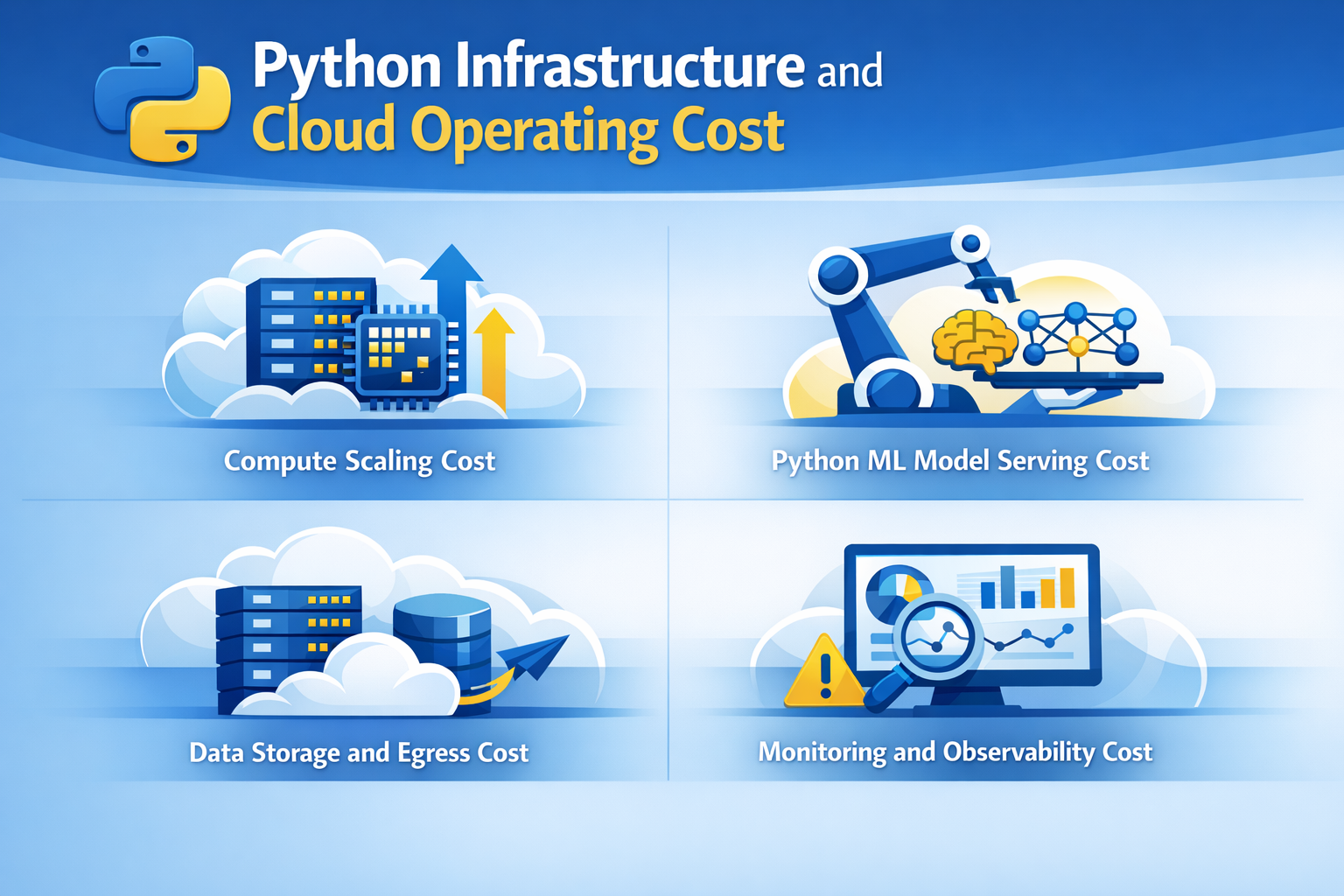
Cloud infrastructure is where Python TCO surprises are most frequent and most avoidable. As per a Cloud Report found that organisations waste an average of 27% of their cloud spend. Across a $500,000 annual cloud budget, that is $135,000 disappearing every year without producing any product value.
For Python applications specifically, infrastructure cost is shaped by four variables that are almost always underestimated at the build stage:
Compute scaling cost. A Python Django or FastAPI application designed for 1,000 concurrent users and deployed into an environment that needs to handle 50,000 concurrent users within eighteen months requires infrastructure that was not sized in the original budget. Auto-scaling solves the technical problem but creates a billing problem if the cost model did not account for it.
Python ML model serving cost. TensorFlow and PyTorch model inference on GPU instances is significantly more expensive than general compute. A Python AI application with real-time inference requirements can generate infrastructure bills that exceed the original build cost within the first year of production operation.
Data storage and egress cost. Python data pipelines and analytics platforms generate and move large volumes of data. A TCO definition specifically flags cloud egress fees as frequently overlooked hidden costs in technology TCO calculations. A Python data platform processing terabytes monthly can accumulate significant egress charges that were not modelled in the original infrastructure budget.
Monitoring and observability cost. Production Python applications require monitoring tools (Datadog, New Relic, AWS CloudWatch) that carry their own licensing and usage costs. These are consistently treated as afterthoughts rather than budgeted operating costs.
Benchmark: For Python SaaS and AI platforms, infrastructure operating cost typically ranges from 15 to 30% of the annual equivalent build cost, scaling upward as user volume and data volume increase.
TCO Component 3: Python Application Maintenance Cost
Maintenance is the TCO component with the most reliable benchmark and the widest gap between what gets budgeted and what actually gets spent. According to a 2025’s research software development cost breakdown, maintenance typically represents 20% of the original development cost each year, covering ongoing work to manage technical debt, update dependencies, and sustain performance.
For a Python platform built for $80,000, that is $16,000 per year in maintenance cost that belongs in the TCO model from Day 1. Over five years, the cumulative maintenance cost of $80,000 equals the original build cost. The five-year TCO is therefore $160,000, not $80,000. This is the number that the original budget approval almost never shows.
Adds a further dimension: organisations that ignore technical debt spend up to 40% more on maintenance than peers who address it early. For Python projects specifically, this means that maintenance cost is not fixed at 20% of build cost per year. It escalates as technical debt accumulates, and it escalates faster in Python than in statically typed languages due to the dynamic typing and change-proneness characteristics documented in the IEEE research.
Python maintenance cost components that belong in every TCO model:
Routine dependency updates and security patches
Python version upgrades and framework version migrations
Performance optimisation as data volume and user load grow
Bug fixing and defect resolution
Integration maintenance when third-party APIs change
Documentation updates as features evolve
Model retraining and calibration for Python AI/ML applications
TCO Component 4: Python Technical Debt Accumulation and Remediation
Technical debt is the TCO component that organisations most consistently refuse to budget for and then most consistently pay for anyway, at a premium.
A study cited found that complex software systems can incur up to 300% more maintenance costs than well-designed ones. The same research found that 79% of modernisation efforts by companies carrying significant technical debt are failing. Many CIOs estimate 10% to 20% of their technical budget for new products is diverted to resolving issues related to technical debt, and that 60% say technical debt has increased materially over the past three years.
For Python specifically, IEEE research published in the Journal of Software Evolution and Process found that more than 90% of Python files in studied production projects contain co-occurring technical debt, with documentation debt and test debt appearing in the majority of files. The median fixing rate for larger Python projects is between 20 and 30%, meaning the majority of identified Python technical debt goes unresolved in any given period and compounds into future maintenance cost.
2025 infrastructure analysis found that around 40% of infrastructure systems already carry significant technical debt burden, with 93% of development teams reporting they are currently experiencing technical debt. This is not a niche problem. It is the default state of software systems that are not actively managed against it.
The Python TCO implication is direct: every sprint of deferred refactoring, every undocumented API, every untested module, and every skipped dependency update adds to a technical debt balance that will eventually be paid. The question is whether it is paid at maintenance-phase rates or at emergency-remediation rates, the latter of which is consistently higher.
TCO Component 5: Python Security and Compliance Cost
Security and compliance represent a TCO component that is both consistently underestimated and consistently non-negotiable once it surfaces.
Intangible costs including compliance risks are a recognised category of TCO that must be assigned monetary value. For Python applications handling personal data (GDPR), financial transactions (PCI-DSS), or healthcare records (HIPAA), the compliance architecture cost is not optional. It is a cost that can be planned and budgeted at the build stage or discovered and paid at the incident and remediation stage, at dramatically different price points.
The Equifax case, cited by Leobit’s TCO analysis, is the most-referenced example: an initial $170 million budget for a case management system that eventually cost over $270 million before being abandoned, driven significantly by poor security and compliance design that was not properly TCO-modelled at the start.
For Python development projects in regulated industries, compliance architecture adds 15 to 25% to the overall build cost when designed in from Day 1. Retrofitting compliance architecture after launch typically costs two to three times that figure, because it requires touching code across multiple application layers simultaneously.
Security-specific TCO costs that belong in every Python project model include:
Dependency vulnerability scanning and remediation (automated tools plus engineering time)
Security audit costs (penetration testing, code review by security specialists)
Compliance certification maintenance (annual audits, policy updates)
Incident response capability (monitoring, alerting, on-call engineering)
Data encryption and access control maintenance as user base scales
TCO Component 6: Python Team and Hiring Cost Over the Lifecycle
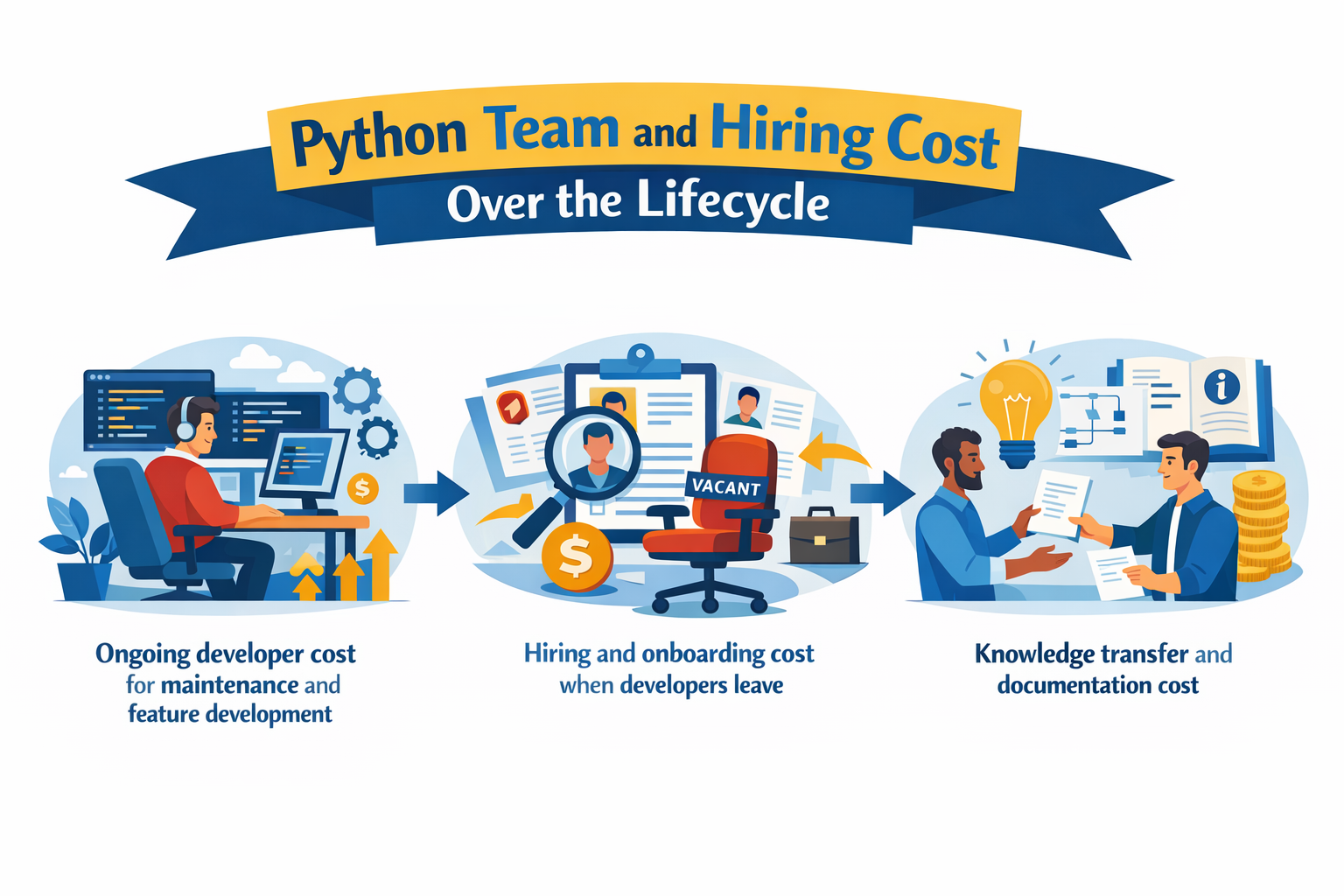
The developer cost that most Python project budgets calculate is the build-phase development cost. The developer cost that belongs in a TCO model extends across the entire product lifecycle and includes costs that the original budget never captures.
CIO’s 2025 TCO guidance specifically identifies end-user expenses and the opportunity cost of downtime, training, and productivity losses as TCO components that organisations frequently omit from initial software investment analysis. For Python development, this includes:
Ongoing developer cost for maintenance and feature development. A Python SaaS platform or AI system does not stop requiring developer time after launch. The product roadmap continues. Bug fixes need engineering time. Performance optimisation requires skilled Python engineers. For most Python products, ongoing developer cost is the single largest TCO component after Year 1.
Hiring and onboarding cost when developers leave. According to daily.dev Recruiter’s 2026 hiring analysis, replacing a developer costs up to 21% of their annual salary in direct costs. The indirect cost, measured in delayed delivery and codebase context reconstruction, is typically larger. For a Python SaaS platform with an ongoing engineering team, developer turnover is a recurring TCO cost that the original budget never modelled.
Knowledge transfer and documentation cost. When a Python developer who has worked on a system for eighteen months leaves, the institutional knowledge they carry is an asset that has accumulated cost to create and creates cost when lost. Comprehensive documentation, structured knowledge transfer, and codebase handover reduce this cost but do not eliminate it.
The most effective way to reduce the team cost component of Python TCO is to stabilise the engineering team. Acquaint Softtech’s dedicated Python development team model builds continuity into the engagement by design: free developer replacement with full context handover, 24-month average team tenure, and structured knowledge management as part of the delivery process rather than an afterthought.
TCO Component 7: Python Application Scaling and Evolution Cost
The final TCO component is the cost of growing the Python application as the business it supports grows. This is perhaps the most difficult to model at the build stage because it depends on growth trajectories that are inherently uncertain. But it is also the component where early architectural decisions have the highest long-term cost leverage.
TCO analysis frames this clearly: the 3-year TCO gap between legacy and cloud-native Python architecture can exceed $1 million for mid-market SaaS platforms. A Python Django application designed for 10,000 users that needs to serve 500,000 users requires either an architecture that anticipated that scale or a significant rearchitecting engagement that costs multiples of the original scaling budget.
Scaling cost categories for Python projects include:
Database scaling (PostgreSQL read replicas, Redis cluster expansion, migration to distributed data stores)
Compute scaling (container orchestration via Kubernetes, auto-scaling configuration, CDN integration)
Python ML model scaling (increased inference infrastructure, model versioning systems, A/B testing frameworks)
API rate limit and performance optimisation as third-party usage grows
Feature development cost as the product roadmap expands beyond MVP
For teams planning a Python project that will need to scale, the complete guide to hiring Python developers addresses the team structure decisions (dedicated team versus staff augmentation versus project-based engagement) that affect how scaling cost is absorbed as the product grows.
Python Development TCO: 5-Year Model by Project Type
The following models use benchmark data from verified 2025 and 2026 sources. All figures are estimates for planning purposes and will vary based on specific project complexity, team location, and engagement model.
Model A: Python Internal Automation Platform
Cost Component | Year 1 | Year 2 | Year 3 | Year 4 | Year 5 |
Build cost | $45,000 | — | — | — | — |
Infrastructure (cloud, monitoring) | $6,000 | $7,000 | $8,000 | $9,000 | $10,000 |
Maintenance (20% build/yr) | $9,000 | $9,000 | $10,000 | $11,000 | $12,000 |
Security patches and compliance | $3,000 | $3,500 | $4,000 | $4,500 | $5,000 |
Feature development | $0 | $12,000 | $15,000 | $18,000 | $20,000 |
Technical debt remediation | $0 | $2,000 | $4,000 | $6,000 | $8,000 |
Annual TCO | $63,000 | $33,500 | $41,000 | $48,500 | $55,000 |
Cumulative TCO | $63,000 | $96,500 | $137,500 | $186,000 | $241,000 |
Key insight: The cumulative 5-year TCO of $241,000 is 5.4 times the original build cost of $45,000. A budget approved on the basis of the $45,000 build figure represents less than 19% of the total ownership cost over the application’s useful life.
Model B: Python SaaS Platform (Post-MVP Scaling)
Cost Component | Year 1 | Year 2 | Year 3 | Year 4 | Year 5 |
Build cost (MVP) | $65,000 | — | — | — | — |
Infrastructure (scaling from MVP to growth) | $12,000 | $25,000 | $45,000 | $70,000 | $90,000 |
Maintenance | $13,000 | $15,000 | $18,000 | $20,000 | $22,000 |
Ongoing development (roadmap features) | $0 | $38,400 | $57,600 | $76,800 | $96,000 |
Security, compliance, audits | $8,000 | $10,000 | $12,000 | $14,000 | $16,000 |
Technical debt remediation | $0 | $5,000 | $10,000 | $15,000 | $20,000 |
Annual TCO | $98,000 | $93,400 | $142,600 | $195,800 | $244,000 |
Cumulative TCO | $98,000 | $191,400 | $334,000 | $529,800 | $773,800 |
Key insight: Infrastructure cost on a growing Python SaaS platform escalates significantly as user volume increases, reaching $90,000 per year by Year 5 from $12,000 in Year 1. This scaling curve is almost never modelled in the original SaaS MVP budget.
Model C: Python AI/ML Analytics Platform
Cost Component | Year 1 | Year 2 | Year 3 | Year 4 | Year 5 |
Build cost | $120,000 | — | — | — | — |
GPU infrastructure (inference + training) | $30,000 | $45,000 | $65,000 | $85,000 | $100,000 |
Maintenance and dependency management | $24,000 | $26,000 | $28,000 | $30,000 | $32,000 |
Model retraining and calibration | $15,000 | $18,000 | $22,000 | $26,000 | $30,000 |
Ongoing ML feature development | $0 | $57,600 | $76,800 | $96,000 | $115,200 |
Compliance and data governance | $12,000 | $14,000 | $16,000 | $18,000 | $20,000 |
Technical debt and refactoring | $0 | $8,000 | $15,000 | $22,000 | $28,000 |
Annual TCO | $201,000 | $168,600 | $222,800 | $277,000 | $325,200 |
Cumulative TCO | $201,000 | $369,600 | $592,400 | $869,400 | $1,194,600 |
Key insight: GPU infrastructure for Python ML model inference represents the fastest-growing cost component, reaching $100,000 per year by Year 5. Model retraining cost, which most Python AI project budgets do not model at all, adds $30,000 per year by Year 5. The 5-year TCO of approximately $1.2 million is 10 times the original build cost.
How Python Framework and Architecture Decisions Shape TCO Before Build Begins
The highest leverage point in Python development TCO is the build phase, specifically the architecture and framework decisions made before the first sprint begins. Those decisions determine the maintenance cost, the scaling cost, and the technical debt trajectory for the entire lifecycle.
2025 cost breakdown confirms what every experienced CTO knows: most cost overruns trace back to decisions made early in the lifecycle. The discovery phase sets the cost trajectory. This is not a planning platitude. It is a documented financial pattern across hundreds of software projects.
For Python specifically:
Django versus FastAPI at the architecture stage carries a TCO implication. Django’s batteries-included approach produces faster initial build times but creates scaling constraints at high concurrency loads that require significant infrastructure cost to address. FastAPI’s async-native architecture costs more to build correctly but produces lower infrastructure TCO at scale. The right choice depends on the specific product requirements, not a universal preference. Getting that choice wrong at the build stage costs multiples of the original build cost to correct later.
Database schema design at the Django ORM level is a TCO decision. A schema not designed for multi-tenancy costs significantly more to adapt for multi-tenancy than a schema designed for it from Day 1. A PostgreSQL schema without proper indexing strategy accumulates query performance cost that compounds as data volume grows. These decisions belong in the architecture phase, not the optimisation phase.
Python ML pipeline architecture determines model maintenance TCO. A TensorFlow or PyTorch model deployed without versioning, without drift monitoring, and without a structured retraining pipeline accumulates ML technical debt that eventually requires a significant rearchitecting engagement. Building those systems in from the start costs less than retrofitting them under production pressure.
The Python development architecture and frameworks guide covers the specific framework and architecture decisions that most significantly affect TCO across the full Python project lifecycle, with cost implications for each choice.
How to Reduce Python Development TCO Without Reducing Quality
TCO reduction in Python development is not about building cheaper. It is about building with lower lifecycle cost, which often means investing more carefully at the build stage to avoid paying multiples of that cost in maintenance, remediation, and rearchitecting later.
Invest in Python architecture correctness at the build stage. The Bitcot TCO analysis confirms this: technical leaders who treat TCO as a planning discipline rather than a post-hoc accounting exercise make better architecture decisions, more defensible budget cases to the board, and more sustainable products at scale. Every dollar spent on architecture review at the build stage saves three to five dollars in technical debt remediation during the maintenance phase.
Choose a Python development partner with long-term engagement continuity. Developer turnover is a recurring TCO cost that compounds. Replacing a developer costs up to 21% of annual salary in direct costs. A dedicated Python development partner with structured continuity guarantees, like Acquaint Softtech’s free developer replacement with full context handover, reduces this TCO category materially.
Build Python maintenance cycles into the engagement model from Day 1. A Python application that receives regular dependency updates, scheduled security patches, and quarterly performance reviews accumulates less technical debt than one that is touched only when something breaks. A research confirms that proactive technical debt management reduces maintenance cost by up to 40% relative to reactive approaches. Acquaint Softtech’s support and maintenance services are structured as ongoing engagements for exactly this reason.
Right-size Python infrastructure from the start. Cloud waste of 27% per Flexera’s 2025 data is the most common infrastructure TCO problem. Right-sizing compute, using reserved instances for predictable workloads, and implementing proper auto-scaling for variable workloads reduces cloud TCO without reducing availability or performance.
Model Python TCO explicitly before budget approval. The most effective TCO reduction strategy is building the complete five-year cost model before the budget is approved, not after the application is in production. This does not prevent spend. It allocates spend to the right phases: more at the architecture and build stage, appropriately modelled at the maintenance and scaling stages, without the emergency-rate remediation cost that deferred technical debt eventually demands.
Acquaint Softtech: Python Development Structured for Lower TCO
Acquaint Softtech is headquartered in Ahmedabad, India, with 13 years of Python software delivery experience, 1,300+ projects completed globally, and verified five-star ratings across Clutch (35+ reviews) and Upwork (1,293+ reviews, 98% job success rate).
Every Acquaint Softtech Python engagement is structured to reduce lifecycle TCO, not just build cost. Developers are 100% in-house and multi-stage assessed, covering technical depth, production experience, documentation discipline, and clean architecture practice. Every engagement includes full NDA and IP assignment from Day 1. Free developer replacement with complete context handover protects continuity and eliminates the knowledge-loss TCO component. 48-hour onboarding eliminates the four to eight-week ramp cost that marketplace freelancers carry.
Acquaint Softtech Python Development Pricing (2026)
Engagement Model | Rate | TCO Impact |
Part-Time / Hourly | From $22/hr (up to 4 hrs/day) | Low-commitment maintenance and feature support |
Full-Time Dedicated Python Developer | $3,200/month (176 hrs) | Predictable ongoing TCO, continuity guarantee |
Fixed-Price Python Project | From $5,000 | Hard build cost ceiling, zero overrun risk |
Support and Maintenance | Custom SLA | Proactive TCO management, technical debt prevention |
The 40% cost savings versus US in-house Python hiring is a TCO input, not just a rate comparison. Lower ongoing developer cost across the full lifecycle reduces the team cost component of TCO in every year after Year 1.
Conclusion: TCO Is the Python Budget That Actually Gets Spent
The build estimate is the Python budget that gets approved. TCO is the Python budget that actually gets spent.
A Python automation platform built for $45,000 carries a five-year TCO of approximately $241,000. A Python SaaS product built for $65,000 reaches $773,000 in cumulative TCO over five years as infrastructure scales with the business. A Python AI/ML platform built for $120,000 approaches $1.2 million in five-year TCO when GPU inference cost, model retraining, and ongoing development are properly modelled.
These numbers are not arguments against Python development investment. The ROI data from our Python development ROI calculator guide shows that the returns from successful Python automation and platform development consistently outpace these TCO figures when both sides of the equation are calculated correctly. The point is that the returns need to be calculated against the complete TCO, not the build estimate, to produce an investment case that holds up over the full lifecycle.
Organisations that model TCO before approving software budgets make better architecture decisions, manage ongoing costs more effectively, and avoid the expensive surprises that come from planning only as far as go-live.
Acquaint Softtech builds Python applications with their full lifecycle cost in mind. Architecture decisions are evaluated for TCO impact, not just build efficiency. Developer continuity is structured to reduce the team cost component across every year of the engagement. Maintenance and technical debt are managed proactively rather than reactively. And 1,300+ completed Python projects provide the comparable cost data that makes TCO modelling accurate rather than speculative.
Frequently Asked Questions
-
What is Total Cost of Ownership (TCO) in Python development and why does it matter?
TCO in Python development is the complete financial cost of building, operating, maintaining, and evolving a Python application across its entire lifecycle, including initial build cost, ongoing infrastructure, maintenance, technical debt remediation, security and compliance, team costs, and scaling expenses. According to Gartner’s definition cited by TechTarget, TCO is a comprehensive assessment of all costs across the lifecycle of a technology asset. It matters because organisations that evaluate Python projects only on build cost consistently underestimate true investment by a factor of three to five over a five-year lifecycle. A Python platform built for $80,000 that runs for five years typically carries a cumulative TCO of $240,000 to $400,000 when all ongoing cost components are properly modelled.
-
How much does Python application maintenance cost annually?
According to McKinsey research cited by AgileEngine’s 2025 software development cost breakdown, maintenance typically represents 20% of the original development cost each year, covering technical debt management, dependency updates, and performance maintenance. For Python specifically, this baseline is vulnerable to escalation: Gartner’s May 2025 technical debt research found that organisations ignoring technical debt spend up to 40% more on maintenance than peers who address it early. For a Python AI/ML application, maintenance extends further to include model retraining and calibration cycles, which add meaningfully to the annual cost. Budgeting 20% of original build cost per year as a maintenance baseline is the minimum; Python ML projects should budget 25 to 30%.
-
What is Python technical debt and how much does it cost over a project lifecycle?
Python technical debt is the accumulated cost of shortcuts, undocumented code, skipped tests, deferred upgrades, and suboptimal architecture decisions that reduce the long-term maintainability of a Python application. IEEE research published in the Journal of Software Evolution found that more than 90% of Python files in production systems contain co-occurring technical debt. MIT research found that complex software systems can incur up to 300% more maintenance costs than well-designed ones. For Python projects specifically, the dynamic type system and change-prone nature of Python code creates higher technical debt accumulation risk than statically typed languages. Unmanaged Python technical debt does not sit still. It compounds with every sprint that builds on top of it.
-
How does Python framework choice affect long-term TCO?
Framework choice is one of the highest-leverage TCO decisions in Python development because it shapes maintenance cost, scaling cost, and technical debt trajectory across the entire product lifecycle. Django’s batteries-included approach suits feature-rich web platforms and reduces initial build time but creates scaling constraints that increase infrastructure TCO at high concurrency. FastAPI’s async-native design costs more to implement correctly but produces lower infrastructure TCO at scale. A poorly chosen framework for the product’s requirements can require a significant rearchitecting engagement within eighteen to twenty-four months of launch, adding cost that was never in the original TCO model. The Python development architecture and frameworks guide at acquaintsoft.com/blog/python-development-architecture-frameworks covers these framework TCO implications in detail.
-
What Python infrastructure costs are most frequently missed in TCO models?
The four most consistently missed Python infrastructure TCO costs are GPU compute for ML model inference (which can exceed the original build cost within the first year for AI-heavy Python applications), cloud egress fees for data-intensive Python pipelines (flagged by TechTarget’s TCO analysis as frequently overlooked), monitoring and observability tooling (Datadog, New Relic, CloudWatch carry their own licensing costs), and auto-scaling billing for production spikes that exceed the original infrastructure sizing. Flexera’s 2025 State of the Cloud Report found that organisations waste an average of 27% of cloud spend. For Python projects, right-sizing from the start and implementing proper auto-scaling governance reduces this waste category significantly.
-
How do I calculate the TCO of a Python project before it starts?
Use the formula TCO equals upfront costs plus operating costs multiplied by years of use, minus residual value, per WalkMe’s 2025 TCO analysis. For Python development, populate seven cost components: build cost, infrastructure and cloud operating cost, maintenance (20% of build cost per year as baseline), technical debt remediation (typically 5 to 15% of build cost annually for unmanaged codebases), security and compliance cost, team and hiring cost across the lifecycle, and scaling and evolution cost as the product grows. Model the calculation across three to five years, run sensitivity analysis against a 20% cost overrun and a 20% underestimate on maintenance, and present the cumulative TCO figure alongside the build cost when requesting budget approval. The ROI calculator blog at acquaintsoft.com/blog/roi-calculator-python-development-payback-period provides the payback period model that pairs with the TCO calculation.
-
What is the TCO difference between hiring a dedicated Python development team versus using freelancers?
Over a three to five year Python product lifecycle, the dedicated team model consistently delivers lower TCO than freelance sourcing despite appearing more expensive on a per-hour basis. The TCO difference comes from four components: freelance onboarding ramp (4 to 8 weeks at full rate versus 48 hours for a vetted partner), developer turnover replacement cost (21% of annual salary per daily.dev Recruiter 2026, paid repeatedly across a multi-year engagement), rework from insufficient code quality (CloudQA’s 2025 data puts 30 to 50% of sprint capacity absorbed by bugs in poorly managed projects), and IP protection gaps that create legal cost and code ownership risk. A dedicated Python development team at $3,200 per month with continuity guarantee, vetted production experience, and structured knowledge management produces lower cumulative TCO than a series of freelance engagements at higher apparent hourly rates with compounding hidden costs.
-
How does proactive Python technical debt management reduce TCO?
Proactively managing Python technical debt reduces TCO through three specific mechanisms. First, it prevents the escalation of maintenance cost: Gartner’s research shows organisations that address technical debt early spend 40% less on maintenance than those that defer it. Second, it maintains engineering velocity: CAST Highlight’s 2025 State of Software Quality report found that accumulated technical debt slashes developer velocity by 45%, meaning technical debt does not just add cost directly. It reduces the productivity of every sprint that builds on top of it. Third, it reduces the probability of catastrophic remediation: MIT research found that poorly designed systems incur up to 300% more maintenance cost than well-designed ones, and the Equifax example cited by Leobit demonstrates that unmanaged technical debt can produce remediation costs that exceed the original build cost by a factor of two or more.
We’re Acquaint Softtech, your technology growth partner. Whether you're building a SaaS product, modernizing enterprise software, or hiring vetted remote developers, we’re built for flexibility and speed. Our official partnerships with Laravel, Statamic, and Bagisto reflect our commitment to excellence, not limitation. We work across stacks, time zones, and industries to bring your tech vision to life.
Table of Contents
Get Started with Acquaint Softtech
- 13+ Years Delivering Software Excellence
- 1300+ Projects Delivered With Precision
- Official Laravel & Laravel News Partner
- Official Statamic Partner
Related Blog

The Complete Guide to Hiring Python Developers in 2026: Rates, Models, Vetting and Red Flags
A complete guide to hiring Python developers in 2026. Compare real hourly rates across India, Eastern Europe and the US, choose the right engagement model, vet candidates correctly, and avoid the red flags that cost companies months of wasted budget.
Acquaint Softtech
March 4, 2026
Python Development in 2026: Architecture Patterns, Frameworks and Real-World Industry Applications
Explore Python backend architecture patterns, framework comparisons (Django vs FastAPI vs Flask), scalability decisions, and real-world Python development use cases across healthcare, FinTech, SaaS, EdTech, and logistics in 2026.
Acquaint Softtech
March 4, 2026
Python Development Cost: Fixed Price vs Dedicated Team vs Staff Augmentation
Compare Python development costs across fixed price, dedicated team, and staff augmentation models. Real 2026 data, expert insights, and Acquaint Softtech pricing to help you decide.
Acquaint Softtech
March 10, 2026Your Project. Our Expertise. Let’s Connect.
Get in touch with our team to discuss your goals and start your journey with vetted developers in 48 hours.