

Python Development in 2026: Architecture Patterns, Frameworks and Real-World Industry Applications
Explore Python backend architecture patterns, framework comparisons (Django vs FastAPI vs Flask), scalability decisions, and real-world Python development use cases across healthcare, FinTech, SaaS, EdTech, and logistics in 2026.

Acquaint Softtech
Introduction: Python Is Not Just Popular. It Is the Productive Choice.
In 2026, Python sits at the intersection of three of the fastest-growing areas in software: AI and machine learning, scalable web product development, and enterprise data engineering. Its dominance in the TIOBE Index is not a coincidence. It reflects a structural advantage that engineering teams discovered years ago and have since refused to abandon: Python lets you move faster, integrate more easily, and build systems that are maintainable by teams, not just by the original author.
But Python's popularity creates a problem for business and technical decision makers. The language is broad. The ecosystem is enormous. Django, FastAPI, Flask, microservices, monoliths, REST, GraphQL, async, sync - the number of architectural decisions required before a line of production code is written is significant. Getting those decisions wrong early does not just create technical debt. It creates systems that cannot scale, cannot be handed off, and cannot evolve without a full rewrite. That is why choosing the right Python development services partner from the start matters as much as the architecture decisions themselves.
This guide covers what experienced Python development teams actually build in 2026: which frameworks win in which contexts, which architectural patterns hold up at scale, and what Python looks like inside the industries where it is creating measurable business value. It is written for technical leads, CTOs, and product decision makers who want to understand Python development at a level deeper than the marketing materials. If you need engineers to execute on these patterns, you can hire Python developers from Acquaint Softtech and have them onboarded in 48 hours.
Python Framework Comparison in 2026: Django vs FastAPI vs Flask
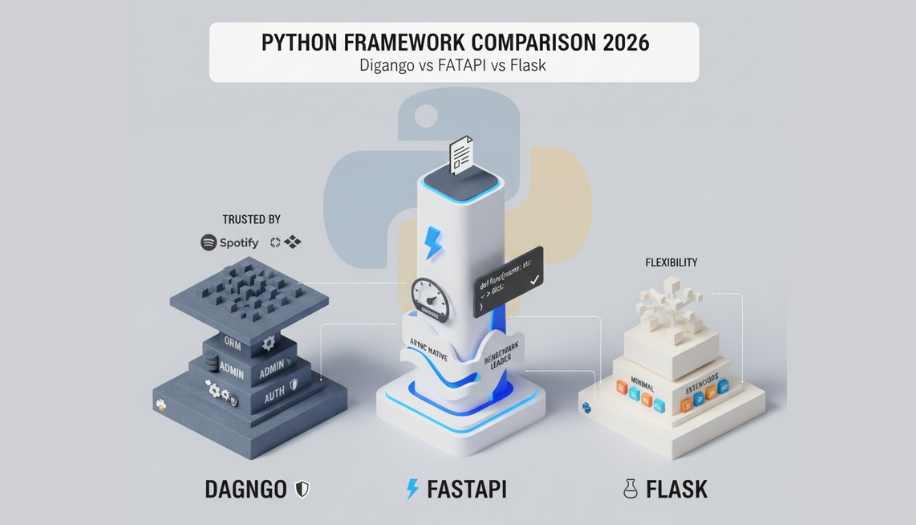
Choosing the wrong framework for your product stage is one of the most common and expensive early architecture mistakes. Here is how the three dominant Python web frameworks actually differ in production.
Django: The Default for Product Companies
Django remains the most complete Python framework for teams building products with multi-user access, complex data models, admin interfaces, and authentication systems. Its batteries-included philosophy means that authentication, ORM, admin panel, form handling, and session management are available without reaching for third-party packages on day one.
Django is the right choice when:
Your product has a complex data model with many relational tables and business logic tied to that data
You need an admin interface for internal operations without building one from scratch
Your team is building a SaaS platform, marketplace, or content-heavy web application
You want a mature, opinionated structure that keeps a growing team consistent across the codebase
Django's Django REST Framework (DRF) extension makes it a strong choice for API-first products as well. At Acquaint Softtech, the majority of Python development services engagements requiring a full-featured web backend start with Django as the default unless a specific performance or architectural constraint points elsewhere.
FastAPI: The Right Tool for High-Performance APIs and AI Workloads
FastAPI has become the framework of choice for teams building high-throughput APIs, microservices, and AI model serving endpoints. Its async-first design delivers measurable performance advantages in concurrent request handling, and its automatic OpenAPI documentation removes a consistent friction point in API development.
FastAPI is the right choice when:
Your system processes high volumes of concurrent API requests where latency matters at the p95 and p99 level
You are building microservices that communicate across service boundaries
You are serving machine learning models as callable APIs
Your team prioritizes type safety and wants Python type hints enforced at the framework level
You need automatic API documentation that stays in sync with the code
The performance gap between FastAPI and Django for raw API throughput is meaningful. In benchmark testing, FastAPI consistently handles two to three times the request volume of Django REST Framework under equivalent load conditions. For products where API performance is a business requirement, not just a preference, that gap matters. For AI workloads, AI training data is an important part of developing and fine-tuning reliable models
Flask: Lightweight, But With Trade-offs
Flask remains relevant for small internal tools, single-purpose APIs, and rapid prototyping. Its minimalist core is genuinely useful when you want to build something tightly scoped without framework overhead. However, Flask's flexibility becomes a liability at scale. Without Django's opinionated structure or FastAPI's type enforcement, large Flask codebases tend to accumulate inconsistencies as team size grows.
Flask is the right choice when:
You are building a small internal tool or single-endpoint service
You need a lightweight wrapper around a specific function or script
The project scope is explicitly bounded and will not expand
For most product companies, Flask is a prototyping tool rather than a production foundation. Teams that start with Flask and scale tend to either migrate to Django for structure or FastAPI for performance within 12 to 18 months.
Python Backend Architecture Patterns That Hold Up at Scale
Framework selection is only the beginning. The architectural decisions made in the first few months of a product's life determine whether it scales gracefully or requires a painful rewrite at the worst possible time.
The Monolith vs Microservices Decision
The microservices-first approach became fashionable in the mid-2010s and caused a significant number of engineering teams to over-architect early products. In 2026, the consensus among experienced Python engineering teams is clearer: start with a well-structured monolith, decompose into services when specific boundaries emerge from real usage.
A monolith is not a failure mode. Instagram ran on a Django monolith well past 100 million users before decomposing specific high-load functions into services. The key is building the monolith with service decomposition in mind from the start, which means clear module boundaries, minimal cross-module coupling, and event-driven communication patterns even within a single codebase.
When to consider breaking the monolith into Python microservices:
A specific component has dramatically different scaling requirements from the rest of the system (for example, a real-time notifications service vs a reporting engine)
Deployment frequency for one module is blocking deployment of others
Teams are large enough that coordination overhead on a single codebase is meaningfully slowing delivery
A specific component needs a different technology stack (for example, a Go-based low-latency service alongside a Python-based product backend)
The Python development services engagements at Acquaint Softtech that have held up best over time are those where the initial architecture was a structured Django monolith with clear domain boundaries, not a distributed microservices system built before the product had validated its own structure. If you need an experienced team to make this call with you rather than for you, you can hire Python developers with the architectural depth to guide it correctly from the start.
REST vs GraphQL in Python: A Production-Grade Decision
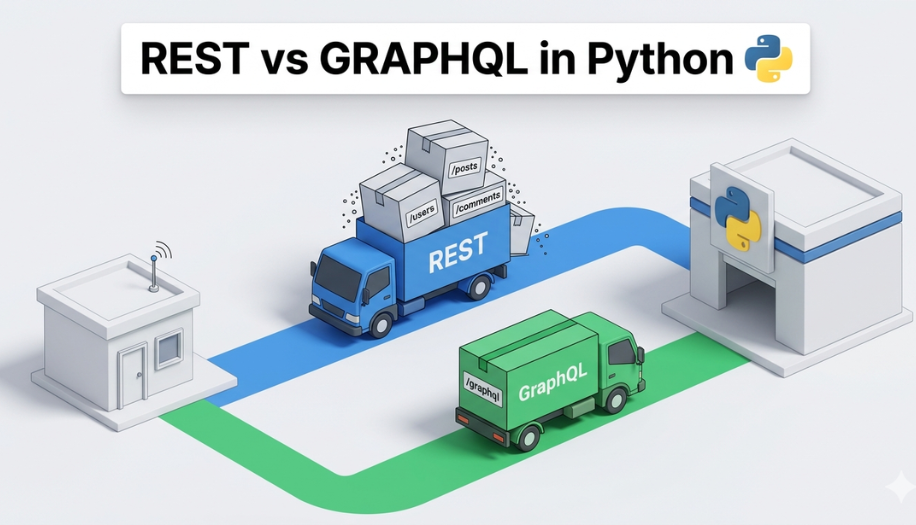
REST and GraphQL are not interchangeable, and the choice has downstream consequences for client development, API versioning, and backend query complexity.
REST (via Django REST Framework or FastAPI) is the better choice when:
Your API has a clear resource-based structure
Clients are external developers or third-party integrations that need predictable, versioned endpoints
Caching at the HTTP layer is a meaningful performance requirement
Your team is smaller and wants simpler API contracts to maintain
GraphQL (via Strawberry or Graphene for Python) is the better choice when:
You have multiple client types (web, mobile, third-party) with significantly different data requirements
Overfetching and underfetching from REST endpoints is creating measurable frontend performance problems
Your frontend teams are consuming the API and can benefit from query flexibility
Your data model is highly relational and clients need to traverse relationships efficiently
Most production Python systems at Acquaint Softtech use REST for public-facing and third-party APIs, and consider GraphQL specifically for internal product APIs where multiple frontend surfaces consume the same backend.
Async Architecture: When It Helps and When It Does Not
Python async architecture via FastAPI or Django's ASGI support is genuinely valuable in specific scenarios and genuinely harmful in others. The distinction matters because many teams adopt async based on the assumption that it is always faster.
Async Python delivers meaningful performance improvement when:
Your endpoint spends most of its time waiting on I/O: database queries, external API calls, file reads
Your system needs to maintain many concurrent connections simultaneously (WebSockets, long-polling)
You are building a real-time event streaming system
Async Python adds complexity without benefit when:
Your endpoint is CPU-bound (heavy computation that holds the event loop)
Your team is not experienced with async/await patterns and the debugging overhead of async exceptions
Your database driver does not support async natively (in which case you are blocking the event loop anyway)
The engineering discipline of knowing when not to use async is as important as knowing how to implement it. Acquaint Softtech's AI development services team builds FastAPI async endpoints specifically for ML model serving, where inference latency is primarily I/O-bound and concurrent request handling directly impacts throughput.
Database Architecture: PostgreSQL, Redis, and Getting the Data Layer Right
The most common cause of Python application performance problems in production is not the application layer. It is the database layer. Poor schema design, missing indexes, unoptimized ORM queries, and absent caching are responsible for the majority of production performance incidents across Python web applications.
Key principles for a production-ready Python data layer:
Schema design upfront: Django ORM migrations make it easy to change the schema later, which leads many teams to defer data modeling decisions. The tables you create in the first three months tend to be the ones that remain under load five years later. Design them deliberately.
Index strategy: Every foreign key column that will be used in a filter or join needs an index. Django does not create these automatically. Missing indexes on a table with 10 million rows can turn a 5ms query into a 4-second one.
Avoid N+1 queries: Django ORM's lazy loading is convenient but dangerous at scale. Every list view that triggers a query per object is a production incident waiting to happen. Use select_related for foreign key traversal and prefetch_related for many-to-many relationships consistently.
Redis for caching: For read-heavy endpoints where the underlying data changes infrequently, Redis caching reduces database load dramatically. The investment in cache invalidation logic pays back quickly at scale.
Read replicas for reporting: Analytical queries and report generation should run against a read replica, not the primary database. Mixing OLTP and OLAP workloads on a single database instance is a common cause of production slowdowns during business hours.
Python Development Across Industries: What Real Implementations Look Like
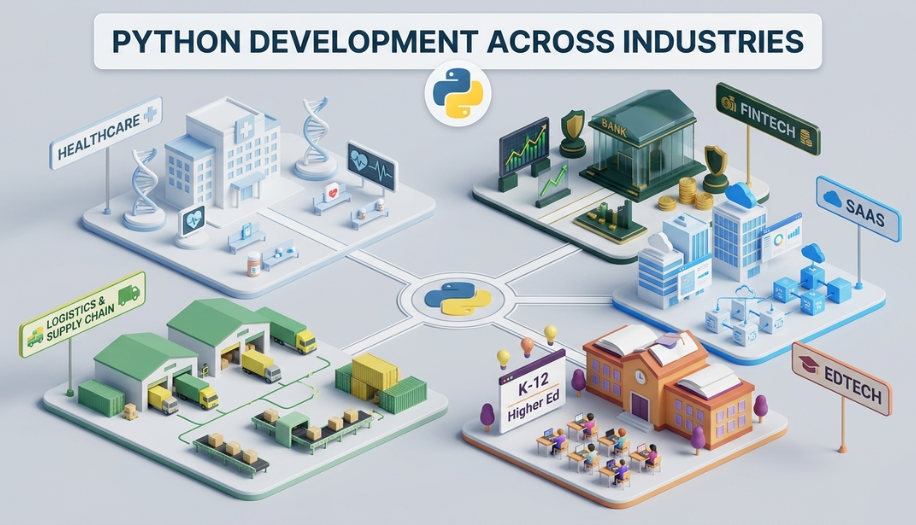
Python's architectural flexibility is one reason it dominates across industries that have very different technical requirements. Here is what Python development looks like in the sectors where Acquaint Softtech has delivered production systems.
Python for Healthcare: Compliance, Analytics, and Clinical Data Pipelines
Healthcare is one of the most technically demanding environments for Python development. The combination of strict regulatory requirements (HIPAA, GDPR), sensitive clinical data, and the need for analytical accuracy creates a context where engineering shortcuts have genuine consequences.
Acquaint Softtech built a GDPR-compliant predictive analytics platform for BIANALISI, Italy's largest diagnostics group, deploying a team of 6 to 10 Python developers. The platform replaced manual monthly reporting cycles with automated data pipelines that could surface patient risk patterns earlier and with greater consistency. The architecture required:
Strict data access controls at the row level, not just the API level
Audit logging for every data access event, not just mutations
Data anonymisation pipelines that preserved analytical utility while meeting GDPR requirements
Clinical dashboard interfaces that presented probabilistic outputs in formats clinicians could interpret and act on
Python for healthcare is not just a technical choice. It is a compliance engineering challenge. Teams building in this space need developers who understand regulatory boundaries, not just framework syntax. Acquaint Softtech's software product development practice for healthcare clients includes compliance review as a standard part of architecture design.
Python for FinTech: High-Volume Transactions and Regulatory Compliance
FinTech Python development sits at the intersection of performance, security, and auditability. Payment processing engines, fraud detection models, credit scoring pipelines, and regulatory reporting tools are all common Python workloads in financial services.
The distinguishing characteristics of well-built Python FinTech systems include:
Idempotency in payment processing: Every transaction mutation must be idempotent so that retries on network failure do not result in duplicate charges. This is an architectural requirement, not a nice-to-have.
Audit trails by default: Every state change in a financial system must be logged immutably. Django's signal system combined with a separate audit log table handles this cleanly.
Fraud detection via ML pipelines: Python's native ML ecosystem (Scikit-learn, XGBoost, TensorFlow) makes it the practical choice for fraud signal processing. FastAPI serves model predictions as low-latency API endpoints that the transaction processing layer queries in real time.
Async for high-throughput transaction queues: Celery with Redis or RabbitMQ handles background transaction processing reliably, decoupling payment initiation from settlement logic.
Python for SaaS: Architecture That Scales From 100 to 100,000 Users
SaaS Python development has a specific scaling challenge that differs from single-tenant applications: the multi-tenancy model. How you isolate tenant data, how you handle per-tenant configuration, and how you bill usage all require deliberate architectural choices that become very expensive to change after launch.
The two dominant multi-tenancy patterns in Django-based SaaS:
Shared schema with tenant identifier: All tenants share the same database tables, with a tenant_id foreign key on every relevant table. Simpler to operate, but requires careful query filtering to prevent data leakage. Django-tenants middleware handles this pattern well.
Separate schemas per tenant: Each tenant gets their own PostgreSQL schema. Better isolation, easier per-tenant backup and migration, but higher operational complexity at large tenant counts.
Beyond multi-tenancy, Python SaaS platforms benefit from a clean background task architecture. Celery handles subscription renewal jobs, usage calculation, email notifications, and data export processes without blocking web request handling. Acquaint Softtech has built SaaS platforms that scale from early-stage products with dozens of users to platforms handling 100,000 active subscribers, and the architecture decisions made in the first sprint are the ones that matter most at that scale.
If you are building a SaaS product and want to get the architecture right from the start, you can hire Python developers with SaaS-specific production experience, or explore our discovery workshop services to validate your architecture before writing the first line of code.
Python for EdTech: Platform Architecture That Supports Learning at Scale
EdTech platforms have a specific set of requirements that make Python a natural fit: content delivery, user progress tracking, assessment logic, notification systems, and integration with video infrastructure. Acquaint Softtech built a scalable web platform for an EdTech company that needed to handle simultaneous course delivery across thousands of concurrent learners without performance degradation.
The key architectural elements included:
Django REST Framework for the course content and user management API
Celery for asynchronous processing of progress tracking events and certificate generation
PostgreSQL for structured learner data with Redis for session management
AWS S3 for video and content asset delivery, integrated with the Django backend via pre-signed URL generation
The platform launched on schedule and scaled without architectural rework as the user base grew, which is the outcome of getting foundational decisions right during the discovery phase rather than patching them after launch.
Python for Logistics and Supply Chain: Real-Time Data Pipelines and Automation
Logistics Python development is fundamentally about data pipeline architecture: ingesting data from multiple sources (ERP systems, GPS feeds, carrier APIs, warehouse management systems), transforming it into consistent formats, and making it available for decision-making in near real time.
Python's data engineering ecosystem is purpose-built for this: Apache Airflow for pipeline orchestration, Pandas and Polars for data transformation, FastAPI for real-time data endpoint serving, and Celery for background synchronisation jobs. The combination handles the complexity of logistics data, which is characteristically messy, inconsistent, and sourced from systems that were never designed to communicate with each other.
Python Migrations and Modernisation: When to Rewrite vs Refactor
A significant portion of Python development work in 2026 is not greenfield. It is modernisation: moving from Python 2 codebases, upgrading from older Django versions, migrating monoliths into services, or rebuilding applications originally built on frameworks that no longer fit the product's scale.
The rewrite vs refactor decision is not primarily technical. It is economical. A full rewrite carries the risk of losing working functionality, delays new feature delivery, and introduces a period of running two systems in parallel. A refactor preserves working code but accumulates complexity as old and new patterns coexist.
The practical framework:
Refactor first when the existing codebase has reasonable test coverage (above 60%), a coherent data model, and architectural problems that are isolated to specific modules
Rewrite specific modules when a component's design is fundamentally incompatible with current requirements and test coverage is insufficient to safely refactor
Full rewrite only when the existing system is essentially undocumented, has no meaningful test coverage, has a data model that cannot be evolved without a migration, and is actively blocking delivery
Acquaint Softtech's version upgrade services and support and maintenance services cover the full spectrum of Python modernisation work, from Django version upgrades across multiple major versions to full architectural migrations from legacy Python 2 systems.
What Acquaint Softtech Builds in Python: Our Technical Capabilities
Our Python development services practice covers the full stack of Python engineering. Here is what our in-house engineers build in production:
Web Applications and APIs
Django-based multi-user web applications with complex permission systems
FastAPI microservices and high-throughput API layers
Django REST Framework and GraphQL APIs for SaaS and enterprise platforms
AI and Machine Learning Systems
Production ML pipelines using TensorFlow, PyTorch, Scikit-learn, and Keras
AI model serving via FastAPI async endpoints
NLP pipelines, recommendation engines, and predictive analytics dashboards
Integration of LLM-based features (OpenAI, Anthropic, Mistral, LLaMA) into Python backends
Data Engineering
Apache Airflow pipeline orchestration for ETL and ELT workflows
Real-time data ingestion and transformation pipelines
Analytics dashboards powered by Python data processing backends
Clinical and enterprise data pipelines with compliance-grade logging
Infrastructure and Deployment
Docker and Kubernetes containerisation of Python services
CI/CD pipeline configuration for GitHub Actions, Jenkins, and GitLab CI
AWS, GCP, and Azure deployment of Python applications
Serverless Python via AWS Lambda and GCP Cloud Run
Our AI development services practice handles the ML and AI workload end of this stack. Our software product development practice covers product-focused Python development from discovery through deployment. For teams that need Python capacity added to an existing engineering organisation, staff augmentation and dedicated software development teams are the engagement models that fit best.
Build Your Python Product on Architecture That Lasts
Our Python development team builds systems that are maintainable, scalable, and designed to evolve with your product, not ones that require a rewrite every 18 months.
Frequently Asked Questions
-
Which Python framework should I choose for a new product in 2026: Django, FastAPI, or Flask?
For most product companies building their first or second major product, Django is the right starting point. It handles authentication, ORM, admin, and API development out of the box, which reduces the number of architectural decisions your team needs to make before shipping. FastAPI is the better choice when you are building a high-performance API, a microservice, or an AI model serving layer where async throughput matters. Flask is appropriate for small internal tools or isolated single-purpose services, not for products expected to grow.
-
When should a Python application move from a monolith to microservices?
When a specific component has meaningfully different scaling, deployment, or team ownership requirements from the rest of the system. Not before. Premature microservices decomposition is one of the most common sources of unnecessary engineering complexity in growing Python products. Start with a well-structured Django monolith, build clear module boundaries, and decompose when real-world usage reveals where the seams should be.
-
What does Python development cost for a mid-sized product?
A mid-sized Python product (API backend, admin interface, basic analytics, third-party integrations) built by a 2 to 3 developer team over 4 to 6 months typically ranges from $40,000 to $120,000 depending on complexity and the hiring model. At Acquaint Softtech, a dedicated Python developer costs $3,200/month for a full-time engagement. Fixed-budget projects start from $5,000. The right model depends on whether your product is in active development (dedicated team) or has a defined, bounded scope (fixed price).
-
How does Python handle AI and ML workloads in production?
Python is the primary language for production AI and ML. TensorFlow, PyTorch, Scikit-learn, and Keras are all Python-native, which means your data science team and your backend team operate in the same language. FastAPI serves model predictions as low-latency API endpoints. Airflow orchestrates the retraining and data preparation pipelines. The result is a coherent system where model development and production deployment do not require a translation layer between teams.
-
Is Python suitable for healthcare or FinTech applications with strict compliance requirements?
Yes. Python is used extensively in both sectors. The key is that compliance requirements (HIPAA, GDPR, PCI-DSS) are architectural concerns, not language concerns. Python's ecosystem supports row-level data access controls, immutable audit logging, data encryption, and the separation of analytical and operational data stores that compliance environments require. Acquaint Softtech has delivered GDPR-compliant clinical analytics platforms for European healthcare clients and FinTech payment systems with full audit trail architecture.
-
What is the best way to scale a Python web application from early-stage to enterprise?
The foundation is getting the data model right early, adding indexes proactively, using Celery for background processing from the start, and implementing Redis caching before you need it rather than after. At the infrastructure level, horizontal scaling of stateless application instances behind a load balancer handles most traffic growth. Read replicas separate reporting workloads from transactional ones. Microservices decomposition comes last, when specific components genuinely require it. The teams that scale Python applications smoothly are those that planned for growth in the first sprint, not the ones that retrofitted scalability patterns under load.
We’re Acquaint Softtech, your technology growth partner. Whether you're building a SaaS product, modernizing enterprise software, or hiring vetted remote developers, we’re built for flexibility and speed. Our official partnerships with Laravel, Statamic, and Bagisto reflect our commitment to excellence, not limitation. We work across stacks, time zones, and industries to bring your tech vision to life.
Table of Contents
Get Started with Acquaint Softtech
- 13+ Years Delivering Software Excellence
- 1300+ Projects Delivered With Precision
- Official Laravel & Laravel News Partner
- Official Statamic Partner
Related Blog

The Complete Guide to Hiring Python Developers in 2026: Rates, Models, Vetting and Red Flags
A complete guide to hiring Python developers in 2026. Compare real hourly rates across India, Eastern Europe and the US, choose the right engagement model, vet candidates correctly, and avoid the red flags that cost companies months of wasted budget.
Acquaint Softtech
March 4, 2026
Why $20/Hour Python Developers from India Outperform $80/Hour Freelancers
Paying $80/hr for a freelance Python developer does not guarantee better results. Here is why vetted India-based Python developers consistently outdeliver on quality, speed, and total cost.
Acquaint Softtech
March 12, 2026
Python Development Cost: Fixed Price vs Dedicated Team vs Staff Augmentation
Compare Python development costs across fixed price, dedicated team, and staff augmentation models. Real 2026 data, expert insights, and Acquaint Softtech pricing to help you decide.
Acquaint Softtech
March 10, 2026Your Project. Our Expertise. Let’s Connect.
Get in touch with our team to discuss your goals and start your journey with vetted developers in 48 hours.