

Why $20/Hour Python Developers from India Outperform $80/Hour Freelancers
Paying $80/hr for a freelance Python developer does not guarantee better results. Here is why vetted India-based Python developers consistently outdeliver on quality, speed, and total cost.

Acquaint Softtech
The Price Tag Assumption That Costs Companies Millions
There is a belief buried deep in most hiring decisions: that a higher hourly rate signals a better developer. It sounds logical. It is not.
When a company pays $80 per hour for a freelance Python developer on Upwork or Toptal, they are paying for a rate. They are not automatically paying for production depth, communication discipline, IP protection, or delivery continuity. When a company hires a vetted $20 to $30 per hour Python developer from India through a structured offshore partner, they often receive all four and more.
The gap between the price and the outcome is not accidental. It is structural. And in 2026, with Python dominating AI, data engineering, and SaaS backend development, understanding that gap is one of the most important cost decisions a product team can make.
This is not an argument that every cheap developer is great or that every expensive freelancer is bad. It is a data-backed case for why the $20 per hour number misleads buyers into dismissing an option that consistently outperforms its price tag when the engagement is structured correctly.
What the Numbers Actually Say in 2026
Start with the cost reality. According to Glassdoor’s February 2026 data, the median total compensation for a Python developer in the US sits at $128,630 per year, approximately $62 per hour at full-time hours. When employer taxes, benefits, equipment, onboarding, and overhead are added, the true annual cost of a mid-level US Python developer easily exceeds $180,000. Freelance Python developers billing $80 per hour on major platforms reflect that same market pricing minus the employment overhead but with their own risk premium built in.
On the other side, India-based Python developers through a vetted offshore partner like Acquaint Softtech start at $22 per hour part-time and $3,200 per month full-time. According to Second Talent’s 2026 country hiring guide, India offers 65 to 75% cost savings versus US equivalents, the highest savings globally for comparable experience levels. That is not a small rounding difference. It is a structural cost advantage that holds at every seniority tier.
What buyers too often miss is that this cost gap does not originate from a quality gap. It originates from a cost-of-living gap. The same engineering output that costs $80 per hour in San Francisco or London costs $25 to $40 per hour in Bangalore, Pune, or Ahmedabad when the developer is properly vetted, experienced, and working within a structured engagement framework.
India produces approximately 2.55 million STEM graduates per year, according to data from Airswift’s global STEM talent rankings. It accounts for 31% of STEM graduates worldwide, according to Papaya Global’s workforce analysis. The India Skills Report 2026, produced by ETS, CII, AICTE, and AIU, found that Computer Science and IT engineers now lead employability metrics at 80% and 78% respectively, driven by roles in AI, data analytics, cloud, and automation. The talent base is not narrow. It is the deepest Python development ecosystem on earth.
What a $80/Hour Freelancer Actually Delivers (And What They Often Do Not)
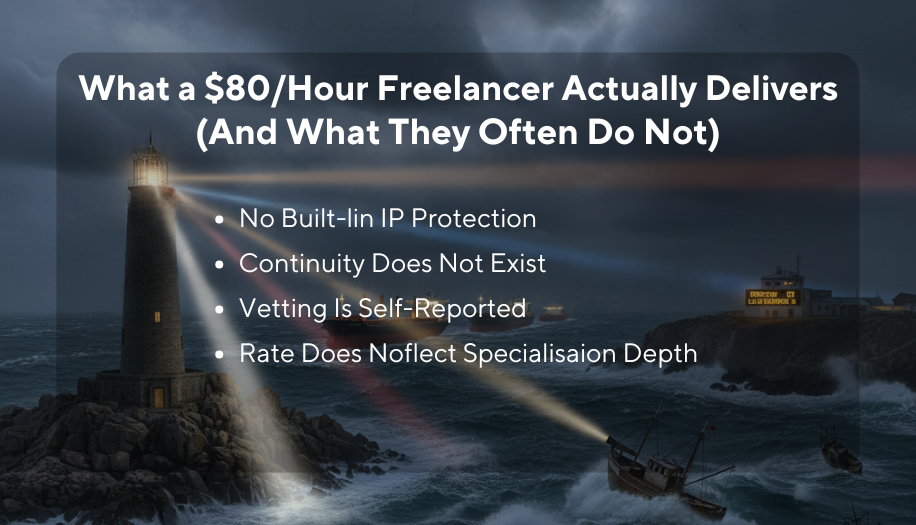
The freelance model has genuine use cases. Short tasks with fully defined scope, one-off scripts, isolated bug fixes. Outside of those specific scenarios, the structural limitations of high-rate freelance Python work show up in patterns that repeat across engagements.
No Built-In IP Protection
PatentPC’s 2025 analysis of freelance developer contracts found that code ownership when hiring a freelance developer is often unclear, with significant risk around confidentiality and legal obligations. A freelancer on a platform operates under the platform’s terms, not necessarily a bespoke NDA and IP assignment agreement that clearly transfers ownership of every line of code to you before work begins. For SaaS products, AI systems, and data platforms, that ambiguity is not a theoretical risk. It is a business liability.
Continuity Does Not Exist
Freelancers finish engagements and move on. When they do, everything they know about your codebase architecture, undocumented design decisions, and production edge cases walks out with them. The next developer you bring in starts from scratch. According to BlueOptima’s research on code quality and developer productivity, poor code structure and inadequate documentation means subsequent developers must slog through convoluted logic, compounding the time and cost of the original work.
McKinsey’s research on software team productivity has consistently placed the cost of re-onboarding and rework from a poorly structured developer engagement at three to five times the original salary equivalent. When that freelancer leaves mid-project, which happens regularly on platforms without continuity guarantees, the downstream cost calculation changes completely.
Vetting Is Self-Reported
On most freelance platforms, vetting is light. Developers list skills, upload portfolios, and accumulate reviews. None of that reliably predicts whether a developer can architect a scalable Django application, optimize PostgreSQL query performance under load, or debug a FastAPI production incident at 2am. The reviews tell you whether previous clients were happy. They do not tell you whether the code those clients received is maintainable twelve months later or whether it will hold up when traffic scales.
Rate Does Not Reflect Specialisation Depth
A $80 per hour Python freelancer and a $80 per hour Python AI/ML engineer are listed identically on most platforms. One has built production recommendation engines with PyTorch and deployed ML model APIs through FastAPI. The other knows the framework from tutorials. Both charge $80 per hour. The rate gives you no signal on which one is billing you.
Why India-Based Python Developers Consistently Over-Deliver
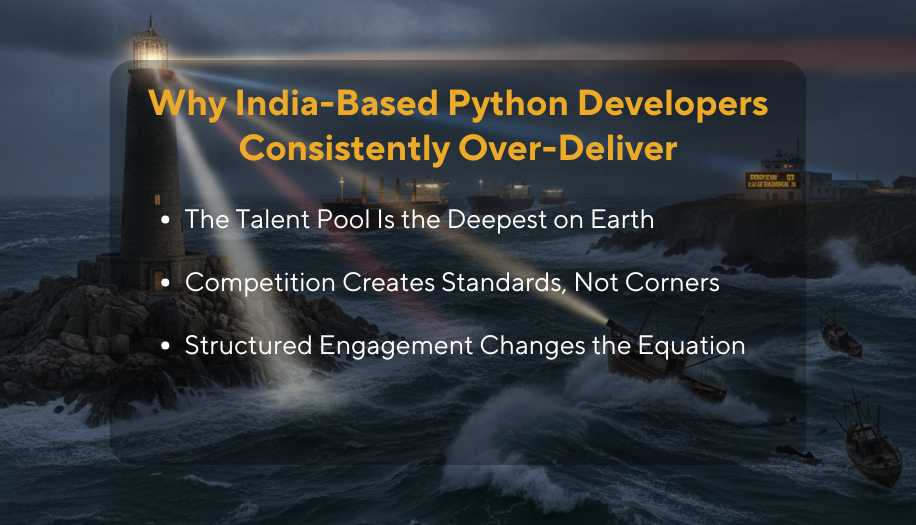
The performance gap is not about national origin. It is about the structural conditions that the best India-based offshore partners create around their developers and their clients.
The Talent Pool Is the Deepest on Earth
India’s Python developer ecosystem is not a mass-market commodity pool. At the top tier, particularly in cities like Bangalore, Pune, Hyderabad, and Ahmedabad, Python engineers have built production-scale systems for US SaaS companies, European fintech platforms, Australian healthcare providers, and Gulf logistics businesses. They have shipped multi-tenant Django applications, FastAPI-served ML model endpoints, Apache Airflow data pipelines, and React-backed full-stack platforms. This is not a tutorial experience. It is the kind of production depth that comes from years of working across international product standards.
According to the India Skills Report 2026, overall engineering employability in India has risen to 56.35%, nearly a 10-percentage-point jump over four years. CSE and IT graduates lead at 80% employability, with skills in AI, data analytics, and cloud driving the strongest hiring outcomes. The pool of deeply skilled Python engineers is growing, not shrinking.
Competition Creates Standards, Not Corners
India produces 2.55 million STEM graduates annually. That competitive environment means the developers who rise to senior and specialist levels have been tested against the widest talent pool in the world. They have survived hiring filters, competitive coding assessments, and years of delivery accountability on international projects. The Indian developer market is not easy. Getting to senior level in a competitive tech hub like Bangalore requires the same depth of production experience that makes a developer valuable anywhere.
As Sohail Saifi, a software development analyst writing for Medium in 2025, observed: Indian development teams excel at the pragmatic approach to innovation that determines startup success. Shipping products quickly, iterating based on feedback, and scaling efficiently. That is exactly what product teams need from Python developers in 2026, regardless of the rate they pay.
Structured Engagement Changes the Equation
The difference between a $20 per hour India-based Python developer who delivers and one who does not is almost never the developer. It is the engagement structure around them.
A freelancer on a platform, regardless of rate, operates alone. A developer placed by a structured offshore partner like Acquaint Softtech is assessed through multi-stage technical and communication evaluation before client contact, onboarded within 48 hours with full sprint integration, covered by a comprehensive NDA and IP assignment agreement from Day 1, supported by a continuity guarantee that provides a free replacement with full context handover if the developer leaves, and aligned to the client’s tools, sprint cadence, and delivery standards from the first day of work.
That structure is what converts a $22 per hour rate into a $22 per hour outcome that outperforms an $80 per hour freelance engagement. The rate is the input. The structure is what determines the output.
A Direct Comparison: $20/Hour India Partner vs $80/Hour Freelancer
Factor | Vetted India Partner ($22/hr) | Marketplace Freelancer ($80/hr) |
Hourly Rate | From $22/hr | $80/hr+ |
Monthly Cost (Full-Time) | $3,200/month | $13,000+/month |
IP and Code Ownership | Full NDA and IP assignment, Day 1 | Platform terms, often unclear |
Vetting Process | Multi-stage internal assessment | Self-reported, platform reviews |
Onboarding Time | 48 hours to sprint-ready | 1 to 4 weeks typically |
Continuity Guarantee | Free replacement, full handover | None |
Sprint Integration | Native, uses your tools and process | Variable by freelancer |
AI/ML Specialist Access | In-house pool, production-tested | Rate premium, unclear depth |
Communication Structure | Defined overlap windows, documented | Freelancer-dependent |
Annual Cost Saving vs US | 65 to 75% | 20 to 40% at best |
The monthly cost difference alone is material. At full-time hours, a $80 per hour freelancer costs over $13,000 per month, roughly four times the $3,200 per month rate for a dedicated full-time India-based Python developer through Acquaint Softtech. Over a six-month product build, that difference is $58,000. Over a twelve-month engagement, it is $116,000. That is a product marketing budget, a second developer, or runway that determines whether a startup reaches its next funding milestone.
For a full breakdown of hiring models, read our complete Python developer hiring guide.
The Hidden Cost Calculation That Changes Everything
The headline rate comparison above tells part of the story. The complete picture includes the costs that appear nowhere in an hourly rate but determine total engagement cost more than any other variable.
Rework cost. According to research cited by BlueOptima on software development productivity, poor code quality directly grinds development to a halt. When a developer writes undocumented code, skips testing discipline, or structures database queries without production optimization in mind, the next person who touches that code pays the cost in debugging time, rewrites, and delayed features. That cost does not appear on the invoice from the original developer. It appears months later in sprint velocity numbers and engineer burnout.
Onboarding cost. Every week a developer spends getting oriented before making meaningful commits is a week of paid productivity that delivers nothing. A $80 per hour freelancer who takes three weeks to ramp up costs $9,600 before a single production commit. Acquaint Softtech’s 48-hour onboarding model eliminates that category almost entirely.
Scope abandonment cost. The most underestimated risk in freelance Python development is mid-project departure. A developer who leaves when a project is 60% complete does not just take their remaining hours with them. They take their understanding of architectural decisions, undocumented workarounds, and the context that makes the remaining 40% of the build possible. Replacing them restarts a significant portion of the onboarding cycle and often requires partial rewrites where documentation was insufficient.
Security and compliance exposure. Codeloom Technologies’ 2026 software development mistakes guide identified shipping without full code ownership, credentials, and documentation as one of the most damaging mistakes a company can make, resulting in vendor lock-in, stalled upgrades, and costly takeovers. Freelance engagements without explicit IP assignment agreements create exactly this exposure. For fintech, healthcare, and SaaS products handling user data, that is not just a business risk. It is a compliance and legal risk.
When these hidden costs are added to the headline rate, the $80 per hour freelancer frequently costs more per delivered feature than the $22 per hour vetted offshore engineer.
What India-Based Python Developers Actually Build in 2026
A common assumption behind the high-rate preference is that India-based developers handle simpler work while expensive freelancers tackle the complex stuff. The project record at Acquaint Softtech dismantles that assumption directly.
Acquaint Softtech’s India-based Python team has delivered work across these categories in recent client engagements:
Healthcare analytics platforms that detect clusters of abnormal diagnostic trends, requiring deep understanding of medical data structures, compliance constraints, and real-time analysis pipelines
Fintech compliance systems with audit trails, access boundaries, and structured transaction processing, built to handle regulatory scrutiny
AI-powered data processing tools that reduced report creation time from four days to one and saved 200 engineering hours per week for a client
SaaS platforms with multi-tenant architecture, subscription billing integration, Celery-based background task processing, and Redis caching for performance at scale
Real estate platforms that eliminated stuck payments, reduced tenant misunderstandings, and streamlined internal ticket processing
None of those are simple projects. All were delivered by India-based Python teams at rates that are a fraction of what equivalent US or Western European freelancers charge. The work speaks for itself across 35+ verified Clutch reviews and 1,293+ Upwork engagements at 98% job success rate.
For a detailed example of what this looks like in a regulated industry, read the Bianalisi healthcare analytics case study, which documents how Acquaint Softtech’s Python team delivered diagnostic trend detection capabilities that exceeded the client’s timeline expectations.
How to Tell a Vetted India-Based Developer from a Cheap One
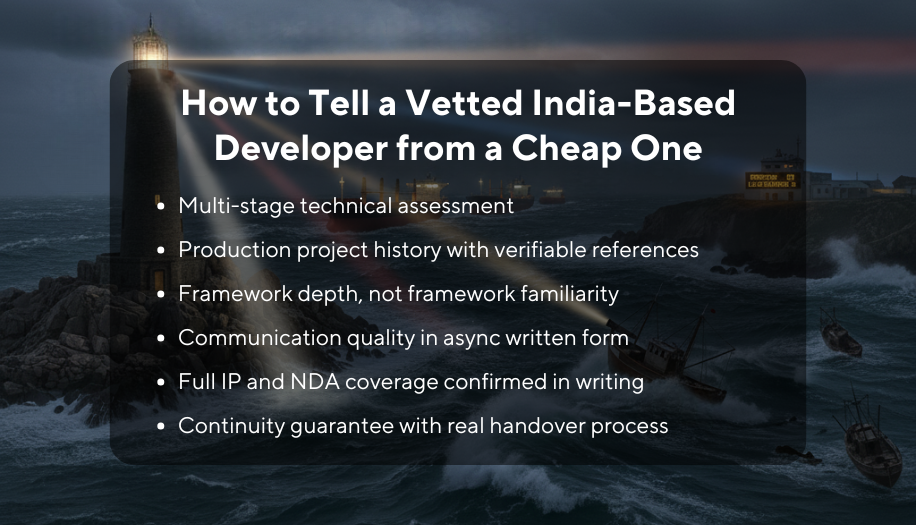
This is the question that sits behind the real concern. Not whether Indian developers can be as good as $80/hour freelancers, but how to reliably find the ones that are. Because the assumption that cheaper always means worse partly exists because buyers have been burned by low-quality offshore work, and that experience was real.
The distinction between a vetted India-based Python developer and a low-quality one comes down to six criteria. These apply regardless of the platform or partner you are evaluating.
Multi-stage technical assessment. A code test is not a vetting process. Real assessment includes system design thinking, live debugging, architectural reasoning under realistic constraints, and production scenario discussion. Developers who understand when Django ORM queries will create N+1 problems and how to fix them have production experience. Developers who only know tutorial patterns do not.
Production project history with verifiable references. Portfolio links and GitHub repositories are a starting point. Actual client references from international engagements, where delivery quality and communication can be verified, are the standard that matters.
Framework depth, not framework familiarity. There is a well-documented gap between listing Django on a CV and having shipped a multi-tenant SaaS platform with Celery task queues, Redis caching, and optimized ORM queries under production load. The interview process needs to probe depth, not surface recognition.
Communication quality in async written form. Distributed development runs on written communication. A developer who writes clear, structured technical updates, surfaces blockers proactively, and explains architectural decisions in plain terms reduces management overhead significantly. This quality is assessable before hire and should be assessed.
Full IP and NDA coverage confirmed in writing. Before a developer writes a single line of code. Not after. Not implied by platform terms. Explicitly. Every line of code produced belongs to the client, with no licensing restrictions or shared ownership claims.
Continuity guarantee with real handover process. Any vetted partner should be able to answer clearly: if this developer leaves tomorrow, what happens next? Free replacement, full context handover, and zero disruption to your sprint are the baseline expectation, not a premium feature.
Acquaint Softtech’s Python developer selection process covers every one of these criteria before any engineer is presented to a client. The 48-hour onboarding is possible because developers arrive already assessed, already aligned to production standards, and already capable of integrating into an agile team from Day 1.
Explore how this works in practice by reading about Python development services and staff augmentation at Acquaint Softtech, or see the full range of engagement models on the hire Python developers page.
Acquaint Softtech: India-Based Python Development at Verified Quality
Acquaint Softtech is headquartered in Ahmedabad, India, with 13 years of delivery experience and 1,300+ projects completed across 20+ industries globally. Ratings include five stars across 35+ verified Clutch reviews and 1,293+ Upwork reviews at 98% job success rate.
The Python team is 100% in-house. Zero freelancers. Zero subcontractors. Zero marketplace matches. Multi-stage assessment before any developer reaches a client. Full NDA and IP assignment from Day 1. Free replacement with complete context handover if a developer leaves at any point.
Python Developer Pricing at Acquaint Softtech (2026)
Engagement Model | Rate | What It Covers |
Part-Time / Hourly | From $22/hr | Up to 4 hrs/day. Bug fixes, audits, focused features |
Full-Time Dedicated | $3,200/month | 176 hrs/month. Sprint integration, continuous delivery |
Fixed-Price Project | From $5,000 | Defined scope. Milestone payments. Zero overruns |
Technology Stack
Web and API: Django, FastAPI, Flask, Django REST Framework
AI and ML: TensorFlow, PyTorch, scikit-learn, Keras, Pandas, NumPy, LangChain
Databases: PostgreSQL, MySQL, MongoDB, Redis
Cloud: AWS, GCP, Azure, Docker, Kubernetes
DevOps: GitHub Actions, Jenkins, Terraform, Ansible
Frontend integration: React, Next.js, Vue.js
What Clients Say

“Overall a great experience working with Acquaint Softtech. Alpesh is knowledgeable, communicative, and once he understands the project, he gives clear explanations about the work needing to be done and executes accordingly.” — Daniel Sebastian, CEO, Audio Design Desk (Upwork, Python engagement)
“Acquaint Softtech’s work transformed the client’s data handling process, saving 200 hours per week and reducing report creation time from four days to one.” — Rafal Styczen, Chairman, Ailleron (Clutch, AI Development)
“Alpesh was very fast in his delivery of the project, built a beautiful frontend template which looked exactly like the example I sent through.” — James Verney (Upwork, Python/Django)
For a broader view of delivery quality, explore Acquaint Softtech case studies across fintech, healthcare, SaaS, e-commerce, and real estate.
Conclusion
The $20 per hour vs $80 per hour comparison is framed wrong by most buyers. The real question is not which number is larger. It is which number reflects the structure, depth, and delivery accountability your product actually needs.
India-based Python developers from a vetted partner like Acquaint Softtech regularly outperform high-rate freelancers on total cost, delivery quality, IP clarity, and engagement continuity because they bring production-tested engineering skills within a structure that eliminates the risk categories that make cheap freelance work expensive. The rate is a cost-of-living artifact. The structure is what determines whether you are paying for an outcome or paying for an invoice.
India accounts for 31% of global STEM graduates, leads the world’s Python developer ecosystem in absolute size, and produces engineering talent that powers products at Instagram, Google, Spotify, and thousands of SaaS companies that have quietly made offshore India teams a standard part of their engineering strategy. The question is not whether it works. The question is whether the engagement is structured correctly.
At Acquaint Softtech, 1,300+ completed projects and a 98% Upwork job success rate across 1,293 reviews provide a verified answer to that question.
Ready to get production-grade Python development at $22/hour instead of $80/hour?
Acquaint Softtech delivers pre-vetted, in-house Python developers, sprint-ready within 48 hours, covered by full NDA and IP ownership from Day 1, with zero agency markup and zero freelancer risk.
Frequently Asked Questions
-
Are $20/hour Python developers from India actually as good as $80/hour US freelancers?
When properly vetted, yes, frequently better on total outcome. The rate reflects cost of living, not capability. India produces approximately 2.55 million STEM graduates annually, with Computer Science and IT engineers leading employability metrics at 80% in the India Skills Report 2026. The developers who reach senior and specialist level in competitive Indian tech hubs have production experience comparable to their counterparts anywhere. The difference is structure: a vetted offshore partner provides IP protection, sprint integration, and continuity guarantees that most freelance engagements do not. The rate is a cost-of-living artifact, not a quality signal.
-
What are the real risks of hiring a cheap freelance Python developer?
The risks are not primarily about the developer being bad. They are structural. Unclear IP ownership means code you paid for may not legally belong to you without an explicit NDA and assignment agreement. No continuity guarantee means a mid-project departure restarts onboarding and can require partial rewrites. Self-reported vetting means production depth is unverified until the code ships. Poor documentation practices, which BlueOptima’s research identifies as a direct cause of development slowdowns, compound over months into significant rework cost. High hourly rate freelancers reduce some of these risks but do not eliminate them, particularly IP clarity and continuity.
-
How does Acquaint Softtech vet Python developers before placing them with clients?
Every developer goes through a multi-stage internal assessment that covers technical depth, production project history, system design thinking, framework fluency rather than surface familiarity, async written communication quality, and agile team integration experience. This is not a single code submission. It covers live debugging, architectural reasoning, and production scenario discussion. Clients still conduct their own technical interview. Acquaint Softtech ensures the developer who reaches that interview has already cleared every baseline qualification criterion.
-
What happens if my India-based Python developer leaves mid-project?
With Acquaint Softtech, every engagement includes a continuity guarantee. If a developer leaves for any reason, a free replacement is provided with a complete context handover covering codebase documentation, architectural decisions, and team introductions. Your project timeline is not held hostage by individual availability. This applies to all engagement models: hourly, full-time dedicated, and fixed-price projects. Compare this to a freelance engagement, where no such mechanism exists and departure typically means restarting the search, re-paying for onboarding, and absorbing the knowledge loss.
-
Can India-based Python developers handle AI and machine learning projects?
Yes, and India leads globally in this category. Python’s dominance in AI and ML means TensorFlow, PyTorch, scikit-learn, LangChain, and production ML deployment experience are deep in India’s developer ecosystem. Acquaint Softtech’s AI development engagements include healthcare analytics platforms, financial data processing systems, and AI-powered product development across multiple industries. The Bianalisi case study, for example, documents a Python AI engagement in medical diagnostics that detected abnormal trends earlier than the client expected. See AI development services for specific capability details.
-
Is a dedicated India-based Python developer better than a US freelancer for SaaS products?
For SaaS products that evolve over time, the dedicated model consistently outperforms freelance regardless of rate. SaaS platforms need engineers who accumulate context over months: the data model decisions, the performance bottlenecks already solved, the business logic edge cases already handled. A freelancer, whether charging $30 or $100 per hour, delivers deliverables. A dedicated developer takes ownership. Acquaint Softtech’s full-time dedicated Python developers at $3,200 per month integrate into your sprint, learn your codebase, and build the kind of deep product knowledge that shortens every subsequent sprint. Explore the dedicated development teams model for more detail.
-
How quickly can I get an India-based Python developer started?
Through Acquaint Softtech, the path from requirements to sprint-ready developer is 48 hours. Share your technical requirements, receive two to three pre-vetted developer profiles within 24 hours, conduct your own technical interview, and onboard within two days. Traditional recruitment for a Python developer takes 4 to 12 weeks on average. For product teams under delivery pressure or with a time-sensitive launch, that 48-hour timeline is itself a competitive advantage. Start the process on the hire Python developers page.
-
What is Python staff augmentation and when should I use it instead of a full-time hire?
Python staff augmentation means adding vetted Python engineers to your existing team without permanent hiring overhead. Your augmented developer works in your tools, follows your sprint process, and delivers code under your technical ownership. Use it when you have an existing team that needs additional capacity for a specific phase (a major feature launch, a platform rebuild, an AI integration), when specialised Python skills are needed temporarily, or when traditional hiring is too slow for your delivery timeline. Acquaint Softtech’s staff augmentation starts at $22 per hour part-time, with full-time options at $3,200 per month. See the full staff augmentation model for detail.
We’re Acquaint Softtech, your technology growth partner. Whether you're building a SaaS product, modernizing enterprise software, or hiring vetted remote developers, we’re built for flexibility and speed. Our official partnerships with Laravel, Statamic, and Bagisto reflect our commitment to excellence, not limitation. We work across stacks, time zones, and industries to bring your tech vision to life.
Table of Contents
Get Started with Acquaint Softtech
- 13+ Years Delivering Software Excellence
- 1300+ Projects Delivered With Precision
- Official Laravel & Laravel News Partner
- Official Statamic Partner
Related Blog

The Complete Guide to Hiring Python Developers in 2026: Rates, Models, Vetting and Red Flags
A complete guide to hiring Python developers in 2026. Compare real hourly rates across India, Eastern Europe and the US, choose the right engagement model, vet candidates correctly, and avoid the red flags that cost companies months of wasted budget.
Acquaint Softtech
March 4, 2026
Python Development in 2026: Architecture Patterns, Frameworks and Real-World Industry Applications
Explore Python backend architecture patterns, framework comparisons (Django vs FastAPI vs Flask), scalability decisions, and real-world Python development use cases across healthcare, FinTech, SaaS, EdTech, and logistics in 2026.
Acquaint Softtech
March 4, 2026
Offshore Python Developer Rates: India vs Eastern Europe vs LATAM
Compare offshore Python developer rates across India, Eastern Europe, and LATAM for 2026. Real hourly data by seniority, hidden cost analysis, and why India still leads on total value.
Acquaint Softtech
March 11, 2026Your Project. Our Expertise. Let’s Connect.
Get in touch with our team to discuss your goals and start your journey with vetted developers in 48 hours.