

Python Development Cost for Mid-Sized Businesses: The 2026 Complete Breakdown
Discover what Python development really costs mid-sized businesses in 2026. Fixed price vs dedicated team vs staff augmentation, real data, regional rates, hidden costs, and Acquaint Softtech pricing from $18/hr.

Acquaint Softtech
Mid-sized businesses occupy an uncomfortable position in the Python hiring market. They are too large to operate with a single freelancer and too lean to absorb the overhead of a full in-house engineering department. The result is a buying decision that needs real cost clarity, and that is exactly what most pricing guides fail to provide.
This guide breaks down what Python development actually costs for mid-sized businesses in 2026. Not rate-card averages that obscure the true picture, but a full cost analysis covering project types, engagement models, regional rates, hidden cost categories, and what the numbers actually mean for a business running at your scale.
Python is the most widely used programming language on earth. According to the TIOBE Index (February 2026), it holds a 21.81% market share, more than 10 percentage points ahead of every competitor. The Stack Overflow 2025 Developer Survey confirmed that 58% of developers use Python regularly. For mid-sized businesses, Python is not a niche choice. It is the default choice for web platforms, data pipelines, automation systems, and AI-enabled products. That means understanding Python development cost is not an optional exercise. It is a budget-planning requirement.
What Makes Python Development Cost Different for Mid-Sized Businesses
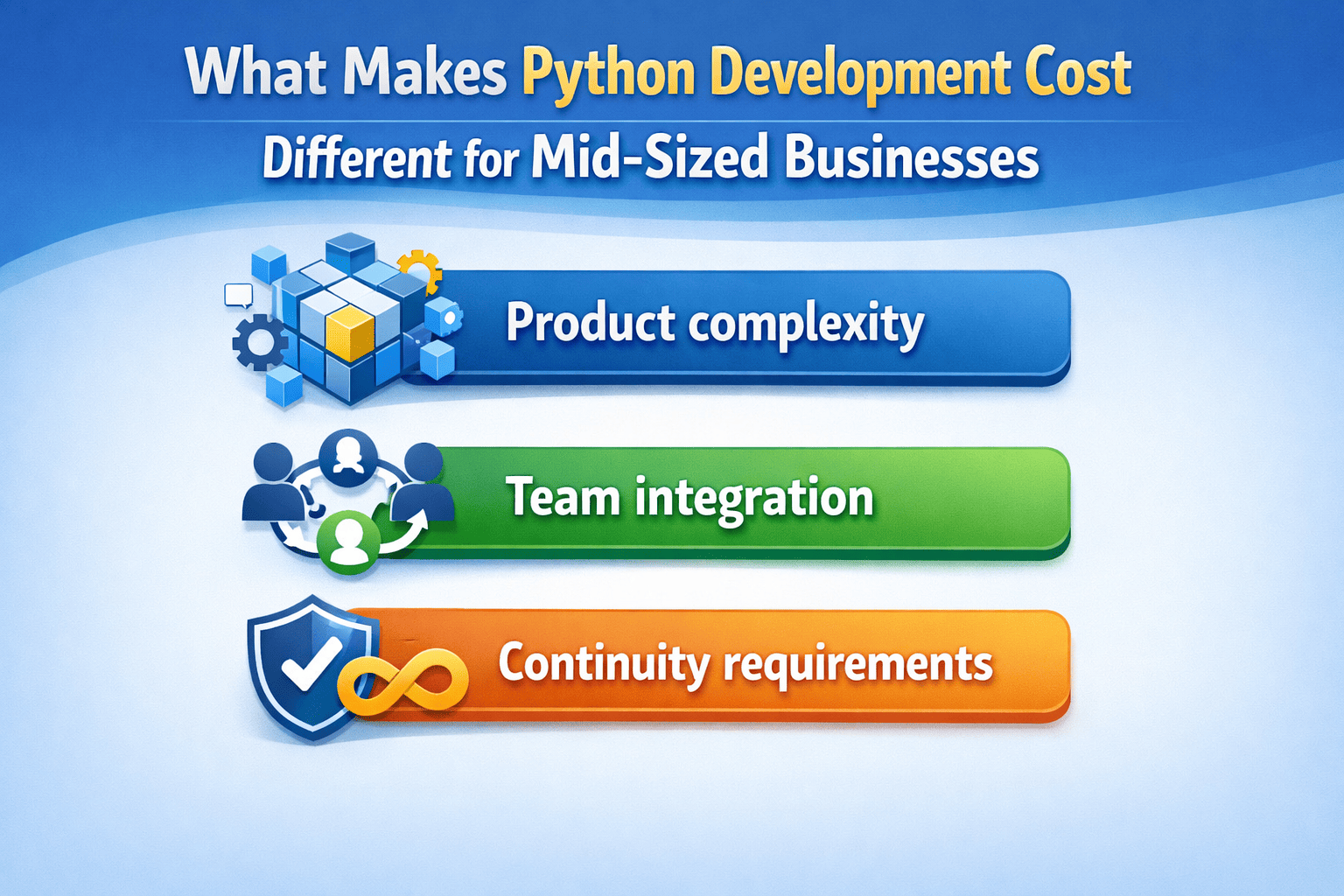
Startup pricing guides and enterprise procurement models are both poor guides for mid-sized business buyers. Startups optimise for lowest upfront spend. Enterprises build internal teams and absorb costs through headcount budgets. Mid-sized businesses need something different: predictable ongoing delivery cost, engineering quality that does not require constant oversight, and enough flexibility to scale up or down as product priorities shift.
Three factors push Python development costs higher at this scale than pricing guides typically reflect:
Product complexity. Mid-sized businesses are rarely building MVPs. They are extending platforms, integrating APIs, building analytics pipelines, or adding AI features to existing products. This adds scope and therefore adds cost.
Team integration. A developer who joins a mid-sized product team needs to integrate with existing infrastructure, existing codebase conventions, existing sprint processes. That onboarding cost is real, even if it rarely appears on an invoice.
Continuity requirements. Mid-sized businesses cannot absorb developer departures mid-project the way freelance-reliant startups sometimes can. Knowledge loss is expensive. Replacement cycles are expensive. Continuity protection has a measurable cost.
Python Development Cost by Project Type: 2026 Benchmarks
Project complexity is the first determinant of total Python development cost. Before any conversation about engagement model or location, the type of system being built sets the cost floor.
Project Type | Complexity | Typical Range | Timeline |
Automation tool / internal script | Low | $5,000 - $15,000 | 2-6 weeks |
REST API / microservice | Low-Medium | $8,000 - $25,000 | 1-3 months |
Mid-complexity SaaS platform | Medium | $15,000 - $50,000 | 2-4 months |
Data pipeline / analytics system | Medium-High | $20,000 - $60,000 | 2-5 months |
Enterprise platform / ML system | High | $50,000 - $150,000+ | 4-9 months |
For mid-sized businesses, the relevant range is most often the middle three tiers. If your product is a data-driven SaaS platform or a system integrating third-party APIs with backend automation, budget planning in the $20,000 to $80,000 range for a defined build phase is realistic, depending on the engagement model.
Specialisation adds cost at every tier. Python developers with production-grade AI and ML capability, specifically TensorFlow, PyTorch, FastAPI-served model deployment, command a 20 to 40% premium over general backend engineers. The same applies to healthcare (HIPAA compliance), fintech (PCI-DSS), and enterprise data architecture. See the complete guide to hiring Python developers for a detailed breakdown of specialisation premiums by use case.
Python Developer Hourly Rate in 2026: What the Numbers Actually Mean
Hourly rate comparisons are almost always misleading without context. Here is a cross-referenced view from verified 2026 sources:
Source | Python Dev Rate / Salary | Notes |
Glassdoor (Feb 2026) | $129,000/year (~$62/hr) | US median total compensation |
ZipRecruiter (March 2026) | $143,658/year (~$69/hr) | Mid-level US developers |
Built In (2026) | $127,649 total comp | 7+ yr developers reach $150k base |
Arc.dev (2026) | $61-$80/hr global average | Across engagement types |
Upwork platform median (2026) | $30/hr | Blended global freelance pool |
Acquaint Softtech (dedicated) | $18/hr (~$3,200/month) | Full-time, 100% in-house, vetted |
The $30/hr Upwork median and the $62/hr Glassdoor median are measuring completely different things. Upwork reflects a blended global pool of freelance talent at every experience level. Glassdoor reflects total US compensation including bonuses and profit-sharing for employed developers. Neither number is wrong. Both are misleading without that context.
For mid-sized businesses making budget decisions, the practical number is the total employer cost. Per Flexiple's analysis, the total annual cost of a mid-level US in-house Python developer, including salary, employer taxes, benefits (25 to 40% on top of base), recruitment fees ($10,000 to $30,000 per hire), equipment, and onboarding productivity loss, routinely reaches $180,000 to $260,000. That is the number your financial model needs to beat.
Regional Python Developer Rates: India vs Eastern Europe vs LATAM
Geography is the second major cost variable, but it is not a simple quality proxy. The same production-level Python skill costs $100 to $150 or more per hour in the US or Western Europe, $40 to $80 per hour in Eastern Europe, and $20 to $45 per hour from vetted offshore teams in India. This is a cost-of-living gap, not a capability gap.
Region | Mid-Level Rate | Senior Rate | AI/ML Specialist |
US / Western Europe | $69-$100/hr | $100-$150+/hr | $130-$200/hr |
Eastern Europe (Poland, Romania) | $40-$60/hr | $55-$80/hr | $70-$99/hr |
LATAM (Argentina, Colombia) | $38-$58/hr | $50-$74/hr | $55-$80/hr |
India (vetted partner) | $28-$35/hr | $35-$55/hr | $45-$65/hr |
India (Acquaint Softtech) | $18/hr (full-time) | $22/hr (full utilisation) | In-house, pre-vetted |
India produces more Python developers than any other country, and its ecosystem has matured specifically around the frameworks that matter most in 2026: Django for web platforms, FastAPI for async APIs and ML model serving, TensorFlow and PyTorch for AI development, and Apache Airflow for data pipeline orchestration. According to ConnectMKD's 2026 offshore development guide, India produces over 1.5 million IT graduates annually.
Eastern Europe is the strongest choice for European businesses that need near-complete timezone overlap. LATAM is ideal for US product teams where daily synchronous collaboration matters more than rate optimisation. For mid-sized businesses where cost efficiency and engineering depth are both priorities, vetted India-based partners consistently deliver the best total value. Explore the full offshore Python developer rates comparison for detailed regional analysis.
The Three Engagement Models: Fixed Price, Dedicated Team, Staff Augmentation
The engagement model determines total cost more than the hourly rate. This is the point most mid-sized businesses get wrong. A $50/hr freelancer who requires two months of onboarding, creates undocumented code, and leaves mid-project costs far more than a $32/hr dedicated offshore engineer who integrates into your sprints from Day 1.
Fixed Price Python Development
Fixed price means agreeing on a scope and budget upfront, with the vendor delivering to that specification. Payments are tied to milestones. The cost ceiling is known in advance.
This model works well when scope is stable, requirements are fully documented before work begins, and you need cost certainty above all else. It suits one-time platform builds, compliance audits, or specific feature additions where requirements will not shift.
The limitation is scope change cost. As Erik Brynjolfsson, MIT economist, has noted: in software, the cost of changing requirements increases exponentially the further into development you go. Fixed price contracts absorb that cost through scope change orders, which is why many fixed-price projects end up costing significantly more than initially quoted.
At Acquaint Softtech, fixed-price Python projects start from $5,000 with milestone-based payments and a defined scope and timeline. For US-based agencies, fixed-price Python projects typically run $10,000 to $150,000 or more depending on complexity.
Dedicated Python Development Team
A dedicated team means embedding Python engineers in your workflow for continuous product development. Engineers accumulate knowledge of your codebase, your architectural decisions, and your edge cases over time. This accumulated context compounds into faster delivery as the engagement progresses.
This is the model most often chosen by SaaS companies scaling platforms and mid-market businesses modernising existing systems. It works when your product evolves continuously and requirements shift with user feedback or market conditions.
The dedicated offshore team model closes the cost gap with US in-house hiring significantly. At Acquaint Softtech, a dedicated full-time Python developer costs $3,200 per month at 176 hours per month, approximately $18 per hour at full utilisation. For context, a mid-level Python developer in the US earns $143,658 per year on average according to ZipRecruiter's March 2026 data, approximately $69 per hour before employer costs. That is roughly 40% less than the equivalent US in-house hire when benefits, taxes, and onboarding are factored in.
Python Staff Augmentation
Staff augmentation means embedding additional Python developers into your existing team for a defined period. You retain technical direction. The developers follow your processes, commit to your repository, and join your sprint ceremonies.
This model works particularly well when you already have an engineering team but need additional capacity, specific specialisation (such as AI and ML expertise for a pipeline build), or scale for a major feature launch without permanent headcount additions.
The risk in staff augmentation is the quality of the vetting process. Marketplace-matched developers and freelance platforms offer variable quality with no institutional accountability. For more on choosing the right model for your business, see the guide to Python development architecture and frameworks for the technical context that informs engagement model decisions.
Hidden Cost Categories Mid-Sized Businesses Systematically Underestimate
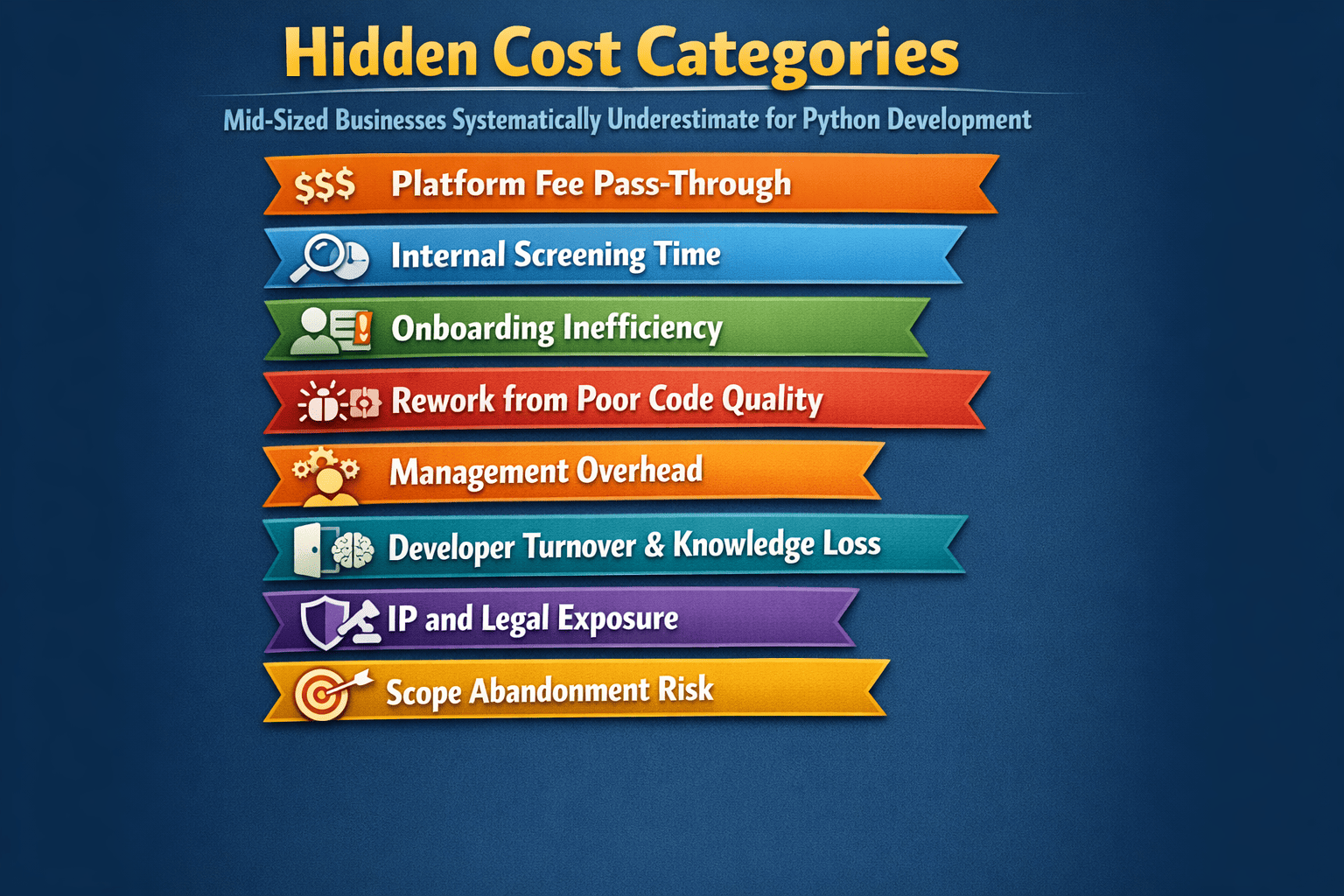
The invoice is never the bill. According to a 2026 developer hiring analysis published by daily.dev Recruiter, mis-hires, turnover, onboarding delays, and rework alone can add $50,000 to $150,000 to a hiring decision that looked economical on paper. The eight cost categories that mid-sized businesses most consistently underestimate are:
Platform fee pass-through (15 to 35% above quoted rate). When freelancers pay 10 to 20% commission to a marketplace platform, they price that cost into their quoted rate. The combined pass-through effect means the real gap between what you pay and what the developer receives is 20 to 35% of transaction value.
Internal screening time (15 to 25 hours of senior team time). A realistic freelancer search for a mid-level Python developer includes reviewing 30 to 80 applications, shortlisting 8 to 12, and conducting 3 to 5 technical interviews. At $100 per hour equivalent cost for a CTO or senior engineer, that is $1,500 to $2,500 before a single line of code is written.
Onboarding inefficiency (4 to 8 weeks of reduced productivity). A developer unfamiliar with your codebase, your infrastructure, and your team conventions operates at reduced capacity for weeks, billed at full rate.
Rework from poor code quality. Per CloudQA 2025 data, poor code quality consumes 30 to 50% of sprint capacity in rework. Undocumented APIs, unoptimised database queries, and missing test coverage are rewritten at the same or higher cost as the original build.
Management overhead (20 to 40% of a senior team member's time). Freelance Python developers do not manage themselves. A senior engineer spending 25% of their time coordinating a freelance developer is spending ten hours per week on management instead of architecture or feature delivery.
Developer turnover and knowledge loss (up to 21% of annual salary). When a Python developer leaves mid-project, they take accumulated codebase knowledge with them. The daily.dev Recruiter 2026 analysis puts replacement costs at up to 21% of annual salary in direct costs alone, before rework is calculated.
IP and legal exposure. Platform terms of service are not the same as a bespoke NDA and IP assignment agreement. For Python projects involving proprietary algorithms or SaaS platform business logic, that ambiguity creates genuine post-launch legal risk.
Scope abandonment risk. When a freelancer leaves at 60% project completion, the new developer inherits a codebase they did not build, with documentation that is incomplete. Financial modelling from DEV Community's 2026 cost reduction analysis shows teams that skip proper documentation burn an average of six months in rework.
Together, these categories routinely push the true cost of a freelance Python engagement three to five times above the advertised rate. McKinsey research consistently finds that a poorly chosen software hire costs 3 to 5 times the annual salary in productivity loss and rework.
Real-World Case: Bianalisi Healthcare Analytics
Understanding Python development cost in context requires looking at outcomes, not just rates. Acquaint Softtech's work with Bianalisi, an Italian medical diagnostics company, illustrates how the right Python engagement model changes outcomes.
The project involved building Python-powered healthcare analytics tools to detect clusters of abnormal diagnostic trends in patient data. The engagement used a dedicated team model, with engineers embedded in the client's workflow and operating with full context of the healthcare compliance requirements and the diagnostic data architecture.
The result: the client was able to detect abnormal diagnostic trend clusters earlier than expected, a direct outcome of using engineers with deep domain context rather than general-purpose developers. Separately, Acquaint Softtech's work for Ailleron transformed the client's data handling process, saving 200 hours per week and reducing report creation time from four days to one, according to Rafal Styczen, Chairman of Ailleron, on Clutch.
Both outcomes illustrate the same principle: the cost of Python development for mid-sized businesses is not just the hourly rate or the monthly engagement cost. It is the cost divided by the value delivered. Deeply contextualised engineers with healthcare compliance knowledge, production-grade ML capability, and embedded team accountability deliver outcomes that general-purpose freelancers structurally cannot.
Why India-Based Python Developers Outperform Freelancers for Mid-Sized Businesses
The comparison between Indian offshore teams and marketplace freelancers is frequently framed as a quality versus cost tradeoff. The 2026 data does not support that framing.
India produces more Python developers than any other nation, with its ecosystem concentrated around the frameworks that matter most: Django, FastAPI, Flask, TensorFlow, PyTorch, and Apache Airflow. The country's developer community has not just scaled in quantity, it has deepened in specialisation. Production-grade AI and ML capability, fintech compliance experience, and enterprise data engineering expertise are all available within the India offshore market at 40 to 60% of the equivalent US cost.
The distinction is between marketplace sourcing and vetted partner engagement. An Upwork search returns blended talent with variable quality and no institutional accountability. A structured engagement through a vetted offshore partner with multi-stage assessment, NDA coverage, and continuity guarantees operates at a fundamentally different quality level. The rate advantage holds. The quality risk does not.
Acquaint Softtech: Python Development Pricing and What Is Included
Acquaint Softtech is a software development company and staff augmentation partner headquartered in Ahmedabad, India, with 13 years of delivery experience, 1,300 or more projects completed globally, and verified ratings across Clutch (35 or more five-star reviews) and Upwork (1,293 or more reviews at 98% job success rate). Every Python developer is a permanent in-house employee, not a freelancer, not a subcontractor, and not a marketplace match.
Engagement Model | Pricing | Best For |
Part-Time / Hourly | From $20/hr | Specific features, audits, short sprints |
Full-Time Dedicated Developer | $3,200/month (176 hrs) | Ongoing SaaS, evolving platforms |
Fixed-Price Project | From $5,000 | Defined builds with stable scope |
Python Staff Augmentation | From $20/hr, flexible scale | Expanding existing dev teams |
Every engagement at Acquaint Softtech includes:
Full NDA and IP assignment before any code is written. Your architecture, business logic, and data belong to you from Day 1.
48-hour onboarding. Developer profiles shared within 24 hours. Sprint-ready within 48 hours.
Free developer replacement with complete context handover if a developer leaves for any reason, including codebase documentation, architectural decisions, and team introductions.
Zero agency markup and zero platform commission. The quoted rate is the paid rate.
Multi-stage internal assessment covering framework depth, production debugging experience, communication quality, and agile team integration before any client match.
Flexible scaling. Add, reduce, or replace developers with 30 days notice.
Technologies: Django, FastAPI, Flask, TensorFlow, PyTorch, scikit-learn, LangChain, PostgreSQL, Redis, MongoDB, AWS, GCP, Azure, Docker, Kubernetes, React, Next.js, Vue.js.
For mid-sized businesses evaluating Python development partners, hire Python developers from Acquaint Softtech and get developer profiles within 24 hours.
How to Choose the Right Model for Your Business
The engagement model decision for mid-sized businesses comes down to two variables: how stable your requirements are, and how much engineering context needs to accumulate over time.
Choose a fixed-price Python development model if your scope is fully defined and stable, you need a one-time build with clear milestones, and cost certainty matters more than flexibility.
Choose a dedicated Python development team if your product evolves continuously, you are building a SaaS platform, AI-enabled product, or data engineering system, and you need engineers who accumulate codebase context over months rather than starting fresh each engagement.
Choose Python staff augmentation if you already have an engineering team and need additional capacity or specific specialisation for a defined period, without permanent headcount commitments.
The pattern in 2026 is clear: for established software teams building products that evolve over time, dedicated teams and staff augmentation consistently outperform fixed-price outsourcing on total cost, delivery quality, and speed, once rework and scope change expenses are factored in.
Frequently Asked Questions
-
What is the average Python development cost for a mid-sized business project in 2026?
For a mid-complexity SaaS platform or data-driven application, the typical range is $15,000 to $60,000 for a defined build phase. Enterprise-level systems or ML platforms run $50,000 to $150,000 or more. These figures vary significantly based on engagement model, location of developers, and specialisation requirements.
-
Is offshore Python development from India reliable for production-grade systems?
Yes. India produces more Python developers than any other country, with deep specialisation in Django, FastAPI, TensorFlow, and PyTorch. The quality distinction is between marketplace sourcing and vetted partner engagement. A structured offshore partner with multi-stage assessment, NDA coverage, and continuity guarantees delivers production-grade results at 40 to 60% of US in-house cost.
-
What is the difference between a dedicated Python team and Python staff augmentation?
A dedicated Python development team typically manages the development process independently within your product context. Python staff augmentation places engineers directly inside your existing team structure, following your processes, committing to your repository, and attending your sprint ceremonies. Staff augmentation is preferred when you already have technical leadership and need additional capacity.
-
How much does it cost to hire a dedicated Python developer from Acquaint Softtech?
A full-time dedicated Python developer from Acquaint Softtech costs $3,200 per month for 176 hours, approximately $18 per hour at full utilisation. Part-time or hourly engagements start from $20 per hour. Fixed-price projects start from $5,000. All pricing is transparent with no agency markup, no platform commission, and no costs for onboarding or developer replacement.
-
How do hidden costs affect the true Python development cost comparison?
Hidden costs including platform fee pass-through (15 to 35%), internal screening time, onboarding inefficiency, rework from poor code quality, management overhead, and developer turnover can push the true cost of a freelance Python engagement three to five times above the quoted rate. These categories rarely appear on invoices but consistently appear in project post-mortems.
-
How quickly can a Python developer be onboarded for a mid-sized business project?
Through a structured offshore partner like Acquaint Softtech, the process runs from requirements sharing to sprint-ready in 48 hours. Developer profiles are shared within 24 hours. The client conducts their own technical interview, selects the right fit, and onboarding is completed within two days. There is no lengthy procurement cycle and no agency intermediaries.
We’re Acquaint Softtech, your technology growth partner. Whether you're building a SaaS product, modernizing enterprise software, or hiring vetted remote developers, we’re built for flexibility and speed. Our official partnerships with Laravel, Statamic, and Bagisto reflect our commitment to excellence, not limitation. We work across stacks, time zones, and industries to bring your tech vision to life.
Table of Contents
Get Started with Acquaint Softtech
- 13+ Years Delivering Software Excellence
- 1300+ Projects Delivered With Precision
- Official Laravel & Laravel News Partner
- Official Statamic Partner
Related Blog

The Complete Guide to Hiring Python Developers in 2026: Rates, Models, Vetting and Red Flags
A complete guide to hiring Python developers in 2026. Compare real hourly rates across India, Eastern Europe and the US, choose the right engagement model, vet candidates correctly, and avoid the red flags that cost companies months of wasted budget.
Acquaint Softtech
March 4, 2026
Python Development in 2026: Architecture Patterns, Frameworks and Real-World Industry Applications
Explore Python backend architecture patterns, framework comparisons (Django vs FastAPI vs Flask), scalability decisions, and real-world Python development use cases across healthcare, FinTech, SaaS, EdTech, and logistics in 2026.
Acquaint Softtech
March 4, 2026
Offshore Python Developer Rates: India vs Eastern Europe vs LATAM
Compare offshore Python developer rates across India, Eastern Europe, and LATAM for 2026. Real hourly data by seniority, hidden cost analysis, and why India still leads on total value.
Acquaint Softtech
March 11, 2026Your Project. Our Expertise. Let’s Connect.
Get in touch with our team to discuss your goals and start your journey with vetted developers in 48 hours.