

How We Helped Italy's Based Diagnostics Group Detect Patient Risk Patterns Earlier with Python
Discover how Acquaint Softtech helped BIANALISI SPA, Italy's largest diagnostics group build a GDPR-compliant predictive analytics platform using Python that cut reporting time by 75% and enabled earlier detection of diagnostic risk patterns.

Acquaint Softtech

Client: Giovanni Gianolli, CEO — BIANALISI SPA, Italy
Industry: Medical / Healthcare Diagnostics
Technology: Python
Project Duration: April – November 2025
Team Size: 6–10 Engineers
Project Investment: $49,999
Clutch Rating: 5.0 / 5.0
When Italy's largest integrated diagnostics group needed to move beyond retrospective reporting and into genuinely predictive clinical intelligence, they didn't want a vendor that simply understood databases. They needed a team that understood diagnostics, the kind of work where a delayed insight doesn't just slow down a business, it can affect a patient's outcome.
That's exactly what BIANALISI SPA brought to Acquaint Softtech's door in early 2025. And what followed became one of the most clinically meaningful software engagements we've delivered.
Who Is BIANALISI SPA?
BIANALISI is Italy's largest integrated diagnostics group, backed by Charme Capital Partners, Columna Capital, and entrepreneur Giuliano Caslini. The organisation offers an extensive range of diagnostic services - laboratory testing, imaging, outpatient care serving patients, physicians, clinics, and businesses across multiple Italian regions.
At the scale BIANALISI operates, data is not a byproduct of clinical work. It is the clinical work. Every test result, every imaging record, every outpatient report generates data that, if properly structured and analysed, can reveal population-level health patterns no individual clinician could detect alone.
The challenge? That data was sitting in fragmented systems, being analysed manually, after the fact.
The Problem: Valuable Clinical Data, Siloed and Underutilised
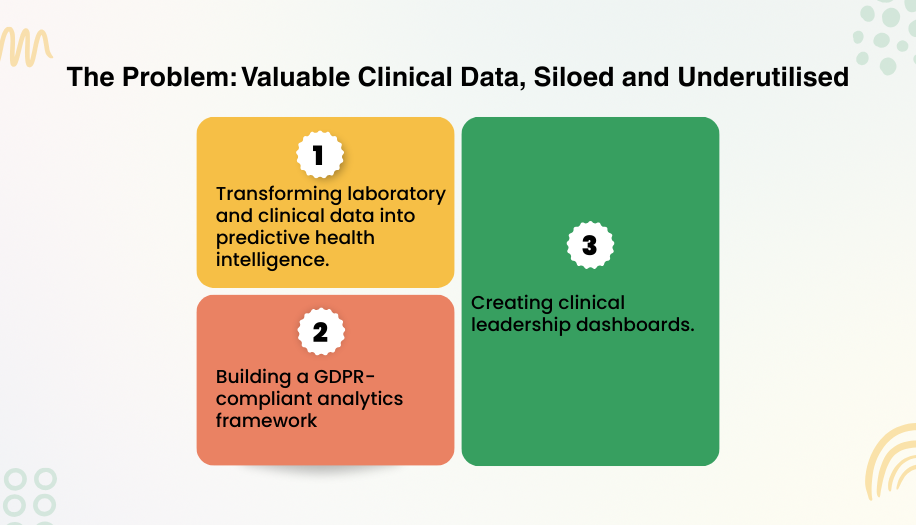
Giovanni Gianolli, CEO of BIANALISI, described the situation plainly when engaging us. The organisation had three core objectives that existing infrastructure simply could not support:
1. Transforming laboratory and clinical data into predictive health intelligence. Rather than identifying risk patterns after monthly audits, BIANALISI wanted the ability to detect diagnostic anomalies within the same reporting cycle while there was still time to act.
2. Building a GDPR-compliant analytics framework. Operating across Italian healthcare facilities, every data workflow needed to satisfy strict European data protection regulations. This was non-negotiable. Any predictive modelling that compromised patient privacy or data integrity would be unusable, regardless of its technical sophistication.
3. Creating clinical leadership dashboards. Regional medical directors and central operations teams needed visibility into treatment trends, diagnostic anomalies, and cross-facility workload distributions without requiring them to manually extract data from multiple systems.
The status quo involved analysts spending significant time gathering and cleaning data before any insight could surface. Regional performance reporting was slow. Risk identification depended on human memory and periodic review rather than automated signal detection.
For an organisation managing diagnostic services at national scale, this was a structural gap, not just an operational inconvenience.
Why BIANALISI Chose Acquaint Softtech
When Giovanni's team searched for a healthcare software development partner, Clutch's verified reviews pointed consistently toward Acquaint Softtech. Beyond ratings, two factors sealed the decision: pricing that fit the project's defined scope, and a clear alignment in values specifically, the belief that analytics should serve clinical reality, not just demonstrate technical capability.
For a diagnostics organisation where model outputs would be evaluated by laboratory directors before deployment, working with a team that prioritised clinical interpretability over algorithmic complexity was not just preferable. It was essential.
The Engagement: What We Built
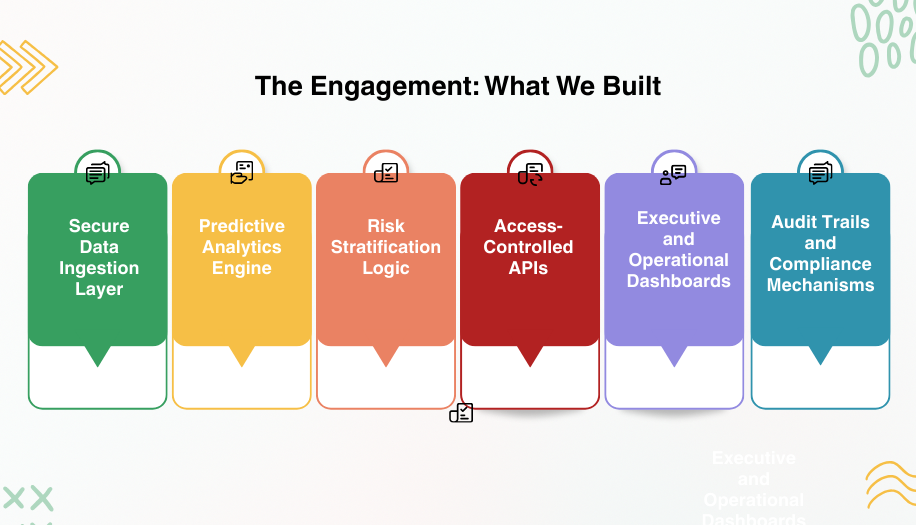
The project ran from April through November 2025 across structured phases: discovery, data validation, predictive modelling, dashboard development, pilot deployment, and refinement.
Our team of 6–10 engineers worked closely with BIANALISI's IT leadership and medical directors throughout. Here's what the engagement delivered:
Secure Data Ingestion Layer
We designed and implemented a data ingestion architecture capable of processing laboratory test records, diagnostic imaging metadata, and outpatient service documentation from multiple regional systems. Given that BIANALISI's data existed across disparate sources, this foundation was the prerequisite for everything that followed.
Crucially, the ingestion layer was built with patient privacy safeguards integrated from the outset, not added as a compliance afterthought. Partially anonymised clinical datasets were cleaned and structured for statistical modelling while preserving the clinical signals that make predictive analysis meaningful.
Predictive Analytics Engine
Using Python as the backend technology, our team developed models capable of identifying early risk indicators within diagnostic results and treatment pathways. This was not pattern recognition for its own sake. Every model assumption was validated with BIANALISI's laboratory specialists before deployment to ensure outputs aligned with real clinical workflows.
As Giovanni noted in his Clutch review, the team understood that "healthcare analytics is not purely mathematical, it is contextual." Our Python developers brought statistical maturity to large, partially anonymised datasets while maintaining the clinical signal integrity that makes a predictive output trustworthy rather than technically impressive.
Risk Stratification Logic
Beyond detecting anomalies, the system incorporated risk stratification based on laboratory and diagnostic patterns. This allowed clinical supervisors to prioritise review based on objective risk scoring rather than relying solely on individual clinical judgement or periodic audits.
Access-Controlled APIs
We implemented APIs for data retrieval across authorised departments, with access controls structured around real operational roles. This ensured that sensitive clinical information remained appropriately gated while still enabling the cross-regional data aggregation that meaningful analysis requires.
Executive and Operational Dashboards
Two dashboard tiers were delivered:
Executive-Level Dashboards for regional medical directors and central leadership, displaying cross-regional trends and system-wide performance
Operational Dashboards for clinical supervisors, providing granular visibility into facility-level activity, diagnostic workloads, and flagged cases requiring secondary review
Audit Trails and Compliance Mechanisms
Every data access, model output, and system event was logged through audit trails aligned with European compliance standards. Data privacy and anonymisation safeguards were integrated directly into model training workflows, not layered on after the fact.
The Results: What Changed for BIANALISI
The measurable outcomes from this engagement reflect what happens when technical capability meets clinical context.
Earlier Detection of Diagnostic Risk Patterns
Within pilot regions, clinical directors gained the ability to detect clusters of abnormal diagnostic trends earlier than previously possible. Risk patterns that would previously surface during monthly audits were now identified within the same reporting cycle, allowing immediate escalation rather than delayed response.
In one concrete instance documented during the pilot, a regional medical supervisor used the new dashboard to identify an unusual spike in related laboratory indicators within a specific patient group. The clinical review was initiated immediately rather than waiting for the next scheduled audit. That is the difference between reactive analysis and predictive intelligence.
Consolidated Cross-Regional Reporting
Laboratory trend analysis that previously required manual extraction from multiple regional systems was consolidated into a single platform. This eliminated hours of analyst time spent on data gathering that delivered no clinical value in itself.
Faster Report Preparation
The reduction in time spent preparing cross-regional performance reports was significant. What had previously required multi-day manual aggregation became an automated process, freeing clinical leadership to focus on interpretation and response rather than data assembly.
Faster Case Escalation
Secondary review cases escalated faster. When a clinical indicator flagged a pattern, the system surfaced it to the appropriate supervisor directly rather than waiting for it to appear in a periodic manual review.
5.0 Rating Across All Categories
BIANALISI rated the engagement 5.0 out of 5.0 for quality, schedule, and cost on Clutch. The "willing to refer" score was 4.5 - reflecting near-complete satisfaction, with the only noted improvement being a suggestion to introduce multi-region benchmarking comparisons earlier in the engagement (which the team implemented efficiently once proposed).
What Giovanni Said
"They delivered analytics that were trusted, not just technically correct."
That quote, from Giovanni Gianolli's verified Clutch review, captures what differentiated this engagement. Technical correctness is the baseline. Trust, from laboratory directors, from clinical supervisors, from executives reviewing cross-regional trends is what makes an analytics system actually usable in a healthcare environment.
The team's technical maturity in Python-based statistical modelling was evident throughout. So was their commitment to making model outputs clinically interpretable by repeatedly engaging BIANALISI's laboratory specialists to validate whether predictive outputs aligned with real clinical workflows.
What This Means for Healthcare Organisations Evaluating Similar Projects
If your organisation manages clinical data across multiple facilities and still relies on periodic manual reporting to identify risk patterns, this project demonstrates what's achievable within a defined timeframe and budget.
The technical architecture we built for BIANALISI - secure data ingestion, predictive modelling in Python, GDPR-compliant audit trails, and tiered clinical dashboards, represents a pattern applicable to diagnostics groups, hospital networks, and clinical research organisations facing similar challenges.
The critical factors that made this engagement work:
Clinical involvement from day one. Laboratory specialists were part of model validation, not brought in after build.
Compliance built in, not bolted on. GDPR requirements shaped the architecture from ingestion layer to dashboard access controls.
Phased delivery. Discovery, validation, modelling, and deployment each had clear checkpoints, allowing regulatory and clinical clarifications to be incorporated without derailing progress.
Python expertise applied to clinical context. Statistical modelling capability meant nothing without the domain understanding to apply it meaningfully.
About Acquaint Softtech
Acquaint Softtech is a global engineering partner with 70+ in-house developers across Python, Laravel, MERN, MEAN, Django, React Native, and DevOps. We help healthcare organisations, SaaS companies, fintech firms, and enterprises build software that solves real operational problems, not just technically impressive systems.
As an Official Laravel Partner with verified reviews across 34 Clutch engagements, we deploy vetted developers within 48 hours and support projects from MVP through enterprise scale.
Our healthcare experience spans clinical data analytics, patient management platforms, clinical dashboards, and HIPAA/GDPR-compliant software architectures.
Ready to Transform Your Clinical Data into Actionable Intelligence?
If your organisation is sitting on diagnostic, laboratory, or patient data that isn't yet working hard enough, we'd like to have a direct conversation about what's possible.
FAQs
-
What is healthcare predictive analytics software development?
Healthcare predictive analytics software development involves building systems that analyse clinical and laboratory data to identify risk patterns, anomalies, and trends before they are detected through manual review. These systems typically use machine learning and statistical modelling to surface insights that support earlier clinical decision-making.
-
Why is Python the preferred language for healthcare data analytics?
As we cover in our complete Python developer hiring guide, Python offers a mature ecosystem of statistical and machine learning libraries including pandas, scikit-learn, and NumPy that are well-suited to processing large clinical datasets. Its readability also supports collaboration between data scientists and clinical specialists during model validation, which is critical in healthcare contexts.
-
How do you ensure GDPR compliance in healthcare analytics platforms?
GDPR compliance in healthcare analytics requires anonymisation or pseudonymisation of patient data, access-controlled APIs that restrict data retrieval to authorised roles, comprehensive audit trails logging all data access and system events, and data minimisation principles applied at the ingestion layer. These safeguards should be built into the architecture from the start, not added as afterthoughts.
-
What is the typical timeline for building a clinical analytics platform?
The BIANALISI engagement ran from April to November 2025, approximately seven months covering discovery, data validation, predictive modelling, dashboard development, pilot deployment, and refinement. Timeline varies with data complexity, number of regional systems being integrated, and compliance requirements.
-
Can predictive analytics software integrate with existing hospital and laboratory systems?
Yes. Integration with existing laboratory information systems, imaging platforms, and outpatient documentation systems is typically part of the data ingestion design. This requires understanding the data schemas and export capabilities of existing systems, which is why the discovery phase of the engagement is critical.
-
How much does it cost to build a healthcare analytics platform?
The BIANALISI engagement fell within the 49,999 range for a 6–10 person team over seven months. Actual cost depends on the number of data sources being integrated, the complexity of predictive models, dashboard requirements, and compliance scope. Acquaint Softtech's hourly rates range from 49/hr, which makes complex projects achievable within defined budgets.
-
What industries does Acquaint Softtech serve beyond healthcare?
Beyond healthcare and medical diagnostics, Acquaint Softtech serves fintech, real estate, eCommerce, SaaS platforms, banking technology, logistics, and EdTech organisations. The firm has delivered 1,300+ projects across 20+ industries since 2013.
-
What is staff augmentation in software development?
Staff augmentation is a model where a software partner provides vetted engineers who integrate directly with your existing team joining standups, working within your workflows, and operating as internal team members. Unlike outsourcing, where a vendor owns the delivery process, staff augmentation puts your team in control while extending its capacity and technical capability.
-
How quickly can Acquaint Softtech deploy developers for a healthcare project?
Acquaint Softtech deploys vetted developers within 48 hours. For healthcare-specific engagements, the team also includes developers with prior exposure to GDPR-compliant architectures, clinical data workflows, and Python-based analytics infrastructure.
We’re Acquaint Softtech, your technology growth partner. Whether you're building a SaaS product, modernizing enterprise software, or hiring vetted remote developers, we’re built for flexibility and speed. Our official partnerships with Laravel, Statamic, and Bagisto reflect our commitment to excellence, not limitation. We work across stacks, time zones, and industries to bring your tech vision to life.
Table of Contents
Get Started with Acquaint Softtech
- 13+ Years Delivering Software Excellence
- 1300+ Projects Delivered With Precision
- Official Laravel & Laravel News Partner
- Official Statamic Partner
Related Reading

The Complete Guide to Hiring Python Developers in 2026: Rates, Models, Vetting and Red Flags
A complete guide to hiring Python developers in 2026. Compare real hourly rates across India, Eastern Europe and the US, choose the right engagement model, vet candidates correctly, and avoid the red flags that cost companies months of wasted budget.
Acquaint Softtech
March 4, 2026
Python Development in 2026: Architecture Patterns, Frameworks and Real-World Industry Applications
Explore Python backend architecture patterns, framework comparisons (Django vs FastAPI vs Flask), scalability decisions, and real-world Python development use cases across healthcare, FinTech, SaaS, EdTech, and logistics in 2026.
Acquaint Softtech
March 4, 2026
How Much Does It Cost to Hire a Python Developer in 2026?
Looking for actual Python developer salaries in 2026? See data-backed hourly rates for junior to senior devs in the US, Europe, and India. Compare hiring models to protect your budget.
Acquaint Softtech
March 5, 2026Your Project. Our Expertise. Let’s Connect.
Get in touch with our team to discuss your goals and start your journey with vetted developers in 48 hours.