

Staff Augmentation Pricing Models Explained: Monthly Retainer vs Hourly vs Project-Based
Most clients pick a staff augmentation pricing model based on the rate. That is the wrong variable. The pricing model determines your vendor's incentives, your budget predictability, and who carries the risk when delivery slips.

Mukesh Ram
I have been in client conversations about pricing for 13 years. The question that comes up most often at the start is: what is your hourly rate? It is a reasonable question but it is the wrong one to lead with.
The pricing model matters more than the rate. The model determines what your vendor is incentivised to do, what happens when scope changes, how predictable your monthly budget is, and who absorbs the cost when delivery takes longer than expected.

- Founders and CTOs evaluating staff augmentation for the first time and comparing vendor quotes
- Engineering leads who have had budget surprises on a previous engagement and want to understand why
- Procurement or finance teams trying to understand which pricing structure gives the most budget predictability
- Anyone who has received three quotes in different formats and cannot figure out how to compare them
There is three main pricing models in staff augmentation: time and materials (hourly), monthly retainer, and project-based (fixed scope). Each of them has a scenario where it is clearly the right choice and a scenario where it will cost you more than the alternative. This article covers all three without a sales angle. For how these models compare against Upwork and agency pricing specifically, the full cost breakdown covers the actual numbers.
Model 1: Time and Materials (Hourly)
.png "Model 1: Time and Materials (Hourly)")
Time and Materials (Hourly)
How it works: You pay for hours worked. The vendor bills at an agreed hourly rate. Scope can change at any time. You pay for the actual time the developer spends on your project. |
Best for: Early-stage projects where the scope is still evolving. Feature additions to a live product where you want to control exactly how much you spend each month. Short-term engagements where you know what you need and can define it tightly. |
Not ideal for: Long-term product development where scope evolves constantly. Situations where you cannot dedicate management time to reviewing timesheets and approving work. Any case where budget predictability matters more than flexibility. |
Vendor incentive: The vendor earns more when the developer works more hours. There is no inherent pressure to be efficient. A slow developer or an undefined task both produce more hours. This model rewards thoroughness but can also reward inefficiency if the client is not actively managing utilisation. |
The hourly model is not bad. It is specifically suited to situations where scope is genuinely unclear. The problem is that it is also the model that produces the most disputes because each invoice is a negotiation about whether the hours were necessary.
A useful comparison: our rate data by country shows what hourly rates actually look like across regions in 2026. The rate is only part of the picture. The question is what oversight the hourly model requires from your side.
Model 2: Monthly Retainer
Monthly Retainer
How it works: You pay a fixed monthly fee for a dedicated developer or team. The developer works exclusively on your product for the engagement period. The rate is fixed regardless of how many hours the developer works within standard working hours. |
Best for: Ongoing product development where you need consistent, predictable delivery. Companies with a defined roadmap and enough work to keep a developer fully engaged. Long-term engagements where institutional knowledge compounds into faster delivery over time. |
Not ideal for: Short engagements under 2 months. Projects with a clear end date and fixed scope. Situations where the workload fluctuates significantly month to month and you would end up paying for under-utilised capacity. |
Vendor incentive: The vendor earns a consistent amount regardless of output. The incentive is on quality and retention, because the engagement continues only if the client renews. This model aligns vendor incentives with sustained delivery quality better than hourly. |
Monthly retainers is the model we use at Acquaint for the majority of our engagements. The developer is yours for the engagement period, the budget is predictable, and the institutional knowledge the developer builds over time produce compounding value that the hourly model cannot replicate.
It also pairs well with a dedicated development team structure where you need more than one developer working as a unit rather than individuals billed separately. The structure changes but the predictability principle is the same.
Model 3: Project-Based (Fixed Scope)
.png "Project-Based (Fixed Price)")
Project-Based (Fixed Price)
How it works: You define the scope upfront and the vendor quotes a fixed price for delivery. The vendor owns the timeline and the budget. Changes to scope trigger a change request process. |
Best for: Well-defined, bounded projects where the requirements are stable and unlikely to change. MVP builds with a clear feature set. Version upgrades, migrations, or specific technical builds where the output is unambiguous. |
Not ideal for: Products in active development where requirements evolve. Anything where the client expects to be able to change their mind during the project. Long-term engagements where the business context will shift. |
Vendor incentive: The vendor earns more when they deliver faster than the scope assumed. This can be good (efficient delivery) or risky (corners cut to hit timeline). Fixed price also incentivises narrow scope interpretation, so vendors sometimes quote strictly on what was written rather than what the client meant. Change requests are where the margin gets recovered. |
Not Sure Which Pricing Model Your Situation Calls For?
I answer this question at least five times a week. Send me a short description of what you are building, how defined the scope is, and how long you need the engagement to last. I will tell you which model fits and why the alternatives would work against you in your specific situation. Takes about 15 minutes.
Side-by-Side: How the Three Models Compare
Here is the same set of questions applied to each model. The right column for your situation tells you which model to choose.
Dimension | Hourly (T&M) | Monthly Retainer | Fixed Scope |
Budget predictability | Low. Invoice varies monthly. | High. Fixed amount each month. | High upfront. Low after sign-off. |
Scope flexibility | High. Change anything anytime. | High. Roadmap can evolve freely. | Low. Changes cost extra. |
Vendor delivery incentive | Hours, not output. | Relationship and renewal. | Speed of delivery. |
Client management time | High. You monitor hours. | Low after onboarding. | Low during build. |
Best for | Evolving early-stage scope. | Ongoing product development. | Defined, bounded projects. |
Minimum commitment | Per task or per week. | Typically 3 months. | Project duration. |
Risk if scope changes | Rises directly with changes. | Absorbed within retainer. | Change requests add cost. |
The Question to Ask Before Choosing a Model
How confident are you in the scope right now, on a scale of 1 to 10?
Score 8 to 10: Fixed scope is worth evaluating. The scope is clear enough to protect you.
Score 5 to 7: Monthly retainer. The scope will evolve and you need flexibility without paying for every change.
Score 1 to 4: Time and materials, but only if you have the management bandwidth to monitor it actively.
Most clients overestimate their scope confidence at the start of a project.
That is why the monthly retainer is the most common model for ongoing product work.
The Hidden Variable: What Each Model Does to Your Vendor's Behaviour
This is the part that most pricing guides do not cover. The pricing model does not just affect your invoice. It changes how the developer and their vendor think about the engagement day to day.
Hourly
When a developer is paid hourly, thoroughness pays. A well-researched approach, careful documentation, and iterative refinement are all billable. This is not always a problem, and careful work is often worth paying for. But when the client has not defined the task clearly, an hourly engagement can produce excellent exploration of an unclear problem at a cost that surprises no one but the client.
Monthly retainer
When a developer is on a retainer, the vendor's incentive is renewal. The engagement continues if the client is satisfied with delivery. This creates pressure in the right direction: deliver consistently, communicate well, build context that makes the next sprint faster. The developer has a reason to care about the product long-term, not just the current task.
Fixed scope
When a project is fixed-price, the vendor's margin is protected by delivering exactly what was written in the scope. This is not dishonesty. It is rational behaviour under the model. A vendor who consistently absorbs scope creep on fixed-price projects will not survive long. Understanding this means you should read every change request as the model working as designed, not as a vendor being difficult.
How Acquaint Softtech Prices Staff Augmentation Engagements
Our IT staff augmentation engagements run on monthly retainers as the default model. Here is why we built it this way and what that means for how the engagement operates.
Rate | Starts at $22/hr, which works out to $3,200/month for a full-time developer. Senior developers with 5 to 8 years of production experience run $4,500 to $6,500/month. All rates are all-inclusive: no additional employer costs, no platform fees, no account manager markup. |
What is included | Named developer, NDA and IP assignment from day one, direct Slack or Teams access without an account manager layer, weekly check-in framework, free replacement within 48 hours if the developer is not the right fit. |
What is not included by default | Project management, QA engineering, and DevOps scoping. These are available and scoped in the initial call. They are not assumed and will not appear on your first invoice without discussion. |
Minimum term | Three months. Not a lock-in. The reason: a developer builds meaningful codebase context in weeks 3 to 6 that makes every subsequent sprint faster. Engagements shorter than 3 months rarely get past the ramp-up phase before they end. |
How billing works | Fixed monthly invoice, same date each month. No variable hours to reconcile. No surprise line items. If you add scope outside the sprint, a change request is issued and approved before work begins. |
If your project is better served by a fixed-scope model or hourly, we say so in the initial conversation. Our hire remote developers page covers how both models are structured for different engagement types. And the IT staff augmentation vs in-house recruitment gives you the side-by-side cost data that makes the model decision concrete.
Want to See the Actual Rate Card for Your Stack and Seniority Level?
Most vendors give you a range. I give clients a specific number based on their stack, team size, and the seniority level their situation actually requires. That conversation takes 15 minutes and produces a number you can put in a budget, not a range you have to guess at. If the number does not work, I will tell you that too.
FAQ's
-
What is the difference between time and materials and a monthly retainer?
In time and materials, you pay for hours worked. The invoice varies based on actual time. In a monthly retainer, you pay a fixed amount for the developer's full-time capacity. The retainer is predictable. T&M is flexible. The choice depends on how defined your scope is and how much management bandwidth you have to monitor hours.
-
Is hourly billing or a monthly retainer cheaper for long-term staff augmentation?
Monthly retainer is almost always cheaper for engagements longer than 3 months. Hourly billing for full-time equivalent work typically carries a premium rate to account for the administrative overhead and the client management time. Retainer rates are lower because they provide the vendor with revenue certainty. The total monthly cost is usually 15 to 25% lower on a retainer versus hourly at the same seniority level.
-
Can I switch from hourly to a monthly retainer mid-engagement?
Yes. Most vendors will allow the switch at the start of a new billing cycle. The practical reason to switch: if your developer is consistently working 35+ hours per week and the scope is stable, you are overpaying on an hourly model. Switching to a retainer at the equivalent monthly amount locks in the rate and removes the invoice variability.
-
What happens if I do not use all the hours in a monthly retainer?
In a properly structured monthly retainer, the developer is dedicated to your project for the full month. Unused hours are not rolled over and are not refunded. This is the trade-off for rate predictability and exclusivity. The practical answer: if your workload is consistently below what a full-time developer can handle, a part-time engagement (typically half-retainer) is the right structure.
-
How does a fixed-scope project price get calculated?
The vendor estimates the hours required for each deliverable, applies their blended rate, adds a contingency for scope ambiguity, and arrives at a fixed price. The contingency is the key variable. Vendors with more experience build smaller contingencies because they know where the surprises live. Vendors with less experience either under-quote and absorb losses or build large contingencies that make them uncompetitive.
-
What should I do if a vendor quote uses a pricing model I do not recognise?
Ask them to map it to one of the three standard models. Any legitimate vendor can explain whether they are billing on hours, on a monthly basis, or on a fixed scope. If the answer is a hybrid, ask specifically: what is fixed, what is variable, and what triggers additional billing. Pricing ambiguity in the proposal is rarely resolved in the client's favour mid-engagement.
-
Which pricing model gives the most budget predictability?
Monthly retainer and fixed-scope both give high budget predictability, but in different ways. Fixed-scope is predictable for the project and then done. Monthly retainer is predictable on an ongoing basis and continues as long as the engagement runs. For ongoing product development, the retainer wins on predictability because you know exactly what development costs each month without renegotiating at every project boundary.
I love to make a difference. Thus, I started Acquaint Softtech with the vision of making developers easily accessible and affordable to all. Me and my beloved team have been fulfilling this vision for over 15 years now and will continue to get even bigger and better.
Table of Contents
Get Started with Acquaint Softtech
- 13+ Years Delivering Software Excellence
- 1300+ Projects Delivered With Precision
- Official Laravel & Laravel News Partner
- Official Statamic Partner
Related Reading
.webp "The COO's Guide to Managing External Dev Teams")
The COO's Guide to Managing External Dev Teams: KPIs, Governance Framework and Red Flags (2026)
Most COOs manage external dev teams through the CTO. That works until it doesn't. This framework gives the COO direct visibility into 7 KPIs, a governance structure, and 8 red flags that do not require technical knowledge to read.

Acquaint Softtech
March 25, 2026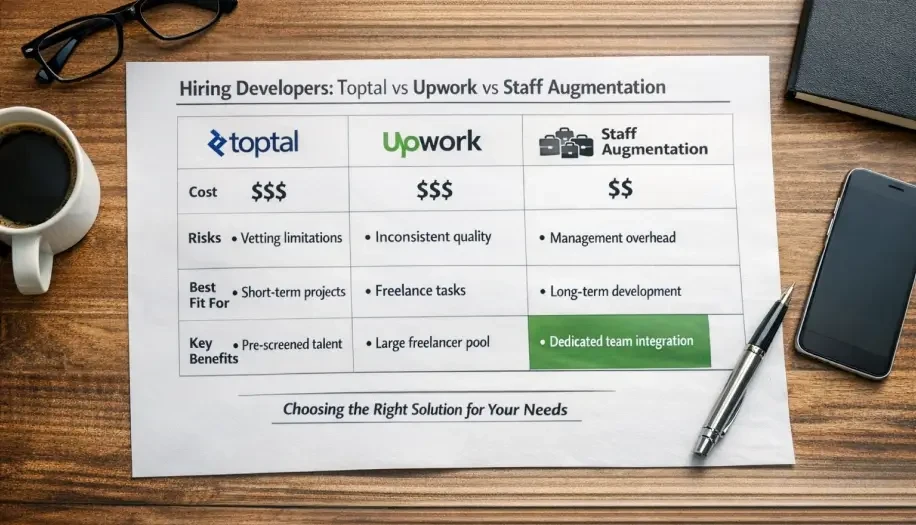
Toptal vs Upwork vs Staff Augmentation: An Honest CTO's Guide for 2026
Toptal, Upwork, and staff augmentation each solve a different problem. This honest vendor-side guide covers what each model actually costs, where each one breaks down, and which fits your situation.
Acquaint Softtech
March 16, 2026
How to Build a Dream Remote Dev Team in 30 Days: The Step-by-Step Playbook (2026)
Most CTOs build remote dev teams by adding one developer at a time and hoping the team forms itself. This 30-day playbook is how the best-performing remote teams are built deliberately. Day by day.
Acquaint Softtech
March 31, 2026India (Head Office)
203/204, Shapath-II, Near Silver Leaf Hotel, Opp. Rajpath Club, SG Highway, Ahmedabad-380054, Gujarat
USA
7838 Camino Cielo St, Highland, CA 92346
UK
The Powerhouse, 21 Woodthorpe Road, Ashford, England, TW15 2RP
New Zealand
42 Exler Place, Avondale, Auckland 0600, New Zealand
Canada
141 Skyview Bay NE , Calgary, Alberta, T3N 2K6