

AI-Powered Damage Assessment: Computer Vision for Auto and Property Claim Estimates
AI-powered damage assessment uses computer vision to analyze photos of a damaged vehicle or property and produce a repair estimate in seconds. A trained model runs four steps: it classifies the type of damage, such as a scratch, dent, crack, or structural break; detects where the damage is; segments the image to measure severity and extent; and then estimates a repair cost using integrated pricing data. This speeds up first notice of loss, flags possible fraud from photo and claims patterns, and frees adjusters to focus on complex cases. Yes, AI can estimate car and property damage today, with a confidence score on every estimate and human review for the uncertain ones.

Acquaint Softtech
Why does estimating a simple dented bumper still take days, a phone call, and an in-person adjuster visit? For most insurers, the honest reason is that damage assessment is still done by human eyes on a schedule, and that is exactly what computer vision now changes.
As a Technical Content Writer at Acquaint Softtech with over three years covering applied AI in insurance claims, I have watched photo-based estimates move from demo to production, so if you want to build this, you can start with our AI development services and turn a claimant's photos into an instant estimate.

- You want to understand the computer vision pipeline behind damage assessment.
- You are weighing whether to build a custom model or buy a tool.
- You care about accuracy, confidence scores, and human review.
- You want a realistic cost, timeline, and tech stack for the build.
This article explains how AI-powered damage assessment works and how to build it, which is what you need before scoping a project. Because these models make decisions that affect policyholders, their use falls under the artificial intelligence guidance that insurance regulators, coordinated through the National Association of Insurance Commissioners, now expect insurers to follow. To see how damage assessment fits the wider claims and platform picture, our complete guide to InsurTech software development gives the full context.
What Is AI-Powered Damage Assessment?

AI-powered damage assessment is the use of computer vision to analyze photos of a damaged vehicle or property and generate an accurate repair estimate automatically. It replaces a slow, manual, human-eye review with a model that returns a consistent estimate in seconds, which shortens the whole claims cycle and removes a lot of variation between adjusters. Building that kind of applied AI is the focus of our software product development services when it is part of a larger product.
The value shows up first at the front of the claim: a policyholder photographs the damage, and the model evaluates it immediately rather than waiting for an appointment. That speed and consistency are why insurers across auto and property are investing here. The models themselves are built by hire AI and ML engineers.
Damage assessment is one piece of a broader move to automate the claim end-to-end, from first notice of loss to settlement. We cover that wider shift in our guide to insurance claims automation.
How Does AI Damage Assessment Work?
AI damage assessment works as a pipeline of computer vision steps, typically built on convolutional neural networks. The model first classifies the nature of the damage, distinguishing a scratch from a dent, a crack, or a structural break; then it detects exactly where on the vehicle or property the damage sits; then it segments the image into smaller regions to measure how severe and how extensive the damage is. Building these vision pipelines is precise work for our hire Python developers.
From pixels to a repair estimate
Once the model understands what is damaged and how badly, it turns that into money by combining the visual assessment with integrated repair-pricing data to produce an estimated cost and a recommended work plan. Every estimate carries a confidence score, so low-certainty cases can be routed to a person rather than auto-approved. Engineering that end-to-end flow is the kind of build you get when you hire remote developers.
A production damage system is more than one model; it is several working together with the data, rules, and infrastructure around them. That full-system ownership is what our dedicated software development teams provide.
Can AI Estimate Car and Property Damage?
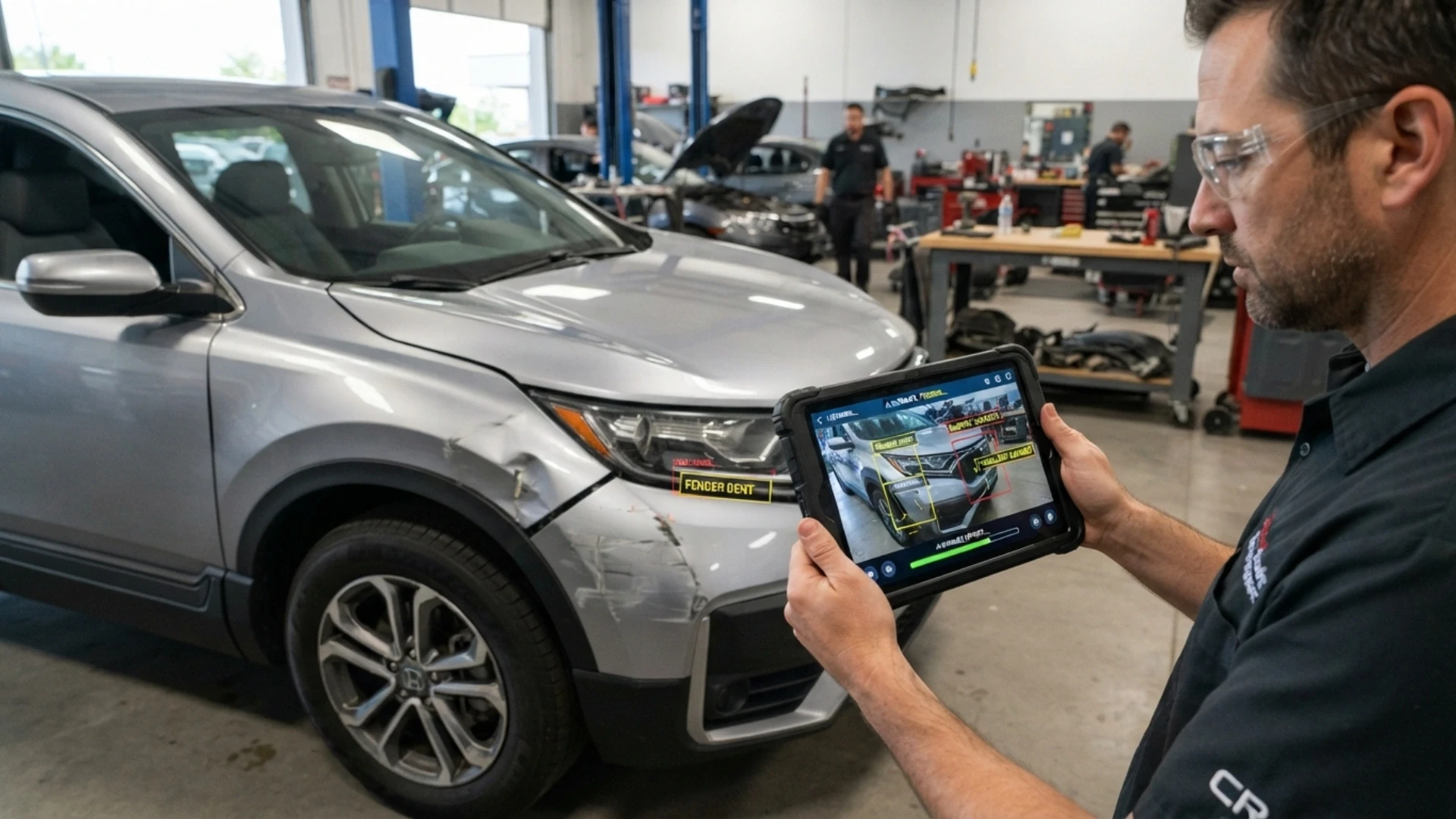
Yes, AI can estimate both car and property damage today, and the same core approach applies to each: a model trained on labeled images learns to recognize, locate, and measure damage, then maps it to a repair cost. Auto claims were the first mover because vehicle damage is visually consistent, and property damage is following as models are trained on roofs, interiors, and structural loss. Deciding where AI fits your specific lines is a strategy question you can work through with our virtual CTO services.
Where it fits, and where it should not decide alone
AI is strongest on common, high-volume damage and weakest on rare or ambiguous cases, which is why a confidence score and a human fallback are not optional extras but core design. The goal is to automate the straightforward majority and escalate the rest, not to remove the adjuster. Scoping exactly which claims to automate first is what our product discovery workshop is built to do.
These estimates also feed automated decisions about coverage and payout, which carry their own fairness and documentation expectations. We cover automated decisioning in our insurance underwriting platform guide.
Wondering If AI Damage Assessment Is Right for Your Claims Process?
Tell us about your claims process, claim volumes, and automation goals, and our experts will evaluate your data readiness, recommend the right AI approach, and provide a practical implementation plan within 48 hours. Our team can deploy your first engineer within 48 hours to help you move from evaluation to execution faster.
Faster FNOL, Fraud Detection, and Efficiency
The clearest payoff is at first notice of loss: a claimant submits photos through a mobile-friendly portal and gets an immediate AI evaluation, which compresses the slowest part of the claim. Instead of waiting days for an appointment, the estimate begins the moment the photos arrive. The backend services that handle that intake and evaluation are built by hired Django developers.
Catching fraud at submission
The same model can flag potential fraud early by cross-referencing the claim against past claims data and analyzing photo metadata for anomalies, such as reused or altered images. Catching this at submission is far cheaper than discovering it after payout. The automated checks and pipelines that run these comparisons are built by hire automation engineers.
Automating the routine estimates also lets human adjusters spend their time on complex and edge-case evaluations where judgment actually matters. When a project needs extra hands to reach production quickly, you can scale up with our IT staff augmentation.
How to Build a Damage Assessment ML Model

Building a damage assessment model starts long before any training: you assemble and label a large, representative dataset of damage images, because the labels are what the model actually learns from. From there you train the vision models for classification, detection, and segmentation, integrate repair-pricing data for cost, add confidence scoring, and wrap it all in an API. Delivering that full build is what our software development outsourcing teams take on end to end.
Buy, build, or blend
Not every insurer should train from scratch; sometimes the right call is to build on existing vision capabilities and focus your effort on the data and integration that make it yours. The decision turns on your data, your volumes, and how much accuracy on your specific claims is worth. For a faster start on the surrounding product, you can build on our white-label software development.
Whatever the model, it has to live inside real application code that handles uploads, results, and edge cases gracefully. That backend is often built by hire Laravel developers, where the core runs on PHP.
Data, Accuracy, and Human in the Loop
Accuracy in damage assessment is overwhelmingly a data problem, not a model problem: the system is only as good as the labeled images and edge cases it has seen. That is why a serious build invests heavily in data collection, labeling quality, and ongoing retraining as new damage patterns appear. Keeping models accurate over time, with monitoring and retraining, is part of our support and maintenance services.
Confidence scores and graceful failure
A trustworthy system attaches a confidence score to every estimate and routes low-confidence cases to a human, so the model never quietly forces a bad decision. The infrastructure that serves the model reliably and falls back cleanly when an image is poor is the work of hire DevOps engineers. Human reviewers need a clear interface to see flagged cases, the model's reasoning, and the original images side by side. That review dashboard is the kind of interface and hire MEAN stack developers build.
Integrating Into the Claims Workflow
A damage model only creates value when it is wired into the claim, so the estimate flows automatically into the claims system, the adjuster's queue, and the policyholder's update. The capture experience matters most: a clean mobile app that guides the claimant to take usable photos is half the battle. That app is built when you hire React Native developers.
Adding AI to an existing claims system
Most insurers are not starting fresh; they are adding AI to a claims system that already works, which means integrating through APIs without disrupting live operations. Doing that safely on an older platform is exactly what our version upgrade services handle.
How the model plugs into policy, billing, and the rest of the core determines how much value you actually capture. We map those connections in our guide to modern core insurance platform development.
Cost, Timeline, and Tech Stack
.webp "Cost, Timeline, and Tech Stack")
Cost is driven less by the model code and more by data: collecting and labeling enough images is usually the largest line item. As a rough guide from our delivery work, a focused MVP, say single-vehicle damage classification plus an estimate, commonly runs from about $80,000 to $200,000, while a full multi-class auto and property system with cost estimation, fraud flags, mobile capture, and claims integration runs higher. The claimant-facing submission portal that feeds it is built when you hire WordPress developers.
Stack and delivery
The stack pairs deep-learning vision models with labeled image datasets, integrated repair-pricing data, a mobile capture app, an inference API, and an adjuster dashboard, all monitored and retrained over time. Settlement and payment flows that close the claim borrow from familiar checkout patterns with hire WooCommerce developers know well.
A model-plus-product build has many moving parts and dependencies, so disciplined sequencing keeps it on track. You can add one or hiring project managers to keep the program moving.
Pipeline step | What it does | Output |
Classification | Identifies the type of damage | Scratch, dent, crack, break |
Detection | Locates the damage | Where it sits |
Segmentation | Measures severity and extent | Affected regions |
Cost estimation | Maps damage to price | Estimate and work plan |
Wondering What It Will Take to Build an AI Damage Assessment Solution?
Share your claim types, available image data, and existing claims system, and we'll provide a tailored AI implementation estimate with the expected cost, timeline, and integration approach within 48 hours.
Real Case Study: A Custom Model Shipped to Production
Acquaint Softtech built and shipped custom machine-learning models for Trestle Studio, a real estate investment and development firm, training the models on the client's own data to score inputs by high-intent signals and feeding the results straight into daily operations.
This is a real, Clutch-verified engagement, and although the models analyze behavioral signals rather than images, it demonstrates the exact discipline a damage-assessment build demands: a custom model trained on real data, shipped to production, and wired into the workflow it serves.
The challenge, the approach, and the outcome
Trestle Studio needed to know which signals and campaigns actually drove revenue rather than noise, so the challenge was turning messy real-world data into reliable, actionable scores. The team developed custom models that analyzed language patterns and behavioral indicators, scored each input by intent, and surfaced the results where the business could act on them, all delivered with organized, transparent communication.
The outcome was improved operational response efficiency and a clear view of which marketing campaigns drove genuine business, which is the same payoff a damage model delivers when it turns raw inputs into a decision people trust. The interface where those scores surface for the team is the kind of build you get when you hire MERN stack developers.
The organized, communicative way the team runs model work like this, with no black boxes, is simply how we operate. You can see how we work on our culture page.
Property | Before | After | |
Signal quality | Noisy, hard to act on | Scored by intent | |
Decisions | Slow, manual | Faster operational response | |
Visibility | Unclear ROI | Clear revenue drivers | |
Looking to Speed Up Claims Without Sacrificing Accuracy?
Whether you're automating vehicle, property, or health insurance claims, we'll help you build an AI-powered damage assessment solution with confidence scoring and human review to improve accuracy and reduce processing time. Our team can deploy your first engineer within 48 hours to help you get started quickly.
Frequently Asked Questions
-
How does AI damage assessment software work?
A trained computer vision model analyzes photos of the damage in steps: it classifies the damage type, detects where it is, segments the image to measure severity and extent, then maps that to a repair cost using integrated pricing data. Each estimate comes with a confidence score, so uncertain cases go to a human instead of being auto-approved.
-
Can AI estimate car damage?
Yes. A model trained on labeled images of vehicle damage can recognize, locate, and measure damage, then produce a repair estimate in seconds, often at first notice of loss. Auto claims led the way because vehicle damage is visually consistent, and the same approach now extends to property damage.
-
How do you build a damage assessment ML model?
Start by collecting and labeling a large, representative dataset of damage images, since the labels are what the model learns from. Then train vision models for classification, detection, and segmentation, integrate repair-pricing data for cost, add confidence scoring, and expose it through an API. Plan for ongoing retraining as new damage patterns appear.
-
How much does AI damage assessment cost to build?
It depends on scope, and data labeling is usually the highest cost. As a rough guide, a focused MVP runs from about $80,000 to $200,000, while a full multi-class auto and property system with cost estimation, fraud flags, mobile capture, and claims integration runs higher. India-based teams reduce build cost by up to 40 percent.
-
How accurate is AI damage assessment?
Accuracy depends mostly on the training data, not the model alone. These systems perform well on common, high-volume damage and less well on rare or ambiguous cases, which is why every estimate carries a confidence score and low-confidence cases are routed to a human adjuster rather than approved automatically.
-
Can AI detect insurance fraud from photos?
Yes, to a degree. The model can flag possible fraud at submission by cross-referencing the claim against past claims data and analyzing photo metadata for anomalies such as reused or edited images. It surfaces suspicious cases for investigation rather than making a final fraud determination on its own.
We’re Acquaint Softtech, your technology growth partner. Whether you're building a SaaS product, modernizing enterprise software, or hiring vetted remote developers, we’re built for flexibility and speed. Our official partnerships with Laravel, Statamic, and Bagisto reflect our commitment to excellence, not limitation. We work across stacks, time zones, and industries to bring your tech vision to life.
Table of Contents
Get Started with Acquaint Softtech
- 13+ Years Delivering Software Excellence
- 1300+ Projects Delivered With Precision
- Official Laravel & Laravel News Partner
- Official Statamic Partner
Related Blog
.webp "The Complete Guide to InsurTech Software Development in 2026")
The Complete Guide to InsurTech Software Development in 2026
InsurTech software is not a fintech variant with policy fields. It is a policy-centric, regulator-accountable platform that runs quote, bind, issue, endorse, pay, and report as one system.
Acquaint Softtech
May 5, 2026
Insurance Claims Automation: FNOL, Straight-Through Processing, and AI-Driven Adjudication
AI-driven claims automation reduces claim processing costs from $15–$22 to $3–$5 and cuts turnaround time from 14 days to under 24 hours. Explore the complete 2026 claims automation architecture, from FNOL intake to AI fraud detection and adjudication.

Manish Patel
May 21, 2026
Modern Insurance Underwriting: AI-Driven Risk Assessment, Automated Decisions, and Continuous Underwriting
Modern insurance underwriting uses AI and machine learning to evaluate applicant risk, automate accept-or-decline decisions, and continuously monitor policyholder risk after policy binding. Automated systems process 500 to 1,500 data variables in seconds, reduce quote cycle time from days to under three minutes, and achieve 90-99% accuracy on low-complexity risks. Carriers deploying AI underwriting report 3-6 point loss ratio improvements within the first year.
Manish Patel
June 2, 2026India (Head Office)
203/204, Shapath-II, Near Silver Leaf Hotel, Opp. Rajpath Club, SG Highway, Ahmedabad-380054, Gujarat
USA
7838 Camino Cielo St, Highland, CA 92346
UK
The Powerhouse, 21 Woodthorpe Road, Ashford, England, TW15 2RP
New Zealand
42 Exler Place, Avondale, Auckland 0600, New Zealand
Canada
141 Skyview Bay NE , Calgary, Alberta, T3N 2K6