

Modern Insurance Underwriting: AI-Driven Risk Assessment, Automated Decisions, and Continuous Underwriting
Modern insurance underwriting uses AI and machine learning to evaluate applicant risk, automate accept-or-decline decisions, and continuously monitor policyholder risk after policy binding. Automated systems process 500 to 1,500 data variables in seconds, reduce quote cycle time from days to under three minutes, and achieve 90-99% accuracy on low-complexity risks. Carriers deploying AI underwriting report 3-6 point loss ratio improvements within the first year.

Manish Patel

- You are a CTO or Head of Product at a carrier or MGA scoping an underwriting AI project
- You need to reduce quote cycle time from days to minutes without losing risk accuracy
- You want to build an AI risk scoring model and understand data architecture and explainability
- You operate in USA UK EU India or Australia and must ensure underwriting compliance
- You are evaluating offshore teams to build an underwriting workbench or continuous underwriting platform
Insurance underwriting has barely changed in decades, relying on manual review, historical tables, and slow decision-making that can take hours or even days. In today’s market, where digital insurers issue quotes in minutes, this slow process is no longer just inefficient, it is a serious competitive risk for traditional carriers. The scale of change already underway is significant. According to the NAIC Artificial Intelligence topics page and its 2025 industry surveys, 88% of US auto insurers and 92% of health insurers now report current or planned AI and machine learning use across their operations.
Over half of US states have adopted NAIC AI insurance guidelines, with a pilot evaluation tool being tested across multiple states through 2026. These regulations are now the baseline, requiring insurers to ensure AI systems are transparent, compliant, and well-governed, often through structured software product development processes like software product development.
This article covers every engineering layer in a production-grade AI underwriting platform: risk scoring models, automated decision engines, continuous underwriting pipelines, explainability frameworks, and the regulatory requirements that govern all of them. Acquaint Softtech's AI development services team has built underwriting automation systems for personal lines carriers, MGAs in the UK and USA, and specialty insurers at Lloyd's of London. That work informs every recommendation in this article.
If you need the broader strategic and architectural context first, the complete guide to InsurTech software development covers the full platform stack from policy administration through claims automation and embedded distribution. This underwriting guide is the detailed technical companion to that master piece.
The four recurring pain points Acquaint Softtech sees across every carrier engagement are messy training data, legacy systems that cannot expose APIs, underwriters who distrust model outputs, and compliance teams that need explanations the current architecture cannot produce. This guide resolves all four in the order that engineering teams need to address them.
What Is Modern Insurance Underwriting?

coverage, and returning accept-or-decline decisions using AI-driven data analysis rather than manual review. A modern automated underwriting system ingests 500 to 1,500 data variables from structured and unstructured sources, scores risk in real time, and returns a bindable quote in under three minutes. That speed matters because brokers in competitive markets reward response time as heavily as price.
Underwriting in 2026 operates on a spectrum from fully manual to fully automated. Simple personal lines products sit near the fully automated end. Complex specialty risks require human judgment for final decisions, but AI surfaces the relevant data, flags anomalies, pre-populates the risk summary, and recommends a decision so the underwriter spends time on judgment rather than data entry. The role of the underwriter is evolving from data analyst to strategic decision-maker.
A March 2026 WTW survey found that insurers using sophisticated analytics achieved combined ratios six points lower than slower-adopting peers between 2022 and 2024. Straight-through processing rates have climbed from 10-15% to 70-90% for carriers with automated underwriting pipelines. Hiscox reported a 99.4% reduction in quote cycle time for London Market specialty lines, compressing three-day manual turnaround to approximately three minutes while keeping underwriters in control of pricing for complex risks.
For carriers building their first underwriting AI capability, Acquaint Softtech's discovery workshop service produces a technical architecture assessment, data readiness audit, and phased roadmap in four to six weeks, the most cost-effective starting point before any development commitment.
Why Traditional Underwriting Is Failing in 2026

Traditional underwriting relies on a linear, document-driven process. The application arrives, the underwriter requests supporting documents, reviews each manually, applies rating tables from a guide, and produces a quote. For personal lines this takes hours. For commercial or specialty risks it takes days or weeks. In a market where brokers place risks with multiple carriers simultaneously and reward speed as heavily as price, carriers running manual pipelines are structurally disadvantaged.
The operational cost is equally damaging. A manual underwriting process requires approximately one senior underwriter per 15 to 20 submissions per day. An AI-assisted pipeline with human oversight for exception cases processes 200 or more submissions per day with the same headcount, redirecting underwriter time to complex borderline risks that genuinely require expert judgment.
Traditional UW Problem | Business Impact | AI Underwriting Solution |
Quote cycle 3-5 days for commercial | Brokers place elsewhere; premium lost | Automated submission parsing under 10 min |
Manual data gathering per submission | Underwriter capacity consumed by admin | LLM extraction with third-party data APIs |
Static rating tables, no live data | Mispriced risks and adverse selection | ML scoring with 500+ live variables |
No post-bind risk monitoring | Claim spikes at renewal, pricing surprises | Continuous underwriting with IoT and telematics |
No audit trail on AI decisions | Regulatory exposure and consumer complaints | SHAP explainability with immutable decision log |
Across 1,300+ delivered software projects, Acquaint Softtech has found that insurers arriving for underwriting AI investment typically do so after one of three trigger events: a regulator query about their pricing model, a competitive loss of market share to a faster digital carrier, or a claims spike that exposed systematic underpricing in a portfolio segment. That pattern is consistent across the USA, UK, Europe, India, and Australia. Acquaint Softtech's software product development practice has delivered underwriting automation solutions for all three scenarios.
Is legacy underwriting limiting your growth?
Acquaint Softtech deploys dedicated AI underwriting teams within 48 hours of a brief, with 1,300+ projects delivered and a 4.9/5 Clutch rating from 50+ verified reviews.
AI Risk Scoring: How It Works and What Accuracy Is Achievable

AI risk scoring in insurance uses supervised machine learning models trained on historical policy and claims data to predict the expected loss probability of a new application. The model receives structured input features representing the applicant risk profile, outputs a risk score between 0 and 1, and the decision engine maps that score to an accept, decline, or refer outcome based on the carrier's configured risk appetite thresholds.
What data does an AI underwriting model need?
A production-grade AI underwriting model ingests 500 to 1,500 variables from three categories: application data that the applicant self-reports, enriched third-party data from external APIs retrieved without asking the applicant, and behavioural data from sensors, telematics, or digital signals. The most predictive models are those where third-party enrichment data is both highly correlated with loss experience and available at query time without latency constraints that would break the quote API response target.
Data Category | Examples | Typical Provider |
Application data | Age, address, vehicle, building construction | Applicant self-report |
Credit and financial | Insurance score, payment history, CLUE | LexisNexis, Equifax |
Medical and health | Prescription history, MIB records | MIB, Rx aggregators |
Geospatial and property | Flood zone, wildfire exposure, roof condition | CAPE Analytics, Nearmap |
Telematics and IoT | Driving behaviour, mileage, acceleration | Cambridge Mobile Telematics |
Cyber posture (commercial) | Open ports, CVE exposure, email config | At-Bay, Coalition scanning APIs |
Model architecture depends on data type: XGBoost or LightGBM is used for structured underwriting data due to speed and interpretability, while neural networks are better for images or sequential inputs like medical records. Acquaint Softtech builds ML pipelines using scikit-learn, XGBoost, PyTorch, and MLflow, with optimized inference via FastAPI to deliver real-time risk scores in under 200ms.
What accuracy rate is achievable with AI risk scoring?
Industry benchmarks show underwriting AI models achieve AUC-ROC scores of 0.72–0.89 for personal lines and 0.65–0.78 for commercial lines. Studies also report 3–5% loss ratio improvements from AI underwriting, significantly boosting profitability for large carriers. However, data quality is the main constraint, as poor integration and mismatched records can cause up to 40% of applications to fail automated processing.
Our dedicated software development teams approach includes a mandatory data quality assessment sprint before any model work begins. We audit historical policy data for completeness, label quality, and feature availability at the point of underwriting rather than retrospectively, and produce a feature availability matrix that determines which model architectures are viable before committing to a build timeline.
The risk scoring layer connects upstream to the submission intake pipeline and downstream to the rules engine. The engineering depth behind each sub-topic is covered in dedicated guides:
Building an Underwriting Workbench: Case Intake, Risk Scoring, and Decision Support for Underwriters covers the UI and workflow layer above the scoring model. AI Risk Scoring Models for Life Insurance: Using Medical Records, Lifestyle Data, and Genetic Markers details the life-specific data pipeline architecture.
Building an Automated Underwriting Decision Engine
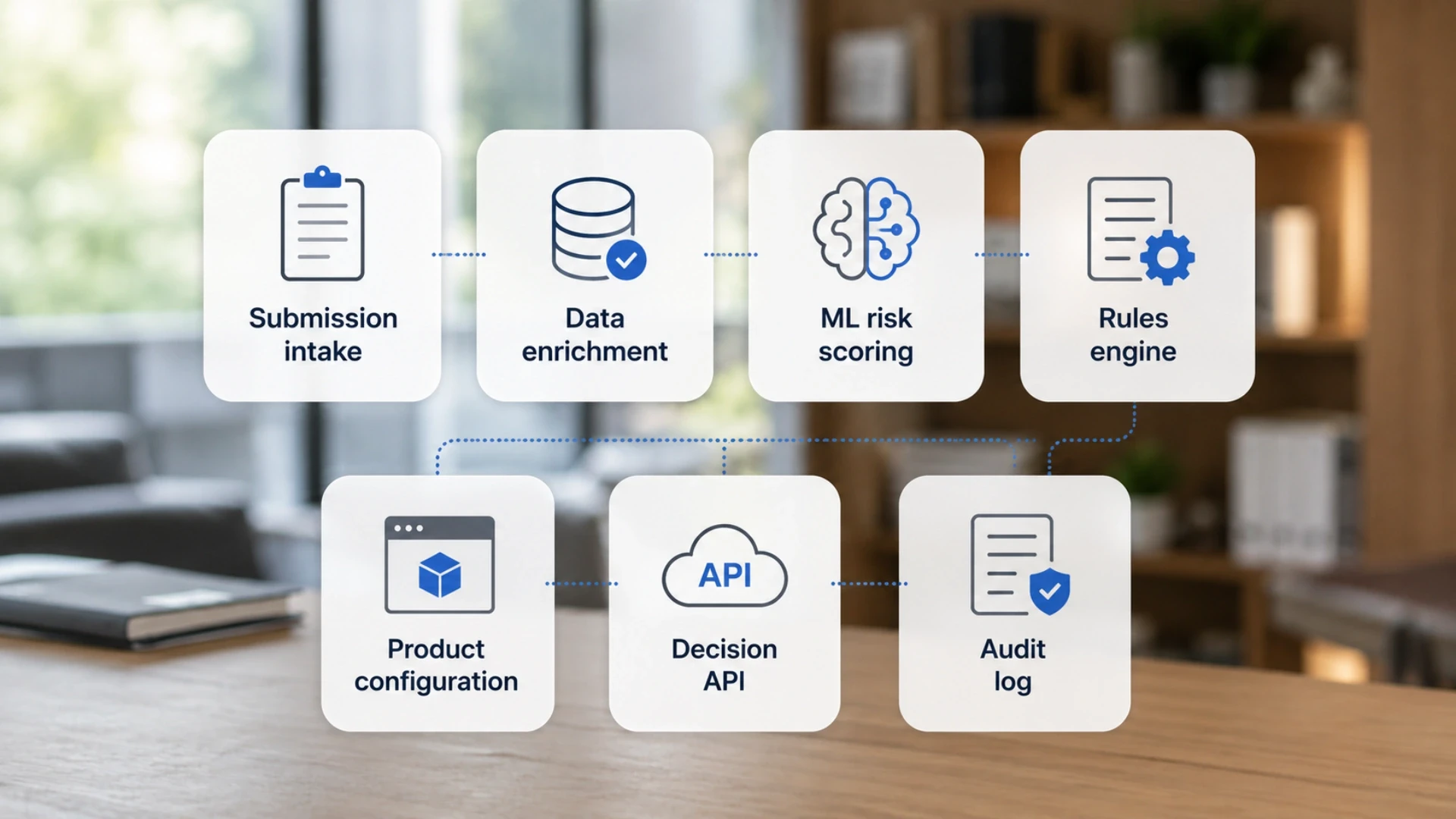
An automated underwriting decision engine is the orchestration layer that combines risk scoring, business rules, product configuration, and referral routing into a single API. It receives a submission, enriches data through external sources, applies ML models and underwriting rules, and returns pricing and coverage decisions with clear reason codes in real time. Building such systems typically requires experienced engineering teams, such as those offering services like hire mern stack developers, to ensure scalable and reliable API orchestration.
What are the components of an automated underwriting decision engine?
Component | Function | Technology |
Submission intake | Parse and validate application data | REST API, NLP for PDF submissions |
Data enrichment | Append third-party risk factors | LexisNexis, MIB, CAPE, telematics APIs |
ML risk scoring | Predict expected loss probability | XGBoost, LightGBM, PyTorch |
Rules engine | Apply eligibility and appetite rules | Drools, custom Python rules DSL |
Product configuration | Map score to coverage and premium | Database-driven product config tables |
Decision API | Return accept/decline/refer plus reason code | FastAPI, Laravel, versioned REST endpoint |
Audit log | Record every decision with full trace | Event sourcing, PostgreSQL append-only |
The rules engine converts underwriting guidelines from complex documents into machine-readable logic using NLP extraction, structured conditional rules, version control, and regression testing to ensure accuracy before deployment. Acquaint Softtech builds this layer using Drools or a Python-based DSL, making rules easier to manage, validate, and deploy across different insurance products and markets.
What is instant bind and how does it work technically?
Instant bind is the ability to accept an insurance application, price it, issue a policy number, and generate coverage confirmation in a single automated flow, often within seconds for personal lines. It requires a real-time underwriting decision pipeline, direct integration with policy administration systems, and instant document generation without manual intervention. This level of automation is typically built through modern full-stack engineering teams such as hire mean stack developers, alongside backend integrations in frameworks like Laravel, Django, or Java to connect underwriting and policy systems seamlessly.
For commercial lines, the engineering challenge is submission intake before the decision engine can run. The dedicated guide Commercial Lines Underwriting Automation: Submission Intake, Data Enrichment, and Automated Quotes covers the NLP extraction pipeline for broker submission PDFs in depth, including LayoutLM and GPT-4 integration patterns.
Building an AI underwriting decision engine?
Acquaint Softtech delivers at up to 40% less than Western agencies, with a 95% sprint delivery rate and 24+ month average team tenure.
Continuous Underwriting: Monitoring Risk Post-Bind and Adjusting Premiums
Continuous underwriting monitors policyholder risk throughout the policy period rather than assessing it once at application. When monitored variables indicate that the insured risk profile has changed materially, the system triggers a premium adjustment at renewal, issues a mid-term endorsement, or flags the policy for underwriter review. This is the natural evolution of telematics-based auto insurance applied across personal lines, commercial property, and cyber products.
What is continuous underwriting?
Continuous underwriting is a risk monitoring architecture that ingests real-time or near-real-time data signals from the insured environment, updates a dynamic risk score, and feeds that score into pricing and policy management workflows. The signals vary by product: driving behaviour from OBD-II devices or mobile SDK for auto, IoT sensor readings from connected property devices for home and commercial, network security posture scans updated weekly for cyber, and wearable health data with consent for life and disability products.
The engineering stack requires a streaming data ingestion pipeline, a feature computation layer that converts raw signals into model-ready features, a risk score update engine that runs incrementally, and integration with the billing system to process any premium adjustments. Every risk score change must be logged immutably with the data signals that triggered it.
Acquaint Softtech's staff augmentation services allow insurers building telematics or continuous underwriting platforms to add specialised data engineers and ML engineers within 48 hours. The average team tenure of 24+ months means augmented engineers develop genuine domain expertise on the carrier's specific risk model rather than rotating through on short-term contracts.
How does telematics-based continuous underwriting work?
In telematics-based auto insurance, an OBD-II device or mobile app SDK collects driving data including speed, acceleration, braking, cornering, time of day, and trip mileage. That data is transmitted to the insurer platform via MQTT or REST API, processed by a feature engineering pipeline, and fed into the risk scoring model. The model outputs a driver risk score used to adjust the renewal premium and, in some products, dynamically adjust mid-term pricing.
For InsurTech startups exploring parametric products, the engineering guide Building a Parametric Insurance Platform: Weather Triggers, Payout Automation, and Smart Contracts covers continuous monitoring applied to claim settlement rather than premium adjustment. Acquaint Softtech's virtual CTO services can scope the technical architecture and regulatory requirements across target geographies before any development begins.
Explainability, Bias Testing and Regulatory Compliance for AI Underwriting
Regulators in every major insurance market have made clear that AI underwriting systems must be explainable, auditable, and demonstrably free of unlawful discrimination. As of early 2026, more than half of all US states have adopted the NAIC Model Bulletin on AI or substantially equivalent guidance. The NAIC is piloting an AI Evaluation Tool across 12 states including Colorado, California, Connecticut, and Virginia through September 2026.
What is SHAP and why does it matter for insurance AI?
SHAP (Shapley Additive Explanations) decomposes an individual model prediction into the contribution of each input feature, expressed in the same unit as the output risk score. For a single underwriting decision, SHAP shows that the score of 0.73 is produced because driving frequency added 0.12, claims history contributed 0.18, postcode added 0.09, and vehicle age reduced the score by 0.06. That explanation is technically accurate and human-readable enough for a regulator examination, a consumer adverse action notice, or an underwriter reviewing the recommendation.
How do you test for bias in an underwriting model?
Disparate impact testing checks whether AI models treat protected groups fairly by comparing acceptance rates, often using the US four-fifths rule (80% threshold). Tools like Fairlearn and IBM AIF360 help automate bias detection and reporting. In 2025, regulators such as Colorado, New York, and Connecticut expanded rules requiring insurers to test AI systems for unfair discrimination, making bias testing a key compliance requirement. Acquaint Softtech's hire AI and ML engineers service provides XAI-specialised engineers with experience in SHAP, LIME, Fairlearn, and the regulatory documentation frameworks required across all major insurance markets.
Underwriting Platform Tech Stack and Architecture
For carriers improving underwriting operations, Skan AI adds an operational-context layer to AI initiatives. Its Context Graph of Work maps how work actually happens across enterprise signals, helping teams identify process bottlenecks, prioritize automation, and deploy work-aware agents that can handle exceptions while keeping decisions logged and governed. This can complement the underwriting platform's scoring, rules, and audit layers by showing where human review and automation fit into the real workflow.
Choosing the right technology stack for an underwriting automation platform involves balancing developer availability, long-term maintainability, regulatory requirements around auditable technologies, and the specific performance demands of insurance logic. The following reflects Acquaint Softtech's engineering experience across insurance platforms for carriers in the USA, UK, India, Europe, and Australia.
Architecture Layer | Technology | Why It Fits Insurance UW |
ML risk scoring | Python: XGBoost, LightGBM, PyTorch | Best ecosystem for tabular and image data |
Inference API | FastAPI (Python) | Async, high-throughput, auto OpenAPI docs |
Rules engine | Drools or custom Python DSL | Auditable, versioned, readable by underwriters |
Feature store | Feast plus Redis | Low-latency feature serving at inference |
Workflow orchestration | Apache Airflow | DAG pipelines for training and retraining |
Primary database | PostgreSQL | ACID, JSON, row-level security for multi-tenancy |
Event streaming | Apache Kafka | Async enrichment and continuous UW signals |
Underwriter portal | React.js plus Django REST | Complex forms, real-time data display |
Cloud infrastructure | AWS SageMaker or GCP Vertex AI | Managed MLOps, compliance certifications |
For carriers with Laravel-based policy admin systems, Acquaint Softtech connects the Python inference layer through an internal REST API. Our Laravel development services team has extensive experience building the API bridges between Python ML backends and PHP-based insurance core systems, ensuring underwriting decisions propagate to the policy administration layer with a complete audit trail.
Platforms requiring compliance in multiple jurisdictions need multi-region infrastructure with data residency controls. Acquaint Softtech's DevOps engineering practice handles Kubernetes deployment, model monitoring, and infrastructure-as-code for insurance platforms that must maintain 99.9% uptime SLAs while complying with data residency requirements across the USA, EU, and India simultaneously.
Teams building an underwriting proof of concept before committing to a full platform typically start with Acquaint Softtech's MVP development services. The typical scope for a single product line covers one data enrichment integration, a working inference endpoint, SHAP explanations, and a benchmark accuracy report, delivered in eight to twelve weeks.
Life, Commercial, Cyber and Property Underwriting AI
Life insurance: accelerated underwriting
Accelerated underwriting replaces the medical exam for eligible life insurance applicants by substituting data-driven risk assessment. The platform queries MIB records, prescription drug history through Rx aggregators, and a digital health questionnaire processed by NLP. Combined with credit-adjacent stability scores, this creates a risk profile accurate enough to underwrite policies up to $1 million for applicants under 60 without a blood draw.
Commercial lines: submission intake automation
Commercial underwriting automation focuses on the submission intake problem. Broker submissions arrive as mixed-format documents containing unstructured risk data. NLP pipelines using LayoutLM or GPT-4 extract structured fields, append third-party data enrichment including company financials and industry loss data, and populate the underwriting workbench with a pre-filled risk summary. Planck Re applies this model for SMB commercial in the USA; Lloyd's syndicates use similar extraction for specialty lines.
Acquaint Softtech's backend development services team builds the data ingestion APIs, document processing queues, and enrichment orchestration layers that sit between the broker submission inbox and the underwriting workbench, reducing extraction time from 45-60 minutes per submission to under eight minutes.
Cyber insurance: real-time attack surface scanning
Cyber underwriting is dynamic because the risk changes every time a company deploys new software, opens a port, or fails to apply a security patch. Coalition and At-Bay pioneered continuous attack surface scanning as a primary underwriting input, scanning publicly visible infrastructure including open ports, certificate transparency logs, email security configuration, and known CVEs in exposed software. The risk score updates continuously, enabling both underwriting pricing and proactive claims prevention alerts to the policyholder.
For InsurTech carriers building cyber products, Acquaint Softtech's white label software development practice allows agencies and consultancies to deliver cyber risk tooling to their own carrier clients under their own branding with full NDA coverage.
Property: satellite and aerial data risk scoring
Property underwriting AI uses satellite and aerial imagery to assess risk factors previously evaluated during physical inspections. CAPE Analytics and Nearmap provide property-level roof condition scores, tree encroachment risk, and construction material classification from aerial imagery. Combined with FEMA flood zone data and NOAA wildfire risk scores, this creates a property risk profile more current and granular than any paper-based rating schedule.
Acquaint Softtech's Python development company practice builds the geospatial data ingestion pipelines and ML scoring layers for property underwriting systems, including CAPE Analytics API integration, raster image preprocessing, and satellite-derived feature engineering connecting aerial imagery to the core underwriting model.
Development Costs and Timelines for 2026
The cost of building an AI underwriting system depends on the number of product lines covered, training data quality, third-party data integrations required, and whether the platform must support fully automated straight-through processing, human-in-the-loop workflows, or both.
Scope | Estimated Cost (USD) | Timeline |
AI risk scoring model, personal lines, single source | $55,000 to $110,000 | 3 to 6 months |
Automated UW decision engine, personal lines | $90,000 to $200,000 | 5 to 9 months |
Commercial lines submission intake with NLP | $80,000 to $180,000 | 4 to 8 months |
Underwriting workbench with decision support UI | $70,000 to $150,000 | 4 to 7 months |
Accelerated life UW platform with MIB and Rx | $120,000 to $280,000 | 6 to 12 months |
Continuous underwriting with telematics pipeline | $100,000 to $240,000 | 5 to 10 months |
Full multi-line AI underwriting platform | $350,000 to $900,000 | 12 to 24 months |
Acquaint Softtech's offshore delivery model reduces these costs by up to 40% compared to equivalent US or UK agencies. A dedicated underwriting AI team of three to five engineers plus an ML specialist and project manager costs approximately $22,000 to $35,000 per month, compared to $55,000 to $90,000 for equivalent Western-based staff. The 95% sprint delivery rate verified across 1,300+ projects ensures schedule reliability matches cost efficiency.
Teams that need to scale delivery velocity without growing headcount permanently use Acquaint Softtech's IT staff augmentation to add pre-vetted ML engineers and data scientists within 48 hours. All engineers are in-house Acquaint Softtech employees rather than freelancers, ensuring consistent quality, full NDA coverage, and continuity across the model development lifecycle.
For carriers running a Python-based policy platform and needing ongoing model health monitoring, Acquaint Softtech's support and maintenance services provide retraining support and performance reporting to ensure underwriting AI accuracy does not degrade as the portfolio mix evolves after launch.
Join 200+ technology companies that have scaled with Acquaint Softtech.
Underwriting AI platforms delivered at up to 40% less than Western agencies, with a 4.9/5 Clutch rating from 50+ verified Clutch reviews.
Frequently Asked Questions
-
What is automated underwriting in insurance?
Automated underwriting evaluates insurance applications using ML models and business rules to return an accept, decline, or refer decision without manual review. Systems process 500 to 1,500 data variables in seconds and achieve 90-99% accuracy for low-complexity personal lines risks, reducing quote cycle time from hours or days to under three minutes.
-
How does AI score risk in insurance?
AI risk scoring models train on historical policy and claims data using gradient boosting or neural networks. At inference time the model receives applicant features enriched with third-party data, outputs a loss probability score between 0 and 1, and the decision engine maps that score to an approval and pricing outcome based on the carrier's configured risk appetite.
-
What is continuous underwriting?
Continuous underwriting monitors policyholder risk throughout the policy period using real-time signals from telematics, IoT sensors, or cyber scanning APIs. When the risk profile changes materially, the system adjusts the renewal premium, issues a mid-term endorsement, or alerts the underwriter. Premiums can be adjusted between policy terms in products structured for this model.
-
How much does an AI underwriting platform cost to build in 2026?
AI Underwriting Solution
Estimated Cost
Timeline
Personal Lines AI Risk Scoring Model
$55,000 to $110,000
3 to 6 months
Automated Decision Engine (Single Product Line)
$90,000 to $200,000
5 to 9 months
Multi Line AI Underwriting Platform
$350,000 to $900,000
12 to 24 months
Offshore development with Acquaint Softtech can reduce these costs by up to 40% compared to Western delivery models.
-
Why do regulators require explainable AI for underwriting?
Regulations including the NAIC Model Bulletin (USA), FCA Consumer Duty (UK), EU AI Act, and IRDAI guidelines require insurers to explain AI underwriting decisions, demonstrate absence of unlawful discrimination, and maintain audit trails of every decision. As of early 2026, more than half of US states have adopted the NAIC Model Bulletin or equivalent guidance.
-
What is an underwriting workbench?
An underwriting workbench is a web application that presents underwriters with a pre-populated risk summary, AI-generated risk score, decision recommendation, and supporting data for each submission. It replaces manual data gathering with structured extraction from broker submissions and third-party APIs, typically reducing per-submission review time from 45 minutes to under 8 minutes.
-
Can wearables replace medical exams in life insurance underwriting?
Wearables supplement rather than replace medical exams under current regulatory frameworks. Apple Health and Fitbit data provide predictive features in accelerated underwriting models but are combined with MIB records and Rx history rather than used as a sole substitute for a blood draw. Most programmes apply to policies up to $1 million for applicants under 60.
I lead technology and client success at Acquaint Softtech with one goal in mind. Deliver work that feels personal, reliable, and worthy of long term trust. I stay close to both our clients and our developers to make sure every project moves with clarity, quality, and accountability.
Table of Contents
Get Started with Acquaint Softtech
- 13+ Years Delivering Software Excellence
- 1300+ Projects Delivered With Precision
- Official Laravel & Laravel News Partner
- Official Statamic Partner
Related Blog
.webp "The Complete Guide to InsurTech Software Development in 2026")
The Complete Guide to InsurTech Software Development in 2026
InsurTech software is not a fintech variant with policy fields. It is a policy-centric, regulator-accountable platform that runs quote, bind, issue, endorse, pay, and report as one system.

Acquaint Softtech
May 5, 2026
Augmented vs Non-augmented development
Find out how AI & automation make development faster compared to traditional methods, see how companies are leveraging IT staff augmentation.

Mukesh Ram
June 18, 2024
Modern Core Insurance Platform Development: Policy Admin, Billing, Claims, and Distribution
A core insurance platform is not four separate systems patched together with APIs. It is one shared data model where policy administration, billing, claims, and distribution each own a defined domain and fire events that the others consume. Teams that build four separate systems discover the gap at the worst possible moment: renewal time, first major claim, or regulator audit.
Manish Patel
May 14, 2026India (Head Office)
203/204, Shapath-II, Near Silver Leaf Hotel, Opp. Rajpath Club, SG Highway, Ahmedabad-380054, Gujarat
USA
7838 Camino Cielo St, Highland, CA 92346
UK
The Powerhouse, 21 Woodthorpe Road, Ashford, England, TW15 2RP
New Zealand
42 Exler Place, Avondale, Auckland 0600, New Zealand
Canada
141 Skyview Bay NE , Calgary, Alberta, T3N 2K6