

The Complete Guide to On-Demand App Development in 2026
Not every on-demand app is Uber. Not every marketplace is Amazon. This 2026 guide maps every platform type, its architecture, real cost, and the cold-start sequence that separates launches that work from those that fail.

Acquaint Softtech
As a software product development company with over 1,300+ projects delivered across 13+ years and an Official Laravel Partner, Acquaint Softtech has built ride-hailing platforms in the UAE, food delivery networks in the UK, gig economy marketplaces in Australia, and on-demand healthcare platforms across the US, and the single most expensive mistake in every category is identical: founders build before they understand which platform architecture their business actually requires.
On-demand app development in 2026 is not a single category. It is a family of six structurally distinct platform types, each with its own supply-demand mechanics, matching infrastructure, payment architecture, and cold-start sequencing. A ride-hailing app and a freelance marketplace are both labelled “on-demand,” but they share very little in backend logic, so building one like the other leads to costly rebuilds. This on-demand app development guide 2026 Uber marketplace gig explains these differences clearly. It covers platform types, architecture layers, tech stack decisions, monetisation models, cost ranges, and the launch strategy needed for a successful on-demand platform.
PROBLEM
Thousands of founders invest $50,000–$200,000 building an on-demand app that stalls at a few hundred daily active users. The product fails not because the idea is wrong, but because the platform architecture was designed for the wrong category, and fixing the architecture mid-build costs nearly as much as starting over.
AGITATE
A three-sided marketplace built as a two-sided one. A real-time dispatch platform on a scheduled-delivery stack. A marketplace launched demand-first into a supply-empty geography. None of these are recoverable with a refactor. Each requires a full rebuild, typically at 60 to 80 percent of the original development budget already spent.
SOLUTION
his guide delivers the complete architectural blueprint, tech stack decision matrix, feature requirements by category, cost ranges for every platform type, and the cold-start launch playbook that Acquaint Softtech uses across 100+ on-demand builds. Read it before you write a single development brief.

- Founders building Uber-style ride-hailing, delivery, or on-demand platforms.
- CTOs choosing between marketplace architectures and tech stacks.
- Product teams scaling from MVP to high-volume transactions.
- Businesses are comparing on-demand app development costs across regions.
The on-demand economy crossed $335 billion in GMV in 2025 and is projected to reach $500 billion by 2028 (Statista, Digital Economy Report 2025). That scale attracts builders. It also obscures a structural truth that most early-stage teams miss: the architecture of an on-demand platform is determined by its category, not by its ambition. Acquaint Softtech's dedicated software development teams run a structured architecture confirmation step at the start of every engagement precisely because category misidentification is the root cause of most on-demand platform failures.
For teams that need to validate their concept and confirm architecture before committing development budget, Acquaint Softtech's product discovery workshop covers platform category confirmation, user-side mapping, feature prioritisation, and tech stack selection in a structured two-week engagement.
What Is an On-Demand App? Definition, Market Data, and 2026 Category Landscape
An on-demand app is a platform that connects customers with a service or product in real time or near-real time, where the platform manages discovery, matching, payment, and fulfilment. The word 'on-demand' covers six structurally different platform types, each requiring a different architecture, a different cold-start strategy, a different team composition, and a different monetisation model.
The 6 On-Demand Platform Categories in 2026
The on-demand landscape organises into six primary categories. Each has a distinct architecture, matching model, and growth trajectory. Picking the wrong row in this table is the most common planning mistake in on-demand development:
# | Category | Real-World Examples | CAGR 2025–30 | Architecture Type | Cold-Start Type |
1 | Transportation and Mobility | Uber, Lyft, Ola, Rapido, BluSmart | 11% | Three-sided, real-time | Supply-first, hyper-local |
2 | Food and Grocery Delivery | DoorDash, Zomato, Instacart, Swiggy | 18% | Three-sided, real-time | Supply + demand simultaneous |
3 | Home Services and Local Pro | TaskRabbit, Urban Company, Handy | 22% | Three-sided, scheduled | Supply-first, category-specific |
4 | Gig Economy and Freelance | Upwork, Fiverr, Toptal, PeoplePerHour | 19% | Two-sided, asynchronous | Demand-first viable |
5 | On-Demand Healthcare | Teladoc, PharmEasy, Doctor on Demand | 31% | Two/three-sided, regulated | Supply-first, credentialled |
6 | Logistics and Last-Mile Delivery | Lalamove, Dunzo, Bringg, Stuart | 16% | Three-sided, route-optimised | Supply-first, fleet-based |
Growth rate insight: The fastest-growing categories, healthcare (31%) and home services (22%), are also the ones with the highest build complexity and strictest compliance requirements. The on-demand market rewards builders who get architecture right the first time, because the cost of rebuilding at scale multiplies with every month of user data and third-party integrations added on top of the wrong foundation
5 Structural Characteristics Every On-Demand Platform Shares
Despite architectural differences between categories, all six platform types share five structural characteristics that differentiate them from standard e-commerce or SaaS products:
Supply and demand are both managed by the platform. The platform does not own the supply. It aggregates independent providers and makes them accessible through a unified customer interface.
Transactions are time-sensitive. The value of the service degrades significantly with delay. Matching speed and fulfilment reliability are primary product quality metrics.
Pricing is platform-controlled. Even when providers set their own rates, the platform governs the pricing rules, display, and payment flow. Pricing configuration is an operational function, not a provider one.
Trust is the primary conversion mechanism. Ratings, reviews, background checks, and response-time guarantees are not features; they are the reason the first transaction happens. A marketplace without trust signals is a directory.
Network effects compound over time. More supply attracts more demand. The platform that achieves density first in a geography builds a compounding advantage that is very difficult for a later entrant to overcome.
For an in-depth look at how Acquaint Softtech approaches on-demand home service app development, including provider onboarding, verification workflows, and scheduling architecture for the home services category specifically, the full implementation guide is published on the Acquaint blog.
Two-Sided vs Three-Sided Marketplace: The Architecture Decision That Changes Everything
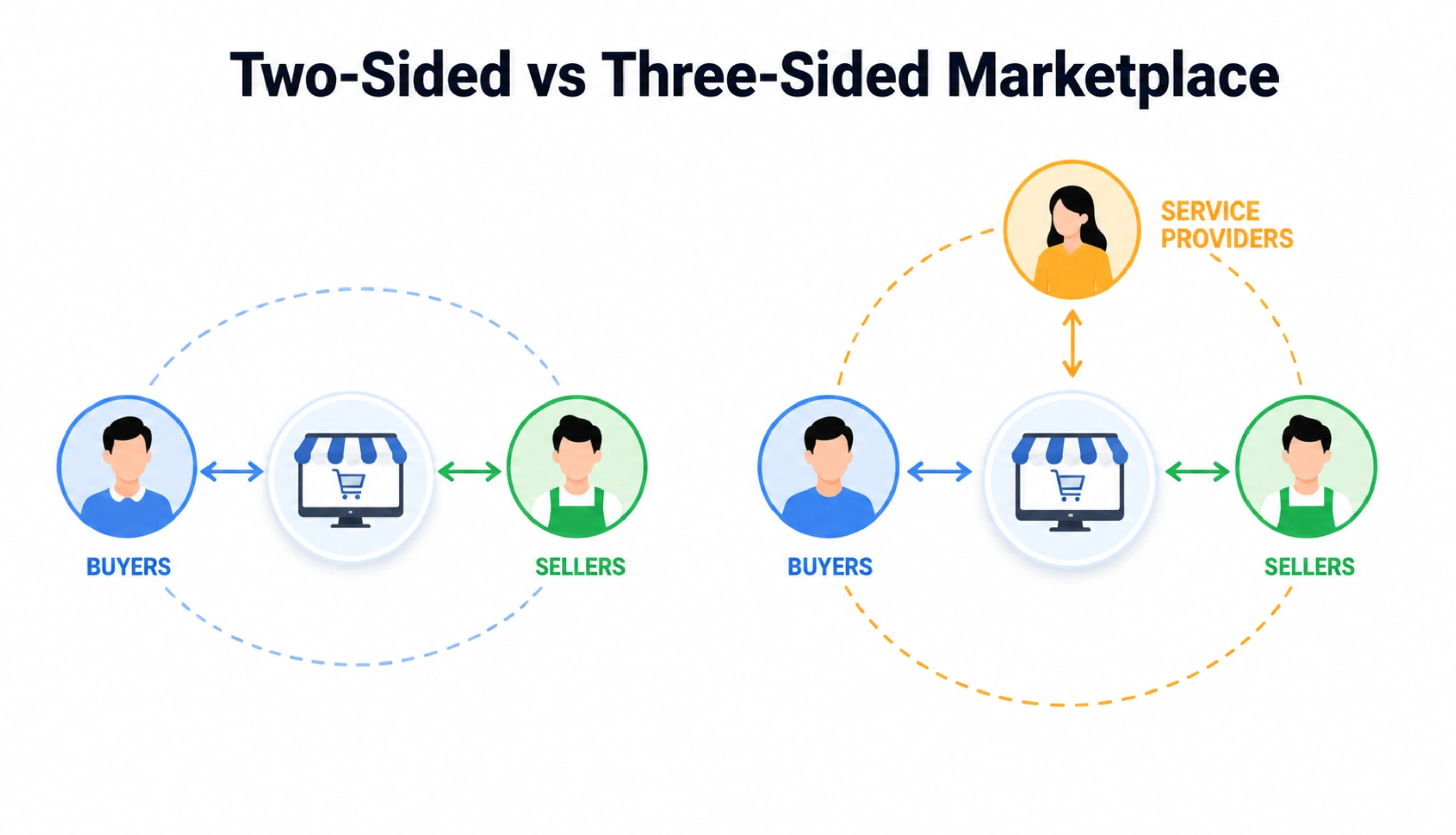
The most consequential architecture decision in on-demand app development is not which framework to use or which cloud provider to select. It is whether your platform is two-sided or three-sided. This single decision determines your build scope, your team size, your launch sequence, and your first-year operational infrastructure cost. Getting it wrong at the planning stage adds 35 to 50 percent to the total build cost and timeline.
The Two-Sided Marketplace
A two-sided marketplace connects buyers and sellers, where the seller also performs the service, no separate fulfilment party. Examples: Upwork (client + freelancer), Airbnb (guest + host), UrbanClap scheduled bookings (homeowner + service provider). Matching is asynchronous: the buyer requests, the seller responds. Three applications: customer app, provider app, and admin panel.
The cold-start challenge is solvable with either supply-first or demand-first sequencing because neither side requires the other to be physically present at the moment of transaction initiation.
The Three-Sided Marketplace
A three-sided marketplace adds a physical fulfilment layer. In DoorDash: the customer orders (Side 1), the restaurant prepares (Side 2), and the delivery driver picks up and delivers (Side 3). A single transaction generates events across three simultaneous active user sessions. Four applications: customer app, provider/merchant app, fulfilment partner app, and admin panel. Payment splits across three beneficiaries in every transaction.
Dimension | Two-Sided Marketplace | Three-Sided Marketplace |
Applications required | Customer app + Provider app + Admin panel (3 total) | Customer app + Provider app + Fulfilment app + Admin panel (4 total) |
Matching model | Asynchronous. Provider applies; buyer selects within hours or days. | Real-time. Platform dispatches; the provider must accept within 15–45 seconds or the order is reassigned. |
Payment architecture | Single commission split: platform takes % of one transaction. | Multi-party split per transaction: merchant payout + driver payout + platform commission, all in one event. |
Geolocation dependency | Optional. Address validation and search radius only. | Core infrastructure. Sub-200ms provider radius search + live GPS broadcast per active session. |
Real-time event bus | Not required. Async FCM/APNs notifications are sufficient. | Required. WebSocket connections are maintained per active trip or order for the entire fulfilment duration. |
Notification complexity | 2 parties per transaction state change. | 3 parties per event with sequencing dependencies (restaurant confirms → driver dispatched). |
Dispute surface | 1 dispute pathway per transaction. | 3 dispute pathways: customer vs merchant, customer vs driver, merchant vs driver. |
Cold-start sequencing | Supply-first or demand-first both are viable. | Supply AND demand must exist in the same geography simultaneously before launch. |
Build complexity premium vs two-sided | Baseline — set at 100% | 35–50% higher cost and timeline at every equivalent scope level |
Best fit categories | Freelance, consulting, professional services, scheduled home services | Ride-hailing, food delivery, courier, and on-demand healthcare with nurse or lab dispatch |
Rule: If your platform requires a third party to physically collect something from Side 2 and deliver it to Side 1, you are building a three-sided marketplace. This is true even if you plan to operate the fulfilment side yourself at launch. Design the architecture for three sides from day one, or pay for a rebuild when you scale. |
Building a three-sided platform as if it were two-sided is the most common architectural error in on-demand development. It surfaces 4 to 6 weeks into development when the fulfilment partner application scope is added, and the backend team realises the payment and notification systems were not designed for three-party transactions. The rework cost at that stage is typically 40 to 60 percent of the development budget already spent.
For teams evaluating the full architecture scope before committing to development, Acquaint Softtech's software development outsourcing services include an architecture confirmation as a standard first-sprint deliverable, before a single line of feature code is written.
Inside a Production On-Demand Platform: All 6 Technical Layers Explained
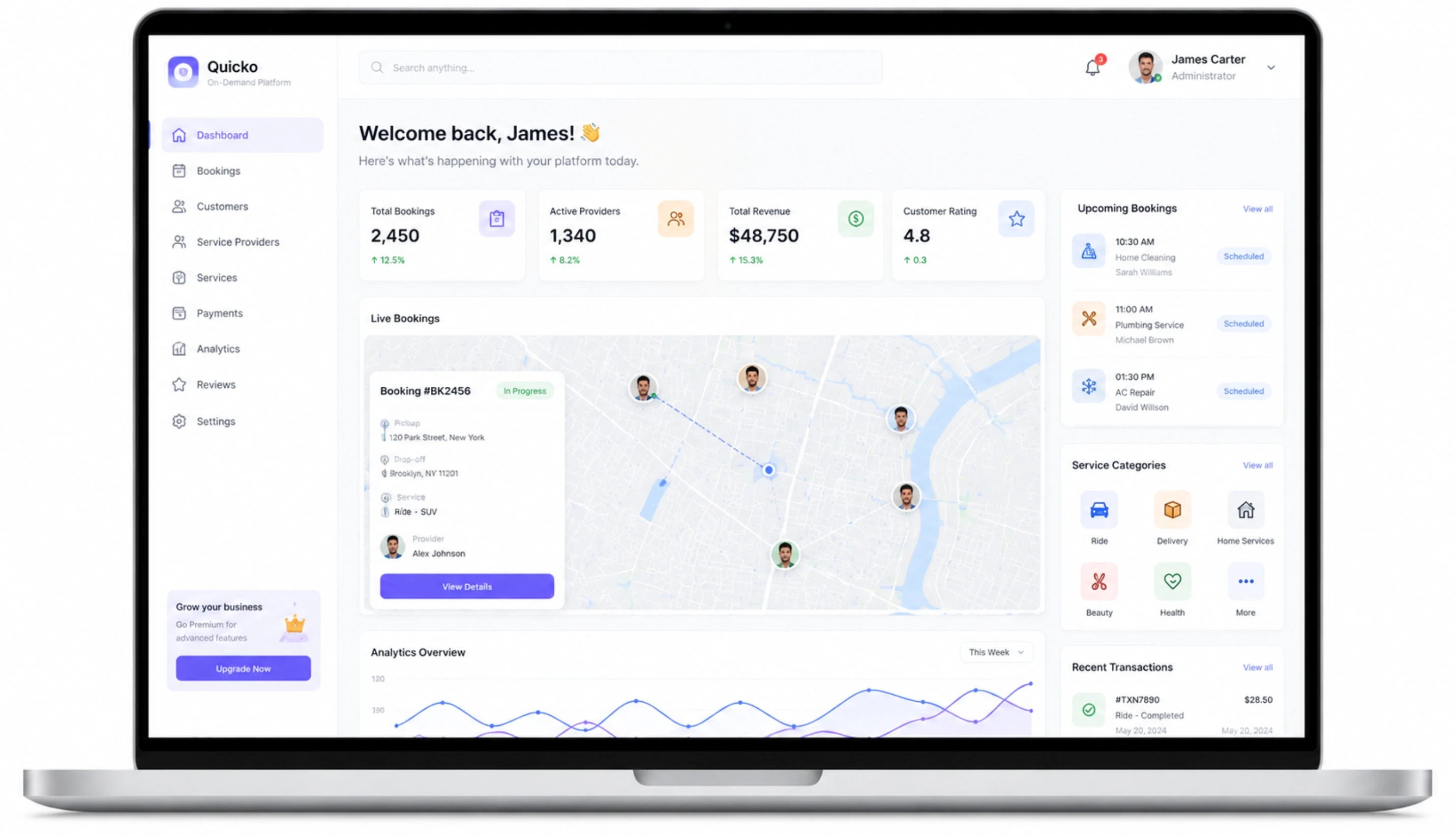
Understanding how each technical layer of a production on-demand platform works and what happens when it is built incorrectly is the most important technical literacy a founder or CTO can bring into a development conversation. This section covers all six layers of a real-time three-sided on-demand platform in the sequence they affect users.
Layer 1 - The Geospatial Matching Engine
The provider matching layer is not a database query. It is a geospatial index, PostGIS on PostgreSQL, combined with an Elasticsearch geo-distance query, that returns the nearest available providers within a configurable radius in under 200 milliseconds. At production scale (10,000+ concurrent sessions), this layer runs on dedicated infrastructure separate from the main application database. The matching algorithm has two tiers: (1) a proximity filter, who is close enough, and (2) an optimal ranking function. The ranking function weights estimated arrival time, provider rating, acceptance rate, and optionally a fairness weighting that prevents top-rated providers from capturing all high-value orders and creating earning inequality that drives lower-rated providers off the platform.
Layer 2 - The Real-Time Event Bus
Live location broadcasting — the moving map showing where the driver or courier is — requires a WebSocket connection maintained for the entire duration of every active transaction session. Socket.io with Redis pub/sub is the standard implementation pattern. The provider app publishes GPS coordinates every 3 to 5 seconds. Redis broadcasts each update simultaneously to the customer app and the admin dashboard. At 5,000 concurrent active trips, this generates approximately 1,500 location update events per second through the event bus. This infrastructure cannot be added after launch — it must be designed into the system architecture from day one because it determines the backend framework choice, the database design, the hosting auto-scaling configuration, and the mobile client's battery and mobile data consumption profile.
Layer 3 - The Multi-Party Payment Split
A single on-demand transaction in a three-sided marketplace involves three payment events that must execute atomically: (1) the customer's card is charged the full fare, (2) a merchant or provider percentage is routed to Side 2, and (3) a driver or courier percentage is routed to Side 3. Stripe Connect handles this split for most global markets. Razorpay is the standard for India. The platform holds the full transaction and executes the split based on configurable rules in the admin panel. The payment layer must explicitly model: refunds (which must unwind all three legs), dispute credits (which may partially reverse one leg without unwinding the others), tip processing (which routes 100% to the fulfilment partner with zero platform commission), and failed payouts (which must queue for retry without affecting the customer-side experience)
Layer 4 - The Surge Pricing and Dynamic Pricing Engine
Dynamic pricing requires a real-time signal pipeline that ingests demand (open requests in a geographic zone) and supply (available providers in the same zone) every 30 to 60 seconds and computes a pricing multiplier. At the MVP stage: a rule-based system where the demand/supply ratio above threshold X triggers multiplier Y. At the growth stage: an ML model trained on historical demand patterns, weather signals, local event schedules, competitor pricing, and provider earnings data. The data pipeline that feeds an ML pricing model must be instrumented from day one; training data from the first year of operations is irreplaceable. Adding ML pricing to a platform that was not instrumented from launch requires a data infrastructure rebuild, not an addition. Acquaint Softtech's AI development services include dynamic pricing engine development as a growth-stage component, with the MVP rule-based version included in the standard scope.
Layer 5 - The Transaction State Machine and Notification Engine
Every on-demand transaction is a state machine: REQUEST CREATED → PROVIDER MATCHED → PROVIDER ACCEPTED → EN ROUTE → ARRIVED → IN PROGRESS → COMPLETED → PAYMENT SETTLED.
Every state transition generates push notifications to 2 or 3 parties simultaneously, with sequencing dependencies that must be enforced at the infrastructure level. The restaurant must confirm before the driver is dispatched. The driver must accept before the customer is shown a live map. The payment must settle before the earnings dashboard updates. Building this state machine incorrectly, out of sequence, with missing transitions, or without timeout handling for expired provider assignments, produces the most common on-demand platform bugs reported by users: stuck orders, missed driver assignments, incorrect payout states, and double-charging.
Layer 6 - The Admin Panel and Operations Console
The admin panel is the operational control centre for the entire platform — not a reporting dashboard. A production on-demand admin panel covers:
(1) User management - KYC status, verification documents, account suspension and reinstatement;
(2) Service configuration - categories, pricing rules, surge zones by geography, minimum order values;
(3) Live order management - all active transactions visible in real time, manual dispatch override capability;
(4) Dispute resolution - full transaction audit trail with timestamps, credit issuance, partial refund processing without full order cancellation;
(5) Payout management -batched payouts to providers, minimum payout thresholds, tax documentation by jurisdiction;
(6) Analytics - GMV, take rate, acceptance rate, cancellation rate, average earnings per provider, by zone and time period. Never scope an MVP without the admin panel. A customer-only app with manual operations is a demo, not a product.
For a detailed walkthrough of the full development process from concept through launch, including how these six layers are implemented sprint by sprint, the on-demand delivery app development guide on the Acquaint blog covers the complete implementation path.
Need the Full Architecture Map for Your Platform?
Acquaint Softtech delivers a complete architecture map — all 6 layers, payment split design, notification state machine, and admin panel scope — within 48 hours of your brief. You see the complete build scope before a single sprint starts.
On-Demand App Tech Stack Comparison 2026: The Full Decision Matrix
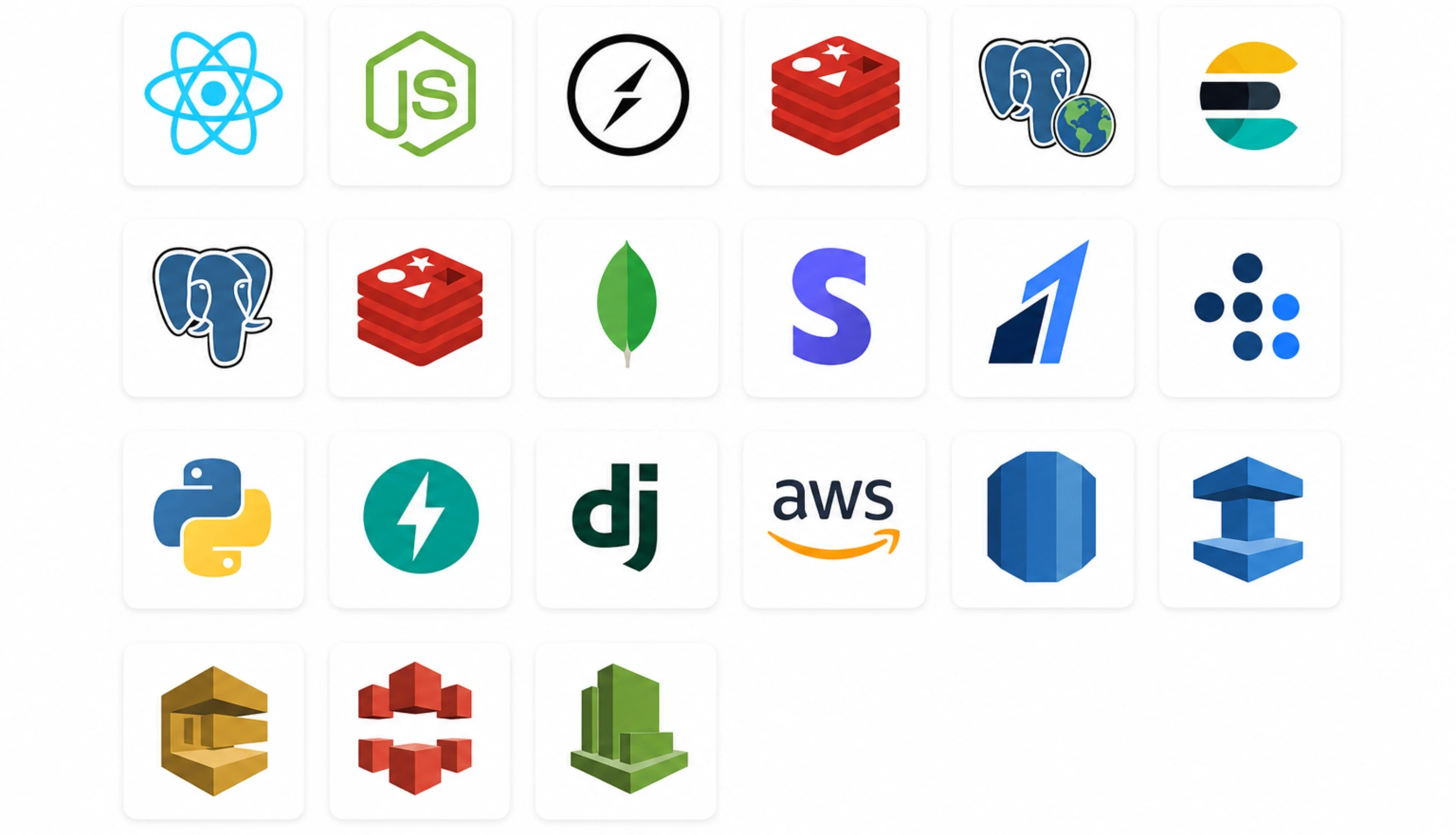
The best tech stack for on-demand platforms in 2026 is determined by three variables: whether the platform requires real-time matching and location broadcasting, whether the business logic is complex or relatively standard, and whether the development team has existing expertise in a given language or ecosystem. Teams building mobile-first platforms often choose to hire React Native developers to accelerate cross-platform delivery without maintaining separate iOS and Android codebases. The matrix below covers every layer with a specific choice rationale for each platform type.
Stack Layer | Real-Time Platforms (Ride, Food, Courier) | Scheduled Platforms (Home Services, Freelance) | Acquaint Default |
Mobile apps | React Native (JS/TS). 32% global cross-platform share (Statista 2025). Largest talent pool. Mature on-demand libraries (react-native-maps, react-native-ble-plx, react-native-payments). | React Native or Flutter. Both viable. Flutter is preferred for pixel-perfect clinical UI with complex custom animations. | React Native for all on-demand builds. Flutter only when pixel-perfect custom UI or healthcare waveform rendering is required. |
Backend API | Node.js — event-driven, WebSocket-native. Handles 10,000+ concurrent real-time connections on a single instance with non-blocking I/O. | Laravel (Official Laravel Partner). Complex business logic, Horizon job queues, Sanctum API tokens, payment libraries — all mature and production-proven. | Laravel primary API for business-logic-heavy platforms. Node.js for real-time event-driven platforms. Hybrid pattern (Laravel + Node.js WebSocket microservice) for platforms requiring both. |
Real-time layer | Socket.io + Redis pub/sub. Required for live GPS broadcast, order state updates, and driver dispatch events. | Not required at MVP stage. Laravel Horizon queues + FCM/APNs handle async event notifications reliably. | Socket.io + Redis on all platforms with live location tracking or real-time order status. Redis pub/sub is used as the internal event bus between microservices. |
Geospatial index | PostGIS (PostgreSQL extension) + Elasticsearch geo-distance query. Sub-200ms provider radius search at 10,000+ concurrent requests. | Google Maps Platform for address validation and distance matrix. PostGIS optional for advanced proximity search. | PostGIS for all spatial queries. Google Maps Platform for routing, display, and address autocomplete on all platforms. |
Primary database | PostgreSQL + PostGIS. Redis for session cache and real-time pub/sub. MongoDB for flexible event logs and schema-less provider service data. | PostgreSQL for relational data. Redis for caching. MongoDB optional for unstructured service logs. | PostgreSQL primary + Redis cache on all platforms. MongoDB was added for high-volume event logging at the growth stage. |
Payment processing | Stripe Connect for multi-party splits (US, UK, Australia, UAE, Canada). Razorpay for India. Braintree for US enterprise. | Stripe Connect for escrow and milestone payments. Same regional options. | Stripe Connect is the default for all new builds. Custom integration for regional payment rails is not yet supported by Stripe (e.g., specific MENA markets). |
AI and ML layer | Python FastAPI or Django ML microservice. Integrated via internal REST API. Handles surge pricing models, driver matching optimisation, demand forecasting, and fraud detection signals. | Python ML service for a recommendation engine and demand forecasting. Optional at MVP. Growth-stage add-on. | Python ML microservice as a growth-stage component. Integrated via REST API with the primary Laravel or Node.js backend. |
Infrastructure | AWS ECS with auto-scaling groups. RDS (PostgreSQL), ElastiCache (Redis), SQS for async queues, CloudFront CDN, CloudWatch monitoring. | AWS or GCP. Less infrastructure complexity at the MVP stage. Single EC2 + RDS viable at launch for scheduled platforms. | AWS ECS auto-scaling is the production standard. Kubernetes for platforms scaling beyond 50,000 daily active users. |
For on-demand platforms that require AI-driven matching, demand forecasting, or surge pricing, Acquaint Softtech's Laravel AI development practice integrates LLM (Large Language Model) and RAG (Retrieval-Augmented Generation) pipelines into the Laravel backend. These services handle provider recommendation, conversational support interfaces, and automated fraud detection signal processing.
React Native holds a 32% market share among cross-platform mobile frameworks globally (Statista, 2025), making it the default mobile choice for on-demand builds. For teams evaluating React Native specifically, the guide to top React Native app development companies in 2026 published on the Acquaint blog, covers framework selection, performance benchmarks, and vendor evaluation criteria in detail.
On-Demand Feature Matrix: What Every Category Must Have to Operate
Every on-demand platform has a universal baseline feature set and a set of category-specific features that are non-negotiable for the platform to function. The distinction matters at the scoping stage because category-specific features are the ones that most frequently surprise teams that have not built in a specific vertical before, and they are the ones that cannot be added post-launch without a significant architecture change.
Universal Feature Set - 10 Features Required in Every On-Demand Platform
These 10 features are required in every on-demand platform regardless of category. None is optional at the MVP stage:
# | Feature | What It Does | Skip It and What Happens |
1 | OTP-based authentication | Mobile number verification for both sides. Password-less login. Role-based access from account creation. | Fraud rates spike within weeks. Fake provider accounts are the most common early-stage platform abuse. |
2 | Service discovery and search | Category browse, text search, location-radius filter, price range, rating sort. Sub-200ms response at scale. | Users cannot find providers. First sessions end without transactions. Organic retention is near zero. |
3 | Booking or order placement flow | Select service → confirm details → preview price → confirm. Maximum 4 taps to confirm a booking. | Booking abandonment exceeds 60%. Customers who cannot place an order in 60 seconds rarely return. |
4 | Multi-party payment processing | Card on file, in-app wallet, cash option. PCI-DSS compliant tokenised card storage. Multi-party split for three-sided. | No platform commission capture. Refund disputes have no resolution mechanism. Manual payment creates fraud exposure. |
5 | Push notifications (FCM + APNs) | Transaction state change notifications for all parties. Firebase for Android, Apple Push Notification Service for iOS. | Customers and providers have no awareness of transaction events. Cancellation rates spike immediately after launch. |
6 | Real-time order status tracking | Live status updates across all transaction states. Map view for active trips and deliveries. | Customers phone providers directly. Platform disintermediation, the bypass of the app, happens within weeks. |
7 | Ratings and reviews | Two-directional: customer rates provider, provider rates customer after every completed transaction. Admin moderation. | Trust signals never form. Without ratings, new customers have no quality signal. First-order conversion stays low. |
8 | In-app dispute submission | Ticket with transaction reference + evidence upload. Escalation path to the admin panel with full audit trail. | Disputes go to WhatsApp or email. No audit trail. Provider payouts cannot be safely adjusted. Fraud is undetectable. |
9 | Provider dashboard | Earnings summary, payout history, active job calendar, document upload, and KYC status visibility. | Top providers leave for platforms that give them earnings visibility. Provider churn kills supply density. |
10 | Admin panel | User management, order management, pricing config, payout processing, analytics. Required from day 1. | The platform cannot be operated without direct database access. Scale is structurally impossible. |
Category-Specific Feature Requirements - Non-Negotiable by Platform Type
These features cannot be added post-launch without significant architecture changes. They must be scoped from day one:
Platform Type | Category-Specific Required Features | Primary Architecture Implication |
Ride-Hailing | Real-time GPS dispatch engine, surge pricing calculator, route navigation (Mapbox or Google Maps), driver earnings dashboard, trip-sharing safety feature (SOS + trip share with contact), driver background check, and vehicle document verification | WebSocket infrastructure from day 1. PostGIS geospatial index. Multi-vehicle-type pricing config in admin. |
Food Delivery | Three-party order orchestration, restaurant-side tablet or kitchen display app, estimated preparation time (EPT) engine, delivery dispatch based on EPT, live order tracking for three parties, contactless delivery confirmation with photo capture | Three-party notification sequencing. EPT calculation pipeline. Restaurant POS webhook integration optional. |
Home Services | Provider availability calendar, service-area polygon per provider, identity and credential verification workflow (government ID + trade license), in-home arrival confirmation, post-service photo upload, scheduled vs instant booking toggle | Zone-based provider matching. Credential document storage (S3 + CDN). Scheduled job queue (Laravel Horizon). |
Gig / Freelance | Proposal and bidding system, milestone-based payment escrow with hold and release, contract PDF generation, file delivery and version management, hourly billing with time-tracking, portfolio and work sample management | Escrow hold/release state machine. Contract PDF generation (PDF via S3). Hourly billing event tracking. |
Healthcare On-Demand | HIPAA-compliant PHI storage (AES-256 at rest), TLS 1.3 in transit, video consultation (WebRTC or Agora SDK), e-prescription module, EMR integration capability, insurance verification flow, regulatory compliance layer per geography | Encrypted data layer from day 1. Video infrastructure (Agora or Twilio). Audit log for all PHI access events. |
Logistics / Last-Mile | Proof-of-delivery (photo + digital signature), multi-stop route optimisation engine, barcode/QR scan at intake and delivery, fleet management dashboard, real-time ETD per stop, weight and dimension-based pricing calculator | Route optimisation engine (OR-Tools or custom). Fleet tracking at scale. POD media storage with CDN delivery. |
For the full feature breakdown and cost ranges for taxi and ride-hailing platforms specifically, the on-demand taxi booking app cost guide covers per-feature development cost estimates and recommended MVP feature sets for the ride-hailing category.
Know Your Category? Get a Scoped Feature List in 48 Hours.
Acquaint Softtech maps your platform's required features by category, clearly separates must-have from nice-to-have at the MVP stage, and delivers a development scope document within 48 hours of your brief.
On-Demand App Monetisation Models: How the Revenue Actually Works
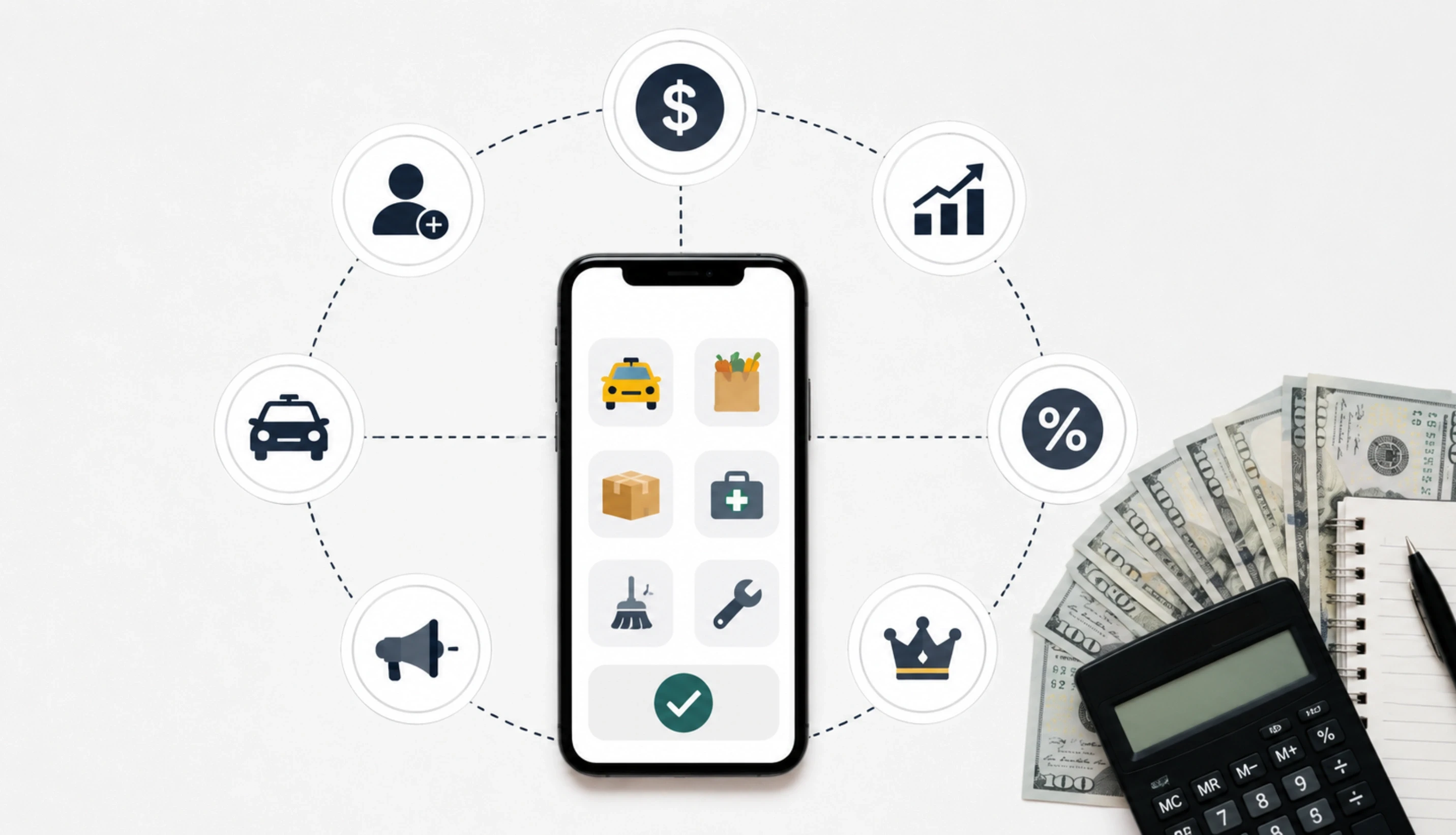
Most on-demand platforms combine two or three revenue streams. The primary model is set at launch and determines the payment architecture built into the platform. The secondary models are layered in as the platform achieves transaction density. Understanding which monetisation model applies to your category determines which payment infrastructure is required from day one.
Revenue Model | How It Works | Typical Take Rate | Best-Fit Categories | Required in Build |
Commission per transaction | The platform takes a percentage of every completed transaction before disbursing the provider payout. | 10–30% depending on category and geography | Ride-hailing, food delivery, home services, and healthcare | Multi-party payment split. Configurable commission rate per category in the admin panel. |
Provider subscription | Providers pay a fixed monthly fee for platform access, reduced commission rates, or featured placement in search results. | $30–$500/month per provider | Freelance, home services, healthcare directories, legal on-demand | Stripe Billing subscription management. Tier-based commission rate logic. |
Customer subscription | Customers pay for unlimited delivery, reduced fees, or priority matching. Modelled on DashPass and Amazon Prime. | $5–$20/month per customer | Food delivery, ride-hailing, grocery delivery | Subscription state is applied to commission calculation at checkout. Tier-based pricing logic. |
Lead generation fee | Providers pay per qualified lead connection, regardless of whether a transaction completes. | $2–$50 per qualified lead | Home services, legal on-demand, and healthcare consultation | Lead credit wallet. Credit deduction per customer connection event. Depletion notification. |
Surge pricing uplift | Dynamic pricing multiplier applied during high-demand periods. A portion of the uplift is retained by the platform. | Platform retains 15–25% of total surge uplift revenue | Ride-hailing, on-demand courier, food delivery | Surge pricing engine. Real-time demand/supply signal pipeline updated every 30–60 seconds. |
In-app advertising | Promoted placement in search results, homepage features, or sponsored provider cards with impression-based billing. | CPM $2–$15 or CPC $0.50–$5.00, depending on placement | Food delivery, home services, and e-commerce on demand | Ad slot configuration in admin. Impression and click tracking. Ad spend dashboard for merchants. |
SaaS and white-label licensing | Platform technology is licensed to operators who run their own branded marketplace at a recurring monthly fee. | $500–$5,000+ per month per operator instance | All categories at scale, franchise or regional operator models | Multi-tenant architecture. Operator configuration panel. White-label deployment and domain pipeline. |
The standard commission rates by category as of 2026: ride-hailing platforms take 20 to 25 percent from drivers; food delivery platforms take 15 to 30 percent from restaurants; freelance platforms take 10 to 20 percent from providers; home services platforms take 15 to 25 percent from service professionals. These rates compress as platforms mature and face competition from both direct competitors and provider-to-customer bypass channels.
For teams building white-label on-demand platforms, a branded marketplace on top of a proven infrastructure base, Acquaint Softtech's white label software development company services deliver a fully configurable multi-tenant on-demand platform with operator controls, zone management, and custom branding deployed under the client's domain.
What Does It Cost to Build an On-Demand App in 2026?
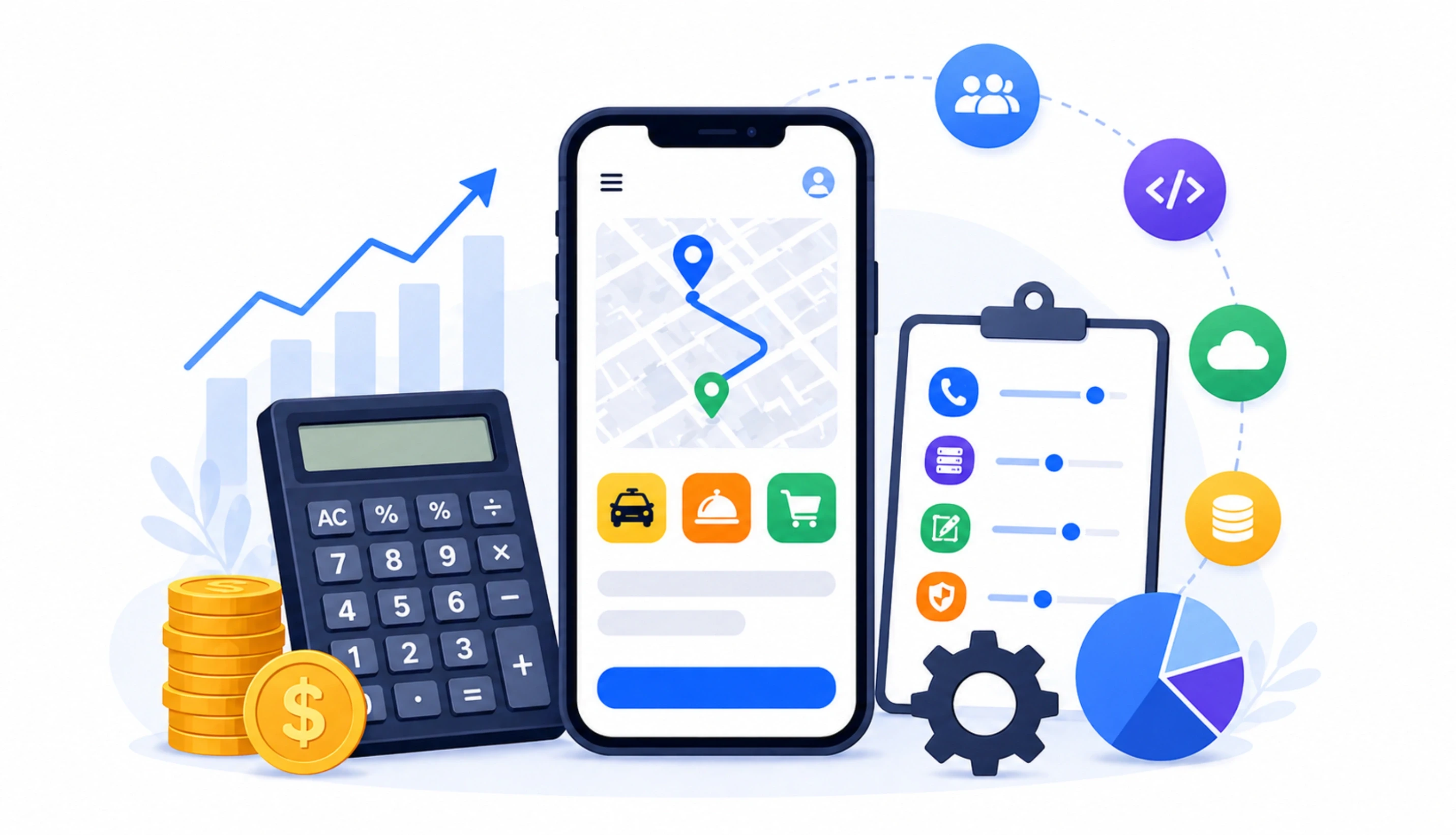
On-demand app development cost in India is the most-searched question in this category. All figures below are based on Acquaint Softtech's delivery data across 1,300+ projects, quoted in USD, for India-based dedicated team development. Costs vary by platform type, user-side count, real-time infrastructure requirements, AI feature inclusion, and regulatory compliance layers.
Cost by Platform Type and Development Stage
Platform Type | MVP (Production-Ready) | Growth Stage | Enterprise Scale | US/UK In-House Equiv. |
Ride-Hailing (Uber-style) | $30,000–$55,000 | $55,000–$120,000 | $120,000–$300,000+ | $180,000–$600,000+ |
Food Delivery (DoorDash-style) | $35,000–$65,000 | $65,000–$140,000 | $140,000–$350,000+ | $200,000–$700,000+ |
Home Services Marketplace | $25,000–$50,000 | $50,000–$110,000 | $110,000–$280,000+ | $150,000–$550,000+ |
Freelance / Gig Marketplace | $20,000–$45,000 | $45,000–$90,000 | $90,000–$250,000+ | $120,000–$450,000+ |
Healthcare On-Demand (HIPAA) | $35,000–$70,000 | $70,000–$150,000 | $150,000–$400,000+ | $220,000–$800,000+ |
Logistics / Last-Mile Delivery | $30,000–$60,000 | $60,000–$130,000 | $130,000–$320,000+ | $180,000–$640,000+ |
On-Demand Courier App | $25,000–$50,000 | $50,000–$100,000 | $100,000–$260,000+ | $150,000–$520,000+ |
On-Demand Beauty / Lifestyle | $20,000–$45,000 | $45,000–$90,000 | $90,000–$230,000+ | $120,000–$460,000+ |
Cost by Team Composition - Monthly Dedicated Team Rate
Team Composition | Monthly Rate (India) | Equiv. US/UK Monthly | Annual Saving vs US | Best For |
1 Senior Dev + PM | $5,000–$8,000 | $25,000–$40,000 | $200,000–$380,000/yr | Single-feature builds or post-MVP iteration sprints |
2 Devs + QA + PM | $9,000–$14,000 | $45,000–$70,000 | $360,000–$660,000/yr | Two-sided MVP or major feature expansion to the existing platform |
3 Devs + QA + PM (Standard) | $13,000–$20,000 | $65,000–$100,000 | $570,000–$960,000/yr | Full three-sided marketplace MVP — the most common engagement type |
5 Devs + 2 QA + PM + DevOps | $20,000–$32,000 | $100,000–$160,000 | $960,000–$1,500,000+/yr | Growth-stage platform with an AI layer, Kubernetes, and multi-city support |
What the Monthly Rate Includes - No Hidden Costs
✓ All client applications (4 for three-sided platforms) ✓ Real-time geolocation and matching infrastructure ✓ Payment gateway integration (Stripe Connect / Razorpay) ✓ Push notification infrastructure (FCM + APNs) | ✓ AWS staging and production environment with CI/CD pipeline ✓ Sprint planning and review sessions (1–2 hrs/week client) ✓ Full API documentation and codebase handoff at engagement end ✓ 30-day post-handoff support at no additional charge |
The rate the client pays is the rate. No additional employer overhead, equipment costs, HR, payroll processing, or benefits costs apply. Acquaint Softtech absorbs all operating costs within the quoted monthly rate.
For teams that need a single specialist added to an in-house team, rather than a full platform build, Acquaint Softtech's IT staff augmentation services place a pre-vetted React Native, Laravel, Node.js, Python, MERN, or DevOps engineer into the client's sprint within 48 hours. The engineer operates under the client's project management process, Jira board, and code review standards.
For courier and logistics platform cost ranges specifically, the on-demand courier app cost guide covers per-feature cost estimates and the infrastructure decisions that most affect budget in the logistics category.
Get a Scoped Cost Estimate for Your On-Demand Platform
Describe your platform type, the number of user sides, your target geography, and whether you need AI features or regulatory compliance. Acquaint Softtech returns a scoped cost estimate and team structure within 48 hours. No commitment required before you review.
The Cold-Start Launch Playbook: 4 Stages From Zero to Operating Density
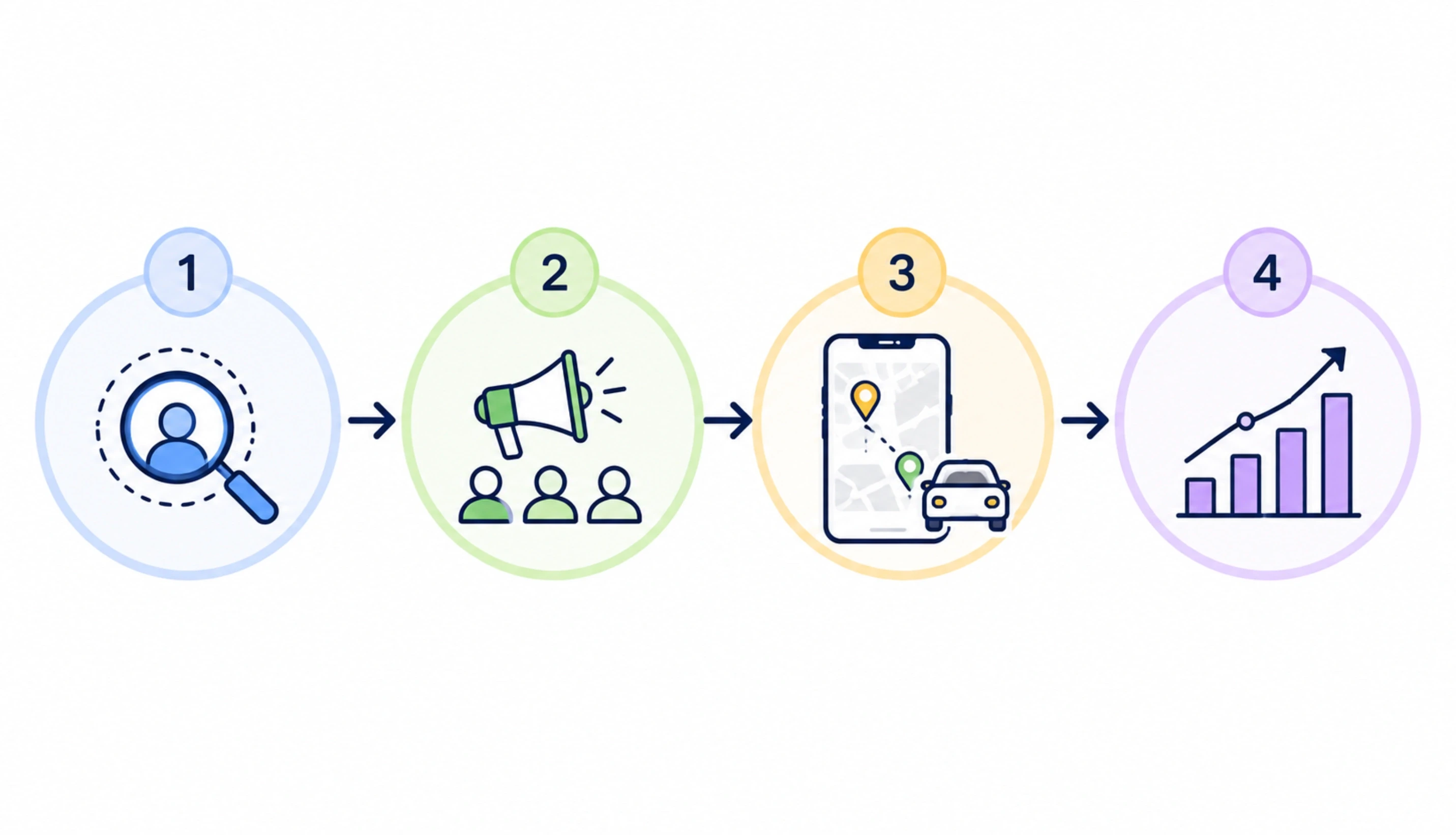
The cold-start problem is the most common on-demand startup failure mode and the one most frequently underestimated at the planning stage. An on-demand marketplace has no value to customers if there is no supply, and no value to providers if there are no customers. Both sides must exist in the same geography for the platform to produce its first successful transaction. The sequence in which supply and demand are built determines whether the launch survives the first 90 days.
Stage 1:Supply-First, Hyper-Local
The consistent pattern across every successful on-demand launch is supply acquisition before any demand-side marketing spend. Minimum supply thresholds before demand activation: 50–100 verified drivers in one district for ride-hailing; 20–30 restaurant partners in one neighbourhood for food delivery; 30–50 credentialled providers in one service category for home services; 15–20 verified professionals per specialty per city for healthcare on-demand.
Supply-first has two compounding functions: (1) It guarantees the customer's first experience is successful; a customer who cannot find a provider within 3 minutes in a new on-demand app does not give the platform a second chance; (2) It creates a genuine earnings opportunity for early providers, which drives organic word-of-mouth supply recruitment. Early providers in a growing marketplace earn more per hour than later ones because density is lower and the platform subsidises their early participation.
Stage 2: Geographic Concentration
The geographic error in on-demand launches is attempting city-wide coverage from day one. Supply thinning across an entire metropolitan area produces slow match times (which destroys customer retention), low provider earnings per hour (which drives provider churn), and poor customer experience (which prevents word-of-mouth growth). The correct approach: launch in 2 to 3 high-density districts, achieve matching density within those zones, then expand only after the core metrics are healthy.
Uber launched in a 4-square-mile zone of San Francisco in 2010. Rapido launched in one area of Bangalore. Urban Company launched in one Delhi neighbourhood. Geographic concentration is not a limitation; it is the mechanism that makes the early marketplace produce the density required for the response-time guarantees that convert customers. Minimum supply density thresholds before demand activation: 40–60 active drivers per 100 sq km for ride-hailing; 20–30 restaurant partners per launch area for food delivery; 15–20 verified providers per category per city for home services.
Stage 3 : Demand Activation With a Provider Response-Time Guarantee
Demand activation, the first consumer marketing spend, should be timed to coincide with confirmed supply density in the launch zone. The demand activation mechanism that consistently outperforms standard promotional offers is a provider response-time guarantee: 'a driver in under 4 minutes or your next ride is free,' 'a plumber within 90 minutes or your booking is waived.' This converts supply density into a customer promise. The platform is not selling 'an app', it is selling a reliability commitment that the supply density already makes possible. The response-time guarantee is also what justifies the customer's risk of trying a new platform over an established competitor. It must be backed by supply data, not used as a marketing claim before the supply exists.
Stage 4: Retention Before Geographic Expansion
The most common post-launch error is expanding geographically before achieving retention in the launch zone. Geographic expansion dilutes supply density in the existing zone → degrades match times → degrades provider earnings → drives provider churn → degrades customer experience. A compounding spiral that has ended more on-demand companies than competition or market size. The retention benchmark before geographic expansion: 30-day repeat-use rate above 40% in the existing zone.
Below 40%, the product is not yet a habit. Geographic expansion below the 40% threshold compounds a retention problem rather than solving it. Measure: customer cohort retention weekly, provider earnings per active hour weekly, and match time by zone. These three metrics tell you when to expand, not your investor timeline.
Platform Tooling Required to Execute the Cold-Start Playbook
The cold-start playbook is not just a go-to-market strategy. It requires specific platform tooling that must be in the MVP scope:
Provider onboarding flow with document upload (government ID, trade license, vehicle documents), identity verification, and admin-side KYC approval workflow
Zone management in the admin panel: define launch zones geographically, set supply density thresholds per zone, expand service areas without a code deployment
Supply density dashboard: real-time view of active providers per zone, acceptance rates, and average response times, viewable by the ops team without engineering access
Response-time SLA configuration: set and display provider response-time guarantees to customers by zone and service category
Retention analytics: 7-day, 14-day, and 30-day repeat-use rate by customer cohort, and provider earnings per active hour by zone, visible in the admin panel
Acquaint Softtech's virtual CTO services include a cold-start strategy as a component of the product advisory engagement for early-stage on-demand startups, covering launch zone selection, supply acquisition tooling design, and the analytics instrumentation required to track the density and retention metrics that govern expansion decisions.
The 12 On-Demand Sub-Pillar Categories: Your Deep-Dive Index
This master guide is the root of a 290-article content cluster. Each sub-pillar below covers architecture, features, team composition, costs, and development decisions for one specific on-demand platform type. If your platform fits a specific category, start with the relevant sub-pillar guide after reading this one.
# | Category | Sub-Pillar Guide Title | Clusters | Key Technical Focus |
1 | Ride-Hailing and Taxi | How Ride-Hailing Apps Work: Architecture, Driver Matching, and Real-Time Location Tracking | 27 | Real-time dispatch, surge pricing, GPS matching, driver app |
2 | Food Delivery | Building a Food Delivery App Like Zomato or DoorDash: Architecture, Features, and Scale | 27 | EPT engine, restaurant tablet app, three-sided orchestration |
3 | Home Services | Building a Home Services App Like UrbanClap or TaskRabbit: Marketplace Architecture for Local Services | 25 | Provider verification, scheduling engine, zone management |
4 | Logistics and Last-Mile | Building an On-Demand Logistics Platform: Courier, Parcel, and Last-Mile Delivery Apps | 23 | Route optimisation, proof of delivery, fleet management |
5 | Healthcare On-Demand | Building On-Demand Healthcare Apps: Doctor Consultation, Medicine Delivery, and Home Sample Collection | 18 | HIPAA compliance, WebRTC video, EMR integration, PHI storage |
6 | Gig and Freelance | Building a Freelance Marketplace Like Upwork or Fiverr: Two-Sided Platform Architecture | 20 | Escrow, bidding system, milestone payments, and hourly billing |
7 | Beauty, Fitness, Lifestyle | Building On-Demand Lifestyle Apps: Beauty, Fitness, Wellness, and Personal Care Marketplaces | 18 | Stylist matching, appointment scheduling, portfolio management |
8 | Features and Architecture | On-Demand App Architecture: Scalable Three-Sided Platforms for Customers, Providers, and Admin | 24 | System design, microservices, scalability patterns, state machines |
9 | AI and Analytics | AI in On-Demand Apps: Matching, Pricing, Fraud Detection, and Predictive Analytics | 21 | ML matching, dynamic pricing models, fraud signal pipelines |
10 | Startup Guidance | How to Build an On-Demand Startup: From Idea to MVP to Scale | 25 | Business model, unit economics, funding sequencing, team building |
11 | Industry Trends | The Future of On-Demand Apps 2026–2030: Trends, Predictions, and What to Build Now | 19 | EV integration, AI agents, super-app convergence, hyperlocal trends |
12 | Why Acquaint Softtech | Why Choose Acquaint Softtech for On-Demand App Development: 100+ Marketplace Projects Delivered | 30 | Delivery model, portfolio, technology partnerships, client results |
Ready to Build Your On-Demand Platform With Acquaint Softtech?
1,300+ projects. 48+ Clutch reviews. 1,293 Upwork jobs. Acquaint Softtech assembles your full on-demand development team, customer app, provider app, fulfilment app, admin panel, and backend, within 48 hours of project confirmation. You interview every developer. The rate you see is the rate you pay.
Frequently Asked Questions
-
How much does it cost to build an on-demand app like Uber?
A basic ride-hailing MVP costs $30,000 to $55,000 with core apps (customer, driver, admin). A growth-stage platform with features like surge pricing and multi-city support ranges from $55,000 to $120,000. Enterprise-level systems with AI and auto-scaling infrastructure can exceed $120,000 to $300,000+. Costs depend on real-time complexity, features, and geography, with US/UK builds costing 3 to 5 times more.
-
What features does a marketplace app need?
Every on-demand platform requires core features like authentication, search, booking flow, payments, notifications, real-time tracking, reviews, dispute handling, earnings dashboard, and admin panel. Advanced marketplaces also need dispatch systems, live GPS tracking, and multi-party payments. Category-specific features (like healthcare compliance or logistics routing) must be planned from the start.
-
What is the best tech stack for on-demand platforms in 2026?
Real-time apps (ride-hailing, delivery) use React Native, Node.js, Redis, PostgreSQL (with geospatial), and AWS. Scheduled platforms (freelance, home services) often use Laravel, PostgreSQL, and Redis. AI features like matching and pricing rely on Python-based microservices. The final stack depends on real-time needs and system complexity.
-
How long does it take to build an on-demand MVP?
A full MVP takes 10 to 14 weeks, including discovery, development, and QA. A lighter version can launch in 6 to 8 weeks, while advanced platforms with AI or compliance needs may take 16 to 24 weeks. Timelines are finalized during the discovery phase with a structured sprint plan.
-
How do I solve the cold-start problem for an on-demand marketplace?
Start with a supply-first approach in one geographic area. Ensure enough providers (e.g., drivers or vendors) before attracting users. Once supply is stable, launch demand campaigns. Expand only after achieving 40%+ repeat usage; scaling will amplify early problems.
-
What government or regulatory standards apply to on-demand apps in 2026?
Compliance depends on category and region. Examples include HIPAA (healthcare, US), PCI-DSS (payments), FDA SaMD (AI healthcare tools), and food safety regulations (UK). Platforms must design compliance into architecture from the beginning, not after launch.
-
Can I outsource my on-demand app development to India without sacrificing quality?
Yes, if structured correctly. High-quality outsourcing requires dedicated teams, experienced tech leads, agile sprint cycles, and full IP ownership agreements. This approach can reduce costs by around 40% compared to in-house teams in the US or UK.
-
What happens to the codebase at the end of an Acquaint Softtech engagement?
The client fully owns the codebase. This includes repository access, infrastructure configs, API documentation, and credentials. A handoff session and 30-day support period ensure a smooth transition, with no ongoing dependency unless contracted.
We’re Acquaint Softtech, your technology growth partner. Whether you're building a SaaS product, modernizing enterprise software, or hiring vetted remote developers, we’re built for flexibility and speed. Our official partnerships with Laravel, Statamic, and Bagisto reflect our commitment to excellence, not limitation. We work across stacks, time zones, and industries to bring your tech vision to life.
Table of Contents
Get Started with Acquaint Softtech
- 13+ Years Delivering Software Excellence
- 1300+ Projects Delivered With Precision
- Official Laravel & Laravel News Partner
- Official Statamic Partner
Related Blog

10 Must Follow Steps of Mobile App Development Process
The mobile app development process is a structured set of 10 steps that moves an idea from concept to a published app: ideation, target audience and monetization, choosing the platform, UI/UX design, picking tools, choosing the right partner, fast development, testing and deployment, marketing, and post-launch maintenance. Following the steps in order, rather than rushing to publish, is what separates apps that get downloads from the ones that get ignored.

Mukesh Ram
July 29, 2019
12 Practical Tips to Master Android App Development in 2026
Mastering Android development in 2026 means writing Kotlin, building interfaces in Jetpack Compose, and keeping your app inside Google Play's target API rules. From 31 August 2026, new apps and updates must target Android 16 (API level 36) and existing apps must target at least Android 15 (API level 35) to stay available on newer devices. Craft matters, but compliance decides whether anyone can install what you build.
Mukesh Ram
July 24, 2018
The Best Flutter App Development Company For Your Dream Project
The best Flutter app development company depends on your project goals, but the top-rated partners all share three traits: a real portfolio of published Flutter apps, clean state management (BLoC, Provider, or Riverpod), and full lifecycle support from UI design to backend sync and CI/CD. In 2026, Flutter holds roughly 46% of the cross-platform developer market, so choosing a proven team, not the first Google result, is what protects your budget and timeline.
Mukesh Ram
July 5, 2019India (Head Office)
203/204, Shapath-II, Near Silver Leaf Hotel, Opp. Rajpath Club, SG Highway, Ahmedabad-380054, Gujarat
USA
7838 Camino Cielo St, Highland, CA 92346
UK
The Powerhouse, 21 Woodthorpe Road, Ashford, England, TW15 2RP
New Zealand
42 Exler Place, Avondale, Auckland 0600, New Zealand
Canada
141 Skyview Bay NE , Calgary, Alberta, T3N 2K6