

The Complete Guide to Logistics & Supply Chain Software Development in 2026
Logistics and supply chain software development in 2026 is not a single discipline. It is six distinct product categories, each with its own integration burden, operational perimeter, and cost curve.

Acquaint Softtech
Most briefs that reach Acquaint Softtech for logistics software product development are scoped at half their actual cost. Integration is added at the end instead of being designed in on day one. Teams are planned as engineers only, missing the operations lead, the integration specialist, and the DevOps capacity the work actually needs.
The result is predictable: six-figure integration rework, missed launches because event contracts were never specified, carrier and EDI connections stalled because schemas were decided too late, and vendor changes mid-build because domain depth was never there.
According to US Bureau of Labor Statistics data on transportation and warehousing, the sector employs over 6.5 million workers in the US alone, and the operational cost of a failed logistics cutover is measured in weeks of lost revenue, not engineering hours. Industry failure-mode studies consistently place integration gaps and untested cutovers at the top of the root-cause list.

- Founders evaluating a logistics software build for the first time and trying to scope cost, integration surface, and timeline.
- CTOs and engineering leads at 3PLs, shippers, or LogiTech startups comparing in-house build versus outsourced delivery.
- Product managers planning a TMS, WMS, OMS, or last-mile platform and selecting a primary tech stack.
- COOs and operations heads building a vendor framework for an ongoing logistics software development programme.
This logistics software development guide 2026 fixes that gap with an operator-level roadmap drawn from real delivery. Acquaint Softtech is an Official Laravel Partner with 70+ engineers, 1,300+ projects shipped over 13 years, and 48 verified Clutch reviews; our logistics practice covers transportation management, warehouse management, order management, last-mile delivery, freight and customs, and AI-assisted ETA and exception workflows.
You can start with our custom software product development approach if you want a single end-to-end engagement. Every cost, timeline, and delivery benchmark below comes from shipped work, not theory.
Logistics Software Market in 2026: What's Driving Demand
Before scoping a logistics software build, it is worth understanding the market context in which the product will land. The 2026 logistics software market is being reshaped by four converging forces, and each one is creating distinct categories of buying demand that map directly to the build decisions later in this guide.
eCommerce growth has made same-day and next-day delivery the default promise
Consumer expectation for fast delivery is no longer a premium segment; it is the baseline. Across 2024 and 2025, same-day and next-day delivery settled into 35 to 55 percent of urban eCommerce volume in mature markets. The implication for software buyers: last-mile platforms, rate shopping, and real-time routing are no longer nice-to-haves; they are baseline commercial requirements. The throwaway spreadsheet-based last-mile workflows of five years ago are being replaced with proper platforms.
Labour cost pressure is forcing warehouse digitization
Warehouse labour shortages and wage inflation across the US, UK, Australia, and the UAE have made manual pick-and-pack uneconomical above modest volumes. UK data from the Office for National Statistics shows that median hourly earnings for roles in transport and storage have continued to rise, based on the Annual Survey of Hours and Earnings (ASHE). The implication: there is real, sustained buying demand for WMS platforms, pick-path optimization tools, and the integrations that tie them into ordering and shipping systems. Logistics software market trends 2026 increasingly align with digital logistics trends 2026, favouring products that close the loop from order to shipped package with the smallest possible human touch.
AI-assisted logistics workflow is moving from pilot to production
Dynamic ETA prediction, exception classification on delayed shipments, and automated document extraction from POD images crossed from pilot to standard offering in 2024 and 2025 across major 3PLs and shippers. The implication: logistics software now usually includes at least one AI feature. Acquaint Softtech delivers this work through our ai development services practice, with most engagements integrating narrow task-specific models for route optimization and exception triage, and large language models for document understanding.
Trade and compliance enforcement is tightening
Cross-border compliance enforcement has tightened meaningfully. US Customs and Border Protection updated its Automated Commercial Environment (ACE) reporting requirements across 2024 and 2025. UK HMRC and EU customs authorities ran coordinated enforcement programmes on undervalued eCommerce imports. The UAE Federal Authority for Identity, Citizenship, Customs & Port Security has continued tightening its electronic declaration regime. The implication: logistics software buyers are scrutinizing vendor integration depth on customs, duty calculation, and HS code classification more carefully than they did three years ago.
What this means for logistics software demand in 2026
These four forces produce a market where the most common active buying conversations Acquaint Softtech has with new prospects fall into four shapes: last-mile and routing platform builds (Force 1), WMS and automation platforms (Force 2), AI-feature additions to existing logistics products (Force 3), and customs and compliance modules (Force 4). All four require the same underlying engineering discipline. The differences are in scope, integration, and time horizon.
Stepping back, this is also why businesses need logistics software development as a strategic capability rather than a one-off project. The market is no longer rewarding one-shot builds that ignore real-time ETA, AI integration, or evolving customs enforcement. It is rewarding systems that ship, then iterate against real operational and commercial data over multi-year horizons. The vendor relationship that supports that iteration matters more than any single launch milestone.
Quick Take
Four forces are shaping demand in 2026: same-day as baseline, warehouse labour pressure, AI moving to production, and tighter customs enforcement. The buying conversation is now about durable, multi-year systems, not one-shot builds.
Map Your Product to Market Forces →
What Logistics Software Actually Is: The Six Categories
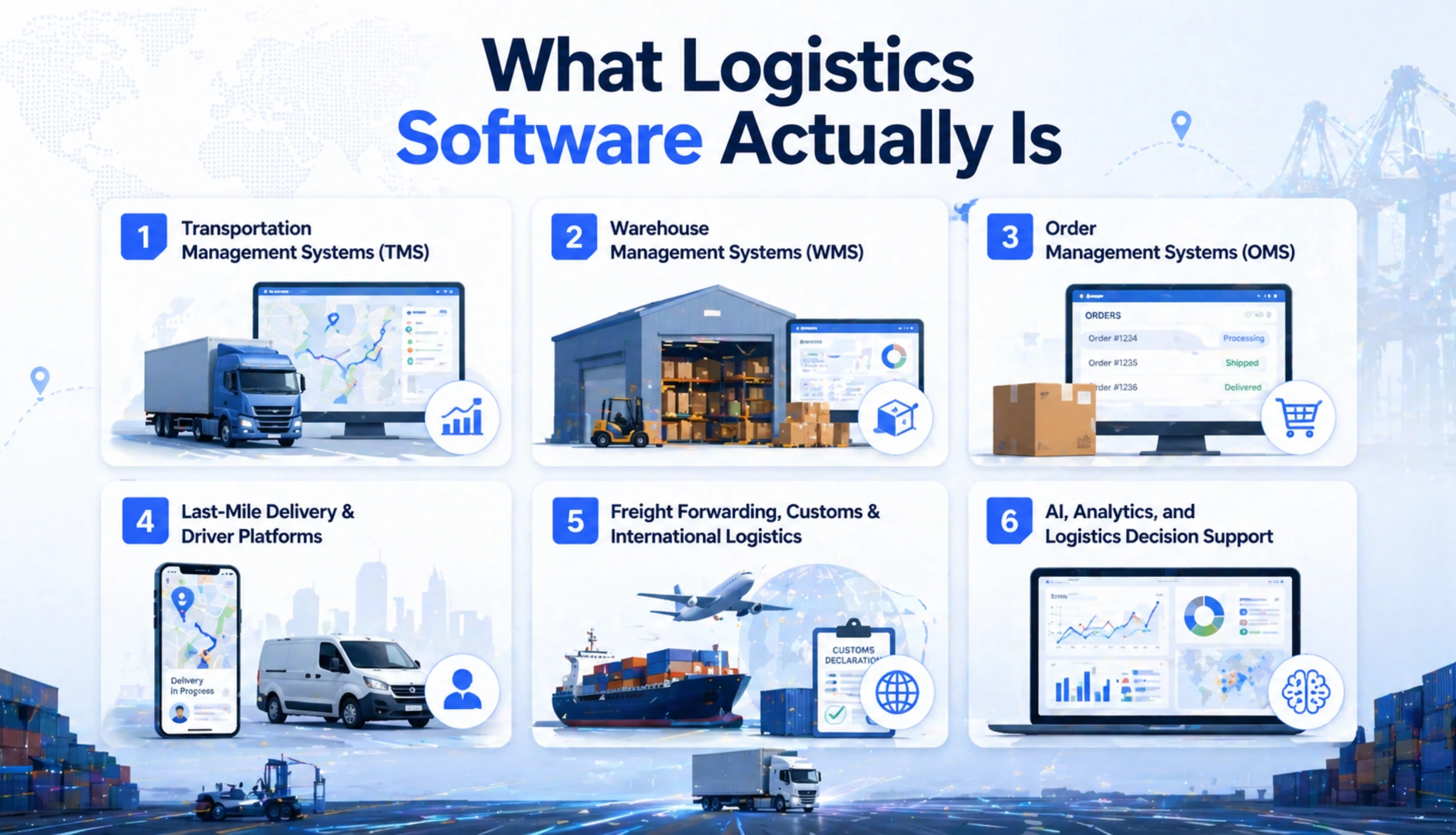
Logistics software is any system that plans, executes, tracks, or analyzes the movement of goods from supplier to customer. Across our 1,300+ delivered projects at Acquaint Softtech, logistics engagements consistently fall into six distinct categories that differ by user, by integration surface, and by operational weight.
Understanding which category your product belongs to is the single most important early decision. It determines the team you need, the integrations you must build, the operational stakeholders you answer to, and the cost. Some products span two categories; where they do, the higher-complexity category sets the standard for the entire system.
Transportation Management Systems (TMS)
TMS platforms own load tendering, carrier rate comparison, dispatch, tracking, Proof of Delivery (POD) capture, and freight invoice reconciliation. The engineering perimeter spans carrier API integrations, EDI partner connections, fuel card interfaces, and freight accounting. The operational focus is on dispatcher productivity, freight cost control, and accessorial charge recovery.
TMS builds tend to be medium-weight in code volume but heavy in integration surface. A mature TMS catches a wrongly billed accessorial charge from a carrier within twenty-four hours of the invoice landing, which is where most teams recover the software's cost within the first year. Common buyers: 3PLs, shippers with three or more carriers, freight brokerages, and logistics startups building managed freight products.
Warehouse Management Systems (WMS)
WMS platforms own bin-level inventory, pick path generation, pack station queues, receiving, put-away, cycle counts, and staff productivity. The engineering perimeter includes barcode scanner and RF device integration, conveyor PLC interfaces, and ERP stock sync. WMS carries the heaviest event throughput in logistics software: a mid-size warehouse produces thousands of scan events per hour at peak.
Custom WMS work usually replaces an off-the-shelf product that has hit a workflow or scaling ceiling, and the rebuild has to support data migration from the legacy system without losing the audit trail. Greenfield WMS builds are rare because off-the-shelf incumbents like Manhattan SCALE and Blue Yonder hold the market for standard operations. Common buyers: 3PLs with multi-tenant warehousing, specialty operations (cold chain, hazardous goods, pharma) that off-the-shelf WMSes serve poorly, and retailers consolidating multiple acquired warehouse systems.
Order Management Systems (OMS)
OMS platforms own the customer order from placement to delivery confirmation. They hold the promise date, the payment state, the allocation decision across warehouses, the cancellation and returns history, and the integration surface back to the storefront and the customer service team.
OMS is the smallest of the three core categories in code volume but the most commercially sensitive. An OMS that shows a customer the wrong delivery date or fails to sync a cancellation to the warehouse generates downstream cost across the operation. Common buyers: D2C brands with multi-warehouse operations, retailers running omnichannel fulfilment, and marketplaces coordinating orders across third-party sellers.
Last-Mile Delivery & Driver Platforms
Last-mile platforms own the final leg from the distribution centre or dark store to the customer's door. They cover route optimization, driver dispatch, in-vehicle navigation, real-time customer ETA, proof of delivery capture (photo, signature, OTP), and returns pick-up. The engineering split is roughly one-third backend (routing algorithms, dispatch engine, time-series tracking), one-third driver mobile app (offline-first, battery-aware, GPS-accurate), and one-third customer-facing tracking experience.
Common buyers: quick-commerce operators, food delivery platforms, pharmacy delivery, white-label last-mile providers for retailers, and 3pl service providers building their own last-mile capability instead of subcontracting.
Freight Forwarding, Customs & International Logistics
Freight forwarding platforms handle ocean, air, and road freight bookings across multiple carriers and modes. They add customs documentation, HS code classification, duty and tax calculation, restricted-goods handling, and multi-party visibility across shipper, consignee, forwarder, and customs broker. Customs integration specifically carries country-by-country rule sets that change quarterly.
This category is where off-the-shelf products age fastest, because trade rules move per country per quarter. Common buyers: freight forwarders scaling beyond spreadsheet operations, cross-border eCommerce platforms, and enterprise shippers consolidating customs compliance across multiple import lanes.
AI, Analytics, and Logistics Decision Support
This category is the fastest-growing in the 2026 market: predictive ETA, exception classification, demand anomaly detection, automated POD document extraction, and AI-assisted dispatcher copilots. The engineering challenge is less about model training and more about integration, governance, and explainability. A useful logistics AI feature fits the dispatcher's existing workflow, exposes its reasoning, and degrades gracefully when the model is uncertain. It is not a generic chatbot bolted onto a dispatch console.
The first decision in any logistics software programme is which of these six categories the product belongs to. Some products span two: a WMS with an embedded last-mile module, for example. Where two categories overlap, the higher-complexity category sets the build standard for the entire system. Team composition, cost ranges, and timeline expectations all derive from the category.
Quick Take
Logistics software splits into six categories: TMS, WMS, OMS, last-mile, freight/customs, and logistics AI. Pick the category first. Team, integrations, stakeholders, and cost all derive from it.
Acquaint Softtech delivers all six categories through our software development services practice. The category-specific delivery teams pull from a 70+ engineer bench, with logistics-experienced tech leads who have shipped at least one production system in the relevant category.
Let Us Map Your Product to the Right Build Shape in 48 Hours
Tell us the workflow you want to digitize. We send back a category fit, a team structure, and a phased cost model within 48 hours. You interview the proposed tech lead before any engagement starts.
Logistics Software vs General SaaS: The Structural Difference
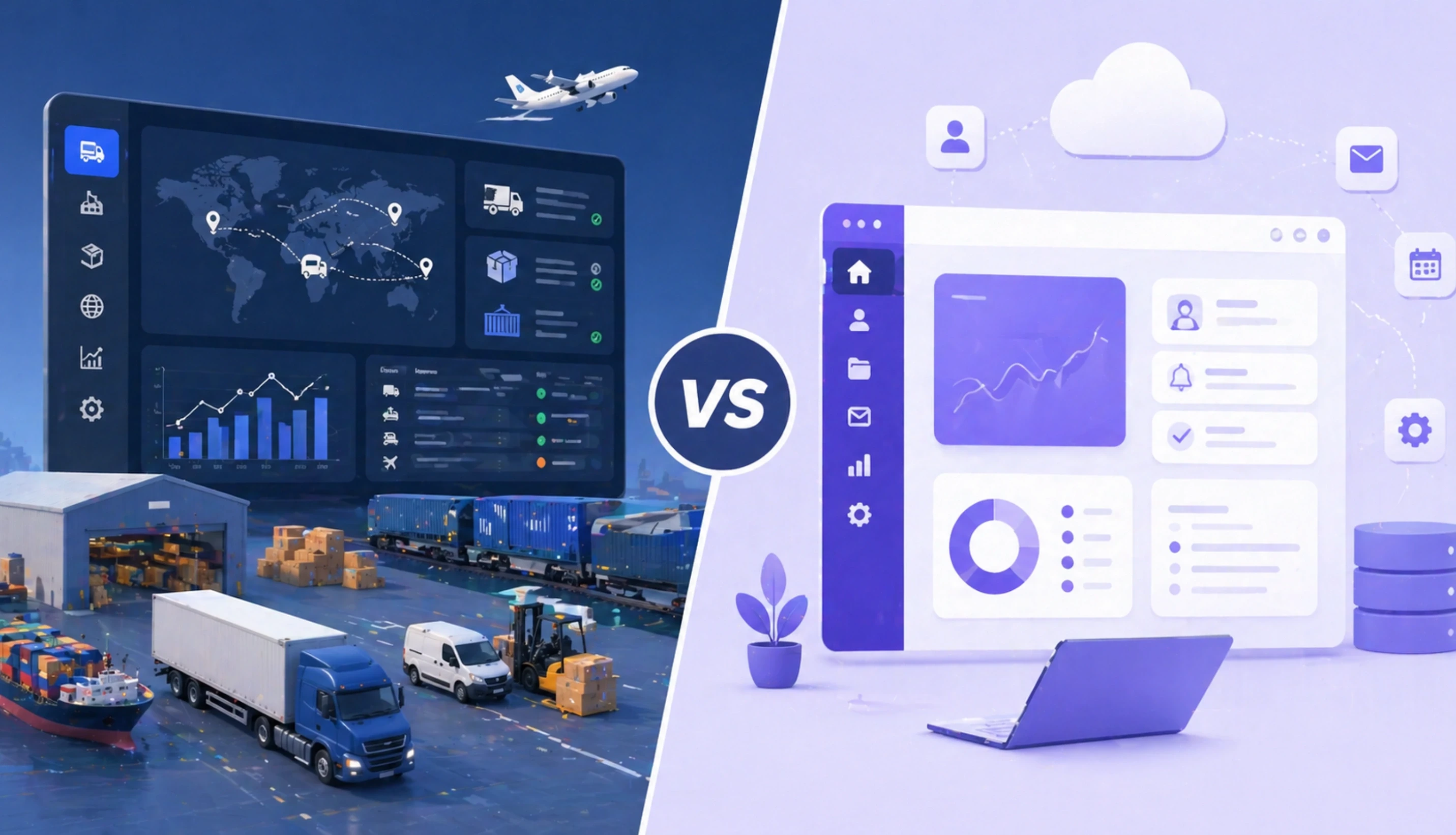
Founders coming from a general SaaS background often estimate logistics projects using SaaS benchmarks. The estimates are wrong by a factor of two to three because logistics carries five structural costs that SaaS does not. The table below shows the differences side by side.
Dimension | General SaaS Build | Logistics Software Build |
Integration burden | REST APIs to a handful of services like Stripe, Twilio, or Salesforce. | Carrier APIs (FedEx, UPS, DHL and regional), EDI 856/940/945/214 messages, ERP stock feeds, WMS scanners, customs systems. |
Event throughput | Hundreds to low thousands of events per hour at peak. | Thousands to tens of thousands of scan, dispatch, and tracking events per hour at peak. |
Audit trail | Optional; usually limited to admin and security events. | Mandatory for freight invoicing, customs, and cross-border trade; immutable with six-year retention. |
Testing burden | Unit, integration, and end-to-end automated tests cover most paths. | All of the above plus cutover rehearsal, peak-load simulation, carrier certification, and a documented test evidence trail. |
Hosting and infrastructure | Any major cloud region; cost optimised for performance. | Regional data residency for customs data; high-availability zones; isolated environments per tenant where required. |
Build timeline | MVP in 8 to 12 weeks is realistic for a focused scope. | MVP in 16 to 24 weeks is realistic; parallel-run cutover adds another 4 to 8 weeks. |
Team composition | Frontend, backend, devops, QA. | All of the above plus an integration specialist, an operations lead or domain SME, and a DevOps engineer with high-availability experience. |
The principle: logistics software is not SaaS with extra integrations. It is SaaS with a parallel operations programme running through every sprint.
Acquaint Softtech runs that parallel programme as a standard part of every logistics engagement. That is why our logistics clients deploy production-ready systems rather than systems that need a six-month integration retrofit before launch. The integration test pack is built incrementally, sprint by sprint, alongside the code, not bolted on at the end. If your team has not delivered a logistics-aligned build before, the lower-risk path is a dedicated software development team with a tech lead who has shipped logistics software in the same category.
How a Logistics Software Build Actually Works: Phase by Phase
Founders ask us how to build logistics management system and logistics software end-to-end without skipping the steps that logistics specifically requires. The answer is the five-phase delivery shape below, a step-by-step logistics software development model we use across every logistics engagement at Acquaint Softtech, regardless of category.
Across our logistics delivery operations, a build runs in five named phases. The phase names below match what appears on Acquaint Softtech project plans and what the client signs off on at each stage. Each phase has a clear entry condition, a clear deliverable, and a clear exit. Clients can pause the engagement at the end of any phase, which is what makes the model risk-adjusted for both sides.
Phase | Weeks | Key Output | Client Owner |
1. Discovery & operational scoping | Week 1 to 3 | Signed operational map and MVP scope | Head of Logistics / COO |
2. Architecture & integration design | Week 3 to 6 | Signed target architecture & integration contracts | CTO / Technical Lead |
3. Iterative build with production readouts | Week 6 to 22 | Production-grade platform in staging each sprint | Product Owner |
4. Cutover rehearsal & carrier certification | Week 20 to 26 | Carrier-certified integrations + rehearsed cutover | Operations Director |
5. Production deployment & hyper-care | Week 24 to 32 | Live platform + runbooks + named on-call rotation | Operations + CTO |
Discovery and Operational Scoping
The product manager, the client operations lead, and the Acquaint tech lead define the scope, the data model, and the integration perimeter. The output is a written specification that names every entity the system will hold, every external integration, every user role, and the operational KPIs the build will target. No code is written in this phase. The client signs the specification before Phase 2 begins. This is also the right time to run a structured discovery workshop for startups if the product is at the idea or early-validation stage. The workshop converts a vision document into a buildable specification.
Architecture and Integration Design
The tech lead and an integration specialist produce the system architecture, the event contracts between TMS, WMS, and OMS, the data flow diagram, the carrier API surface, the EDI message handlers, and the disaster recovery plan, with clear clarity on WMS vs TMS vs OMS explained within the system design. A peak-load projection runs in parallel. The architecture document is reviewed with the client's CTO or technical lead. Phase 2 ends with a signed architecture. The document is what the client will hand to a carrier certification reviewer or an enterprise procurement team months later; building it well saves significant time downstream.
Iterative Build
Two-week sprints, each ending in a demo to the client. The team is typically 4 to 8 engineers: a tech lead, two to four backend engineers, one to two frontend or mobile engineers, a QA engineer, and a part-time DevOps engineer. The tech lead runs the standup, the sprint planning, and the retrospective. The client product owner approves user stories. Integration test coverage is updated at the end of every sprint, not at the end of the project. This is a non-trivial discipline; it adds about 10% to development time and removes about 60% of the integration retrofit risk at the end. In the development team model, the client's product owner sits in on every sprint planning and review.
Cutover Rehearsal and Carrier Certification
Carrier integrations are certified against each partner's test environment: FedEx, UPS, DHL, and any regional carrier. EDI partners run their 856, 940, 945, and 214 certification cycles. A full cutover rehearsal runs against a production-like dataset. The operational runbook is tested end-to-end: receive order, allocate, pick, pack, dispatch, track, and reconcile. For enterprise-scale builds, this is the package a procurement security team or 3PL parent company will request before signing the go-live gate.
Production Deployment and Hyper-care
Production cutover is staged: a soft launch with a single lane or warehouse, then a controlled rollout, then full release. Each step is gated on a defined set of operational metrics (error rate, pick accuracy, dispatch latency, POD match rate) that must hold before the next gate opens. Hyper-care is a four to eight-week period where the build team stays on the engagement to fix production issues within agreed SLA windows. After hyper-care, the engagement either rolls into a longer support contract through software support and maintenance services or transitions back to the client's internal team with a documented handover.
Quick Take Builds run in five named phases: Discovery, Architecture, Iterative Build, Cutover Rehearsal, Production & Hyper-care. Every phase has a signed deliverable and a clean pause point, which is how the model stays risk-adjusted for both sides. |
Who Should Be on Your Logistics Build Team
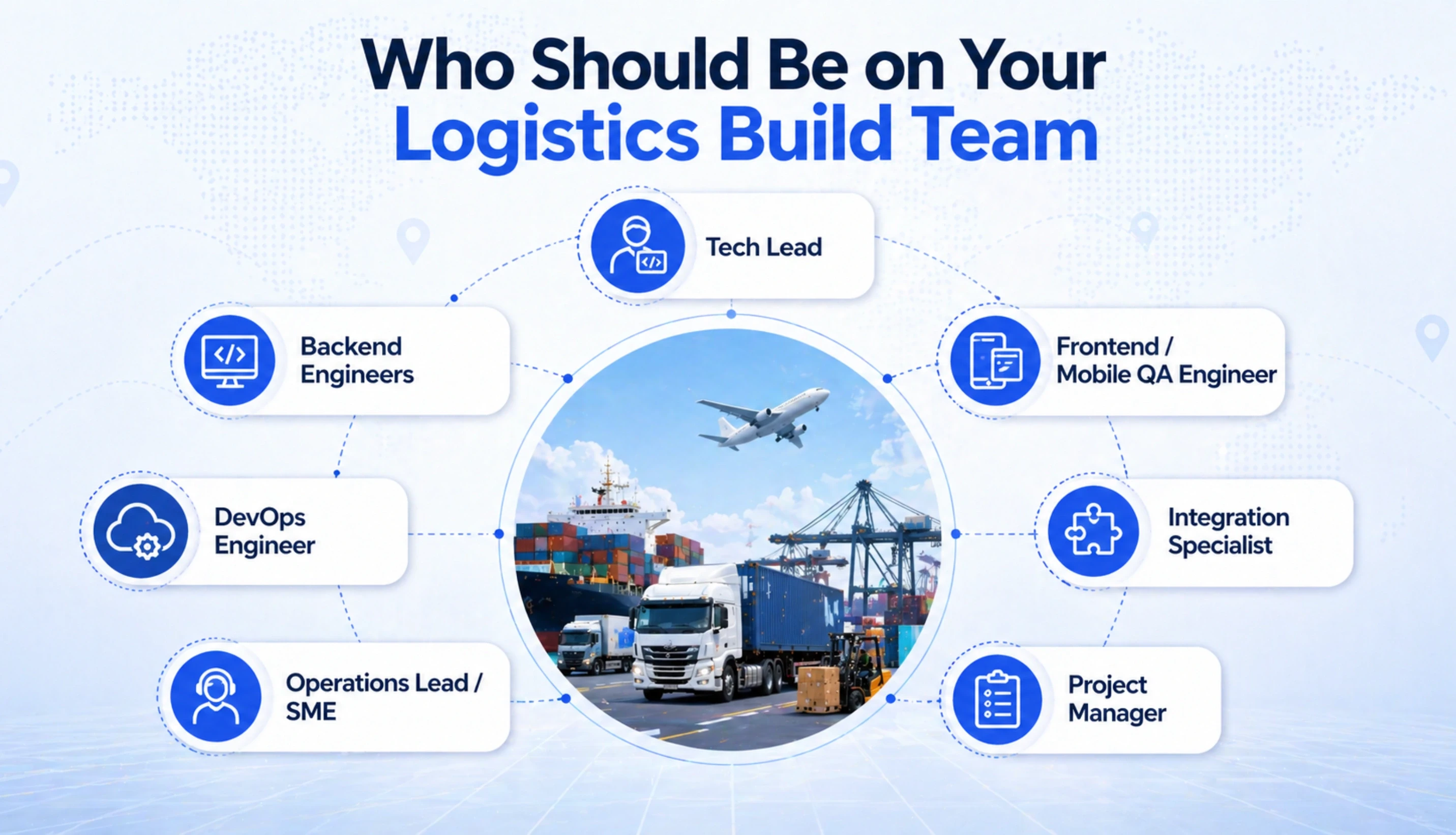
A common reason logistics builds run over budget is that the team composition was modelled on a general SaaS build and only adjusted later. Logistics needs roles that a SaaS team often does without, specifically an integration specialist, an operations lead or domain SME, and a DevOps engineer with high-availability experience. Below is the team composition we deploy on most logistics engagements at Acquaint Softtech, with allocations that hold for a 4 to 8-person team.
Role | Allocation | Owns | Typical Seniority |
Tech Lead | Full-time | Architecture, code review, sprint planning, integration oversight, and client escalation. | Senior (8+ years) |
Backend Engineers | 2 to 4 full-time | API design, business logic, carrier & EDI integration, audit log infrastructure, and workers. | Mid to Senior |
Frontend / Mobile | 1 to 2 full-time | Dispatcher console, picker app, driver app, role-specific surfaces, offline-first behaviour. | Mid to Senior |
QA Engineer | Full-time | Functional, regression, and cutover validation; carrier-cert test evidence trail. | Mid to Senior |
DevOps Engineer | Part-time (50%) | Environment management, deployment pipeline, high-availability cloud configuration, and observability. | Senior |
Integration Specialist | Part-time (20-40%) | Carrier API onboarding, EDI message certification, ERP event contracts, schema versioning. | Senior |
Operations Lead / SME | Part-time (10-20%) | Workflow validation, KPI definition, and change management with warehouse & dispatch teams. | Domain expert |
Project Manager | Part-time (30%) | Sprint cadence, demos, status reporting, client coordination, and change order tracking. | Mid to Senior |
The integration specialist, the operations lead, and the senior DevOps engineer are the three roles most commonly missing from initial estimates. They are not optional in logistics. At Acquaint Softtech, the integration specialist and the senior DevOps engineer are bench resources we share across multiple logistics engagements. The client pays for the percentage they actually consume rather than carrying a full headcount.
If you need to embed Acquaint engineers into your existing team under your management, our it staff augmentation services model is the right shape. If the scope needs a dedicated project manager layer, you can hire a technical project manager from our bench for a logistics programme specifically.
How the Team Scales Through the Build
The team composition changes through the five phases. Phase 1 is heavy on the tech lead, the integration specialist, and the operations lead, code engineers are not yet involved. Phase 2 adds the DevOps engineer for the architecture work. Phase 3 ramps to full team size and stays there for the bulk of the build. Phase 4 brings the QA engineer and integration specialist back to full intensity for carrier certification.
Phase 5 narrows back to the tech lead, one or two engineers, and the DevOps engineer for hyper-care. Capacity planning that assumes a flat 8-engineer team across all 30 weeks overpays in Phases 1, 2, and 5 and underpays in Phase 3. The phased shape is one of the levers that keep the cost model honest.
What Features Does Logistics Software Need? (By Category)
"What features does logistics software need?" is the second most common question we hear at the start of a build conversation, after "what does it cost?" The answer depends on the category. The table below summarises the must-have V1 features and the common V2/V3 features for each of the six categories, drawn from the Acquaint Softtech delivery archive.
Treat the V1 column as the minimum credible feature set for a production launch. Treat the V2/V3 column as the features that buyers commonly request in the first 6 to 12 months after launch, once initial usage data is in. Logistics software features and architecture decisions are easier to defend when they are tied to specific user workflows rather than to a long, generic checklist.
Logistics Category | Must-Have Features (V1) | Common V2/V3 Features |
Transportation Management (TMS) | Load tendering; carrier rate shopping; dispatch board; shipment tracking ingestion; POD capture; freight invoice reconciliation; exception alerting; full audit log. | EDI partner onboarding (940/856/214); multi-currency rating; accessorial auto-recovery; lane performance analytics; AI ETA prediction; automated document extraction from POD. |
Warehouse Management (WMS) | Receiving & put-away; bin-level inventory; one picking strategy; pack verification; cycle counts; RF/barcode scanning; ERP stock sync; dispatch handoff; audit log. | Multi-picking strategies (wave/batch/zone/cluster); slotting optimization; cross-dock; yard management; 3PL billing; conveyor PLC integration; pick-path ML. |
Order Management (OMS) | Order ingestion from storefront; payment state sync; multi-warehouse allocation; promise date calculation; cancellation & returns; customer service visibility; reporting. | Order splitting across warehouses; partial fulfilment; pre-order & backorder; loyalty points; subscription orders; GDPR-compliant PII handling; omnichannel inventory view. |
Last-Mile & Driver Platforms | Route optimization; driver dispatch; in-vehicle navigation; customer tracking page; POD capture (photo/signature/OTP); offline-first driver app; cash-on-delivery support. | Multi-stop optimization with time windows; driver earnings; fleet mix optimization; cold-chain monitoring; proof-of-safety checks; customer rescheduling self-service; white-label branding. |
Freight, Customs & International | Multi-mode booking (ocean/air/road); HS code classification; duty & tax calculation; customs document generation; multi-party visibility; restricted-goods handling. | Automated customs filing (ACE/HMRC); trade-lane analytics; FCL/LCL consolidation; landed-cost calculator; container tracking; supplier portal; EORI/VAT automation. |
AI, Analytics & Decision Support | Predictive ETA; exception classification; dispatcher copilot UI; explainability per prediction; human-in-the-loop queue; outcome instrumentation. | Demand anomaly detection; POD document extraction; multi-modal model ensembles; federated learning across 3PL clients; automated exception remediation; clinical-grade monitoring. |
This is a starting checklist, not a specification. The actual feature set for any specific product is a conversation between the product owner, the operations lead, and the tech lead. Acquaint Softtech runs that conversation as part of Phase 1 (Discovery), with the output being a prioritized feature backlog tied to the V1 launch criteria. If the feature scope is uncertain or the product is at the early validation stage, our MVP development services practice is the right shape. The MVP scope deliberately covers the V1 column above and defers the V2/V3 column until the first cohort of users has validated the core workflow.
Get a Named Team Proposal Against Your V1 Feature List in 48 Hours
Share your category and your shortlist of V1 features. We respond with a team structure, a phased cost model, and a named technical lead you can interview before you commit. No SOW signed without client's approval of the team.
What a Logistics Software Build Includes: The Full Scope
Logistics clients sometimes receive build estimates that look attractive on a per-developer basis but exclude six items that are not optional in logistics. Below is what every Acquaint Softtech logistics build includes inside the quoted price, with no surcharge. The combined cost of these items, when added later as change orders, is usually 15 to 25 percent of the original build estimate.
Integration test pack and carrier certification evidence
A running integration test suite that covers every carrier API, every EDI message, and every ERP event contract. The test pack is maintained alongside the code and generates the evidence required for each carrier's certification cycle. Carrier rejection in certification is the single most common cause of missed go-live dates in logistics, and the test pack is what prevents it.
Cutover rehearsal and rollback plan
A full cutover rehearsal runs against a production-like dataset before go-live. The rollback plan is tested, documented, and signed off by the client's Operations Director. Rollback is not a backup restoration; it is a clean return to the previous system without data loss or operational disruption. Most teams that skip rehearsal learn what it costs on go-live weekend.
Audit log infrastructure for freight and customs
Immutable, append-only audit logs covering every write to freight invoices, customs declarations, POD events, and dispatch decisions. Default retention is six years to align with US customs and most EU trade regulations. A mid-size 3PL processes 5 to 20 million audit events per month, and the infrastructure has to handle that volume cheaply, query it in under a second for an ops review, and survive any reasonable cloud failure scenario without losing events.
Disaster recovery and backup verification
Encrypted backups, tested restoration, and a documented Recovery Time Objective (RTO) and Recovery Point Objective (RPO). Backup restoration is exercised once during the build and the result is documented. This is what the client will be asked to demonstrate during a carrier security review or an enterprise customer's vendor assessment.
Production runbook and on-call documentation
A written runbook covering the deploy procedure, rollback, common incident classes, escalation paths, and the on-call rotation. The runbook is the bridge between the build team and whichever team owns the system in steady state, whether that is Acquaint Softtech under a support contract or the client's internal operations team.
Observability and alerting stack from day one
Logging, metrics, and alerting are built into the platform from sprint one, not bolted on before go-live. Every service publishes structured logs, every business event generates a metric, and every SLA-critical event has a threshold alert tied to a named on-call rotation. If the build estimate does not include these six items, they will be added later as change orders. For clients who have built a logistics product but do not have these artifacts yet, our software version upgrade services practice includes an integration and observability retrofit programme.
What Does Logistics Software Development Cost in 2026?
This section answers the most common questions we receive from prospective clients. Logistics software development cost in 2026 varies by category, by jurisdiction, and by team model. The table below shows the ranges Acquaint Softtech sees in active engagements as a logistics software development company serving clients across the US, UK, Australia, and the UAE, separated by engagement size. All numbers are in US dollars per month for an offshore dedicated team based in India.
The equivalent in-house cost is calculated using the fully-loaded cost of an in-house engineer in San Francisco, including logistics automation benefits, payroll taxes, recruiting, and overhead at roughly 1.4 times the salary. Earnings data from the U.S. Census Bureau's American Community Survey provides the underlying salary baseline for software occupations by metro area.
Engagement Tier | Monthly Cost (USD) | Equivalent In-House (USA) | Annual Saving | Mgmt Overhead |
Small (3 to 4 engineers) | $13,000 to $20,000 | $60,000 to $80,000 | $564,000 to $720,000 | 1 to 2 hrs/wk |
Medium (5 to 8 engineers) | $22,000 to $36,000 | $100,000 to $160,000 | $936,000 to $1,488,000 | 2 to 4 hrs/wk |
Large (9 to 15 engineers) | $38,000 to $65,000 | $180,000 to $300,000 | $1,704,000 to $2,820,000 | 4 to 6 hrs/wk |
SAVINGS | Logistics clients consistently save 40% or more by switching from US in-house hiring to an Acquaint Softtech dedicated team, without losing integration, audit, or accountability discipline. |
What the monthly rate includes at Acquaint Softtech
All engineering hours within the contracted team capacity.
Tech lead time for sprint planning, code review, and architecture decisions.
QA engineer time for functional, regression, and carrier-certification test execution.
DevOps time for environment management and deployment pipeline maintenance.
Integration test pack maintenance through the build.
Project management hours for sprint cadence, demos, and reporting.
Standard tooling: Jira, Git, CI pipeline, staging environment hosting.
The rate the client pays is the rate. No additional employer overhead on top. Third-party penetration testing, carrier certification fees, and production cloud hosting are billed separately and pass-through, with no markup.
Total Build Cost by Logistics Category
The team-size table above gives the monthly run rate. The category determines how long that team runs, which sets the total build cost. Below is the typical first-version build cost by category, assuming a focused MVP scope rather than a full feature set.
Category | Cost Range (USD) | Duration (Weeks) | Team Size |
|---|---|---|---|
TMS MVP | $80,000 – $180,000 | 16 – 22 weeks | Small team |
WMS MVP | $120,000 – $250,000 | 20 – 28 weeks | Medium team |
OMS MVP | $60,000 – $140,000 | 14 – 20 weeks | Small team |
Last-mile & Driver Platform | $130,000 – $260,000 | 20 – 30 weeks | Medium team |
Freight & Customs Module | $120,000 – $220,000 | 18 – 26 weeks | Medium team |
Logistics AI Feature (Existing) | $60,000 – $150,000 | 12 – 20 weeks | Small specialized team |
If you want to start small and prove the product before committing to the full build, our MVP services practice covers a 10-to-12-week logistics MVP that becomes the foundation of the full V1 build. The MVP costs $40,000 to $80,000 and gives you a working system in production with one or two warehouses, suitable for early validation and the next funding conversation. For LogiTech startups planning a multi-tenant SaaS product, our software development outsourcing engagements wrap the build, the integration test pack, and the go-to-production hardening into a single fixed-team contract.
Want a Logistics Build Estimate Grounded in Real Delivery Data?
Send us a one-paragraph description of the product you want to build. We send back a team structure, a phase plan, and a monthly rate within 48 hours. You interview the proposed tech lead before any engagement starts. No engagement begins without client approval of the team and the plan.
Data, Integration & Compliance: What the Code Actually Has to Do
Integration and compliance are the areas where briefs are vaguest, and the cost of vagueness is highest. The clearest way to think about logistics data and compliance requirements is as a set of concrete engineering decisions rather than a policy document. This section walks through the seven engineering domains a logistics platform touches, with the actual technical decisions a development team has to make in each.
Encryption and data at rest
AES-256 for data at rest. TLS 1.3 for data in transit. Field-level encryption for the most sensitive data fields, where the threat model justifies it, typically customer PII, customs declaration details, and payment references. Key management runs through the cloud provider's Key Management Service (KMS) with rotation policies documented in the runbook.
Carrier API integration surface
Carrier integrations with FedEx, UPS, DHL, Blue Dart, Delhivery, Aramex, and regional carriers are delivered as a named integration surface with rate shopping, label generation, tracking webhook ingestion, and POD capture. Every integration has a named owner, a certification log, and a rollback plan in case the partner changes their schema without notice, which happens at least once a year with at least one carrier.
EDI message handling
EDI integrations with large shippers or 3PL partners are delivered as a separate module with the 940 (Warehouse Shipping Order), 945 (Warehouse Shipping Advice), 856 (Advance Shipment Notice), and 214 (Transportation Carrier Shipment Status) message handlers scoped and tested against the partner's certification environment. EDI is a 40-year-old standard in active daily use; modern logistics software does not skip it.
Customs and trade compliance
Cross-border shipments require HS code classification, duty and tax calculation, restricted-goods handling, and customs document generation. US shipments integrate with CBP's Automated Commercial Environment; UK shipments integrate with HMRC CHIEF and CDS; EU shipments integrate with national customs systems aligned to the Union Customs Code. The code does not have to know every rule, but it does have to know which rule set applies to each lane.
Audit logging
Every write to freight invoices, customs declarations, POD events, and dispatch decisions is logged with user identity, timestamp, action type, and the record affected. Logs are immutable and stored separately from the application database. Six-year retention is the default. The system provides a query interface for operations and finance leads to answer audit questions without engineering intervention. Audit log volume scales with throughput and is genuinely large: a 50-truck 3PL generates 200,000 to 1,000,000 audit events per day.
Access control and engineer-side discipline
Role-Based Access Control (RBAC) with the principle of least privilege as the default. Multi-factor authentication for every operation and admin account. Session timeouts appropriate to the workflow. Production engineering access is restricted to a named subset of the team and is logged with the same rigour as operational access. Acquaint Softtech engineers who work on logistics projects with a confidentiality agreement covering customer PII and commercial freight data. Background checks are run for engineers who will hold production access. This is a contract term in any legitimate logistics software engagement, not a negotiation point.
Disaster recovery and high availability
Multi-AZ deployment with automated failover. Database replicas in a second region. A documented Recovery Time Objective (RTO) under four hours and a Recovery Point Objective (RPO) under fifteen minutes for production logistics systems. Backups are encrypted and tested. Rollback from a failed release has to be a one-command operation with a named owner.
All seven engineering domains above run as a parallel programme inside our end-to-end software product development engagements. Integration discipline is not a separate workstream we add at the end. It is sprint discipline, sprint after sprint, with the integration test pack versioned alongside the code.
The Tech Stack Question: What to Build Logistics Software In
This section is the logistics software tech stack guide we hand to founders and CTOs at the start of every build. The right stack for a logistics product depends on the category, the team you can hire and retain, and the integration surface. Below is what Acquaint Softtech sees most often across our logistics delivery, with the trade-offs at each layer.
Backend: Laravel, Python, or Node.js
Laravel is our most-deployed backend for TMS and OMS work, and for freight and customs platforms. The framework is mature, the ecosystem is well-documented, and the talent pool is deep. Acquaint Softtech is an Official Laravel Partner, which means we get early access to framework features and direct escalation to the core team for complex deployments. Python (Django or FastAPI) is the right choice when the product has a significant AI, analytics, or device-data ingestion component. Node.js fits real-time use cases such as live driver tracking, dispatcher dashboards, and any product where WebSocket-heavy traffic dominates.
We compare these stacks in detail in our PHP vs Python vs Node.js for SaaS analysis, and the same trade-offs hold for logistics, with the addition of EDI library availability favouring Java and Python for deep EDI integration. If you need backend specialists, you can hire a dedicated Laravel developer or hire a dedicated Python developer from our bench within 48 hours.
Frontend: React or Vue
React dominates dispatcher consoles, warehouse dashboards, and shipper portals. Component libraries with WCAG 2.1 AA accessibility built in (Mantine, Chakra UI, MUI) are important for dispatcher interfaces because dispatchers use the system under time pressure, and any usability friction translates directly into missed SLAs. Vue is a credible alternative for smaller teams that prefer its developer experience.
Mobile: React Native or native (Swift, Kotlin)
React Native is the default for driver and picker apps because the codebase is shared across iOS and Android, and the development cost is roughly 60 percent of two native builds. Native is the right choice when the app integrates deeply with device hardware, such as Bluetooth Low Energy for scanners, battery-aware GPS for long driver shifts, or frame-rate-critical UI. You can hire React Native developers from our bench, or scope the app end-to-end through our React Native app development practice.
Database: PostgreSQL or a managed equivalent
PostgreSQL is the workhorse for logistics transactional data. It supports JSONB for flexible shipment fields, strong transactional guarantees for inventory and freight invoicing, and Row-Level Security for multi-tenant 3PL platforms. For high-volume time-series data from driver GPS or IoT sensors, a time-series database is added alongside the primary database. TimescaleDB (a PostgreSQL extension) and InfluxDB are the common choices.
Hosting: AWS, Azure, or Google Cloud
All three major clouds offer the services required for a production logistics platform: managed Postgres, managed event buses (Kafka, EventBridge, Pub/Sub), multi-AZ deployment, and region-specific data residency. The choice is usually driven by the client's existing cloud relationship, the available regional data residency, and the ecosystem fit for any AI workload. For UK and EU clients, data residency in-region is the governing constraint.
If you need a stack-specific team, the Acquaint Softtech hire pages list the seniority bands and engagement models available. To keep your infrastructure reliable, secure, and continuously deployed, you can hire DevOps engineers who specialize in cloud pipelines, containerization, and system observability. For fractional senior technical leadership during the architecture and vendor-selection phases, our CTO services practice provides experienced CTOs on a part-time engagement.
Multi-tenant scalability at 162,000+ recordsOur global real estate platform engagement scaled to 162,000+ live properties across multiple markets, with the same multi-tenant data isolation pattern a 3PL logistics platform serving multiple clients' needs. Different vertical, identical scaling shape: Row-Level Security in PostgreSQL, regional read replicas, and a worker pool sized to async load rather than peak. |
If three or more of the answers point toward partner involvement, the next decision is which partner shape fits. Acquaint Softtech delivers both shapes. Our staff augmentation services cover the embedded model, the right shape when you want to hire developers for logistics software development and absorb them into your existing team. Our software development team covers the vendor-managed model, the right shape when you want to outsource logistics software development to India end-to-end while keeping the codebase, the data, and the IP in your own jurisdiction.
We Build the Team. You Interview Before You Commit.
Tell us your category (TMS, WMS, OMS, last-mile, freight/customs, or logistics AI), your target jurisdiction, and your timeline. We send a team structure with named developer profiles within 48 hours. You interview before you commit. No engagement starts without your approval of the team.
3 Misconceptions About Logistics Software Development
These three misconceptions show up in almost every first-call conversation Acquaint Softtech has with a new logistics prospect. Each one, left uncorrected, leads to a predictable category of build failure later.
MISCONCEPTION : Off-the-shelf TMS or WMS products cover everything we need, so we never need custom software.
REALITY : Off-the-shelf products cover the baseline. They rarely cover the workflow that makes a 3PL, a shipper, or a LogiTech product distinctive. Most of our logistics engagements are not TMS or WMS replacements. They are integrations, extensions, and workflow tools that sit alongside an incumbent product and use its APIs to read and write the canonical record.
MISCONCEPTION : Offshore logistics development is risky because of data residency.
REALITY Data residency is a configuration decision, not a vendor location decision. Acquaint Softtech engineers based in India routinely build systems where the production data, the staging data, and even the development environments are hosted in US, UK, EU, or UAE regions per the client's regulatory requirement. Engineering access is controlled through identity and audit, not geography.
MISCONCEPTION : We can hire one logistics engineer in-house and they will figure out the rest.
REALITY : A single logistics engineer, even a senior one, cannot replace the team composition logistics requires. The integration specialist role, the DevOps role at production scale, the operations SME role, and the QA discipline are all distinct from "the engineer who writes the code." The right pattern for a small team is to add a senior engineer in-house and supplement with vendor-provided integration, DevOps, and operations advisory bench resources.
If you have heard one or more of these from another vendor or from internal stakeholders, treat it as a signal that the conversation needs more depth before any commitment. Our virtual CTO services practice exists for exactly this kind of pre-build clarification engagement, where the deliverable is a signed-off architecture and integration plan rather than code.
For pre-revenue LogiTech founders specifically, our development outsourcing engagement model bundles the architecture, the integration test pack, and the build into a single accountability structure rather than three separate vendors. For teams weighing an offshore partner, our red flags when outsourcing development analysis apply to logistics backends as much as it does to Python platforms.
See What a Logistics Software Build Looks Like for Your Product
Send us your category, your jurisdiction, and a paragraph on the workflow you want to digitise or replace. We respond within 48 hours with a phase plan, a team structure, and a monthly rate. You interview the proposed tech lead before any engagement starts.
FAQ
-
How much does it cost to build logistics software?
A focused logistics MVP built with an offshore Acquaint Softtech team typically lands between $80,000 and $250,000 for the build phase, depending on the category and the integration surface. It does not include cloud hosting, carrier certification fees, or post-launch support, which are separate. A full-featured logistics platform with multi-carrier integration, multi-warehouse support, and AI features sits between $250,000 and $700,000, depending on category.
-
What features should a logistics management system have at a minimum?
The features depend on the category, but every credible logistics software build needs eight foundational capabilities: role-based access control with multi-factor authentication, encrypted data storage and transmission, an immutable audit log of every write to freight and customs records, integration with at least one external system (carrier API, EDI partner, or ERP), operational reporting outputs, a backup and disaster recovery process with documented RTO and RPO.
-
How long does a logistics software MVP take to build in 2026?
A focused logistics MVP typically takes 16 to 24 weeks to first production release, compared with 8 to 12 weeks for a general SaaS MVP. The added time is the integration programme that runs in parallel: carrier certification cycles, EDI partner onboarding, cutover rehearsal, and the disaster recovery validation before go-live.
A TMS or OMS MVP sits at the lower end of the range; a WMS or last-mile build sits at the higher end. Acquaint Softtech ships first production releases for logistics clients in the 16 to 22-week window for the majority of engagements.
-
Which tech stack is best for supply chain software in 2026?
There is no single best stack. The most common stack we deploy at Acquaint Softtech for logistics in 2026 is Laravel or Node.js for TMS and OMS backends, Python (FastAPI) for WMS and AI-heavy workloads, React for dispatcher and warehouse consoles, React Native or Flutter for driver and picker apps, PostgreSQL with JSONB and Row-Level Security for the data layer, Redis for hot paths, a managed event bus (Kafka, EventBridge, or Pub/Sub) between services, and AWS, Azure, or Google Cloud for hosting. Stack fit matters less than team experience with the stack.
-
How long does it take to build a WMS?
A focused WMS MVP covering receiving, put-away, one picking strategy, pack verification, and dispatch runs for four to six months with a four-engineer team. A production-grade WMS covering multiple picking strategies, RF and barcode scanning, multi-warehouse stock sync, and ERP integration runs eight to twelve months.
-
Can we outsource logistics software development to an offshore team without compromising data residency?
Yes, when the engagement is structured correctly. The cloud region holds the data, not the developer. Acquaint Softtech routinely builds logistics systems where the data, the staging environments, and the production environments are all hosted in the client's required jurisdiction, while the engineering team is in India.
-
What happens to the codebase and the data if the engagement ends?
The codebase belongs to the client from day one. It is hosted in the client's repository, or in a repository we transfer to the client at any point on request. The data is hosted in the client's cloud account, not ours. At the end of an engagement, the build team produces a written handover including the architecture document, the runbook, the integration test pack, and a knowledge transfer session for whichever team takes over operations.
-
How do we handle operations workflow validation if our team is in a different time zone from our developers?
Operations workflow validation runs as scheduled sessions, not as informal back-and-forth. Acquaint Softtech overlaps four to five hours per day with US Eastern, US Pacific, UK, and Australian working hours, depending on the engagement. Demos, sprint reviews, and operations lead sessions are scheduled inside the overlap.
-
Is a dedicated team appropriate for a pre-revenue LogiTech startup?
Yes, in most cases, because the alternative for a pre-revenue startup is usually a freelance team that costs less per hour but lacks the integration discipline that logistics requires. A dedicated team of 3 to 4 engineers from Acquaint Softtech costs $13,000 to $20,000 per month all-in, which is below the fully-loaded cost of one mid-level US logistics engineer.
-
Can we build the dispatcher app, the warehouse app, and the driver app on the same codebase?
Technically, yes; practically, no. The dispatcher workflow (load tendering, multi-shipment context, carrier rate comparison) is fundamentally different from the warehouse workflow (bin-level pick paths, pack verification) and the driver workflow (route navigation, POD capture). The right pattern is separate apps that share the same backend services and data layers but present role-specific surfaces.
We’re Acquaint Softtech, your technology growth partner. Whether you're building a SaaS product, modernizing enterprise software, or hiring vetted remote developers, we’re built for flexibility and speed. Our official partnerships with Laravel, Statamic, and Bagisto reflect our commitment to excellence, not limitation. We work across stacks, time zones, and industries to bring your tech vision to life.
Table of Contents
Get Started with Acquaint Softtech
- 13+ Years Delivering Software Excellence
- 1300+ Projects Delivered With Precision
- Official Laravel & Laravel News Partner
- Official Statamic Partner
Related Reading

Proof of Concept: Why is it important in software development?
Discover how a Proof of Concept (PoC) can validate your project's feasibility, enhance stakeholder trust, and streamline development processes effectively.
Acquaint Softtech
April 28, 2025
How to Choose a Software Development Company in 2026
Every software development company proposal looks good on page one. The rate is reasonable. The timeline sounds achievable. The case studies are polished. Here is the framework that tells you what is actually behind it.

Ahmed Ginani
April 6, 2026
Top Software Development Outsourcing Companies
Choosing the right software development outsourcing company is no longer just a cost decision, it is a strategic move that directly impacts product speed, scalability.According to Deloitte’s Global Outsourcing Survey, over 76% of companies outsource IT functions, including development, QA, and UI/UX, while data from Market.us research reports shows the global outsourcing market was valued at USD 534.9 billion in 2024 and is projected to reach USD 940 billion by 2034, highlighting its rapid adoption across industries.
However, identifying the right software development outsourcing partner remains a major challenge, as hundreds of vendors claim similar expertise without proven delivery depth. To simplify this process, we analyzed 100+ software development outsourcing companies across trusted directories and client review platforms, focusing on key factors such as technical capability, real-world project delivery, communication standards, and long-term scalability support.

Zubair Pateljiwala
April 2, 2026India (Head Office)
203/204, Shapath-II, Near Silver Leaf Hotel, Opp. Rajpath Club, SG Highway, Ahmedabad-380054, Gujarat
USA
7838 Camino Cielo St, Highland, CA 92346
UK
The Powerhouse, 21 Woodthorpe Road, Ashford, England, TW15 2RP
New Zealand
42 Exler Place, Avondale, Auckland 0600, New Zealand
Canada
141 Skyview Bay NE , Calgary, Alberta, T3N 2K6