

Production Security Incident: What a DevSecOps Engineer Is Hired to Prevent and Fix
A production security incident is preventable in almost every case. Here are the 6 infrastructure controls a DevSecOps engineer implements and what the response looks like after one occurs.

Taukir katava
As a DevOps Engineer at Acquaint Softtech, a software development partner, the most urgent calls I receive are not about slow pipelines or high cloud bills. They are from CTOs dealing with a production security incident: an exposed API endpoint, an S3 bucket with public access, a compromised credential, or a database accessible without authentication. These incidents share a pattern: they were all preventable. A DevSecOps engineer implements the controls that make each of them either impossible or immediately detectable. This article covers what those controls are, what a DevSecOps engineer fixes after an incident, and what the engagement costs in 2026.

- CTOs and engineering leads who have had a production security incident and need to prevent the next one
- SaaS founders who have never had a security audit and are growing to the size where one incident would be genuinely damaging
- Companies preparing for enterprise sales or compliance requirements (SOC 2, ISO 27001, GDPR) that require security controls to be documented
- Engineering leads who want to understand the difference between a DevOps engineer and a DevSecOps engineer before their next hire
The cost of a production security incident extends well beyond the immediate technical remediation. A breached customer database triggers GDPR notification obligations, potential regulatory fines, customer trust damage, and the reputational cost of public disclosure. A compromised production environment can require a complete infrastructure rebuild. The technical fix take hours. The business consequences take months. This is why security is not a post-launch consideration for a production SaaS product.
The cloud infrastructure context for security work, including the traffic spike and cost optimisation infrastructure that shares the same AWS layer, is covered in the cloud cost audit guide. Security controls sit on top of the same infrastructure that handles scaling and cost governance.
What a DevSecOps Engineer Implements to Prevent Incidents

Prevention is cheaper than remediation in every security context. Here are the six infrastructure-level security controls a DevSecOps engineer implements to eliminate the most common production incident vectors.
IAM and least-privilege access control
Every AWS user, role, and service has access only to the resources it specifically needs. A developer account cannot access production infrastructure. An EC2 instance role cannot access S3 buckets it does not explicitly serve. A DevSecOps engineer audits existing IAM policies, removes over-permissive wildcards, and implements role separation between environments. This single control prevents the majority of credential-based incidents.
Secrets management with AWS Secrets Manager or HashiCorp Vault
Application secrets (database passwords, API keys, payment gateway credentials) are removed from environment variables, configuration files, and source code. They are stored in AWS Secrets Manager with automatic rotation. Applications retrieve secrets at runtime via the Secrets Manager API. A credential that is never stored in plaintext cannot be leaked from a repository or a misconfigured instance.
WAF and network perimeter security
AWS WAF (Web Application Firewall) sits in front of the Application Load Balancer and inspects every incoming request. It blocks known attack patterns (SQL injection, XSS, CSRF), rate-limits abusive IPs, and can apply geographic restrictions. CloudFront provides an additional DDoS mitigation layer at the edge. Together, these controls filter the most common attack traffic before it reaches the application servers.
S3 bucket access controls and public access blocks
Misconfigured S3 buckets (public access enabled on a bucket containing customer data) are one of the most common causes of data exposure incidents. A DevSecOps engineer enables the account-level S3 Block Public Access setting, audits bucket policies, enables S3 access logging, and configures CloudTrail to track all data plane operations. A publicly accessible data bucket becomes detectable within minutes of misconfiguration.
Security group and VPC network segmentation
Every resource in the VPC is in the correct subnet (public, private, or database) with security group rules that permit only the specific ports and protocols required for its function. A database instance in the private subnet has no path to the internet and accepts connections only from application servers in the application subnet. A misconfigured port or route that opens a security gap is caught during the DevSecOps engineer's regular security group audit.
CloudTrail logging and security alerting
AWS CloudTrail records every API call in the account. A DevSecOps engineer enables CloudTrail across all regions, stores logs in a dedicated S3 bucket with object lock, and configures CloudWatch Alarms or AWS Security Hub to alert on high-risk events: root account login, IAM policy changes, security group rule modifications, and S3 policy changes. A security incident that would otherwise go undetected for weeks is flagged within minutes.
The AWS WAF and CloudFront configuration specifically is covered in our AWS WAF and CloudFront security guide. For teams that want to understand the full DevSecOps hiring cost before starting, the DevSecOps engineer cost breakdown covers the 2026 rate comparison for security-focused DevOps engineers.
Need These Security Controls Implemented Before Your Next Incident? Start in 48 Hours.
Tell Acquaint Softtech your cloud provider, current security posture (none / partial / audited), and whether you are facing a compliance requirement or responding to an incident. A vetted DevSecOps engineer will assess the priority controls and send an implementation plan within the first week.
What a DevSecOps Engineer Does After an Incident Has Occurred
When an incident has already happened, the DevSecOps response follow a defined sequence. The sequence is the same regardless of the incident type: contain first, investigate second, remediate third, harden fourth.
Immediate containment (Hours 1 to 4)
Revoke the compromised credentials immediately. Isolate the affected instance or resource from the network. If a data breach is confirmed, take the affected service offline until the vector is identified. The priority in the first four hours is stopping the bleeding, not understanding how it happened.
Incident scope investigation (Hours 4 to 24)
Review CloudTrail logs to identify which resources were accessed, which actions were performed, and whether any data was exfiltrated. Review VPC flow logs to identify unusual traffic patterns. Check for persistence mechanisms: backdoor users created, SSH keys added, Lambda functions deployed. The investigation determines the full scope of the incident.
Remediation and clean rebuild (Days 1 to 7)
Terminate and rebuild compromised instances from clean AMIs. Rotate all credentials that were exposed or in scope during the incident. Audit and revoke any IAM policies or keys that were created during the compromise window. For data breaches, identify the affected records and prepare GDPR or regulatory notifications as required.
Hardening to prevent recurrence (Days 7 to 30)
Implement the prevention controls that would have blocked this specific incident. For most production incidents, the hardening phase implements three to five of the six controls listed above that were not previously in place. This is the phase that converts a reactive response into a lasting security improvement.
What a DevSecOps Engineer Costs in 2026: Honest Numbers
DevSecOps engineers command a premium over standard DevOps engineers because security expertise requires additional depth in IAM, compliance frameworks, and incident response. Here are the 2026 numbers.
Engagement type | Cost (Acquaint Softtech rates) |
Post-incident emergency response (48-hour start) | Senior DevSecOps: $22/hour | First 2 weeks at $22/hour: approximately $1,760 |
Security implementation (greenfield, no controls) | 4 to 8 days: $5,600 to $16,000 absorbed into first sprint |
Ongoing DevSecOps monthly retainer | from $3,200/month dedicated |
Security audit only (point-in-time) | 2 to 3 days: $2,800 to $6,000 | Findings report delivered |
Compliance prep (SOC 2 Type I readiness) | 3 to 6 weeks: $12,000 to $27,000 depending on starting point |
The cost of not having DevSecOps vs the cost of having it
Average cost of a data breach (SMB, 2025 IBM report): $3.31 million
GDPR fine for a significant breach: 4% of global annual turnover or EUR 20 million (higher applies)
AWS infrastructure rebuild after a serious compromise: $15,000 to $80,000 in DevOps time
Customer churn after a disclosed breach: 15 to 30% within 12 months (varies by industry)
Cost of a DevSecOps engineer on monthly retainer: from $3,200/month
Cost of a 3-day post-incident security hardening engagement: $8,400 to $15,000
One prevented incident pays for years of DevSecOps retainer on most platforms.
For teams evaluating the full DevOps cost structure including DevSecOps, the DevOps engineer cost guide covers the rate comparison by region. Acquaint Softtech's staff augmentation model provides DevSecOps engineers on monthly retainer from Day 1.
Spending on Cloud Infrastructure Without Security Controls? That Is Not a Risk. It Is a Certainty.
Acquaint Softtech DevSecOps engineers implement the six prevention controls in the first sprint. Post-incident response available in 48 hours. Ongoing security retainer from $3,200/month. Tell us your current cloud provider and security posture.
DevSecOps vs DevOps: What Is the Actual Difference When Hiring?
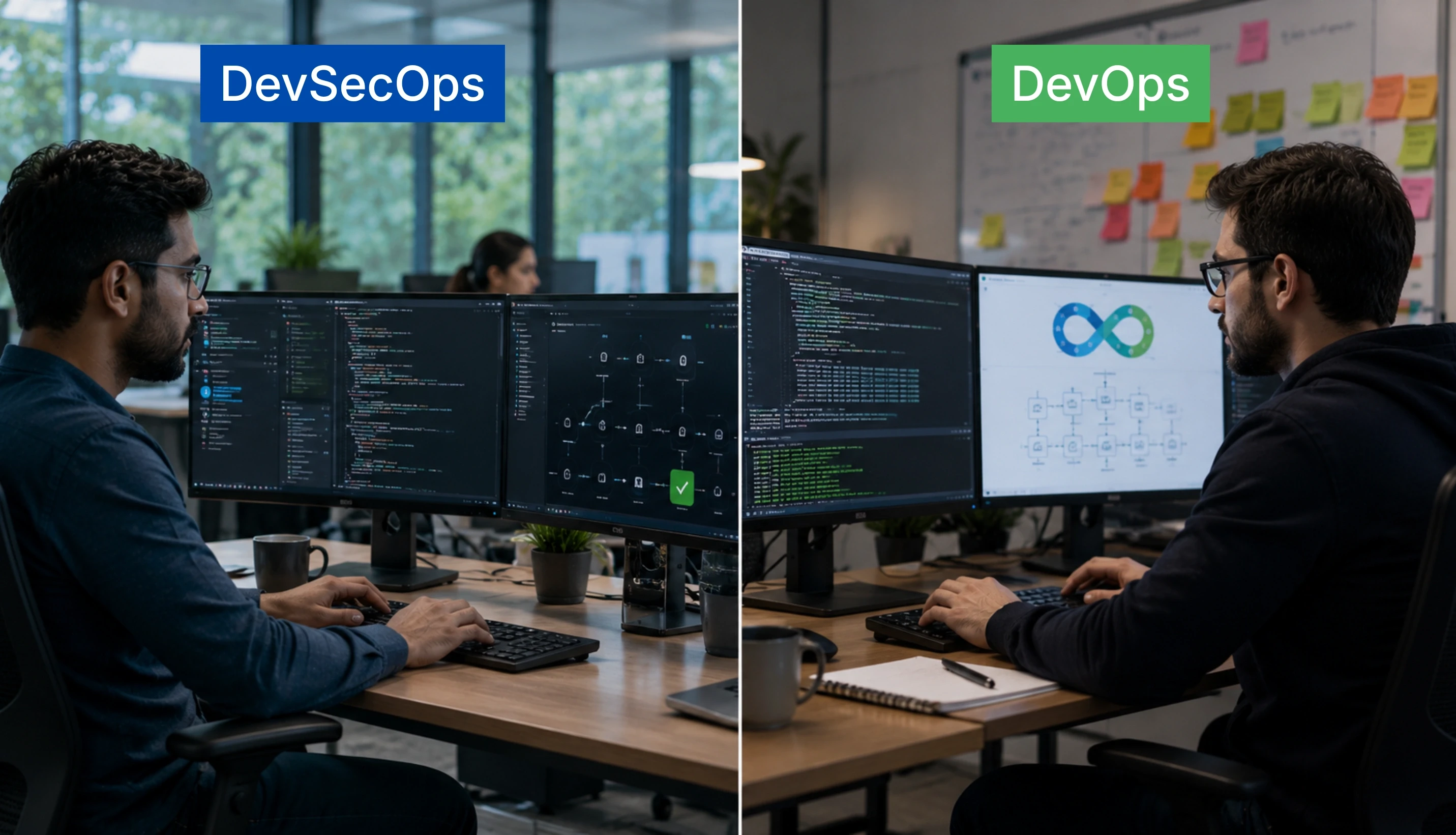
The distinction between a DevOps engineer and a DevSecOps engineer matters when hiring because the skill set are different and the use cases are different. Most teams need a DevOps engineer first and a DevSecOps engineer when one of three conditions applies.
Hire a DevOps engineer when |
Your primary problems are CI/CD pipeline speed, deployment reliability, infrastructure scaling, and cloud cost. A DevOps engineer with general security awareness (IAM hygiene, security group best practices, secrets management) handles the security baseline that most platforms need. This is the right hire for teams at the MVP to post-launch stage without specific compliance requirements. |
Hire a DevSecOps engineer when |
You have had a production incident and need a security-first rebuild. You are pursuing SOC 2, ISO 27001, or PCI-DSS compliance. Your platform processes financial data, health data, or personal data at a scale where a breach would have regulatory consequences. Or you have enterprise clients who require a security audit as part of their vendor evaluation. |
When one person covers both |
Many experienced DevOps engineers at the senior level have sufficient security depth to cover both roles for a platform that is not pursuing formal compliance. Acquaint Softtech pre-vets DevOps engineers for their security knowledge and can identify which candidates cover both DevOps and DevSecOps requirements from a single engagement. |
For teams evaluating whether to use a dedicated DevSecOps team structure, Acquaint Softtech's dedicated development teams service includes security-specialised DevOps engineers within a managed team structure. The hire DevOps engineers service covers both standard DevOps and DevSecOps profiles.
Ready to Implement Security Controls That Prevent the Next Incident? Acquaint Softtech Has DevSecOps Engineers Available.
Pre-vetted DevSecOps engineers with production security implementation experience across AWS, Azure, and GCP. Monthly retainer from $3,200. 48-hour start for post-incident response. Profiles within 24 hours. Tell us your platform and security requirements.
Frequently Asked Questions
-
What is the difference between DevOps and DevSecOps?
A DevOps engineer focuses on deployment pipelines, cloud infrastructure, container orchestration, and reliability. A DevSecOps engineer applies the same infrastructure expertise with a security-first lens: implementing IAM least-privilege, secrets management, WAF configuration, security group auditing, and compliance controls as first-class deliverables. A senior DevOps engineer with strong security knowledge often covers both, while a dedicated DevSecOps engineer is appropriate for platforms with formal compliance requirements
-
What does a DevSecOps engineer do after a production security incident?
The response follows four phases: immediate containment (revoke credentials, isolate affected resources), incident scope investigation (CloudTrail review, data exfiltration assessment), remediation and clean rebuild (rotate all affected credentials, rebuild compromised instances), and hardening to prevent recurrence (implement the prevention controls that would have blocked this incident). The remediation phase takes days. The hardening phase takes weeks.
-
How do I know if my platform needs a DevSecOps engineer?
A DevSecOps engineer is appropriate when: you have had a production incident, you are pursuing SOC 2 or ISO 27001 compliance, you process financial or health data at a scale where a breach has regulatory consequences, or your enterprise clients require a security audit. For earlier-stage platforms without these requirements, a DevOps engineer with strong security awareness covers the baseline controls.
-
How quickly can a DevSecOps engineer start after a production incident?
Acquaint Softtech can match a DevSecOps engineer profile within 24 hours of a brief and have the engineer in your first standup within 48 hours. For post-incident response, the immediate containment steps can begin in the first days of the engagement. Full security hardening is complete within 2 to 4 weeks depending on the scope of the incident and the starting state of the security controls.
-
How much does a DevSecOps engagement cost at Acquaint Softtech?
Post-incident emergency response: from $3,200/month on a monthly retainer. First sprint begins within 48 hours. Ongoing DevSecOps retainer: from $3,200/month for a dedicated engineer. A point-in-time security audit costs $2,800 to $6,000. SOC 2 readiness preparation costs $12,000 to $27,000 depending on the starting posture. All rates are all-in with no additional charges.
-
What is the cost of not having security controls on a production platform?
The average cost of a data breach for a small to mid-size business in 2025 was $3.31 million (IBM Cost of Data Breach Report). GDPR fines for significant breaches can reach 4% of global annual turnover. AWS infrastructure rebuilds after a serious compromise cost $15,000 to $80,000 in DevOps time. One prevented breach pays for several years of DevSecOps retainer on most platforms.
-
Can one DevOps engineer handle both DevOps and security responsibilities?
Yes, for most platforms that are not pursuing formal compliance. Senior DevOps engineers with security depth cover IAM configuration, secrets management, WAF setup, and security group management effectively. The distinction becomes important when a platform needs to pass a third-party security audit, achieve SOC 2 certification, or recover from a serious production incident where dedicated security expertise is required.
Taukir Katava is a DevOps Engineer at Acquaint Softtech with 4+ years of experience across AWS, Azure, and GCP. He specialises in Kubernetes cluster administration, CI/CD pipeline automation, and cloud infrastructure design for high-traffic platforms. Taukir writes about the practical side of production DevOps: what infrastructure decisions cost and what they actually deliver.
Table of Contents
Get Started with Acquaint Softtech
- 13+ Years Delivering Software Excellence
- 1300+ Projects Delivered With Precision
- Official Laravel & Laravel News Partner
- Official Statamic Partner
Related Reading
Deployment Pipeline Taking Hours: What Hiring a DevOps Engineer Cuts It Down To
A deployment pipeline that takes hours is costing your business more than just developer time. Here is what a DevOps engineer diagnoses, fixes first, and delivers in the first 30 days.
Taukir katava
May 4, 2026
App Crashes Every Traffic Spike: The Infrastructure a DevOps Engineer Builds to Stop It
If your app crashes every time traffic spikes, the problem is infrastructure gaps, not code. Here is what a DevOps engineer diagnoses, builds, and delivers in the first 30 days.
Taukir katava
May 7, 2026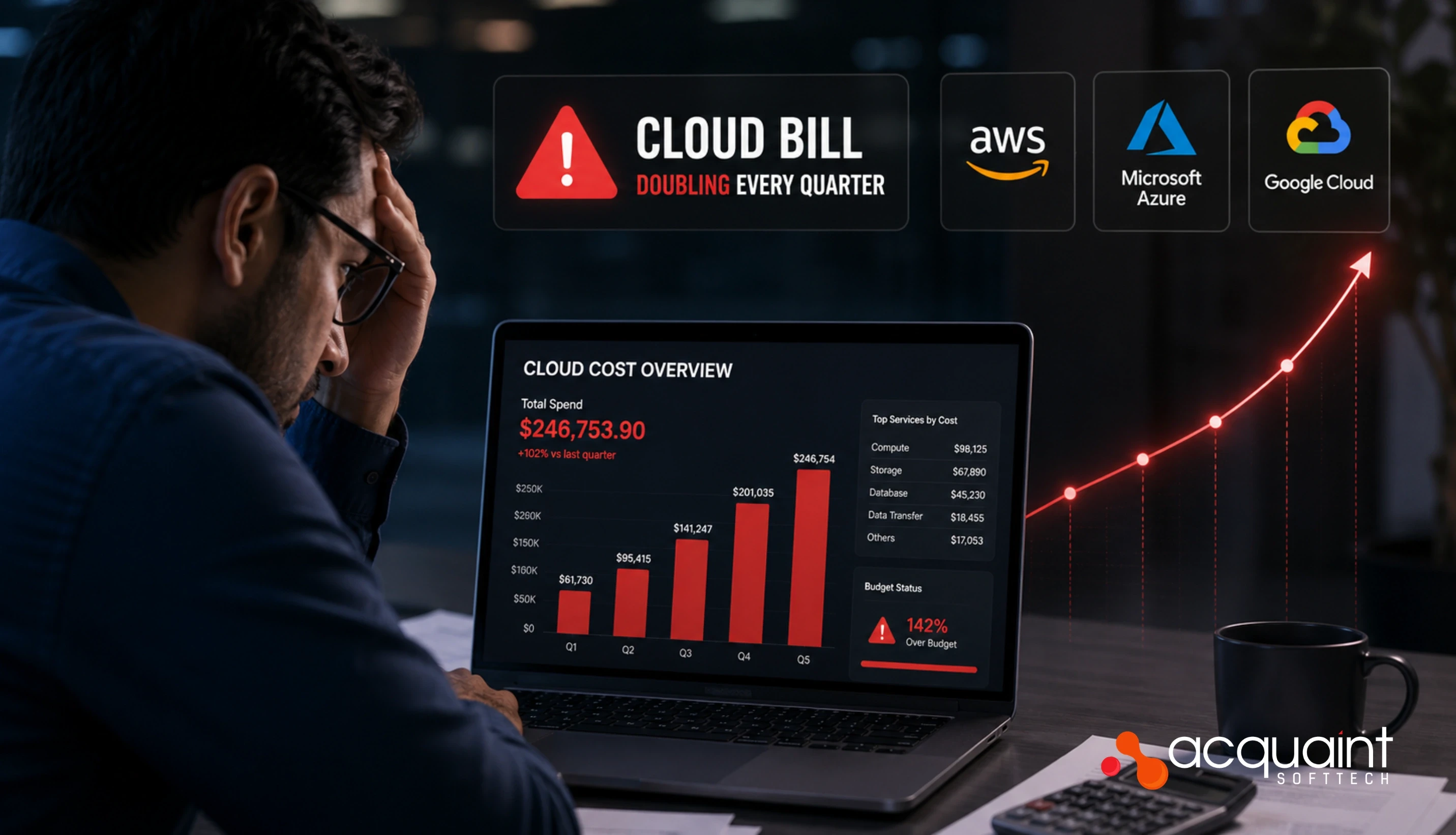
Cloud Bill Doubling Every Quarter: What a DevOps Engineer Finds and Fixes in 30 Days
AWS bill doubling every quarter without a clear reason? A DevOps engineer typically finds 20 to 40% of cloud spend as waste. Here are the 7 categories they fix first.