

React Native vs Flutter for FinTech Apps: Performance, Security, and Cost
For fintech apps in 2026, both Flutter and React Native are strong choices. Flutter is better for performance and security, making it ideal for apps with real-time charts and sensitive data. React Native is better for faster development, easier hiring, and large-scale team growth due to its bigger developer ecosystem.

Ahmed Ginani
If you are weighing React Native vs Flutter for a fintech app, here is the honest answer before we go deep: both are excellent in 2026, and the better choice depends on whether you optimize for performance and security or for hiring and integration. As someone who matches teams to projects at Acquaint Softtech, I see this decision made well and badly every month, and the difference is rarely the framework itself. We guide it through our React Native development practice and broader mobile expertise.
Flutter tends to win when raw performance and security top your list. It compiles to native machine code, which makes the app harder to reverse-engineer and smoother for graphics-heavy screens like real-time charts, and that is a real, measurable edge documented by independent 2026 enterprise framework benchmarks.

- You are a fintech founder or CTO choosing between React Native and Flutter for your app.
- You care most about performance, security, and long-term cost, not hype.
- You are worried about hiring and maintaining the right developers for whichever you pick.
- You are building for the USA, UK, Europe, UAE, or India and need compliance-grade security.
- You want a clear recommendation and a realistic cost and timeline before you commit.
React Native tends to win when hiring speed, deep native SDK integration, and large-team scaling matter more, because its talent pool and ecosystem are bigger. For the wider build context, our guide on software product engineering companies sets the scene.
My practical rule, which the rest of this guide backs up with evidence: choose Flutter for performance-critical, security-sensitive fintech apps, and choose React Native for faster hiring, heavier native integrations, and very large engineering teams. Either way, the implementation quality matters more than the logo, which is squarely a software product development concern.v
How Each Framework Actually Works

To choose well, it helps to understand the one architectural difference that drives everything else: how each framework puts pixels on the screen. React Native renders real native UI components, so a button becomes a true iOS or Android button, coordinated through a JavaScript layer. Flutter draws its own UI with its own engine and compiles Dart to native code, so the app looks identical everywhere and talks closer to the hardware. At Acquaint Softtech, our MERN stack developers and mobile engineers work in both, so we choose on fit rather than familiarity.
That single difference explains most of the trade-offs you will read about. Because Flutter owns the rendering stack through its Impeller engine, it delivers consistent, smooth visuals and stronger raw performance. Because React Native uses real native components, it integrates more naturally with platform features and native SDKs, and it leans on the enormous JavaScript ecosystem. Both are mature and production-proven, so this is about fit, not risk, a point we make often through our product engineering services.
Adoption reflects this balance: recent surveys put Flutter at roughly 46% of developers and React Native around 32 to 35%, with React Native still backed by a deeper hiring market. The framework decision sits inside a bigger stack choice, which we compare in our guide on Laravel vs MERN stack for startups.
Performance: Where the Real Difference Shows
On raw performance, Flutter has a genuine edge for the demanding parts of a fintech app, though for ordinary screens the gap is small. Because Flutter compiles ahead-of-time to native code and its Impeller engine talks directly to the GPU through Metal on iOS and Vulkan on Android, it produces noticeably fewer dropped frames during complex animations; independent 2026 benchmarks cite 30 to 50% fewer jank frames than the older renderer. For live price charts, trading screens, and rich transaction animations, that smoothness is real. Our mobile engineers say the same; this is not a loyalty contest.
That said, for standard fintech screens, dashboards, transfers, statements, the practical performance difference between the two is minimal, and good engineering matters more than the framework. React Native's newer architecture has closed much of the old gap, so unless your app is animation-heavy or latency-sensitive, you will not feel a difference your users notice. Knowing when performance truly matters is part of sound AI and product engineering judgment, and the deployment patterns behind a fast app are covered in our MERN stack app deployment guide.
From the field: Do not pick a framework on benchmark numbers your app will never hit. If you are building a high-frequency trading screen or a chart-heavy investing app, Flutter's performance edge is worth it. If you are building a typical banking, payments, or wallet app, both frameworks are fast enough, and you should decide on hiring, integration, and cost instead.
Security: The Deciding Factor for FinTech

Security is where fintech leaders should pay closest attention, and it is the one area where the framework choice has a real, structural impact. Because Flutter compiles to native ARM machine code, its logic is harder to reverse-engineer than React Native, which ships a JavaScript bundle that, without heavy obfuscation, is easier for an attacker to inspect. For a high-security fintech or payments app, that difference is a legitimate reason many teams lean Flutter. At Acquaint Softtech, our DevOps engineers harden either choice for production.
The important nuance is that this is a starting advantage, not a finished one. React Native fintech apps are perfectly secure when built correctly, with code obfuscation, secure storage, certificate pinning, and proper key handling, and many regulated apps run on it safely. The framework sets the baseline; your engineering discipline sets the outcome. Building that discipline in is core to software development outsourcing.
Get a Free FinTech App Security and Stack Review
Send us your app concept and target markets, and we will review the right framework, security model, and architecture, with a build estimate, within 48 hours. We deliver at $25 to $49 per hour, up to 40% below Western agencies, with 95% on-time sprint delivery.
Cost, Hiring, and Long-Term Maintenance
On cost, the two are closer than most comparisons admit, and the bigger money question is hiring and maintenance over years, not the initial build. Flutter developer rates run roughly $18 to $50 an hour and React Native roughly $20 to $60, with both offering 85 to 90% code reuse across iOS and Android, so the headline build cost is similar. Where they diverge is the talent market: React Native draws on the vast JavaScript developer pool, while strong Flutter and Dart specialists are rarer and can be harder to replace. Helping clients navigate exactly this is what our staff augmentation is built for.
That hiring reality has real consequences. I have seen a fintech rebuild a Flutter app in React Native specifically because they could not find enough Flutter developers to maintain and scale it, and the switch gave them easier hiring and long-term stability.
The lesson is not that one framework is better; it is that you must be able to staff your choice for the long haul, which is why a flexible dedicated software team model de-risks either path, supported over time by ongoing support and maintenance.
Total cost of ownership also includes upgrades as both frameworks evolve quickly. Budgeting for periodic version upgrade services keeps either app current and secure, and the broader hiring-economics picture is laid out in our story on how a startup saved $60K a year on remote hiring.
Head-to-Head Comparison Table
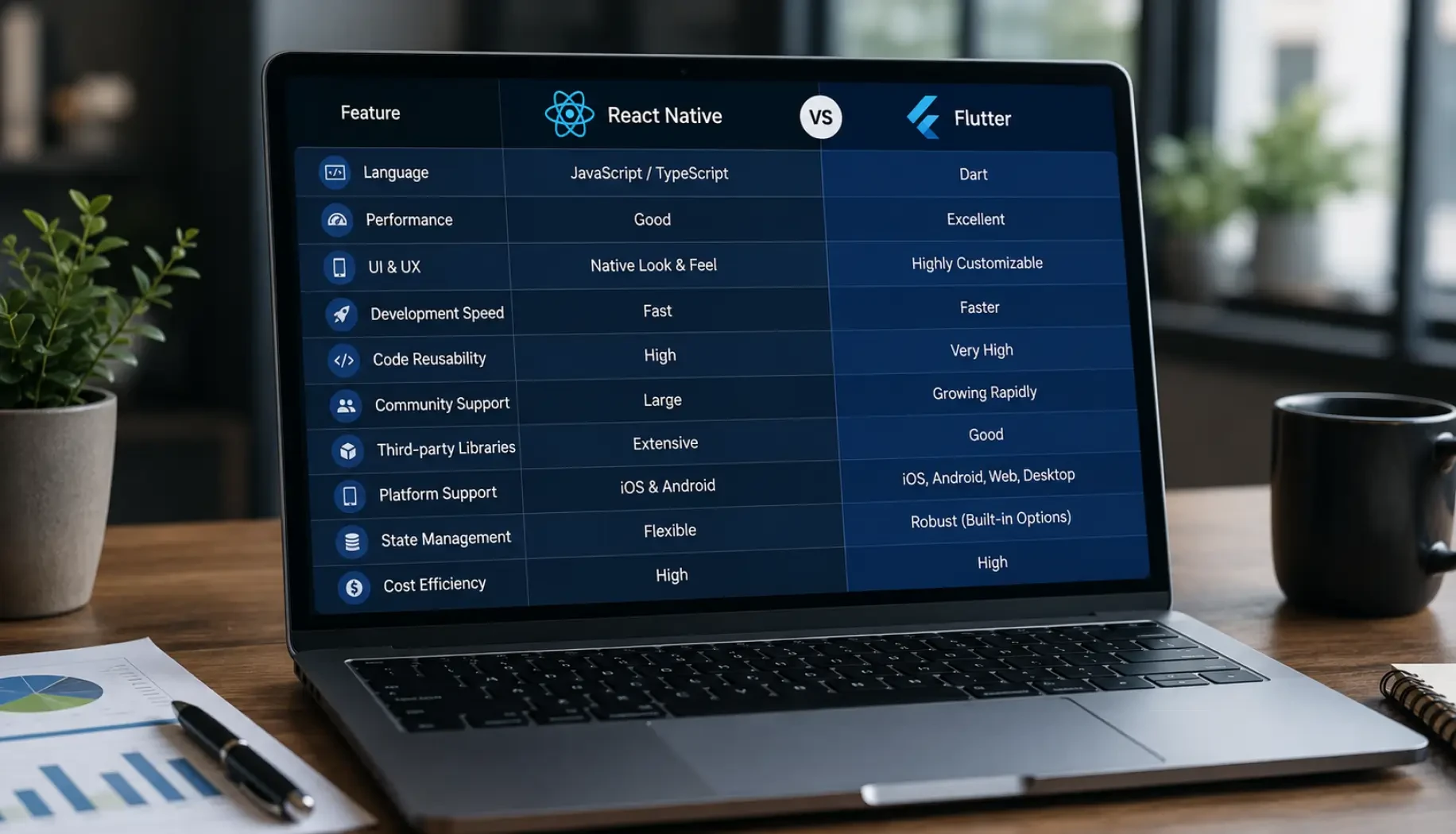
Here is the comparison distilled into the dimensions that actually decide a fintech build. Treat it as a starting point for discussion with your team, not a verdict, because the right pick depends on your weighting of each row. Our virtual CTO services help leaders apply this to their specific roadmap.
Dimension | React Native | Flutter |
Performance | Strong | Stronger (AOT) |
Security | Needs extra hardening | Native code, harder to crack |
Native Integration | Easier | Via plugins |
Talent Pool | Very large | Smaller |
UI Consistency | Per-platform | Pixel-identical |
Team Scaling | Strong (JS tooling) | Good |
Development Cost | $20–60/hr | $18–50/hr |
The pattern is clear: Flutter leads on performance, security baseline, and UI consistency; React Native leads on integration, talent, and large-team scaling; cost is close. For content-driven or marketing surfaces around the app, teams sometimes add WordPress developers, and the wider engineering-partner landscape is covered in our roundup of the top MERN stack development companies in India.
Want This Applied to Your App? Book a Free Strategy Call
Book a free 30-minute call, and we will weigh these dimensions for your fintech app and recommend a framework, team, and phased plan, with your first engineer deployed within 48 hours. We work as an extension of your team, with a verified track record on Clutch.
A Simple Decision Framework
When clients ask me to make this simple, I give them a short set of questions that almost always point to the right framework. Run through these honestly, and the answer usually becomes obvious. We formalize this kind of decision in a structured discovery workshop.
1. Is the app performance- or graphics-heavy? Live trading, rich charts, or heavy animation lean toward Flutter.
2. Is top-tier security a hard requirement? If reverse-engineering resistance is critical, Flutter starts ahead, though both can be hardened.
3. Do you need deep native SDK integrations? Heavy use of platform features or native modules favors React Native.
4. How easily can you hire and scale the team? If fast hiring and a deep talent pool matter, React Native wins.
5. How large is the engineering org? Very large multi-team codebases often favor React Native's JavaScript tooling.
If your answers cluster around performance and security, build in Flutter; if they cluster around hiring, integration, and team scale, build in React Native.
When it is genuinely mixed, I usually recommend React Native for the easier talent path, then invest in security hardening. For senior input on this call, our MEAN stack developers and architects weigh in.
Build Time, Tech Stack, and Real Numbers

Whichever framework you choose, a fintech app shares the same supporting stack: a secure backend (often Python or Node.js), encrypted storage, API integrations to banking and payment rails, and strong authentication. The mobile framework is only the front end; most of the security and compliance work lives behind it. At Acquaint Softtech, our Python developers and Django developers build that backend to fintech-grade standards.
On numbers, a cross-platform fintech MVP in either framework typically runs a few months and from the mid-five figures, with cost driven more by features, integrations, and compliance than by the framework. Both give you one codebase for iOS and Android, which is the real saving versus building twice. For heavier data and automation needs, teams add automation engineers to keep testing and releases reliable.
Build Scope | Indicative Cost (USD) | Timeline |
Cross-platform MVP | $40K to $90K | 3 to 6 months |
Full fintech app + integrations | $90K to $250K | 6 to 12 months |
Multi-market, high-security build | $250K+ | 12 months+ |
Maintenance and upgrades | Annual retainer | Continuous |
India-based teams deliver either framework at up to 40% lower cost than Western agencies, which is why many fintechs build with a remote partner and scale the team flexibly. For commerce-facing fintech features, some teams also bring in WooCommerce developers, and project delivery is kept on track by experienced project managers.
Case Study: A FinTech App We Delivered
To ground this in real delivery, consider SuperFi, a UK consumer-credit fintech that helps people manage and clear credit-card and loan debt. The client needed a trustworthy, cross-platform app delivered quickly and on budget, without standing up an in-house mobile team, exactly the situation this framework decision sits inside. You can see this and related work in our portfolio of client case studies.
At Acquaint Softtech, we delivered a next-generation website and mobile app with a dedicated team, steering the project to an on-time launch with no cost overrun. The cross-platform mobile build was handled by experienced React Native developers, giving SuperFi one codebase for iOS and Android and a faster path to market, while a white label development approach kept the product fully under the client's brand. The same affordability and security logic any fintech app needs sat at the core.
Outcome | Challenge | Result | |
Speed to market | Idea to working app | On-time launch, widely adopted | |
Budget | Avoid cost overrun | No overrun, controlled cost | |
Platforms | iOS and Android | One cross-platform codebase | |
Team | No in-house mobile team | Dedicated team delivered | |
Want a FinTech App Delivered Like SuperFi? Talk to Us
Book a free discovery call, and we will recommend React Native or Flutter for your app, scope the build, and deploy your first engineer within 48 hours. We launched a UK consumer-credit app on time and on budget, with a verified track record on Clutch.
Best Practices and Mistakes to Avoid

What we recommend
Across the fintech apps we have staffed and shipped, a few habits separate smooth builds from painful ones. Choose the framework based on your real priorities, performance, and security versus hiring and integration, not on trends.
Harden security regardless of framework, with obfuscation, secure storage, and certificate pinning. Confirm you can hire and maintain your choice before you commit, and keep the framework version current as both evolve quickly. These habits keep quality high, a point reinforced in our roundup of the best software product engineering companies.
What to avoid
The common mistakes are predictable. Picking Flutter for its performance edge when your app is a standard banking UI wastes a harder hiring path you did not need. Picking React Native and skipping security hardening leaves your JavaScript bundle exposed.
Choosing a benchmark your app will never reach, or on which framework your last developer liked, ignores the questions that actually matter. And forgetting maintenance and hiring leads to the rebuilds I see too often. Avoiding these is mostly disciplined decision-making, and the data discipline behind a solid app is covered in our MERN stack guide for beginners.
Build Your FinTech App With the Right Framework and Team
Book a free consultation and get a clear React Native or Flutter recommendation plus a phased build plan, with your first engineer deployed within 48 hours. We deliver at $25 to $49 per hour, up to 40% below Western agencies, with 95% on-time sprint delivery and 1,300+ projects behind us.
Frequently Asked Questions
-
Is React Native or Flutter better for fintech apps?
Both are strong. Flutter has an edge in raw performance and security because it compiles to native code, so it suits performance- and security-critical apps. React Native has an edge in hiring, native integration, and large-team scaling. The best choice depends on your priorities.
-
Which is more secure, React Native or Flutter?
Flutter starts with a security edge because it compiles to native machine code that is harder to reverse-engineer, while React Native ships an inspectable JavaScript bundle. However, both are secure when hardened properly with obfuscation, secure storage, and certificate pinning.
-
How much does a React Native or Flutter fintech app cost to build?
Project Type
Cost
Cross-platform MVP
$40,000 – $90,000
Full FinTech App (with integrations)
$90,000 – $250,000
Multi-market High-security Build
$250,000+
India-based Team Savings
Up to 40% lower cost
-
How long does a React Native or Flutter fintech app take to build?
A cross-platform MVP typically takes 3 to 6 months, and a full fintech app with integrations 6 to 12 months. Both frameworks share one codebase for iOS and Android, so the timeline is driven mainly by feature depth and compliance, not the framework.
-
What is the best tech stack for a fintech app?
React Native or Flutter for the cross-platform front end, a secure backend in Python or Node.js, encrypted storage, banking and payment API integrations, and strong authentication. Most security and compliance work lives in the backend, not the mobile framework.
-
Why do some banks choose Flutter?
Banks and payment apps such as Google Pay often choose Flutter for its native-code performance, pixel-perfect UI consistency, smooth real-time chart and transaction animations, and a security baseline that is harder to reverse-engineer.
I help agencies and founders scale their tech teams with the right developers at the right time. At Acquaint Softtech, I focus on building long term partnerships and making remote hiring simple, predictable, and results driven. My goal is straightforward to help businesses grow faster with reliable dedicated developers.
Table of Contents
Get Started with Acquaint Softtech
- 13+ Years Delivering Software Excellence
- 1300+ Projects Delivered With Precision
- Official Laravel & Laravel News Partner
- Official Statamic Partner
Related Blog

Deploying MERN Stack Apps: Cloud, Serverless, and Best Practices
Master MERN Stack app deployment with a field-tested guide covering MERN cloud deployment, serverless MERN stack, and the best practices for production-ready apps.

Acquaint Softtech
October 16, 2025
Top MERN Stack Development Companies in India to Hire in 2026
MERN is a modern JavaScript technology stack built on MongoDB, Express.js, React, and Node.js, widely used to develop fast, scalable, and dynamic web applications. Industry insights indicate that JavaScript remains the most used programming language globally, making MERN a preferred choice for businesses looking to build high-performance digital products with a unified tech stack.
However, searching for top MERN stack development companies in India reveals numerous service providers, making evaluation time-consuming and complex. To simplify this process, we analyzed 100+ MERN development firms, shortlisted companies with proven project delivery experience, and focused on teams known for building scalable web applications and product-driven solutions.

Zubair Pateljiwala
October 22, 2024
Top 10 Software Product Engineering Companies in 2026
As businesses continue to shift toward digital-first strategies, partnering with a software product development company to build scalable and reliable software products has become essential for staying competitive. Companies across industries now rely on product engineering partners to accelerate innovation, shorten development cycles, and deliver high-quality digital experiences that meet evolving user expectations.
With increasing investments in cloud, AI, and platform modernization, demand for product engineering expertise is growing rapidly. Recent market insights indicate the global engineering services market is projected to surpass $1 trillion by 2030, highlighting the critical role engineering partners play in driving product innovation and long-term growth.
Zubair Pateljiwala
March 7, 2025India (Head Office)
203/204, Shapath-II, Near Silver Leaf Hotel, Opp. Rajpath Club, SG Highway, Ahmedabad-380054, Gujarat
USA
7838 Camino Cielo St, Highland, CA 92346
UK
The Powerhouse, 21 Woodthorpe Road, Ashford, England, TW15 2RP
New Zealand
42 Exler Place, Avondale, Auckland 0600, New Zealand
Canada
141 Skyview Bay NE , Calgary, Alberta, T3N 2K6