

The Complete Guide to SaaS Product Development in 2026
SaaS product development in 2026 is five interlocking decisions: architecture, billing, compliance, AI, and team model, each with a costly alternative if made in the wrong order. This guide covers all five with specific cost ranges, comparison tables, and real delivery data from 1,300+ projects.

Acquaint Softtech
As a software development partner with over 1,300+ projects delivered across 13+ years, Acquaint Softtech has observed every architectural mistake, billing mismatch, and compliance gap that stalls a SaaS product between its prototype and its first $1 million in ARR (Annual Recurring Revenue). The global SaaS market is growing at approximately 20% annually, projected to reach $247 billion by the end of 2025 (Gartner public cloud forecast). Competition inside that market is correspondingly intense. Products built on architecturally weak foundations hit a scaling ceiling that costs $150,000 to $400,000 to correct after the fact. This SaaS product development guide 2026 covers the five decisions that determine whether a SaaS platform will scale, pass enterprise security reviews, and sustain revenue as the product grows, in the sequence those decisions must be made.

- Founders and CTOs evaluate SaaS architecture before the first developer writes a line of code.
- Engineering directors whose current monolith cannot handle multi-tenancy or usage-based billing without a rebuild.
- Product companies that have outgrown a shared-schema database and need to understand what a migration actually costs.
- Founders and agencies are evaluating whether to build in-house or outsource to a dedicated SaaS development team.
- COOs and VPs of Engineering are building a vendor selection framework for an ongoing SaaS development programme.
PROBLEM · AGITATE · SOLUTION Problem: You have a SaaS idea, or a live product, and the path from current state to a compliant, scalable, revenue-generating platform is unclear. Five decisions feel simultaneous and equally urgent. Solution: This guide resolves the ambiguity. It covers architecture, billing, compliance, AI, cost, and team model, with specific decision frameworks, cost ranges, and comparison tables, so each decision is made in the right order and at the right time. |
The structural misunderstanding most SaaS founders carry into their first architecture meeting is treating the five core decisions as independent choices. Architecture can wait until the product proves itself. Billing can come from Stripe later. Compliance is an enterprise problem. AI can be layered in post-launch. The team model can evolve organically. This produces technical debt at every stage. The guide below treats the five decisions as a single interdependent system, because that is what they are. A SaaS product development company that has built across 1,300+ projects knows which decisions cannot be deferred and which the evidence shows should be.
What SaaS Product Development Actually Means in 2026

SaaS (Software as a Service) product development is the end-to-end process of designing, building, and scaling a software application that customers access via the internet on a subscription or consumption basis. The definition is straightforward. The execution is not. SaaS product development in 2026 requires simultaneous command of architectural patterns (multi-tenancy, schema isolation, microservice decomposition), billing infrastructure (metering, dunning, revenue recognition), compliance frameworks (SOC 2, GDPR, HIPAA), AI integration (LLM APIs, RAG pipelines, inference cost management), and team structure. These five domains interact. A billing architecture choice constrains the data model. A compliance requirement constrains the cloud region. An AI feature constrains the token cost model.
The three types of SaaS products Acquaint Softtech builds most frequently:
1. Horizontal SaaS: tools usable across industries, project management, CRM, analytics dashboards, and HR platforms. The business model scales through volume. Differentiation is the primary challenge.
2. Vertical SaaS: products built for a specific industry, healthcare, fintech, logistics, proptech. Higher switching cost, higher compliance exposure, and 2 to 3 times higher net revenue retention than horizontal SaaS (a16z public market data).
3. Infrastructure SaaS: platforms that other software products are built on top of, analytics engines, payment orchestration layers, AI inference platforms, identity providers. The buyer is a developer or product team.
The SaaS market context for 2026 - key numbers every builder should know:
$247 billion: projected global SaaS market value by the end of 2025 (Gartner public cloud forecast).
20%: approximate annual growth rate of the global SaaS market.
76% of companies now outsource IT functions, including SaaS development (Deloitte 2024 Global Outsourcing Survey).
$534.9 billion: global software development outsourcing market value in 2024, projected to be $940 billion by 2034 (Market.us research).
2–3×: higher net revenue retention in vertical SaaS versus horizontal SaaS at equivalent revenue ranges.
30–50%: reduction in boilerplate coding time from AI-assisted development tools (GitHub Copilot, Cursor, Claude Code), compressing MVP timelines from 18–24 months to 8–14 months.
The five decisions SaaS product development requires and the sequence in which they must be made:
1. Architecture & Multi-Tenancy → 2. Tech Stack → 3. Billing System → 4. Compliance Framework → 5. AI Integration → Team Structure
SaaS Architecture: The Decision That Cannot Be Undone Cheaply

SaaS architecture is not a synonym for cloud hosting. It is the structural set of decisions that determines how a platform isolates data between customers, scales under load, deploys features without downtime, and recovers from failures without data loss. Three architecture decisions drive cost and scalability more than any others: multi-tenancy model, deployment model, and service decomposition strategy.
Multi-Tenancy: The Foundational Choice
Multi-tenancy is the architecture pattern that allows a single SaaS instance to serve multiple customers while keeping each customer's data completely isolated. The three patterns and the real cost of choosing incorrectly:
Pattern | How It Works | Isolation Level | Cost to Fix Later | Best Use Case |
Shared DB, Shared Schema | All tenants share tables; the tenant_id column separates data at the query level | Low - a query bug or ORM misconfiguration leaks data | $80,000 – $250,000 migration | Rapid prototypes and internal tools only - not for customer-facing SaaS |
Shared DB, Schema-per-Tenant | Each tenant has its own Postgres schema; one database server | High - schemas isolated at the DB engine level | $30,000 – $90,000 if redesigned later | Most SaaS products in 2026, recommended default for new builds |
Database-per-Tenant | Each tenant has a fully separate database instance | Maximum required by some regulated enterprise buyers | Not applicable build correctly from the start | Healthcare SaaS, enterprise fintech, and high-compliance verticals requiring strict isolation guarantees |
Acquaint Softtech recommends schema-per-tenant as the default for new SaaS products in 2026. It passes most SOC 2 Type II enterprise security reviews, supports per-tenant migrations without global risk, and works cleanly in Laravel (stancl/tenancy), Django (django-tenants), and Node.js. The migration cost from shared-schema to schema-per-tenant at scale is $80,000 to $250,000, the strongest possible argument for choosing the correct pattern at the start.
Deployment Model: Single-Region vs Multi-Region
Model | Right for Which Products | Cost Premium |
Single-region | Geographically concentrated customer base; products where all customers are in one jurisdiction | Baseline, no premium |
Multi-region active-active | Enterprise customers in the EU, the US, and APAC simultaneously; data residency requirements under GDPR, PDPA, or India's DPDP Act | 30–60% higher ongoing infrastructure; $15,000–$40,000 initial build cost |
Multi-region active-passive (DR) | Products that need sub-4-hour RTO (Recovery Time Objective) for SOC 2 availability criteria | 10–20% higher infrastructure |
Service Decomposition: Monolith vs Microservices
The monolith vs microservices question is the most frequently misapplied architectural decision in SaaS product development.
The Evidence-Based Rule Acquaint Softtech Applies:
Premature decomposition is the single most common cause of SaaS delivery failure in teams with fewer than 20 engineers. The modular monolith delivers 95% of the scalability benefit at 30% of the complexity cost. |
Is Your SaaS Architecture Ready to Scale?
Acquaint Softtech reviews existing SaaS architectures, identifies the specific multi-tenancy, deployment, and decomposition gaps, and delivers a remediation roadmap within 48 hours. You review it before any engagement begins.
SaaS Tech Stack Comparison 2026: Laravel vs Python vs Node.js
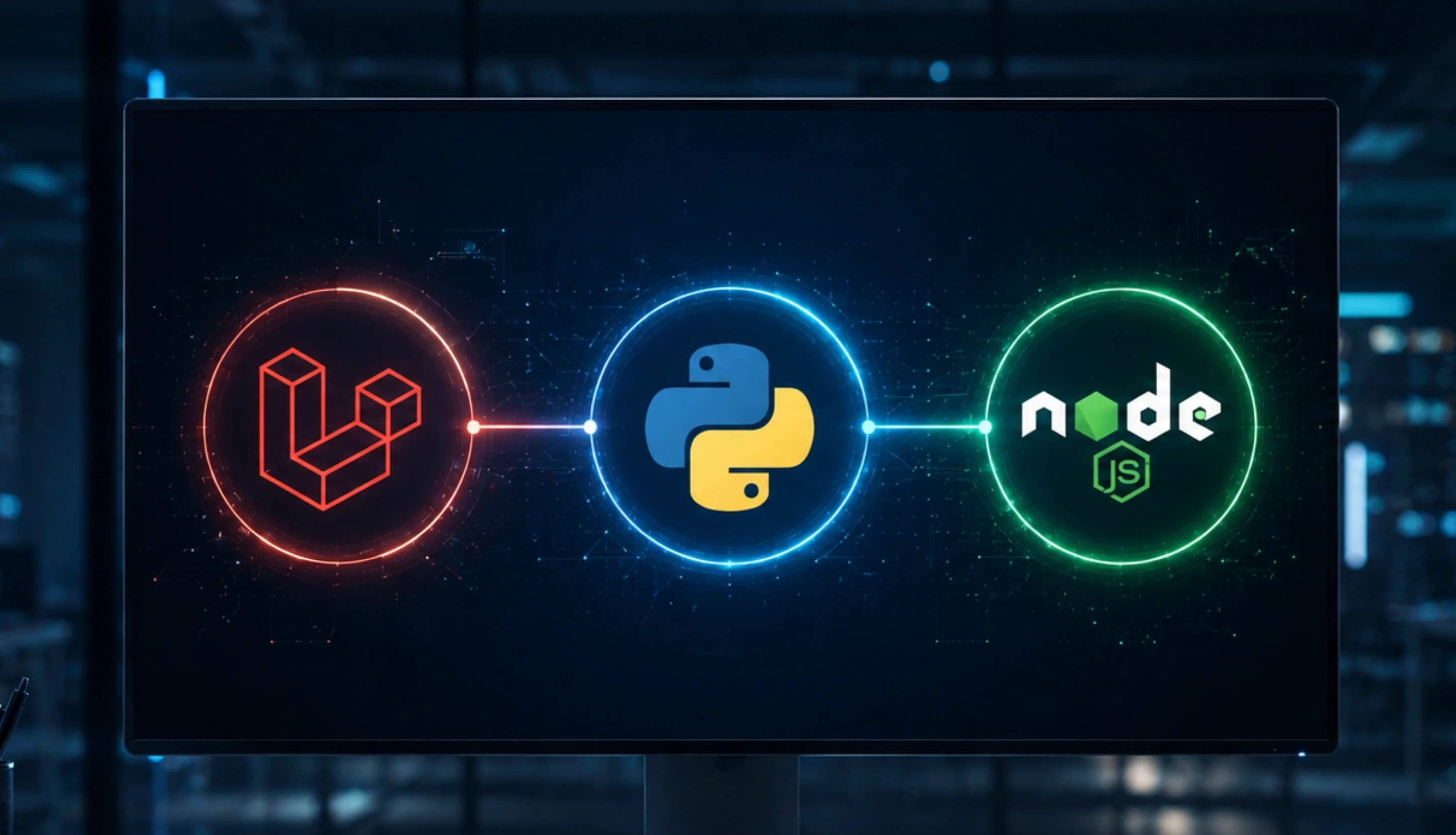
The correct tech stack is the one that maximizes developer availability, minimizes infrastructure cost at the current scale, and does not create a framework ceiling before the target scale is reached. The comparison below is drawn from Acquaint Softtech's delivery data across SaaS products built in all three stacks across 13 years.
Dimension | Laravel (PHP) | Python (Django / FastAPI) | Node.js (MERN / Express) |
Primary SaaS use case | Multi-tenant SaaS, subscription billing, CMS-backed platforms, Official Laravel Partner workflow | AI-heavy SaaS, data pipelines, ML integration, analytics platforms | Real-time SaaS, collaborative tools, event-driven systems, API-first products |
Multi-tenancy support | stancl/tenancy - production-grade, schema-per-tenant native, most mature Laravel package for this purpose | django-tenants - production-ready, requires schema discipline, fewer edge case docs | Custom implementation required - flexible but no opinionated package with same maturity |
Billing integration | Laravel Cashier - Stripe/Paddle native, subscription + proration + invoicing as first-party package | dj-stripe + Stripe SDK - full-featured, more manual configuration wiring | Stripe Node SDK - complete control, requires custom subscription and dunning logic |
AI integration (2026) | Laravel AI SDK (official 2025+), Prism library, OpenAI + Anthropic wrappers built in | Native: OpenAI, LangChain, LlamaIndex, Hugging Face - strongest AI ecosystem across any backend language | LangChain.js, Vercel AI SDK, OpenAI Node SDK -strong but smaller ecosystem than Python |
Feature flags (SaaS gating) | Laravel Pennant - first-party package, per-tenant plan gating, A/B tests, staged rollouts | Waffle or custom - no first-party equivalent to Pennant | LaunchDarkly integration or custom - no framework-native equivalent |
Developer availability (India) | Largest pool - highest availability, lowest cost per senior engineer | Large and fast-growing pool due to AI market demand | Large pool highest demand, slightly higher cost per engineer |
Typical monthly cost (10-eng, India) | $13,000 – $18,000 / month | $14,000 – $21,000 / month | $15,000 – $23,000 / month |
Time to production-ready SaaS MVP | 12 – 16 weeks | 14 – 18 weeks | 12 – 16 weeks |
Acquaint Softtech with the official partnership | Yes - Official Laravel Partner | No (capability only) | No (capability only) |
Acquaint Softtech is an Official Laravel Partner. Laravel delivery follows the framework's own certification standards. For SaaS products with heavy AI requirements, Acquaint Softtech frequently combines Laravel for the application layer with a Python microservice for inference, giving clients the developer availability and billing maturity of Laravel alongside Python's AI ecosystem depth. The published PHP vs Python vs Node.js comparison for SaaS covers the trade-offs in detail, including benchmark data and per-use-case recommendations.
Frontend Stack - Three Options for SaaS in 2026
React + Next.js (App Router): dominant choice. Component model matches SaaS UI patterns. Next.js App Router enables SSR for performance-critical pages. Vercel AI SDK integrates directly for streaming AI responses. React Query for server state management. Best for most SaaS products.
Vue.js + Nuxt 3: correct for teams with existing Vue expertise. Nuxt 3 reaches feature parity with Next.js for most SaaS applications. Smaller ecosystem; fewer hiring options in India compared to React.
Angular: appropriate for enterprise SaaS where TypeScript strictness and opinionated structure reduce risk in teams of 15+ frontend engineers. Higher learning curve; stronger architectural guardrails.
Infrastructure Stack - AWS Services by Function
Function | AWS Service | Notes | Cost/Month at 5K MAU |
Compute | ECS Fargate or EC2 | Fargate for containerized workloads without instance management overhead | $80 – $400 |
Primary database | RDS PostgreSQL / Aurora Serverless | PostgreSQL is dominant for SaaS; Aurora Serverless for variable-load products | $200 – $600 |
Caching + Queue | ElastiCache (Redis) + SQS | Redis for sessions, rate limiting; SQS for durable inter-service messaging | $50 – $200 |
File storage | S3 + CloudFront | S3 for uploads; CloudFront for static asset and media CDN delivery | $30 – $150 |
AI inference | Bedrock or direct API | AWS Bedrock for hosted models; direct OpenAI/Anthropic API for GPT-4o or Claude 3.5 | $300 – $2,500 (usage-driven) |
Monitoring | CloudWatch + Datadog | CloudWatch for infrastructure; Datadog for application performance monitoring | $50 – $300 |
Total infrastructure cost for a SaaS product at 1,000 to 5,000 MAU: $800 to $2,500 per month, before AI inference. Infrastructure cost is the smallest variable in SaaS total cost of ownership, engineering and compliance costs dominate.
Need a Tech Stack Decision Before Your First Sprint?
Acquaint Softtech recommends the correct backend, frontend, and infrastructure stack based on your SaaS product type, compliance requirements, and developer availability constraints. A stack recommendation with full rationale is delivered within 48 hours.
SaaS Billing Architecture: Subscriptions, Usage, and Proration
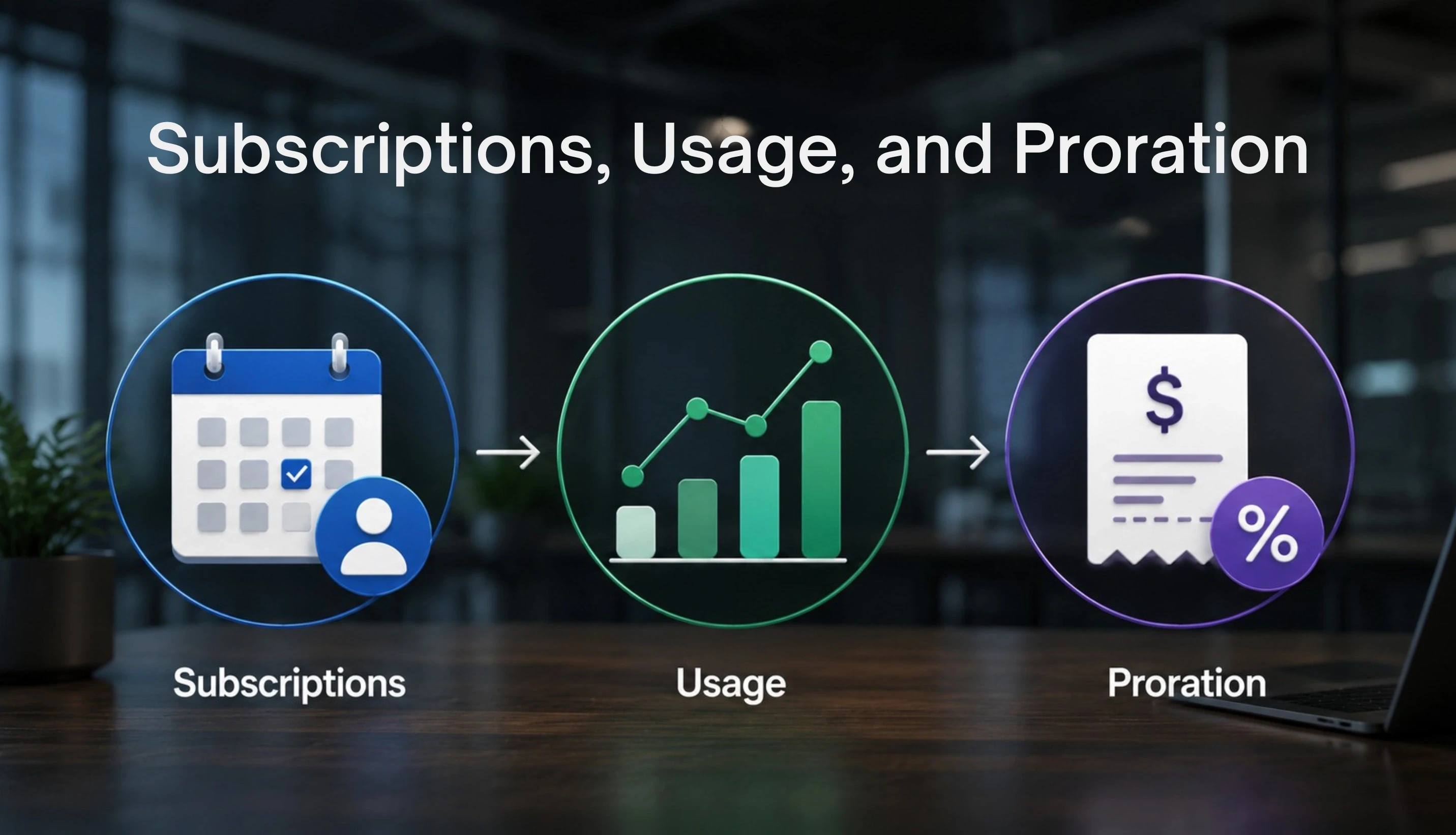
SaaS billing is the second most frequently under-designed component in SaaS products, after multi-tenancy. A billing system that cannot support the revenue model the product will eventually need is not a billing system, it is a future refactor costing 40% to 60% more than building the correct system from the start.
The Four Billing Models: Which Is Dominant in 2026
Billing Model | How It Works | Best SaaS Use Case | 2026 Trend |
Flat-rate subscription | Fixed monthly or annual fee regardless of usage | Simple tools, internal enterprise SaaS with defined scope | Declining being replaced by hybrid models |
Seat-based subscription | Fee per user per month; seats define the billing unit | Collaboration tools, CRM, HR platforms, where value = user count | Stable appropriate when the value delivered correlates with the user count |
Usage-based (metered) | Fee per API call, GB stored, compute hour, or event processed | AI-powered SaaS, communications platforms, infrastructure SaaS | Fastest growing adopted by Twilio, Anthropic, Vercel, AWS, OpenAI |
Hybrid (base + overage) | Base subscription + usage-based overage charges above the base | Most new SaaS products launched 2024–2026, maximize revenue per customer | Now the dominant model for new SaaS product launches |
The Six Billing Components Every SaaS Must Implement
Component | What It Must Do | Implementation Complexity | Recommended Tool |
Trial management | Start trial, set end date, prevent double-trial, convert or expire cleanly | Low | Stripe Trial / Chargebee native |
Plan upgrades/downgrades | Prorate unused balance immediately or at period end; update entitlements in real time | Medium - proration logic varies by billing cadence | Stripe Billing or Chargebee |
Usage metering | Count events in real time, store raw events, aggregate at billing cycle, report to billing provider | High - requires an idempotent event pipeline and deduplication | Stripe Meters (GA 2024) / Lago / Metronome |
Dunning | Retry failed payments on schedule, notify customer, pause access gracefully before cancellation | Medium - Stripe Smart Retries covers most; custom rules require config | Stripe Smart Retries + Chargebee dunning |
Tax calculation | VAT for EU customers, GST for Indian customers, sales tax for US states, and B2B exemption by jurisdiction | High - multi-jurisdiction rules change frequently | TaxJar / Avalara / Stripe Tax |
Revenue recognition | Separate deferred revenue from earned, report MRR / ARR/churn / expansion MRR accurately | High - requires a dedicated reporting layer | Maxio / ChartMogul / Stripe Revenue Recognition |
Billing Provider Decision Framework
4. Under $10M ARR: Stripe. Best documentation, webhook reliability, Stripe Radar for fraud, and Stripe Meters for usage-based billing. Correct for the majority of SaaS products.
5. Above $10M ARR with complex revenue recognition: Chargebee or Maxio. Revenue operations reporting, complex dunning workflows, and enterprise invoicing that Stripe does not support natively.
6. Products avoiding VAT/sales tax registration: Paddle as Merchant of Record. Paddle collects, remits, and manages tax liability for 50+ jurisdictions. Removes significant compliance overhead for products with global consumer markets.
7. High-volume metering (>100M events/month): dedicated metering layer (Lago, Metronome) before billing provider. Reduces latency on usage aggregation and prevents Stripe API rate limit exposure.
Acquaint Softtech's dedicated software development teams with Stripe, Chargebee, and Paddle across SaaS engagements. Billing configuration, including proration, dunning, multi-currency, and metering pipelines, is part of the standard Stage 2 delivery specification, not a separate engagement.
Build the Billing System That Will Scale With Your Revenue Model
Acquaint Softtech configures the right billing provider, implements usage metering pipelines, and sets up dunning workflows for SaaS products at any stage of growth. Developer profiles shared within 48 hours.
SaaS Compliance 2026: SOC 2, GDPR, HIPAA, and PCI-DSS
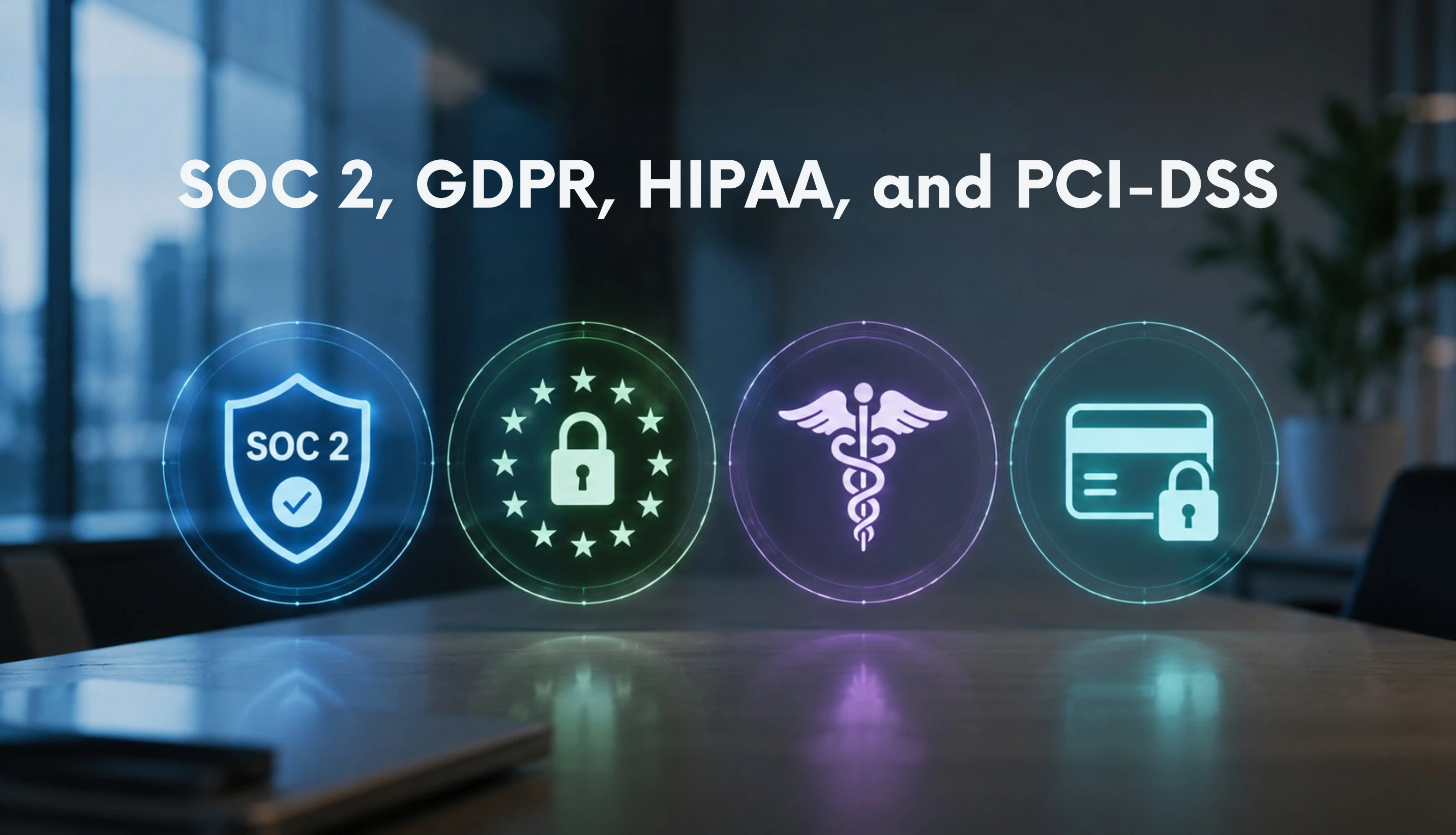
SaaS compliance is the primary gate for products moving from SMB customers to enterprise contracts in 2026. A single missing technical control can block a $400,000 annual deal. The four frameworks that SaaS products encounter most frequently, with the specific technical controls each requires:
SOC 2 Type II - The US Enterprise Contract Prerequisite
What it audits:
Five Trust Service Criteria: security, availability, processing integrity, confidentiality, and privacy. The Type II designation requires a 6-month observation period, during which the auditor verifies that controls operated consistently, not just that they were documented.
Technical controls required:
Multi-factor authentication on all administrative access: production systems, cloud management consoles, version control platforms.
Encryption at rest (AES-256) and in transit (TLS 1.2 minimum, TLS 1.3 preferred) for all data, including backups and logs.
Access logging with minimum 90-day retention: who accessed what system, from which IP, at what time, with what action.
Change management documentation for every production change: approver, change description, and rollback plan.
Incident response procedure with defined and tested RTO (Recovery Time Objective < 4 hours for most SaaS products meeting availability criteria).
Vulnerability scanning quarterly minimum; penetration testing annually by a third-party vendor.
Vendor risk management: documented assessment of every third-party service the product relies on.
Cost in 2026:
|
GDPR - EU Data Residents
Who it applies to:
Any SaaS product processing personal data of EU residents, regardless of where the vendor is headquartered. No minimum revenue threshold. Applicable to the first EU user.
Technical requirements:
DSAR (Data Subject Access Request) workflow: complete, accurate export of all user data within 30 days, machine-readable format, including all sub-processor data.
Right to erasure: verifiable deletion from every table, backup, log, and sub-processor within the regulatory window. Must be tested and documented, not asserted.
Sub-processor register: every third-party service receiving user data must be listed and covered by a signed DPA (Data Processing Agreement). This includes analytics tools, email providers, AI APIs, support systems, and error tracking.
Breach notification: affected data subjects notified within 72 hours of a confirmed breach. Requires an incident detection and escalation workflow that can meet this timeline.
The most frequently overlooked GDPR requirement: the sub-processor register. OpenAI's API, Anthropic's API, Segment, Intercom, Datadog, Sentry, and every analytics tool your SaaS sends user data to must be listed, DPA-covered, and reviewable before your first EU user is onboarded. |
HIPAA - Healthcare SaaS
Who it applies to:
Any SaaS product handling PHI (Protected Health Information), any product used by healthcare providers, health insurers, or their business associates.
Technical safeguards:
Unique user identification: no shared logins in any production environment.
Automatic logoff after a defined inactivity period, configurable per role.
Audit controls: all PHI access logged with user identity, timestamp, and action type, immutable logs.
PHI encryption: AES-256 at rest and TLS 1.2+ in transit, including in backups, exports, and API responses.
Business Associate Agreements (BAAs): required with every vendor that processes PHI. AWS, Google Cloud, and Azure offer HIPAA-eligible service tiers. OpenAI's standard API does not offer a BAA. Anthropic's enterprise tier does.
PCI-DSS - Payment Card Data
SAQ A (minimal scope): SaaS using Stripe, Paddle, or Braintree with client-side tokenization and no raw card number storage. 2–4 weeks to achieve. $2,000 – $8,000 cost.
SAQ D or Level 1 (full scope): SaaS that stores or processes raw card data. Requires a Qualified Security Assessor (QSA) audit. $50,000 – $200,000 annually. 6–12 months to prepare.
Framework | Who Needs It | Timeline to Achieve | 2026 Total Cost Range |
SOC 2 Type II | US enterprise SaaS | 6–12 months (incl. 6-mo observation) | $40,000 – $110,000 |
GDPR | Any SaaS with EU users | 2–4 months for controls | $10,000 – $40,000 |
HIPAA | Healthcare SaaS / PHI handlers | 3–6 months | $20,000 – $80,000 |
PCI-DSS SAQ A | Stripe/Paddle tokenization only | 2–4 weeks | $2,000 – $8,000 |
PCI-DSS Level 1 | Direct card data processing | 6–12 months | $50,000 – $200,000/year |
ISO 27001 | Enterprise SaaS, EU/APAC markets | 9–18 months | $30,000 – $120,000 |
Need a Compliance-Ready SaaS Architecture?
Acquaint Softtech builds HIPAA-compliant, SOC 2-ready, and GDPR-conformant SaaS platforms for clients across the US, UK, Australia, and UAE. A compliance control checklist tailored to your product is shared within 48 hours.
AI in SaaS: What to Build, What to Wrap, and What to Avoid

AI in SaaS product development in 2026 is not optional for products competing in markets where AI-native competitors exist. The three categories of AI integration are wrapping (calling an LLM API without custom training), fine-tuning (adapting a foundation model on proprietary data), and building (training a custom model from scratch). For 99% of SaaS products, wrapping is the correct starting point.
AI Features by Implementation Complexity and Cost
AI Feature | What It Does for the User | Implementation Time | Cost (India team) | Monthly Inference Cost (est.) |
Document intelligence | Summarisation, extraction, and classification of uploaded documents | 3–6 weeks | $15,000 to $40,000 | $800 – $2,500 |
Conversational search | Natural language query over structured product data | 4–8 weeks | $20,000 to $60,000 | $400 – $1,800 |
Workflow automation | AI-powered decision routing replacing manual triage | 6–12 weeks | $30,000 to $90,000 | $600 – $2,000 |
AI onboarding assistant | Adaptive onboarding that responds to user answers | 3–5 weeks | $12,000 to $35,000 | $400 – $1,500 |
Predictive churn detection | Identifies at-risk customers 30–90 days ahead | 8–16 weeks | $40,000 to $120,000 | $200 – $800 |
AI-generated content | Draft generation from structured data (emails, reports, descriptions) | 2–4 weeks | $8,000 to $25,000 | $300 – $1,200 |
RAG (knowledge base Q&A) | Answers questions using the platform's own document store | 6–10 weeks | $25,000 to $70,000 | $500 – $2,000 |
The Five AI Implementation Mistakes That Waste Budgets
Building RAG before testing simple prompts. Most document intelligence use cases can be resolved with a structured prompt and a 128K-token context window. Test prompts first. Build a RAG pipeline when prompt-only approaches fail specific accuracy targets - not before.
Streaming AI without designing UX for the latency. Streaming responses via SSE or WebSockets require a UI pattern that communicates partial output during inference. A blank screen during a 3-second LLM inference produces higher abandonment than a loading indicator.
Ignoring inference cost modelling. GPT-4o input costs approximately $2.50 per million tokens; Claude 3.5 Sonnet approximately $3.00. A SaaS product processing 100,000 documents per month at 5,000 tokens each spends $1,250 – $1,500 per month on inference alone, before compute, storage, or retrieval costs.
Fine-tuning before sufficient training data. Fine-tuning is only appropriate with 10,000+ correct input/output examples and after prompt-only approaches have reached an accuracy ceiling. Premature fine-tuning adds $20,000 – $80,000 in engineering cost before it is justified by the performance gap.
Using a non-BAA AI provider for healthcare data. OpenAI's standard API does not offer a HIPAA Business Associate Agreement. Healthcare SaaS must use Anthropic's enterprise tier, AWS Bedrock, or Azure OpenAI, all of which offer BAAs, or ensure PHI never reaches the AI API.
Acquaint Softtech's AI development services cover the full spectrum: LLM integration, RAG pipeline development, fine-tuning on client data, and the production infrastructure to serve AI features at scale. The Laravel AI SDK, presented at Laracon India 2026, provides first-party AI integration for Laravel SaaS products combining the framework's application stability with OpenAI and Anthropic inference.
SaaS Development Cost in 2026: Full Cost Table

For startups looking for a smaller starting point, Acquaint Softtech offers fixed-project MVP development from $5,000, with the final cost depending on the product scope, features, team requirements, and technical complexity. This provides a flexible entry point before moving to larger dedicated teams or full-scale SaaS development.
Engagement Type | Team Composition | Monthly Cost (India) | Equiv. US In-House / Month | Timeline to Production MVP |
Startup SaaS MVP | 2 full-stack, 1 frontend, 1 QA | $8,000 – $14,000 | $45,000 – $65,000 | 12 – 18 weeks |
Growth-stage SaaS | 3 full-stack, 1 frontend, 1 DevOps, 1 QA | $14,000 – $22,000 | $70,000 – $100,000 | 16 – 24 weeks |
Mid-market SaaS | 4 full-stack, 1 frontend, 1 DevOps, 1 QA, 1 PM | $18,000 – $30,000 | $90,000 – $135,000 | 18 – 30 weeks |
Enterprise SaaS | 6+ engineers, 1 architect, 1 DevOps, 1 QA lead, 1 PM | $30,000 – $55,000 | $150,000 – $280,000 | 24 – 52 weeks |
Feature augmentation | 2–3 specialists added to the existing client team | $10,000 – $18,000 | $50,000 – $90,000 | Ongoing - no fixed timeline |
What the Acquaint Softtech monthly rate includes no hidden costs:
Developer salaries and benefits (no employer overhead charged to the client on top of the quoted rate)
Code review and quality assurance, peer review on every pull request, sprint-level QA testing
Team management and sprint coordination, daily standup, sprint planning, retrospective
Security and compliance practices, NDA signed before access, secure development standards throughout
48-hour deployment capability from engagement confirmation
Developer profile sharing and client interview process before a single line of code is written
What drives SaaS development cost upward and by how much:
Multi-region deployment: adds 25% to 40% to ongoing infrastructure and DevOps costs.
SOC 2 Type II preparation: adds $20,000 to $40,000 in engineering effort before the external audit begins.
Usage-based billing metering: adds 4 to 8 weeks of engineering time versus flat-rate subscription billing.
AI inference: $300 to $2,500 per month per active AI feature at mid-scale, depending on token volume and model tier.
Real-time features: collaborative editing, live notifications, real-time dashboards - adds 30% to 50% to backend complexity due to WebSocket infrastructure.
Database-per-tenant isolation: adds 20% to 35% to ongoing infrastructure versus schema-per-tenant.
The rate the client pays is the rate, with no additional employer overhead on top. For startups that need a smaller entry point, Acquaint Softtech’s MVP development starts from $5,000 for fixed projects, while larger production-ready SaaS MVP development company engagements typically range from $8,000 to $14,000 per month and take 12 to 18 weeks, depending on scope and team requirements. This makes it possible to choose an engagement that fits both the product needs and budget.
The 6-Stage SaaS Development Roadmap
The following roadmap reflects the actual delivery sequence Acquaint Softtech uses across SaaS engagements. Every stage has a defined output, a defined timeline range, and a specific cost implication if it is compressed or skipped.
Stage 1: Discovery and Architecture Definition
The discovery stage produces three outputs that determine the cost and timeline of every subsequent stage:
Data model: complete entity-relationship diagram including tenant boundaries, user roles, billing event schema, and compliance-sensitive data classification.
Architecture decision record: multi-tenancy model, deployment model, service decomposition rationale, and the cost implication of each choice.
Compliance scope document: which frameworks apply, which technical controls are required for the current build, and which can be deferred.
Skipping discovery is the single most reliable predictor of SaaS budget overrun. Acquaint Softtech's discovery workshop delivers these three outputs in 2 to 3 weeks via structured working sessions with client product and technical leadership.
Stage 2: Core Infrastructure and Multi-Tenancy
What this stage delivers:
Cloud environment: VPC, subnets, security groups, IAM roles, environment separation (dev/staging / production)
CI/CD pipeline: GitHub Actions or GitLab CI, automated test suite, staging deployment on every PR
Database schema with tenant isolation: schema-per-tenant migration framework, per-tenant backup policy
Authentication system: OAuth 2.0, MFA enforcement, session management, API token issuance and revocation
Billing integration: Stripe or Chargebee configured for the product's billing model, including trial and dunning
Teams that build features on an unvalidated infrastructure foundation spend 40% to 60% of their feature budget rebuilding that foundation later. Acquaint Softtech's 95% first-time delivery rate on sprint goals depends on Stage 2 being complete before Stage 3 begins.
Stage 3: Core Feature Development
Feature development follows infrastructure with a 2-week validation overlap. Priority sequence within this stage:
Features that define the product's primary value proposition, what the customer pays for
Features that enable customer onboarding, trial signup, plan selection, workspace setup
Features that enforce billing and entitlements, plan gating, usage enforcement, upgrade/downgrade flows
Secondary features based on the product roadmap priority order
Stage 4: Compliance Implementation
Compliance controls that require the most engineering effort must be designed during Stage 3, not retrofitted after it:
GDPR data deletion workflows must be designed schema-first, retroactive implementation costs 3–5× more because every table holding personal data requires schema changes.
SOC 2 access controls must be embedded in the role model during Stage 2, not added as middleware in Stage 4.
HIPAA PHI encryption must be built into the data model at the column level during Stage 2.
Compliance documentation is generated as a byproduct of development when controls are implemented correctly, not retrospectively from memory.
Stage 5: AI Feature Integration
AI features are implemented after the core product is stable. AI feature design requires knowing what data the platform holds and how customers actually interact with it. An AI feature designed before the product has real users is a product guess. An AI feature designed after 6 weeks of real usage data is a validated product decision.
Stage 6: Performance, Security, and Launch Readiness
Load testing: expected peak traffic × 3 safety margin, with documented results and performance baselines.
Penetration testing: third-party security vendor, required for SOC 2 and recommended for all production SaaS products.
SOC 2 controls documentation: evidence package for products targeting enterprise buyers within 12 months of launch.
Production deployment: 48-hour deployment from client approval, with rollback capability within 4 hours
How to Hire: In-House vs Outsourcing vs Dedicated Team
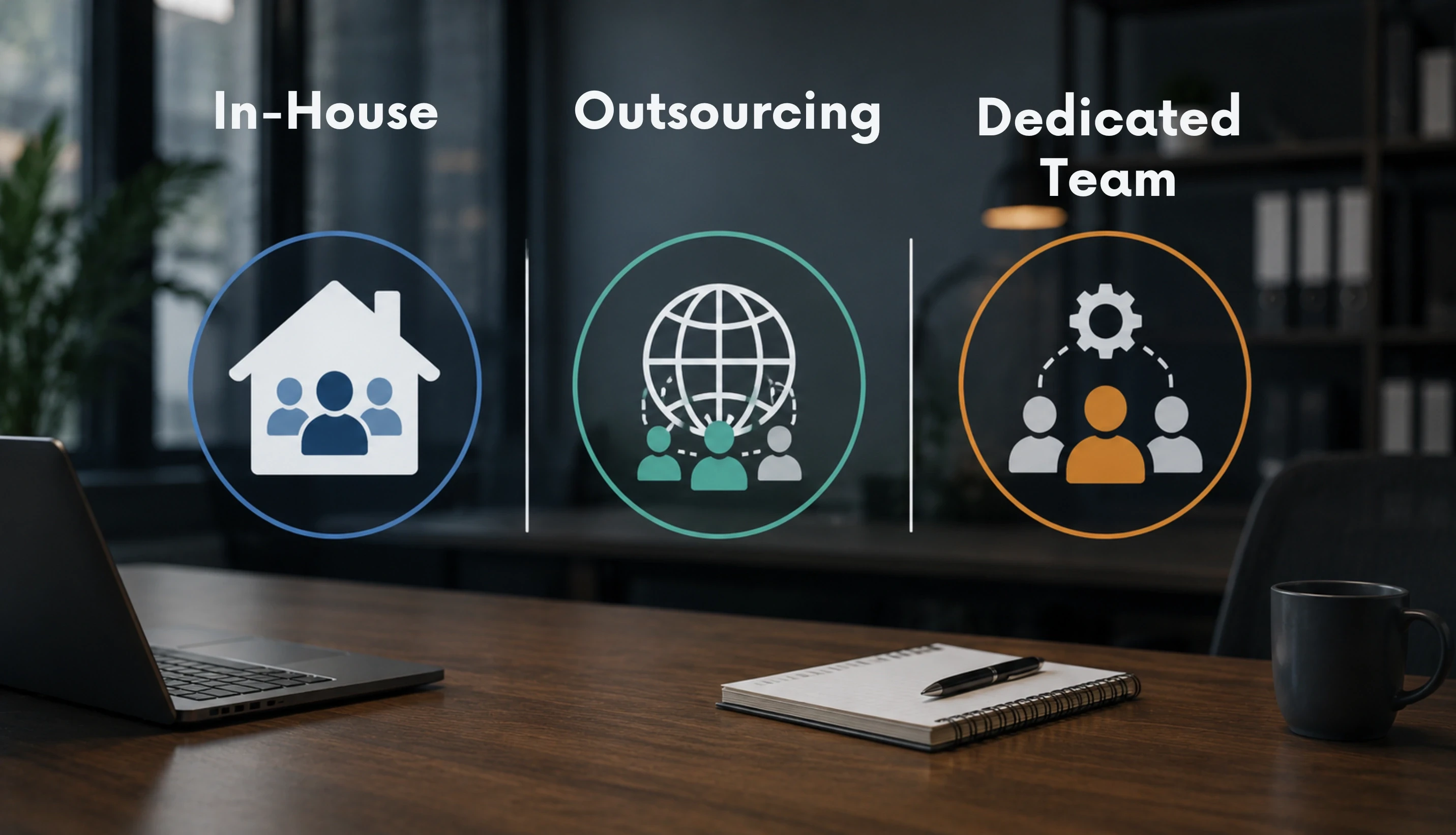
The team model decision is a cost, speed, and accountability question not a quality question. Each model has a correct use case. Applying the wrong model to the wrong situation is the most common and most expensive hiring mistake SaaS founders make.
Dimension | In-House (US/UK) | Fixed-Price Outsourcing | Dedicated Team (Acquaint) |
Monthly cost senior engineer | $12,000 – $18,000 fully loaded | $6,000 – $12,000 (project-based) | $4,500 – $8,000 (ongoing) |
Time to first productive commit | 3–6 months: recruit, hire, onboard | 2–4 weeks: scope fixed upfront | 48 hours from engagement confirmation |
Accountability structure | Employee - client manages daily work | Vendor owns the scope delivery | Vendor owns team; client directs outcomes |
Replacement if underperforming | Weeks to months (employment law) | Contract-dependent - risk of project stall | 48 hours - vendor responsibility; no client effort |
IP ownership | Assigned to the company by an employment contract | Contract-dependent - always specify explicitly | 100% client IP by default - NDA signed day one |
Cost savings vs US in-house | Baseline - no saving | 40–50% saving on project cost | 40–70% saving on equivalent capability |
Average engagement duration | N/A | Project duration (weeks to months) | 24+ months average - Acquaint Softtech data |
Best for | Long-term core product team; investor requirements | Defined scope, fixed deliverables, one-time build | Ongoing SaaS development without internal eng management |
The dedicated team model is not staff augmentation. Staff augmentation places individual contractors under client management, the client allocates work, reviews quality, and manages performance. A dedicated team is a vendor-managed delivery structure: Acquaint Softtech owns team composition, quality assurance, and continuity. The client directs product priorities; the vendor delivers them. The distinction matters most when an engineer underperforms: in a dedicated team model, replacement is 48 hours and vendor-managed; in staff augmentation, replacement falls to the client.
When to choose each model:
In-house: when you have a VP of Engineering or CTO who can manage individual engineers, when investors require it for governance, and when the product roadmap is long-term and stable. Not appropriate when time-to-market is the primary constraint.
Fixed-price outsourcing: when the scope is fully defined and unlikely to change. A clearly specified MVP with defined features, data model, and compliance requirements. Risk: Scope changes are expensive in fixed-price contracts.
Dedicated team: when the product roadmap evolves continuously, when the client lacks internal engineering management capacity, or when specific framework expertise is scarce locally.
The global SaaS market is growing at approximately 20% annually, projected to reach $247 billion by the end of 2025 (Gartner public cloud forecast). Competition inside that market is correspondingly intense. Products built on architecturally weak foundations hit a scaling ceiling that costs $150,000 to $400,000 to correct after the fact. This SaaS product development guide 2026 explains the five critical decisions that determine whether a SaaS platform can scale efficiently, pass enterprise security reviews, and sustain long-term revenue growth, in the sequence those decisions must be made.
As teams move from planning to execution, choosing the right development expertise becomes critical. Whether you need to hire Laravel developers for backend systems, hire Python developers for AI and data-driven features, hire MERN stack developers for full-stack web applications, or hire DevOps engineers for infrastructure and CI/CD, having access to pre-vetted talent accelerates delivery. Clients can review developer profiles within 48 hours, and no engagement begins until the team has been fully evaluated and approved.
For clients who need technical leadership alongside a delivery team, Acquaint Softtech's virtual CTO services provide fractional CTO-level architecture ownership without the full-time hiring cost - appropriate for SaaS founders who need both strategic technical direction and delivery execution.
Ready to Build Your SaaS Product With a Team That Has Done It Before?
Acquaint Softtech sends a proposed team structure, developer profiles, and a technical approach document within 48 hours of your initial conversation. You interview the engineers before any engagement begins. No commitment until you are satisfied with the team.
SaaS Industry Trends 2026 and What They Mean for Builders
Five structural trends are reshaping SaaS product development in 2026. Each has a concrete decision implication for founders and engineering leaders building or scaling a SaaS product now.
AI-Native Competition Is Compressing MVP Timelines
AI-assisted development tools reduce boilerplate coding time by 30% to 50%. MVP timelines have dropped from 18–24 months in 2020 to 8–14 months in 2026. The implication: competitive moats built on feature volume no longer hold. Sustainable moats in 2026 are proprietary data that competitors cannot replicate, compliance certifications that take 6–18 months to earn, and domain expertise embedded in the product's workflow design.
Usage-Based Pricing Has Replaced Seat-Based as the Growth Model
Twilio, Anthropic, Vercel, AWS, and Stripe all charge based on consumption. The dominant new SaaS pricing model in 2026 is hybrid: base subscription + usage-based overage. The implication: billing infrastructure must support metering from day one. Retrofitting usage-based metering into a flat-rate system costs 40% to 60% more than building it correctly at the start.
Enterprise Compliance Has Moved Down-Market
SOC 2 Type II used to be a $10 million ARR requirement. In 2026, it appears in vendor risk questionnaires at $500,000 ARR. The compliance threshold has moved down-market by two full customer segments in four years. SaaS products targeting mid-market buyers (200–2,000 employees) should begin SOC 2 Type II preparation at $300,000 to $500,000 ARR.
Vertical SaaS Outperforms Horizontal on Key Revenue Metrics
Vertical SaaS products achieve 2–3× higher net revenue retention than horizontal SaaS at equivalent revenue ranges (a16z public SaaS market data). Vertical SaaS is used for mission-critical workflows that are difficult to replace; horizontal SaaS faces continuous substitution pressure from well-funded competitors. Domain expertise combined with software execution is a stronger moat than software execution alone.
White-Label SaaS Is Growing as a Revenue and Distribution Model
White-label SaaS a single codebase branded and deployed separately for multiple clients, is growing as a revenue model for agencies and product companies. The technical requirements are per-tenant branding, custom domain support, and theme management without per-client code changes. Products built with this model can expand revenue without expanding engineering headcount proportionally.
Client Reference: SuperFi: SaaS MVP in Record Time
Case Study: SuperFi | Fintech | MVP Development | Founder: Nick Spiller
Situation: Nick Spiller needed to build a fintech SaaS MVP on a defined timeline and budget, without building a full in-house engineering team. The product required a secure, multi-tenant architecture with payment integration and compliance-aware data handling from the foundation. What Acquaint Softtech Delivered: Acquaint Softtech applied the 6-stage roadmap: discovery first, infrastructure and multi-tenancy before feature development, and billing integration in Stage 2. Nick benefited from access to Acquaint Softtech's full talent pool without recruitment overhead, and from a development process that produced a compliance-aware architecture from the first commit rather than as a retrofit. Outcome: • MVP delivered in record time with strong early user adoption • Over $60,000 saved on annual hiring costs versus an equivalent US-based team • Compliance-aware architecture from the foundation, no technical debt to address before the first enterprise conversation • Continued engagement with Acquaint Softtech post-launch for performance optimization and feature expansion The complete fintech app development case study highlights how the platform was engineered for scalability, compliance, and rapid MVP delivery. |
The 7 Questions That Tell You If Your SaaS Architecture Is Right
Apply this framework before the first sprint begins, or before committing budget to a refactor. Each question has a Yes/No answer and a direct cost implication.
Does your data model prevent one tenant from accessing another tenant's data at the database level - not just at the application level?
Yes → your multi-tenancy model is correct. No → shared-schema with tenant_id filtering is an application-level control, not a database-level isolation guarantee. Enterprise buyers will flag this in security reviews. Budget $80,000 – $250,000 for the migration or redesign now. |
Can your billing system handle both flat-rate subscriptions and usage-based metering without rebuilding the metering infrastructure?
Yes → your billing architecture is future-proof for hybrid pricing. No → usage-based metering must be designed into the event pipeline before the product scales. Retrofitting costs 40–60% more than building it correctly. |
If a customer sends a GDPR data subject access request today, can your team fulfil it within 30 days with a complete, accurate export?
Yes → GDPR data subject rights are technically implemented. No → GDPR compliance is incomplete regardless of what the privacy policy states. DSAR workflow and data deletion must exist before the first EU user, not after. |
Can your CI/CD pipeline deploy to production in under 15 minutes with automated rollback if health checks fail?
Yes → your DevOps foundation supports safe, fast iteration. No → manual deployments are both a scaling bottleneck and a SOC 2 change management compliance risk. |
Has your AI inference cost been modelled per feature at the expected monthly usage volume before the feature was designed?
Yes → AI features will not produce cost surprises post-launch. No → build the cost model before the feature. At GPT-4o pricing, 100,000 documents/month at 5,000 tokens = $1,250 – $1,500/month in inference alone. |
Can you replace an underperforming engineer within 1 week without losing sprint continuity?
Yes → your team model has adequate continuity protection. No → if the model is staff augmentation or in-house, a single resignation creates a 3–6 month recovery period. The dedicated team model (vendor-managed) provides 48-hour replacement. |
Does your architecture support zero-downtime feature deployment?
Yes → your deployment model supports continuous delivery. No → scheduled maintenance windows for feature deployment create a ceiling on iteration speed and a customer experience risk at scale. |
Answered No to 2 or More? Let Us Fix It Before It Becomes Expensive.
Acquaint Softtech identifies exactly which architectural gaps exist in your SaaS product and delivers a specific remediation plan within 48 hours - before you spend budget on a refactor that could have been avoided.
Frequently Asked Questions
-
How much does SaaS development cost in 2026?
SaaS development cost ranges from $8,000 to $14,000 per month for a 4-person startup MVP team (India-based) to $30,000 to $55,000 per month for a 10-person enterprise-grade team. Total cost to reach a production-ready SaaS MVP is typically $48,000 to $200,000. The equivalent US in-house team costs 3 to 4 times more for the same output at the same speed.
-
What tech stack is best for SaaS in 2026?
Laravel (PHP) is the most productive backend stack for most SaaS products in 2026: mature multi-tenancy tooling (stancl/tenancy), first-party billing integration (Laravel Cashier), and the largest developer pool in India. Python (Django or FastAPI) is correct for AI-heavy SaaS with data pipeline or ML inference requirements. Node.js is appropriate for real-time collaborative SaaS products. The frontend stack for almost all SaaS products in 2026 is React with Next.js.
-
How long does it take to build a SaaS MVP?
A production-ready SaaS MVP, multi-tenant architecture, authentication, billing, core feature set, and basic compliance controls, takes 12 to 18 weeks with a focused 4 to 6-person team. Teams that compress or skip the 2 to 3 week discovery phase spend 6 to 10 additional weeks rebuilding architectural decisions made incorrectly under time pressure.
-
What compliance does a SaaS product need?
GDPR is required from day one if the product has any EU users. SOC 2 Type II preparation should begin at the first enterprise conversation, in 2026, this is approximately $500,000 ARR. Healthcare SaaS requires HIPAA. Products using Stripe or Paddle client-side tokenization require PCI-DSS SAQ A only (2–4 weeks, $2,000 – $8,000). Products processing raw card data require PCI-DSS Level 1 (full audit, $50,000 – $200,000 annually).
-
What is multi-tenancy, and which pattern should I choose?
Multi-tenancy allows a single SaaS instance to serve multiple customers with isolated data. The three patterns are: shared-schema (cheapest, highest risk), schema-per-tenant (balanced, recommended default), and database-per-tenant (maximum isolation, highest cost). Schema-per-tenant is the correct choice for most new SaaS products in 2026. Migration from shared-schema to schema-per-tenant at scale costs $80,000 – $250,000 - the primary argument for choosing correctly at the start.
-
What is the difference between staff augmentation and a dedicated development team?
Staff augmentation places individual contractors under client management. The client allocates work, reviews quality, and manages performance. A dedicated team is vendor-managed: the vendor owns composition, quality, and continuity while the client directs outcomes. Replacement of an underperforming engineer: 48 hours in a dedicated team model versus weeks in staff augmentation. For SaaS products in active development without internal engineering management capacity, dedicated teams consistently deliver lower cost and lower risk.
-
How should I add AI features to an existing SaaS product?
Identify the 2–3 workflows involving the most manual cognitive work. Test whether a structured LLM API prompt can automate or assist those workflows. Do not build RAG pipelines before testing prompts. Do not fine-tune before having 10,000+ correct output examples. Model the inference cost before building the feature: at $2.50 – $3.00 per million tokens, a high-volume document feature can cost more than the infrastructure it runs on.
-
What happens to my codebase and IP if the engagement with Acquaint Softtech ends?
Acquaint Softtech transfers 100% of the codebase, documentation, and intellectual property to the client from the first commit, not at engagement end. The client owns every line of code. All engineers sign NDAs before accessing client systems. The engagement ending requires no code handover ceremony: the client already owns the repository, deployment configuration, and all documentation.
We’re Acquaint Softtech, your technology growth partner. Whether you're building a SaaS product, modernizing enterprise software, or hiring vetted remote developers, we’re built for flexibility and speed. Our official partnerships with Laravel, Statamic, and Bagisto reflect our commitment to excellence, not limitation. We work across stacks, time zones, and industries to bring your tech vision to life.
Table of Contents
Get Started with Acquaint Softtech
- 13+ Years Delivering Software Excellence
- 1300+ Projects Delivered With Precision
- Official Laravel & Laravel News Partner
- Official Statamic Partner
Related Blog
How to Outsource SaaS Product Development Without Losing Control
The fear of losing control is the main reason founders delay outsourcing SaaS development by 6 to 12 months. Here are the 6 mechanisms that keep you in charge of product direction while a vendor manages delivery.

Mukesh Ram
April 20, 2026
Essential Monetization Strategies for SaaS Products
Looking to boost your SaaS revenue? Discover the top monetization strategies that successful SaaS companies use to maximize profits! Unlock the full potential of your SaaS product.
Mukesh Ram
September 12, 2024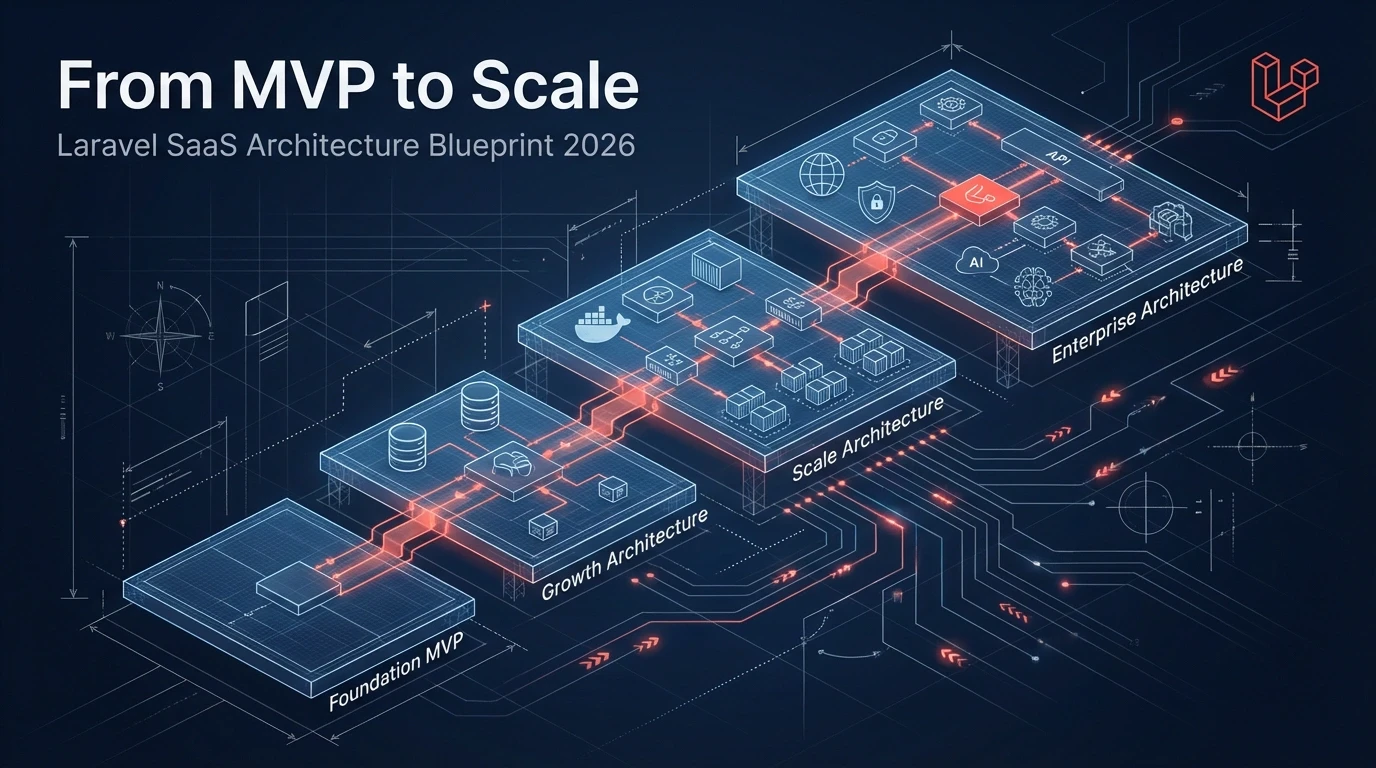
From MVP to Scale: The Laravel SaaS Architecture Blueprint for 2026
From MVP to 100K users, the architecture decisions that felt small at month one become expensive at month twelve. Here is the Laravel SaaS blueprint we use across 200+ Laravel projects.
Acquaint Softtech
March 10, 2026India (Head Office)
203/204, Shapath-II, Near Silver Leaf Hotel, Opp. Rajpath Club, SG Highway, Ahmedabad-380054, Gujarat
USA
7838 Camino Cielo St, Highland, CA 92346
UK
The Powerhouse, 21 Woodthorpe Road, Ashford, England, TW15 2RP
New Zealand
42 Exler Place, Avondale, Auckland 0600, New Zealand
Canada
141 Skyview Bay NE , Calgary, Alberta, T3N 2K6