

From MVP to Scale: The Laravel SaaS Architecture Blueprint for 2026
From MVP to 100K users, the architecture decisions that felt small at month one become expensive at month twelve. Here is the Laravel SaaS blueprint we use across 200+ Laravel projects.

Acquaint Softtech
The Architecture Decision You Cannot Undo at Month Six
Most SaaS founders think about architecture too late.
You build an MVP to validate the idea. You cut corners on purpose because speed matters more than elegance at month one. That is the right call. The problem comes at month six when you have paying customers, a growing user base, and an architecture that was never designed to handle either of those things.
We have been in that conversation with hundreds of SaaS founders across 200+ Laravel projects at Acquaint Softtech, a Laravel Development Company with 13+ years of hands-on product delivery. The patterns are consistent. The mistakes are predictable. And most of them were avoidable with a small number of deliberate decisions made earlier in the build.
This blueprint covers the four stages of Laravel SaaS architecture, what to build at each stage, what to defer, and the specific decisions that save you a full rebuild down the road.

- SaaS Founders building their first Laravel product and thinking about the right foundations
- CTOs inheriting a Laravel codebase and trying to understand what needs to change before the next growth phase
- Engineering leads deciding whether to refactor now or build on top of existing architecture
- Anyone who has heard the phrase 'we need to rewrite it from scratch' and wants to understand why it keeps happening
The Four Stages of Laravel SaaS Architecture
Every SaaS product we have worked on passes through four architectural stages. The decisions at each stage build on the previous one. Skipping a stage does not save time. It creates debt that compounds.
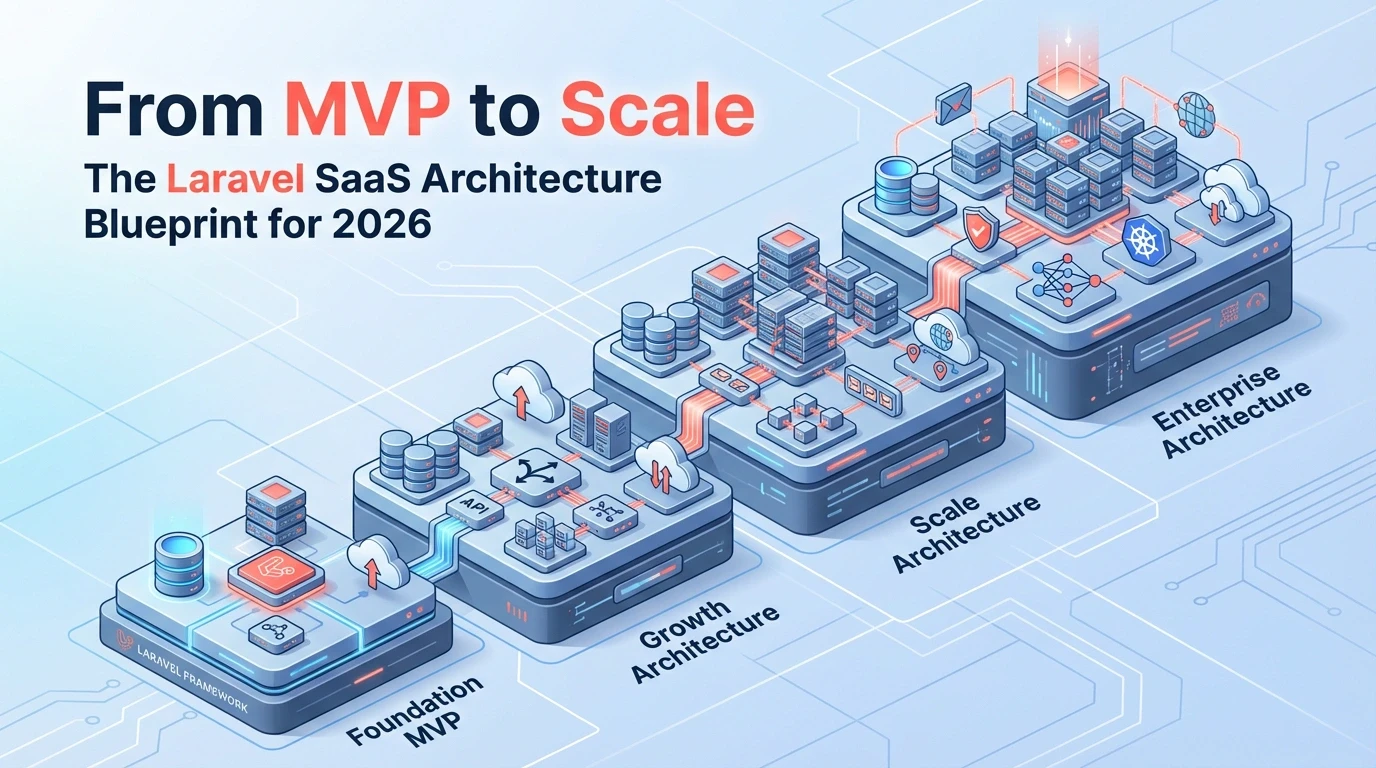
Stage 1: Foundation MVP | 0 to 500 users | 0 to 3 months
Goal: Validate the core idea with real users as fast as possible. Architecture serves speed, not scale.
Database: Single relational database. PostgreSQL preferred for JSON support and query performance. Avoid premature sharding.
Authentication: Laravel Breeze or Jetstream with Sanctum for API tokens. Do not build custom auth at this stage.
Multi-tenancy: Simple scoping by user or team ID. Do not implement full multi-tenancy yet. You do not know your tenancy model until real customers tell you.
Queue system: Laravel Horizon with Redis from day one. Background jobs are not optional, even at MVP stage. They prevent blocking and give you async capability without rearchitecting later.
Feature flags: Implement a lightweight feature flag system from week one. You need the ability to ship to specific users without deploying to everyone.
What to skip: Microservices, event sourcing, CQRS, custom caching layers. These are optimization tools, not foundation tools.
Stage 2: Growth Architecture | 500 to 10,000 users | 3 to 12 months
Goal: Handle real load without rebuilding. This is where MVP shortcuts start to cost real money if you built on the wrong foundations.
Multi-tenancy decision: By this stage you know whether you need single-database multi-tenancy (tenant scoping via global scopes), multi-database (one database per tenant), or hybrid. Make this call at stage two, not stage three. Refactoring multi-tenancy at scale is one of the most expensive mistakes in SaaS architecture.
Caching strategy: Introduce Redis caching for hot data paths. Route model binding with cache. Cache expensive Eloquent queries with tagged cache so invalidation is precise, not global.
Job queues by priority: Split your Horizon queue config into high, default, and low priority workers. Transactional emails and webhooks go to high. Reports and exports go to low. Mixing these kills user-facing response time.
API versioning: If you have external integrations or a public API, version it now. /api/v1/ costs nothing to add. Migrating a versioned API later while keeping backwards compatibility is expensive.
Observability: Add Laravel Telescope in staging. Add error tracking (Sentry or Bugsnag) in production. You cannot fix what you cannot see.
What to skip: Full event sourcing, custom service mesh, distributed tracing. Still premature unless your product is explicitly event-driven by design.
Stage 3: Scale Architecture | 10,000 to 100,000 users | 12 to 36 months
Goal: Sustain performance under real concurrency without developer heroics every deploy.
Read replicas: Add database read replicas for reporting, analytics, and export queries. Configure Laravel's read/write connection splitting. Keep write operations on primary.
Queue scaling: Move from a single Redis instance to Redis Cluster. Use separate queue connections for different job classes. Monitor queue depth per worker type in Horizon.
Storage architecture: Move all file storage to S3 or equivalent object storage if you have not already. Never store binary files in your database or on local server disk.
Search: If you have any user-facing search functionality, introduce Laravel Scout with Meilisearch or Algolia at this stage. Database LIKE queries at 50K records break response time.
Rate limiting: Move from basic throttle middleware to a proper rate limiting strategy using Redis-backed limiters. Protect both public API endpoints and authenticated user actions.
Background processing audit: Audit every job in your queue. Identify jobs that are blocking unnecessarily, jobs that have no retry logic, and jobs that write to the database inside a loop. Fix these before they become incidents.
Stage 4: Enterprise Architecture | 100,000 plus users | 36 months plus
Goal: Horizontal scalability, zero-downtime deployments, and multi-region capability.
Service extraction: Extract only the services that have genuinely different scaling characteristics. Billing, notifications, and analytics are common extraction candidates. Do not extract for organizational reasons alone.
Event-driven architecture: Introduce Laravel Event Sourcing for domains where full audit history matters (billing, compliance, access control). Not for everything.
Database sharding: Implement application-level sharding only if read replicas and query optimization have been exhausted. Sharding is operationally complex and hard to reverse.
Multi-region: Use CDN edge caching aggressively before considering multi-region database replication. Most SaaS products never need true active-active multi-region.
SLA engineering: Define, measure, and enforce internal SLOs before committing to client-facing SLAs. You need 90 days of baseline data before you can commit to uptime numbers.
The Five Architecture Mistakes That Force a Rebuild
Across 200+ Laravel projects, five architecture decisions cause the most painful mid-flight rebuilds. All of them are preventable.
1 Putting business logic in controllers
Controllers should receive requests and return responses. Business logic belongs in service classes, action classes, or domain objects. When business logic lives in controllers, it cannot be reused, tested independently, or extended without copying code. At 50+ controllers, this becomes unmanageable. Refactoring it is expensive and risky.
2 Ignoring multi-tenancy design until customers demand it
The cheapest time to design your tenancy model is before your first tenant. The second cheapest time is before your tenth. After that, every decision about data isolation, query scoping, and permission models becomes a migration project that touches almost every part of the codebase.
3 Using synchronous processing for everything
Sending emails synchronously, processing uploads in the request cycle, generating reports on page load. These patterns work at 10 users and break at 1,000. Laravel Horizon and Redis give you a production-grade async processing layer from day one. There is no reason to skip it.
4 Building custom auth instead of using Laravel's ecosystem
Laravel Sanctum, Passport, and Fortify exist because authentication is both security-critical and repetitive. Custom auth code is almost always less secure, less tested, and harder to maintain than the official packages. The time saved by building custom auth is always spent debugging it later.
5 Skipping feature flags
Feature flags let you deploy code to production without showing it to users, roll out features to specific customers or pricing tiers, and kill a bad feature without a rollback. SaaS products without feature flags deploy fear instead of code. Add a lightweight flag system at MVP stage and you will use it every week from that point forward.
The Laravel SaaS Technology Decision Matrix
These are the specific tool and pattern decisions we make on every Laravel SaaS engagement. The matrix shows what we use at each stage and why.
Decision Area | MVP Stage | Growth Stage | Scale Stage |
Authentication | Breeze + Sanctum | Sanctum + MFA | Sanctum + SSO + SAML |
Database | PostgreSQL (single) | PostgreSQL + read replica | PostgreSQL + sharding strategy |
Multi-tenancy | Scope by team ID | Single-DB or multi-DB | Confirmed model + full isolation |
Queue processing | Horizon + Redis (single) | Horizon + priority queues | Redis Cluster + per-class workers |
Caching | Basic route caching | Redis tagged cache | Distributed cache + edge CDN |
Search | Eloquent LIKE (acceptable) | Scout + Meilisearch | Scout + Algolia or Elasticsearch |
File storage | S3 from day one | S3 + CDN | S3 multi-region + signed URLs |
Observability | Telescope (staging only) | Sentry + Telescope | Sentry + APM + custom dashboards |
Feature flags | Custom lightweight flags | Flags + A/B testing | Full flag management platform |
Deployments | Basic CI/CD | Zero-downtime deploys | Blue/green or canary deploys |
The Team Structure That Matches Each Stage
Architecture decisions and team structure are connected. The right architecture for the wrong team size creates bottlenecks. The wrong architecture for the right team size creates chaos. However, a proper SaaS team training program can help fix this issue. Alternatively, here is how we help SaaS founders structure their engineering capacity at each stage.
MVP Stage (0 to 3 months)
1 to 2 senior full-stack Laravel developers. One person can own the architecture if they are senior enough. Two people with clear ownership split is better. This is the stage where Acquaint Softtech clients most commonly start with a single staff augmentation developer who knows both the framework and the product patterns.
1 senior full-stack Laravel developer
Part-time QA support
Founder as product owner
Growth Stage (3 to 12 months)
3 to 5 developers. You need specialisation at this point. A backend lead who owns the architecture, a frontend developer who owns the user experience layer, and at least one developer who can own DevOps and infrastructure decisions. Acquaint Softtech commonly deploys a team of three at this stage.
1 backend lead (Laravel architecture)
1 to 2 full-stack developers
1 frontend specialist
1 part-time DevOps
Scale Stage (12 to 36 months)
5 to 10 developers with defined domains. At this stage you need developers who own specific parts of the system: billing, notifications, user management, core product. Without domain ownership, architecture decisions get made by whoever is available, which is how architecture debt accumulates silently.
1 technical lead (architecture owner)
2 to 3 backend developers by domain
1 to 2 frontend developers
1 DevOps engineer
1 dedicated QA engineer
Real Example: SuperFi UK FinTech from Idea to Launch
SuperFi is a UK-based FinTech platform that helps users manage credit card debt, track repayment timelines, and improve their credit scores. Nick Spiller came to us with a validated concept and a clear launch deadline.
The architecture challenge was not just technical. SuperFi needed to integrate with Truelayer for live banking data and payment processing, comply with UK financial regulations from the first user, and handle the data sensitivity that comes with accessing users' banking information. Cutting corners on the foundation was not an option.
What we built at MVP stage:
React Native app for Android and iOS from a single codebase
Laravel backend with Sanctum authentication and structured API layer
Truelayer integration for live banking data access and payment initiation
Intercom integration for customer engagement and support
UK financial regulation compliance built into the data model from week one
Admin panel for Nick to manage the platform, user data, and product analytics
The result: delivered on schedule, within budget, with a team of 14 engineers assembled and productive from week one. SuperFi saved over $60,000 compared to equivalent UK in-house hiring costs and launched to a market that received the product well.
Nick Spiller, Founder, SuperFi (Verified Clutch Review)
They have delivered our product on track with a high caliber of detail. Their communication is consistent and they are responsive to every feature improvement and ultimate feedback we have given them.
read Full case study: Fintech Mobile App Development
The Right Architecture Decision Is Always the One You Can Grow Through
You do not need to build for 100,000 users on day one. You need to build in a way that does not require a full rewrite to reach 10,000 users.
That distinction drives every architecture decision in this blueprint. Build the foundations correctly at stage one, make the right decisions at stage two, and the jump from 10,000 to 100,000 users becomes an engineering challenge, not an existential crisis.
We apply this blueprint across every Laravel SaaS engagement at Acquaint Softtech. The team that built SuperFi, the team that scaled Ailleron's data infrastructure, the team that handles real-time multi-tenant systems for enterprise clients, all work from the same core principles.
If you are at any stage of this journey and want a technical second opinion, we offer a free 30-minute architecture call with no obligation. Learn more about our staff augmentation model or hire dedicated Laravel developers today.
Book a Free Laravel Architecture Review
Tell us which stage you are at and what your current architecture looks like.
We will walk through the key decisions for your next growth phase and flag anything that needs attention before it becomes expensive.
FAQ's
-
Is Laravel a good choice for SaaS products in 2026?
Yes. Laravel remains one of the most productive frameworks for SaaS development in 2026. The ecosystem has matured significantly, with first-party solutions for authentication, queuing, caching, and deployment. Its Eloquent ORM, job queue system, and artisan tooling reduce boilerplate and let teams focus on product logic rather than infrastructure. Acquaint Softtech has delivered 200+ Laravel projects, and the framework's reliability at scale is well-proven.
-
What is the best multi-tenancy approach for a Laravel SaaS?
It depends on your data isolation requirements. Single-database multi-tenancy using global scopes is simpler to operate and usually sufficient for most SaaS products. Multi-database tenancy gives stronger data isolation and is required for enterprise clients with strict compliance needs. The wrong choice is making no choice and scoping by user ID without a plan, which creates a painful migration at scale.
-
How many developers do I need to build a Laravel SaaS MVP?
One senior full-stack Laravel developer who understands both product and architecture can deliver a solid MVP in 8 to 12 weeks, depending on scope. Adding a second developer for parallel workstreams reduces time to launch. The key is seniority, not headcount. A senior Laravel developer making the right architecture decisions at MVP stage saves significantly more time than two junior developers building fast.
-
When should a SaaS start thinking about Laravel microservices?
Later than most people think. Microservices solve team scaling problems more than they solve technical problems. We recommend keeping a Laravel monolith until you have specific, evidence-based reasons to extract a service: a component with genuinely different scaling needs, a team that cannot work effectively in the same codebase, or a compliance requirement that demands hard service isolation.
-
How does staff augmentation work for a SaaS Laravel project?
We deploy a pre-vetted senior Laravel developer into your existing team within 48 hours. They work inside your sprint process, your tools, and your codebase from day one. You get direct Slack access to the developer. There is no account manager layer. For SaaS founders who need to move fast without the overhead of a full hiring cycle, this is the fastest way to add verified Laravel capacity to a growing product team.
We’re Acquaint Softtech, your technology growth partner. Whether you're building a SaaS product, modernizing enterprise software, or hiring vetted remote developers, we’re built for flexibility and speed. Our official partnerships with Laravel, Statamic, and Bagisto reflect our commitment to excellence, not limitation. We work across stacks, time zones, and industries to bring your tech vision to life.
Table of Contents
Get Started with Acquaint Softtech
- 13+ Years Delivering Software Excellence
- 1300+ Projects Delivered With Precision
- Official Laravel & Laravel News Partner
- Official Statamic Partner
Related Reading
Real Clients, Real Results: What Our Verified Clutch Reviews Actually Say
Four real clients. Four verified outcomes. This is what working with Acquaint Softtech actually looks like from the client side, in their own words from Clutch.
Acquaint Softtech
March 9, 2026
We've Reviewed 1,300+ Projects: Here's What Separates Great Dev Teams from Expensive Mistakes
After 1,300+ projects, we know exactly what separates a great dev team from an expensive mistake. Here is the data-backed evaluation framework every CTO and Founder needs before signing.
Acquaint Softtech
March 7, 2026
Staff Augmentation vs Upwork vs Agency: Real Cost Breakdown for CTOs in 2026
Staff augmentation, Upwork, or a dev agency? The real cost difference in 2026 is bigger than most CTOs expect. Here are the actual numbers with zero fluff.
Acquaint Softtech
March 8, 2026Your Project. Our Expertise. Let’s Connect.
Get in touch with our team to discuss your goals and start your journey with vetted developers in 48 hours.