

How to Outsource SaaS Product Development Without Losing Control
The fear of losing control is the main reason founders delay outsourcing SaaS development by 6 to 12 months. Here are the 6 mechanisms that keep you in charge of product direction while a vendor manages delivery.

Mukesh Ram
I founded Acquaint Softtech as a software development partner 13 years ago to help product companies build software without the overhead of a full in-house engineering function. The conversation I have had most consistently over those 13 years is the one where a SaaS founder says: I want to outsource development but I am worried about losing control of the product. This article gives you the 6 mechanisms that eliminate that risk.

- SaaS founders who want to outsource development but are worried about losing product direction
- Non-technical co-founders who need development capacity without full-time in-house hiring
- CTOs evaluating a transition from in-house development to an outsourced or hybrid model
- Product managers who have had a bad outsourcing experience and want to understand what went wrong structurally
The fear of losing control is the most common reason founders delay outsourcing by 6 to 12 months past the point where it would have accelerated their product. The fear is understandable. And it is based on a real pattern: outsourcing arrangements do fail when the control mechanisms are not in place. The answer is not to avoid outsourcing. The answer is to design the engagement so that control is structurally built in rather than assumed.
Before any outsourcing engagement begins, the quality of your brief determines whether the vendor builds the right thing. The software development brief framework covers the 7 sections that produce proposals you can compare and budgets that hold through delivery. Start there, then come back to this article for the engagement structure that keeps you in control once the work begins.
Why Outsourcing Feels Like Losing Control (And Why It Does Not Have To)
.webp "Why Outsourcing Feels Like Losing Control (And Why It Does Not Have To)")
The loss-of-control feeling in outsourcing comes from one of three structural problems. Identifying which one is relevant to your situation tells you which mechanism to prioritise.
Problem 1: The vendor builds what was specified, not what was needed |
The requirement was ambiguous. The vendor interpreted it one way. You intended it another. The feature ships. You discover the misalignment at demo. This is a specification problem, not an outsourcing problem. It happens with in-house developers too. The fix is a better brief and a better acceptance criteria process, not abandoning outsourcing. |
Problem 2: The vendor makes architecture decisions without client input |
The vendor chose the approach that was fastest to build rather than the one that was easiest to extend. The client discovers this when they try to add the next feature and the architecture makes it expensive. This is a governance problem. The fix is establishing architecture decision rights in the contract and the sprint process. |
Problem 3: The client does not know what is happening until it is too late to change |
No visibility into in-progress work. Updates only when asked. Problems surface at sprint review rather than mid-sprint. This is a communication structure problem. The fix is a defined communication cadence with mid-sprint check-ins, not just end-of-sprint reviews. |
The 6 Control Mechanisms That Keep You in Charge
Each of these mechanisms addresses one of the three structural problems above. Together they produce an outsourcing engagement where you retain full product direction while the vendor manages delivery.
1. Sprint priorities are set by you, not the vendorThe vendor executes. You direct. Sprint planning is a standing meeting between your product owner or CTO and the vendor's technical lead. The agenda is yours: what gets built this sprint, in what order, and to what standard. The vendor translates priorities into tasks. The client does not assign tasks to individual developers, but the client owns the priority stack absolutely. |
2. Architecture decisions require client sign-offSignificant architecture choices, technology selections, and structural design decisions require explicit client approval before implementation begins. This does not mean the client makes every technical decision. It means the vendor proposes, explains the trade-offs, and the client approves. A vendor who makes architecture decisions unilaterally is one who will build something that is hard to change later. |
3. Mid-sprint check-in is mandatory, not optionalEnd-of-sprint reviews catch problems too late to fix without cost. A 30-minute mid-sprint check-in on Wednesday, for a Monday-to-Friday sprint, allows problems to surface while there is still time to course-correct within the sprint. This single practice eliminates most of the surprise delivery that erodes trust in outsourced engagements. |
4. Code lives in the client's repository from Day 1Not transferred at engagement end. Not in the vendor's repository with periodic exports. Every commit goes directly into your repository under your access controls. This is a non-negotiable contract term. It means you can terminate any engagement and take the codebase with you without negotiation. |
5. Acceptance criteria are written before development startsNot evaluated at the end. Written at sprint planning, before any development begins. The developer knows what done looks like before they start writing code. Acceptance criteria written after development is done is the vendor deciding what they built was what you wanted. That is the opposite of control. |
6. The vendor tracks and reports delivery metricsSprint delivery rate, ticket cycle time, PR review time, and defect rate are tracked by the vendor and reported to the client on a weekly basis. A vendor who does not track their own delivery performance is a vendor who cannot tell you whether they are performing well. The metrics should be in the contract as a reporting obligation, not as a favour. |
The pricing model you choose also affects control. A monthly retainer gives you more flexibility to redirect priorities than a fixed-price contract where scope changes require formal change requests. The staff augmentation pricing models guide covers which model gives you the most control over sprint direction at different product stages. This is similar to how SaaS teams evaluate supporting tools, where factors like neverbounce pricing influence long-term cost planning and stack decisions.
Want to See How Acquaint Structures Control for SaaS Clients?
Every Acquaint Softtech engagement for SaaS products includes all 6 of these mechanisms by default: sprint priority ownership, architecture sign-off process, mid-sprint check-ins, client-owned repository from Day 1, acceptance criteria at planning, and weekly delivery metrics. Tell me what you are building and I will show you what the engagement structure looks like.
The Vendor Selection Step That Determines Whether Control Is Even Possible

The 6 mechanisms above require a vendor who supports them. Not every vendor does. The vendor selection step is where you filter for vendors whose engagement model is compatible with the control structures above.
Use the offshore due diligence checklist to verify vendor credentials before any contract discussion. Then ask these specific questions in the first vendor call to establish whether their engagement model supports the control mechanisms:
Does your standard contract include the client's repository as the primary code location? | Yes: proceed to next question. No: negotiate this or move on. Code in the vendor's repository with client access is not the same as code in the client's repository. |
Do you run mid-sprint check-ins with clients or only end-of-sprint reviews? | Mid-sprint is the right answer. End-of-sprint only is the answer from a vendor who does not want problems surfaced while they can still be fixed at no cost to the vendor. |
Who owns architecture decisions in your typical engagement? | The right answer is: we propose, you approve. The wrong answer is either: we own the architecture (vendor overreach) or: you own all decisions (the vendor is abdicating the expertise you are paying for). |
What metrics do you report to clients and how often? | A vendor who tracks nothing cannot demonstrate performance improvement. A vendor who tracks delivery rate, ticket cycle time, and defect rate weekly has thought about accountability. |
The Technical Leadership Question
Outsourcing SaaS development without internal technical leadership is the highest-risk version of the model. Not because outsourcing is inherently riskier, but because the control mechanisms above require someone on the client side who can evaluate architecture proposals, write acceptance criteria, and assess delivery quality.
If you do not have that person internally, you have two options. First, hire or engage a technical advisor or virtual CTO who attends sprint planning, reviews architecture proposals, and represents the client's technical interests in the engagement. Second, choose a vendor whose product engineering model includes a technical advisory function as part of the engagement scope.
Our virtual CTO services combine with the dedicated development team model to provide exactly this structure: a senior technical advisor who owns the architecture review and client-side technical accountability, with a dedicated delivery team executing underneath that direction. The combination covers both the strategy and delivery layers without the cost of a full-time CTO plus a full-time team.
The Measurement Framework That Tells You Whether Outsourcing Is Working
Most founders evaluating whether their outsourcing engagement is working asks the wrong question. The wrong question is: are the developers working hard? The right questions are outcome-based.
Sprint delivery rate | What percentage of committed sprint items are completed by sprint end? Below 80% for two consecutive sprints is an underperformance signal, not a temporary dip. |
Feature cycle time | How long from feature definition to feature in staging? Increasing cycle times with no corresponding increase in feature complexity indicate a growing problem in the development process. |
Defect escape rate | How many bugs reach staging or production that should have been caught in development? A vendor with a well-functioning QA process has a low defect escape rate. A vendor without one does not. |
Architecture review time | How quickly does the vendor respond to architecture questions and produce proposals? Slow architecture response delays every decision that depends on it. |
Dependency on the client | How many blockers per sprint require client decisions to resolve? A high number means the vendor is not managing the engagement proactively. A low number means they are. |
For the full KPI framework and governance structure for managing an external development team, including the 8 red flags that signal engagement deterioration before it becomes a crisis, the COO guide to managing external dev teams covers the complete measurement and governance approach.
Want to See the Metrics Dashboard We Use for SaaS Client Engagements?
We track sprint delivery rate, cycle time, defect escape rate, and client dependency score for every active SaaS engagement. We share this dashboard with clients weekly. Tell me what you are building and I will show you what a week of data looks like from a running engagement.
The Architecture Question in Outsourced SaaS Development
SaaS products have specific architectural requirements that differ from standard web applications. Multi-tenancy, subscription billing, feature gating, and usage metering are not standard development tasks. They are architectural decisions that, if made incorrectly early, become expensive to correct later.
When outsourcing SaaS development, the vendor's understanding of these architecture is one of the most important qualification criteria. A vendor who treats a SaaS product like a standard web application will produce a codebase that does not scale to the tenant volumes and billing complexity the product requires.
The Laravel SaaS architecture guide covers the structural decisions from MVP to scale for the most common SaaS architecture pattern we work with. Before engaging any vendor for SaaS development, ask them to walk you through how they would approach the multi-tenancy decision for your product. Their answer tells you whether they understand SaaS architecture or are treating it like a standard project.
What Outsourcing SaaS Development Looks Like at Acquaint Softtech
Our dedicated development teams for SaaS products are built for exactly the engagement structure described in this article. Here is what the first 90 days looks like in practice.
Week 1 to 2: Discovery and architecture | We review your product brief, existing codebase if any, and product roadmap. We produce an architecture proposal with trade-offs for the client to approve. Multi-tenancy strategy, billing architecture, and API design are the first decisions we establish. |
Week 2 to 3: Team assembly and sprint 1 planning | The named development team is confirmed and the client interviews key team members. Sprint 1 is scoped at 60% of normal velocity to allow for codebase and architecture context building. Acceptance criteria for sprint 1 items are written in the planning session. |
Week 3 onwards: Sprint delivery rhythm | Monday sprint planning with client. Wednesday mid-sprint check-in. Friday sprint review. Weekly delivery metrics shared every Monday morning before planning begins. Architecture decisions proposed in async first, approved in sync sprint planning. |
Month 2 to 3: Full velocity | By sprint 3 to 4, the team is at full velocity. The client's management overhead is 2 to 3 hours per week: sprint planning, mid-sprint check-in, and sprint review. Everything else runs under the vendor's management. |
For founders who have not yet decided whether outsourcing is the right model for their stage, the 5-minute staff augmentation self-assessment identifies the specific decision that most people in the evaluation process are avoiding. And for the full cost model showing what outsourcing costs versus in-house development, the side-by-side numbers are there.
Ready to Outsource SaaS Development With All 6 Control Mechanisms in Place?
Share your product description, stage, and what you need the team to deliver in the first 90 days. I will send back a proposed team structure and the specific engagement terms that give you full product direction with vendor-managed delivery. No commitment before you have seen the structure.
Frequently Asked Questions
-
How do I maintain product vision when a vendor is building my SaaS product?
Product vision is maintained through the sprint priority process, not the development process. The vendor's job is to build what you specify. Your job is to specify the right things in the right order. The control mechanisms in this article ensure the specification process is disciplined: acceptance criteria at planning, architecture sign-off, and mid-sprint check-ins. When these are in place, the vendor cannot build in a direction you have not approved.
-
What is the minimum engagement length for outsourcing SaaS product development?
Three months is the practical minimum for the engagement to produce its value. The first month is largely setup and context building: architecture decisions, team onboarding, and sprint process establishment. The second month is the first full-velocity delivery period. The third month is where the team's accumulated product context begins to compound into faster, more accurate delivery. Shorter engagements rarely justify the onboarding investment.
-
How do I handle feature requests that come from users during an outsourced engagement?
User feature requests go into the product backlog, which you manage. At each sprint planning session, you reprioritise the backlog based on user input, business priorities, and technical context from the vendor. The vendor executes against the prioritised backlog. Requests do not go directly to the developer. They go through the product owner, into the backlog, and into the sprint when prioritised.
-
What happens if the vendor's technical lead leaves during my engagement?
A vendor with a proper continuity commitment will manage the transition: knowledge transfer from the departing technical lead, documentation of all architecture decisions made, and a qualified replacement confirmed with client approval before the transition completes. This should be a contract term, not a policy promise. Ask specifically how the vendor has handled technical lead transitions in the past and what the contractual obligations are.
-
Is it possible to outsource SaaS development without any internal technical capacity?
Yes, with the right vendor structure. If you have no internal technical leadership, the vendor's technical lead and the virtual CTO layer fill that function. The client still owns product direction: priorities, features, and business requirements. The vendor owns the technical decisions with client approval at key milestones. This requires a vendor who offers genuine product engineering rather than pure execution, and a contract that defines the approval process clearly.
-
How do I know when it is time to move from fully outsourced to a hybrid model?
Three signals. First, the product has enough complexity and institutional knowledge that losing a vendor team creates significant risk. Second, the volume and continuity of development justifies a permanent in-house hire at lower total cost than the outsourced rate. Third, the product direction requires someone with daily, deep product context that a part-time technical lead or virtual CTO arrangement cannot provide. Any one of these signals is worth evaluating. All three together makes the hybrid or in-house transition the right next step.
-
What contract terms protect my product direction in an outsourced engagement?
The most important terms: IP assignment from first commit, client-owned repository as primary code location, architecture decision approval process, mid-sprint communication obligations, handover process on termination, and weekly delivery metrics as a reporting obligation. Each of these corresponds to one of the control mechanisms in this article. A vendor who will not include these terms in a standard contract is a vendor whose engagement model does not support the control structures that make outsourcing work.
I love to make a difference. Thus, I started Acquaint Softtech with the vision of making developers easily accessible and affordable to all. Me and my beloved team have been fulfilling this vision for over 15 years now and will continue to get even bigger and better.
Table of Contents
Get Started with Acquaint Softtech
- 13+ Years Delivering Software Excellence
- 1300+ Projects Delivered With Precision
- Official Laravel & Laravel News Partner
- Official Statamic Partner
Related Reading
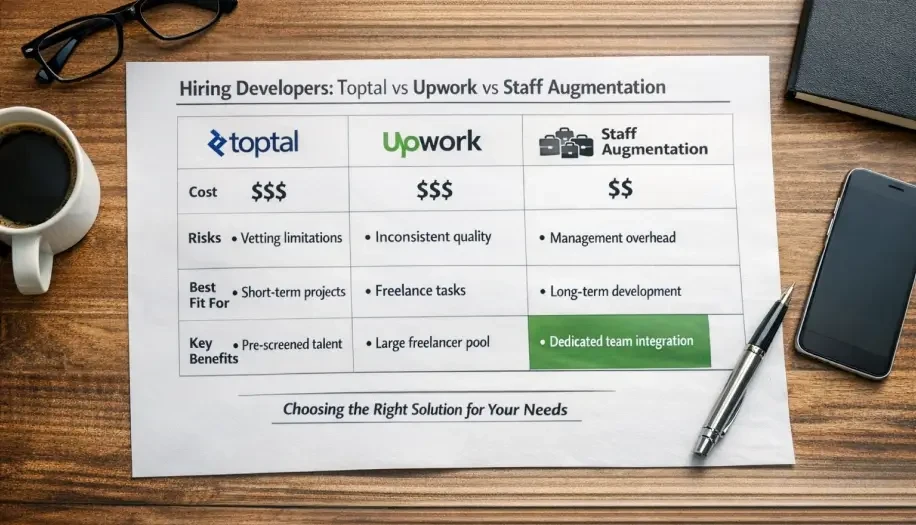
Toptal vs Upwork vs Staff Augmentation: An Honest CTO's Guide for 2026
Toptal, Upwork, and staff augmentation each solve a different problem. This honest vendor-side guide covers what each model actually costs, where each one breaks down, and which fits your situation.

Acquaint Softtech
March 16, 2026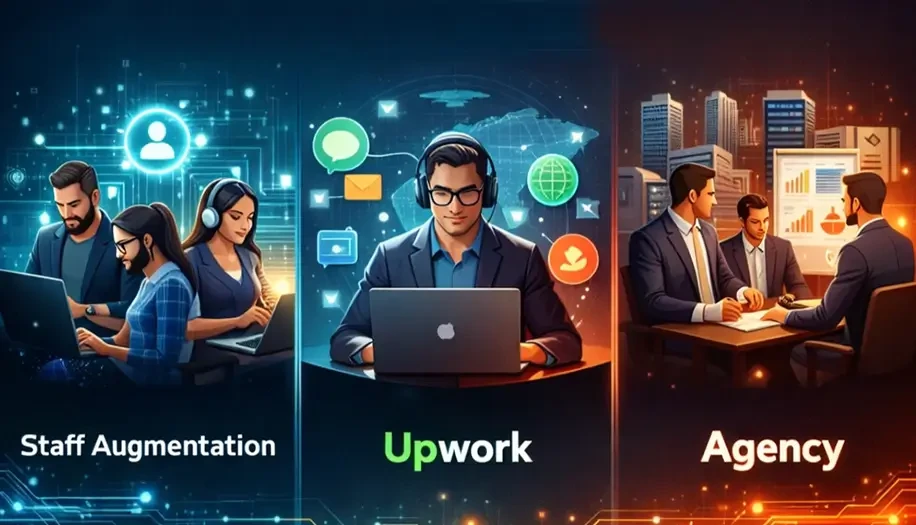
Staff Augmentation vs Upwork vs Agency: Real Cost Breakdown for CTOs in 2026
Staff augmentation, Upwork, or a dev agency? The real cost difference in 2026 is bigger than most CTOs expect. Here are the actual numbers with zero fluff.
Acquaint Softtech
March 8, 2026
Top Benefits of Choosing To Develop An SaaS Solution
Discover how SaaS can revolutionize your business operations. SaaS offers flexibility, cost savings, and scalability by providing cloud-based software solutions.
Mukesh Ram
September 24, 2024India (Head Office)
203/204, Shapath-II, Near Silver Leaf Hotel, Opp. Rajpath Club, SG Highway, Ahmedabad-380054, Gujarat
USA
7838 Camino Cielo St, Highland, CA 92346
UK
The Powerhouse, 21 Woodthorpe Road, Ashford, England, TW15 2RP
New Zealand
42 Exler Place, Avondale, Auckland 0600, New Zealand
Canada
141 Skyview Bay NE , Calgary, Alberta, T3N 2K6