

How to Scale Your Engineering Team From 3 to 30 Without Losing Culture: The COO's Playbook
Scaling from 3 to 30 engineers breaks most teams somewhere between 8 and 15. Not because the people are wrong. Because the systems that worked at 5 cannot survive at 15. This playbook covers all 4 stages.

Acquaint Softtech
Where Scaling Engineering Teams Actually Breaks
Most engineering teams do not break at 30 people. They break somewhere between 8 and 15. That is the stage where the informal coordination that worked when everyone sat in the same room or the same Slack channel stops working, and the formal systems that need to replace it have not been built yet.
At Acquaint Softtech, we have scaled our own engineering team from a handful of developers to 70+ full-time in-house engineers. We have also helped clients scale their engineering capacity through our staff augmentation model across hundreds of engagements. The patterns that cause scaling failures are remarkably consistent across companies of different sizes, industries, and geographies.
This playbook covers 4 stages of engineering team growth, the specific culture and delivery risks at each stage, and the systems that need to be in place before the team grows into the next stage. The goal is not just to add headcount. It is to add headcount without losing the velocity, quality, and culture that made the team worth scaling in the first place.

- COOs who own engineering delivery and need a framework for managing team growth across stages
- Founders who are growing their engineering function for the first time and want to avoid the most expensive mistakes
- CTOs who are scaling a team and want their COO to understand the operational implications at each stage
- Engineering leads who have been asked to take on more team management responsibility as the team grows
The 4 Stages of Engineering Team Scaling
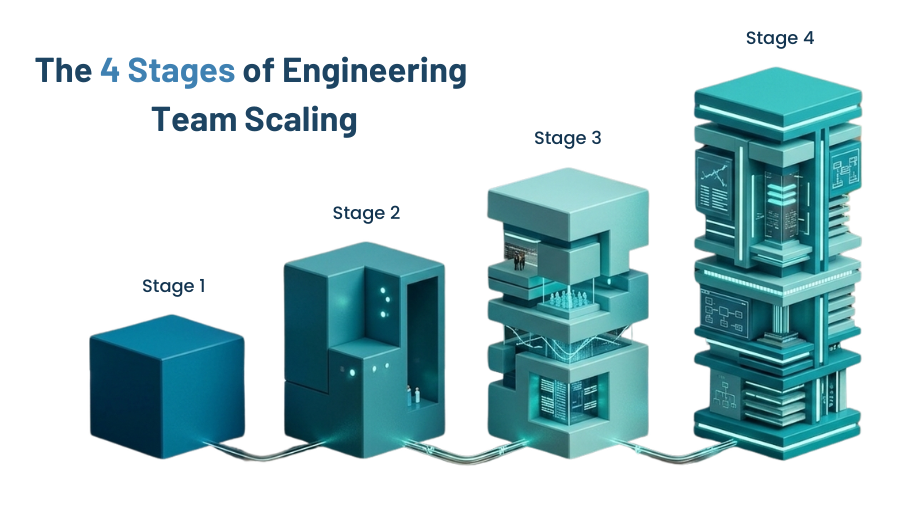
Every engineering team moves through these stages in roughly this order. The timelines vary. The failure patterns at each transition are consistent.
Stage 1 | The Founding Team | Team size: 3 to 7 engineers
Core challenge | Speed over process. Build fast, ship fast, learn fast. Every engineer knows what every other engineer is doing. Communication is direct and informal. |
Culture risk | Heroism becomes the culture. Individual output becomes the benchmark. Engineers who joined for the scrappy startup phase become uncomfortable when process is introduced. 'We used to move so much faster' becomes the most dangerous phrase in engineering. |
Act now on | Document how decisions are made, not just what decisions were made. Start a lightweight architecture decision record (ADR) before it feels necessary. The founders' instincts about quality and velocity are the culture. Write them down before you hire someone who does not share them. |
What breaks | Nothing breaks cleanly at this stage. The technical debt accumulates quietly. The architecture decisions made under speed pressure become the constraints that slow down Stage 2 and Stage 3. |
Stage 2 | The First Growth Phase | Team size: 8 to 15 engineers
Core challenge | Informal coordination fails. The team is too large for everyone to know what everyone else is working on. Duplicate work, conflicting architectural decisions, and missed dependencies begin appearing. |
Culture risk | The founding team becomes a bottleneck. Senior engineers who thrived as individual contributors in Stage 1 are now blocking junior engineers who need decisions and guidance. Founding team members resist the shift from doing to enabling because enabling feels like losing impact. |
Act now on | Introduce a formal sprint process if one does not exist. Establish team leads with explicit mentoring responsibilities, not just technical authority. Define who makes which architectural decisions and at what level of impact they require broader review. |
What breaks | Sprint velocity drops mysteriously without any individual underperforming. The cause is coordination overhead that nobody is measuring and nobody has assigned to fix. PR review backlogs grow because senior engineers are reviewing too many PRs and the review process has no defined turnaround SLA. |
Stage 3 | The Team-of-Teams Phase | Team size: 16 to 25 engineers
Core challenge | A single engineering team becomes multiple teams. Coordination between teams becomes as important as coordination within teams. Architectural consistency across teams requires deliberate governance. |
Culture risk | The culture fragments along team lines. Team A develops different norms from Team B. New engineers who join Team B have a different experience from those who join Team A. The founding culture exists in the founders' memories but not in the documented systems. |
Act now on | Establish cross-team architecture reviews. Create a shared engineering handbook that documents culture, standards, and decision-making processes explicitly. Run cross-team retrospectives monthly, not just within-team retrospectives. Establish an engineering all-hands rhythm. |
What breaks | Duplicated infrastructure, inconsistent API patterns, and incompatible data models that require expensive refactoring to align. The cost of architectural divergence compounds with every sprint. Inter-team dependency management becomes a full-time job that nobody is assigned to. |
Stage 4 | The Scaled Engineering Organisation | Team size: 26 to 35+ engineers
Core challenge | Engineering becomes an organisational function, not just a technical function. Engineering leadership requires people management capability, not just technical depth. The COO's relationship to engineering shifts from direct involvement to governance and measurement. |
Culture risk | The leaders who scaled the team technically may not be the right leaders to manage the organisation it has become. Promoting the best engineer to Engineering Manager without management training is the most expensive mistake at this stage. The new manager struggles, the team suffers, and the engineer loses the work they were best at. |
Act now on | Invest in engineering management as a distinct discipline. Establish career tracks that let senior engineers grow without moving into management. Create an OKR framework that connects engineering output to business outcomes measurable at the COO level. Define the engineering metrics that matter at scale. |
What breaks | High attrition among senior engineers who feel the culture has been lost. Velocity plateaus despite headcount growth because the coordination overhead of a large team has not been managed proactively. The COO loses visibility into engineering delivery and relies on lagging indicators like missed deadlines instead of leading indicators. |
What Engineering Culture Actually Is and How It Survives Scaling
Culture is not a ping pong table or a team lunch. It is the set of decisions that happen automatically, without management intervention, because everyone on the team has internalised the same values and norms.
At a 5-person team, culture is transmitted through proximity and observation. At a 30-person team, it requires explicit documentation, deliberate onboarding, and active reinforcement. The culture does not survive scaling automatically. It survives because someone is actively managing its transmission.
The 5 Elements of Engineering Culture That Must Be Explicit at Scale
Decision-making authority
Who decides what at which level of impact. A junior engineer should know exactly when they can make a technical decision independently and when they need to escalate. Without explicit authority maps, every decision either gets blocked waiting for escalation or gets made inconsistently by different engineers.
Quality standards
What good code looks like in this codebase, articulated specifically enough that a new engineer can apply the standard without supervision. Not 'write clean code'. Write the CONTRIBUTING.md that defines clean code for your specific conventions, architecture patterns, and review criteria.
Communication norms
What gets communicated in which channel, at what frequency, with what expected response time. A team of 5 communicates naturally. A team of 30 communicates according to explicit norms or develops costly misalignments in expectations across members.
Failure handling
How the team responds to production incidents, missed deadlines, and delivery failures. A culture that treats failure as a system problem produces learning. A culture that treats failure as a people problem produces fear. The difference is visible in how incidents are reviewed and what retrospectives actually produce.
Career growth
What progression looks like in this engineering organisation, for both individual contributors and managers. Ambiguity about career growth drives attrition among the engineers you most want to retain. Explicit progression frameworks do not need to be complex. They need to exist and be applied consistently.
The COO's Scaling Playbook: 12 Specific Actions
These 12 actions cover the most critical COO-level interventions across the 4 scaling stages. Each one has a clear owner, a specific action, and a timing recommendation. For the onboarding component, see our remote developer onboarding checklist which covers the tactical week-by-week process.
01. Document the architecture decision record before Stage 2
Start an ADR (Architecture Decision Record) log in Stage 1. Every significant technical decision is documented with the context, the options considered, and the reasoning for the choice made. New engineers in Stage 2 and beyond read the ADR log to understand not just what was built but why.
Owner: CTO (writes), COO (ensures it exists) | Timing: Before 8th engineer joins
02. Establish sprint cadence and definition of done before Stage 2
A formal sprint process with a written definition of done must be in place before the team exceeds 7 engineers. Beyond 7, informal coordination cannot keep everyone aligned on what done means. The definition of done is non-negotiable: it applies to every PR in every sprint.
Owner: Engineering Lead | Timing: Before 8th engineer joins
03. Assign explicit team lead responsibilities in Stage 2
When the team exceeds 8 engineers, designate team leads with explicit mentoring responsibilities: 2 to 3 junior engineers per lead, weekly 1:1 check-ins, PR review responsibility for their group. The team lead role must be named and compensated, not implied and voluntary.
Owner: COO | Timing: First week of Stage 2
04. Introduce engineering metrics that the COO tracks weekly
Sprint velocity, PR cycle time, deployment frequency, and production incident rate. These 4 metrics give the COO a leading indicator view of engineering health without requiring deep technical involvement. Track them in a shared dashboard, review them weekly, and act on trends not individual data points.
Owner: COO (tracks), Engineering Lead (owns) | Timing: Start of Stage 2
05. Write the engineering handbook before Stage 3
The engineering handbook is a single document covering: coding standards, communication norms, decision-making authority, career progression, on-call policies, incident response procedures, and the team's quality expectations. New engineers onboard from the handbook. The handbook is updated when anything changes.
Owner: Engineering Lead (writes), COO (approves) | Timing: Before 16th engineer joins
06. Establish cross-team architecture reviews in Stage 3
When multiple teams are working on the same codebase, architectural decisions made by one team affect all teams. A weekly 30-minute cross-team architecture review prevents expensive divergence. Attendance: team leads and senior engineers. Outcome: awareness of decisions that require broader alignment before implementation.
Owner: CTO (facilitates) | Timing: First week of Stage 3
07. Separate the IC and management career tracks before Stage 3
Create explicit career progression paths for both individual contributors and engineering managers. Senior engineers should be able to grow to Staff and Principal Engineer levels without managing people. The absence of an IC track creates pressure on senior engineers to move into management even when they do not want to, producing poor managers and losing great engineers.
Owner: COO (owns), CTO (designs) | Timing: Before 16th engineer joins
08. Run cross-team retrospectives monthly from Stage 3 onwards
Within-team retrospectives improve the team's own process. Cross-team retrospectives surface the coordination problems between teams that within-team retrospectives cannot see. Run a 60-minute cross-team retro monthly covering: inter-team dependency failures, duplicated work, and architectural divergence detected during the month.
Owner: Engineering Lead | Timing: Monthly from Stage 3
09. Invest in engineering manager training before Stage 4
Engineering managers who have not been trained in management produce burnout, attrition, and communication breakdowns. Invest in management training (structured frameworks, coaching, external courses) before the team reaches Stage 4. The cost of management training is a fraction of the cost of attrition in the engineers the poor management drives away.
Owner: COO | Timing: Before 26th engineer joins
10. Connect engineering OKRs to business outcomes from Stage 4
Engineering OKRs at Stage 4 should be measurable at the business level: time-to-market for new features, system reliability measured in customer-facing uptime, developer productivity measured in deployment frequency. Technical OKRs (test coverage, tech debt ratio) are important internally but the COO needs to see business outcome connection.
Owner: COO (owns), CTO (designs) | Timing: Before 26th engineer joins
11. Use staff augmentation to test new technical directions before hiring permanently
Before adding a permanent engineering specialisation (DevOps, ML, data engineering), use staff augmentation to prove the business case. A 3-month staff augmentation engagement validates whether the specialisation produces the expected outcome before you hire, onboard, and pay the 6-month recruitment and ramp cost of a permanent hire.
Owner: COO | Timing: Ongoing from Stage 2
12. Run a culture health check at every stage transition
At each stage transition (7 to 8, 15 to 16, 25 to 26 engineers), run a structured culture health check: anonymous team survey on decision-making clarity, communication quality, career development confidence, and psychological safety. Address the lowest-scoring area before moving into the next stage. Do not assume culture is healthy because nobody has complained.
Owner: COO | Timing: At each stage transition
Warning Signals That Your Scaling Is Breaking Culture
These are the early warning signals that a scaling problem is developing, before it becomes a retention crisis or a delivery failure. Each one is visible early enough to act on.
Warning signal: Senior engineers are spending more than 30% of their time on review and meetings
What it means: The team has grown without redesigning how senior engineers spend their time. They are still doing what they did at Stage 1 but the team is Stage 3 in size. They will burn out or leave.
Fix: Audit how senior engineers actually spend their time. Redesign the review process to distribute review load. Introduce team leads to absorb the mentoring overhead.
Warning signal: New engineers take more than 6 weeks to reach full sprint velocity
What it means: The onboarding process has not scaled with the team. New engineers are self-discovering a codebase that is now much larger and more complex than when the onboarding process was last updated.
Fix: Update the engineering handbook. Assign an onboarding buddy for every new hire. Review the first-sprint scope to ensure it is achievable without full codebase knowledge.
Warning signal: The same problems appear in sprint retrospectives across 3 consecutive sprints
What it means: The retrospective process is producing observations but not process changes. The team is talking about problems without the authority or the mechanism to fix them.
Fix: Assign a specific owner to every retrospective action item. Add a standing agenda item to review last sprint's actions before identifying new ones. Treat unresolved retrospective actions as sprint blockers.
Warning signal: Engineers describe the culture as 'what it used to be like'
What it means: The culture has diverged between the founding team's lived experience and what new engineers experience. New engineers are onboarding into a different culture than the one the founders describe.
Fix: Run a culture audit. Compare the founding team's description of culture against what recent hires describe. Close the gap with explicit documentation and updated onboarding.
Warning signal: Attrition is concentrated among engineers at the 12 to 24 month tenure mark
What it means: Engineers who joined during the growth phase are leaving at the moment they have built enough context to be most valuable. The most common causes are management quality and career path ambiguity.
Fix: Conduct exit interviews and analyse the themes. Invest in management training. Review career progression framework and ensure it is visible and applied consistently.
How Staff Augmentation Fits the Scaling Playbook
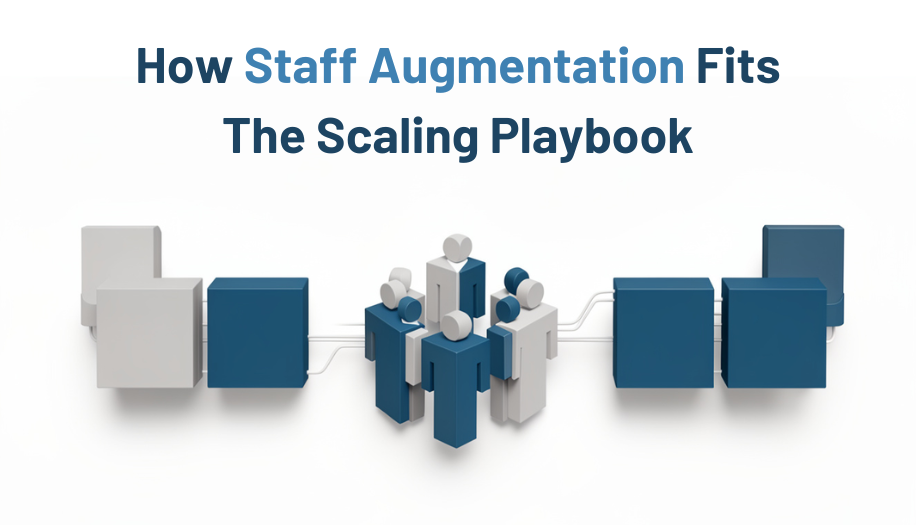
Permanent hiring is not always the right answer at every stage of scaling. Staff augmentation plays a specific role in the scaling playbook that permanent hiring cannot fill as efficiently.
Surge capacity without permanent headcount
When a sprint roadmap requires temporary capacity for a defined period (a product launch, a migration, a new feature build), staff augmentation provides senior engineers without the 6-month permanent hiring cycle. The capacity is right-sized to the need rather than permanently added to headcount.
Testing a new technical capability before hiring for it
Before adding a permanent ML engineer, DevOps specialist, or data engineer, a 90-day staff augmentation engagement proves whether the specialisation delivers the expected business outcome. The investment in permanent hiring is made after the proof of value, not as a bet on it.
Bridging the gap during Stage 2 transitions
The Stage 1 to Stage 2 transition often creates a short-term capacity gap while team leads are being identified and junior engineers are being onboarded. Staff augmentation fills that gap without disrupting the hiring plan for permanent senior positions.
Validating architecture decisions before committing
A senior staff-augmented engineer engaged for 4 to 6 weeks to evaluate and prototype an architectural direction provides an independent technical perspective before the team commits to a significant rebuild or new infrastructure investment.
Acquaint Softtech deploys pre-vetted senior Laravel developers within 48 hours through our staff augmentation model. Engineers integrate directly into your sprint process with full Slack access, PR review participation, and sprint commitment from day one. No 6-month hiring cycle. No onboarding lag beyond the first week. The quality framework is already in place.
Scaling Is a Leadership Problem Before It Is a Headcount Problem
Every engineering team that scales from 3 to 30 passes through the same 4 stages. The headcount decisions are the easy part. The system design decisions, the culture transmission decisions, and the leadership development decisions are where the scaling either holds or breaks.
The COOs who navigate this most successfully are not the ones who trust that culture will take care of itself. They are the ones who treat culture as an operational system that requires design, documentation, and active maintenance at every stage transition.
If you want to pressure-test your current engineering scaling plan against the 4-stage framework, we offer a free 30-minute scoping call. We will map your current team structure against the stage framework and identify the specific systems that need to be in place before your next growth phase. Book your call or explore our staff augmentation model to start the conversation.
FAQ's
-
At what team size do engineering processes need to become formal?
The transition from informal to formal processes needs to happen before the team reaches 8 engineers, not after. At 5 to 7 engineers, informal coordination is still viable. At 8 to 10 engineers, the coordination overhead of informality begins visibly affecting velocity. The common mistake is waiting for the pain to be obvious before introducing process, by which point the team has lost several weeks of productive capacity to coordination failures that a simple sprint process would have prevented.
-
How do you maintain engineering culture during rapid growth?
By treating culture as an operational system rather than an emergent property. Write down the decisions that should happen automatically. Document the standards that define quality. Map the authority that determines who decides what. Onboard every new engineer explicitly from these documents rather than expecting culture to transmit through proximity. Run culture health checks at each stage transition and address the gaps before they widen. Culture does not survive rapid growth accidentally. It survives because someone is actively managing its transmission.
-
What is the biggest mistake COOs make when scaling engineering teams?
Promoting the best engineer into engineering management without management training and without creating an individual contributor career track as an alternative. This produces three problems simultaneously: a struggling manager who is no longer doing the work they were excellent at, a team that is being managed by someone who has not been given the tools to manage well, and a cultural signal that the only path to recognition is management, which drives engineers who want to stay individual contributors to look externally for companies that value senior IC roles.
-
How should a COO measure engineering health at scale?
Through four leading indicators: sprint velocity trend (is the team consistently completing committed scope?), PR cycle time (how long from PR submission to merge, and is it stable or growing?), deployment frequency (how often does code go to production?), and production incident rate (how often does something break in production and how quickly is it resolved?). These four metrics tell the COO whether engineering is healthy without requiring deep technical involvement. They are visible in any modern project management and monitoring tool.
-
When does staff augmentation make more sense than permanent hiring for scaling?
In four specific scenarios: when the capacity need is temporary (a product launch, a migration, a defined feature build), when you are testing a new technical capability before committing to a permanent hire, when you need to bridge a Stage 2 capacity gap while the permanent hiring process runs, and when you need an independent senior perspective on an architectural decision without a long-term headcount commitment. For ongoing, context-dependent product development where institutional knowledge compounds over time, permanent hiring is the right long-term model. Staff augmentation fills the gaps where permanent hiring is too slow, too committed, or too certain for the situation.
We’re Acquaint Softtech, your technology growth partner. Whether you're building a SaaS product, modernizing enterprise software, or hiring vetted remote developers, we’re built for flexibility and speed. Our official partnerships with Laravel, Statamic, and Bagisto reflect our commitment to excellence, not limitation. We work across stacks, time zones, and industries to bring your tech vision to life.
Table of Contents
Get Started with Acquaint Softtech
- 13+ Years Delivering Software Excellence
- 1300+ Projects Delivered With Precision
- Official Laravel & Laravel News Partner
- Official Statamic Partner
Related Reading

How to Guarantee Code Quality From an Offshore Dev Team: The 6-Layer QA Process
Offshore teams do not write bad code because they are offshore. They write bad code because the quality process was never defined. This 6-layer QA framework fixes that before the first line is written.
Acquaint Softtech
March 18, 2026
The 8 Factors That Determine Success or Failure
After 1,300+ projects we know exactly which 8 factors separate successful engagements from expensive failures. None of them are about the technology. All of them are visible before the first sprint.
Acquaint Softtech
March 16, 2026
Staff Augmentation vs Upwork vs Agency: Real Cost Breakdown for CTOs in 2026
Staff augmentation, Upwork, or a dev agency? The real cost difference in 2026 is bigger than most CTOs expect. Here are the actual numbers with zero fluff.