

Onboarding Checklist for Remote Laravel Developers: Week 1, Month 1, Month 3
Most offshore engagements fail in Week 1, not Week 10. This checklist covers every onboarding step for remote Laravel developers: Week 1 setup, Month 1 integration, Month 3 performance.

Acquaint Softtech
Why Most Offshore Engagements Fail in Week 1
The failure point for most offshore Laravel engagements is not Month 3. It is Week 1.
Not because the developer is not good enough. Because the client was not ready.
No documented codebase. No defined sprint process. No clear ownership of who the developer talks to when they have a question. No agreement on what done looks like for the first two weeks. The developer spends five days figuring out how to contribute instead of contributing. Confidence drops on both sides. The engagement never fully recovers.
At Acquaint Softtech, we have onboarded developers into active engagements across 1,300+ projects. Our 48-hour onboarding model and 95% sprint delivery rate are the direct result of a structured onboarding process refined over 13 years. This checklist is that process, made available to any team hiring remote Laravel developers regardless of vendor.

- Print or copy this checklist before your remote Laravel developer's first day.
- Assign an internal owner for each section. Do not let it sit in a shared doc with no owner.
- Week 1 items should be completed before the developer's first working hour, not during it.
- Month 1 and Month 3 items are reviewed in sprint retrospectives and 1:1 check-ins.
- Every item has a reason. If you skip one, understand the risk you are accepting.
PHASE 1: Week 1 Onboarding Checklist
Days 1 to 5 | Complete access setup and first contribution within 5 working days
Day 1: Access and Environment Setup
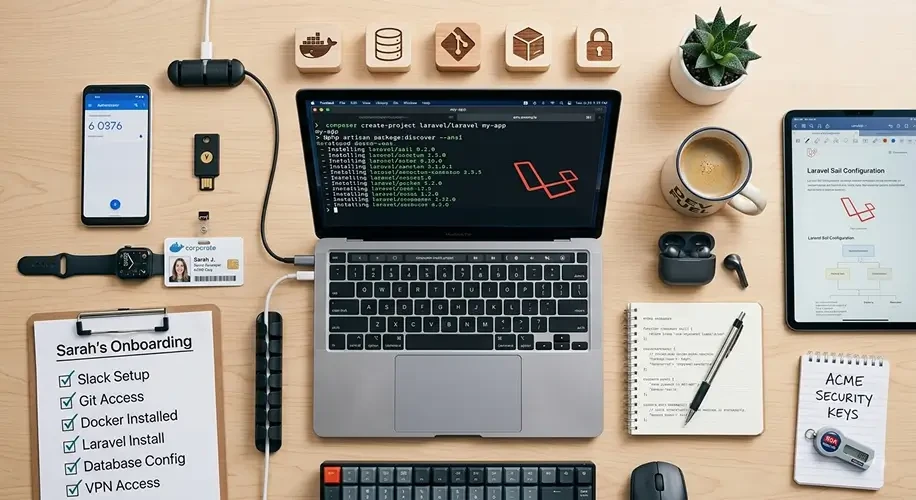
[ ] | ACCESS Invite developer to GitHub/GitLab organisation with correct repo permissions Read access to all repos they will touch. Write access to their working branch. Never direct push to main on day one. |
[ ] | ACCESS Create Slack/Teams account and add to relevant channels At minimum: #general, #engineering, #[project-name], #standup. Add direct channel with their main point of contact. |
[ ] | ACCESS Add to project management tool (Jira, Linear, or equivalent) Create their user account, assign to the active sprint, add to the backlog view. They should be able to see the full picture on day one. |
[ ] | ACCESS Provide access to staging environment and deployment pipeline URL, credentials, and deployment instructions documented. They should be able to deploy to staging independently by end of Week 1. |
[ ] | ACCESS Share cloud infrastructure access if applicable (AWS, GCP, Laravel Forge, Envoyer) Read-only access first. Confirm with your DevOps lead before granting write access to infrastructure. |
[ ] | DOCS Send the codebase README and local development setup guide before Day 1 This is sent the evening before Day 1, not on the morning of. The developer should have their local environment running before their first standup. |
Day 1: Communication Model Alignment
[ ] | PROCESS Schedule Day 1 introduction call (30 minutes maximum) Introductions, communication norms, sprint cadence overview, and one clear objective for Week 1. Do not make this a 2-hour onboarding marathon. |
[ ] | PROCESS Confirm standup format: written or video, time, and channel Written standup in Slack preferred for async teams. Agree on the format, the time, and the expected response window from the client side. |
[ ] | PROCESS Confirm code review process and PR approval requirements Who reviews their PRs? What is the expected turnaround? How many approvals before merge? This needs to be explicit, not assumed. |
[ ] | PROCESS Confirm blocker escalation path If the developer hits a blocker, who do they contact? What channel? What is the expected response time? Undefined escalation paths cause silent blockers that kill sprint velocity. |
[ ] | PROCESS Share sprint schedule: kickoff, review, retro dates and times Add calendar invites immediately. The developer should be in the next sprint kickoff regardless of how early in the sprint they join. |
Days 2 to 3: Codebase Orientation
[ ] | TECHNICAL Provide architecture overview document or diagram High-level: how the application is structured, key service classes, data flow, and any non-obvious patterns. A 1-page diagram is more useful than a 20-page document. |
[ ] | TECHNICAL Walk through the deployment pipeline together (30 minutes) How does code go from local to staging to production? What are the gotchas? This walk-through prevents a category of mistakes that always happen on day two without it. |
[ ] | TECHNICAL Identify and document any known technical debt areas Areas of the codebase the developer should be careful around. Not to avoid, but to be aware of. Undocumented tech debt is how good developers make bad commits. |
[ ] | TECHNICAL Assign a first task: a small, well-scoped bug fix or minor feature The first task should be completable in 1 to 2 days. The goal is a merged PR in Week 1 that gives both sides confidence. Do not assign a complex feature as a first task. |
[ ] | TECHNICAL Review Laravel version, key packages, and any non-standard patterns If the codebase uses a custom service container pattern, a non-standard event system, or any Laravel packages that are unusual, document and explain them explicitly. |
Days 4 to 5: First Contribution and Review
[ ] | DELIVERY Developer submits first PR by end of Day 4 Review it the same day. Fast feedback on the first PR sets the tone for the entire engagement. Slow feedback on Day 4 signals that the client is not engaged. |
[ ] | DELIVERY Code review completed with written feedback Written feedback in the PR comments, not a video call. This creates a searchable record of your codebase standards and expectations from day one. |
[ ] | DELIVERY Day 5 check-in call: 20 minutes Cover three things: what went well, what was unclear, and what needs to change for Week 2. This call prevents small misalignments from becoming Week 2 problems. |
[ ] | DELIVERY Confirm Week 2 sprint tasks are assigned and understood The developer should end Week 1 knowing exactly what they are building in Week 2. Ambiguity at this point kills Monday morning momentum. |
Week 1 Success Criteria
- Developer has working local environment and can deploy to staging independently
- First PR submitted, reviewed, and merged
- Communication model (standup format, blocker path, review process) confirmed and running
- Week 2 sprint tasks assigned and unambiguous
- Both sides have confidence that the engagement is set up to work
PHASE 2: Month 1 Integration Checklist
Weeks 2 to 4 | Full sprint integration, velocity baseline, and quality confirmation.
Sprint Integration
[ ] | SPRINT Developer is fully integrated into sprint planning They estimate their own tasks. They raise concerns during planning, not after sprint kickoff. They are treated as a full team member, not an external contributor. |
[ ] | SPRINT Velocity baseline established by end of Week 3 How many story points per sprint is this developer completing? This baseline is used to plan Month 2 and 3 sprints. Do not judge performance without a baseline. |
[ ] | SPRINT PR turnaround time tracked and within agreed SLA If PRs are sitting unreviewed for more than 24 hours, this is a client-side problem, not a developer problem. Fast review cycles are a shared responsibility. |
[ ] | SPRINT Developer is raising blockers proactively, not silently A developer who goes quiet when blocked is a sign that the escalation path is unclear or intimidating. Silent blockers kill sprints. Ask explicitly in standups. |
Code Quality Confirmation

[ ] | QUALITY Code review feedback is consistent with codebase standards By Week 3, the developer's PRs should require fewer correction cycles. If review cycles are increasing, the standards are not well documented or the developer needs more context. |
[ ] | QUALITY Unit test coverage maintained or improved on all new code Confirm that new features and bug fixes include appropriate test coverage. Establish a minimum coverage threshold if one does not already exist. |
[ ] | QUALITY No production incidents attributable to onboarding developer's code If an incident occurs, run a blameless post-mortem. Identify whether it was a knowledge gap, a process gap, or a review failure. Fix the process. |
[ ] | QUALITY Documentation updated for any new patterns or architectural decisions If the developer introduces a new pattern or makes an architectural decision, it is documented in the same PR. This is a non-negotiable standard from Month 1 onwards. |
Relationship and Communication Health
[ ] | RELATIONSHIP End-of-Month 1 structured feedback session (both directions) The developer gives feedback on the engagement. The client gives feedback on performance. Both sides surface what is working and what needs to change. This call prevents silent dissatisfaction on either side. |
[ ] | RELATIONSHIP Developer has a named internal champion on the client team Not a manager. A peer who can answer the questions the developer feels awkward escalating. This person is often the difference between an engaged developer and a disengaged one. |
[ ] | RELATIONSHIP Timezone and availability expectations explicitly reconfirmed After a month of working together, reconfirm the overlap windows, standup timing, and availability expectations. What seemed fine in Week 1 may need adjustment. |
Month 1 Success Criteria
- Developer completing sprint tasks at or above baseline velocity
- PR quality stable: fewer correction cycles than Week 1
- No silent blockers: developer is raising issues before they become sprint failures
- Both sides have given and received structured feedback
- Engagement feels like a team member, not a vendor
PHASE 3: Month 3 Performance Review Checklist
End of Month 3 | Performance confirmation, scope discussion, and long-term planning.
Performance Against Baseline
[ ] | PERFORMANCE Sprint velocity at or above Month 1 baseline for 6 consecutive sprints Consistent velocity over 6 sprints is the most reliable signal that the developer is fully integrated and performing at their capacity in this codebase. |
[ ] | PERFORMANCE Code review cycle time has stabilised First-time approval rate on PRs should be meaningfully higher than Month 1. If it is not, the issue is either standards documentation or a skills gap that needs addressing. |
[ ] | PERFORMANCE Developer has taken ownership of at least one architectural decision By Month 3, a senior developer should have proposed and led at least one decision about how the codebase is structured, not just executed instructions. This is the signal that they are operating at a senior level. |
[ ] | PERFORMANCE On-call or incident response contribution if applicable Has the developer handled at least one production issue? Their response under pressure is a key signal of their reliability in a long-term engagement. |
Scope and Engagement Review
[ ] | REVIEW Formal 3-month engagement review with both sides Review the original brief against actual delivery. What was completed? What shifted? What should the next 3 months look like? This call is the foundation for engagement continuity or scale-up. |
[ ] | REVIEW Assess whether current team size matches product roadmap needs Month 3 is the right time to ask whether one developer is still the right configuration or whether the roadmap requires scaling the team. Capacity decisions made in Month 3 affect Month 4 delivery. |
[ ] | REVIEW Confirm IP, NDA, and contract terms for renewal or extension Contracts signed at the start of an engagement often have 3-month initial terms. Review and renew before the expiry date, not after. |
[ ] | REVIEW Document institutional knowledge the developer now holds By Month 3, the developer holds context that is not in the codebase: architectural reasoning, past decisions, and product nuances. This knowledge should be documented proactively in case of team changes. |
Long-Term Engagement Health
[ ] | LONG-TERM Developer has been recognised for specific contributions publicly Recognition in sprint reviews, Slack channels, or team calls. Small but significant. Developers who feel their work is noticed stay engaged. Those who feel invisible disengage gradually. |
[ ] | LONG-TERM Developer has been involved in any hiring or onboarding decisions If the team is growing, involving the existing developer in interviewing or onboarding new members signals trust and investment in the relationship. |
[ ] | LONG-TERM Career development discussion completed What does the developer want to learn or grow into? Are there opportunities in the current engagement to support that? This conversation is often skipped with remote developers. It should not be. |
[ ] | LONG-TERM Engagement retention risk assessed Is there any signal that the developer may be disengaging? Changes in communication patterns, velocity dips, or declining initiative are early signals. Address them directly before Month 4. |
Month 3 Success Criteria
- Developer is operating as a full team member with ownership and initiative
- Velocity is stable and predictable enough to plan the next quarter confidently
- Institutional knowledge is documented and not locked in one person's head
- Engagement health is assessed and any risk signals are addressed
- Both sides want to continue: the client because delivery is strong, the developer because the work is meaningful
Why This Checklist Works: The Evidence From 1,300+ Projects

This checklist is not theory. It is the distilled process behind Acquaint Softtech's 48-hour developer onboarding model and 95% sprint delivery rate across active engagements.
Here is what the data from our engagements consistently shows:
Engagements with documented codebase setup guides complete Week 1 tasks 3x faster: The single highest-impact Week 1 action is sending the local development setup guide the evening before Day 1. It costs 30 minutes to write and saves 4 to 8 hours of Day 1 troubleshooting.
Engagements with a named internal champion have 40% lower Month 3 attrition: A peer-level internal champion is the most underrated onboarding element. It is not about management oversight. It is about the developer having someone they can ask the questions they feel awkward raising in a standup.
Engagements with written standup formats outperform video-only standups on velocity: Written standups create a searchable record, remove scheduling overhead, and let developers communicate asynchronously across timezone gaps. They also surface blockers more reliably because writing forces specificity that verbal standups often skip.
First PR merged in Week 1 correlates strongly with Month 3 engagement retention: Surprisingly strong correlation. A merged PR in Week 1 means the developer got a clear task, the client reviewed it promptly, and both sides experienced a successful handoff cycle early. That pattern repeats.
How Acquaint Softtech's 48-Hour Onboarding Model Works
When you hire a dedicated Laravel developer through Acquaint Softtech's staff augmentation model, the onboarding process runs on our side in parallel with yours. Here is what happens in the 48 hours before Day 1.
ACQUAINT SIDE | Before Day 1: We brief the developer on your company, product, and tech stack using the information from our scoping call. We confirm their local environment setup, their preferred communication tools, and their availability windows. We send you a developer profile document covering their background, recent projects, and specific experience relevant to your codebase.
CLIENT SIDE | Before Day 1: You complete the Week 1 access checklist above. We send you a pre-onboarding guide specific to remote Laravel developers that walks you through each step with templates for the codebase README, architecture overview, and Day 1 introduction call agenda.
DAY 1 | First 4 Hours: Developer and client lead complete the Day 1 introduction call. Developer has local environment running and has submitted their first question or observation about the codebase in Slack before the end of the day. Communication model is confirmed. First task is assigned.
END OF WEEK 1 | Confirmation Call: Acquaint Softtech conducts a brief check-in with both the developer and the client lead separately. We identify any friction points and resolve them before they affect Week 2. This call is included in every engagement at no additional cost.
The Checklist Is Not the Work. The Commitment Is.
Every item on this checklist takes time to complete properly. That time is not overhead. It is investment in an engagement that will compound over months.
The engagements that fail do not fail because the developer was wrong. They fail because the setup was incomplete and nobody noticed until it was expensive to fix. The checklist above makes the setup explicit, trackable, and accountable. Combined with the right Laravel developer, it is the foundation for an engagement that reaches Month 3 with momentum instead of regret.
Start Your Onboarding in 48 Hours
Acquaint Softtech deploys pre-vetted senior Laravel developers into active engagements within 48 hours.
Our onboarding model is built around this checklist. You get the developer, the process, and the support.
Staff Augmentation Model | Hire Laravel Developers | Laravel Development Services
Frequently Asked Questions
-
How long does it take to onboard a remote Laravel developer?
With proper preparation, a remote Laravel developer can be submitting their first PR within 48 hours and fully sprint-integrated within 5 working days. The variable is client-side readiness, not developer capability. Engagements where the client sends access credentials and a codebase setup guide before Day 1 consistently achieve this timeline. Engagements where the client waits for Day 1 to start the setup process typically take 5 to 10 working days to reach first contribution.
-
What is the biggest mistake companies make when onboarding offshore Laravel developers?
Treating the onboarding as the developer's responsibility rather than a shared process. The developer cannot set up their own access, document their own codebase, or define their own sprint integration. These are client-side responsibilities. Companies that complete their side of the Week 1 checklist before Day 1 have dramatically better engagement outcomes than those that improvise the onboarding on the fly.
-
How does Acquaint Softtech's 48-hour onboarding work in practice?
When a client confirms an engagement, we brief the assigned developer immediately using information from the scoping call. We send the client a pre-onboarding guide with templates for the codebase README, architecture overview, and Day 1 introduction agenda. The developer arrives on Day 1 with context on the company, product, and tech stack already loaded. We conduct a Week 1 check-in with both sides to resolve any friction before it compounds.
-
Should remote Laravel developers work in the same sprint as the in-house team?
Yes, always. Treating a remote developer as a separate workstream with their own delivery cycle creates communication gaps, review bottlenecks, and misaligned priorities. The most effective model is full sprint integration from Week 1: same planning, same review, same retrospective. The developer is a team member who happens to be remote, not an external contributor on a parallel track.
-
What metrics should I track for a remote Laravel developer in the first 3 months?
Sprint velocity (story points completed per sprint), PR cycle time (time from submission to merge), first-time approval rate on PRs (percentage of PRs that pass review without a correction cycle), and blocker frequency (how often is the developer blocked and for how long). These four metrics give you an accurate picture of performance, process health, and engagement quality through Month 3.
We’re Acquaint Softtech, your technology growth partner. Whether you're building a SaaS product, modernizing enterprise software, or hiring vetted remote developers, we’re built for flexibility and speed. Our official partnerships with Laravel, Statamic, and Bagisto reflect our commitment to excellence, not limitation. We work across stacks, time zones, and industries to bring your tech vision to life.
Table of Contents
Get Started with Acquaint Softtech
- 13+ Years Delivering Software Excellence
- 1300+ Projects Delivered With Precision
- Official Laravel & Laravel News Partner
- Official Statamic Partner
Related Reading
15-Point Checklist: How to Vet a Laravel Dev Company Before Signing
Before you sign with any Laravel dev company, ask these 15 questions. We built this checklist from 1,300+ projects. Most CTOs skip at least 8 of them.
Acquaint Softtech
March 8, 2026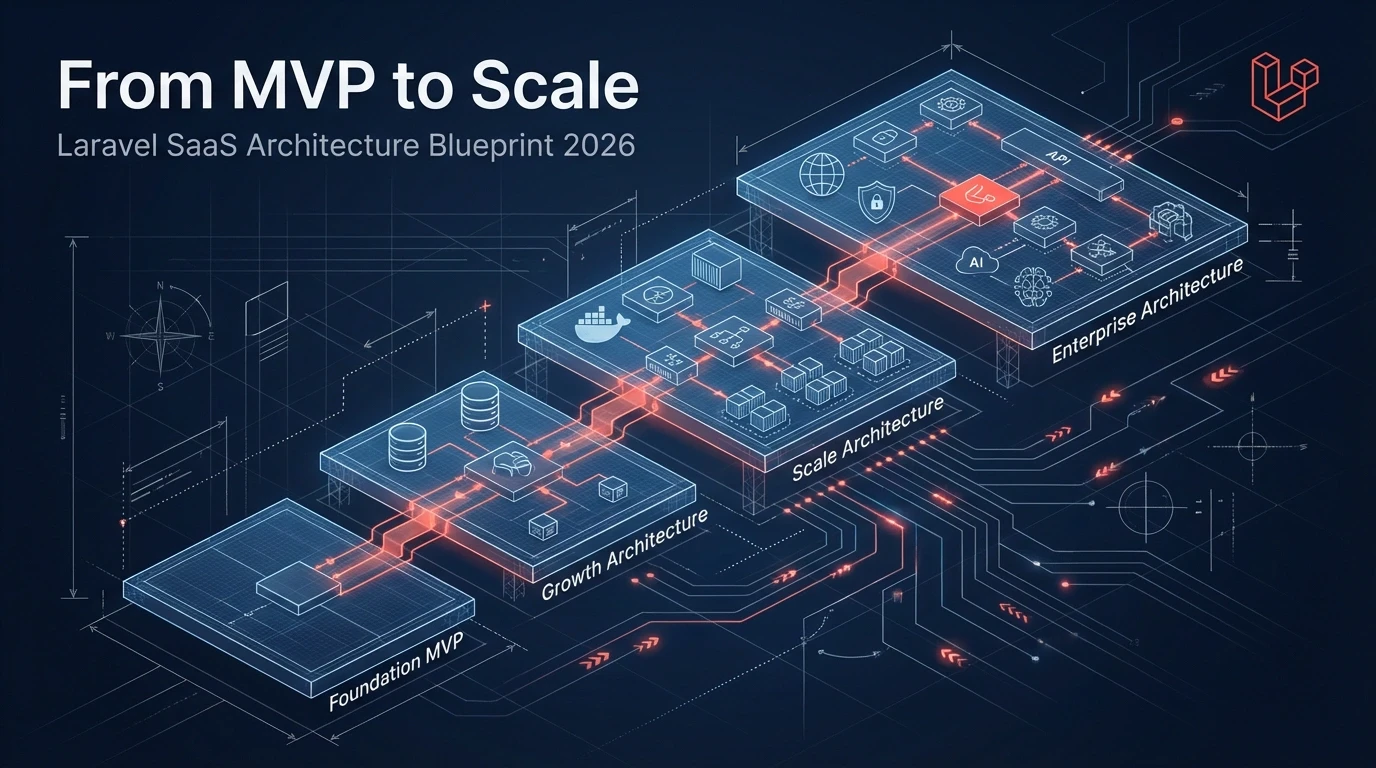
From MVP to Scale: The Laravel SaaS Architecture Blueprint for 2026
From MVP to 100K users, the architecture decisions that felt small at month one become expensive at month twelve. Here is the Laravel SaaS blueprint we use across 200+ Laravel projects.
Acquaint Softtech
March 10, 2026
Staff Augmentation vs Upwork vs Agency: Real Cost Breakdown for CTOs in 2026
Staff augmentation, Upwork, or a dev agency? The real cost difference in 2026 is bigger than most CTOs expect. Here are the actual numbers with zero fluff.