

Why Offshore Development Fails: 7 Most Common Reasons and How to Avoid Each One
Offshore development fails for the same 7 reasons, repeatedly. None of them are about developer quality. All of them are about structure. Here is each one and the specific fix.

Ahmed Ginani
I work in business development at Acquaint Softtech a, software development partner with 1,300+ projects and 13 years of offshore development engagements. The companies that reach out to us after a failed offshore engagement all describe the same patterns. The failure was not random. It was structural. And it was almost always preventable with the right setup. Here are the 7 most common reasons, what each one looks like before it becomes a crisis, and the specific fix.

- CTOs and founders who have had a failed offshore engagement and want to understand what went wrong
- Companies evaluating offshore development for the first time and wanting to know what to watch out for
- Engineering leads who are currently in an offshore engagement that is showing early warning signs
- Procurement leads building a vendor governance framework to prevent these failures proactively
The title of this article is deliberately direct. Offshore development does fail, and at a rate higher than domestic engagements, when certain structural conditions are absent. But the failure is almost never caused by the developers themselves. It is caused by the engagement structure, the vendor selection process, and the governance setup. Fix those three things and the failure rate drop to match or beat domestic alternatives.
Before starting any offshore engagement, the offshore development due diligence checklist covers the 10 verification checks that filter out vendors who are likely to produce these failure modes before any work begins. This article covers what the failure modes look like when they appear, so you can catch them early.
The 7 Failure Reasons
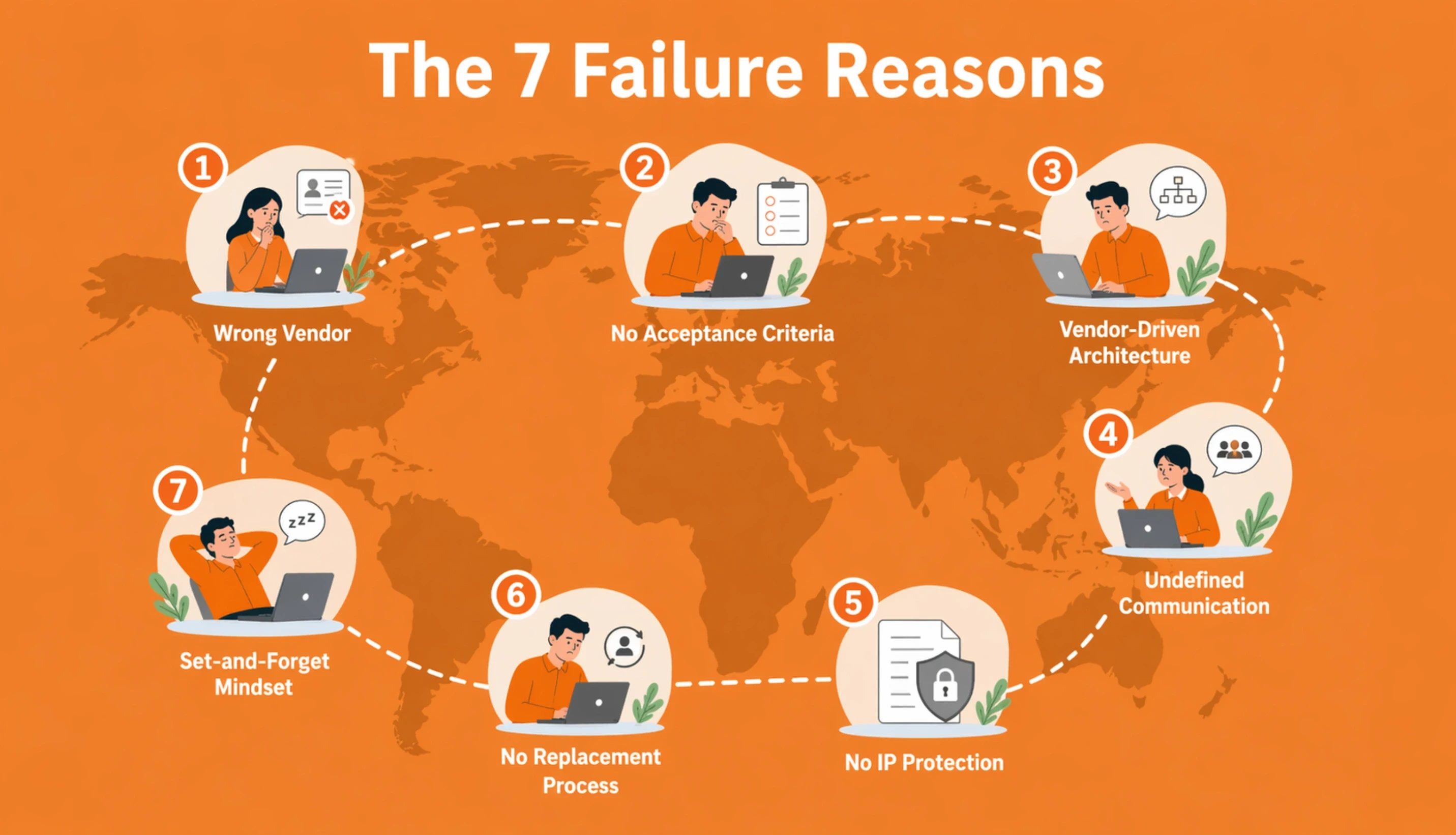
Each failure reason below includes what it looks like in practice, the signal that appears before it becomes critical, and the specific structural fix.
Reason 1: Wrong vendor selected because verification was skipped |
What happens: The vendor looked credible on the proposal. Good website, polished case studies, reasonable rates. After signing, the senior developer on the profile was replaced by someone significantly more junior. The case studies on the website were not from real clients. The QA process described in the sales call did not exist in practice. |
Early signal: Developer profile arrives after contract signing, not before. Case studies cannot be verified with a 5-minute search. No reference clients provided despite being asked. |
Fix: Verify before signing: credentials through independent sources, named developer profile before contract, two reference client calls. The due diligence that takes 2 hours prevents 6 months of wasted budget. |
Reason 2: No acceptance criteria defined before development starts |
What happens: The feature was described in a brief. The developer built an interpretation of that description. The client expected something different. Neither party was wrong. The brief did not specify what done looked like. Change requests began in sprint 2 and never stopped. |
Early signal: Change requests arrive at the end of sprints for work the client felt was clearly specified. Developer defends their interpretation. Both are right within their own frame. |
Fix: Write acceptance criteria at sprint planning before any development begins. One sentence per feature: what does done look like from the user's perspective? This single practice eliminates most change request cycles. |
Reason 3: Architecture decisions made by the vendor without client sign-off |
What happens: The vendor built the fast solution rather than the extensible one. The client discovered this when the next feature required changes to the architecture the vendor chose. A $3,000 feature became a $18,000 architectural refactor because the original decision was made without the client knowing it was a decision. |
Early signal: The vendor says things like 'we handle the technical side' or 'that is a standard approach' without explaining trade-offs. Architecture decisions are presented as completed rather than proposed. |
Fix: Establish architecture sign-off as a contract term. Significant decisions require client approval before implementation. The vendor proposes, explains trade-offs, and the client approves. This adds 30 minutes to sprint planning. It eliminates architectural surprises. |
Reason 4: Communication structure not defined at engagement start |
What happens: The developer was working. Updates came when the client asked. Problems surfaced at sprint review rather than mid-sprint. By the time the client knew about a blocker, it had already delayed the sprint by 4 days. The relationship felt opaque. Trust eroded. |
Early signal: Updates only arrive in response to client messages. Sprint reviews are the first time the client hears about in-progress work. The developer is reachable but not proactively communicative. |
Fix: Define the communication structure on Day 1: daily async standup summary, mid-sprint check-in on Wednesday, sprint review Friday. Put it in the contract. A vendor who resists communication obligations is a vendor who does not want problems surfaced early. |
Seeing Any of These 4 Patterns in Your Current Engagement?
Send me a brief description of what you are observing. I will tell you which failure mode it matches and what the structural fix looks like. If the engagement is recoverable, I will tell you that too. If it is not, I will tell you what the transition process looks like.
Reason 5: No IP protection in the contract |
What happens: The engagement ended. The client asked for the codebase. The vendor said the code was in their repository and access would be provided after final payment. Final payment was disputed because delivery was incomplete. The client had no direct repository access and no IP assignment clause. The codebase was effectively held hostage. |
Early signal: The vendor's repository is the primary code location. The client has read access but not ownership. IP assignment is described as 'handled at project completion' rather than in the contract. |
Fix: IP assignment must be in the standard contract, not negotiated at termination. All code belongs to the client from the moment it is committed. The client's repository is the primary code location from Day 1. These are non-negotiable terms. Any vendor who treats them as negotiating points is showing you how they operate. |
Reason 6: No replacement process when a developer underperforms |
What happens: The developer was not meeting the quality standard. The client raised it with the vendor. The vendor acknowledged it and said they would 'address it internally.' Three sprints later, the same developer was still on the engagement, still producing the same quality of output. The vendor had made a promise with no mechanism behind it. |
Early signal: The vendor responds to performance concerns with reassurance rather than a specific process. No defined timeline for performance improvement or replacement. The same issues appear in multiple retrospectives. |
Fix: Replacement guarantee must be specific and contractual: defined process, defined timeline (typically 48 to 72 hours), client approval of the incoming developer, and structured knowledge transfer. A replacement promise without a process is a sales statement. |
Reason 7: Treating the offshore engagement as a set-and-forget arrangement |
What happens: The client handed over the brief, received the quote, and expected to review output at the end of the sprint. With no mid-sprint interaction, no architecture sign-off, and no acceptance criteria process, the sprint consistently produced work that was technically complete but directionally wrong. The client concluded offshore development does not work. The actual cause was the absence of a governance structure. |
Early signal: The client spends less than 2 hours per week engaged with the offshore team. Sprint reviews are the only interaction. The developer is given maximum autonomy with minimum direction. |
Fix: Offshore development is not a delegation. It is a directed engagement. Sprint planning, mid-sprint check-ins, and weekly metrics review require 2 to 3 hours of client time per week. That investment produces a team at full velocity. Removing it produces drift. |
If you are already in a failing engagement and need to act, the vendor switching guide covers the structured exit process that cuts the transition from 10 weeks to 3. And the KPI framework for managing external dev teams covers the ongoing governance that prevents these failures from developing in the first place.
Evaluating an Offshore Vendor Right Now? Here Is How to Check All 7 Risk Areas.
Send me your vendor shortlist and the brief you are planning to send. I will map it against all 7 failure reasons and tell you which ones the current setup leaves unaddressed. Takes 48 hours and prevents 6 months of the wrong engagement.
What a Well-Structured Offshore Engagement Looks Like
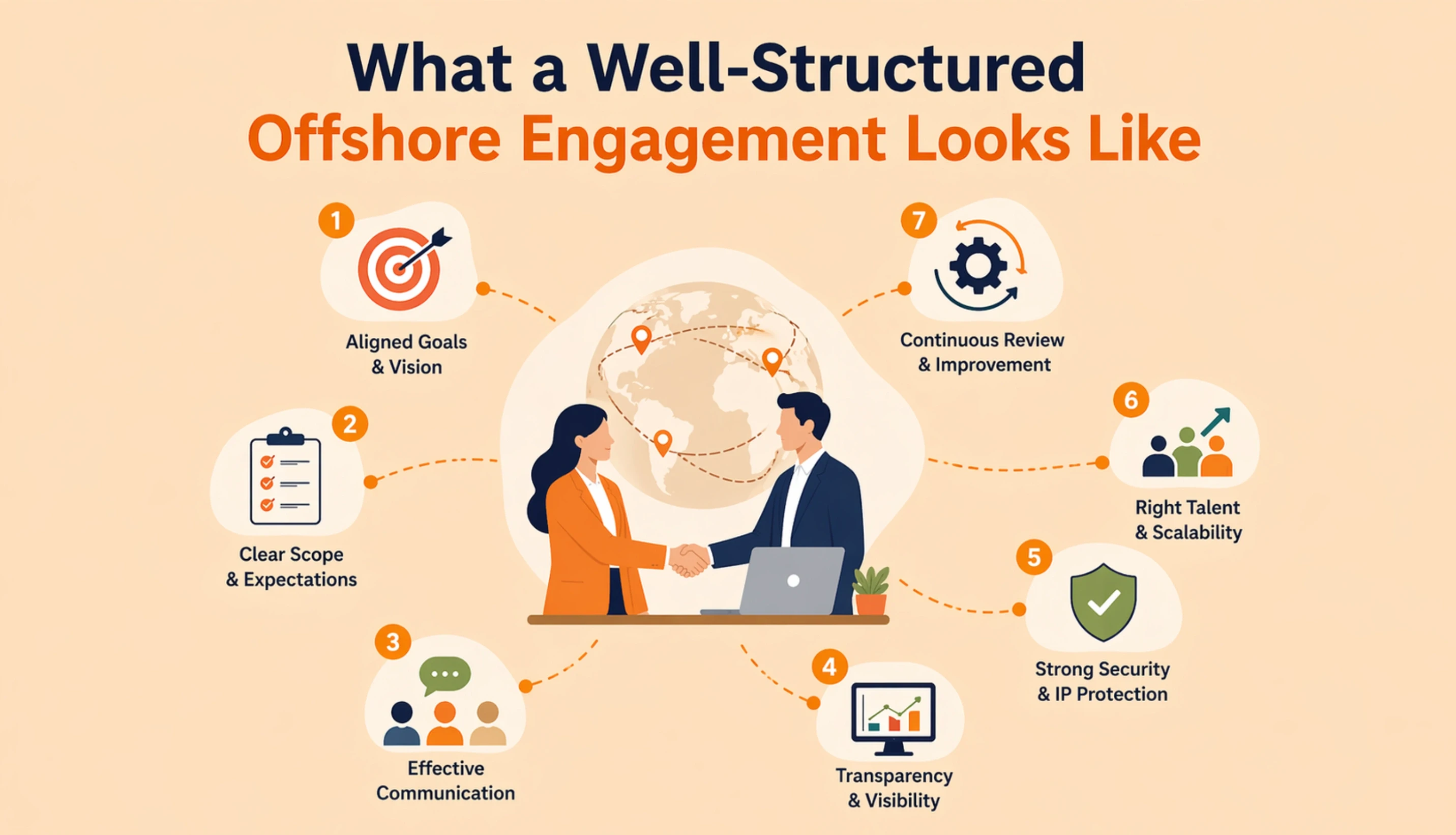
The opposite of these 7 failure reasons is a engagement with specific, verifiable structural safeguards. Here is what each one looks like as a contract term or process.
Named developer, interviewed before signing | Developer profile provided before contract. Client interviews before commitment. Named developer in the contract with replacement obligations if substitution is necessary. |
IP assignment from first commit | All code belongs to the client from the moment it is committed. Client repository is the primary code location. No negotiation at engagement end. |
Acceptance criteria at sprint planning | Every feature has written acceptance criteria before development begins. Reviewed at sprint planning. Evaluated at sprint review. |
Architecture sign-off process | Significant decisions require client approval before implementation. Vendor proposes, explains trade-offs, client approves. Documented in a running decision log. |
Defined communication rhythm | Daily async standup, mid-sprint check-in, sprint review, weekly metrics report. In the contract, not the relationship. |
Contractual replacement guarantee | Specific process, specific timeline, client approval of incoming developer, structured knowledge transfer. Not a promise. |
Weekly delivery metrics | Sprint commitment rate, cycle time, defect escape rate tracked and shared weekly. Performance visibility without surveillance. |
Our dedicated development team model includes all 7 structural safeguards as defaults. They are contract terms, not policies. And when you are evaluating individual developers to join a team, the remote developer interview framework covers the 8 questions that reveal whether the developer will produce the failure patterns above or avoid them.
Want an Offshore Engagement Where All 7 Failure Reasons Are Structurally Prevented?
Every Acquaint engagement includes: named developer before Day 1, IP assignment from first commit, acceptance criteria process, architecture sign-off, defined communication rhythm, contractual replacement guarantee, and weekly metrics. These are default terms, not add-ons. Tell us your stack and what you are building.
Frequently Asked Questions
-
Why does offshore development fail so often?
Most offshore failures are structural, not talent-related. The common causes are: unverified vendors, no acceptance criteria, architecture decisions made without client approval, poor communication structure, no IP protection, and weak governance. Fix the structure and the failure rate drops significantly.
-
Is offshore development risky?
Offshore development carries specific, well-documented risks, but they are all preventable. The 7 failure reasons in this article each have a direct structural fix. Companies that build the right governance from Day 1 consistently get offshore results that match or beat domestic development at 40 to 60% lower cost.
-
How do I protect my IP when working with an offshore developer?
Require IP assignment from first commit as a standard contract term. The client repository must be the primary code location, not the vendor's. Any vendor who treats IP assignment as a negotiation point rather than a default is a risk worth noting before signing.
-
What should be in an offshore development contract?
At minimum: IP assignment from first commit, named developer clause, acceptance criteria process, architecture sign-off requirement, communication rhythm obligations, replacement guarantee with defined timeline, handover process on termination, and weekly delivery metrics as a reporting obligation. If any of these are missing, negotiate them in before signing.
-
How do I know if an offshore vendor is legitimate?
Verify credentials independently: partner status at official programme pages, Clutch reviews by clicking through to named reviewers, team size via LinkedIn headcount, and reference clients via a direct call. A vendor who passes all 10 checks in our offshore due diligence checklist is operating transparently. A vendor who deflects on any of them is not.
-
What does a good offshore development engagement cost in 2026?
A senior developer through a structured India-based vendor runs $38 to $55/hr all-inclusive, or $5,500 to $8,000/month. A dedicated team of 3 developers plus a tech lead runs $13,000 to $20,000/month. These rates include employer costs, equipment, and management overhead that would be additional in a direct hire.
-
Is offshore staff augmentation better than offshore project outsourcing?
Staff augmentation gives you more control: you direct the developer daily, set sprint priorities, and own the product direction. Project outsourcing gives the vendor more latitude on execution but less visibility into the process. For SaaS and ongoing product development, staff augmentation consistently produces better outcomes because the client's product knowledge stays with the team.
I help agencies and founders scale their tech teams with the right developers at the right time. At Acquaint Softtech, I focus on building long term partnerships and making remote hiring simple, predictable, and results driven. My goal is straightforward to help businesses grow faster with reliable dedicated developers.
Table of Contents
Get Started with Acquaint Softtech
- 13+ Years Delivering Software Excellence
- 1300+ Projects Delivered With Precision
- Official Laravel & Laravel News Partner
- Official Statamic Partner
Related Reading
IT Staff Augmentation vs In-House Recruitment in 2025
Confused between IT staff augmentation and in-house hiring? Discover the pros, cons, and best use cases to scale your tech teams smarter in 2025.

Acquaint Softtech
June 17, 2025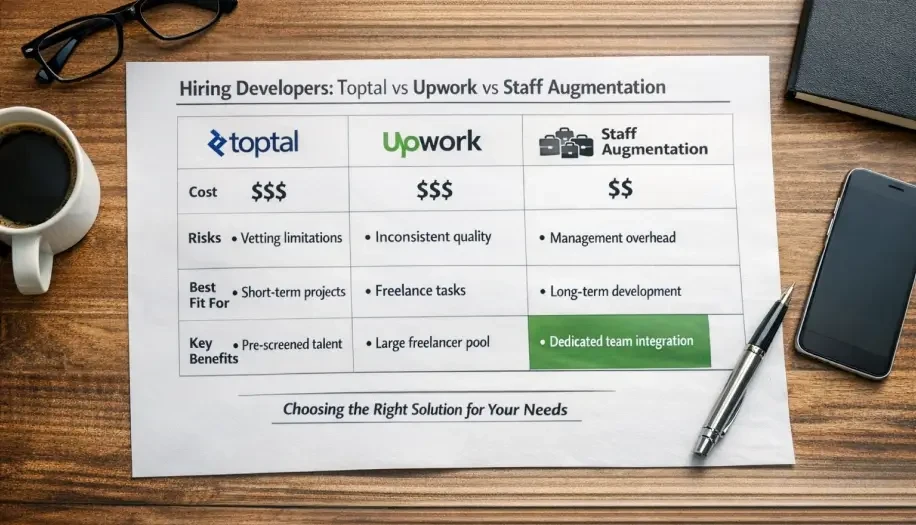
Toptal vs Upwork vs Staff Augmentation: An Honest CTO's Guide for 2026
Toptal, Upwork, and staff augmentation each solve a different problem. This honest vendor-side guide covers what each model actually costs, where each one breaks down, and which fits your situation.
Acquaint Softtech
March 16, 2026
How to Choose a Software Development Company in 2026
Every software development company proposal looks good on page one. The rate is reasonable. The timeline sounds achievable. The case studies are polished. Here is the framework that tells you what is actually behind it.
Ahmed Ginani
April 6, 2026India (Head Office)
203/204, Shapath-II, Near Silver Leaf Hotel, Opp. Rajpath Club, SG Highway, Ahmedabad-380054, Gujarat
USA
7838 Camino Cielo St, Highland, CA 92346
UK
The Powerhouse, 21 Woodthorpe Road, Ashford, England, TW15 2RP
New Zealand
42 Exler Place, Avondale, Auckland 0600, New Zealand
Canada
141 Skyview Bay NE , Calgary, Alberta, T3N 2K6