

API Development Cost in 2026: What Drives the Price, What to Budget, and Where Projects Overrun
Most API budgets are built around the endpoint list. That covers roughly 40% of the real work. Here is what the other 60% looks like and why it is almost always the part that causes overruns.

Chirag Daxini
API projects have a reputation for going over budget. Not because developers are slow or vendors are dishonest. Because the original budget was built around the endpoint list, and the endpoint list covers maybe 40% of what actually needs to be built.

- Founders and CTOs who are about to receive an API development quote and want to know if it is realistic
- Product managers who are scoping an API project for the first time and are not sure what to include
- Engineering leads who have had an API project overrun before and want to understand why
- Businesses evaluating offshore vs onshore API development and needing a cost baseline for 2026
The problem starts with how most companies scope API project. They list the endpoints they need, get a quote per endpoint, and treat the sum as the budget. But the endpoint count describes the visible surface of the API. Authentication, rate limiting, error handling, versioning strategy, documentation, and third-party integration work are all underneath that surface. And most of that work is not in the initial quote.
This article breaks down what API development actually costs in 2026, which components reliably cause overruns, and how to build a budget that holds. If you are looking for the broader question of which stack to build on, the Laravel developer hiring guide covers the stack comparison and rate data in detail. If you already know the stack and want a comparison of hiring models, the real cost breakdown for CTOs has the right numbers.
What Drives API Development Cost: The Full List
Every API project has two cost layers. The visible layer is the one that gets scoped and quoted. The invisible layer is what shows up mid-project when someone asks who is handling authentication, or during launch when a client reports the API has no rate limiting.
Visible layer: what gets quoted
Endpoint development | Each endpoint: the route, the controller logic, the database query, the response format. This is what most developers scope when they quote an API project. It is real work but it is not the majority of the effort. |
Data models and relationships | Designing and implementing the database schema, migrations, relationships between models, and query optimisation. For complex products this can be 15 to 25% of total effort. |
Basic input validation | Validating that request payloads contain required fields and expected data types. Typically included in endpoint quotes. |
Hidden layer: what causes overruns
Authentication and authorisation | Building the login and token system, managing user roles and permissions, handling refresh tokens, implementing OAuth or SSO if required. This is commonly 15 to 30 hours of work that is not in the endpoint count. |
Rate limiting and throttle logic | Protecting the API from abuse and ensuring fair usage. Without this, a high-traffic API is a liability in production. Rate limiting is something developers often assumes is a 30-minute task. It is not. |
Error handling and response standards | Consistent error codes, meaningful error messages, logging that is useful for debugging, and response envelopes that are predictable across all endpoints. Implementing this correctly across a full API is several days of work. |
API versioning | Planning and implementing a versioning strategy before launch is far cheaper than retrofitting it after clients are already using the API. Most projects that did not plan for versioning wish they had. |
Documentation | Interactive documentation using tools like Swagger or Postman collections. It's one of the most consistently skipped part of an API build and one of the most expensive to add retroactively. |
Third-party integration work | Connecting the API to payment gateways, CRM platforms, notification services, or data providers. Each integration has its own authentication pattern, rate limits, error handling, and data transformation requirements. |
Security hardening | SQL injection prevention, CSRF protection, secure headers, input sanitisation beyond basic validation, and TLS configuration. Often assumed to be automatic. Rarely is. |
Testing and QA | Unit tests, integration tests, and load testing. A production API without test coverage is a ticking clock. |
The Rule of Thumb That Holds Across Most ProjectsIf your quote covers endpoints and data models only, the real cost is approximately 2 to 2.5x the quoted amount. The multiplier comes from authentication, error handling, documentation, versioning, and security. These are not optional extras. They are what makes an API production-ready rather than a demo. |
API Development Cost by Project Type: 2026 Price Ranges
These are real offshore rates based on India-based development. Rates are all-inclusive (no hidden employer costs) for engagements through a structured vendor like Acquaint Softtech. Onshore US rates run 3 to 4x higher at each tier.
Simple internal REST API $3,000 to $8,000 | 3 to 6 weeks |
5 to 15 endpoints, basic authentication, minimal third-party integrations, no versioning requirement. Typical use case: internal tool, admin dashboard backend, simple mobile app API. Includes: endpoint development, basic auth, validation, simple documentation, unit tests. |
Standard customer-facing API $10,000 to $25,000 | 6 to 12 weeks |
15 to 40 endpoints, full authentication with role-based access control, rate limiting, error handling standards, interactive documentation, basic versioning, 2 to 4 third-party integrations. Typical use case: SaaS product backend, mobile app API, partner integration layer. |
Complex multi-tenant or enterprise API $25,000 to $60,000 | 12 to 24 weeks |
40+ endpoints, multi-tenant architecture, OAuth and SSO, webhook delivery system, advanced rate limiting per tenant, full API versioning, comprehensive documentation, 5+ integrations, load testing, security audit. Typical use case: SaaS platform API, marketplace backend, B2B data API. |
Public API with SLA requirements $40,000 to $100,000+ | 16 to 32 weeks |
All of the above plus: SLA monitoring, uptime guarantees, rate limiting with metered billing, versioned deprecation policy, developer portal, API key management dashboard, CDN integration, and ongoing maintenance contracts. Typical use case: developer-facing API product, fintech data API, platform integration layer. |
Not Sure If the Quote You Received Covers the Full Scope?
Send us the scope document or the proposal you received. Our team will go through it and flag which cost components are missing before you sign anything. We have reviewed hundreds of API scopes across 13 years of Laravel development. We know where the gaps appear. This takes 24 hours and costs nothing.
The 5 Reasons API Projects Most Commonly Overrun
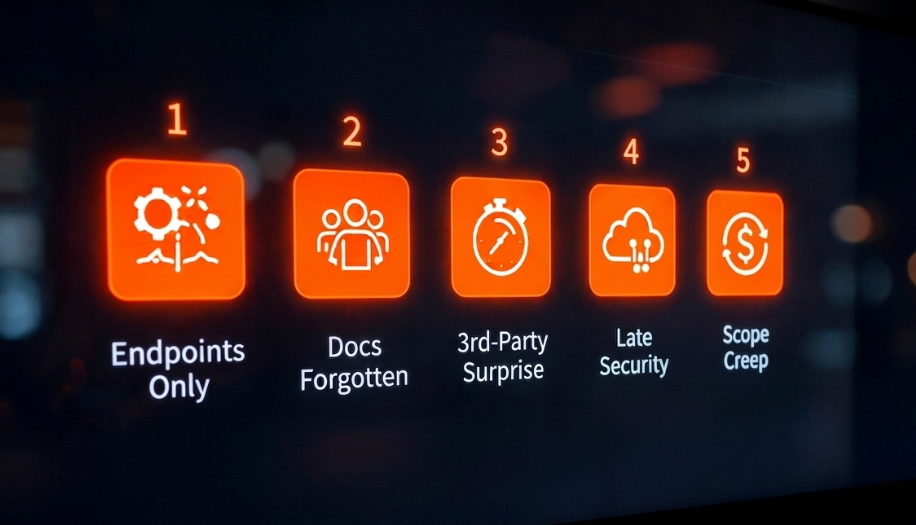
After delivering API projects across every industry and budget range, these are the five causes of overruns that come up most consistently. None of them are developer problems.
1. The scope was endpoints, not architecture
A list of 20 endpoints is not a technical specification. It is a starting point. Every endpoint implies decisions about data structure, error handling, authentication, and side effects that are not visible in the endpoint name. Projects scoped purely around endpoint counts almost always expand because the scope was incomplete from the start.
2. Documentation was not in the original brief
Developers quote what they are asked to build. If documentation is not mentioned, it is not included. Adding Swagger documentation after the fact to a 30-endpoint API is typically a week of work. Scoping it from the start takes the same amount of time but fits within the original budget instead of appearing as a change request.
3. Third-party integrations were underestimated
A payment gateway integration looks like 4 hours of work. It often takes 3 to 5 days when you factor in authentication setup, webhook handling, testing in sandbox and production environments, error states, and the inevitable quirks in the provider's documentation. Each integration is its own project.
4. Security requirements emerged during testing
Penetration testing or security review at the end of development often reveals issues that are expensive to fix retroactively. Rate limiting added after the fact requires restructuring request handling. Security headers added post-launch require deployment changes. Building these in from the start is a fraction of the cost.
5. Scope creep during development
Endpoints get added. Integrations get extended. The mobile team needs a slightly different response shape than the web team. Each change is small. The cumulative effect is a 40% scope increase that nobody explicitly approved. A formal change request process prevents this entirely.
How the Tech Stack and Team Structure Affect Your Cost
The biggest lever on API development cost is not the complexity of the endpoints. It is the combination of team location and the stack. Laravel API development with an offshore team from India through a verified partner typically costs 60 to 70% less than an equivalent project with a US-based team on the same stack. The output quality, when the vendor is properly vetted, is comparable.
Laravel (PHP) $22 to $55/hr offshore | $90 to $150/hr US |
Mature ecosystem, strong community, built-in tools for authentication (Sanctum, Passport), queues (Horizon), and API testing. Most SaaS product APIs built offshore use Laravel. Deep senior talent pool in India. |
Node.js $25 to $60/hr offshore | $95 to $160/hr US |
Strong choice for real-time APIs with WebSocket requirements. JavaScript across the stack reduces context switching if your frontend team is JS-heavy. Talent pool slightly narrower offshore at senior level. |
Python (Django/FastAPI) $28 to $65/hr offshore | $100 to $170/hr US |
Preferred for data-heavy APIs, ML-integrated endpoints, and data engineering pipelines. FastAPI in particular is gaining ground for high-throughput API services. Strong offshore talent base. |
For most product companies choosing between staff augmentation and a project-based engagement for API work, the model question comes down to how much the scope is likely to evolve. Fixed-scope APIs work well with project pricing. APIs where the endpoint list is still being defined work better with a time-and-materials model through a vetted vendor.
Need an API Quote That Actually Covers the Full Scope?
We have been building production APIs for 13 years across SaaS, fintech, e-commerce, and healthcare. When you ask us for a quote, we scope it the way it should be scoped: endpoint development plus authentication, rate limiting, error handling, documentation, and testing. No surprises mid-project. Tell us what you are building and we will come back with a realistic number within 48 hours.
How to Write an API Brief That Prevents Budget Surprises

The brief you send to a vendor determines the quality of the quote you get back. A brief that lists endpoints produces a quote that prices endpoints. Here is what to include instead.
Authentication requirements | Describe the user model. Does your API have multiple user types with different permissions? Does it need OAuth, SSO, or API key management? Are tokens session-based or long-lived? |
Third-party integrations | List every external service the API needs to connect to. Include the integration direction (inbound, outbound, or bidirectional) and whether webhooks are required. |
Expected request volume | An API expecting 100 requests per day is scoped differently from one expecting 100,000. Rate limiting, caching strategy, and infrastructure choices all depend on volume expectations. |
Client types | Is this API consumed by a mobile app, a web frontend, a partner integration, or all three? Different clients often need different response shapes or authentication approaches, which adds work. |
Documentation requirements | State explicitly whether you need Swagger documentation, Postman collections, or a developer portal. If you do not state it, it will not be in the quote. |
Versioning requirements | Do you expect the API to evolve? If yes, the architecture needs to support versioning from day one. Retrofitting this later costs significantly more. |
Security and compliance requirements | State any compliance requirements (GDPR, HIPAA, PCI) upfront. These have architecture implications that affect the full project scope. |
If this process feels like a lot before you have even started scoping, that is the point. A discovery workshop with the right team before scoping is cheaper than two rounds of change requests after work has started. Our vetting checklist for development companies covers what questions to ask before any project begins.
Ready to Scope Your API Project Without the Budget Surprises?
We are an Official Laravel Partner with 13 years of API delivery experience. Our quotes cover the full scope: endpoint development, authentication, rate limiting, error handling, documentation, and testing. Not just the endpoint list. Tell us what you are building and we will come back with a realistic scope and a honest timeline within 48 hours.
FAQ's
-
How much does it cost to build a REST API in 2026?
Depends on the scope, the stack, and where the team is located. A simple internal REST API with 5 to 15 endpoints, basic authentication, and minimal integrations costs $3,000 to $8,000 with an offshore team. A standard customer-facing API costs $10,000 to $25,000. A complex multi-tenant SaaS API costs $25,000 to $60,000. Enterprise-grade APIs with SLA requirements start at $40,000 and run higher. These are offshore rates. US-based teams cost 3 to 4x more at each tier.
-
What is typically not included in an API development quote?
Most API quotes cover endpoint development and basic validation. What is commonly excluded: authentication system, rate limiting, comprehensive error handling standards, versioning architecture, interactive documentation, third-party integration work, security hardening, performance testing, and post-launch maintenance. Always ask which of these is included before comparing quotes.
-
What is the difference between REST API and GraphQL API development cost?
REST API development is generally faster to scope and build for well-defined use cases. GraphQL takes more upfront architecture design but reduces over-fetching and under-fetching for complex query patterns. For most SaaS product backends, REST with thoughtful resource design is cheaper and more maintainable. GraphQL becomes the right choice when you have multiple client types with significantly different data requirements, such as a mobile app and a web app consuming the same backend.
-
How long does API development take?
A simple API takes 3 to 6 weeks. A standard customer-facing API takes 6 to 12 weeks. Complex APIs take 12 to 24 weeks. The biggest variable is not endpoint count but integration complexity and documentation requirements. Projects that front-load their technical discovery phase consistently deliver on time. Projects that skip discovery consistently extend their timeline by 30 to 50%.
-
Is offshore API development reliable in 2026?
Yes, when the vendor is properly vetted and the engagement has clear contract terms covering IP ownership, named developer assignment, and a performance replacement clause. The risk in offshore API development is not the developer's technical capability. It is the contract structure and the onboarding process. A developer joining your project without a clear README, undefined first task, and no standup process will struggle regardless of their skill level.
-
What should a change request process look like for an API project?
Any addition or change to scope that was not in the original brief should go through a written change request before work begins. The change request documents the scope addition, the estimated effort, and the additional cost. Nothing should be invoiced that was not pre-approved. This applies to endpoint additions, integration scope changes, authentication changes, and documentation format changes. Vendors who bill for scope changes without a pre-approval trail are a red flag.
-
Do I need to worry about API versioning from the start?
If you expect the API to be consumed by external clients or third parties, yes. If the API is internal and you control all consumers, you have more flexibility. The cost of planning versioning from the start is a few days of architecture work. The cost of retrofitting versioning to a live API with active consumers can be months of work plus managing a deprecation cycle. It is worth doing correctly the first time.
With over 11 years of experience in web application development and project management, I excel in leading cross-functional teams to deliver innovative digital solutions. My expertise spans eCommerce platforms, ERP systems, and JS & PHP-based frameworks, including WordPress, React JS, and Laravel. As a Technical Project Manager, I specialize in strategic planning, system design, and end-to-end project execution, transforming complex ideas into scalable, high-impact applications.
Table of Contents
Get Started with Acquaint Softtech
- 13+ Years Delivering Software Excellence
- 1300+ Projects Delivered With Precision
- Official Laravel & Laravel News Partner
- Official Statamic Partner
Related Reading
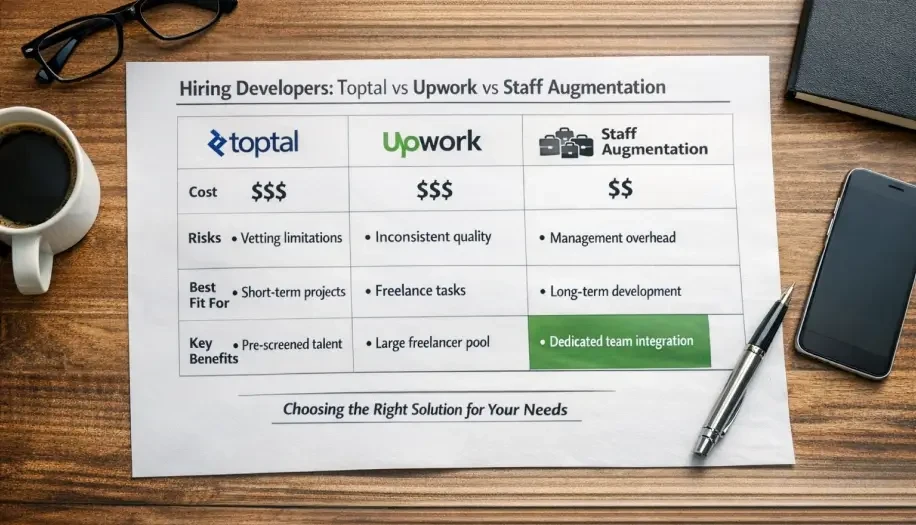
Toptal vs Upwork vs Staff Augmentation: An Honest CTO's Guide for 2026
Toptal, Upwork, and staff augmentation each solve a different problem. This honest vendor-side guide covers what each model actually costs, where each one breaks down, and which fits your situation.

Acquaint Softtech
March 16, 2026
Why Businesses Choose Laravel for Scalable Applications
Over 1.5M websites run on Laravel. See why companies trust Laravel development services for scalable SaaS, enterprise modernization, API integrations, and long-term maintainability.

Mukesh Ram
March 2, 2026
Onboarding Checklist for Remote Laravel Developers: Week 1, Month 1, Month 3
Most offshore engagements fail in Week 1, not Week 10. This checklist covers every onboarding step for remote Laravel developers: Week 1 setup, Month 1 integration, Month 3 performance.