

AWS CodePipeline vs GitHub Actions for SaaS: What a DevOps Engineer Recommends and Why
AWS CodePipeline and GitHub Actions both work on AWS. But they solve different problems. Here is the honest comparison and what a DevOps engineer recommends for SaaS startups in 2026.

Taukir katava
As a DevOps Engineer at Acquaint Softtech, a software development partner, most of the SaaS teams I work with are already on AWS. The CI/CD question for these teams is not GitHub Actions vs Jenkins vs GitLab CI. It is AWS CodePipeline vs GitHub Actions - two tools that both run natively on AWS but solve the problem from different directions. This guide covers exactly when each tool is the right choice, what implementation looks like, and what a DevOps engineer charges to set up either in 2026.

- SaaS CTOs on AWS deciding between CodePipeline and GitHub Actions for a new pipeline
- Engineering leads currently on GitHub Actions who are evaluating whether CodePipeline would serve them better at scale
- Teams who have been quoted different rates for each tool and want to understand the real cost difference
- Companies hiring a DevOps engineer and wanting to brief them on the CI/CD decision before the engagement starts
The CodePipeline vs GitHub Actions question come up in almost every AWS-based SaaS engagement I handle. Both tools integrate with AWS natively. Both can deploy to EC2, ECS, EKS, and Lambda. The difference is in the origin of the pipeline trigger, the depth of AWS-native integration, and where the complexity of managing the tool sits.
If your team is also evaluating Jenkins and GitLab CI alongside these two, the full CI/CD tool comparison guide covers all five options across eight dimensions. This article focuses specifically on the AWS-native comparison.
What Each Tool Actually Is
AWS CodePipeline
A fully managed continuous delivery service built into AWS. Pipelines are configured through the AWS Console, AWS CDK, or CloudFormation. Triggers come from AWS services: CodeCommit, S3, ECR, or third-party sources via CodeConnections (GitHub, Bitbucket). Each stage in the pipeline calls an AWS action: CodeBuild for compilation and testing, CodeDeploy for deployment, Lambda for custom steps.
Best for: Best for: Teams who want their entire CI/CD stack inside AWS with native IAM integration, CloudTrail auditability, and no external platform dependency. Also best for teams whose source code is in CodeCommit or who need to trigger pipelines from S3 or ECR events rather than Git commits.
GitHub Actions
A cloud-hosted CI/CD platform built into GitHub. Pipelines are YAML workflow files stored in the repository. Triggers are GitHub events: push, pull request, release, schedule. GitHub-managed runners execute the pipeline. AWS deployment is handled through official GitHub Actions for AWS (configure-aws-credentials, aws-actions/amazon-ecr-login, etc.).
Best for: Best for: Teams whose source code is on GitHub and who want the pipeline to live alongside the code in the same platform. Also best for teams with existing GitHub Actions expertise and teams who want to avoid the AWS Console for pipeline management.
Side-by-Side Comparison: 8 Key Dimensions
Here is the honest comparison across the dimensions that matter most for a SaaS team making this decision.
Dimension | AWS CodePipeline | GitHub Actions |
Pipeline config location | AWS Console / CloudFormation / CDK | YAML files in the repository |
Trigger source | AWS services: CodeCommit, S3, ECR, GitHub (via CodeConnections) | GitHub events: push, PR, release, schedule, manual |
AWS IAM integration | Native: pipelines assume IAM roles directly | Via OIDC: GitHub Actions federate with IAM roles |
Secrets management | Native AWS Secrets Manager and SSM Parameter Store | GitHub Secrets (or AWS Secrets Manager via action) |
Audit trail | CloudTrail logs every pipeline action automatically | GitHub Actions logs + CloudTrail for AWS calls |
Setup time | 3 to 6 days for a production pipeline | 1 to 3 days for a production pipeline |
Maintenance overhead | Low: AWS manages the platform | Low: GitHub manages the platform |
Cost model | Per pipeline action execution + CodeBuild minutes | Per runner minute beyond free tier |
For teams dealing with a slow pipeline regardless of which tool they choose, the deployment pipeline fix guide covers the root causes and the 30-day fix sequence. The tool rarely causes the slowness - pipeline design does.
Not Sure Which Tool Fits Your AWS Stack?
Tell Acquaint Softtech your source control platform, AWS services used, and current deployment frequency. A vetted DevOps engineer will recommend the right tool for your SaaS architecture and send a matched profile within 24 hours.
The Decision Framework: 4 Questions That Choose the Tool
Most SaaS teams on AWS land clearly on one tool after the first two questions. Run your situation through these four before briefing your DevOps engineer.
Q1: Where is your source code?
GitHub: GitHub Actions is the natural starting point. The integration is seamless, YAML lives in the repo, and setup is fastest. CodeCommit or S3-triggered pipelines: AWS CodePipeline is the native fit. Third-party Git (Bitbucket, GitLab): CodePipeline supports both via CodeConnections.
Q2: Do you need full AWS-native auditability?
Yes (compliance, SOC 2, regulated industries): CodePipeline gives you CloudTrail logging of every pipeline action with no additional configuration. GitHub Actions requires explicit CloudTrail setup for AWS calls. No specific audit requirement: both tools are appropriate and the decision moves to Q3.
Q3: How complex is your deployment target?
Standard ECS, EC2, or Lambda deployment: GitHub Actions with official AWS actions handles this cleanly. Complex multi-stage AWS deployments (CodeDeploy Blue-Green, Elastic Beanstalk, multi-account deployments): CodePipeline's native AWS action integrations simplify this significantly.
Q4: Who manages the pipeline going forward?
A DevOps engineer familiar with AWS Console and CloudFormation: CodePipeline is manageable. A developer team who prefers version-controlled YAML in the repository: GitHub Actions wins because the pipeline is code, reviewed and versioned like any other file in the project.
The full cost of setting up either pipeline from scratch, including what a DevOps engineer charges per tool, is in the CI/CD pipeline setup cost guide. This covers what is included in a production-grade implementation and what each tool costs to maintain ongoing.
What a DevOps Engineer Charges to Implement Each in 2026
The setup complexity differs between the two tools. Here are the honest 2026 numbers based on Acquaint Softtech DevOps engineers at $22/hour.
Item | AWS CodePipeline | GitHub Actions |
Setup time | 3 to 6 days | 1 to 3 days |
DevOps cost at $22/hr | $528 to $1,056 | $176 to $528 |
What is included | Pipeline stages, CodeBuild projects, IAM roles, CodeDeploy config, CloudWatch alarms | Workflow YAML files, AWS OIDC setup, secrets config, deployment jobs, status checks |
Ongoing maintenance | Low: managed by AWS | Low: managed by GitHub |
Cost at scale | Per action execution + CodeBuild minutes | Per runner minute beyond free tier |
Best deployment target | ECS, EC2, Lambda, CodeDeploy | ECS, EC2, Lambda, EKS, Kubernetes |
Acquaint Softtech's hire DevOps engineers service provides vetted engineers with production experience on both CodePipeline and GitHub Actions across SaaS, gaming, and media platforms. Matched profile within 24 hours.
For teams evaluating the DevOps engineer rate by region and seniority before engaging, the DevOps engineer cost guide covers the full 2026 comparison. Acquaint Softtech's starting rate is $22/hour for a DevOps engineer on a monthly retainer.
Know Which AWS CI/CD Tool You Need? Get a DevOps Engineer Who Has Implemented Both.
Taukir and the Acquaint Softtech DevOps team have implemented AWS CodePipeline and GitHub Actions pipelines across SaaS products, gaming platforms, and media infrastructure. Tell us your AWS stack, source control, and deployment target. Matched profile in 24 hours.
Migration: Switching Between the Two Tools
If you are already on one tool and wondering whether to switch, the migration decision deserve the same analysis as the initial selection. Here is the honest guidance for each direction.
GitHub Actions to AWS CodePipeline |
Makes sense when: Your compliance requirements need full AWS-native audit logging. Your team manages AWS infrastructure exclusively through CloudFormation or CDK and wants the pipeline to follow the same pattern. Migration effort: 3 to 5 days. Beware of: YAML workflows that use GitHub-specific features (github.event context, GitHub environment protection rules) that do not have direct CodePipeline equivalents. |
AWS CodePipeline to GitHub Actions |
Makes sense when: Your team prefers version-controlled pipeline configuration in the repository. Your pipeline triggers are exclusively Git events (push, PR) rather than AWS service events. Migration effort: 1 to 3 days. Easier direction: CodePipeline stage logic translates more cleanly to GitHub Actions YAML than the reverse. |
For teams whose cloud bill has grown alongside their pipeline infrastructure, the cloud cost audit guide covers what a DevOps engineer finds and fixes in the first 30 days. CodeBuild minutes and CodePipeline executions are among the AWS cost items that accumulate faster than teams expect.
For individual DevOps capacity on a monthly retainer, Acquaint Softtech's staff augmentation model provides a dedicated engineer in your standup in 48 hours.
For a vendor-managed DevOps function covering CI/CD and broader infrastructure, dedicated development teams covers the full team structure.
Ready to Implement Your AWS CI/CD Pipeline? Start in 48 Hours.
Acquaint Softtech DevOps engineers implement production-grade AWS CodePipeline and GitHub Actions pipelines in the first sprint. Starting at $22/hour. Matched profile in 24 hours. Engineer in your standup in 48 hours. Tell us your AWS stack and deployment target.
Frequently Asked Questions
-
Is AWS CodePipeline better than GitHub Actions?
Neither is universally better. CodePipeline is better when you need full AWS-native audit logging, your source is in CodeCommit, or your deployment targets are deeply AWS-specific (multi-account CodeDeploy). GitHub Actions is better when your source is on GitHub, you want pipeline configuration in the repository, and your team prefers YAML over the AWS Console.
-
Can GitHub Actions deploy to AWS as reliably as CodePipeline?
Yes. GitHub Actions uses AWS OIDC federation to assume IAM roles, removing the need for long-lived AWS credentials. Official GitHub Actions for ECR, ECS, and S3 handle the most common SaaS deployment patterns. The reliability difference between the two tools is negligible for standard SaaS deployments.
-
How much does AWS CodePipeline cost to run?
AWS charges $1 per active pipeline per month (free tier: 1 pipeline free). CodeBuild, which runs the build and test stages, charges per build minute: $0.005 per minute on general1.small. A pipeline running 20 builds per day at 5 minutes each costs approximately $15 per month in CodeBuild alone.
-
How long does it take to set up AWS CodePipeline?
A production-grade CodePipeline takes 3 to 6 days for a DevOps engineer. This includes pipeline stages, CodeBuild project configuration, IAM roles, CodeDeploy integration, and CloudWatch alarms. At Acquaint Softtech rates of $22/hour, this costs $528 to $1,056.
-
Can I use both CodePipeline and GitHub Actions together?
Yes. A common pattern is GitHub Actions for PR checks (unit tests, linting, security scans) and CodePipeline for production deployment (triggered by an ECR push or S3 artifact upload). This combines GitHub Actions' speed for developer feedback with CodePipeline's native AWS deployment integration.
-
What does Acquaint Softtech charge to implement GitHub Actions on AWS?
A production-grade GitHub Actions pipeline for an AWS deployment takes 1 to 3 days at $22/hour. Total cost: $176 to $528 for the implementation. This is typically absorbed into the first sprint of a monthly retainer engagement.
-
Which AWS CI/CD tool has a larger DevOps hiring pool?
GitHub Actions has the larger hiring pool in 2026. Most DevOps engineers working with AWS have implemented GitHub Actions. AWS CodePipeline experience is more AWS-specialist and commands a slight rate premium. Both tools have sufficient hiring depth that they should not drive the tool decision alone.
Taukir Katava is a DevOps Engineer at Acquaint Softtech with 4+ years of experience across AWS, Azure, and GCP. He specialises in Kubernetes cluster administration, CI/CD pipeline automation, and cloud infrastructure design for high-traffic platforms. Taukir writes about the practical side of production DevOps: what infrastructure decisions cost and what they actually deliver.
Table of Contents
Get Started with Acquaint Softtech
- 13+ Years Delivering Software Excellence
- 1300+ Projects Delivered With Precision
- Official Laravel & Laravel News Partner
- Official Statamic Partner
Related Reading

App Crashes Every Traffic Spike: The Infrastructure a DevOps Engineer Builds to Stop It
If your app crashes every time traffic spikes, the problem is infrastructure gaps, not code. Here is what a DevOps engineer diagnoses, builds, and delivers in the first 30 days.
Taukir katava
May 7, 2026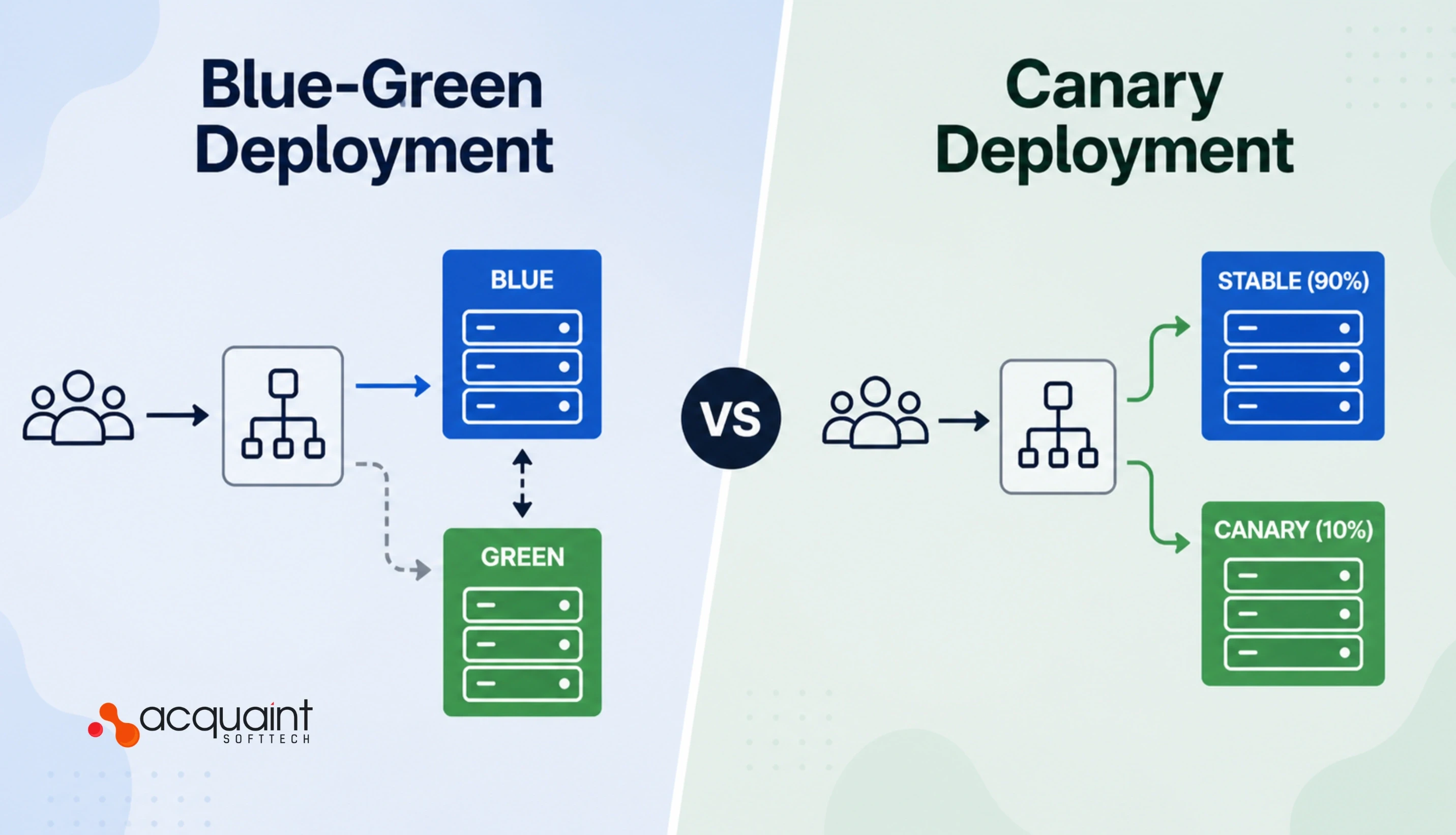
Blue-Green vs Canary Deployment: Which Strategy Does Your Platform Need and What Does It Cost?
Blue-Green gives instant rollback in seconds. Canary limits blast radius to 5% of users. The right deployment strategy depends on your platform's risk profile. Honest comparison with 2026 implementation costs.
Taukir katava
May 6, 2026
GitHub Actions vs Jenkins vs GitLab CI: Which CI/CD Tool Should You Hire a DevOps Engineer to Implement?
GitHub Actions, Jenkins, and GitLab CI each win in a different context. Here is the honest comparison from a DevOps engineer who has implemented all three in production, with the 5-question decision framework.
Taukir katava
May 5, 2026India (Head Office)
203/204, Shapath-II, Near Silver Leaf Hotel, Opp. Rajpath Club, SG Highway, Ahmedabad-380054, Gujarat
USA
7838 Camino Cielo St, Highland, CA 92346
UK
The Powerhouse, 21 Woodthorpe Road, Ashford, England, TW15 2RP
New Zealand
42 Exler Place, Avondale, Auckland 0600, New Zealand
Canada
141 Skyview Bay NE , Calgary, Alberta, T3N 2K6