

How Case-Study-Driven Planning Reduces Python Project Cost
Most Python projects run over budget because teams plan in a vacuum. Here is how case-study-driven planning cuts Python development costs, reduces scope creep, and protects timelines with real data.

Acquaint Softtech
Why Most Python Projects Spend More Than They Should Before a Line of Code Is Written
Most Python project budgets do not blow up during development. They blow up during planning, or more accurately, because of what planning failed to do.
A team scopes a Django SaaS platform, picks a timeline, staffs up, and starts building. Three months in, requirements shift. Stakeholders add features. Edge cases emerge that nobody modelled. A technical assumption made in week one turns out to be wrong, and fixing it at week twelve costs six times what it would have cost in week one. This is not bad luck. It is a pattern so consistent across software projects that multiple decades of research have produced numbers that should stop every technical leader in their tracks.
According to McKinsey and the University of Oxford, large IT projects run an average of 45% over budget, deliver 56% less value than predicted, and take 7% longer than planned. According to data compiled by Runn from PMI’s 2025 Pulse of the Profession research, just one in every 200 IT projects meets all three success measures simultaneously: on budget, on time, and delivering the intended benefits. Source: runn.io
The question worth asking is not why Python projects go over budget. That is well-established. The question is what separates the projects that do not. The answer, consistently, is better input at the planning stage, and the most useful planning input available to any Python development team is a documented case study from a comparable project that has already been through the fire.
This blog explains exactly how case-study-driven Python project planning works, what it protects against, where it saves real money, and how Acquaint Softtech applies it as a standard practice across every Python engagement.
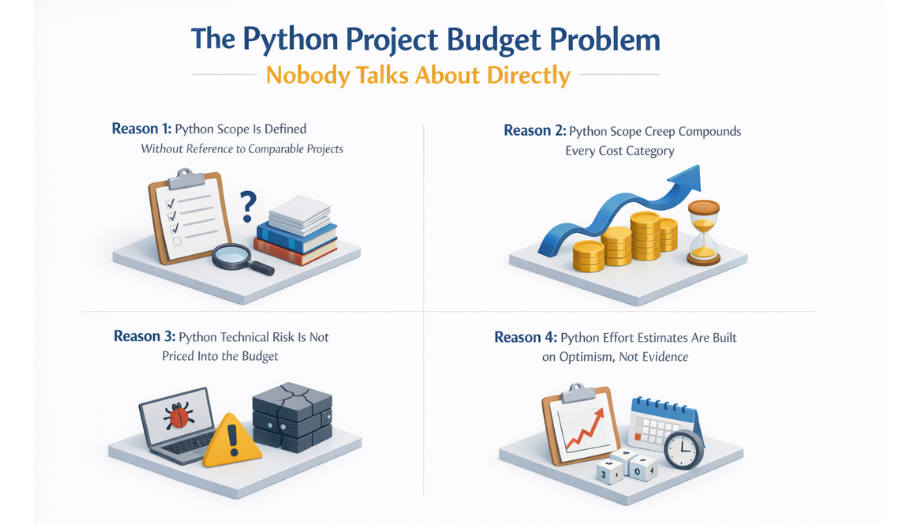
The Python Project Budget Problem Nobody Talks About Directly
Before getting into the solution, it is worth being precise about the problem.
Python projects fail their budgets for four reasons that recur with striking regularity across industries, geographies, and team sizes. They are not exotic. They are structural.
Reason 1: Python Scope Is Defined Without Reference to Comparable Projects
When a team scopes a new Python project, they are almost always working from requirements documents, stakeholder interviews, and educated guesses. What they rarely have is specific, documented insight into what a comparable Python project actually required, where the effort was underestimated, which integrations took longer than expected, and what architectural decisions created technical debt three months in.
On average IT projects overrun their budgets by 75%, extend timelines by nearly 50%, and deliver value that falls short by around 40%. Both McKinsey and BCG independently concluded that most cost overruns trace back to decisions made early in the project lifecycle, not during execution. The discovery and planning phase sets the cost trajectory.
A Python project scoped without reference to real prior-project data is being planned in a vacuum. The consequences are predictable.
Reason 2: Python Scope Creep Compounds Every Cost Category
According to the Project Management Institute’s Pulse of the Profession report, scope creep now affects 52% of projects, up from 43% five years ago. Studies cited by The Primestone Group put the average cost overrun on projects experiencing scope creep at 27%, with 85% of scope-creep-affected projects exceeding their initial budgets.
For Python specifically, scope creep takes a distinctive shape. Django ORM models that were not designed for multi-tenancy need to be redesigned when a multi-tenant requirement emerges in month two. FastAPI endpoints scoped for simple CRUD operations require authentication, rate limiting, and async processing when load requirements are raised mid-project. Data pipeline logic that was assumed to run on a weekly batch schedule needs real-time streaming when a business requirement changes. Each of these is a Python-specific scope expansion that a team with prior case study reference would have anticipated, scoped for, or priced contingency against upfront.
Reason 3: Python Technical Risk Is Not Priced Into the Budget
a disciplined, even marginally higher investment in the discovery and planning phases has an outsized impact on Total Cost of Ownership because it directly mitigates scope creep and technical debt, which are the primary drivers of budget overruns during the far more expensive development and maintenance phases.
Python technical risk includes framework choice (Django versus FastAPI versus Flask carries real cost implications at scale), database schema design (a poorly designed PostgreSQL schema on a Django project creates ORM query problems that compound with every new feature), dependency management (adding a library that conflicts with the existing stack costs sprint time to resolve), and deployment architecture (a Python application designed for single-server deployment that needs Kubernetes orchestration at scale requires significant rearchitecting).
None of these risks are invisible. They are all documented in case studies from projects that have already encountered them. Teams that do not read those case studies encounter them fresh, pay full price, and contribute another data point to the 70% of software projects that exceed their initial budget. Source: acquaintsoft.com/blog/software-development-budget-overruns-facts-statistics
Reason 4: Python Effort Estimates Are Built on Optimism, Not Evidence
IBM’s Rule of 100, applied to Python development, is straightforward: a bug or design flaw identified during planning costs approximately 1x to fix. The same issue identified during testing costs 10x to fix. Found in production, it costs 100x. Source: cloudqa.io
Effort estimates built on optimism rather than evidence from comparable Python projects systematically underestimate complexity in exactly the areas where the Rule of 100 multiplier is most punishing: database design, API architecture, and third-party integration logic. A team that has read detailed post-mortems from comparable Python projects estimates differently, budgets more accurately, and does not produce the kind of sprints where 30 to 50% of capacity is consumed by fixing what was built in the previous sprint. Source: cloudqa.io
What Case-Study-Driven Python Project Planning Actually Means

The term gets used loosely, so it is worth being specific about what it means in practice and what it does not mean.
Case-study-driven Python project planning does not mean copying a prior project’s architecture. It means using documented real-world project outcomes, technical decisions, cost drivers, and failure modes as a primary input to the scoping, estimation, and risk-assessment phases of a new Python project.
It operates through four concrete mechanisms.
Mechanism 1: Comparative Scope Calibration for Python Projects
Before finalising a Python project scope, a team with access to relevant case studies can answer questions that cannot be answered from requirements documents alone.
How long did authentication and authorisation implementation actually take on a comparable Python SaaS project? How many sprint cycles did a similar healthcare analytics Python platform spend on GDPR compliance work? What was the actual API integration overhead for a fintech Python platform connecting to payment processors and regulatory reporting systems?
These are not questions that can be answered with confidence from first principles on a new project. They can be answered from documented case studies. The difference between a scope built on those answers and a scope built without them is typically the difference between a 10% contingency buffer and a 40% budget overrun.
Mechanism 2: Technical Architecture Decision Reference for Python Builds
Python framework and architecture choices made early in a project carry cost consequences for months or years afterward. Django’s monolithic architecture suits some SaaS products and creates scaling bottlenecks for others. FastAPI’s async-native design is the right choice for high-throughput ML model serving but adds complexity overhead to simple CRUD applications. A PostgreSQL schema designed without multi-tenancy in mind must be rearchitected when multi-tenancy is introduced, typically at significant sprint cost.
Case studies document these architectural decision points, the context in which they were made, and what happened downstream as a result. A Python development team with access to that documentation makes different architecture choices at the beginning of a project. Those choices compound positively over the entire engagement, compressing rework, reducing technical debt, and protecting the sprint capacity that budget estimates assumed would be available for feature delivery.
Mechanism 3: Risk Identification from Python Project Post-Mortems
Every Python project that has been through a post-mortem process produces a list of what went wrong, when the team knew something was wrong, and what it cost to fix it at the point of discovery versus what it would have cost to prevent it at the planning stage.
These post-mortems are the most valuable planning input available to a new Python project team. They convert abstract risk categories (scope creep, technical debt, integration complexity) into specific, quantified incidents with known cost multipliers. A team that reads ten post-mortems from comparable Python projects enters the planning phase knowing which risks to price, which assumptions to challenge, and which integration points deserve a contingency buffer that the initial estimate does not reflect.
Mechanism 4: Realistic Python Timeline Benchmarking
According to Runn’s IT project management statistics research, projects that fail on budget also failed on time, with average schedule overruns of 46% on projects that also exceeded budget. Timeline optimism and budget optimism are correlated because they share the same root cause: estimation without reference to comparable project actuals.
Case studies provide the timeline actuals that make milestone planning realistic. A Python MVP that a team estimates at eight weeks typically takes twelve to fourteen when authentication, deployment infrastructure, QA cycles, and stakeholder review time are measured against prior project actuals rather than theoretical capacity. A team that builds its Python project timeline from case-study benchmarks produces milestones that survive contact with reality.
How the Bianalisi Python Case Study Changed What Future Healthcare Python Projects Cost
Acquaint Softtech completed a major Python healthcare analytics engagement for BIANALISI SPA, Italy’s largest integrated diagnostics group, between April and November 2025. The project involved building a GDPR-compliant predictive analytics platform using Python that cut reporting time by 75% and enabled earlier detection of diagnostic risk patterns across patient data.
The Bianalisi engagement is documented in full at acquaintsoft.com/blog/python-healthcare-analytics-bianalisi-case-study. What makes it relevant here is not just what was delivered, but what the documented process of delivering it revealed about planning.
What the Bianalisi Python Project Documented for Future Healthcare Builds
GDPR compliance architecture adds real sprint cost. Healthcare Python projects in the EU require GDPR-native data handling from the first line of code, not retrofitted at the end. On the Bianalisi project, this shaped the PostgreSQL schema design, the data access layer, the audit logging implementation, and the API security model. Teams scoping comparable Python healthcare projects without this documentation routinely underestimate compliance architecture cost and pay for it during development.
Diagnostic data pipeline complexity is front-loaded. The data ingestion and normalisation layer on a healthcare Python platform carries more complexity than teams typically estimate. The Bianalisi case documented the specific technical challenges of integrating heterogeneous diagnostic data formats, normalising patient records at scale, and building a real-time pipeline that maintained clinical accuracy. This is a reusable specification for future healthcare Python builds.
Python predictive analytics models require iterative calibration cycles. The machine learning components on the Bianalisi platform, built using Python’s scikit-learn and Pandas stack, required multiple calibration cycles against real diagnostic data before they produced clinically reliable trend detection. Teams that do not budget for calibration cycles in Python ML projects encounter them as unplanned sprint work. The Bianalisi post-mortem makes that budget line visible before the next project starts.
Team size scales non-linearly with healthcare domain complexity. The Bianalisi engagement required a 6 to 10 engineer team to manage the combination of Python ML development, GDPR compliance work, diagnostic data engineering, and clinical accuracy validation simultaneously. A smaller Python team on a comparable healthcare project would not have produced the same output at the same timeline. The case study provides a validated team-size reference for similar engagements.
Giovanni Gianolli, CEO of BIANALISI SPA, noted in the Clutch review that Acquaint Softtech demonstrated strong technical maturity and a deep understanding of the healthcare industry. The client became able to detect clusters of abnormal diagnostic trends earlier than expected.
That outcome is not replicable by accident. It is replicable by design when the planning process is informed by the documented experience of having done it before.
5 Practical Ways Case Studies Reduce Python Project Costs Before Development Starts
The value of case-study-driven planning is not theoretical. It maps to specific, quantifiable cost savings across five categories.
Cost Category | Without Case-Study Planning | With Case-Study-Driven Planning |
Scope accuracy | Requires multiple revision cycles | Calibrated against comparable project actuals |
Technical architecture risk | Discovered during development | Identified and addressed at planning stage |
Integration timeline | Consistently underestimated | Benchmarked against prior integration actuals |
Compliance cost (fintech, healthcare) | Retrofitted, expensive | Designed in from Day 1 |
Contingency buffer accuracy | Based on optimism | Grounded in documented risk frequency |
1. Python Scope Accuracy Reduces Change Order Volume
Every formal scope change on a fixed-price Python project triggers negotiation, delay, and rework. On a time-and-materials Python engagement, every unplanned scope expansion burns sprint capacity that was budgeted for feature delivery. Scope calibration against comparable project actuals reduces the frequency of both by surfacing the requirements that first-pass scoping consistently misses.
According to Agile framework research cited by MoldStud, implementing agile frameworks informed by iterative project data can cut project expenditures by approximately 20 to 30% through more targeted resource allocation and reduction in wasted effort. Case-study-grounded scope is a prerequisite for that efficiency.
2. Python Architecture Decisions Made Right the First Time Avoid Expensive Rewrites
The discovery and planning phases represent a small fraction of the total Python project budget but have an outsized impact on Total Cost of Ownership. The inverse is also documented: architecture decisions made incorrectly at the start of a Python project create technical debt that costs more to address with every sprint that builds on top of them.
A Django project that needs to become multi-tenant after launch, a FastAPI service that needs to add synchronous database access it was not designed for, a Python ML pipeline that needs to scale from batch to streaming, each of these rewrites is substantially more expensive than the architecture decision that would have prevented it. Case studies document exactly these scenarios, which makes them avoidable on subsequent projects.
3. Python Integration Complexity Is Priced Accurately Before the Sprint Plan Is Set
Third-party integrations are consistently one of the most underestimated cost categories in Python project planning. Payment gateway integrations, ERP connectors, healthcare data feeds, regulatory reporting APIs, each of these carries complexity that is not visible in the integration documentation but is visible in case studies from teams that have already built them.
A Python fintech platform that integrates with three payment processors and two regulatory reporting systems is not three times more complex than a platform that integrates with one. The complexity compounds as data formats diverge, error handling requirements multiply, and retry logic needs to account for the specific failure modes of each external system. Case studies from comparable Python fintech integrations surface these compounding factors before the sprint plan is locked.
4. Python Compliance Architecture for Fintech and Healthcare Is Not a Retrofit
Regulatory and compliance layers add 15 to 25% to overall Python project budgets in finance and healthcare. The difference between a compliance layer that is designed in from the start and one that is retrofitted after the core Python application is built is substantial. Retrofit compliance work typically costs two to three times as much as designed-in compliance because it requires touching code across multiple layers of the application.
Case studies from Python fintech and healthcare projects document which compliance requirements appeared later than expected, which data handling patterns required retroactive redesign, and what the sprint cost was of each compliance gap identified after development had started. A Python team that reads those case studies designs compliance from Day 1. The cost difference is real and large.
5. Python Contingency Buffers Are Sized by Evidence, Not Instinct
Most Python project budgets include a contingency buffer determined by instinct, convention (typically 10 to 15%), or negotiation. Case-study-driven planning replaces instinct with documented risk frequency. A team that has access to post-mortems from ten comparable Python projects can calculate what percentage of those projects encountered specific risk events (integration delays, compliance redesigns, infrastructure scaling requirements, third-party API failures) and size their contingency buffer accordingly.
Large projects without evidence-based contingency planning run up to 80% over budget when early estimates miss hidden costs. A 10% contingency on a Python project with documented integration complexity risk is not a contingency. It is false comfort. Case studies make the right number visible.
How Acquaint Softtech Uses Case-Study-Driven Planning on Python Projects
Acquaint Softtech applies case-study-driven planning as a standard practice across every Python engagement, not as a premium add-on or a discovery workshop upsell.
The process works as follows. Before any Python project scope is finalised or any engagement model is agreed, the Acquaint Softtech team reviews documented outcomes from comparable prior Python projects, specifically matching on industry, technology stack, integration complexity, and compliance requirements. The relevant case study findings are used to calibrate scope, identify technical risk categories that require explicit contingency, benchmark integration timelines, and validate the team size and composition required to deliver the project reliably.
This is possible because Acquaint Softtech has delivered 1,300+ Python projects globally across fintech, healthcare, SaaS, e-commerce, real estate, and AI-driven platforms. That project history is not a marketing credential. It is a planning library. Each engagement produces documented technical decisions, timeline actuals, integration complexity benchmarks, and compliance architecture patterns that directly inform the next comparable engagement.
The result is visible in the numbers. Clients consistently report delivery that meets or exceeds timeline expectations. The 40% cost savings versus US in-house Python hiring is not solely a rate advantage. It is also a planning advantage: projects scoped with reference to comparable project actuals require fewer change orders, less rework, and fewer sprint cycles spent on problems that could have been anticipated.
Read the complete Bianalisi healthcare Python case study at acquaintsoft.com/blog/python-healthcare-analytics-bianalisi-case-study and explore the full range of Python delivery examples across industries at acquaintsoft.com/case-studies.
Acquaint Softtech: Python Development with Case-Study-Grounded Planning
Acquaint Softtech is headquartered in Ahmedabad, India, with 13 years of Python software delivery experience, 1,300+ projects completed globally, and verified five-star ratings across Clutch (35+ reviews) and Upwork (1,293+ reviews, 98% job success rate).
Every Python engagement at Acquaint Softtech is built on a 100% in-house team. No freelancers, no subcontractors, no marketplace matches. Every Python engineer is assessed through multi-stage technical evaluation before any client engagement. Every engagement includes a full NDA and IP assignment from Day 1, free developer replacement with complete context handover, and 48-hour onboarding from requirements to sprint-ready.
Python Project Pricing at Acquaint Softtech (2026)
Engagement Model | Rate | Best For |
Part-Time / Hourly | From $22/hr (up to 4 hrs/day) | Focused Python features, audits, bug fixes |
Full-Time Dedicated Python Developer | $3,200/month (176 hrs) | Continuous Python product development |
Fixed-Price Python Project | From $5,000 | Well-scoped Python MVP or platform build |
For Python projects where scope accuracy and cost predictability matter, the case-study-driven planning process starts before the engagement model is agreed. Share your Python project requirements at acquaintsoft.com/contact-us and get a scoping conversation grounded in relevant project actuals, not first-principles estimation.
Python Technology Stack at Acquaint Softtech
Frameworks: Django, FastAPI, Flask, Django REST Framework
AI and ML: TensorFlow, PyTorch, scikit-learn, Keras, Pandas, NumPy, LangChain
Databases: PostgreSQL, MySQL, MongoDB, Redis
Cloud: AWS, GCP, Azure, Docker, Kubernetes
DevOps: GitHub Actions, Jenkins, Terraform, Ansible
Frontend: React, Next.js, Vue.js
Conclusion: Why the Cheapest Python Project Is One That Was Planned with Real Evidence
The 45% average budget overrun on IT projects documented by McKinsey and Oxford is not a mystery. It is the predictable outcome of planning processes that rely on optimism, convention, and first-principles estimation instead of evidence from comparable prior projects.
Case-study-driven Python project planning is not a methodology or a framework. It is a discipline of using what has already been learned on comparable Python projects as the primary input to scope, architecture, timeline, and risk decisions on the next one. IBM’s Rule of 100, the PMI’s scope creep data, AgileEngine’s cost breakdown research, and McKinsey and BCG’s consistent finding that planning phase decisions determine project cost outcomes all point to the same conclusion: the cheapest Python project is the one that was planned with the most accurate information, not the one with the lowest quoted rate.
Acquaint Softtech brings 1,300+ documented Python project outcomes to every new engagement. That history is the planning input that closes the gap between the quoted cost and the real one.
Read the Bianalisi healthcare Python case study to see what case-study-grounded Python delivery looks like in a regulated industry. Explore Python development services for engagement model detail, read about Python project cost models, and see all case studies for delivery examples across industries.
Planning a Python project and want cost accuracy before development starts?
Acquaint Softtech brings 1,300+ completed Python project outcomes to every scoping conversation. Get a planning discussion grounded in real project actuals, not guesswork.
Frequently Asked Questions
-
How does case-study-driven planning actually reduce Python project costs?
Case-study-driven Python project planning reduces costs through five mechanisms: more accurate initial scope calibration against comparable project actuals, which reduces change order volume; earlier identification of technical architecture risks that become expensive to fix later; accurate integration complexity pricing based on documented prior integration timelines; designed-in compliance for Python fintech and healthcare projects rather than retrofitted compliance; and evidence-based contingency buffers sized to documented risk frequency rather than convention. McKinsey and BCG both concluded that most Python project cost overruns trace back to decisions made in the planning phase, not during execution. Better planning inputs produce better financial outcomes.
-
What is scope creep and how does it affect Python project budgets?
Scope creep is the uncontrolled expansion of a Python project’s requirements or deliverables after development has started, without corresponding adjustments to budget, timeline, or resources. According to PMI’s Pulse of the Profession research, scope creep now affects 52% of projects and has been rising steadily. Studies put the average budget overrun on scope-creep-affected projects at 27%, with 85% of those projects exceeding their initial budgets. For Python projects specifically, scope creep often emerges at the framework and architecture level: a Django application that was not designed for multi-tenancy, a FastAPI service that needs streaming added mid-project, or a Python ML pipeline that needs production-grade monitoring that was not in the initial scope. Case-study-driven planning surfaces these patterns before the sprint plan is locked.
-
How does Acquaint Softtech use its project history to reduce Python development costs for clients?
Acquaint Softtech has delivered 1,300+ Python projects globally across fintech, healthcare, SaaS, real estate, and AI platforms. Before finalising any Python project scope, the team reviews documented outcomes from comparable prior engagements, calibrating scope against real project actuals, identifying technical risk categories from post-mortems, and benchmarking integration timelines against prior comparable integration work. This process replaces first-principles estimation with evidence-based planning and directly reduces the frequency of the scope changes, rework cycles, and integration surprises that drive Python project cost overruns.
-
Why do most Python project budget estimates fail?
The research is consistent: IT project estimates fail because they are built on optimistic assumptions rather than evidence from comparable prior projects. McKinsey and Oxford found that large IT projects run an average of 45% over budget and deliver 56% less value than predicted. AgileEngine’s 2025 analysis confirmed that most cost overruns trace back to decisions made during the discovery and planning phase. For Python projects specifically, the most common estimation failures are underestimating integration complexity, not pricing compliance architecture for regulated industries, failing to plan for iterative calibration cycles in ML projects, and not accounting for the non-linear complexity growth that occurs when requirements are added mid-project.
-
What types of Python projects benefit most from case-study-driven planning?
Python projects that carry the highest planning risk and therefore benefit most from case-study-driven planning are healthcare and fintech Python platforms (where compliance architecture must be designed in from Day 1), Python AI and ML systems (where calibration cycles and data pipeline complexity are consistently underestimated), multi-tenant Python SaaS platforms (where schema design decisions made early create expensive technical debt if wrong), and Python projects with multiple third-party integrations (where integration complexity compounds non-linearly and is difficult to estimate without prior actuals). These are also the project types where Acquaint Softtech’s 1,300+ project history provides the most concentrated planning input, because they represent the core of the delivery portfolio.
-
How does Python technical debt affect project costs over time?
Python technical debt accumulates when architecture decisions made early in a project trade short-term delivery speed for long-term maintainability. A Django ORM model designed without considering query optimisation creates database performance problems as data volume grows. A FastAPI service without proper async handling creates concurrency bottlenecks under load. A Python ML pipeline without monitoring creates model drift that surfaces in production. IBM’s Rule of 100 establishes that fixing these issues in production costs approximately 100 times more than addressing them during design. Case-study-driven planning surfaces the specific Python architecture decisions that most frequently produce technical debt on comparable projects, making them avoidable rather than inevitable.
-
What is the discovery workshop process at Acquaint Softtech for Python projects?
Acquaint Softtech’s discovery workshop for Python projects is a structured engagement that takes client requirements through comparative scoping against relevant prior project data, technical architecture risk assessment, integration complexity benchmarking, compliance requirement identification, and team composition planning. It produces a documented scope, a risk-calibrated timeline, an evidence-based contingency budget, and a validated team structure before the development engagement begins. This process is available as a standalone engagement for teams that want planning-level confidence before committing to a full Python development budget.
-
How do I reduce scope creep risk on a Python SaaS platform build?
Reducing scope creep risk on a Python SaaS platform build requires four things: a tightly documented initial scope with explicit exclusions listed alongside inclusions, a formal change control process where every new requirement is evaluated for impact on budget and timeline before approval, architecture decisions made with multi-tenancy and scalability in mind from Day 1 rather than retrofitted later, and a planning process grounded in comparable project actuals rather than first-principles estimation. Acquaint Softtech’s Python SaaS delivery process incorporates all four as standard practice. See Python development services for the full delivery model and read about the dedicated Python development team model for ongoing SaaS platform development where scope evolution is expected.
We’re Acquaint Softtech, your technology growth partner. Whether you're building a SaaS product, modernizing enterprise software, or hiring vetted remote developers, we’re built for flexibility and speed. Our official partnerships with Laravel, Statamic, and Bagisto reflect our commitment to excellence, not limitation. We work across stacks, time zones, and industries to bring your tech vision to life.
Table of Contents
Get Started with Acquaint Softtech
- 13+ Years Delivering Software Excellence
- 1300+ Projects Delivered With Precision
- Official Laravel & Laravel News Partner
- Official Statamic Partner
Related Blog

The Complete Guide to Hiring Python Developers in 2026: Rates, Models, Vetting and Red Flags
A complete guide to hiring Python developers in 2026. Compare real hourly rates across India, Eastern Europe and the US, choose the right engagement model, vet candidates correctly, and avoid the red flags that cost companies months of wasted budget.
Acquaint Softtech
March 4, 2026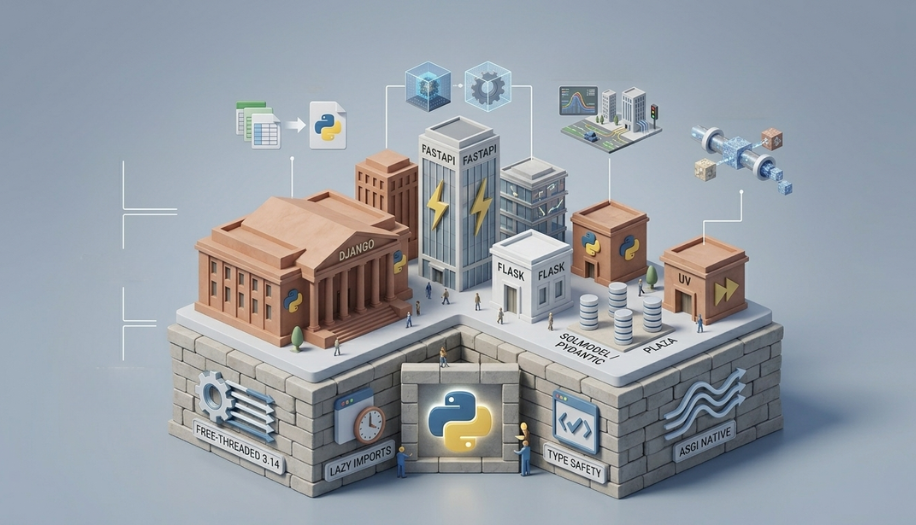
Python Development in 2026: Architecture Patterns, Frameworks and Real-World Industry Applications
Explore Python backend architecture patterns, framework comparisons (Django vs FastAPI vs Flask), scalability decisions, and real-world Python development use cases across healthcare, FinTech, SaaS, EdTech, and logistics in 2026.
Acquaint Softtech
March 4, 2026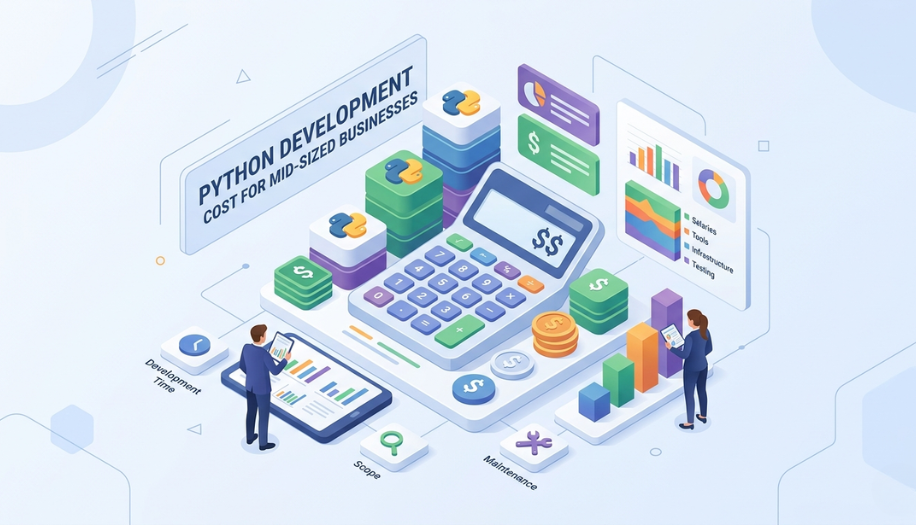
Python Development Cost for Mid-Sized Businesses: The 2026 Complete Breakdown
Discover what Python development really costs mid-sized businesses in 2026. Fixed price vs dedicated team vs staff augmentation, real data, regional rates, hidden costs, and Acquaint Softtech pricing from $18/hr.
Acquaint Softtech
March 17, 2026Your Project. Our Expertise. Let’s Connect.
Get in touch with our team to discuss your goals and start your journey with vetted developers in 48 hours.