

The Complete Guide to EdTech Software Development in 2026
Complete guide to EdTech software development in 2026. LMS architecture, virtual classroom tech stack, AI tutoring system design, MVP timeline, and cost.

Acquaint Softtech
What is EdTech software development in 2026? EdTech software development is the end-to-end engineering of platforms that track the learner journey: enrollment, course delivery, assessment, and credentialing. In 2026, a working EdTech platform combines a Learning Management System (LMS) with at least one adjacent module, typically a virtual classroom or an AI tutor. At Acquaint Softtech, fixed-project MVP development starts from $5,000, while the final cost depends on the project scope, features, and requirements. A small EdTech MVP typically takes 5 to 6 months, with the overall cost varying based on the team size and complexity. |

- EdTech founders deciding between custom LMS and off-the-shelf platforms.
- Product teams building virtual classrooms, AI tutoring, or assessment systems.
- CTOs evaluating tech stacks and EdTech development partners.
- Education leaders setting up long-term digital learning and vendor programs.
At Acquaint Softtech, with over 1,300 projects delivered across 13 years, we have watched the same mistake play out at more than 40 online learning platforms: treating EdTech like content hosting, then discovering that the real product is the accountability layer, not the video player.
By then, launch is slipping, assessments are misfiring, and learner drop-off has crossed 40 percent. This complete guide is the operator's view of EdTech software development in 2026, covering every question a founder, CTO, or Head of Product should answer before scoping a build, and it is anchored in our custom software product development services for online learning platforms.
The categories in this space (LMS, Learning Experience Platform or LXP, course marketplace, virtual classroom, and AI tutor) get used interchangeably in founder conversations and then drift apart fast in architecture. Part of why the confusion persists is that the underlying interoperability standards themselves evolved in stages. The US Department of Defense's ADL Initiative published SCORM in 2000 and xAPI in 2013, and most teams scoping an LMS today still mix up what each one actually covers.
This guide defines each category and walks the full build path: what goes into the LMS core, what the virtual classroom stack looks like, where AI tutoring actually helps versus hallucinates, the best tech stack for learning platforms in 2026, how long an EdTech MVP takes, what it costs in India versus the US and Europe, and how to decide between hiring, outsourcing, and a custom LMS partnership. The patterns come from engagements like Good2Know (an automotive knowledge platform) and ASQS (an aviation training and audit platform).
What Is EdTech Software? A Grounded Definition for 2026
EdTech software is the category of systems that handle the accounting of learning. It tracks who enrolled, what they attempted, how they scored, what they mastered, and what credential the outcome produced. It is not a content library with a login screen. The defining characteristic of EdTech software in 2026 is that it owns the relationship between a learner, a course, an assessment, and an outcome in a single auditable record.
Most first-time buyers ask how they can host videos and PDFs for their students. That framing produces a website, not a platform. A website cannot prove anything to a regulator, an auditor, an employer, or an accreditation body. EdTech software can, and that distinction is why the category exists as a separate discipline in software engineering.
The four accountability layers that define EdTech software
Enrollment and identity:
A persistent learner record created through a Student Information System (SIS) sync, a Human Resource Information System (HRIS) feed, a parent-initiated K-12 account, or a self-signup. Every downstream event ties back to this record.
Course structure and delivery:
A course is a versioned tree of learning objects: videos, PDFs, Shareable Content Object Reference Model (SCORM) packages, quizzes, assignments, and live sessions. The platform defines the tree, serves the nodes in order, and records completion on each.
Assessment and grading:
The engine that generates attempts from question banks, time-boxes them, grades automatically where possible, routes manual grading where needed, and produces a score record that stands up to a dispute.
Credentials and reporting:
A signed certificate or Open Badges 3.0 digital badge, an immutable credential record, a verification URL a third party can hit, and compliance rollups for administrators.
If your platform cannot answer "who learned what, when, and with what score," it is content hosting, not EdTech. |
This definition is also the basis for our scoping method inside every product discovery workshop for an LMS build, because the four layers above determine every downstream architectural decision.
Education Technology Market 2026: Where Demand Is Concentrated
Before scoping a platform, founders need a sense of where the education technology market is heading in 2026. The global EdTech market has moved past the post-pandemic correction and is growing again, but unevenly. Corporate learning is expanding faster than consumer upskilling. K-12 digital spend is shifting from pandemic tooling to permanent infrastructure. Higher education is catching up on learner analytics and hybrid delivery. AI-assisted learning has emerged as a new line item that barely existed two years ago.
EdTech development demand by segment (illustrative share, 2026)
Corporate Learning | ██████████████████████████████████ | ~32% |
K-12 Digital | █████████████████████████ | ~24% |
Higher Education | ███████████████████ | ~18% |
Test Prep & Tutoring | ████████████ | ~12% |
Consumer Upskilling | █████████ | ~9% |
AI-Assisted Learning | █████ | ~5% |
What each EdTech segment actually buys
Corporate learning:
Compliance training platforms, onboarding LMS, certification tracking, and AI skill development. Buyers are HR and L&D leaders. Non-negotiables: SCORM/xAPI, HRIS sync, audit-ready reporting.
K-12 digital:
Classroom management, parent portals, adaptive learning, and Children's Online Privacy Protection Act (COPPA) compliant content delivery. Buyers are school districts and private institutions. Family Educational Rights and Privacy Act (FERPA) compliance is table stakes.
Higher education:
Canvas and Moodle replacements, cohort-based degree platforms, proctored assessment engines, Learning Tools Interoperability (LTI) integrations, and accreditation reporting. Buyers are CIOs and Directors of Digital Learning.
Test prep and tutoring:
Adaptive question banks, diagnostic assessments, one-to-one tutoring platforms, and mobile-first learner apps. Buyers are founders of exam-prep startups and private tutoring chains.
Consumer upskilling:
Course marketplaces, subscription platforms, Coursera-style products, instructor payouts, recommendation engines. Buyers are consumer EdTech founders and venture-backed teams.
AI-assisted learning:
AI tutoring, automated grading, adaptive learning paths, and Retrieval Augmented Generation (RAG) over course content. Buyers are existing EdTech platforms adding AI as a layer, plus a small cohort of AI-first learning startups.
The segment choice drives nearly every downstream decision. A corporate compliance LMS and a K-12 classroom tool share maybe 40 percent of their codebase. The rest is segment-specific logic, which is why we start every engagement with explicit segment scoping inside our software product engineering services for an LMS.
Types of Learning Platforms: The 7 Categories EdTech Builders Must Understand
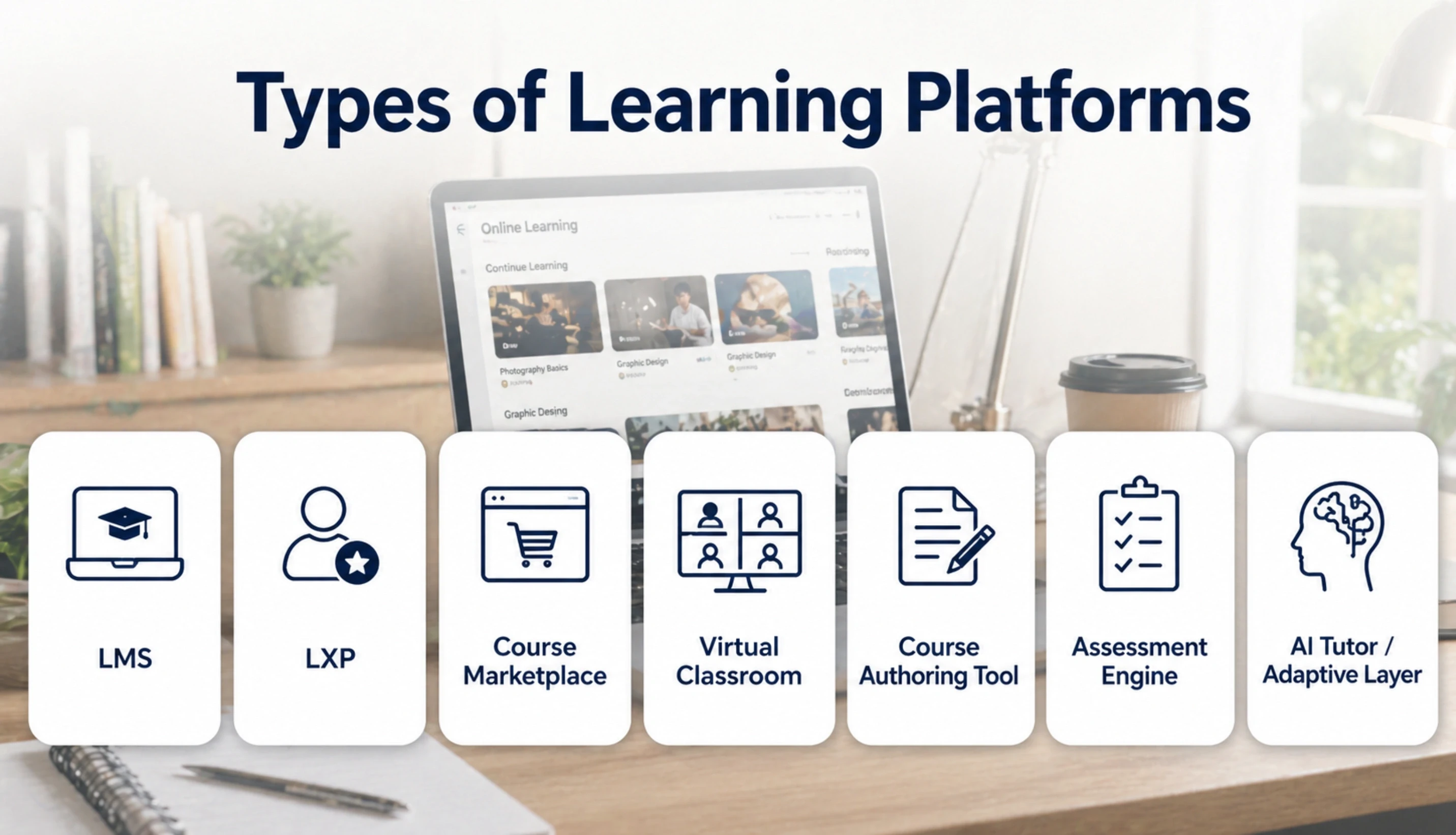
The seven types of learning platforms below dominate the EdTech space in 2026. Each has a different data model, a different core user, and a different development cost profile. Most real products are a hybrid of two categories, never three. The single most expensive scoping mistake is trying to build all seven at once.
Category | Primary purpose and core user | Closest analog and integration hotspots |
LMS | Track completion, assessment, and compliance for a closed learner group. The core user is the administrator; the instructor is second. | Moodle, Canvas, TalentLMS. Integrations: SIS, HRIS, SSO, SCORM, xAPI, LTI. |
LXP | Surface and recommend content based on learner interest and skill gap. The core user is the self-directed professional. | Degreed, EdCast, 360Learning. Integrations: content APIs, skill graphs, HRIS. |
Course Marketplace | A two-sided marketplace where instructors publish, and consumers buy. The core user is the paying consumer, and the instructor is the seller. | Udemy, Coursera, Skillshare. Integrations: Stripe, tax, payouts, reviews, and affiliate. |
Virtual Classroom | Deliver live synchronous lessons with video, chat, whiteboard, and polling. The core user is the live session participant. | Zoom LTI, BigBlueButton, Engageli. Integrations: WebRTC, calendars, and recording storage. |
Course Authoring Tool | Create SCORM or xAPI-compliant content, interactive video, and branching scenarios. The core user is the instructional designer. | Articulate 360, Rise, iSpring, Adapt. Integrations: media storage, LMS SCORM push. |
Assessment Engine | Deliver proctored, timed, banked assessments with auto-grading and analytics. The core user is the exam administrator. | Questionmark, ExamSoft, ProctorU. Integrations: question banks, proctoring APIs, and LMS results push. |
AI Tutor / Adaptive Layer | One-to-one personalised learning, hints, feedback, adaptive sequencing using Large Language Models (LLMs) over course content. The core user is the individual learner. | Khanmigo, Duolingo Max. Integrations: OpenAI or Anthropic APIs, RAG over content, guardrails. |
The prose summary for extraction: an LMS is accountability, an LXP is discovery, a course marketplace is transactions, a virtual classroom is live sessions, a course authoring tool is content creation, an assessment engine is testing, and an AI tutor is personalisation. Most real products combine an LMS with one or two of the other six categories.
LMS Architecture and Features: The Non-Negotiable Core of Every EdTech Build
The LMS is the spine of most EdTech platforms. Even an AI-tutoring product usually sits on top of an LMS that holds ai courses, enrollments, and progress. Skimping on LMS architecture compounds in every module downstream. The minimum viable architecture has six layers that must be present from day one.
What features does an LMS need? (PAA answer, extractable)
A launchable LMS needs six architectural layers: identity and role management with SSO, SIS, and HRIS support; a versioned course and content model compatible with SCORM and xAPI; an enrollment and progress engine with cohort support; an assessment and grading engine with auto-grading and rubric-based manual grading; a credential and compliance layer issuing signed certificates and Open Badges 3.0 digital badges; and an analytics and reporting layer driving learner, instructor, and administrator dashboards. Everything else (gamification, AI tutoring, social features) is additive.
The 6 architectural layers, unpacked
Identity and role layer
Handles learner, instructor, administrator, parent, and reviewer roles with granular permissions. Integrates with Single Sign-On (SSO) providers, SIS, and HRIS. Every action is attributed to a role, and every audit query starts here.
Course and content model
Stores courses as versioned trees of modules and lessons. Supports SCORM 1.2, SCORM 2004, xAPI (also known as Tin Can API), and native content. Learners are pinned to a specific course version on enrollment so content changes do not silently alter an in-flight learner experience.
Enrollment and progress engine
Supports self-signup, admin-assigned, cohort-based, and bulk enrollment via SIS or HRIS sync. Tracks progress at the lesson, activity, and second level on video. Drives at-risk learner flagging and prerequisite enforcement.
Assessment and grading engine
Generates attempts from question banks, supports timed and proctored modes, handles auto-grading and rubric-based manual grading, and produces audit-ready score records with full attempt history. The most under-scoped module in first-time builds.
Credential and compliance layer
Issues certificates and Open Badges 3.0 digital credentials, stores them immutably, and exposes a verification URL for third-party checks. For regulated training, it maintains a compliance audit trail with course version, score, and issuance date.
Analytics and reporting layer
Feeds three dashboards: learner self-progress, instructor engagement and at-risk signals, and administrator licence utilisation and compliance. Stored in a separate reporting database, so heavy queries do not slow the transactional platform.
The six layers above are the baseline for every custom LMS development engagement for learning platforms we run. Features on top of the six are scoped case by case, but the six themselves are not negotiable, and we will push back during discovery if a prospect tries to skip one.
Virtual Classroom Tech Stack: How to Deliver Live Learning at Scale
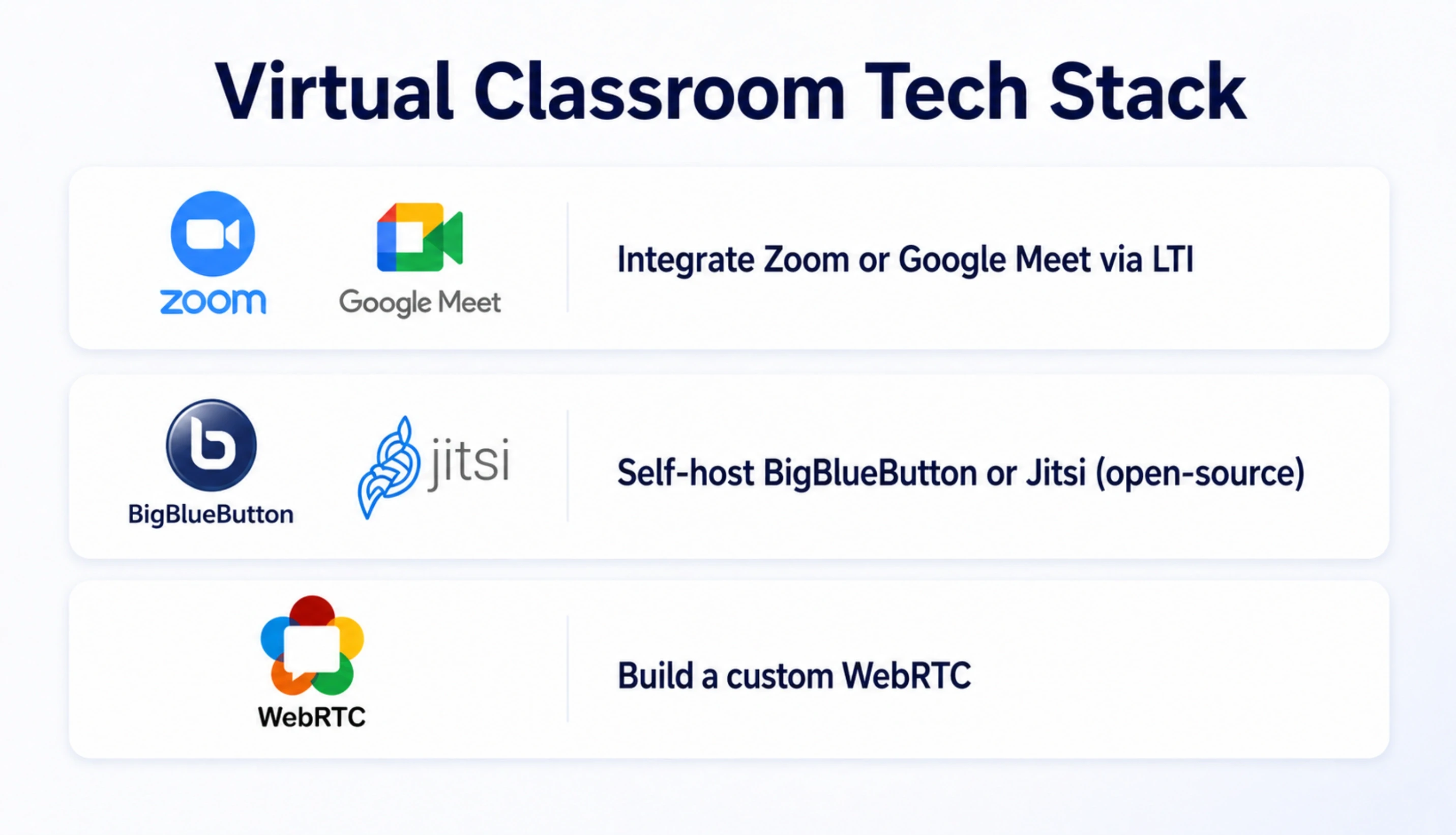
A virtual classroom is a real-time synchronous delivery system. Its architectural constraints are nothing like an LMS: it trades database consistency for real-time video performance, and lives or dies on latency, jitter, and concurrency. The first decision for any founder scoping a virtual classroom tech stack is whether to build from scratch or integrate an existing service.
The 3 viable paths for a classroom tech stack
Path | What you actually do | Best fit | Typical add-on cost |
Integrate Zoom or Google Meet via LTI | Embed existing video conferencing into the LMS via Learning Tools Interoperability (LTI). Minimal development. | Corporate training, higher education, K-12. | 4 to 6 weeks of integration work. Plus Zoom or Meet licences. |
Self-host BigBlueButton or Jitsi (open-source) | Self-host BigBlueButton on your own infrastructure, branded inside the LMS. | Budget-conscious builds, regional data residency needs. | 6 to 10 weeks plus ongoing DevOps for media servers. |
Build a custom WebRTC | Build a live session product on WebRTC plus a Selective Forwarding Unit (SFU) like mediasoup or LiveKit. | EdTech products where the live session is the product, not a feature. | 16 to 24 weeks. Heavy DevOps cost at scale. |
5 components every virtual classroom must get right
Adaptive bitrate and graceful degradation. If the learner's bandwidth drops, the session falls back to audio-only, not a frozen screen.
Session recording pipeline. Automated recording, server-side transcoding, S3 storage, and automatic attachment to the course lesson within 15 minutes of session end.
Attendance and engagement tracking. Join/leave events, time-in-session, chat messages, poll responses, and hand-raise activity are all linked to the learner's LMS record.
In-session interactivity. Whiteboard, breakout rooms, polls, quizzes, and shared document collaboration. Table stakes for K-12 and corporate live training.
Recording-to-transcript pipeline. Automatic transcription (Whisper or AssemblyAI), searchable transcripts, and chapter markers aligned with course lesson breaks.
For platforms that want live sessions without the operational load of running media servers, our default recommendation is Zoom via LTI, plus a custom attendance and recording pipeline. That gets 80 percent of the value at 20 percent of the cost. The architectural guidance is part of our dedicated software development team for an EdTech build.
Scoping an LMS or a Virtual Classroom Build?
Share your learner volume, segment, and integration list, and Acquaint Softtech will send a team structure, a phased timeline, and a fixed monthly cost within 48 hours. You interview every engineer before the engagement starts. No engagement begins without your explicit sign-off on the team and the plan.
AI Tutoring System Design: What Works, What Hallucinates, What Scales
AI tutoring is the most hyped and least understood module in EdTech in 2026. The common assumption is that wrapping a Large Language Model (LLM) around a course library produces a tutor. It does not. It produces a confident chatbot that will cheerfully invent answers, misquote the curriculum, and credit learners for mastery they never demonstrated. A real AI tutoring system design is an engineered system with grounding, evaluation, and guardrails.
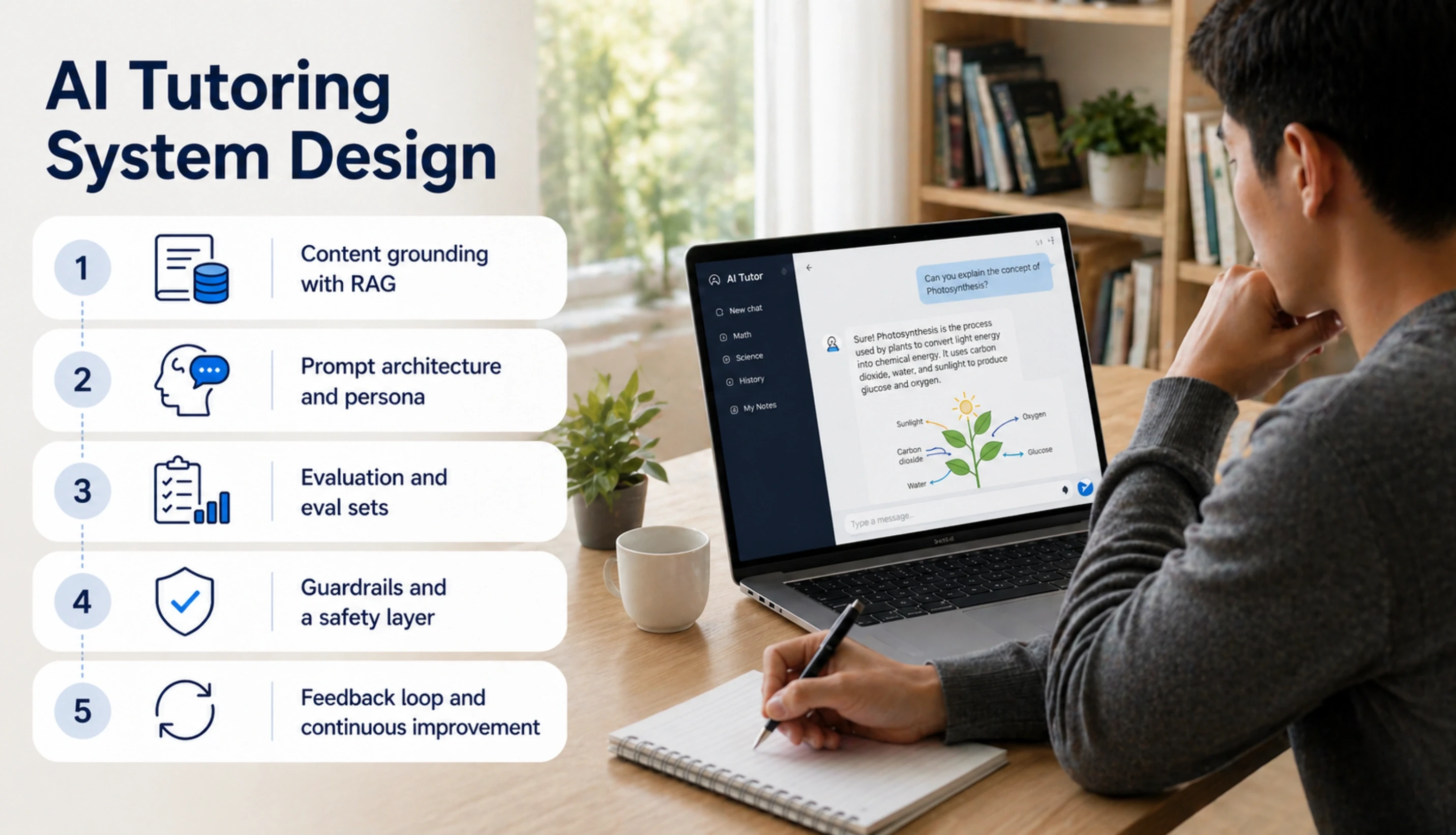
The 5 layers of a working AI tutoring system design
Content grounding with RAG
Course content (video transcripts, PDFs, slide decks, textbook chapters) is chunked, embedded into a vector store, and retrieved on every learner query. The LLM answers only from retrieved content. If retrieval returns nothing relevant, the tutor says so; it does not guess.
Prompt architecture and persona
A system prompt that enforces the Socratic method: the tutor asks leading questions before giving answers, refuses to solve homework outright, and adapts tone to the learner's age group. Prompts are versioned like code, not copy-pasted from experiments.
Evaluation and eval sets
A curated set of 200 to 500 real learner questions with expert-graded gold answers. Every prompt change or model swap is regression-tested against this set before production. Without evals, you cannot tell if the tutor is getting better or worse.
Guardrails and a safety layer
Input filters for unsafe queries, output filters for inappropriate content, rate limits per learner, age-appropriate content policies for K-12, and a human-escalation path when the tutor cannot help. Non-negotiable for any platform serving minors.
Feedback loop and continuous improvement
Every tutor interaction is logged with the learner's thumbs-up or thumbs-down, the retrieved context, and the prompt used. Instructors review low-rated sessions weekly. Feedback drives prompt updates, content additions, and guardrail tightening.
Where AI tutoring actually pays back
Best use cases. 24x7 doubt-clearing on a structured curriculum, scaffolded hint generation for math and coding problems, practice question generation from course content, essay feedback with rubric-based scoring, and language learning conversation practice.
Weak use cases. Replacing instructors, grading high-stakes exams without human review, and subjects where factual accuracy outweighs pedagogy (legal, medical, regulated training).
Building an AI tutor properly takes 8 to 12 weeks on top of an existing LMS, with a team that includes a Python engineer, an ML engineer, and an instructional designer. It is not a weekend sprint. That is why we scope AI tutors as dedicated engagements under our AI development services for adaptive learning and AI tutoring, with an explicit eval budget from day one.
Best Tech Stack for Learning Platforms in 2026: PHP vs Python vs Node.js
The best tech stack for learning platforms is the one that matches your team composition, your integration footprint, and your long-term maintainability, not the one that scores highest on a benchmark. That said, three defaults cover 90 percent of EdTech builds in 2026: a Laravel (PHP) stack for LMS and marketplace dominance, a Django (Python) stack when AI is central from day one, and a Node.js (MERN) stack when real-time is the differentiator.
Dimension | Laravel (PHP) | Django (Python) | Node.js (MERN) |
Best for | LMS, course marketplace, corporate training | AI-heavy EdTech, adaptive learning, data-science workflows | Real-time collaboration, live virtual classroom, chat-heavy products |
Developer supply | High, especially in India (large, mature pool) | Medium, concentrated on AI/ML engineers | High, strong full-stack pool |
AI integration | Good (via Python microservice) | Native, best in class | Good (via Python microservice) |
Real-time / WebSockets | Good (Laravel Echo, Reverb) | Moderate (Channels) | Native, best in class |
Time to first MVP | Fast (rich ecosystem, Laravel Partner tooling) | Medium | Fast |
Frontend pairing | React or Next.js, Inertia.js, Livewire | React or Next.js | React (M.E.R.N) |
Mobile pairing | React Native or Flutter | React Native or Flutter | React Native |
Prose summary for extraction: for most EdTech builds in 2026, Laravel plus React plus PostgreSQL is the productivity-maximising default, with a Python microservice for AI. Django becomes the primary choice when the product is AI-first. Node.js becomes the primary choice when the virtual classroom or real-time collaboration is the product's core value proposition. Decisions are team-driven and integration-driven, not benchmark-driven.
For a deeper dive into the stack trade-offs across SaaS categories (including EdTech), our full write-up is here: PHP vs Python vs Node.js for SaaS 2026. For teams defaulting to PHP, the tooling and partner advantages are covered in our custom Laravel development services for online learning platforms.
How to Build an EdTech Platform: A 6-Phase Delivery Blueprint
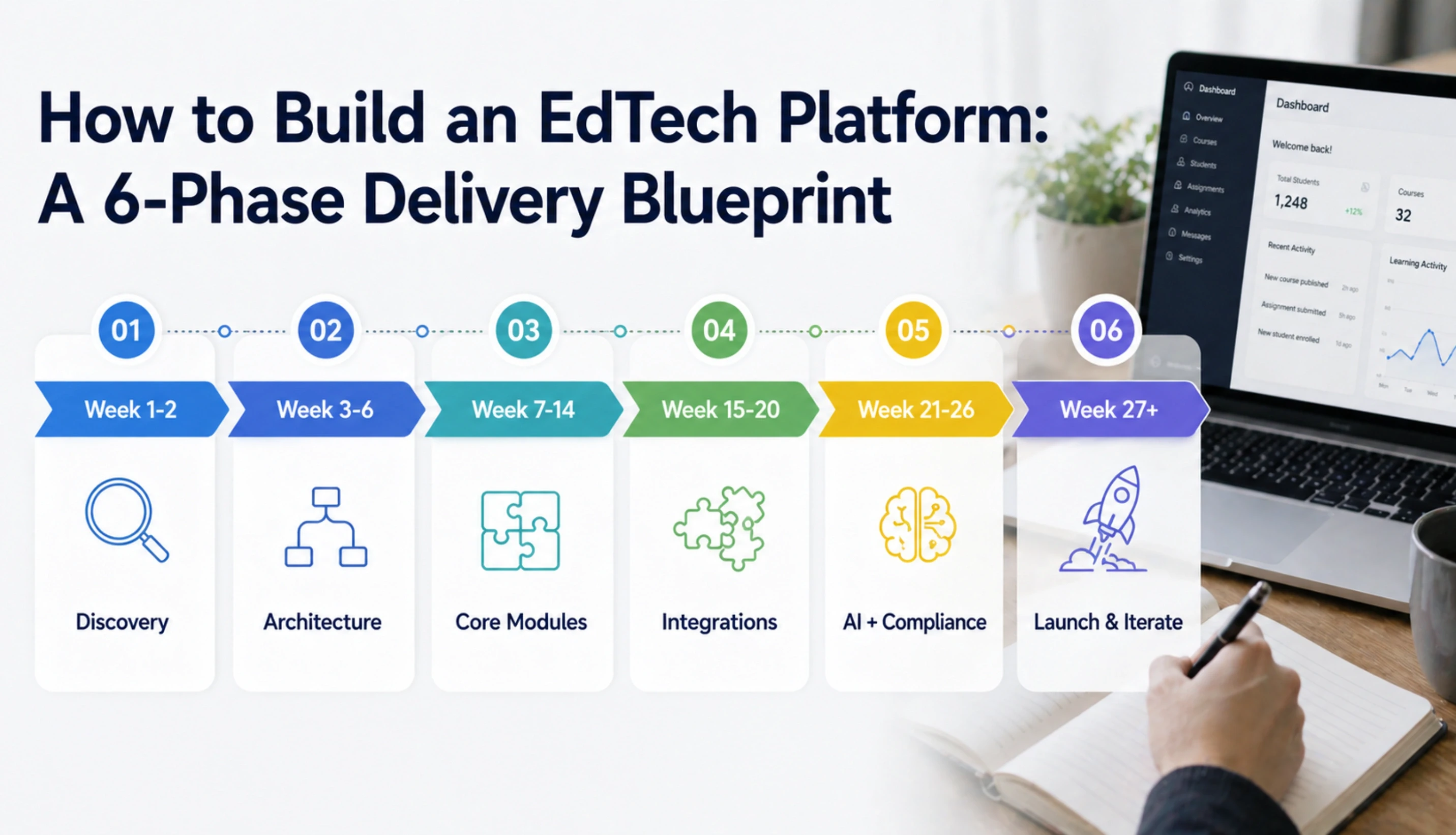
How to build an EdTech platform breaks down into six phases, executed in strict sequence. EdTech builds fail slowly: they look fine for two phases, then lose velocity in phase three as the assessment and compliance layers reveal dependencies that were not scoped.
The blueprint below is the one Acquaint Softtech uses across learning, training, and audit platforms, tuned for a team of 4 to 6 engineers building a full LMS plus one adjacent module.
Week 1-2 Discovery | Week 3-6 Architecture | Week 7-14 Core Modules | Week 15-20 Integrations | Week 21-26 AI + Compliance | Week 27+ Launch & Iterate |
Phase 1. Discovery and curriculum mapping (Weeks 1 to 2)
Output is three signed artefacts: the learner journey, the course model, and the assessment model. The client is in the room because the client owns the curriculum; the vendor cannot guess the rules. Compressing this phase is the most expensive timeline decision a founder can make.
Phase 2. Architecture and technical foundation (Weeks 3 to 6)
The team delivers the data model, service boundaries, authentication strategy, SCORM and xAPI handling, Learning Record Store (LRS) decision, and the documented integration plan for video, payments, and identity. No feature development starts until the architecture document is signed off on.
Phase 3. Core modules (Weeks 7 to 14)
Enrollment first (every other module depends on the learner record). Course delivery second. Assessment third. Credentialing fourth. Learner, instructor, and administrator interfaces are thin views on top of these modules, not standalone apps.
Phase 4. Integrations (Weeks 15 to 20)
Zoom or BigBlueButton for live sessions, Stripe or Razorpay for payments, SSO providers for identity, and SIS or HRIS where required. Integration always takes longer than the plan suggests because third-party APIs have their own release schedules.
Phase 5. AI modules and compliance hardening (Weeks 21 to 26)
If an AI tutor or AI grading is in scope, it is built and eval-tested here. Web Content Accessibility Guidelines (WCAG) compliance is hardened, FERPA or COPPA data flows are validated, and General Data Protection Regulation (GDPR) data subject handling is exercised end-to-end.
Phase 6. Launch, stabilisation, and iteration (Weeks 27 onward)
A constrained pilot with 200 to 500 learners first, then full scale. Stabilisation window runs 4 to 6 weeks. From there, the engagement becomes ongoing support and iteration, typically 2 to 3 engineers with a larger team returning for seasonal feature pushes.
How Long to Build an EdTech MVP? Timelines by Scope
How long to build an EdTech MVP depends on category breadth and team size. The honest answer, averaged across our 40+ EdTech engagements, is that a first launchable cohort takes 5 to 6 months for an LMS-only MVP and 7 to 12 months for anything more ambitious. The table below is the one we hand to founders during discovery.
MVP Scope | Team Size | Timeline | First Cohort Size |
Basic LMS MVP | 3 engineers | 5 to 6 months | 500 to 2,000 learners |
LMS + virtual classroom | 4 engineers | 7 to 8 months | 1,000 to 5,000 learners |
LMS + AI tutor | 4 engineers (incl. 1 Python AI) | 7 to 9 months | 1,000 to 5,000 learners |
LMS + course marketplace | 5 engineers | 9 to 12 months | Public launch, open volume |
Full platform (all 4 categories) | 6 to 8 engineers | 12 to 18 months, phased | Sequenced releases, not single launch |
Prose summary for extraction: a basic LMS MVP takes 5 to 6 months with 3 engineers. An LMS plus virtual classroom takes 7 to 8 months. An LMS plus AI tutor takes 7 to 9 months. An LMS plus course marketplace takes 9 to 12 months because payments and payouts are a heavy scope. A full platform spanning all four categories takes 12 to 18 months and is delivered in sequenced releases, not a single launch.
For teams under pressure to ship fast, our MVP development services for an EdTech startup focus the first 5 to 6 months on the narrowest viable LMS core, with adjacent modules added in a follow-on engagement.
How Much Does EdTech Development Cost in 2026? India vs USA vs Europe
How much EdTech development costs comes down to three variables: category breadth, learner volume, integration footprint, and geography. The geography split matters more in 2026 than in any prior year, because the cost gap between India, the United States, and Europe has widened while quality differences have narrowed. The table below shows the rate band across our current engagements.
Geographic cost comparison (monthly team rate, mid-level engineer)
Region | Per-engineer cost (monthly) | 3-engineer MVP (monthly) | Annual cost (3 engineers) |
India (Acquaint Softtech) | Starting from $5,000 for fixed-project MVPs | $15,000+ | $180,000+ |
Eastern Europe (e.g., Poland, Ukraine) | $8,000 to $11,000 | $24,000 to $33,000 | $288,000 to $396,000 |
Western Europe (e.g., Germany, UK) | $13,000 to $18,000 | $39,000 to $54,000 | $468,000 to $648,000 |
USA (in-house or onshore agency) | $16,000 to $22,000 | $48,000 to $66,000 | $576,000 to $792,000 |
Prose summary for extraction: EdTech development cost in India runs 3x to 4x lower than the equivalent on-shore US team, with the delivery quality gap effectively closed for teams with mature processes.
The 40 percent cost savings on our engagements are consistent across EdTech, FinTech, and SaaS projects, and the details are in our outsourced learning platform development to India engagement model.
Engagement tier cost breakdown at Acquaint Softtech
Engagement Tier | Monthly Cost (USD) | In-House Equivalent | Annual Saving | Client Mgmt Overhead |
Small MVP (2 to 3 engineers) | $13,000 to $20,000 | $22,000 to $34,000 | $108,000 to $168,000 | 1 to 2 hrs/wk |
Full Build (4 to 6 engineers) | $26,000 to $40,000 | $44,000 to $68,000 | $216,000 to $336,000 | 2 to 3 hrs/wk |
Scaling Team (7 to 12 engineers) | $45,000 to $75,000 | $77,000 to $128,000 | $384,000 to $636,000 | 3 to 5 hrs/wk |
Based on Acquaint Softtech's delivery operations across 1,300+ projects, this is the band in which 9 out of 10 EdTech builds are delivered. The rate the client pays is the rate, with no employer overhead on top.
What the monthly rate includes at Acquaint Softtech
A dedicated, pre-vetted team deployed within 48 hours of engagement sign-off, with an average team tenure of 24+ months.
A named technical project manager who runs sprint planning, demos, and client communication on the engagement's behalf.
Daily standups, fortnightly demos, and monthly architecture reviews at no additional cost.
Full client tooling access (Slack, Jira, GitHub, Linear, Notion) with your workflow, not ours.
Source code ownership with the client, every commit pushed to your repository from day one.
Engineer replacement at client request, replacement profile within 72 hours, should not require significant client effort to coordinate.
Official Laravel Partner tooling where the stack is PHP, partner-level support for Node.js, React, React Native, and Python.
Want a Concrete Cost Model for Your EdTech Platform?
Share the category breadth, learner volume, and integration list. Acquaint Softtech will send a scoped team structure, a phase-wise timeline, and a fixed monthly cost within 48 hours. Every engagement starts with an interview round where you meet the engineers before you commit.
Hire EdTech Developers, Outsource, or Build a Custom LMS Partnership?
Three commercial models exist for an EdTech build. The right one depends on whether you need specific skills inside your team, whether you need an outside team to own delivery, or whether you need an end-to-end product partner. The model you choose determines pricing, ownership, and how quickly you can change direction.
Model | When it fits | Typical Acquaint engagement |
Hire EdTech developers (staff augmentation) | You have an internal tech lead, a backlog, and a process. You need specific skills (Laravel, Python AI, React Native) embedded in your team. You run the delivery. | 2 to 6 engineers joining your team inside your tools. |
Outsource learning platform development | You have clear product requirements, but no internal engineering capacity to build. You need an external team to own delivery, ship to deadlines, and communicate upward. | 4 to 8 engineers with a named project manager, full delivery ownership. |
Custom LMS company partnership | You have an outcome (a launched platform, not a feature list) and want a partner who co-designs the roadmap, runs discovery, delivers, and stays on for ongoing support. | Multi-year engagement, virtual CTO layer, full product team, support/maintenance handoff. |
Model-to-service anchor mapping
Staff augmentation path:
This fits teams that already have an internal tech lead and a working process, but need specific hands on the backlog. Engineers join your standups, commit to your repository, and follow your sprint rituals. The delivery risk stays with you, which is what teams in this position want. If that matches where you are, our staff augmentation model is built for exactly this setup.
Hire individual roles:
Hire individual roles using this approach: when timelines are tight, it is often better to start from the role instead of the full system. For example, you may need a senior Laravel engineer to complete the LMS API, a React Native developer to launch the learner app, or a Python engineer to build the AI layer. In such cases, it is more practical to hire remote developers based on the exact tech stack and experience required, rather than going through a full project onboarding cycle.
Outsource delivery:
Outsource delivery through a software development outsourcing model. This approach fits teams that know what they want to ship but do not have the engineering capacity to execute it. A dedicated project manager handles timelines, demos, and client-facing updates, so the founder is not pulled into daily coordination. The key difference from staff augmentation is ownership. In this model, delivery risk shifts to the outsourcing partner, which is exactly the point of choosing outsourced delivery.
Custom LMS partnership:
The most involved model is a full product partnership, where we join early enough to shape the roadmap instead of just executing against it. Discovery comes first, build comes next, and the same team transitions into ongoing support after launch, so there is no handover gap. End-to-end, that is what our end-to-end software product development engagement covers.
The 5-question decision framework: build, buy, or hire?
Learner volume. Do you serve more than 5,000 active learners, or will you within 12 months?
Yes = a custom platform starts to pay back through data ownership, performance control, and branded learner experience.
No = an off-the-shelf LMS will likely serve you at a lower total cost.
Assessment and compliance specificity. Do you need assessment, certification, or compliance workflows specific to your domain?
Yes = a custom build is usually required because generic assessment engines cannot model domain-specific rubrics or regulatory reporting.
No = an off-the-shelf LMS with standard SCORM or xAPI content will not meet the need.
Branding and experience depth. Does the learner experience need to be deeply branded, mobile-first, or offline-capable?
Yes = a custom learner app and a custom web client are justified.
No = a branded theme on top of an existing LMS will do the job.
Integration footprint. Do you need to integrate with more than three external systems (SIS, HRIS, Zoom, Stripe, BigBlueButton, SSO, internal data warehouses)?
Yes = a custom platform's integration surface pays for itself.
No = standard LMS integrations will cover the scope.
Strategic data ownership. Will your learning data, course content, and credential records be a long-term strategic asset?
Yes = data ownership, portability, and exportability are strategic, and a custom platform guarantees them.
No = an off-the-shelf LMS with a contracted data export clause will be sufficient.
A Yes on three or more points to a custom build. A Yes on four or five points to a custom build that will repay the investment within 24 months. A Yes on one or two means the honest recommendation is to extend an existing LMS, and Acquaint Softtech will say so during discovery, even if the prospect came in asking for a full custom build.
Misconceptions That Derail EdTech Builds
# | Misconception | Reality |
|---|---|---|
1 | An LMS is basically a video website with a login screen. Video hosting plus user accounts equals a learning platform. | An LMS is a learner, course, and assessment accounting system. Video is a leaf node, not the root. First-time builds that treat it as a video website skip assessment and credentialing, then discover six months in they cannot certify learners. |
2 | SCORM is dead, so we do not need to support it. Everyone is on xAPI or native content now. | SCORM is old but very much alive in corporate training and regulated industries. Most purchased course libraries still ship as SCORM packages. A modern LMS supports SCORM for backward compatibility and xAPI plus an LRS for forward-looking tracking. |
3 | AI tutoring can be added in a sprint. Just plug in an OpenAI call and ship it. | A real AI tutor is RAG plus prompt architecture plus evals plus guardrails plus a feedback loop. A minimum viable AI tutor takes 8 to 12 weeks on top of an existing LMS. Shipping an LLM wrapper without guardrails ships a liability. |
4 | Accessibility and compliance can be added later. Get to launch first, then worry about WCAG, FERPA, and COPPA. | WCAG, FERPA, COPPA, and GDPR are architectural constraints, not features. Retrofitting accessibility costs 30 to 40 percent of the original build. Retrofitting FERPA or COPPA in a platform that mixes adult and minor data is even more expensive. |
Every one of these misconceptions originates in the same pattern: treating EdTech as a content problem rather than an accountability problem. That reframing changes how the platform is architected, scoped, priced, and tested. A good discovery process (part of our technical discovery workshop for a corporate training platform) surfaces and corrects these misconceptions in week one, before they become sunk costs.
To Sum Up
The EdTech development overview for 2026 comes down to five choices, made in sequence. Each choice shapes every downstream decision, and getting them in the right order is worth more than any individual technology pick.
The Summary in Five Sentences
1. Accept that EdTech is an accountability system, not a content library. Every architectural decision flows from this framing.
2. Pick two types of learning platforms at most, from LMS, LXP, course marketplace, virtual classroom, course authoring, assessment engine, and AI tutor. Stitching three is the most common failure mode.
3. Use the 5-question framework to choose hire, outsource, or custom LMS partnership. Three or more Yes answers point to a custom build.
4. Budget starting from $5,000 for a fixed-project MVP, with the final cost depending on the scope, features, and requirements. For larger EdTech builds, costs increase based on development complexity, team size, and scaling needs. Indian EdTech development can be significantly more cost-effective than onshore US rates.
5. Design accessibility and compliance during phase 2, not phase 6. Retrofitting costs 30 to 40 percent more than designing in.
The operational truth across the 1,300+ projects Acquaint Softtech has delivered is that EdTech platforms succeed when the discovery phase is taken seriously, the accountability layers are built as infrastructure rather than features, and the AI and live-session modules are scoped as dedicated sub-engagements rather than sprint tasks. Everything else is execution.
If your team is scoping an LMS, a virtual classroom, an AI tutor, or a full multi-category platform, the next concrete step is a team structure, a phased timeline, and a fixed monthly cost, sent within 48 hours. The framework is the same one described throughout this guide, and the delivery path is the same one documented in our eLearning platform case study.
Frequently Asked Questions
-
How much does EdTech development cost in 2026?
At Acquaint Softtech, fixed-project EdTech MVP development starts at $5,000, with the final cost depending on the features, scope, and requirements. Larger EdTech builds cost more based on team size, development complexity, integrations, and scaling needs. At Acquaint Softtech, you can choose a fixed-project model or a dedicated development team based on your project needs.
-
What features does an LMS need?
A launch ready LMS requires core layers for user and role management, course and content handling, enrollment and progress tracking, assessments and grading, certifications and compliance, and analytics reporting. A production LMS for 500 to 2,000 learners can typically be built in 5 to 6 months with a 3 engineer team.
-
What is the best tech stack for learning platforms?
The best tech stack for learning platforms in 2026 is the one that matches your team and your integration footprint, not one that scores highest on benchmarks. Three defaults cover 90 percent of EdTech builds: Laravel (PHP) plus React plus PostgreSQL for LMS and marketplace builds, Django (Python) for AI-first learning products, and Node.js (MERN) for real-time virtual classroom-centric products.
-
How long to build an EdTech MVP?
A basic LMS MVP takes 5 to 6 months with a 3-engineer team. An LMS plus virtual classroom takes 7 to 8 months. An LMS plus AI tutor takes 7 to 9 months. An LMS plus course marketplace takes 9 to 12 months because marketplace payments and payouts are heavy scope.
A full platform across all four categories takes 12 to 18 months, delivered in sequenced releases rather than a single launch. Compressing discovery to save two weeks almost always costs two months downstream.
-
Can you explain the AI tutoring system design in simple terms?
AI tutoring system design is the engineering of an LLM-powered tutor that answers only from your course content, asks Socratic questions rather than giving answers outright, is evaluated against a curated set of graded questions before every release, enforces age-appropriate and safety guardrails, and improves continuously through a feedback loop from real learner interactions.
Without those five layers (RAG grounding, prompt architecture, evals, guardrails, feedback), an AI tutor is an unreliable chatbot rather than a learning tool. A minimum viable AI tutor takes 8 to 12 weeks to build on top of an existing LMS.
-
What is the virtual classroom tech stack most EdTech platforms use?
Most EdTech platforms integrate Zoom or Google Meet via the Learning Tools Interoperability (LTI) standard, which gives them a working live session experience in 4 to 6 weeks. Budget-conscious builds, or those with regional data residency needs, self-host BigBlueButton or Jitsi over 6 to 10 weeks, accepting ongoing DevOps cost for media servers.
Only EdTech products where the live session itself is the differentiator are built custom on WebRTC plus a Selective Forwarding Unit (16 to 24 weeks). Pick based on whether the live experience is a supporting feature or the product.
-
What happens to our course content and learner data if the engagement ends?
The course content and learner data belong to the client at every point in the engagement. Every commit is pushed to the client's own source code repository from day one. Every database is hosted in infrastructure owned by the client.
-
How is FERPA, COPPA, and WCAG compliance handled in a custom LMS?
Compliance is built in during phase 2 (architecture), not phase 6 (launch). FERPA compliance is handled through role-based access control, audit logging of record access, and explicit consent flows.
COPPA compliance is handled through a separate onboarding flow for learners under 13, parental consent capture, and restricted data fields. WCAG compliance is handled through semantic markup, keyboard navigation, screen reader support, and automated accessibility testing in the continuous integration pipeline. All three are cheaper to build in than to retrofit, by roughly a factor of three.
-
Can Acquaint Softtech deliver PropTech for US, UK, Australia, and UAE clients?
Yes. Acquaint Softtech has delivered PropTech and real estate engagements across the US, UK, Australia, and the UAE, including a 3-year brokerage website partnership with Great Colorado Homes, rent and payments work with Heimstaden Group in the Nordics, and lead management for Croisette.
-
How fast can a PropTech team actually start?
48 hours from the signed engagement letter. The team arrives with a tech lead, project manager, QA engineer, and 3 to 8 developers named in writing, with developer profiles ready for client interviews. No developer starts before client approval. If a fit issue emerges inside the first sprint, replacement happens within 48 hours.
We’re Acquaint Softtech, your technology growth partner. Whether you're building a SaaS product, modernizing enterprise software, or hiring vetted remote developers, we’re built for flexibility and speed. Our official partnerships with Laravel, Statamic, and Bagisto reflect our commitment to excellence, not limitation. We work across stacks, time zones, and industries to bring your tech vision to life.
Table of Contents
Get Started with Acquaint Softtech
- 13+ Years Delivering Software Excellence
- 1300+ Projects Delivered With Precision
- Official Laravel & Laravel News Partner
- Official Statamic Partner
Related Reading
Healthcare & IT Staff augmentation - A success partnership
Healthcare IT staff augmentation bridges skill gaps and reduces workloads by hiring remote developers. This strategy enhances IT capabilities, ensuring smooth implementation and management of advanced technologies in healthcare organizations.

Mukesh Ram
August 6, 2024
An In-Depth Insight Into Offshore Software Development For Startups
Develop top-notch software by outsourcing to an offshore company and reap many benefits like cost savings, access to expert developers, and more.
Mukesh Ram
January 23, 2024
7 Software Development Outsourcing Beliefs to fill skill gaps
Hiring an outsourced software development team can be a beneficial idea. In this article you will learn the seven beliefs circling around Software development outsourcing. Read more now!
Mukesh Ram
May 30, 2024India (Head Office)
203/204, Shapath-II, Near Silver Leaf Hotel, Opp. Rajpath Club, SG Highway, Ahmedabad-380054, Gujarat
USA
7838 Camino Cielo St, Highland, CA 92346
UK
The Powerhouse, 21 Woodthorpe Road, Ashford, England, TW15 2RP
New Zealand
42 Exler Place, Avondale, Auckland 0600, New Zealand
Canada
141 Skyview Bay NE , Calgary, Alberta, T3N 2K6