

What to Expect in the First 30 Days of a Staff Augmentation Engagement
Most staff augmentation engagements that fail do so in the first 30 days. The onboarding structure determines whether the developer reaches full velocity in week 3 or week 10. Here is exactly what to expect and what to do.

Mukesh Ram
After 13 years and 1,300+ projects at Acquaint Softtech a, software development partner, the pattern is consistent: most staff augmentation engagements that fail do so in the first 30 days. Not because the developer is wrong for the role, but because the onboarding structure was not set up to give them the context they need to perform. This article gives you the week-by-week expectation framework that turns a slow first month into a productive one.

- CTOs and engineering leads who have just confirmed a staff augmentation placement and want to know what to prepare
- Founders starting their first developer engagement and not sure what the first weeks should look like
- Technical leads who have had a slow start with an augmented developer before and want to understand why
- Operations leads building an onboarding process for recurring developer augmentation engagements
The first 30 days of a staff augmentation engagement is not a probation period. It is a context-building period. The developer's goal during this phase is not to deliver at full velocity. The goal is to understand the codebase, the team conventions, the deployment process, and the product domain well enough to deliver at full velocity from sprint 3 onwards. Companies that evaluate a developer's performance in week 1 by the same standard as week 8 are measuring the wrong thing at the wrong time.
The quality of the developer's first 30 days starts with the interview process that preceded it. The remote developer interview framework covers the 8 questions that reveal whether a developer has the onboarding capability to ramp quickly. A developer who interviews well on context-building and communication will onboard faster than a technically stronger developer who does not.
What to Set Up Before Day 1
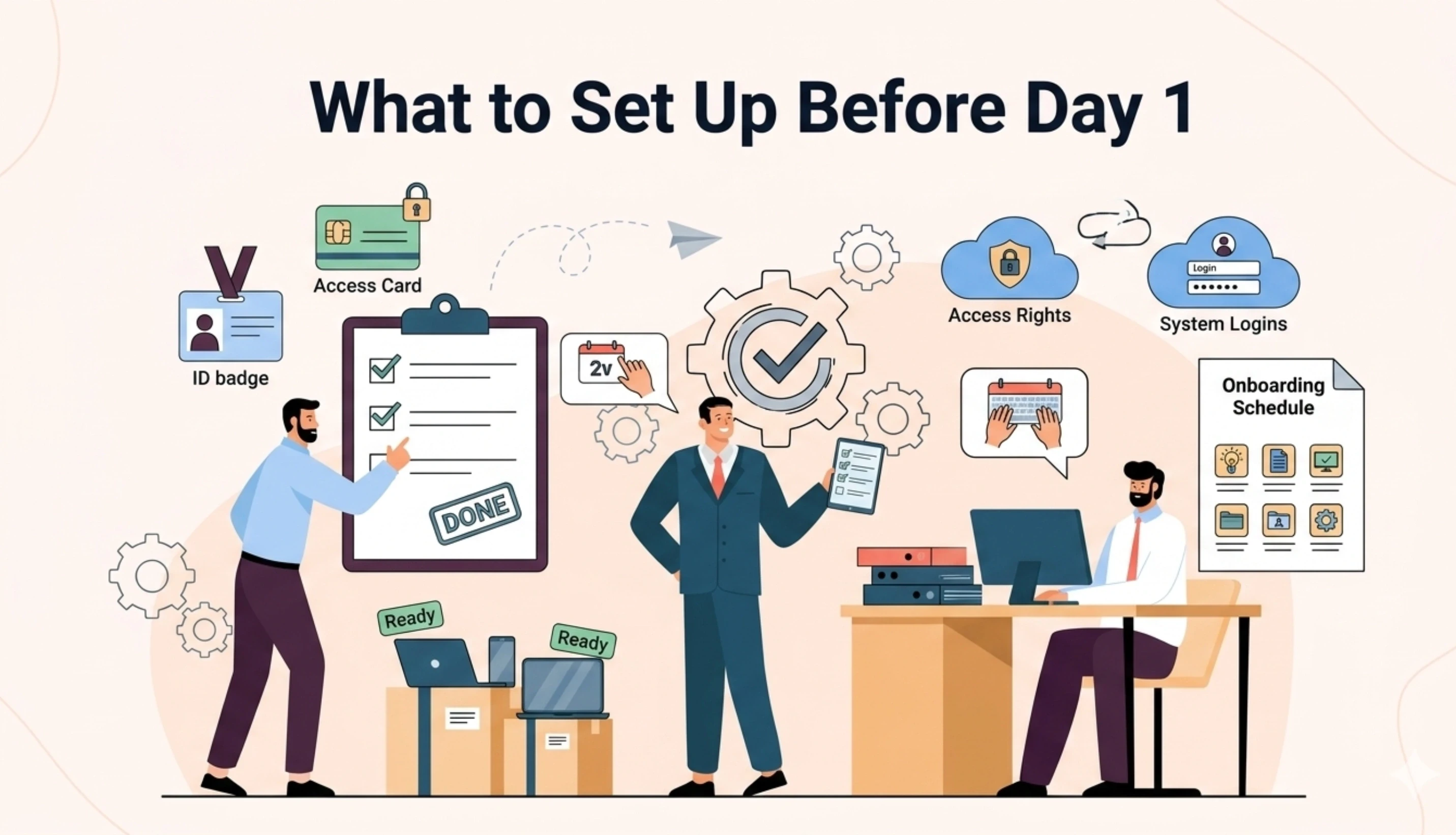
The onboarding experience is determined more by what the client sets up before Day 1 than by what the developer does in Day 1. Here is the pre-engagement checklist that makes the first two weeks productive rather than administrative.
The Day 1 Readiness Checklist
Repository access: Developer has read/write access to the relevant repositories.
Development environment: Setup documentation is written and tested. A developer following it code should have a running local environment in under 60 minutes.
Tooling access: Jira/Linear, Slack/Teams, CI/CD pipeline, staging environment. All credentials ready before the developer's first day.
Codebase overview doc: A 1 to 2 page document covering: architecture overview, key decisions, the most important files and where to find them, and any known gotchas.
Sprint 1 scope: The first sprint is pre-scoped at 60 to 70% of normal sprint velocity. Features are selected for their context-building value, not their complexity.
Onboarding buddy: A named team member who answers setup questions within the first 48 hours. This does not need to be a senior engineer. It needs to be a responsive one.
The time investment to prepare these items: 3 to 5 hours.
The time saved by having them ready: typically 1 to 2 weeks of delayed ramp-up.
Acquaint Softtech's staff augmentation service includes a structured pre-engagement briefing where we help clients prepare the Day 1 readiness checklist items above. For clients who have not run a developer augmentation before, this preparation session prevents the most common first-week friction points before they appear.
Starting a Staff Augmentation Engagement Soon? Let Acquaint Softtech Run the Pre-Engagement Setup.
Acquaint Softtech prepares a Day 1 readiness checklist, reviews the onboarding documentation, and confirms the sprint 1 scope with the client before the developer's first day. This 2-hour session prevents the most common first-week delays. It is included in every Acquaint Softtech placement at no additional cost.
The First 30 Days: Week by Week
Here is the realistic expectation for each week. These are the patterns Acquaint Softtech has observed across 1,300+ placements, not optimistic projections.
Week 1: Days 1 to 7: Environment Setup and Codebase Orientation |
Client does: Approve repository access. Be available for setup questions within 2 hours. Run a 45-minute welcome call on Day 1 covering: team introduction, communication expectations, and sprint 1 priorities. Do not assign urgent production tasks in week 1. |
Developer does: Sets up local development environment using provided documentation. Reads architecture overview and key files. Asks clarifying questions about conventions and patterns. Reviews the sprint 1 scope and confirms understanding of acceptance criteria. |
Milestone: Developer has a running local environment, can run the test suite, and has made their first small commit by end of week 1. This milestone confirms setup is complete. If it is not reached by day 5, there is a setup problem worth addressing immediately. |
Week 2: Days 8 to 14: First Sprint Delivery and Convention Learning |
Client does: Run the sprint planning on Day 8. Keep sprint 1 scope at 60 to 70% of normal velocity. Attend the mid-sprint check-in on Day 11. Provide acceptance feedback within 24 hours of feature submission. Do not compare sprint 1 velocity to sprint 3 velocity. |
Developer does: Completes first feature deliverables. Asks architecture questions before implementing rather than after. Submits PRs for review and responds to feedback within the same business day. Learns the team's code style, naming conventions, and PR process. |
Milestone: Sprint 1 closes with 60 to 80% of committed items accepted. One or two items may roll to sprint 2 due to context gaps. This is normal. A sprint 1 completion rate of 60 to 80% is a healthy signal, not a performance concern. |
Week 3: Days 15 to 21: Context Acceleration and First Full Sprint |
Client does: Run sprint 2 planning at full velocity scope. Share the product roadmap context: what features are coming in the next 3 sprints and why. Introduce the developer to the wider team if not already done. Review sprint 1 metrics with the developer. |
Developer does: Takes on sprint 2 tasks at or near full velocity. Fewer clarification questions per feature than in sprint 1. Begins to identify potential issues or edge cases proactively, before they become sprint blockers. |
Milestone: Sprint 2 commitment rate above 80%. Clarification questions per feature dropping compared to sprint 1. Developer begins flagging potential issues in sprint planning rather than mid-sprint. |
Week 4: Days 22 to 30: Baseline Established and Performance Review |
Client does: Run the sprint 2 review. Hold the 30-day performance check-in with the developer: share the 5 KPI metrics, acknowledge progress, and set expectations for sprint 3 and beyond. Adjust communication cadence if needed based on what worked in the first 30 days. |
Developer does: Delivers sprint 2 at committed velocity. Takes initiative on small improvements or bug fixes beyond the immediate sprint scope. Demonstrates understanding of the product domain by asking roadmap-level questions, not just task-level ones. |
Milestone: Sprint commitment rate 85%+. Defect escape rate below 0.4 per feature. Developer asking product-level questions, not just task-level ones. These three signals together confirm a successful 30-day onboarding. |
The 5 metrics to track across this 30-day period are covered in detail in the developer productivity measurement guide. The guide covers the targets and concern thresholds for each KPI and how to set the baseline in the first sprint before tracking trends.
Want to See How Acquaint Softtech Tracks the 30-Day Onboarding Metrics?
Every Acquaint Softtech placement includes a structured 30-day onboarding report: week-by-week sprint metrics, a Day 1 readiness score, and a 30-day performance review. You see the data before the sprint 3 planning session. Tell me your stack and team structure and I will show you what the first 30-day report looks like.
The Early Warning Signals (and What to Do About Them)
Not every 30-day onboarding goes smoothly. These are the signals that indicates a problem worth addressing before it becomes a pattern, and what the right response is for each.
Developer has not committed code by end of Day 5 |
This is a setup problem, not a performance problem. Either the development environment documentation is incomplete, repository access is not configured correctly, or the developer is stuck and not asking for help. Check with the onboarding buddy first. If the environment is set up and the developer is not committing, have a direct 15-minute call to understand what is blocking them. Do not wait until the week 1 review. |
More than 5 clarification questions per feature in week 2 |
Either the sprint 1 scope was too complex for a context-building sprint, or the acceptance criteria were not written clearly enough. Review the acceptance criteria for the affected features. If they are clear and the questions are about basic codebase structure, provide the developer with the codebase overview documentation and schedule a 30-minute architecture walkthrough. This is a documentation gap, not a developer gap. |
Sprint 1 completion rate below 50% |
This is worth investigating, but not immediately concerning if there is a clear cause. The most common causes: setup took longer than expected, sprint scope was set at full velocity rather than 60 to 70%, or there was a significant blocker that was not surfaced mid-sprint. Have the retrospective conversation and identify the specific cause before drawing a performance conclusion. A second sprint below 50% is the signal to act. |
Developer is unresponsive or slow to reply during business hours |
Address this in the first week, not at the 30-day review. The communication expectation, including response time within business hours and standup attendance, should have been set on Day 1. A reminder conversation framing the expectation as a team norm rather than a criticism is the right first response. If the pattern continues, contact the Acquaint Softtech account manager immediately. |
For the broader governance framework that covers the ongoing engagement beyond the first 30 days, the COO guide to managing external dev teams covers the 7 KPIs and 8 red flags that keep a long-running augmentation engagement healthy. And for the fastest possible path to production code, the hire, onboard, ship production code guide covers how Acquaint Softtech places Laravel developers and ships production code in 14 days.
The 30-Day Onboarding in a Dedicated Team Engagement
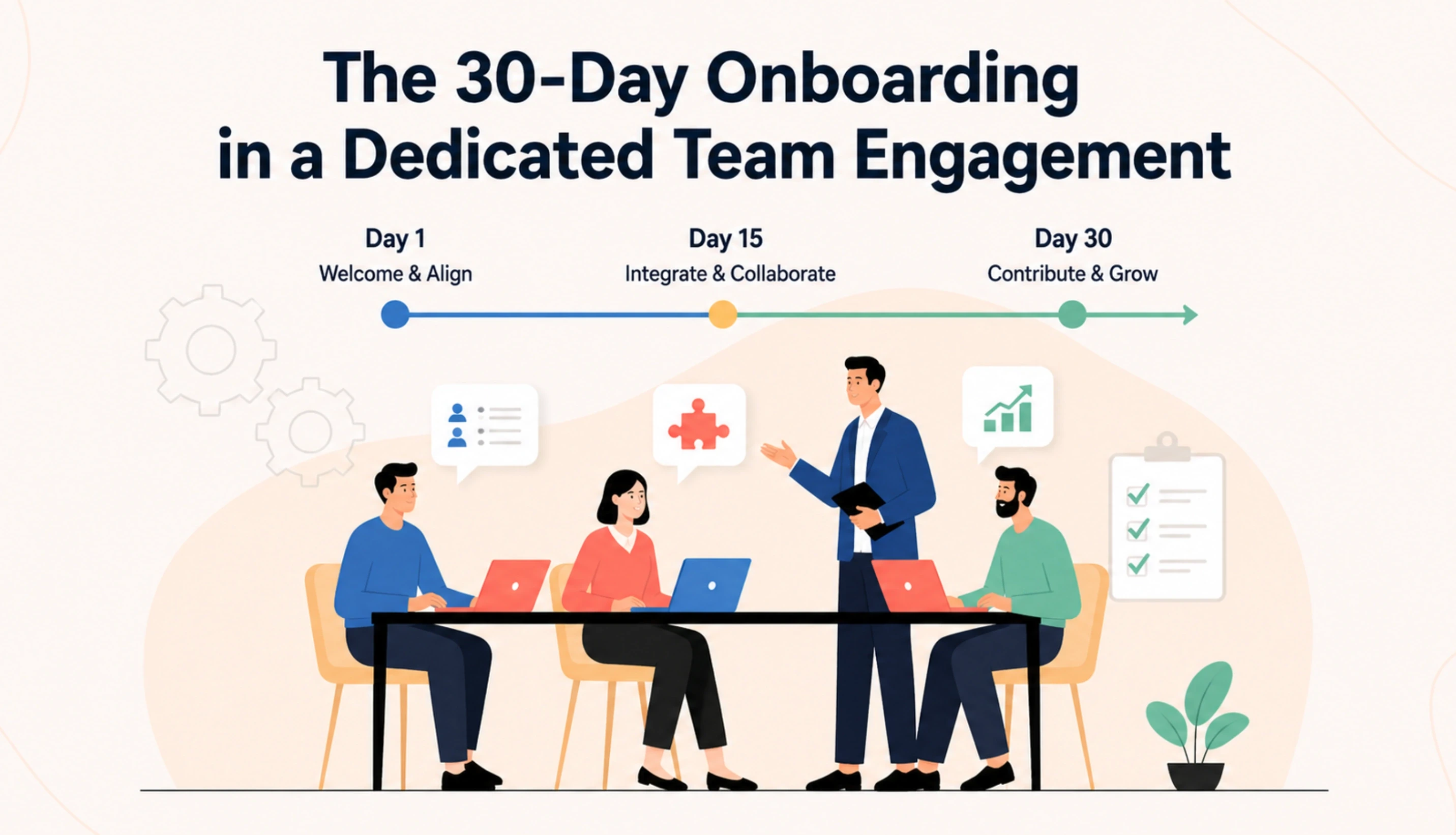
The 30-day framework above applies specifically to individual staff augmentation. For teams using a dedicated team structure, the onboarding dynamic is different: the vendor manages the team onboarding, and the client's responsibility is lighter in the first two weeks. The client does not manage individual developer setup. The vendor's technical lead handles this.
Week 1 in a dedicated team engagement | The vendor's technical lead manages developer environment setup, codebase orientation, and team introductions. The client runs a single 45-minute kickoff call with the technical lead covering sprint 1 priorities, architecture preferences, and communication expectations. The client does not interact with individual developers in week 1. |
Sprint 1 in a dedicated team engagement | Sprint 1 is scoped at 60 to 70% velocity, as with individual augmentation. The difference is that the technical lead manages the sprint task distribution and developer unblocking. The client receives a sprint 1 summary from the technical lead at the end of the week, not individual updates from developers. |
The 30-day milestone in a dedicated team engagement | By day 30, the dedicated team should be operating at 80 to 90% of full sprint velocity. The client's ongoing time commitment from this point is 2 to 3 hours per week: sprint planning, mid-sprint check-in, and sprint review. Everything else runs under vendor management. |
For companies evaluating whether individual staff augmentation or a dedicated team structure is the right fit for their next engagement, our dedicated development teams page covers both engagement models with the specific situations where each produces better outcomes.
Ready to Start a Staff Augmentation Engagement With a Structured 30-Day Onboarding?
Every Acquaint Softtech augmentation includes a pre-engagement setup session, a Day 1 readiness checklist, a structured sprint 1 at 60 to 70% velocity, and a 30-day performance review with KPI data. The first 30 days are not left to chance. Tell me your stack and what you need the developer to build.
Frequently Asked Questions
-
How long does it take for a staff augmentation developer to reach full productivity?
Most augmented developers reach 80 to 90% of full productivity by sprint 3, which is typically the start of week 5. Sprint 1 runs at 60 to 70% velocity while the developer builds codebase context. Sprint 2 runs at 80 to 85%. By sprint 3, the developer should be delivering at committed velocity consistently. This timeline assumes the Day 1 readiness checklist is in place and sprint 1 is scoped appropriately.
-
Why does staff augmentation onboarding fail in the first 30 days?
The most common causes are: development environment documentation that is incomplete or untested, sprint 1 scoped at full velocity before the developer has codebase context, and no clear communication expectations set on Day 1. None of these are developer problems. They are setup problems that the client controls and can prevent before the engagement starts.
-
How do I onboard a remote augmented developer effectively?
Prepare the Day 1 readiness checklist: repository access, tested environment setup documentation, tooling credentials, a codebase overview document, and a sprint 1 scoped at 60 to 70% velocity. Run a 45-minute welcome call on Day 1 covering team introduction, communication expectations, and sprint 1 priorities. Set up a named onboarding buddy who answers setup questions within 2 hours.
-
What should sprint 1 look like for a new augmented developer?
Sprint 1 should be scoped at 60 to 70% of the normal sprint velocity. Features should be chosen for their context-building value: areas of the codebase the developer needs to understand to contribute effectively in future sprints. Do not assign urgent production fixes or complex architectural tasks in sprint 1. The goal of sprint 1 is context, not output.
-
How quickly can an Acquaint Softtech developer start after approval?
Once the client approves a developer profile, Acquaint Softtech has the developer attending the first standup within 48 hours. The pre-engagement setup session can be run on the approval day. Sprint 1 begins in the first full week. From initial brief to a developer in your sprint: typically 5 to 7 business days.
-
What does Acquaint Softtech include in the staff augmentation onboarding?
Every Acquaint Softtech placement includes: a pre-engagement setup session with the client, a Day 1 readiness checklist review, a structured sprint 1 at 60 to 70% velocity, weekly KPI reporting from sprint 1, and a 30-day performance review with the client. These are default terms, not premium additions.
-
Is the 30-day onboarding different for a dedicated team vs individual augmentation?
Yes. For individual augmentation, the client manages developer onboarding with support from the Acquaint Softtech account team. For a dedicated team, the vendor's technical lead manages developer onboarding and the client's first 30-day responsibility is limited to sprint priority setting and a weekly summary review. Dedicated team engagements typically reach full velocity faster because the vendor-managed team structure handles onboarding friction internally.
I love to make a difference. Thus, I started Acquaint Softtech with the vision of making developers easily accessible and affordable to all. Me and my beloved team have been fulfilling this vision for over 15 years now and will continue to get even bigger and better.
Table of Contents
Get Started with Acquaint Softtech
- 13+ Years Delivering Software Excellence
- 1300+ Projects Delivered With Precision
- Official Laravel & Laravel News Partner
- Official Statamic Partner
Related Reading

Still Thinking About Staff Augmentation? Take This 5-Minute Self-Assessment
Most CTOs who are still thinking about staff augmentation after 3 months are not missing information. They are missing one decision. This 10-question self-assessment identifies exactly which one.

Acquaint Softtech
March 30, 2026
IT Staff Augmentation vs In-House Recruitment in 2025
Confused between IT staff augmentation and in-house hiring? Discover the pros, cons, and best use cases to scale your tech teams smarter in 2025.
Acquaint Softtech
June 17, 2025.webp "Why Staff Augmentation Beats Freelancers for Long-Term Projects")
Why Staff Augmentation Beats Freelancers for Long-Term Projects
This article will provide a definitive comparison focusing on three critical areas freelancers often fail at for long-duration projects: Team Stability (Turnover Risk), Knowledge Retention (Bus Factor), and Cultural Integration (Alignment with Core Goals). It positions staff augmentation not just as a temporary fix but as a strategic partnership for sustained growth.

Manish Patel
April 20, 2026India (Head Office)
203/204, Shapath-II, Near Silver Leaf Hotel, Opp. Rajpath Club, SG Highway, Ahmedabad-380054, Gujarat
USA
7838 Camino Cielo St, Highland, CA 92346
UK
The Powerhouse, 21 Woodthorpe Road, Ashford, England, TW15 2RP
New Zealand
42 Exler Place, Avondale, Auckland 0600, New Zealand
Canada
141 Skyview Bay NE , Calgary, Alberta, T3N 2K6