

The Future of E-Commerce Technology 2026-2030: Trends, Predictions, and What to Build
The future of e-commerce is driven by AI, AR, live shopping, and headless commerce for faster, personalized buying experiences. The US e-commerce market is projected to grow from $1.25 trillion in 2025 to $2.08 trillion by 2030.

Mukesh Ram
The next four years will reward the brands that build ahead of the curve. E-commerce is entering its most transformative phase since the shift to mobile. Between 2026 and 2030, the gap will widen sharply between brands that treat technology as a roadmap and those that treat it as a series of catch-up projects.
The risk is not moving too fast. It is mistaking hype for direction, pouring budget into experiments that fade, while missing the structural shifts that quietly become the new baseline customers expect from every store they visit. Reading the curve correctly is a strategic advantage. Acquaint Softtech helps brands build future-ready commerce through its software product development practice, architecting platforms that absorb new capabilities instead of needing rebuilds.

- You are planning technology investments for the next three to five years.
- You want to separate real trends from expensive hype before committing budget.
- You need to know what to build now to stay competitive through 2030.
- You lead product, engineering, or strategy at a growing commerce brand.
- You operate in the USA, UK, Europe, UAE, or India and plan to scale.
The market context sets the stakes. The US e-commerce sector alone is projected to climb from 1.25 trillion dollars in 2025 to 2.08 trillion by 2030, but that growth will not be evenly shared between fast and slow adopters. The shape of that growth is already visible. AI is set to create hundreds of billions in new value across retail through personalization, automation, and entirely new shopping experiences over the next several years.
This report distills the trends that matter into what brands should actually build, separating the durable shifts, AI, immersion, and frictionless architecture from the noise, so technology budgets go toward advantages that compound rather than experiments that expire.
As Founder and CEO of Acquaint Softtech, I expand on our Complete Guide to E-Commerce and D2C Software Development in 2026, the pillar that covers the full technology landscape. Drawing on Acquaint Softtech's experience of delivering 1,300+ projects across 20+ industries, I share practical insights into the technologies, AI innovations, and development strategies shaping the future of digital commerce. Our expertise is backed by a 4.9/5 rating from 50+ verified Clutch reviews and the ability to deploy the first engineer within 48 hours.
The three forces shaping commerce technology to 2030

The future of e-commerce technology is defined by three forces that every major future e-commerce technology 2026 trend falls under: intelligence, AI that personalizes and automates the journey; immersion, AR and live shopping that rival the store; and frictionlessness, architecture that removes every step between wanting and buying.
Understanding this framework matters because it separates durable shifts from fads. Any trend that deepens intelligence, immersion, or frictionlessness is likely structural; anything that does not usually fades once the novelty wears off and budgets tighten. Building toward all three forces at once requires an architecture designed for change. Acquaint Softtech's product development team, including experts available to hire MEAN stack developers, builds platforms that can absorb each new capability without a costly rebuild.
The integrated architecture advantage
The brands that will define commerce by 2030 are those building with integrated architecture rather than a collection of disconnected point solutions, because a unified foundation lets them adopt AI, AR, and voice as features rather than as separate, fragile bolt-ons. The AI intelligence layer underpinning all three forces is built by Acquaint Softtech's AI development services team, who design the data and model foundation that future experiences run on.
AI agents and the rise of agentic commerce

The biggest structural shift through 2030 is agentic commerce, where AI agents autonomously compare products, negotiate, and complete purchases across multiple retailers on a shopper's behalf, without the human ever browsing a store directly. This is no longer speculative: around 23 percent of organizations are already scaling agentic AI systems, and roughly a third of e-commerce enterprises are expected to include agentic AI by 2028, fundamentally changing how products get discovered and bought. Preparing a store for AI agents means exposing clean, machine-readable product data through APIs.
Acquaint Softtech's development services team builds the AI and API layers that make a store visible and transactable to autonomous agents. Businesses looking to accelerate these capabilities can also hire AI/ML engineers to develop intelligent automation, recommendation systems, and agent-ready commerce experiences that support the next generation of online shopping.
Build for machines as customers
When AI agents become buyers, the store must serve machines as well as humans, with structured data, clear APIs, and agent-friendly checkout. Brands whose data is locked inside a rigid template risk becoming invisible in an agent-driven shopping world.
The API-first architecture that makes a store agent-ready is built by Acquaint Softtech's software product team, who expose commerce functions as clean services rather than locked-in pages. How AI fits into the wider store today is covered in our article Why Develop Your E-Commerce Store With Laravel Bagisto guide.
Hyper-personalization becomes the default, not the differentiator
By 2030, AI-driven hyper-personalization will be the baseline customers expect, not a competitive edge. Stores will adapt every element- products, content, pricing, and timing, to the individual, and generic experiences will feel as dated as a non-mobile site does today.
The shift moves AI from recommending products to anticipating needs before the shopper articulates them, using behavioral data, purchase history, and predictive models to surface the right item at the exact moment of intent across every channel. Building real-time, predictive personalization is advanced ML work. Acquaint Softtech's development services team builds the recommendation and prediction engines that turn behavioral data into anticipation, while its white label software development services help businesses launch AI-powered commerce solutions faster under their own brand.
Personalization needs a data foundation
Hyper-personalization is only as good as the unified customer data feeding it, which is why the brands that win build a clean data foundation now, capturing and unifying behavioral signals long before they layer advanced AI on top.
Building for the next five years, not the last five?
Acquaint Softtech builds future-ready, AI-first commerce platforms for brands across the USA, UK, Europe, UAE, and India. Your first engineer deploys within 48 hours of brief.
1,300+ projects • 70+ engineers • 48-hr deployment • 4.9/5 Clutch (50+ reviews)
AR, VR, and immersive shopping go mainstream
Augmented reality moves from novelty to expectation by 2030, letting shoppers place furniture in their room, try on clothes, or test makeup shades before buying. It directly attacks the biggest weakness of online shopping: the inability to experience a product first.
The profitability case is already proven. Retailers using AR report up to 94 percent higher conversion on AR-enabled products, around 40 percent fewer returns, and a 30 percent lift in conversion from virtual try-on. For businesses looking to build these immersive shopping experiences, partnering with a team and hiring MERN stack developers can help accelerate development and deployment. The AR commerce market is forecast to reach 38.5 billion dollars by 2030.
Building AR natively into product pages is specialized engineering. Acquaint Softtech's software product development team integrates AR and 3D product experiences directly into the storefront rather than as a separate app.
AR replaces uncertainty with confidence
Every AR use case does the same thing: it replaces purchase uncertainty with confidence, which is why it cuts returns and lifts conversion simultaneously. By 2030, a product page without an immersive option will feel incomplete to many shoppers.
The performance and infrastructure that keep AR experiences fast are handled by Acquaint Softtech's DevOps engineers, who ensure rich media never slows the storefront down. Common questions on immersive commerce are answered directly on our technical answers hub, which covers implementation in plain language.
Voice commerce and conversational search
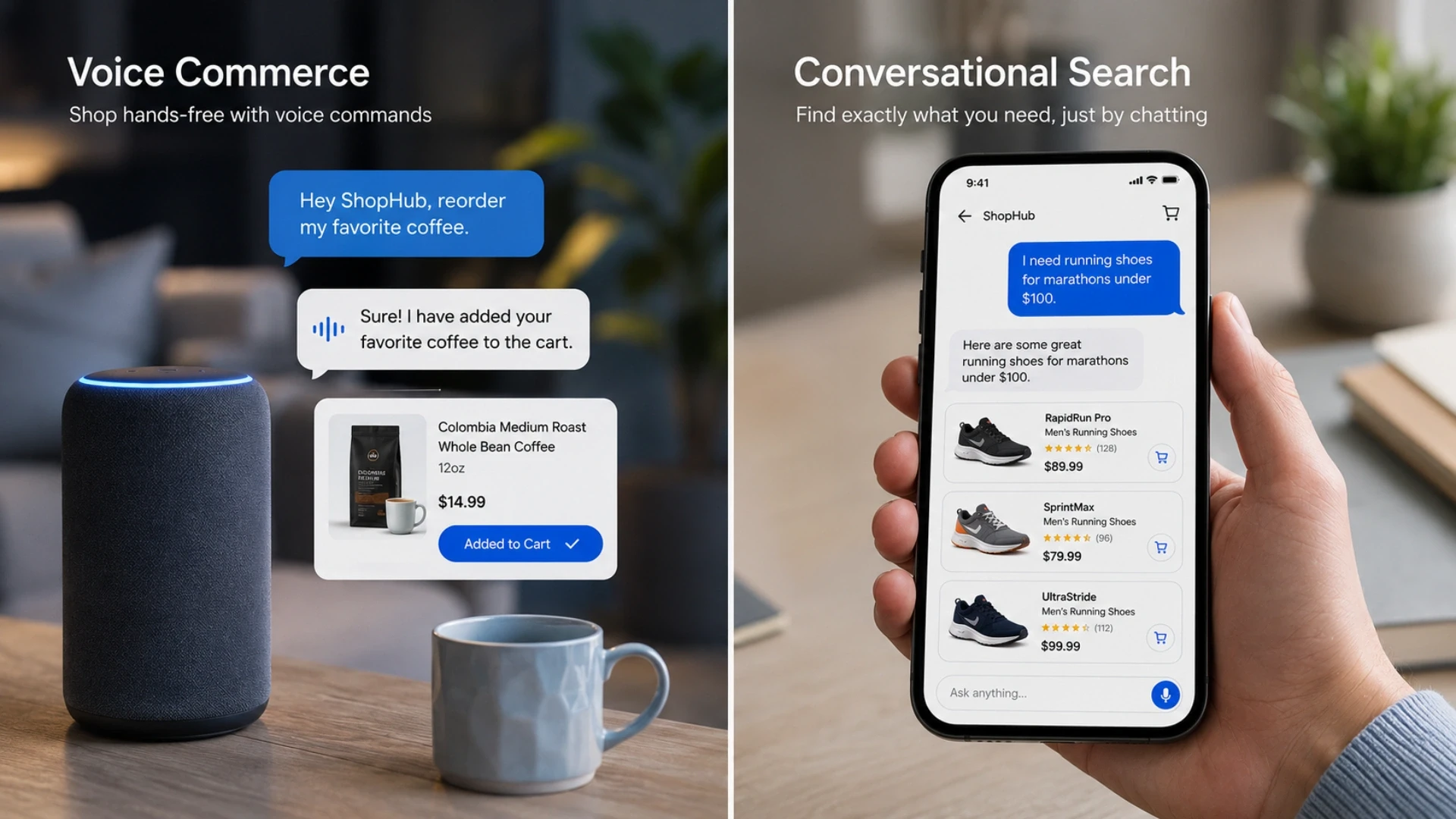
Voice commerce becomes a mainstream channel by 2030, with smart speakers and assistants evolving from playing music to processing purchases. Estimates already put around 35 percent of household grocery and refill purchases through voice commands in 2026.
This rewrites discovery. A command like reorder my coffee triggers a chain of price checks, delivery selection, and secure biometric payment, which means brands must optimize for conversational, natural-language queries rather than short typed keywords. Building voice-ready commerce and conversational search is an AI and integration challenge. Acquaint Softtech's development services team builds the natural-language and voice-checkout layers that capture this channel.
Conversational content wins voice
In a voice-first world, brands whose product content does not answer the natural questions people ask aloud simply become invisible. Optimizing descriptions for conversational, long-tail phrasing is the new SEO discipline for the voice era. The backend that connects voice and conversational interfaces to commerce logic is built by Acquaint Softtech's software product team through clean, channel-agnostic APIs, while ongoing platform modernization and version upgrade services ensure these systems remain scalable, secure, and compatible with evolving commerce technologies.
Social and livestream commerce keep accelerating
Social and livestream commerce continue their rapid climb through 2030, turning scrolling into instant buying and live video into a primary sales channel. Discovery, engagement, and checkout increasingly happen inside the social platform, never touching a traditional store.
For brands, this means the storefront can no longer be the only place commerce happens; product data, inventory, and checkout must extend into social platforms and live shopping experiences through integrations that keep everything in sync. Building these social and livestream integrations on a flexible backend is core engineering. Acquaint Softtech's product development team connects commerce data to social channels so selling happens wherever the customer is.
Human connection becomes premium
As AI handles the routine, human connection becomes the premium layer, with brands using live video, expert consultations, and community to build loyalty. Technology provides the speed, but the human element provides the connection that retains customers.
Teams that need to build these channels quickly can scale through Acquaint Softtech's staff augmentation services, which deploy vetted engineers into the build within 48 hours. How channel strategy fits the full build is covered in our E-Commerce Development Company Services page.
Composable and headless architecture: the foundation that makes it all possible
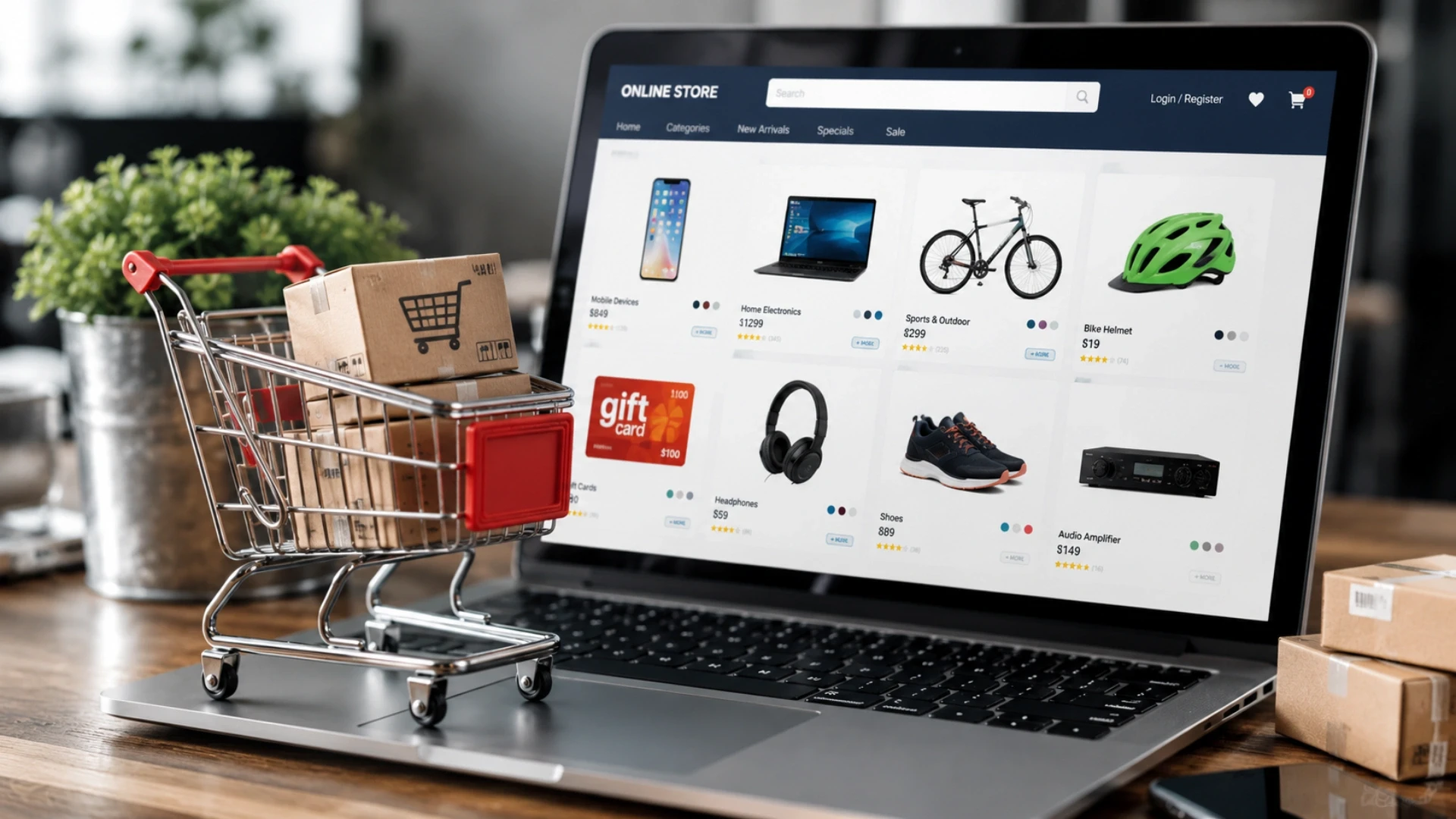
None of these trends- AI agents, AR, voice, social, are achievable on a rigid, all-in-one platform. The foundation that makes the future buildable is composable, headless architecture that separates the backend from the experiences layered on top.
Headless lets a brand deploy new shopping experiences across web, mobile, voice, and IoT without disrupting core operations, while composable lets it assemble best-in-class services and swap them as the technology landscape shifts through 2030.
Building this flexible foundation is the single most important future-proofing decision. Acquaint Softtech's product development team architects composable, API-first platforms designed to absorb whatever comes next.
Architecture is the real bet
The brands that struggle through 2030 will be the ones whose architecture cannot keep up, forced into a full rebuild each time a new channel matters. The right architecture turns every future trend from a crisis into a feature you simply add. The AI services that plug into a composable stack are built by Acquaint Softtech's AI development team, who design each capability as a modular, swappable component. How architecture decisions shape the future is covered in our article Why Develop Your E-Commerce Store With Laravel Bagisto guide.
Case study: building the AI foundation the future runs on
The future of commerce is built on AI and clean data, so the clearest proof of readiness is a brand that already owns that foundation. This engagement, verified on Clutch, shows a behavioral ML recommendation engine, the cornerstone of AI-first commerce.
Case Study: A Future-Ready AI Recommendation Engine A behavioral, ML-driven personalization engine, the foundational technology behind the AI-first commerce future, built and shipped. | Verified on Clutch (4.5/5) |
What the Client Needed • Personalization driven by real behavior, the core of future commerce • A scalable AI foundation to build future experiences on • Relevant products surfaced intelligently across partner stores What Acquaint Delivered → A Python-based ML recommendation engine analyzing behavior in real time → A behavioral data pipeline, the data layer future AI depends on → Dynamic recommendation APIs across product pages and checkout → Performance-tuned so AI recommendations appeared instantly |
The result: measurable gains in engagement, average order value, and repeat purchases. More importantly, the client now owns the AI and data foundation that every future commerce capability, from agentic checkout to predictive replenishment, will be built on top of. |
What makes this relevant to the future is not the recommendation feature itself, but the foundation underneath it: a behavioral data pipeline and a production ML system. That same foundation is what agentic checkout, predictive replenishment, and hyper-personalization will all be built on. This forward-looking foundation is the standard Acquaint Softtech's development services team builds toward, so every AI investment compounds into future capability rather than becoming throwaway work.
Clients who want the same team to build their roadmap year over year choose Acquaint Softtech's dedicated development team model, keeping continuity as the technology evolves. A second custom build is documented in our B2B E-Commerce Marketplace case study, showing future-ready API-driven architecture.
Want a platform ready for whatever comes next?
Acquaint Softtech builds composable, AI-first, future-ready commerce for brands across the USA, UK, Europe, UAE, and India at $25 to $49 per hour, up to 40 percent below Western agency rates, with 95 percent on-time delivery.
Up to 40% cost savings • 95% on-time delivery • Future-ready architecture • 24+ months avg tenure
What to build now: a practical roadmap to 2030
The practical answer to all this change is not to chase every trend, but to build the foundation that lets you adopt any of them. That means investing first in composable architecture, a clean data layer, and AI capability, in that order. Many businesses also choose to work with experienced development partners and hire Laravel developers to build scalable, future-ready platforms that can quickly adapt to evolving technologies and market demands.
With that foundation, the trends become additive: AR is a feature you add to product pages, voice is a new channel on the same backend, agentic commerce is an API you expose, and personalization is a model trained on data you already capture.
Translating this roadmap into a real build plan is where strategy meets engineering. Acquaint Softtech's software product team sequences the foundation first, so future capabilities slot in cleanly.
Start with the foundation, not the feature
The most common mistake is buying the shiny feature before the foundation, bolting AR or voice onto a rigid platform that cannot support it. Build the composable, data-rich, AI-ready base first, and every future trend becomes affordable to adopt. You can start with the foundation and add capacity through Acquaint Softtech's staff augmentation services as each new capability moves up the roadmap.
A note from Mukesh Ram, Founder & CEO
In 13 years of building software, I have learned that the brands who win are rarely the ones who chase every trend. They are the ones who build a foundation strong enough that the next trend is just a feature they add, not a crisis they survive. The future of commerce is intelligent, immersive, and frictionless, but none of it works on a rigid platform. Build the composable, data-rich, AI-ready foundation now, and you will spend the next five years adding capabilities while your competitors spend them rebuilding. That is the whole game. Mukesh Ram, Founder & CEO, Acquaint Softtech | Serving brands across the USA, UK, Europe, UAE, and India |
Join 200+ companies that chose Acquaint Softtech as their development partner.
1,300+ projects. 70+ engineers. 4.9/5 Clutch rating from 50+ verified clients. Official Laravel Partner. Your first engineer deploys within 48 hours of the brief and helps you build for the next five years.
Clutch Premier Verified • Official Laravel Partner • 13+ years • 20+ industries served
Frequently asked questions
-
What are the top e-commerce technology trends for 2026 to 2030?
The leading trends are AI-driven hyper-personalization, agentic AI commerce, AR and VR shopping, voice commerce, social and livestream selling, and composable headless architecture. They fall under three forces: intelligence, immersion, and frictionlessness. The brands that win build an integrated foundation rather than disconnected point solutions.
-
How will AI change online shopping?
AI will shift from recommending products to anticipating needs and acting on them. AI agents will autonomously compare, negotiate, and buy across retailers, while hyper-personalization adapts every element to the individual. Around a third of e-commerce enterprises are expected to use agentic AI by 2028, changing how products get discovered and bought.
-
What e-commerce technology should I invest in now?
Invest in the foundation first: composable headless architecture, a unified customer data layer, and an AI capability, in that order. With that base, AR, voice, agentic commerce, and personalization become features you add rather than rebuild. Buying shiny features before the foundation is the most common and costly mistake.
-
What is the future of online retail?
Online retail by 2030 is intelligent, immersive, and frictionless: AI personalizes and automates the journey, AR and live shopping rival the in-store experience, and headless and voice remove every step between intent and purchase. The US market alone is projected to grow from $1.25 trillion in 2025 to $2.08 trillion by 2030.
-
What is agentic commerce?
Agentic commerce is where AI agents shop on a customer's behalf, autonomously comparing products, negotiating, and completing purchases across multiple retailers without the human browsing directly. It requires stores to expose clean, machine-readable data and agent-friendly checkout, or risk becoming invisible in an agent-driven market.
-
Does AR really improve e-commerce sales?
Yes. Retailers using AR report up to 94 percent higher conversion on AR-enabled products, around 40 percent fewer returns, and a 30 percent lift from virtual try-on. AR works by replacing purchase uncertainty with confidence, which raises conversion and cuts returns at the same time. The AR commerce market is forecast to reach $38.5 billion by 2030.
-
Why is composable architecture important for the future?
Composable, headless architecture separates the backend from the customer experience, letting brands deploy new channels like voice, AR, and social without disrupting core operations, and swap services as technology evolves. It is the foundation that makes every future trend affordable to adopt rather than a costly rebuild each time.
-
How fast can Acquaint start my future-ready project?
Your first engineer deploys within 48 hours of the brief. The path is a free consultation, a discovery workshop to map your technology roadmap, then kickoff in two-week sprints that build the composable, AI-ready foundation first so future capabilities slot in cleanly.
I love to make a difference. Thus, I started Acquaint Softtech with the vision of making developers easily accessible and affordable to all. Me and my beloved team have been fulfilling this vision for over 15 years now and will continue to get even bigger and better.
Table of Contents
Get Started with Acquaint Softtech
- 13+ Years Delivering Software Excellence
- 1300+ Projects Delivered With Precision
- Official Laravel & Laravel News Partner
- Official Statamic Partner
Related Blog
.webp "Why Develop Your E-commerce Website With Laravel Bagisto?")
Why Develop Your E-commerce Website With Laravel Bagisto?
Bagisto is a free, open-source e-commerce platform built on the Laravel PHP framework and Vue.js. Created by Webkul, it lets developers and merchants build highly customizable online stores, multi-vendor marketplaces, and headless commerce with minimal setup. Because it leverages Laravel, you get a robust ecosystem, rapid deployment tools, and huge flexibility for custom enterprise applications, which is why it is a top choice for an e-commerce website with Laravel Bagisto.
Mukesh Ram
April 29, 2022
5 Best Frameworks For E-commerce Website Development In 2019
Frameworks have libraries of pre-written code so you can develop websites faster. Have a look at the 5 best frameworks to develop your e-commerce store.
Mukesh Ram
April 1, 2019India (Head Office)
203/204, Shapath-II, Near Silver Leaf Hotel, Opp. Rajpath Club, SG Highway, Ahmedabad-380054, Gujarat
USA
7838 Camino Cielo St, Highland, CA 92346
UK
The Powerhouse, 21 Woodthorpe Road, Ashford, England, TW15 2RP
New Zealand
42 Exler Place, Avondale, Auckland 0600, New Zealand
Canada
141 Skyview Bay NE , Calgary, Alberta, T3N 2K6