

The Future of Logistics Technology 2026-2030: Trends, Predictions, and What to Build Now
Logistics technology is shifting toward AI-powered, self-healing supply chains with real-time automation and decision-making. Key trends include agentic AI, digital twins, IoT, blockchain, and autonomous systems built on connected data.

Mukesh Ram
What if the biggest logistics risk through 2030 is not adopting the wrong technology, but waiting too long to act? As CEO of Acquaint Softtech, I have seen how organizations that invest early with the right software product development partner build a lasting competitive advantage while others struggle to catch up. The challenge is not predicting every industry change. It is creating a flexible technology foundation that can adapt to whatever comes next.
Investment in logistics tech is accelerating fast; 62% of shippers are planning to triple spending as the supply chain software market heads toward $24B by 2029 and cloud logistics toward $46B by 2030. Companies using AI are already reducing logistics costs by around 15% and cutting disruptions by up to 30% with digital twins. The shift is clear: future leaders won’t just use software; they’ll rely on systems that can think and act.

- You lead logistics strategy and need a clear view of what is coming through 2030.
- You are deciding where to invest your technology budget over the next few years.
- You operate across the USA, UK, Europe, UAE, or India and want region-relevant signals.
- You are a founder choosing which future-ready product to build now.
- You want to separate real, fundable trends from hype before you commit.
This report maps the trends that will define logistics from 2026 to 2030, the predictions worth planning around, and the concrete things worth building now rather than later. It is part of the Complete Guide to Logistics and Supply Chain Software Development in 2026, drawing on platforms Acquaint Softtech has shipped as an Official Laravel Partner with 1,300+ projects, 70+ in-house engineers, and a 4.9/5 Clutch rating from 50+ verified clients.
The big shift: from systems of record to systems of action
Agentic AI and the self-healing supply chain

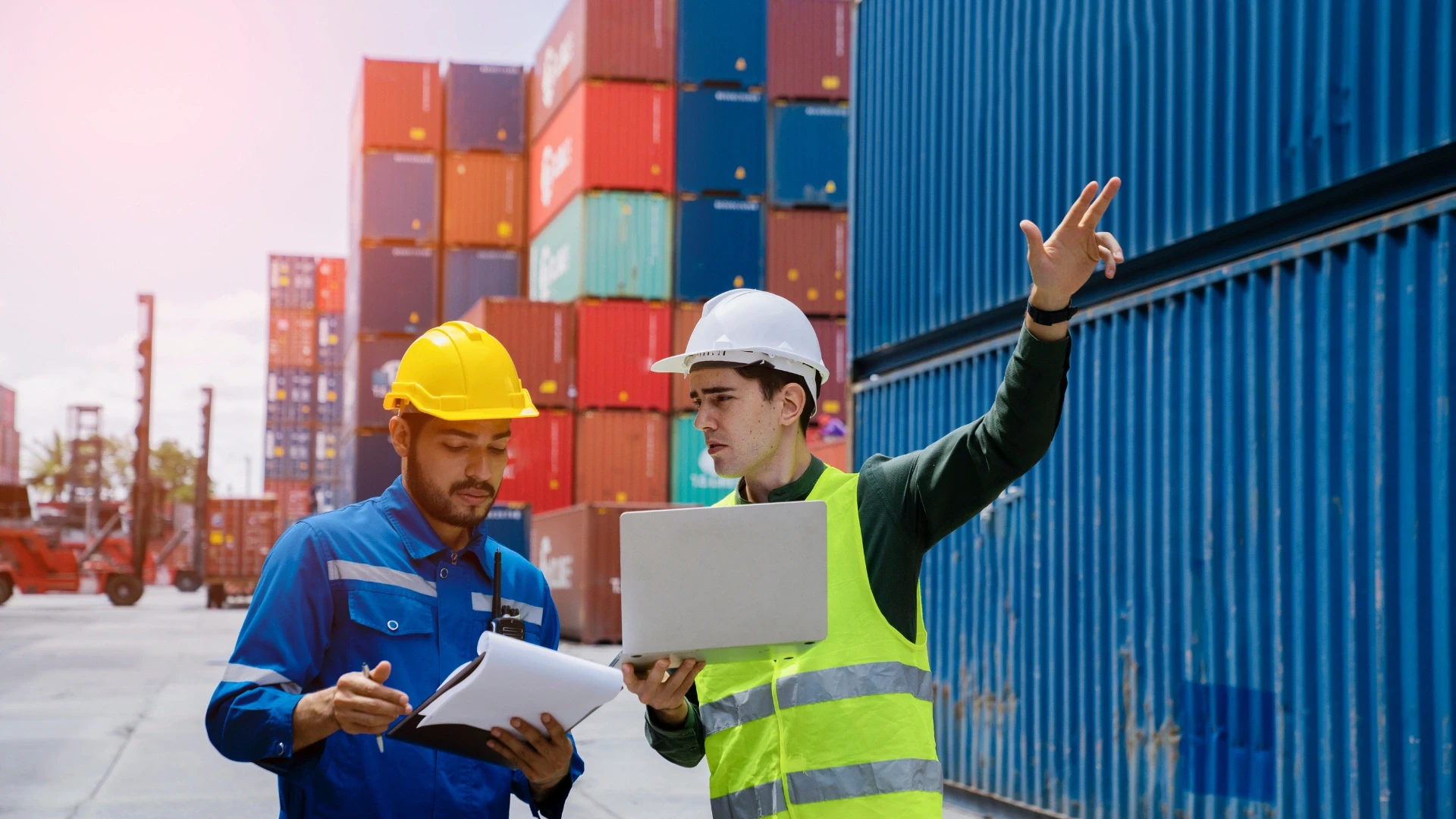
The headline trend through 2030 is agentic AI: software agents that forecast, replan, and resolve disruptions end to end with minimal human input. This produces the self-healing supply chain, where a port closure or demand spike triggers automatic rerouting, rate renegotiation, and inventory adjustment before a human even logs in. Businesses looking to accelerate the development of these intelligent logistics platforms often choose to hire Laravel developers to build scalable, AI-enabled supply chain solutions with faster time to market.
By 2026, AI is already moving from predictive to agentic, and by 2030 autonomous planning, where AI continuously orchestrates demand, supply, and capacity without calendar-based cycles, becomes the norm rather than the experiment.
The winning pattern remains human plus machine: AI executes the routine, people handle judgment calls. Operators exploring this should study how logistics companies use digital twins for supply chain simulation and risk planning alongside agentic execution, since the two reinforce each other. For leaders aligning AI with cross-border operations, an online supply chain MBA concentrating on global trade, analytics, and risk prepares managers to translate digital twins and agentic automation into resilient, compliant networks.
Acquaint Softtech's development services build agentic and decision-support systems on your data. The Python model and pipeline work is delivered by our Python developers. The foundations of these models are covered in an article guide on AI and machine learning in logistics.
Digital twins as the new planning surface
A digital twin is a live virtual replica of a supply chain, warehouse, or network that planners use to simulate changes before making them. By 2030, the unified supply-demand-capacity twin becomes the default planning surface, enabling a simulate-then-act approach instead of guesswork.
The payoff is already measurable: Gartner reports a 30 percent decrease in disruptions for companies using digital twins, and firms leveraging them have seen revenue gains and faster time to market. Twins let an operator test a new warehouse, a sourcing change, or a peak-season plan in software, at zero physical risk. This capability connects directly to warehouse digital twins for layout optimization and to logistics and climate resilience software that adapts routes and plans for extreme weather, both of which depend on a trustworthy virtual model.
Acquaint Softtech's AI development services build simulation and digital-twin models. The data infrastructure behind the twin is built by our backend development team.
Planning for the next five years? Build the foundation these trends need.
Acquaint Softtech builds AI, digital-twin, and connected-data platforms for clients across the USA, UK, Europe, UAE, and India. Your first dedicated engineer deploys within 48 hours of the brief. 1,300+ projects delivered 70+ in-house engineers 48-hr deployment 4.9/5 Clutch (50+ reviews)
Autonomous vehicles, robots, and the labor gap
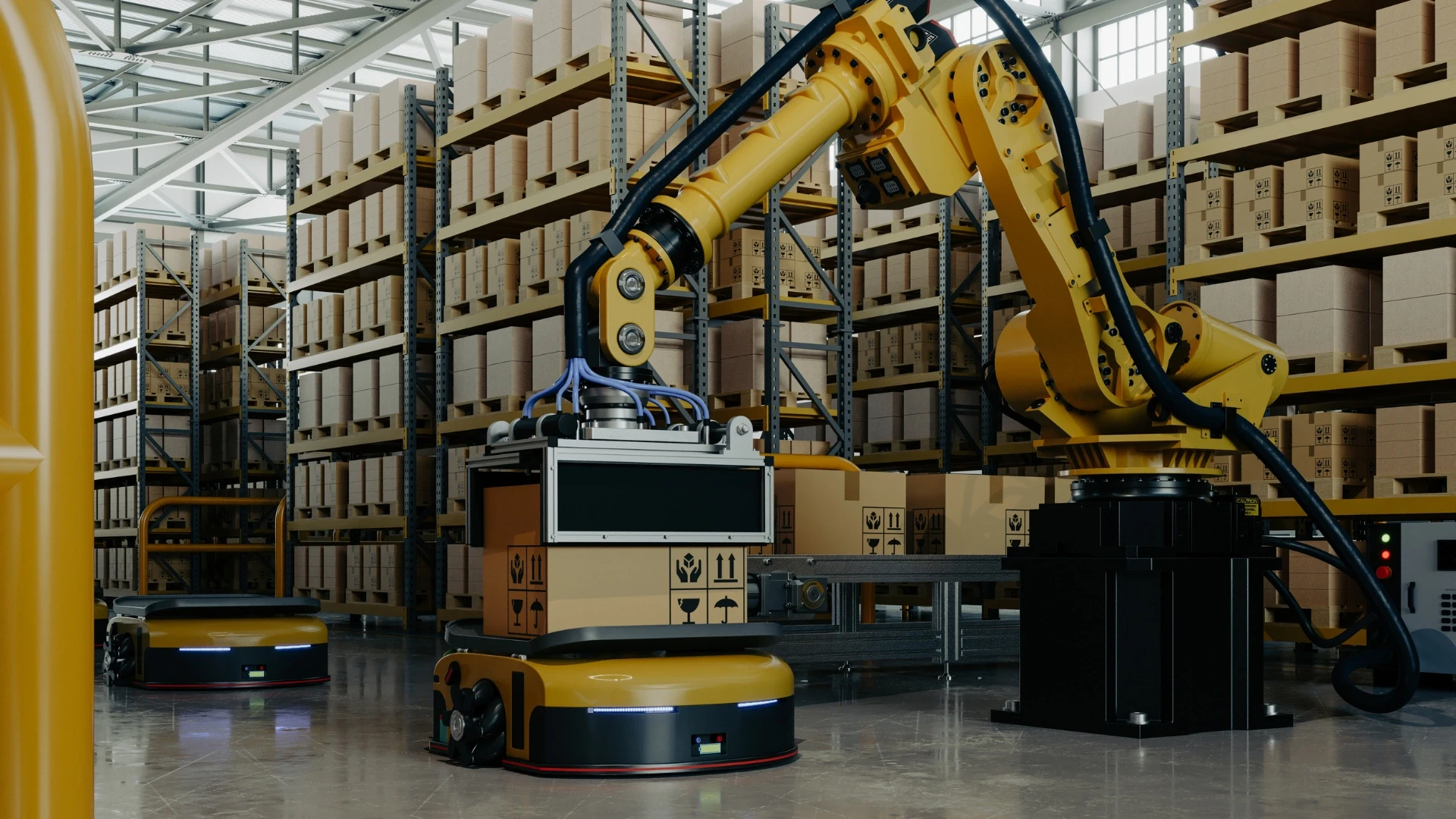
Autonomy is the trend that solves logistics' deepest structural problem: a shrinking workforce. By 2030, driver-out yard tractors, hub-to-hub trucks, beyond-visual-line-of-sight delivery drones, and warehouse robots fill labor gaps that hiring no longer can, while improving asset turns and cutting emissions on fixed routes.
Major ports are already moving to fully automated crane and yard systems, and autonomous mobile robots are scaling warehouse picking and replenishment. The biggest single shift many experts name is autonomous vehicles filling the gap left by aging drivers exiting the market. Operators preparing for this should track warehouse automation trends 2026 covering AGVs, cobots, goods-to-person systems, and ROI, and watch how AR, VR, and spatial computing are entering warehouse operations to guide and train a smaller human workforce.
Acquaint Softtech's software product development team builds the control and orchestration software around automation hardware. The real-time integration with robots and vehicles is built by our DevOps engineers. How vehicle telematics and autonomy data flow today is covered in our article guide on how fleet management systems work.
IoT, 5G, and edge: real-time visibility everywhere

The visibility layer of the future runs on IoT sensors, 5G connectivity, and edge computing working together. Over 80 percent of logistics companies plan to integrate IoT for real-time tracking and loss prevention, turning every vehicle, pallet, and warehouse into a live data source feeding a central control tower.
The shift that matters is where the data is processed. Edge computing analyzes sensor data locally for instant anomaly detection, while 5G moves high-frequency telemetry fast enough for real-time decisions. This is the backbone for everything else in this report.
Operators should explore 5G and edge computing in logistics for real-time data processing, supported by scalable solutions built by dedicated MERN experts through hiring MERN stack developers, and recognize that this connected fabric also widens the attack surface, making logistics cybersecurity to protect fleet, warehouse, and shipment data a board-level concern this decade.
Blockchain, sustainability, and the compliance wave
Two forces converge through 2030: the demand for verifiable transparency and the regulatory push on sustainability. Blockchain provides an immutable record of a product's journey for traceability and provenance, while tightening carbon and labor regulations make environmental tracking a compliance requirement, not a marketing choice.
By 2030, digital product passports, Scope 3 emissions tracking, and verifiable provenance move from optional to mandatory in many markets, especially the EU. Circular logistics, designing reuse, repair, and recycling in from the start, becomes a competitiveness issue. Operators should study blockchain in supply chain for traceability and provenance, build toward sustainability and green supply chain software, and prepare for circular supply chain platforms for reuse, recycling, and reverse material flows. Acquaint Softtech's product development team builds traceability and emissions-tracking platforms. The integration with existing systems is led by our software development outsourcing team.
Regional signals: USA, UK, Europe, UAE, and India

The future of logistics technology will not arrive evenly. Each region has distinct drivers, and where you operate shapes what you should build first. Reading these signals correctly is the difference between building for your market and building for someone else's.
In the USA and UK, autonomous freight and the driver gap dominate. In Europe, sustainability regulation and cross-border compliance lead. The UAE and wider GCC are investing heavily in smart logistics infrastructure, so Middle East and GCC logistics technology opportunities in the UAE, Saudi Arabia, and Qatar are a real opening. India is a standout, with India's logistics opportunity from PM Gati Shakti and the National Logistics Policy and the rise of logistics SaaS in India creating space for founders to build at national scale. Multi-region delivery is supported by our dedicated software development teams.
What to build now: a 2026 to 2030 investment roadmap
The smartest move now is not to chase the flashiest 2030 technology, but to build the foundation everything else depends on. The roadmap below sequences investment so each stage earns its keep and enables the next.
Horizon | What to build |
Now (2026) | Clean, connected data layer across your systems |
Near (2026-2027) | AI demand forecasting, route optimization, real-time visibility |
Mid (2027-2028) | Digital twin for planning, IoT and edge sensing |
Far (2028-2030) | Agentic automation, autonomy orchestration, traceability |
The order matters more than the ambition. Agentic AI on messy, siloed data fails; the same AI on a clean, connected foundation transforms the business. Build the foundation first, layer intelligence on top, and add autonomy and traceability as the technology and your data mature. A virtual CTO can sequence it for you through our virtual CTO services. How to control spend across this roadmap is covered in our full article guide on how to reduce software development costs without reducing quality.
Case study: a future-ready multi-country platform

The clearest proof that the foundation comes first is a real build. This engagement, verified on Clutch, shows a multi-country operator unifying its data into one connected platform, the prerequisite for every future trend in this report.
Case Study: Building the Connected Data Foundation for the Future Custom manufacturer unifying operations across a UK factory, US showrooms, a Brooklyn warehouse, and a Poland finishing facility into one connected platform | Verified on Clutch (5.0/5) | ||
| ||
The Future-Readiness Lesson
| ||
"Their ability to translate a complex multi-location operation into one connected, intuitive platform stood out. They understood that getting the data right first was the foundation for everything we wanted to do next, and delivery milestones were met consistently." CEO, Custom Manufacturing Company (UK, USA, and EU operations) | 5.0/5 on Clutch Read verified reviews and case studies: acquaintsoft.com/case-studies |
What makes this instructive is the sequence: the operator did not chase AI or autonomy first. It built one connected, clean data foundation across four countries, exactly the now stage of the roadmap in Section 08, which is what makes the next stages possible.
Acquaint Softtech's software product development team specializes in building these future-ready foundations. For operators who want to keep the same engineers through the roadmap, the dedicated software development teams model fits best, and you can also explore hiring MEAN stack developers for scalable, long-term engineering support.
Want to be a 2030 leader, not a laggard? Start with the foundation.
Acquaint Softtech builds future-ready logistics platforms for clients across the USA, UK, Europe, UAE, and India at $25 to $49 per hour, up to 40 percent below Western agency rates, with 95 percent on-time sprint delivery. Up to 40% cost savings 95% on-time delivery Multi-region experience 24+ months avg tenure
Expert insight: Mukesh Ram, Founder and CEO, Acquaint Softtech
Every founder and CTO I talk to wants to know which 2030 technology to bet on. It is the wrong question. The technology will keep changing, but the thing that determines whether you can adopt any of it stays the same: do you have clean, connected, trustworthy data. I have watched companies spend fortunes on AI that produced nothing because their data was a mess across ten systems, and I have watched smaller players leap ahead simply because they unified their data first. Build the foundation now. The future bolts onto it cleanly, whatever shape it takes. Mukesh Ram | Founder and CEO, Acquaint Softtech | Logistics technology strategy across the USA, UK, Europe, UAE, and India |
Join 200+ companies building for the next decade with Acquaint Softtech.
1,300+ projects. 70+ engineers. 4.9/5 Clutch rating from 50+ verified clients. Clutch Premier Verified. Official Laravel Partner. Your first engineer deploys within 48 hours of brief. Clutch Premier Verified Official Laravel Partner 13+ years experience 20+ industries served
Frequently asked questions
-
What are the top logistics tech trends for 2026 to 2030?
The top trends are agentic AI and self-healing supply chains, digital twins for simulation, autonomous vehicles and warehouse robots, IoT and 5G real-time visibility, blockchain traceability, and embedded sustainability. They are layers of one shift: from systems that record data to systems that act on it.
-
How will AI change logistics by 2030?
By 2030, AI moves from predictive to agentic, running forecasting, replanning, and disruption response autonomously under human oversight. McKinsey predicts AI will be one of the most important technologies reshaping logistics, with companies already cutting logistics costs around 15 percent after adopting it.
-
What should logistics companies invest in now?
Invest first in a clean, connected data foundation, then AI forecasting and real-time visibility, then digital twins, then agentic automation and traceability. The order matters: advanced AI fails on messy, siloed data, so the unglamorous foundation is the highest-return investment now.
-
What is the future of supply chain software?
Supply chain software is becoming a system of action, not record. Autonomous planning will continuously orchestrate demand, supply, and capacity without calendar-based cycles, supported by digital twins, IoT, and agentic AI, while sustainability and traceability become built-in compliance requirements.
-
What is a self-healing supply chain?
A self-healing supply chain uses AI agents to detect and resolve disruptions automatically, rerouting shipments, renegotiating rates, or adjusting inventory in real time during a port closure or demand spike, with minimal human intervention. It is the practical goal of agentic AI in logistics.
-
How big is the logistics technology market?
The supply chain management software market is climbing past $24 billion by 2029, and cloud logistics toward $46 billion by 2030. About 62 percent of shippers plan to triple technology investment, signaling that spending on these trends is accelerating sharply.
-
Is blockchain actually useful in logistics?
Yes, for traceability and provenance. Blockchain gives an immutable record of a product's journey, which matters most for compliance, sustainability verification, and high-value or regulated goods. It is becoming more relevant as digital product passports and emissions tracking become mandatory in markets like the EU.
-
How does Acquaint Softtech help build future-ready logistics tech?
Acquaint Softtech starts by building the clean, connected data foundation, then layers AI, digital twins, and automation in a staged roadmap, with optional virtual CTO support. The first engineer deploys within 48 hours. Verified 4.9/5 on Clutch from 50+ reviews.
I love to make a difference. Thus, I started Acquaint Softtech with the vision of making developers easily accessible and affordable to all. Me and my beloved team have been fulfilling this vision for over 15 years now and will continue to get even bigger and better.
Table of Contents
Get Started with Acquaint Softtech
- 13+ Years Delivering Software Excellence
- 1300+ Projects Delivered With Precision
- Official Laravel & Laravel News Partner
- Official Statamic Partner
How Fleet Management Systems Work: GPS Tracking, Vehicle Telematics, and Driver Monitoring
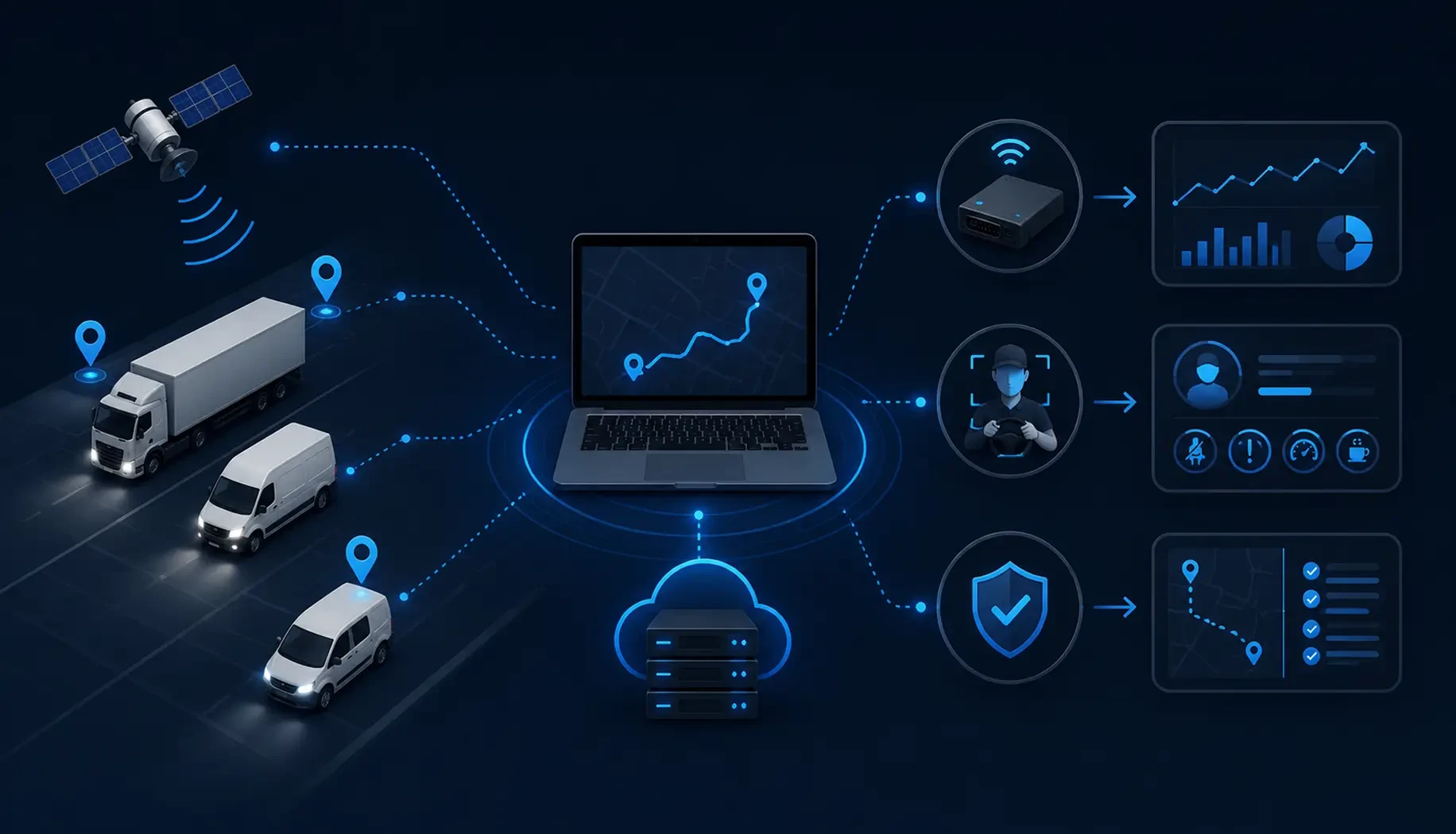
A Fleet Management System is not a map with moving dots. It is the operational control layer that connects GPS position, engine diagnostics, driver behaviour, maintenance schedules, and compliance records into a single decision surface. Most fleet software projects fail because they build the map first and the data pipeline last.

Manish Patel
May 26, 2026India (Head Office)
203/204, Shapath-II, Near Silver Leaf Hotel, Opp. Rajpath Club, SG Highway, Ahmedabad-380054, Gujarat
USA
7838 Camino Cielo St, Highland, CA 92346
UK
The Powerhouse, 21 Woodthorpe Road, Ashford, England, TW15 2RP
New Zealand
42 Exler Place, Avondale, Auckland 0600, New Zealand
Canada
141 Skyview Bay NE , Calgary, Alberta, T3N 2K6