

How Fleet Management Systems Work: GPS Tracking, Vehicle Telematics, and Driver Monitoring
A Fleet Management System is not a map with moving dots. It is the operational control layer that connects GPS position, engine diagnostics, driver behaviour, maintenance schedules, and compliance records into a single decision surface. Most fleet software projects fail because they build the map first and the data pipeline last.

Manish Patel
As Head of Tech and Client Success at Acquaint Softtech, a software development partner with 1,300+ projects delivered across 13 years, I have architected fleet management platforms for logistics companies, last-mile delivery networks, and municipal transport operators across the US, UK, Australia, and the UAE. The builds that succeed share one discipline: they treat the telematics data pipeline as the primary engineering problem and the driver-facing interface as the secondary one. Fleet management software is a real-time data engineering challenge wrapped in an operations product. GPS coordinates arrive every 5 to 30 seconds per vehicle.
Engine diagnostics arrive every 60 seconds. Driver behaviour events fire on every harsh brake, rapid acceleration, and seatbelt unbuckle. A fleet of 200 vehicles generates 800,000 to 1,200,000 data points per day. The platform that manages this data correctly is what separates a fleet management system from a vehicle dot on a map. For the full logistics context, see our software product development services for logistics platforms.

- Fleet and logistics leaders choosing between custom fleet platforms or telematics vendors.
- CTOs designing real-time fleet SaaS with GPS tracking, driver monitoring, and maintenance systems.
- Founders building last-mile delivery platforms and defining MVP requirements.
- Operations teams moving from basic GPS tools and spreadsheets to full fleet management systems.
Problem: Most fleet operators are managing vehicles with a combination of consumer GPS trackers, carrier phone apps, and spreadsheet-based maintenance logs. The data exists in five places and answers zero questions in real time.
Agitation: When a vehicle breaks down 400 miles from the depot, the operations manager discovers the engine threw a fault code 72 hours earlier that nobody saw because the telematics data was in a portal nobody checks. The repair costs three times the preventive maintenance. Multiply that across a 150-vehicle fleet, and the annual waste is six figures.
Solution: A purpose-built fleet management system that ingests telematics data continuously, routes it through rules engines for maintenance alerts, driver safety scoring, and route compliance, and surfaces decisions to operations managers before the breakdown happens. This article maps that system from the data pipeline to the driver app.
The confusion around fleet management systems starts with the word 'tracking.' Most operators equate fleet management with fleet tracking. Tracking is one function inside a fleet management system. A production-grade platform also manages: vehicle health (telematics ingestion, diagnostic trouble code interpretation, preventive maintenance scheduling), driver behaviour (harsh event detection, safety scoring, Hours of Service compliance), fuel management (fuel consumption analysis, idle time tracking, fuel card reconciliation), and asset lifecycle (acquisition tracking, depreciation, disposal planning).
Understanding the full scope before building prevents the most common failure mode: a live tracking map with no operational intelligence underneath it. If you are planning to hire Python developers for fleet GPS tracking architecture, the data pipeline and module sections below will give you a concrete technical scope to start from.
What a Fleet Management System Must Actually Control
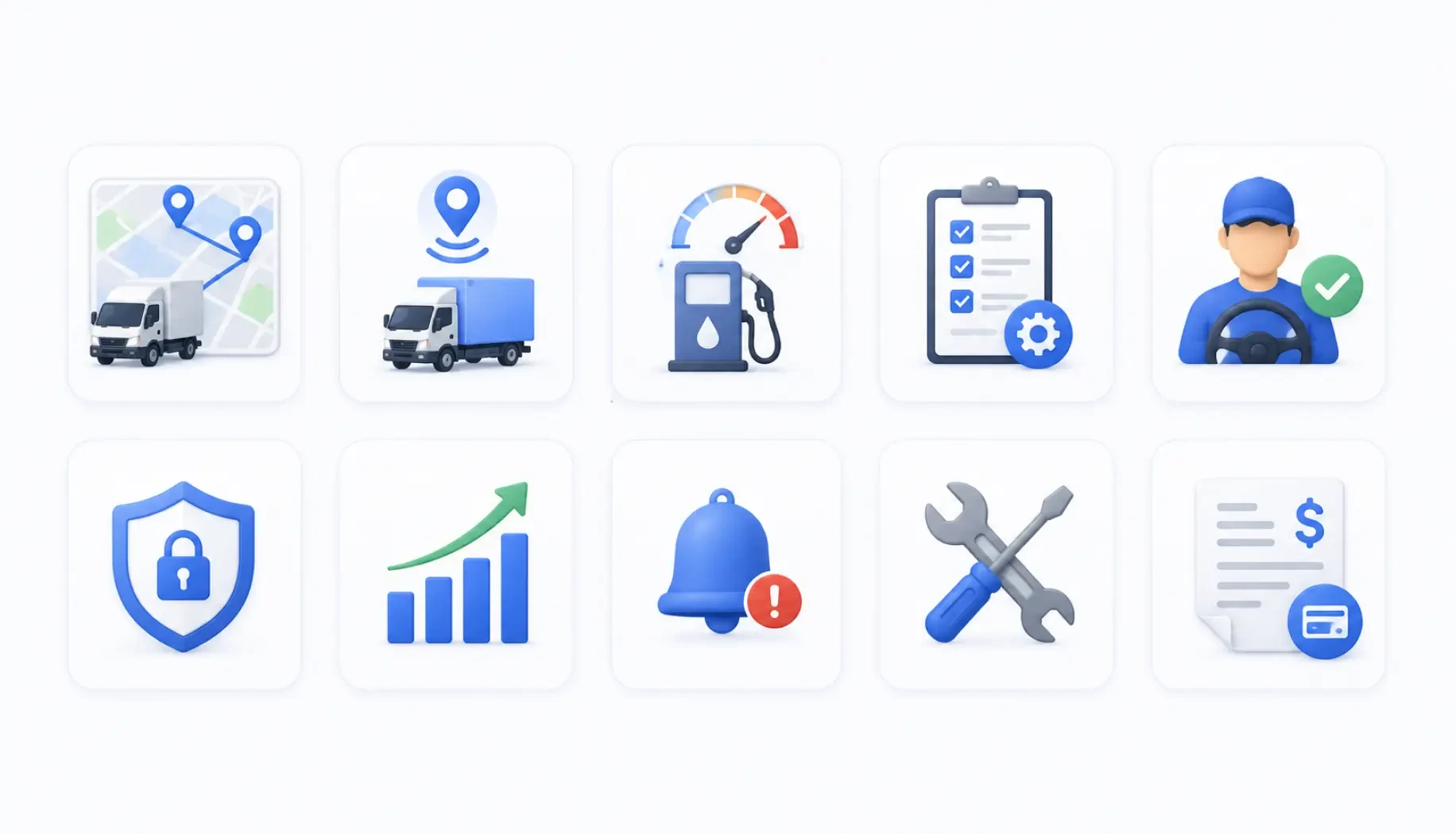
A Fleet Management System (FMS) is the operational platform that controls every aspect of a vehicle fleet from acquisition to disposal. It is not a GPS fleet tracking with a web dashboard. It is not a maintenance reminder app. It is the system of record for vehicle position, vehicle health, driver behaviour, regulatory compliance, and fleet cost management, operating continuously across every vehicle in the fleet.
A production-grade FMS does five things simultaneously.
Ingests real-time telemetry from every vehicle (GPS position, engine diagnostics, driver inputs) and stores it in a time-series pipeline that can handle 1,000+ events per second for a 500-vehicle fleet.
Applies rules to the telemetry stream: geofence violations, speed limit breaches, harsh braking events, engine fault codes, idle time thresholds, and Hours of Service (HOS) violations.
Manages the physical asset lifecycle: acquisition, registration, insurance, scheduled maintenance, unscheduled repair, depreciation tracking, and disposal.
Monitors and scores driver behaviour: safety events, fuel efficiency, compliance with driving regulations, and training needs.
Produces the operational reporting that fleet managers, safety officers, and finance teams require: cost per mile, fuel consumption per vehicle, maintenance cost trends, and driver safety rankings.
Any product that does fewer than these five is a partial tool. Recognising the full scope at project start prevents the most expensive failure mode in fleet software: building a real-time map and then discovering six months later that the operations team also needs maintenance scheduling, fuel reconciliation, and HOS compliance, none of which share data with the tracking module because nobody planned the shared data layer.
The Telematics Data Pipeline: From Sensor to Decision
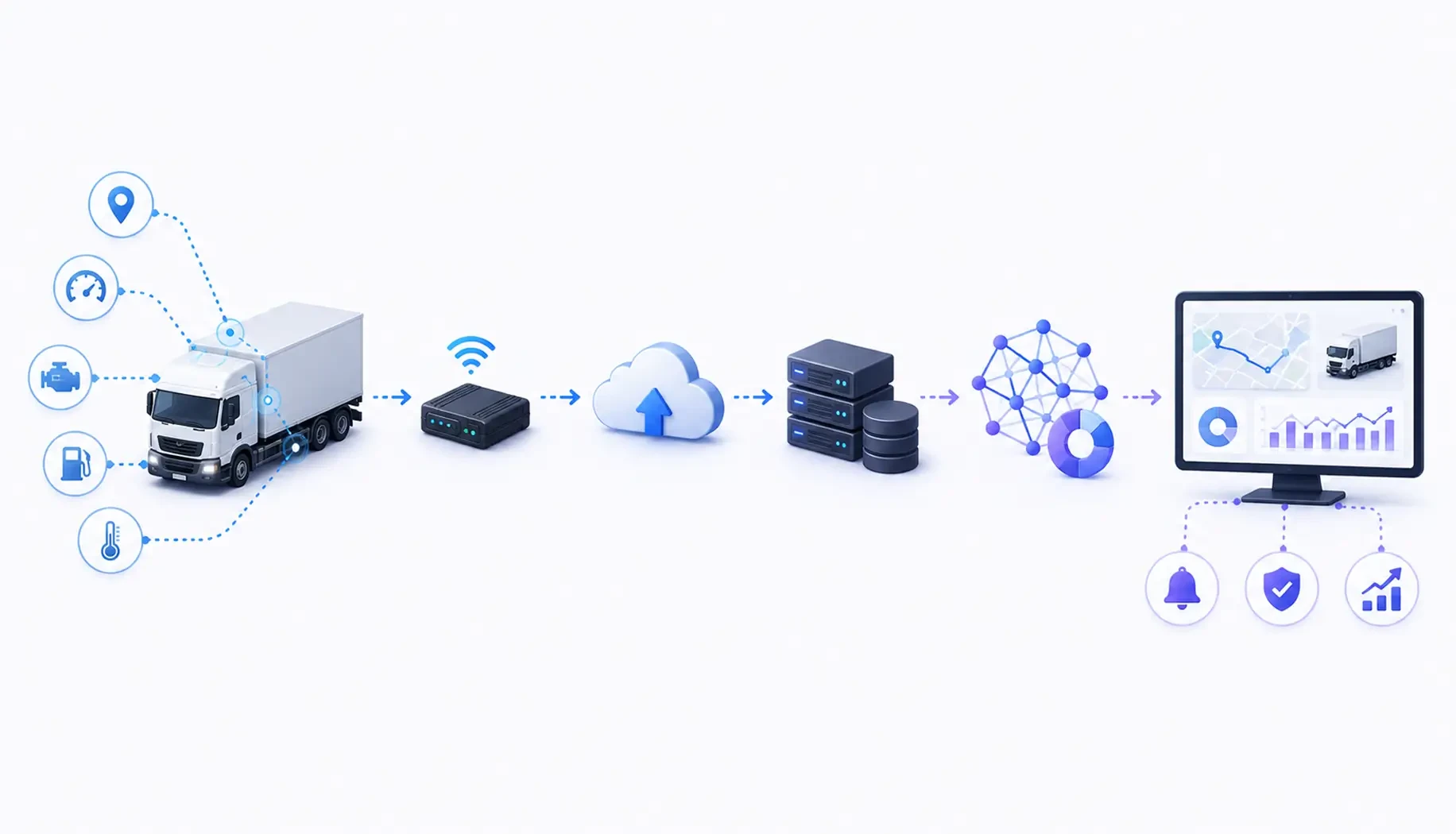
Vehicle telematics is the foundation of every fleet management system. The pipeline that moves data from the vehicle sensor to the operations dashboard determines whether the platform can handle 50 vehicles or 5,000. Understanding the pipeline is the most important technical decision in any fleet software build.
STAGE 01 : Data Acquisition
OBD-II dongles, factory-installed telematics control units (TCUs), or aftermarket GPS/CAN bus devices collect data at the vehicle level. Standard data points: GPS latitude/longitude/altitude/heading/speed (every 5 to 30 seconds), engine RPM, coolant temperature, fuel level, diagnostic trouble codes (DTCs), accelerometer readings for harsh event detection, and odometer. A single vehicle generates 4,000 to 15,000 data points per day, depending on driving hours and reporting frequency.
STAGE 02 :Data Transmission
Devices transmit over cellular (4G/LTE, increasingly 5G) to the platform ingestion endpoint. Protocol options: MQTT for low-bandwidth, high-frequency telemetry (the 2026 default for fleet), HTTP REST for lower-frequency batch uploads, and proprietary vendor protocols that require a translation layer. Transmission must handle: intermittent connectivity (store-and-forward when out of coverage), data compression (critical for high-frequency reporting at fleet scale), and device authentication (every transmission must be verified against a registered device ID).
STAGE 03 : Ingestion and Stream Processing
The platform receives the telemetry stream at an MQTT broker or API gateway, normalises the data format (different device vendors send different schemas), enriches it with fleet context (vehicle ID, assigned driver, current route), and publishes it to a stream processing layer. Apache Kafka is the 2026 default for fleet-scale ingestion. For fleets under 200 vehicles, Redis Streams is a simpler alternative. The stream processor applies real-time rules: geofence entry/exit, speed threshold breach, harsh braking detection, and engine fault code alerting.
STAGE 04: Storage
Processed telemetry is written to a time-series database (TimescaleDB on PostgreSQL, or InfluxDB) for historical analysis, and to a hot cache (Redis) for real-time dashboard queries. Raw telemetry is archived to object storage (S3) for regulatory compliance and dispute resolution. A 500-vehicle fleet generates approximately 2 to 5 GB of telemetry data per month after compression. Retention policy: hot storage for 90 days, warm storage for 1 year, cold archive for 3 to 7 years, depending on regulatory requirements.
STAGE 05 : Decision Surface
The processed, stored, and enriched data is surfaced through three interfaces: a web-based fleet operations dashboard (React or Vue) for dispatchers and fleet managers, a mobile driver app (React Native) for driver task management and HOS logging, and an API layer for integration with TMS, ERP, and third-party analytics tools. The decision surface is the last layer built, not the first. Teams that build the map before the pipeline ship a demo, not a product. For teams evaluating frontend stack options, our MEAN stack developers are experienced in high-concurrency fleet dashboard builds.
GPS Tracking Architecture: Position, Geofence, and History
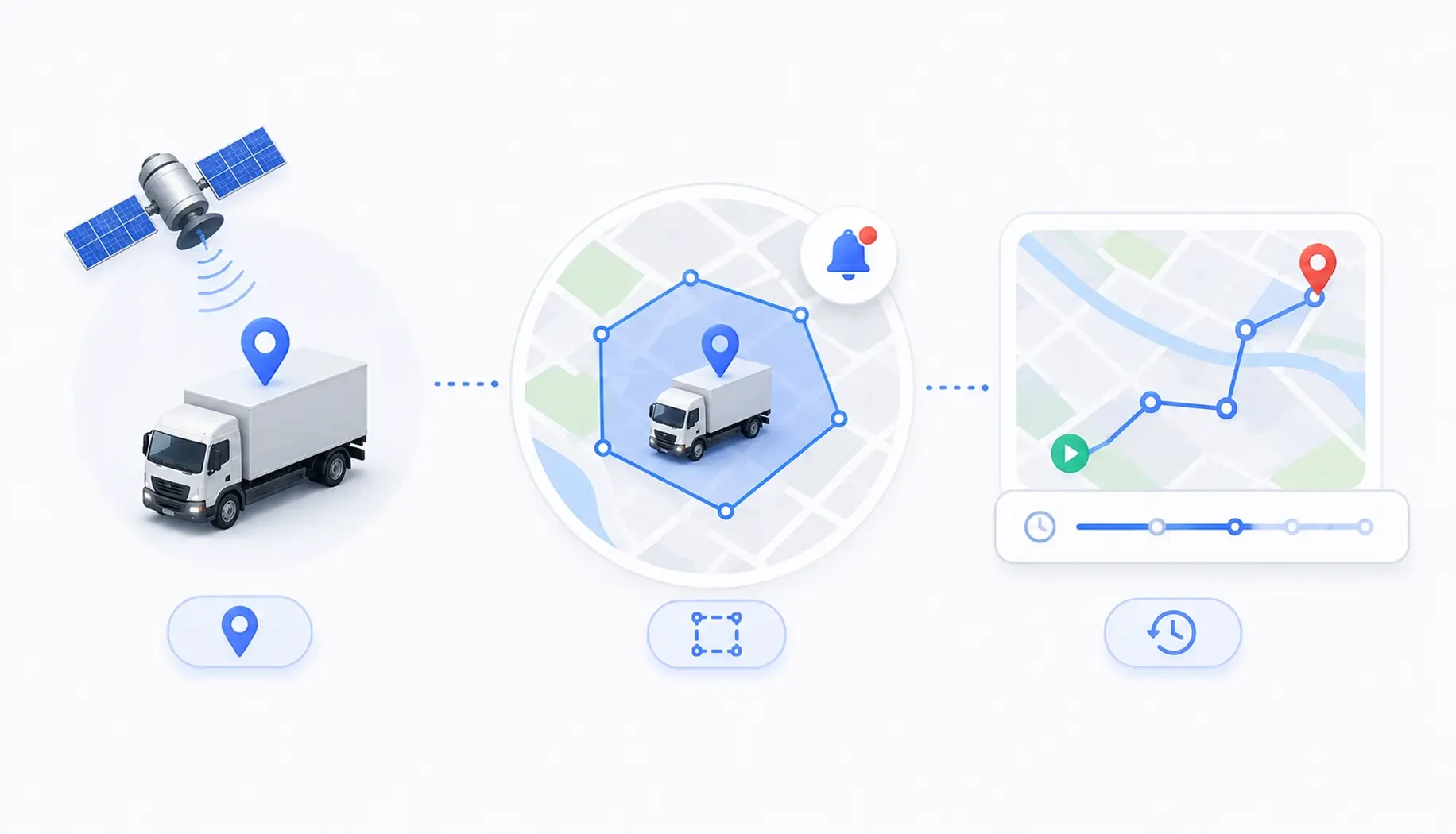
GPS tracking is the most visible module in a fleet management system, but it is built on top of the telematics pipeline, not beside it. The tracking architecture has three operational layers that must work together.
Layer 1: Real-Time Position
Every vehicle's last-known position is held in a hot cache (Redis) with a Time To Live matching the reporting frequency. The dashboard queries the cache, not the database, for the live map. Position updates are pushed to connected browser sessions via WebSocket, not polled. For a 500-vehicle fleet with 10-second reporting, the WebSocket server handles approximately 50 updates per second. This is well within the capacity of a single Node.js WebSocket server, but fleets above 2,000 vehicles need a pub-sub layer (Redis Pub/Sub or Kafka-backed WebSocket gateway) to distribute the load.
Layer 2: Geofencing Engine
Geofences are geographic boundaries (polygons, circles, or corridors) that trigger events when a vehicle enters or exits. The geofencing engine runs as a stream processor subscriber: every position update is evaluated against the active geofence set for that vehicle. Point-in-polygon computation for circular geofences uses the Haversine formula. For complex polygons, the engine uses a ray-casting algorithm with spatial indexing (R-tree or PostGIS) for performance at scale.
A fleet with 500 vehicles and 200 active geofences generates approximately 3,000 to 5,000 geofence evaluations per minute. For operations managing large geofence libraries, our AI development services for route optimisation cover the machine learning layer that can auto-generate geofences from historical stop patterns.
Layer 3: Trip History and Replay
Trip history is constructed by segmenting the continuous position stream into discrete trips using ignition-on/ignition-off events or movement/stationary detection when ignition data is unavailable. Each trip record stores: start time, end time, start location, end location, distance, duration, maximum speed, average speed, idle time, fuel consumed, and a polyline of the route taken.
Trip replay allows the fleet manager to play back any vehicle's route for any date, with speed, events, and stops rendered on the map timeline. This is the most frequently requested feature by operations managers investigating delivery delays, route deviations, or driver disputes.
Driver Monitoring and Safety Scoring
Driver behaviour directly determines fleet operating cost, insurance premiums, and accident rates. A fleet management system monitors driver behaviour through three data sources and converts them into a composite safety score.
Data Source | What It Captures | How It Scores |
Accelerometer (OBD-II or device) | Harsh braking (deceleration > 8 mph/sec), rapid acceleration (> 7 mph/sec), sharp cornering (lateral G-force > 0.4g), impact events | Each harsh event deducts points from a rolling 30-day safety score. Thresholds are configurable per fleet policy. |
Speed Data vs Road Limits | Vehicle speed compared to posted speed limits (sourced from map data or road speed databases) | Speeding events above configurable thresholds (e.g. 5 mph over, 10 mph over) are scored by severity and duration. |
ELD / HOS Data | Hours of Service compliance: driving time, on-duty time, rest periods, cycle limits per FMCSA or regional regulations | HOS violations are scored as critical events. Consecutive compliance days improve the driver's safety score. |
Dashcam / AI Vision (optional) | Forward and cabin camera feeds analysed for distracted driving (phone use, drowsiness), tailgating, lane departure, and traffic sign compliance | AI-scored events from video analysis are integrated into the composite score with human review for disputed events. |
The composite safety score is calculated per driver on a rolling 30-day window and displayed on the fleet manager's dashboard as a ranked leaderboard. Drivers below a configurable threshold trigger automated coaching notifications, manager alerts, or (at the client's discretion) driving restriction flags.
For the mobile driver app that surfaces these scores and coaching alerts, Acquaint Softtech typically recommends React Native app development for logistics driver apps because a single codebase covers both Android devices (dominant in commercial fleets) and iOS devices (common in executive and sales fleets).
Need a Telematics Pipeline and Driver Scoring Architecture Review?
Send us your fleet size, device type (OBD-II, TCU, or aftermarket GPS), and current tracking setup. A senior Acquaint Softtech architect will return a tailored telematics pipeline design, driver scoring model, and team proposal within 48 hours. You interview every proposed developer before engagement begins.
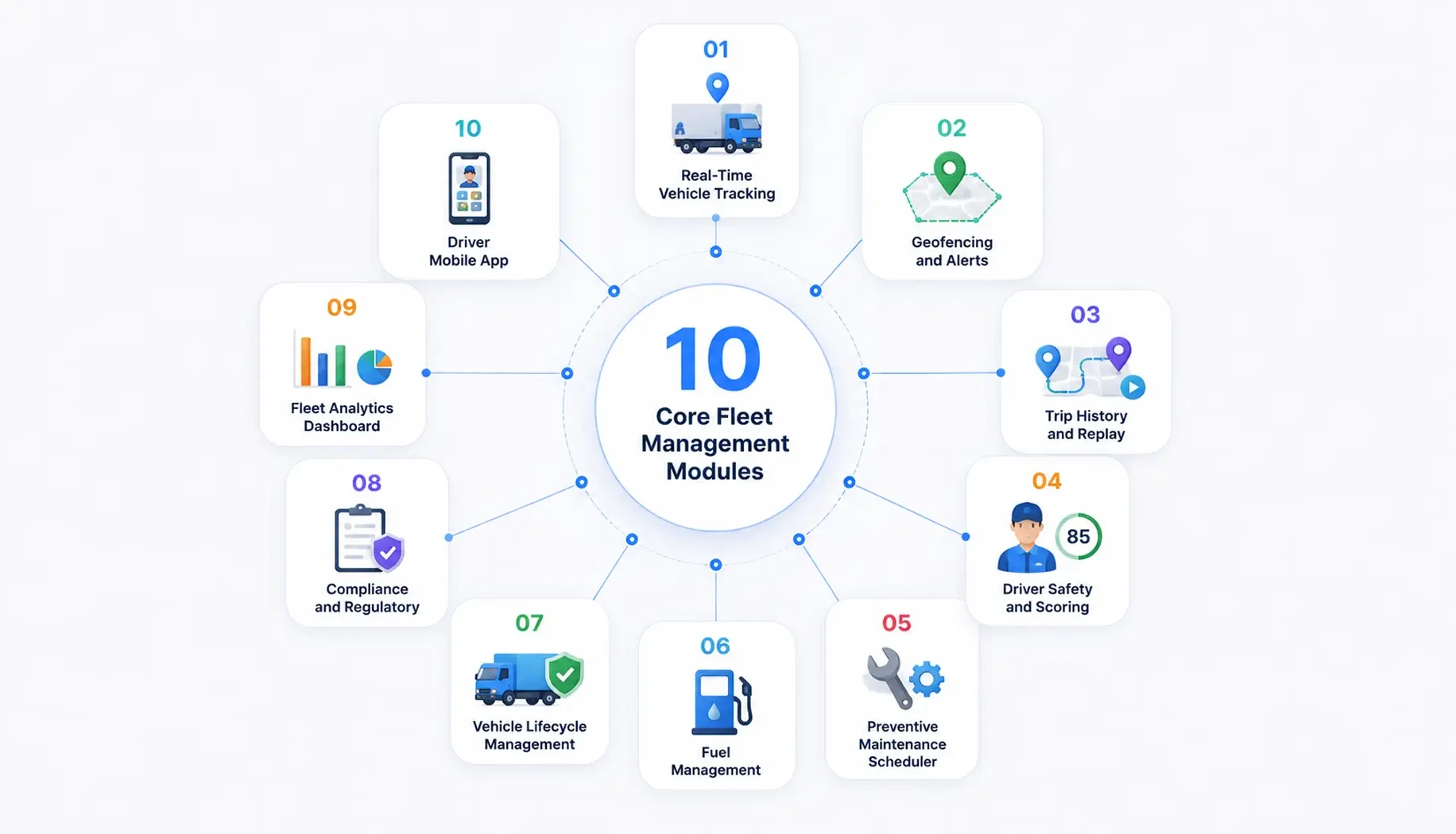
The 10 Core Fleet Management Modules
Every production-grade fleet management system ships these 10 modules. Smaller operations may defer modules 7 through 10 to a later phase. None is optional for a fleet above 200 vehicles.
MODULE 01: Real-Time Vehicle Tracking
The live map. Displays every vehicle's current position, speed, heading, and status (moving, idle, stopped, offline). Powered by the GPS pipeline (Section 3). Includes cluster view for large fleets and individual vehicle zoom with detail overlay.
MODULE 02: Geofencing and Alerts
Geographic boundary management. Create, edit, and monitor circular, polygonal, and corridor geofences. Triggers configurable alerts on entry, exit, dwell time, and speed within the zone.
MODULE 03: Trip History and Replay
Historical route playback per vehicle per day. Trip segmentation, distance calculation, stop duration analysis, and route deviation detection.
MODULE 04: Driver Safety and Scoring
Behavioural monitoring and composite safety scoring (Section 4). Harsh event tracking, speed compliance, HOS monitoring, and coaching triggers.
MODULE 05: Preventive Maintenance Scheduler
Odometer-based and time-based maintenance scheduling. Service reminders, work order generation, vendor assignment, and maintenance cost tracking per vehicle.
MODULE 06: Fuel Management
Fuel consumption tracking (from OBD-II or fuel sensor), idle fuel waste calculation, fuel card transaction reconciliation, MPG/KPL trending per vehicle and driver.
MODULE 07: Vehicle Lifecycle Management
Asset register from acquisition to disposal. Tracks purchase date, depreciation schedule, registration renewal, insurance expiry, inspection due dates, and residual value.
MODULE 08: Compliance and Regulatory
Hours of Service (HOS) logging for FMCSA/EU regulations, Electronic Logging Device (ELD) integration, DVIR (Driver Vehicle Inspection Report) capture, and audit-ready compliance exports.
MODULE 09: Fleet Analytics Dashboard
Operational KPIs: cost per mile, fuel cost per vehicle, utilisation rate, maintenance cost trend, safety score distribution, and on-time delivery rate. Filterable by vehicle, driver, depot, and date range.
MODULE 10: Driver Mobile App
Driver-facing mobile application for HOS logging, DVIR submission, task management, navigation, safety score review, and vehicle assignment confirmation.
Module boundary discipline
Each module owns its own data store. Cross-module data flows through the event bus and shared vehicle identity, never through direct database reads. The maintenance module does not query the fuel module's tables directly.
It subscribes to fuel. event and stores a local projection of fuel-relevant data for its own maintenance cost calculations. This boundary discipline is the single rule that separates a fleet platform that scales from one that breaks when the second development team joins.
Vehicle Health and Predictive Maintenance
Preventive maintenance scheduling (Module 05) is rule-based: every 10,000 miles, change the oil. Predictive maintenance adds a data-driven layer: the engine oil temperature trend over the last 2,000 miles suggests degradation 1,500 miles before the scheduled interval. The vehicle should come in early.
Predictive maintenance requires the telematics pipeline to capture and store engine diagnostic data (coolant temperature, oil pressure, battery voltage, transmission temperature, exhaust gas temperature) continuously, and a machine learning model trained on historical failure patterns to identify early indicators.
Acquaint Softtech's AI development services for predictive maintenance include the ML model training, the real-time scoring pipeline, and the integration with the maintenance scheduler module.
The predictive maintenance architecture adds three components to the standard fleet platform.
Feature Store: Extracts rolling statistics (mean, trend, variance) from raw telemetry for each vehicle. Updated every 24 hours from the time-series database.
ML Scoring Service: A Python service (scikit-learn or XGBoost for tabular fleet data) that scores each vehicle daily against the trained failure prediction model. Outputs a probability-of-failure-within-N-days score per component category (engine, transmission, brakes, battery, tyres).
Alert and Work Order Integration: When the probability score exceeds a configured threshold (typically 70% probability of failure within 14 days), the system creates a predictive maintenance alert, assigns it to the fleet manager for review, and optionally auto-generates a work order in the maintenance scheduler.
Predictive maintenance is a Phase 3 capability for most fleet platform builds. It requires 6 to 12 months of historical telemetry data before the ML model achieves meaningful accuracy. The platform should be ingesting and storing telemetry from day one, so the data is available when the predictive layer is ready to deploy.
For the case study reference on how Acquaint Softtech has handled similar operational-tracking platforms, our aviation safety software case study shows the compliance and audit-trail architecture pattern used across vehicle and aircraft tracking builds.
What a Custom Fleet Platform Costs in 2026
Fleet management platform development cost is driven by fleet size (which determines pipeline scale), module count, and integration complexity (number of telematics device vendors, ERP connections, regulatory reporting feeds). The figures below are from Acquaint Softtech's delivery operations across logistics and transport clients.
Tier | Scope | Timeline | Investment (USD) |
Startup / MVP (Tracking, Geofence, Trip History, Driver App) 1 to 2 device types | Modules 1 to 4 + Driver App | 3 to 5 months | $55,000 to $120,000 |
Mid-Fleet (Full 8 modules, maintenance, fuel, compliance) 3 to 5 device integrations | Modules 1 to 8 | 7 to 12 months | $180,000 to $380,000 |
Enterprise / Multi-Depot (All 10 modules, predictive maintenance, AI safety, multi-tenant) 5+ device types, ERP integration | Full platform | 12 to 20 months | $420,000 to $950,000 |
What the Acquaint fleet engagement includes
Telematics data pipeline (MQTT ingestion, Kafka stream processing, TimescaleDB storage) built as the first deliverable.
Backend API (Python Django or Laravel), fleet dashboard (React), and driver mobile app (React Native) included in the team rate.
Device vendor integration: OBD-II dongle, TCU, and aftermarket GPS device protocol parsing for up to 3 device types per engagement tier.
AWS or Azure cloud infrastructure on the client's account, configured for auto-scaling on telemetry ingestion peaks, handled by our DevOps engineers as part of every fleet engagement.
Sprint-based delivery with client demos every 2 weeks. First live tracking demo within 6 weeks of engagement start.
Full IP, codebase, and infrastructure ownership by the client from day one. No vendor lock-in, no per-vehicle licensing, no ongoing platform fees.
48-hour team deployment from engagement confirmation.
The rate the client pays is the rate. No additional employer overhead on top. Acquaint Softtech is a dedicated software development team partner for logistics platforms, with 70+ multi-stack engineers and an average team tenure of 24+ months on logistics accounts.
Need a Fleet Platform Cost Model for Your Budget Approval?
Share your fleet size, device types, and module priorities. Acquaint Softtech will return a written cost model with team composition, phased timeline, and a comparison against equivalent in-house hiring within 48 hours. No commitment required to receive the document.
Build vs Buy vs Extend: The Fleet Decision Framework
This framework is applied by Acquaint Softtech in every discovery workshop for fleet management projects. Three or more YES answers indicate a custom build outperforms a commercial fleet platform over a 3-year horizon.
Q1: Does your fleet use more than 2 telematics device vendors or aftermarket hardware that commercial platforms do not natively support?
YES → A custom telematics ingestion layer built to your device mix eliminates the data gaps and manual workarounds that come with forcing non-supported devices into a commercial platform.
NO → If your entire fleet uses a single commercial telematics provider (Samsara, Geotab, Verizon Connect), that vendor's native platform may be sufficient.
Q2: Do you need a driver-facing mobile app with features beyond basic HOS logging (custom DVIR forms, delivery task management, customer signature capture, safety coaching)?
YES → Commercial fleet platforms offer generic mobile apps. Custom driver apps with workflow-specific features (delivery confirmation, photo POD, safety event review) require a custom mobile build.
NO → If your drivers only need ELD/HOS compliance and basic navigation, a commercial telematics vendor's mobile app is adequate.
Q3: Does your fleet operate across more than 3 depots with different operational rules, maintenance vendors, or reporting requirements?
YES → Multi-depot fleet management with depot-specific rules, vendor assignments, and reporting hierarchies is poorly served by single-tenant commercial platforms. A custom multi-depot architecture handles this natively.
NO → Single-depot or single-region fleets with uniform rules are well-served by commercial platforms without custom development.
Q4: Is your fleet data currently locked inside a telematics vendor's portal with no API access, and you need to integrate it with your TMS, ERP, or customer portal?
YES → Data lock-in is the most common reason fleet operators move to a custom platform. A custom data pipeline owns the telemetry data on your infrastructure, making integration with any downstream system straightforward. If you need help defining that architecture before committing to a build, our Virtual CTO services can provide that strategic layer.
NO → If your current vendor provides open API access and your integration needs are limited, extending the vendor platform with custom API consumers may be cheaper than a full build.
Q5: Are you building a fleet SaaS product for external customers rather than managing your own fleet?
YES → Multi-tenant fleet platforms with customer isolation, white-label branding, and per-customer billing must be custom-built. For teams considering outsourcing the development of this SaaS layer, Acquaint Softtech handles the full build under a dedicated team model.
NO → If you are managing your own vehicles for your own operation, evaluate commercial options first unless other questions indicate otherwise.
For operations that answer YES to three or more, the MVP development pathway for a logistics startup is the fastest route to a working fleet platform: tracking, geofencing, trip history, and a driver app in 3 to 5 months. For operations that already have a commercial platform and need to extend it, Acquaint Softtech's staff augmentation model for logistics engineering teams adds fleet engineers to your existing team without a full vendor replacement.
Answered YES to 3 or More? Let Us Build Your Fleet Team.
Acquaint Softtech deploys a dedicated fleet platform development team within 48 hours: backend engineers for the telematics pipeline, a frontend developer for the fleet dashboard, a React Native developer for the driver app, a QA engineer, and a DevOps specialist. Average team tenure: 24+ months. First-sprint delivery rate: 95%. You interview every developer before any sprint begins.
Clearing Up Fleet Software Myths
These myths appear in every fleet platform scoping conversation. Correcting them early prevents budget and timeline surprises.
Myth: A GPS tracker on the dashboard is a fleet management system.
Reality: A consumer GPS tracker gives you a dot on a map. A fleet management system gives you the DOT Plus engine diagnostics, driver behaviour scoring, maintenance scheduling, fuel tracking, HOS compliance, and the data pipeline to connect all of them. The dot is one of ten modules. Building from the dot and retrofitting the rest costs significantly more than designing the full platform from the start.
Myth: Fleet management software is only for large fleets.
Reality: The value of a fleet management system starts at approximately 20 vehicles. At that scale, manual tracking, spreadsheet maintenance logs, and fuel card reconciliation consume 8 to 15 hours of operations staff time per week. A platform automates those hours and produces safety and cost data that manual processes cannot. The custom build decision (vs a commercial product) is typically justified at 200+ vehicles or when the operation has multi-depot complexity, non-standard device hardware, or SaaS product ambitions.
Myth: Real-time tracking means the vehicle position updates every second.
Reality: Real-time in fleet management means position updates every 5 to 30 seconds, not every second. 5-second reporting is appropriate for high-security or high-value cargo. 15 to 30-second reporting is standard for commercial fleets. 1-second reporting generates prohibitive data volumes and cellular costs at scale without a proportional increase in operational value. The reporting frequency is a configurable parameter in the telematics device, not a fixed constraint.
Myth: You can switch telematics device vendors without rebuilding the platform.
Reality: If the platform was built with a single-vendor telematics integration hard-coded into the data pipeline, switching devices requires a pipeline rebuild. If the platform was built with a device-agnostic ingestion layer (a protocol adapter pattern), switching vendors requires only a new adapter, a 2 to 4-week integration effort rather than a multi-month rebuild. Architecture decisions in month one determine migration cost in year three.
Ready to Build a Fleet Platform That Scales With Your Operation?
Acquaint Softtech has delivered fleet management, vehicle tracking, and driver monitoring platforms for logistics operators across the US, UK, Australia, and the UAE. Every build starts with the telematics pipeline, not the map. Teams deploy within 48 hours. You interview before you commit. Our MERN stack developers for real-time fleet dashboards and DevOps engineers for high-volume telemetry infrastructure are available for immediate deployment.
Frequently Asked Questions
-
What does fleet management software do?
A fleet management system monitors and controls every aspect of a vehicle fleet: real-time GPS tracking, vehicle health monitoring through telematics, driver behaviour scoring and safety management, preventive and predictive maintenance scheduling, fuel consumption tracking and reconciliation, regulatory compliance (HOS, ELD, DVIR), asset lifecycle management from acquisition to disposal, and operational reporting.
It connects these functions through a shared telematics data pipeline so that a single engine fault code can trigger a maintenance work order, alert the dispatcher to reroute the load, and update the compliance log without manual intervention.
-
How does GPS tracking work in a fleet management system?
Each vehicle has a GPS device (OBD-II, factory unit, or aftermarket tracker) that updates its location every 5 to 30 seconds using satellite signals. This data (location, speed, direction) is sent to the platform via cellular networks using MQTT or HTTP protocols.
The system processes this data in real time, showing live vehicle locations, storing history, and checking geofence boundaries for alerts. Even a 500-vehicle fleet sending frequent updates can be easily handled using stream processing tools like Kafka and WebSockets.
-
What is vehicle telematics?
Vehicle telematics is the collection, transmission, and analysis of data from a vehicle's onboard systems. Beyond GPS position, telematics includes engine diagnostics (RPM, coolant temperature, oil pressure, battery voltage, fault codes via the CAN bus), accelerometer data (for harsh braking, acceleration, and cornering detection), fuel level and consumption, odometer readings, and seatbelt status. This data is the foundation of the fleet management system. Without telematics, the platform is limited to position tracking. With telematics, it can perform predictive maintenance, driver safety scoring, fuel management, and vehicle health monitoring.
-
How much does fleet management software cost to build?
Fleet Management Platform Type
Estimated Cost
Timeline
Startup MVP with Tracking and Driver App
$55,000 to $120,000
3–5 months
Mid Level Fleet Platform
$180,000 to $380,000
7–12 months
Enterprise Fleet Management Solution
$420,000 to $950,000
12–20 months
Enterprise platforms may include AI safety scoring, predictive maintenance, multi depot support, infrastructure setup, and full IP ownership.
-
Can I start with just tracking and add modules later?
Yes, and this is the recommended approach. The critical requirement is that the telematics data pipeline is built to production scale from day one, even if the first visible module is only the live tracking map. When the pipeline is in place, adding modules (maintenance, fuel, driver scoring, compliance) is a matter of subscribing new modules to the existing event stream and building the module-specific interfaces.
When the pipeline is not in place, and each module is built as an independent application, adding modules later requires a platform rebuild to create the shared data layer. Pipeline first, modules second.
-
What happens to our fleet data if the engagement with Acquaint ends?
The client owns the codebase, telemetry data, infrastructure configuration, and all associated IP from day one. At engagement end, Acquaint Softtech conducts a formal handover: repository transfer, documentation walkthrough, operational knowledge transfer, and a 30-day Q&A window at no additional cost.
The fleet platform runs on the client's cloud account (AWS or Azure). There is no Acquaint-controlled infrastructure, no per-vehicle licensing, and no data retention by Acquaint after handover.
-
What tech stack is best for a fleet management system?
The Acquaint Softtech 2026 default for fleet platforms is Python Django or FastAPI for the backend (strongest ecosystem for time-series data processing and ML integration), React for the fleet dashboard, React Native for the driver mobile app, PostgreSQL with TimescaleDB extension for time-series telemetry storage, Apache Kafka for stream processing, Redis for hot cache and real-time position serving, and Kubernetes on AWS or Azure for container orchestration.
-
Is a custom fleet platform appropriate for a fleet under 50 vehicles?
A custom build is rarely justified for fleets under 50 vehicles unless the operation has unique requirements that commercial platforms cannot meet (non-standard hardware, multi-client SaaS ambitions, or deep integration with a proprietary TMS or ERP).
For fleets of 20 to 50 vehicles, a commercial telematics platform (Samsara, Geotab, Verizon Connect) with standard configuration is typically the right starting point. The custom build discussion becomes relevant at 200+ vehicles, at multiple depots with different operational rules, or when the operation needs a fleet platform it owns and can extend without vendor dependency.
I lead technology and client success at Acquaint Softtech with one goal in mind. Deliver work that feels personal, reliable, and worthy of long term trust. I stay close to both our clients and our developers to make sure every project moves with clarity, quality, and accountability.
Table of Contents
Get Started with Acquaint Softtech
- 13+ Years Delivering Software Excellence
- 1300+ Projects Delivered With Precision
- Official Laravel & Laravel News Partner
- Official Statamic Partner
Related Blog
Transportation Management Systems: Carrier Selection, Rate Shopping & Load Optimization
A Transportation Management System is not a tracking map with extra buttons. It is a structured freight operations platform that owns carrier selection, rate negotiation, load planning, dispatch, and proof-of-delivery capture in one governed workflow.
Manish Patel
May 18, 2026
The Complete Guide to Logistics & Supply Chain Software Development in 2026
Logistics and supply chain software development in 2026 is not a single discipline. It is six distinct product categories, each with its own integration burden, operational perimeter, and cost curve.

Acquaint Softtech
May 1, 2026
How Warehouse Management Systems Work: Architecture, Modules, and Data Flow Explained
A Warehouse Management System is not a spreadsheet with barcode readers attached. It is a structured operational platform that owns inventory location, pick sequence, worker task allocation, and carrier handoff in one controlled environment.
Manish Patel
May 8, 2026India (Head Office)
203/204, Shapath-II, Near Silver Leaf Hotel, Opp. Rajpath Club, SG Highway, Ahmedabad-380054, Gujarat
USA
7838 Camino Cielo St, Highland, CA 92346
UK
The Powerhouse, 21 Woodthorpe Road, Ashford, England, TW15 2RP
New Zealand
42 Exler Place, Avondale, Auckland 0600, New Zealand
Canada
141 Skyview Bay NE , Calgary, Alberta, T3N 2K6