

How to Reduce Software Development Costs Without Reducing Quality (2026 Guide)
Most cost reduction attempts in software development cut quality alongside cost. These 7 strategies cut cost by removing waste, not capability. Real 2026 numbers included.

Mukesh Ram
I founded acquaint softtech as a software development partner 13 years ago. The cost question comes up in almost every founder conversation: how do we build good software for less? The honest answer is that cost reduction is possible without quality reduction, but only when you target the right levers. Most companies cut the wrong things. This article covers the 7 levers that reduce cost by removing waste rather than removing capability.

- Founders and CTOs managing a development budget that has grown faster than the output it is producing
- Engineering leads asked to reduce team costs without reducing delivery velocity
- Finance leaders evaluating whether current software development spend is producing the right return
- Companies that have tried cost cutting before and found it reduced quality alongside cost
The reason most cost reduction attempts fail in software development is that they target the wrong variable. Cutting developer headcount, reducing salaries, or switching to the lowest-rate vendor all reduce input cost. They also reduce capability, context, and output quality in proportion. The strategies below target waste, overhead, and structural inefficiency, not capability.
The first step in any cost reduction exercise is understanding where the current spend is actually going. The India software development rates guide provides the 2026 rate benchmarks by seniority and stack that tell you whether your current rates are above or below market. If your rates are below market and quality is still the concern, the cost problem is not rates. It is structure.
The 7 Cost Reduction Strategies That Preserve Quality
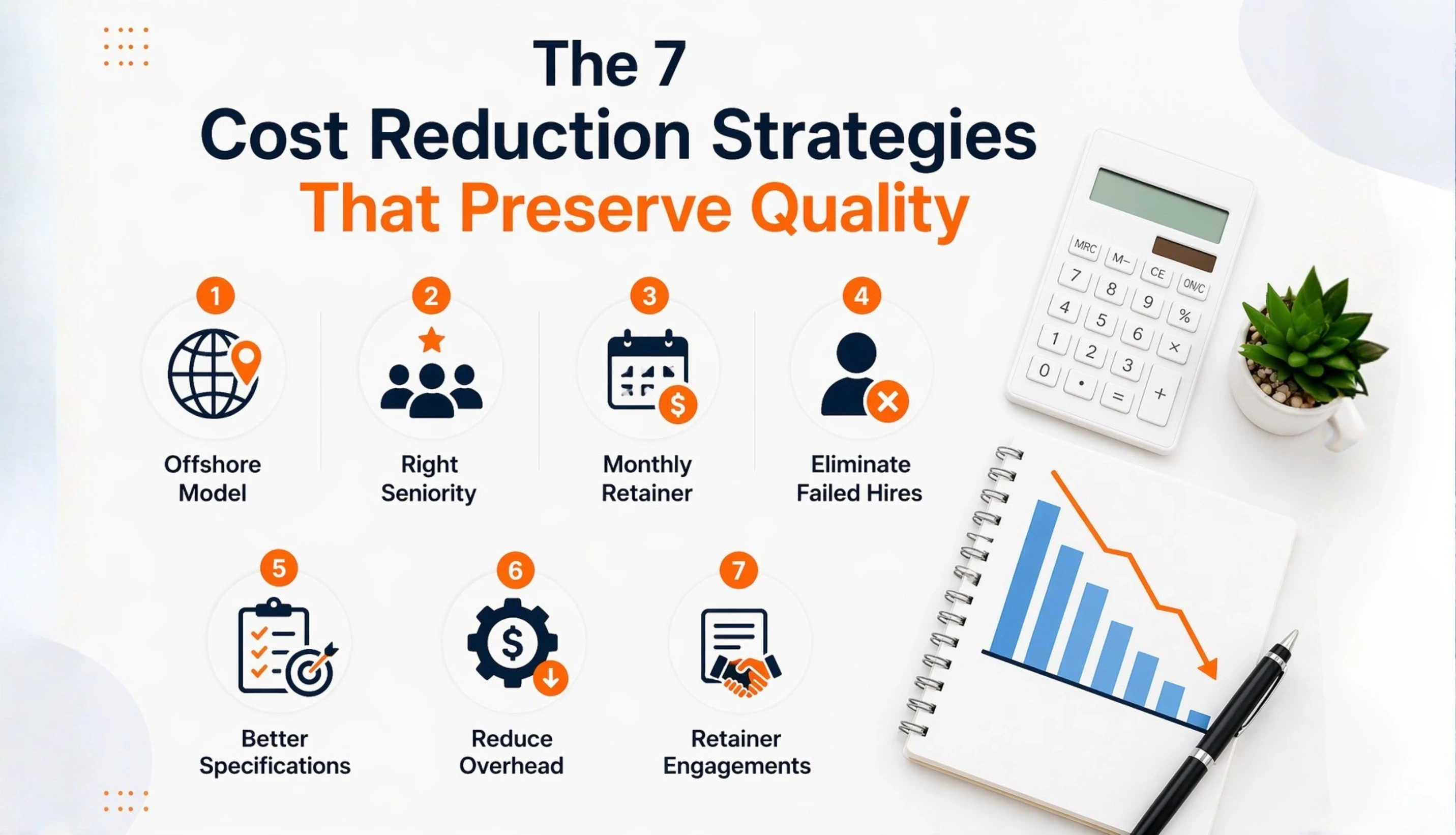
Each strategy below includes what it saves, what it does not touch, and the conditions under which it applies.
Strategy 1: Move to an offshore or hybrid team model |
The saving: For a senior full-stack developer, the fully-loaded cost in the US is $130,000 to $180,000 per year including salary, benefits, payroll taxes, and recruiting. An equivalent offshore developer through a vetted partner such as Acquaint Softtech costs $38,000 to $66,000 per year at $22 to $38 per hour. The saving is 50 to 65% on direct developer cost with no reduction in technical capability when the vetting process is rigorous. |
Applies when: Team management overhead, project context, and sprint governance must remain in place. Offshore savings evaporate if communication structure and acceptance criteria processes are not maintained. |
Strategy 2: Use the right seniority level for each role |
The saving: Senior developers cost 35 to 55% more than mid-level developers. If a senior developer is spending 60% of their time on tasks a mid-level developer could own, the team is paying a premium for capability it is not using. Audit current task distribution by seniority. Move repetitive feature work to mid-level developers. Reserve senior time for architecture, code review, and complex problem-solving. |
Applies when: This strategy requires a technical lead who can accurately categorise work by complexity and make the resourcing decision. It does not work in teams without a defined seniority structure. |
Strategy 3: Replace individual hiring with a monthly retainer model |
The saving: Independent contractor billing includes a hidden premium: the client pays for ramp-up time, context-building, and partial availability across multiple clients. A monthly retainer with a dedicated developer through a staff augmentation model gives full-time exclusivity, stable institutional knowledge, and predictable monthly cost. For engagements longer than 3 months, the retainer model consistently costs 15 to 25% less than hourly billing for the same total hours. |
Applies when: The retainer model works best when workload is consistent and project scope is ongoing. For short, well-defined scopes, a fixed-price project model may be more appropriate. |
Strategy 4: Eliminate the cost of failed hires |
The saving: A failed developer hire costs 6 to 8 weeks of lost productivity plus recruiting time. In 2026, the average CTO spends 15 to 25 hours interviewing before making a developer hire. At a $75 to $150 per hour opportunity cost, that is $1,100 to $3,750 in leadership time per hire, before the developer has written a single line of code. IT staff augmentation through a pre-vetted provider eliminates this cost: Acquaint Softtech delivers two to three developer profiles within 24 hours, the client interviews and approves, and onboarding begins within 48 hours. |
Applies when: This saving is most significant for companies with frequent hiring needs or high developer turnover. For stable, long-term teams with low churn, the benefit is smaller. |
For teams considering moving from individual hiring to a dedicated team structure to capture strategies 1 and 2 simultaneously, the dedicated software development teams model covers how that structure is set up, what it costs, and when it produces better outcomes than individual augmentation.
Want to Know Which of These 4 Strategies Applies to Your Current Setup?
Send me your current team structure, stack, and a rough monthly development spend. I will tell you which cost reduction strategies apply to your situation and what the realistic saving is. This conversation takes 20 minutes and does not require any commitment.
Strategy 5: Fix the specification and acceptance criteria process |
The saving: Rework is the single largest hidden cost in software development. A feature that is built twice because the first version did not match what the client intended costs double the development time with zero additional output. Writing acceptance criteria before development begins, not after, eliminates most rework cycles. For a team delivering 10 features per sprint with a 20% rework rate, fixing the specification process recovers 2 features of capacity per sprint at zero additional cost. |
Applies when: This requires a product owner or technical lead who can write clear acceptance criteria before sprint planning. It is not a vendor-side fix alone. The client must invest the pre-sprint time to specify correctly. |
Strategy 6: Audit and reduce tooling and infrastructure overhead |
The saving: Developer tooling and cloud infrastructure costs compound invisibly. A $400 per month development tool adopted for a sprint that is still running 18 months later represents $7,200 in unaudited spend. A cloud environment sized for peak load running at 10% utilisation most of the month is paying for capacity that is not being used. A quarterly tooling and infrastructure audit typically surfaces 15 to 25% of observable spending that can be reduced or eliminated without any impact on development capability. |
Applies when: This strategy is most valuable for teams that have been building for 12 months or more and have never conducted a systematic audit. Early-stage teams have fewer legacy costs to surface. |
Strategy 7: Switch from fixed-price project contracts to retainer engagements for ongoing work |
The saving: Fixed-price contracts include a vendor contingency of 20 to 35% to cover scope uncertainty. For ongoing product development where requirements evolve sprint by sprint, you pay this contingency on every contract, even when scope does not change. A monthly retainer eliminates the contingency because there is no fixed scope to price against. For product teams with a 12-month active development roadmap, switching from fixed-price to retainer typically reduces total engagement cost by 15 to 20%. |
Applies when: This saving applies to ongoing development work. For one-time, well-defined deliverables with stable requirements, a fixed-price contract with a clear scope is often still the right structure. |
The pricing model decision that underpins strategies 3, 4, and 7 is covered in the staff augmentation pricing models guide. It covers when monthly retainers, hourly models, and fixed-price contracts each make financial sense, with the specific conditions that determine which produces the lower total engagement cost.
Applying These Strategies to an Active Development Budget?
Share your current team structure and monthly spend. Acquaint Softtech will benchmark it against equivalent offshore engagements and tell you which of the 7 strategies produces the most significant saving in your specific situation. No commitment needed before seeing the numbers.
The Costs That Look Like Savings But Are Not
Some cost reduction decisions look good on the budget spreadsheet but produce a higher total cost once rework, replacement, and lost delivery time are factored in. Here are the most common ones.
Hiring the cheapest developer | A developer at $18/hr who produces 35% more rework than one at $32/hr is not cheaper. The total cost calculation must include rework time, client review time, and the opportunity cost of delayed features. The |
Cutting QA to speed up delivery | Removing QA from a sprint saves 1 to 2 days of testing time and produces production bugs that take 3 to 5 times longer to fix than pre-release defects. QA is not an optional cost. It is a cost-reduction mechanism. |
Reducing sprint planning to cut meeting time | A sprint planning session that takes 90 minutes saves development rework that takes 3 to 5 hours. Cutting planning to 30 minutes saves 60 minutes of meeting time and costs 3 to 5 hours of rework per sprint. Net cost: 2 to 4 hours per sprint. |
Choosing a vendor based on rate alone without verifying the governance structure |
A vendor at $22/hr with no IP assignment clause, no mid-sprint check-ins, and no replacement guarantee costs more in total engagement cost than a vendor at $30/hr with all three. The hidden cost of a poorly structured engagement is covered in detail in the hidden cost of hiring a developer analysis. Hidden cost of hiring a developer analysis. |
Before implementing any cost reduction strategy, understanding the true cost of the current structure is the first step. The in-house vs staff augmentation cost comparison provides the side-by-side numbers that reveal where the current model is carrying costs that a different structure would eliminate.
What Cost Reduction Looks Like at Acquaint Softtech
The most common cost reduction engagement Acquaint Softtech handles is a company transitioning from a mixed freelancer or local contractor model to a structured offshore team. Here is what the typical saving looks like across the three most common transitions.
Transition | Typical Current Cost | Typical Cost After Transition |
3 local contractors at $85/hr average, 40 hrs/week each | $42,840/month | $16,800/month with 3 offshore senior developers via Acquaint Softtech dedicated team. Saving: $26,040/month. |
2 full-time US employees (senior dev + mid-level) | $23,000 to $30,000/month fully loaded | $9,500 to $12,000/month with equivalent Acquaint Softtech offshore team. Saving: $11,000 to $18,000/month. |
Agency project contract at $120/hr blended rate, 160 hrs/month | $19,200/month | $7,200 to $10,000/month on Acquaint Softtech retainer. Saving: $9,200 to $12,000/month. |
These savings are before the hidden cost reductions from eliminating recruiting overhead, rework, and tool sprawl. For a realistic picture of what the total transition looks like for a specific team structure, hire remote developers covers the engagement process from brief to first sprint at Acquaint Softtech.
Want the Actual Numbers for Your Team Structure?
Share your current team composition, stack, and monthly development spend. Acquaint Softtech will produce a side-by-side cost comparison against an equivalent offshore engagement within 48 hours. You see the numbers before committing to anything.
Frequently Asked Questions
-
How much can you save by moving software development offshore?
For a senior developer, moving from US in-house to a vetted India-based offshore partner typically saves 50 to 65% on direct developer cost. At Acquaint Softtech, senior developers start at $22/hr compared to $85 to $120/hr for equivalent US contractors. The saving compounds across a full team, with a 3-developer team typically reducing monthly spend by $20,000 to $26,000 against US equivalent rates.
-
What is the biggest hidden cost in software development?
Rework is the largest hidden cost: features built incorrectly and rebuilt costs double the development time with no additional output. Recruiting overhead is the second largest, consuming 15 to 25 hours of senior leadership time per hire. The hidden cost of hiring developer guide covers both in detail with 2026 numbers.
-
How do I reduce software development costs without firing developers?
Target structure and process rather than headcount. Fixing the specification process to eliminate rework, auditing tooling and infrastructure spend quarterly, and moving from fixed-price to retainer contracts for ongoing work typically recovers 20 to 35% of current spend. These levers are waste reduction, not capability reduction.
-
How can I cut developer costs without slowing down delivery?
Match seniority level to task complexity and move repetitive feature work to mid-level developers. Eliminate rework cycles by writing acceptance criteria before development starts, not after. Both changes reduce cost by improving how existing capacity is used, not by reducing the capacity itself.
-
What does a good offshore developer cost in 2026?
At Acquaint Softtech, vetted senior developers start at $22/hr or $3,500 to $5,500/month on a full-time retainer. A dedicated team of 3 developers with a technical lead runs $13,000 to $20,000/month. These rates include all employer overhead, equipment, and management costs with no additional charges.
-
Is it cheaper to use staff augmentation or hire in-house?
Staff augmentation through a vetted offshore partner costs 50 to 65% less than equivalent US in-house hiring when all employer costs are included. The break-even point depends on engagement length: for engagements under 6 months, individual augmentation is usually cheaper. Over 6 months, a dedicated team structure produces the best total cost. The full comparison with current numbers is in the in-house vs staff augmentation guide.
-
Is offshore development cheaper than nearshore?
India-based offshore development is 40 to 60% cheaper than Eastern European nearshore and 20 to 35% cheaper than Latin American nearshore for equivalent seniority levels. The quality gap that existed 10 years ago has largely closed in senior developer tiers. For most SaaS and enterprise development work, India-based offshore with a structured governance setup produces the best cost-to-output ratio available.
I love to make a difference. Thus, I started Acquaint Softtech with the vision of making developers easily accessible and affordable to all. Me and my beloved team have been fulfilling this vision for over 15 years now and will continue to get even bigger and better.
Table of Contents
Get Started with Acquaint Softtech
- 13+ Years Delivering Software Excellence
- 1300+ Projects Delivered With Precision
- Official Laravel & Laravel News Partner
- Official Statamic Partner
Related Reading

Staff Augmentation vs Upwork vs Agency: Real Cost Breakdown for CTOs in 2026
Staff augmentation, Upwork, or a dev agency? The real cost difference in 2026 is bigger than most CTOs expect. Here are the actual numbers with zero fluff.

Acquaint Softtech
March 8, 2026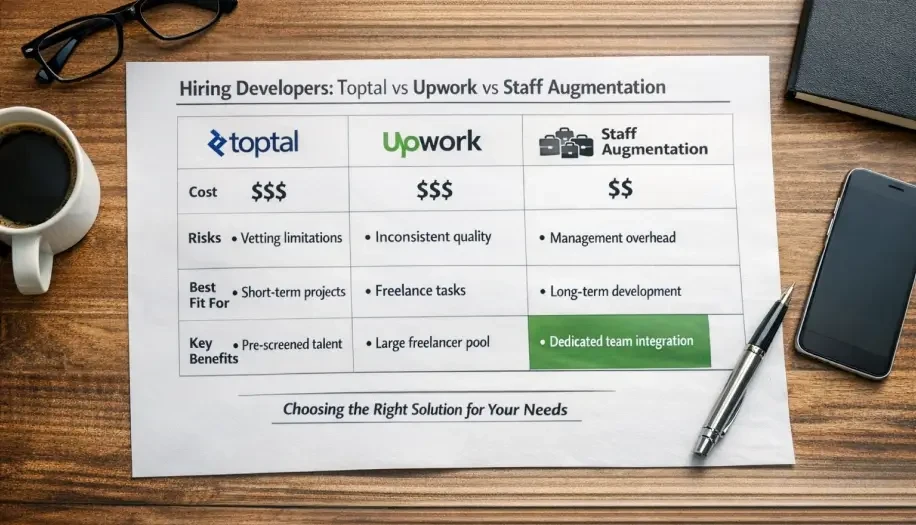
Toptal vs Upwork vs Staff Augmentation: An Honest CTO's Guide for 2026
Toptal, Upwork, and staff augmentation each solve a different problem. This honest vendor-side guide covers what each model actually costs, where each one breaks down, and which fits your situation.
Acquaint Softtech
March 16, 2026
Offshore Development Due Diligence: 10 Things to Verify Before Signing Any Contract
A client signed with a vendor who had 3 actual developers, stolen case studies, and 4 self-written Clutch reviews. 10 checks that take 2 hours prevent this every time.

Ahmed Ginani
April 13, 2026India (Head Office)
203/204, Shapath-II, Near Silver Leaf Hotel, Opp. Rajpath Club, SG Highway, Ahmedabad-380054, Gujarat
USA
7838 Camino Cielo St, Highland, CA 92346
UK
The Powerhouse, 21 Woodthorpe Road, Ashford, England, TW15 2RP
New Zealand
42 Exler Place, Avondale, Auckland 0600, New Zealand
Canada
141 Skyview Bay NE , Calgary, Alberta, T3N 2K6